The further adventures of Sara and Bijou

Perros Guirec is a village in the Cotes d’Amor department in Brittany. It has been a seaside resort since the end of the 19th century. Along with other villages along the coast, it is famous for the pink granite rocks which have been sculpted over the years by the sea and resemble animals and objects. In the winter, the population is around 7200 people. During the months of July and August, when Parisians and tourists alike descend on the many beaches, the population quadruples.
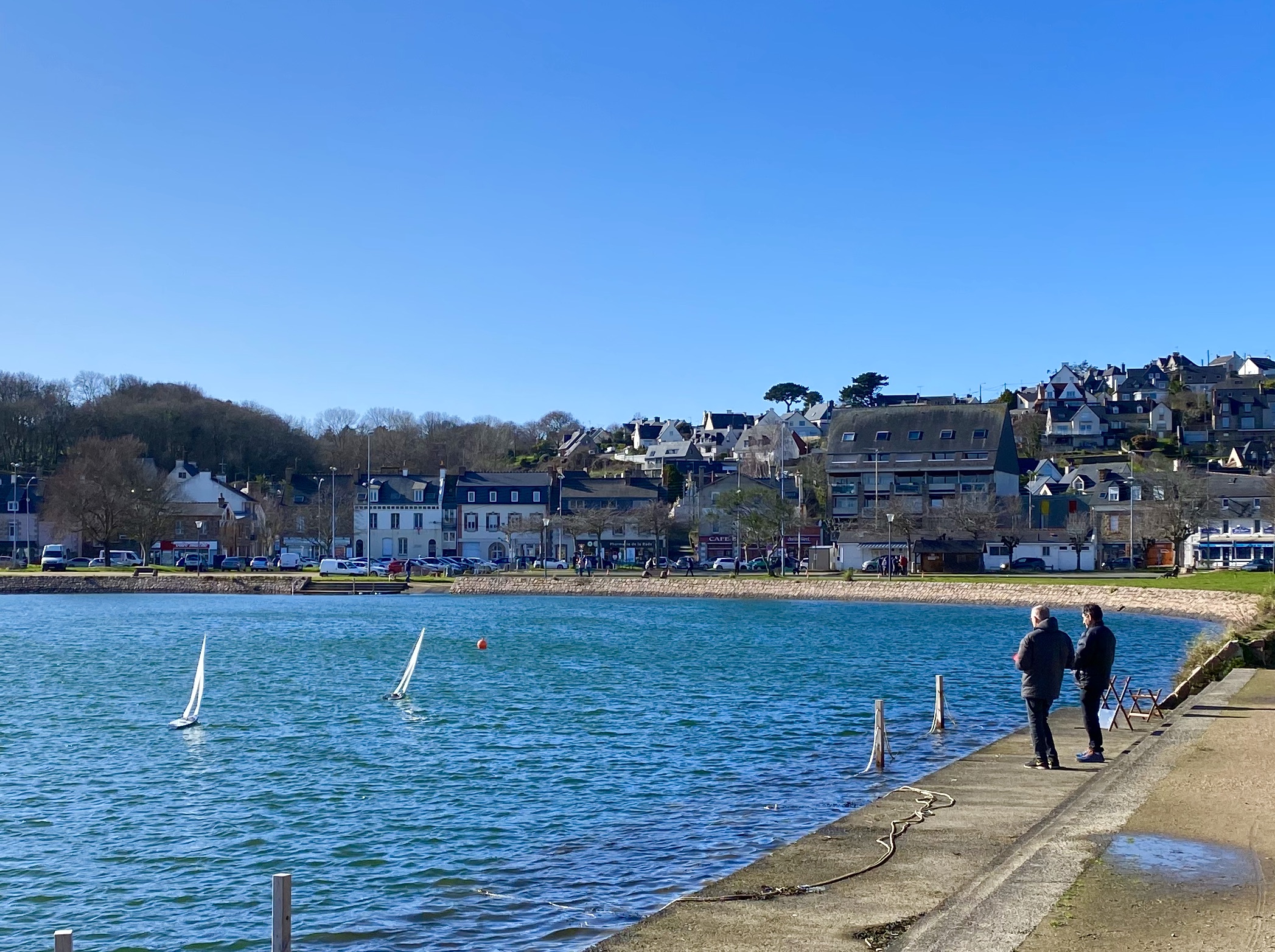
Men playing with mechanised sailboats in the port area
The marina of Perros Guirec

This is the part of Brittany that Bijou and I have landed and spent the last almost four weeks. From my window where I work, I look out on part of the English channel (Perros is directly south of Bournemouth). Today, though cold, the weather is magnificent. The sea is that turquoise blue with whips of white toped waves in the distance. The sail boats are out in force. There is hardly any Covid in this area. A boy at school reportedly was diagnosed with the virus last week but no one else has gotten sick. At the marché and along the streets in Centre Ville, everyone wears a mask. Walking along the sea, people have masks on their wrists or under their chins. They put them on if they pass another being. But one can walk for two or three miles and only pass a handful of people.

Along the shore walking towards the town of Louannec

Two weeks ago, Brittany suffered some of the coldest weather ever known in this area. It can be much like the Bay Area in California–warmer in winter and colder in the summer. But in early February, it snowed, stuck to the ground and one morning, I awoke to a huge patinoire (skating rink) that was the roads and driveways. Wednesday morning, as it was starting to warm up, I walked down to the marché at the port of Perros. There were twice as many stalls out as were out two weeks ago. People look forward to the three marchés in this area: Friday morning, there is one near the Poste in centre-ville, and Sunday morning the market is in La Clarté, high on a hill overlooking the beaches. Many people prefer the outdoor markets although most French have become habituated to American-style supermarkets. They can get eggs that were laid the same morning, vegetables with dirt still on them from being pulled the night before, Bretagne honey and Bretagne beer made in this region plus the hundreds of cheeses from all over France but the freshest are from this area.

Wednesday morning marche at the port of Perros
Les Fromages

This was the area I was to visit over Christmas and due to the new variant from the United Kingdom, I chose not to deal with the train station and the rest of the places it would be hard to socially distance. When it seemed a good possibility that France might have a third lockdown, my friend, Roland who lives in Perros, said “Come stay with us.” “How long will you be gone?” some friends asked. “If there is a confinement, I’ll stay to the end. If not, probably two weeks.” Yet, here it is almost four weeks later, no confinement- although all of France still has a 6pm-6am curfew – and I am still here. There is so much air and there is no Covid. For some unknown reason, my friends have not gotten sick of me. They beg me to please stay longer. I’m not sure I would have that kind of tolerance!!

Bijou watching the birds near the sea
View from my bedroom window, looking out at the point of Perros Guirec and one of les sept îles

Prime Minister Jean Castex and health minister Oliver Véran have been holding press conferences as the health situation has deteriorated sharply in France over the past week.  https://www.thelocal.fr/20210225/what-can-we-expect-from-the-french-prime-ministers-latest-announcement/ According to the French, they are the best at everything. Not true. There is still very little vaccine and what there is is not being given to the 65-74 year old group because “it hasn’t been proved that it is helpful for those over 65 years of age.”
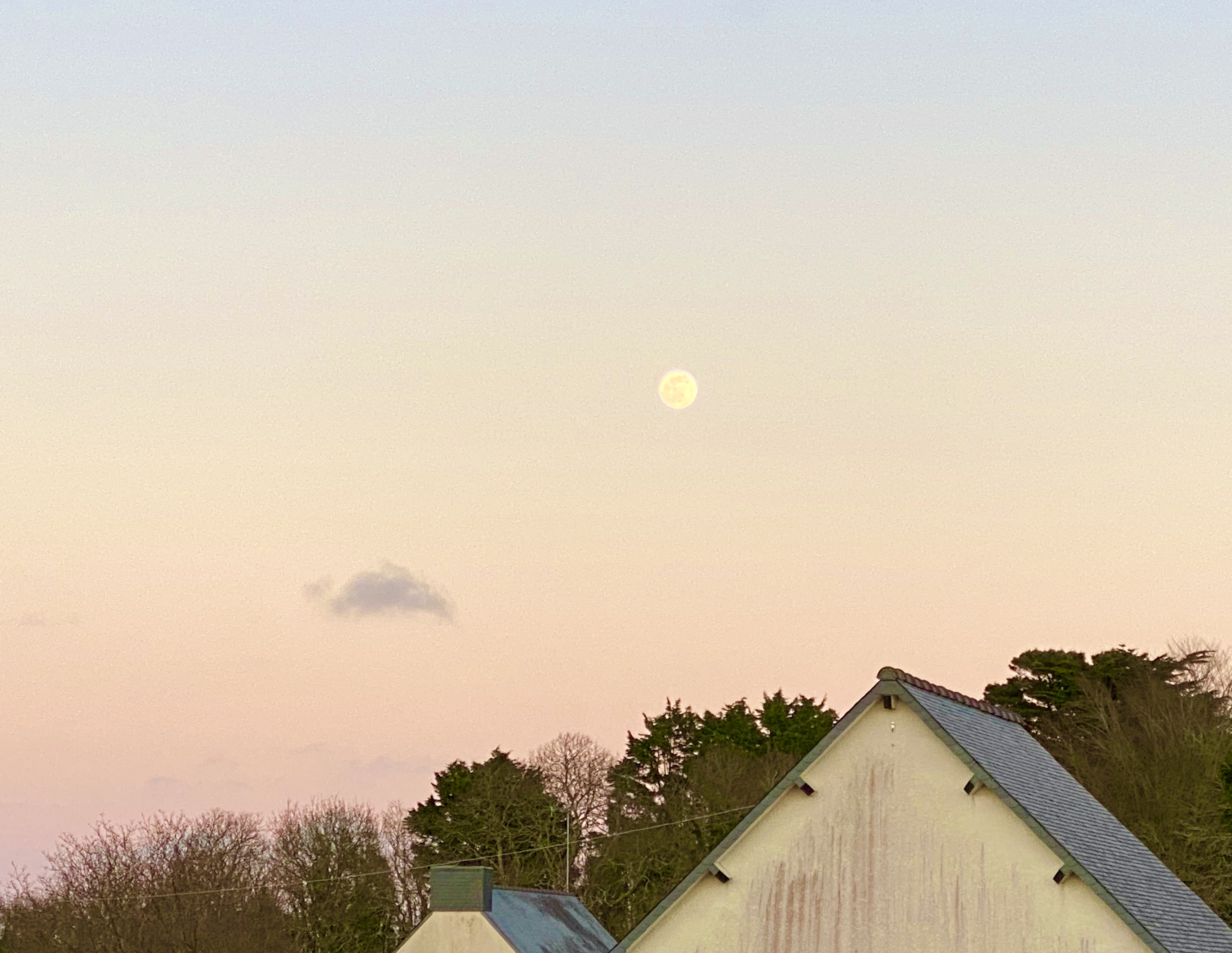
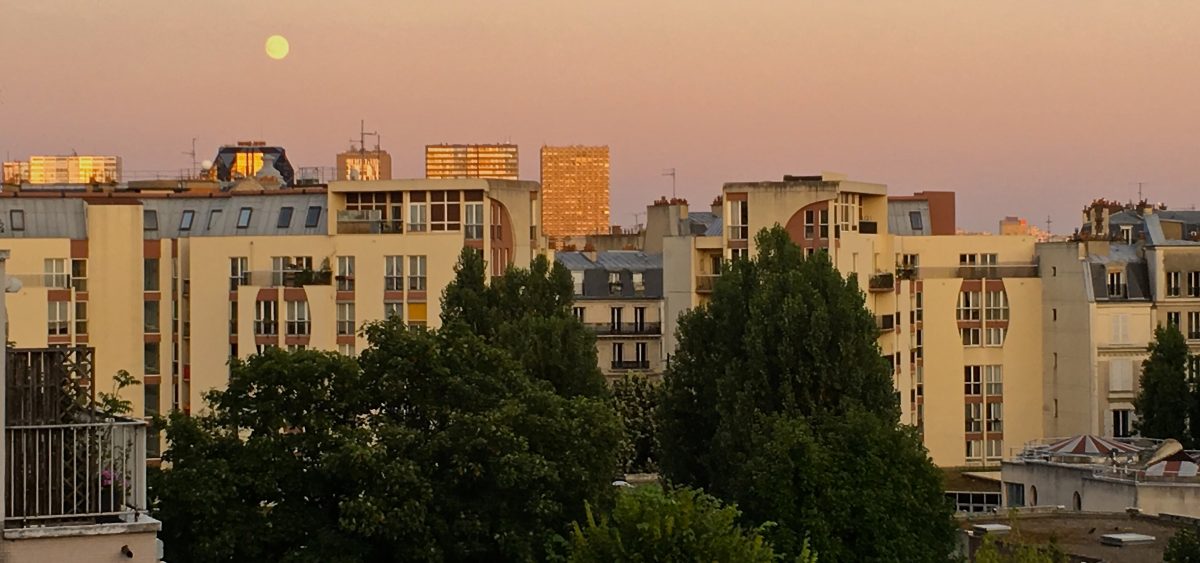
Moon rising over Perros last night

So here I am in this beautiful area of Brittany where there is no Covid, contemplating going back to Paris where there is plenty. It is only because of the kindness of my friends that I even have a choice. Since I have Bijou with me, there is no reason to rush back. Each day, we watch the news wondering if Brittany will have the 6pm curfew lifted. As of yesterday, Friday, it seems they are thinking in terms of regions and not one size fits all. Dunquerque and Nice have been hit very badly. Both cities and areas around them are in a weekend lock-down. Paris was warned that if things didn’t improve, they will also be put in lockdown for as long as three weeks. All this will be decided Saturday, March 6. So I’ve accepted I’ll be here for awhile. My hortensias on my terrace may die from lack of care but I will probably be safe. And taking more long walks along the beautiful blue sea.

jonquils blooming along a walk down at the Port
Huge dice made out of pink granite, which is everywhere on the Côte de Granit Rose

A bientôt,

Sara

France and Vaccinations

In early December, word was out, in the French news, that one of the vaccines, Pfizer, was ready for distribution. It had a 90% efficacy. A couple of days later, we heard/read that the Moderna vaccine was also ready with a similar efficacy. To me, this seemed unbelievable. I had been told early on not to get my hopes up–that the fastest a vaccine had ever been developed was for the measles. That vaccine took 4 years to develop.

So when it became obvious that this not “fake news”, that there really was a vaccine, my spirits soared. I blocked out time to visit California and see my home I still own in Oakland. I wasn’t sure enough to make plane reservations but only because of the three week wait period after the second dose. I wanted to know the exact date the vaccine would actually take effect.

France rolled out a plan in five tiers. The top tier of people receiving the vaccine would be the most vulnerable, all people over 75 years of age, and those in any kind of nursing home. The second tier was all the health care workers, people over 65 years of age with compromising conditions. The fifth tier was called “everybody else.” At 73 and healthy, I fell into that category. OK, I’m glad I’m so healthy but I really didn’t want to have to wait that long!

Then around Christmas time, the tier levels changed. Why I’m not sure. At over 65, I was now in the second tier. I was to be vaccinated in February said the french experts. But that knowledge did me no good at all. By the end of December, the news outlets were reporting that France was failing completely at the job of vaccinating her people. They had hoped, outloud and in writing, to have 21,000,000 people vaccinated by December 31. In actuality, the report was 500-10,000 had been given the first dosage.

France vowed to do better. I still get my neighbourhood listserve from Oakland. Everyday, people were sharing with each other where they had gotten vaccinated. By the end of January, almost everyone I knew 75 or older had at least the first jab. My older friends in Arizona had both jabs and described an extremely well organised, well thought out process of drive-thru vaccinating. I don’t think President Biden had anything to do with this turn-around. My sister, who lives in Michigan, described total chaos in the University of Michigan Hospital. Perhaps it’s the states having control of how it’s done.

Meanwhile back in France, things were moving at a snails pace. For the first time, I found myself jealous of the US and how vaccinating was being handled. In Brittany, where I am at the moment, my friend called to find out when he, at 71, could expect to be vaccinated. He was told June at the earliest. I asked my friend, Barbara, what was going on. Unlike me, she listens to the french news most evenings. It wasn’t just France, she said, it was the EU. They were very slow out of the gate to order vaccines of any kind; way behind the UK and USA. “European Commission President Ursula von der Leyen admitted Wednesday that the EU’s much criticised approval and rollout of vaccines against Covid-19 could be partly blamed on the bloc being over-optimistic, over-confident and plainly “late.” (France24) She added that the EU had received 26 million vaccine doses and that, by the end of the summer, 70 percent of adults in the 27-nation bloc should be inoculated.

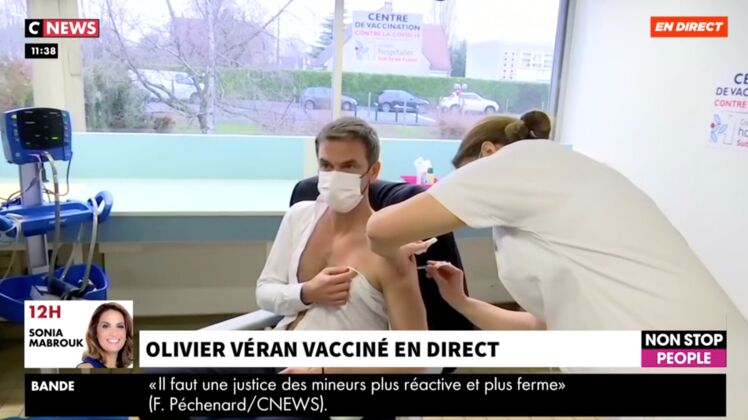
Once a bit of vaccine arrived, a photo of our health minister, Oliver Veran, began circulating on the internet. Our new heartthrob? it asked. He had to take his shirt off to get the jab. A nice distraction I think. Nothing else seems to have changed. Ask anyone here in Brittany if they know any more information and they just shake their heads.

Well, it seems French pride has taken a real hit. Last week, President Macron, told the nation that France would start making both the Pfizer and the Moderna vaccines in France. But production won’t start until March to be ready in April. The vow is that all adults will be vaccinated by the end of summer.

Meanwhile, France has been developing a test that will be an alternative to a poke in the nose. Labs have the green light to start the roll-out of using one’s spit. It must be tested in a lab so no on the spot results. And before you ask, I don’t know anymore. But here is an article in English that will tell you more: https://www.thelocal.fr/20210211/france-rolls-out-saliva-tests-to-detect-covid-19?utm_source=piano&utm_medium=email&utm_campaign=213&tpcc=newsletter_members&pnespid=m_5ysalIV1GNfQzw8MGBMhEA5wXl_kueJbY6Ik4

So here we are, almost exactly a year since we first heard about Covid-19 in Wuhan. And what a year! Another article from The Local compares how European Countries are presently handling all aspects of the virus. https://www.thelocal.fr/20210210/compare-ten-charts-that-show-how-european-countries-have-fared-since-the-second-wave-peak. France is not doing very well. France and Spain are the only two countries who have seen a rise in Covid-19 since the second wave officially began.

https://www.thelocal.fr/20210125/opinion-is-frances-vaccine-programme-a-disaster-not-any-more05e4002c

From my friend, Jay Mac’s blog “JaySpeak” She is a wizard at finding wonderful and timely pictures like this one.

A bientôt,

Sara

Postcard from New York

I met a lovely woman, Marlena Maduro Baraf, through my publishers She Writes Press. She and I decided that, periodically (once a month if we can do it), we would post each other’s blog. Marlena was born in Panama and now lives in New York City. Her blog is called Breathing in Spanish. I encourage you to take a look at it. On our last phone conversation we were comparing the vaccine roll-out–France vs New York. Here is her latest blog:

ECE57E57-00E8-4294-8055-9E2B056E3592.jpeg

When we fly somewhere D does this anxiety bit…walking around all night. Last night he didn’t sleep, insisted we must leave at 8 sharp for our 10:30 appointment in Queens—45 minutes by GPS.  We’d tried the New York State website just pastmidnight. We googled “NYS find your vaccine” and plugged in our zip code. We scanned through the listings

Westchester County Center (closest), 0  Jacob Javits Convention Center, 0
Jones Beach, Jones Beach?, 0  
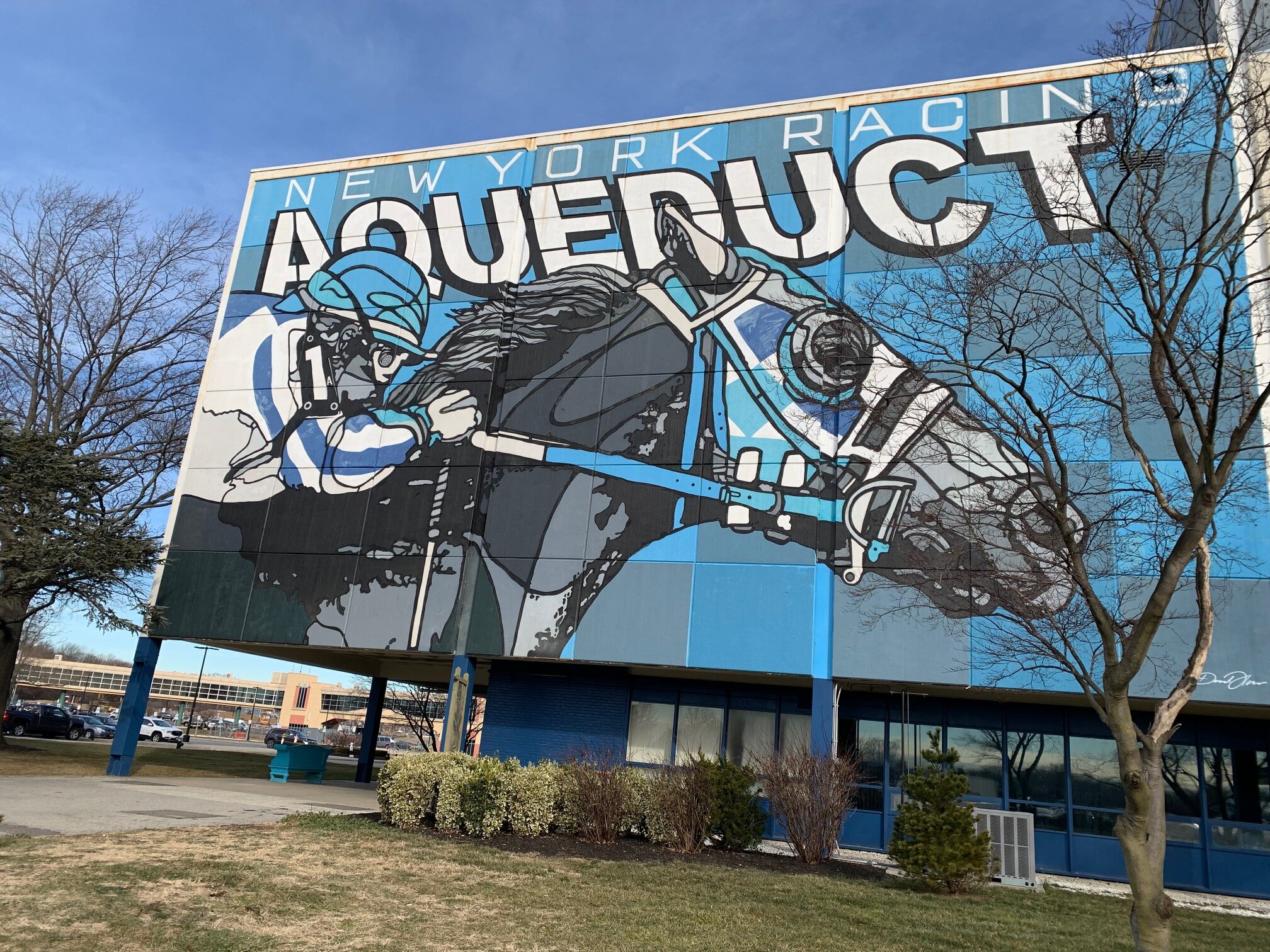
Aqueduct Raceway, where is that?  Jan 18, 3; Jan 25, 54!

Spaces evaporated like bursting bubbles. D got a spot on the 25th. Had to book me on the 26th.

                                                                        *
horses…racetrack…jockeys…death
I grew up near a racetrack in the bushes in Panama City. Our house was surrounded by tall grasses, lizards, snakes, and serenading frogs. My little brother, sister, and I liked to push through the bushes to the outermost curve of the hipódromo to hear the rushing sounds of hooves on dirt and watch the jockeys in brilliant colors fly on their horses. At dinner time one night, we heard shots in the distance. They were coming from más allá, más allá, by the racetrack!Papi turned on the radio. After a while we heard that our president, Jose Antonio Remón Cantera, had been shot while watching the races. I can still feel the rush of excitement—and the worry. Who did it? Is he dead? 

                                                                        *
D is doing the driving. Highway onto highway. As navigator, I look out for the Lefferts Blvd/Aqueduct Raceway exit, but we miss the sudden onramp to the Raceway Casino, so we continue ahead while our GPS circles us back. The place is desolate—roadways, miles of cement, an occasional building. Orange cones lead us to a sign that reads  “vaccines.”  

A soldier waves us through to parking in the vast expanse. We walk to other men and women in rumpled camouflage who examine D’s appointment sheet and driver’s license. Three weeks ago we watched on our tv as thousands of National Guard soldiers assured the safety of our Capitol and capital city. Can they feel the gratitude in my heart?

CF2E6454-42BB-49D8-AB04-53E6F25E80EC_4_5005_c.jpeg

We pass tiny statues of jockeys. Inside are rows of booths for betting and strings of seats facing the track on the other side of giant windows. The “Big A,” a year-round racetrack, is holding live racing without fans—but there are no horses in sight.  In 1973 the champion racehorse Secretariat paraded for the last time at the Big A. Pope John Paul II said mass for 75,000 people in 1995. And now vaccinations.

Win, Exacta, Trifeta, or Pick 4. We approach a betting booth to check in. D cracks a joke. The check-in guys laugh and counter with theirs. People under masks, that’s all we are. Tomorrow’s forecast is snow. Will they vaccinate me today?. A young Hispanic woman with a shirt that says SOMOS Community  takes my ID and my appointment printout to a supervisor. Within ten minutes it’s done. No rigid bureaucracy; instead, basic human competence and good will. 

7FFC18A8-3A44-4BAA-8817-002C7999F6ED.jpeg

Table 7. The nurse asks for our names to which D answers, Donald Duck. She takes mini histories–previous allergies, reactions to vaccinations….  I go first. The prick is like the prick of a very thin mosquito.  Who is paying the gargantuan cost of this day? The state alone? The work day is 7 am to 7 pm,  500 doses per day, the nurse explains. Enters the number of our Pfizer first dose on a small card, with return date for the second dose in 21 days. A weight we’ve been feeling since March begins to lift.

CA132A70-A28D-436A-AF17-730B42BCA16D_4_5005_c.jpeg

We left home at 8:22, 
arrived at Aqueduct parking, 9:22. 
vaccine, 9:47. 
rest at assigned benches 15 minutes 
left racetrack, 10:02.

D and I feel  sleepy in the afternoon and the day after.  We talk about the pleasure of even brief interactions with real people, the individuals entering our data into computers,the National Guard, other guards—all kind and efficient. We feel a deep sense of gratefulness. A glow—even—of love.

                                                                        *

Remón Cantera who earlier had been Panama’s Chief of Police and had ousted several elected Panamanian presidents did die on that fateful afternoon at the races. I was nine at the time. It was the first time I understood the finality of life.    

***


In the United States, each (of fifty) states develops its own criteria for prioritizing vaccinations, generally based on protecting the most vulnerable. New York is vaccinating  Groups 1A and 1B:  people in the health professions, people over 65, mass transit workers, firefighters, grocery store workers in contact with the public, and teachers.  As is true most everywhere in the world, there are not enough vaccines.  

 In poorer communities here—deeply affected by the illness–people don’t have easy access to the internet or transportation or hours off from work.  New York and other states have begun programs of door to door visits to assist people. The state is about to open a vaccinating facility in Yankee Stadium for residents of the Bronx (only) with large numbers of low-income communities. Rhode Island has prioritized neighborhoods that have been hardest hit by the disease.  Rich and poor countries have different access to the vaccine. I’m afraid we’ll experience a new category of have and have nots in the world for a very long time.

But there is hope. New vaccines are being developed and approved surprisingly quickly. Let’s take care of ourselves and one another. News changes daily.


.

Marlena Maduro Baraf is author of the memoir At the Narrow Waist of the World, available where books are sold.

A bientôt,

Sara