And on the 7th day….

I wanted to find a lighthearted title for this week’s Substack. For the last week, I worked eight, nine, ten hours a day unmaking a world that I had built up around myself in Oakland, California since the Oakland Firestorm of 1991. 
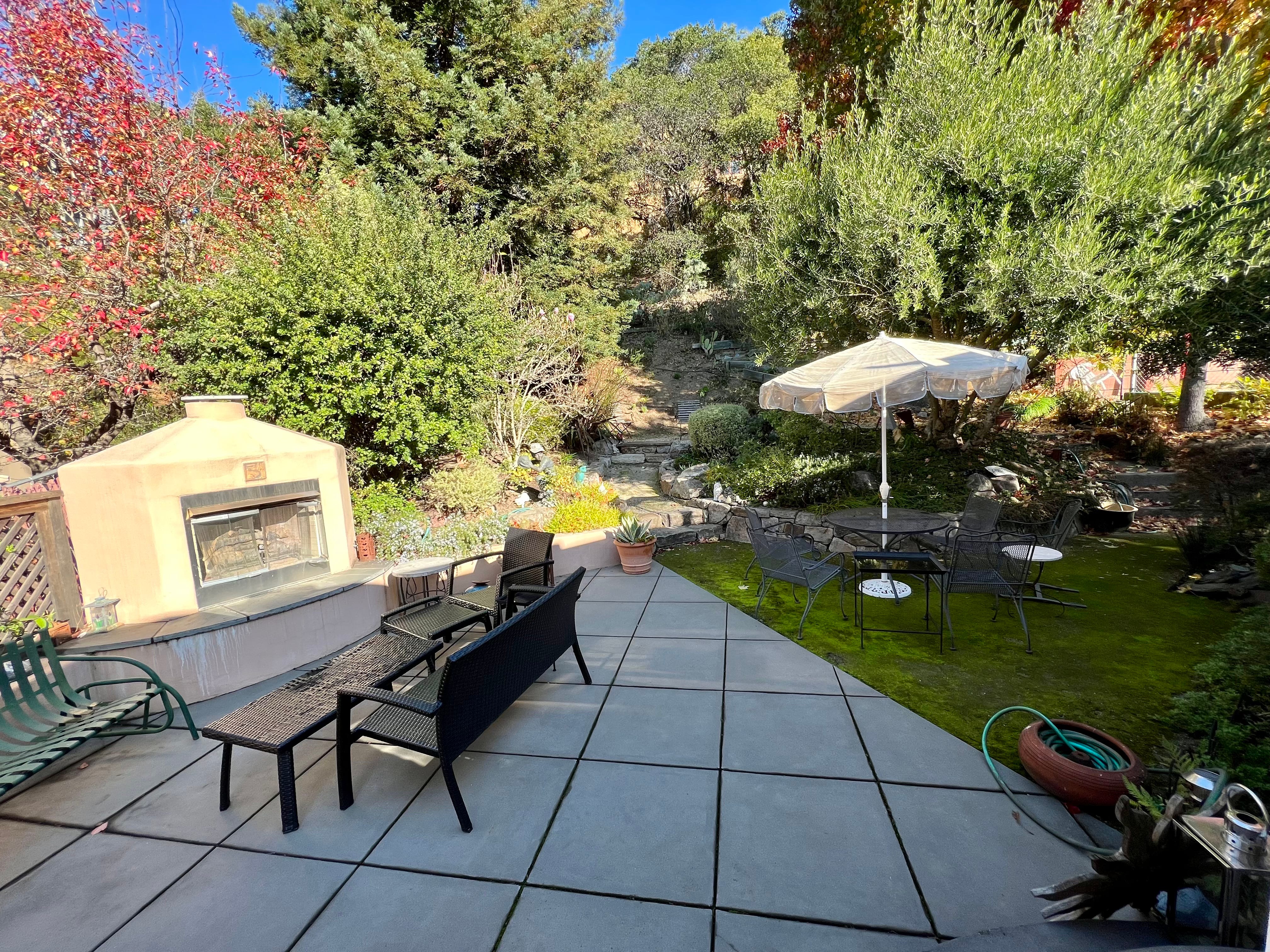
Backyard and terrace with gas fireplace off the bedroom

When my home burned down, I got the incredible opportunity (though I didn’t realise it at the time) to tell my architect exactly what I wanted in a house. I chose to simulate an adobe dwelling in Santa Fe. I was named after my great Aunt Sara who lived there most of her adult life and, romantic that I am, I thought this was a way of honouring her. I mixed the Adobe look with the Tuscan hills architecture around Florence where I spent one of the happiest times of my life. I chose doors from a company in Santa Fe, found mesquite wood at an antique store and asked the builders to plaster around it just as if it was adobe. I learned how to cut plastic garden pots in half, adhere them to the outside wall and stucco over them. Right side up, they became planters. Upside down they become covers for lights. The contractor let me design every nook and cranny (and there were many literal nooks and crannies where I could put all my treasures I’d collected in my travels) , and took my suggestions.

Most of it worked. Some of it didn’t. I closed in a deck and made it my bedroom and made my bedroom a sitting room. The entire top floor was a Master bedroom with french doors that opened onto a terrace with a gas fireplace, a table with six chairs, roses, coreanothus, a magnolia tree and a number of liquid amber. It was a sanctuary. As an old saying goes, I got out of that house exactly what I put into it: my heart and my soul. There were always animals running around as I volunteered at the Oakland Animal Shelter and couldn’t help myself.

In 2013, I had retired and decided to move to Paris for a year. As anyone knows who has been reading this blog since 2016, I fell in love with Paris. One year turned into two years. Two years turned into three. Eventually I was a resident in both countries and financially supporting two residences. As I grew older, I found it tiring to have so much responsibility. The idea that I had to make a decision about living in one place or the other developed long ago but was more a ping pong game in my head. I couldn’t land on a solution. I’d end up saying ‘if I could just beam my Oakland home over to Normandy, I’d be in heaven.’

Of course that was not going to happen. This winter, I made a decision before I realised I had. I decided to sell the sanctuary, leave California, and live permanently in Paris. My US presence would be in Ann Arbor, Michigan where my sister lives. I realised the decision was made at the end of a three month stay in Oakland. Immediately, I began to grieve and remember all the wonderful times in the house. I shut my feelings down temporarily and put the wheels in motion. I made reservations to return to Oakland on April 10th for one week. In that one week, I had to decide what I wanted to keep and would send to Ann Arbor; what I wanted to go to Paris — my hope is to find a larger apartment in Paris once the house sells; —and what to leave behind. I was referred to the most wonderful packer/mover, Amy McEachern, who showed me how to put blue stickies on anything going to Paris and yellow stickies on anything going to Michigan. She would come in with her crew after I left, and pack it all up and get it sent. Then another crew would enter the scene. They’d do an Estate Sale and liquidate what doesn’t sell. At that point, the house will just be a house. My sister has taken all the ceramic cats that lived in the back yard. Everything that possibly could be called a thing will be gone. Thirty years of what I loved, enjoyed waking up to in the morning, looked at when I climbed the stairs up to the bedroom will have traveled somewhere else. I got promises from everyone that that somewhere would not be a dump. The house would then be ready for staging. Staged by someone who doesn’t know the house, all her secrets and stories. I’m sure it will be beautiful but will it feel alive?

A week is not much time to make those kinds of decisions. I was afraid I would procrastinate. I didn’t think I would change my mind. I put out a Help call and friends came over to sit with me or make decisions with me. Either way, they provided energy so that I could get the work done and I got to spend time with them. By Monday, the 5th full day of work, I hit a wall, My exhaustion made me dizzy and I didn’t feel safe driving a car. I asked a friend if we could play Driving Ms Daisy. Amy called to ask if I needed a strong guy to come over and take things out of my attic so I could sort through it. I’d already seen what a mess it was up there. But I couldn’t remember any one thing that was there. I clearly hadn’t missed any of it in the past ten years. I thought about it for two minutes and then told her the truth. I couldn’t move my body, I couldn’t do any more work. I was going to leave it for the Estate and Liquidator people. The sixth day was spent with my realtor and going over everything to make sure the stickies had stayed stuck. And on the 7th day, I went to SFO and slept nine hours on the plane back to Paris. 

For the next three nights, I slept twelve hours a night. I’m sad. But here’s the thing. For one of the first times in my life, I made a decision to let go. I had a choice. I didn’t have to wait until my beautiful home collapsed in an earthquake or burned again in a Firestorm. The choice I made was to let go of something I love knowing that it meant lots of tears, grief, sadness, and memories. I wasn’t going to mistake the sorrow for thoughts that I’d made a mistake. Letting go is hard and I’d been trying to avoid that for years. Letting go also means that I get to move on. I moved to Paris ten years ago. It’s taken me ten years to get the message that it was time to move on. 

Or as a friend of mine says: “It is what it is and probably right on time.”

A bientôt,

Sara

Thanks for reading Out My Window! Subscribe for free to receive new posts and support my work.
Please Keep your Hands in my Food: Why this butter made people mad by Anna Muckerman

I have mentioned before that the indefatigable Judy MacMahon, who writes “le bulletin” substack has pulled as many of us that write about France or Paris together into FranceStack (click to see all the substacks).
She encourages us to repost each other’s writings 1—because they are often on different subjects and 2—to bring attention to other blogs and Substacks that might interest readers. I urge you to go visit Judy’s Substack ‘le bulletin.’ Unlike me, she consistently writes every week, does amazing research on fascinating subjects of French life, and is a wonderful, encouraging supporter of all of us that write here in France.

The following is an article from last week’s ‘le bulletin’ written for her magazine MyFrenchLife.org. She also has a book club that meets on Zoom about 4 times a year. Before the Zoom meeting, readers have a chance to discuss the book as they are reading it. Presently, the book club is reading The Postcard by Anne Berest.

beure - Butter
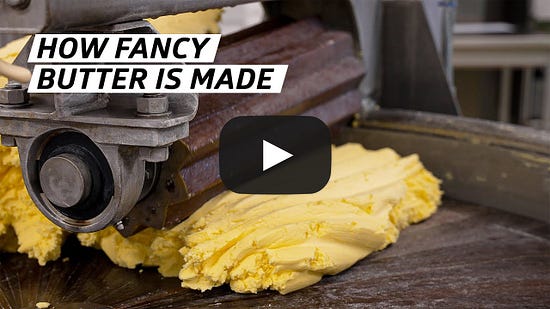
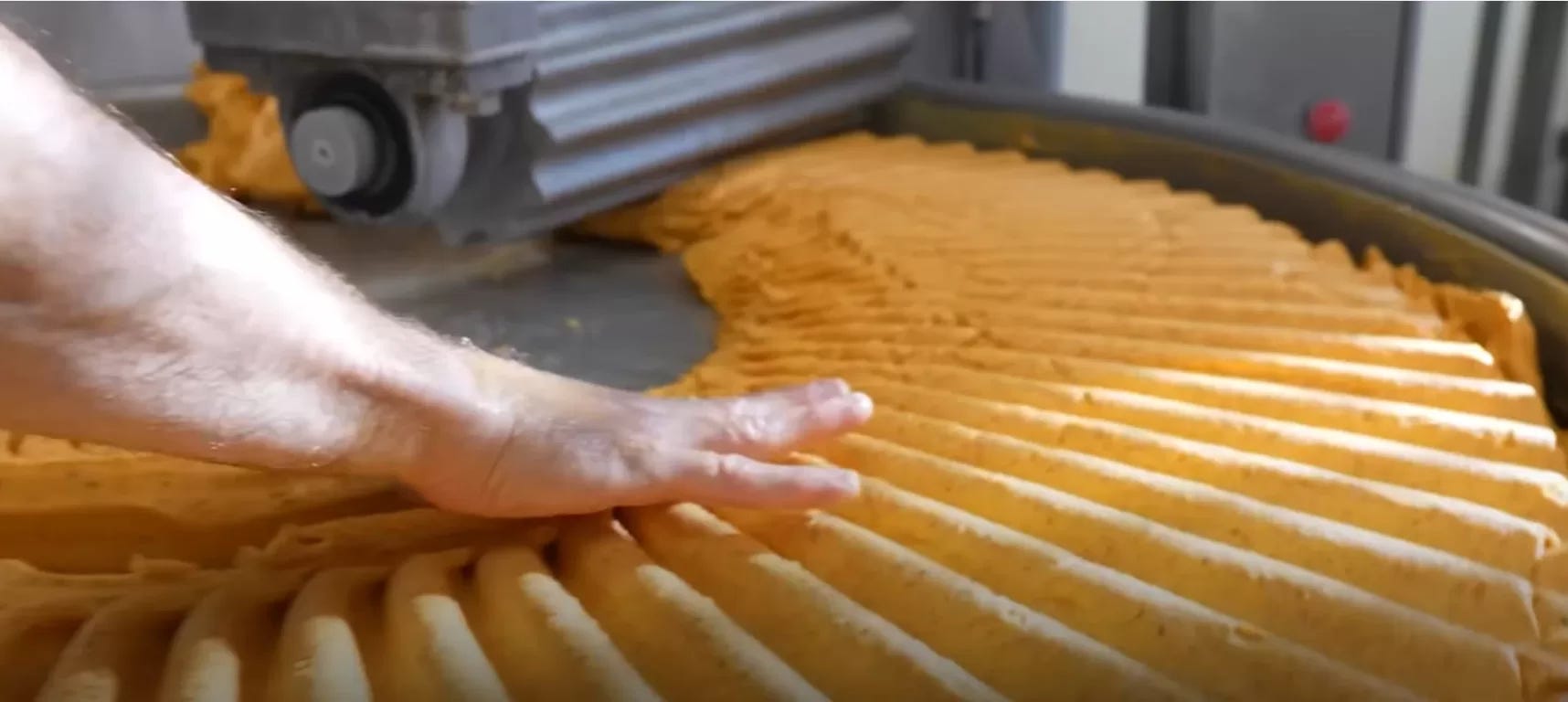
Kneading butter at the Beurre Bordier atelier in Brittany. Image from the Eater video found below

And now to the article by Anna Muckerman…….

Thanks for reading Out My Window! Subscribe for free to receive new posts and support my work

“In July 2022, I was filming a video about Dijon mustard in a village restaurant in Burgundy when the chef said to me,

You should really do a story about Beurre Bordier up in Saint-Malo. That’s what all the big French chefs use.”

Beurre Bordier

I had never heard of Beurre Bordier, but I soon discovered that it was almost like never having heard of Ben & Jerry’s — it was the butter, renowned both in France and worldwide, a gem, but hardly a hidden one.

Four months later, Eater sent me to Beurre Bordier’s atelier in Brittany to see the magic for myself. The company was founded by Jean-Yves Bordier, who in the 1980s revived the historical technique of remalaxage – or re-kneading – and developed a roster of flavored butter including the signature Brittany seaweed butter that the company is known for today.

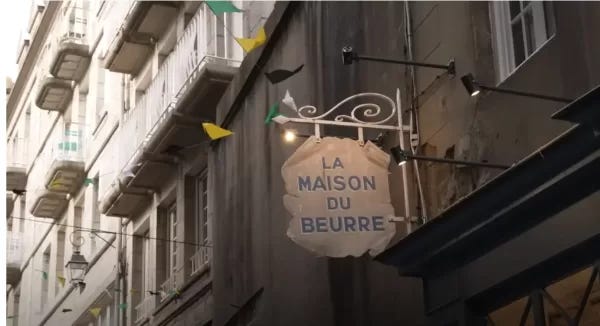
La Maison Du Beurre
Bordier’s flagship store La Maison Du Beurre in Saint-Malo

Monsieur Bordier had recently retired, but the company’s oldest employee Vincent Philippe graciously walked us through the process. I learned that Beurre Bordier does not produce butter from cream. They buy high-quality, organic churned butter in giant blocks and rework it on a giant wooden kneading machine by adding salt and removing water until the flavors become more developed (read: delicious).

Then they add exciting flavors like wild garlic, Madagascan vanilla, buckwheat, or yuzu, to name a few, and form it into custom sizes and shapes for customers around the world.

A few months later, I spotted Beurre Bordier for sale in a swanky Bangkok shopping mall. I excitedly told the young woman behind the counter that I had just been to the place where the butter was made. Understandably, she pointed at the butter as if to say Cool story, and would you like to buy some?

You can see the whole process here:

Butter and YouTube

To date, 6.6 million people have watched this video, making it my most-viewed work (full disclosure: anything about butter performs well on YouTube). Nearly 2,000 people also took the time to leave a comment. Here is a selection of them:

 – “i really like the amount of hand hair that went to making of this butter”

– “love how they wear a Hairnet but his Hairy arms are wide open”

– “Love the taste of finger prints in slice of butter..!!” (This one really cracks me up: What do fingerprints taste like? Imagine slicing butter and finding one inside!)

– “While I’m sure this is quality butter I don’t want employees working gloveless with hairy ass arms kneading my butter.”

– “Hand sweat adds flavor.”

Now, if you’re going to work with YouTube in any capacity, you can’t get bent out of shape about the comments. In fact, it’s wise not to read them at all, except in specific cases like Eater videos because there are often a lot of lovely comments from people who have nice things to say.

However, these particular comments are emblematic of a wider societal problem: We can’t stand hands touching our food. I’ve noticed it in other places, too – like this Instagram Reel and this one where people are wearing gloves while cooking for no apparent reason.

Sure, some people may wear gloves to avoid the squishy texture of raw meat (although in the first video, he doesn’t even touch the ground beef!) but what purpose do gloves serve when slicing an onion or an avocado?

It seems that somewhere along the line, we got the idea that hands = contamination and that we should use gloves when preparing everything, as if the kitchen were a hospital. We forgot that cheese is made of mold and yogurt formed by bacteria. Food should be clean, but it was never sterile to begin with.

No longer a germaphobe

Ironically, I grew up quite the germaphobe. Even as a kid, I couldn’t stand to see people make food while wearing rings and so much as an eyelash hair on my plate would ruin my whole meal. Over time though, as I’ve traveled more and eaten in other people’s homes, I’ve come to realize that hands are precisely what elevates food from a simple means of sustenance to one of life’s greatest pleasures.

Food safety is important, but cleanliness should not mean avoiding human involvement.

In many places worldwide, food is now something that comes in a brightly colored package with lab-derived ingredients. Cheese is wrapped in plastic with a picture of an idealistic-looking farm that hardly resembles modern, industrial dairies. In the U.S., I recently saw flawless, elongated bell peppers, bagged and branded with a cutesy name as if they were produced in a candy factory instead of a field.

This isn’t a rant against mass-scale food production, which has allowed us to more efficiently feed ourselves, and refocus our energy on other areas. I’m simply pointing out that the more detached we become from what food is, the more we develop a warped view of how it should be produced. We’d rather a machine pop out perfectly uniform, brightly dyed pieces of cereal than eat butter molded with care by clean, washed hands.

At Beurre Bordier, Vincent explained that bare hands allow the workers to understand; if the butter has been mixed correctly, and if the temperature and consistency are right. In other words, whether it’s safe and delicious.

To be clear, not all cultures seem to suffer from the fear of hands touching food – some embrace it wholeheartedly. After all, isn’t this the way it’s been done since the literal beginning of mankind?

I, for one, would like to say:

please keep your hands in my food. “

As Vincent told me on the day I visited Beurre Bordier, clean hands are much preferable to dirty gloves.


What’s your view on cooking with your hands? Share in the comments below.


Further reading:
French Butter why is it so delicious?
Butter: Exploring the French Paradox

Thank you for reading Out My Window. This post is public so feel free to share it.

Thank you for being such an important part of my week. This blog wouldn’t exist without you: someone who wants to know more about this wonderful country.

A bientôt,

Sara