A Touristic Pilgrimage to Notre Dame de Paris


There are a lot of substacks about Paris and France. Little Lights on Rosa Happiness Street is worth your investigation. Lorie is a great writer and journalist. 

Here is her post this week on Cathedrale de Notre Dame:

“You could spend a day, a year, even a lifetime exploring this hallowed place. You could also learn from my mistakes.

LORIE TEETER LICHTLEN

DEC 12, 2025


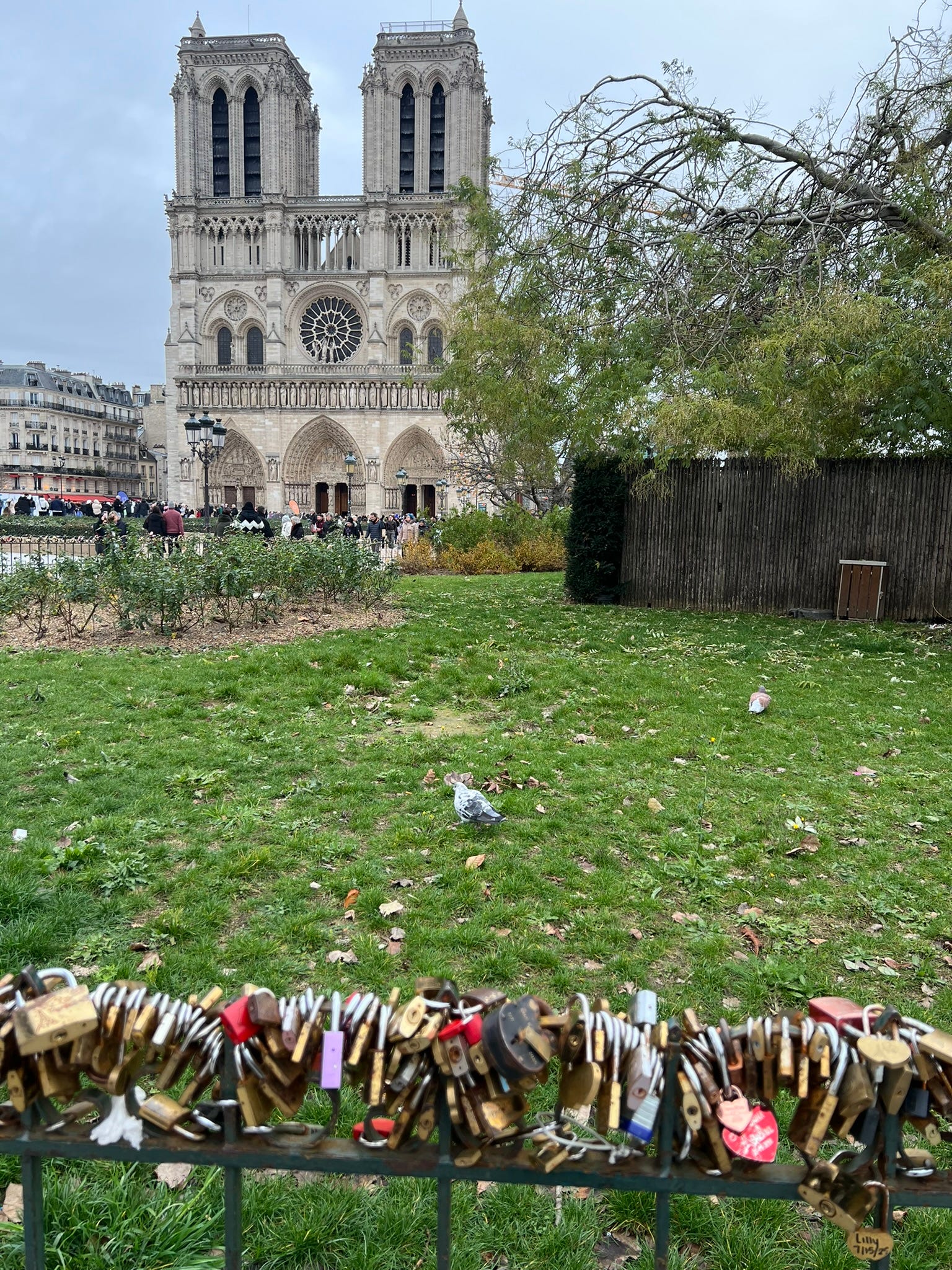
Notre Dame Cathedral on a blustery December day. Photo credit: Lorie Teeter Lichtlen

This week marks the first anniversary of the resurrection of Notre Dame Cathedral.

After the mass for heads of state, which was broadcast around the world, on December 8, 2024, the masses were allowed to visit. They flocked in numbers as monumental as the cathedral itself.

Over the past year, Notre Dame has hosted:

  • 11 million visitors – or more than 30,000 per day, every day, for a year
  • 1600 celebrations – for Lent, Easter, the death of Pope Francis, election of Pope Leo XIV, Advent, Christmas, etc.
  • more than 650 pilgrimages – of which one-third from outside of France
  • 600 official delegations, and
  • 44 groups of “vulnerable, isolated or disabled” people

Meanwhile, the renovations have continued apace. It’s now possible to climb to the towers, visit the crypt and admire the treasures in the sacristy. Thirty priests take turns staffing the two new confession chapels.

Much remains to be done. Designs for new stained-glass windows went on display in Paris this week; the windows themselves will be installed in Notre Dame in 2026. Other projects – notably involving the gargoyles and flying buttresses – will reportedly keep skilled artisans busy until 2030.

With all this exciting activity underway, why did it take me a year to finally visit the “new” Notre Dame?

Well, it took me that long to wait for the crowds to wane or, rather, to work up the courage to face them. I have walked by the cathedral many times over the past year and seen huge lines of people along the concrete forecourt. I have seen them drenched in the rainy spring and fall, and fried in the summer sun. I imagined them travelling from around the world for their dream vacation in Paris, only to find themselves in a very long line, kids whining, and cowering under the makeshift shelter of a scarf. The well-prepared will have brought umbrellas or bought plastic ponchos from the nearby shops.

Admission is free but advance reservations are recommended (there is direct access for the cathedral’s worship services). I tried for months to book and found few slots that would allow me to go in with family or friends, so finally decided to go alone. The evening of Sunday, November 30th, I booked a slot for one person the next afternoon.

Those who haven’t yet made the journey may benefit from my experience.

On this blustery December day, the lines were the shortest I had ever seen. My “reserved” line had about 20 people in it when I joined. After our QR code reservations were scanned, we were all allowed in at precisely 2:45pm. The “no-reservation” line was moving briskly, too.

We passed through the central doors under the 13th century Portal of the Last Judgment, hardly noticing its sculpted scenes of heaven and hell. Pristine statues of the 12 apostles watched quietly as we filed by.

Inside, as my eyes adjusted to the dimmer light, I was struck by the scent of wood smoke. Was it a remainder or a reminder of the tragic fire that nearly destroyed this hallowed place on April 15, 2019?

Many visitors did not heed the request to come without bulky backpacks. There are no lockers or coat check desks at Notre Dame. (No cafeterias or drinking-water fountains either.) Add in throngs in winter coats and it can get congested. At least no one seemed to be lugging luggage when I visited.

A year ago, some said the “new” Notre Dame seemed too new: too bright and shiny for its 860 years. Today’s lighting bathes the cathedral in a gentle golden glow. The result underscores the grandeur of the interior while allowing visitors to marvel at the artistry on display.

The visit is organized clockwise, starting with a welcome desk offering free headsets for guided tours via a mobile app and ending with a small gift shop area. Throughout the cathedral, votive candles can be purchased via credit card and vending machines offer commemorative medals. Proceeds from these and the shop help finance the restoration efforts.

Along the left (north) aisle, a series of chapels represent the stages in the history of Christian revelation, from Adam, Noah and Moses to Solomon and Elijah. Each has its own distinctive style, and each is more stunning or elaborate than the next. The chapels are adorned with precious paintings and frescoes, hand-woven tapestries, decorative tiles, and sculptures in wood, marble and other materials. Some are equipped with mini elevators to allow wheelchair access.
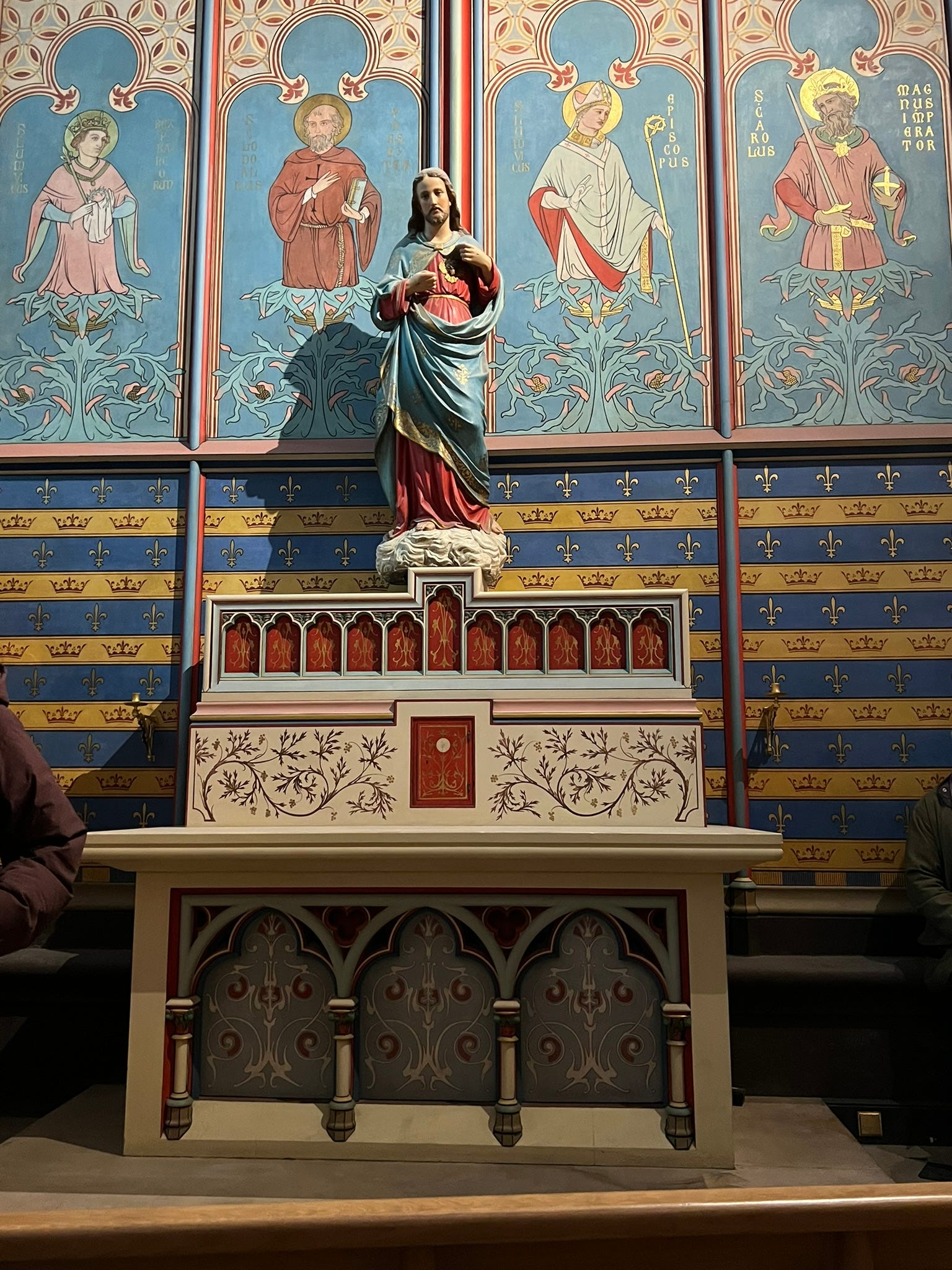
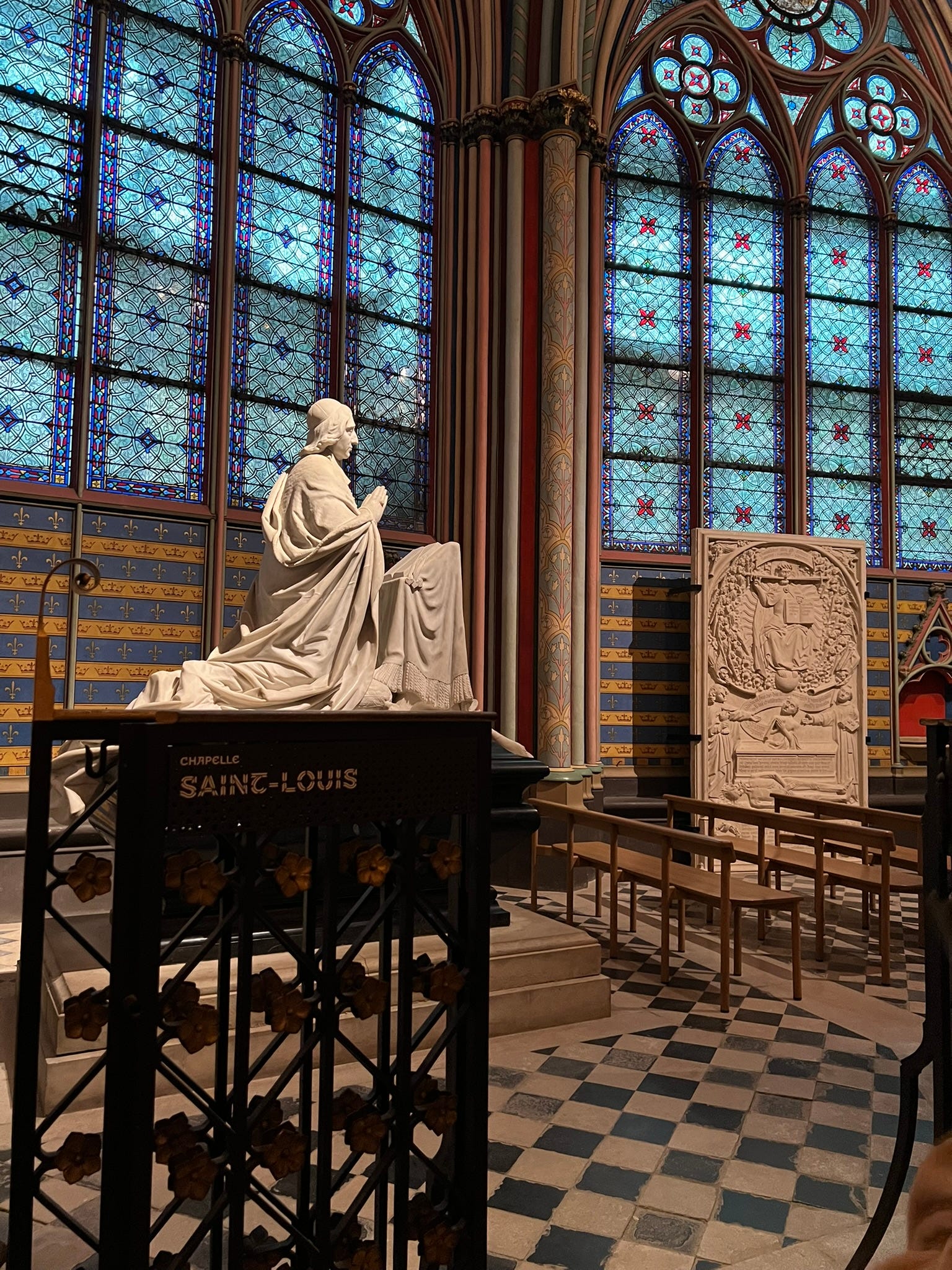
My favorite among the chapels is dedicated to Saint Louis: a beautifully simple space, twice the size of the others, with wooden benches that invite contemplation. Photo credits: Lorie Teeter Lichtlen

Across the aisle from the chapels, the north wall of the choir enclosure is lined with scenes from the life of Christ in polychrome stone. For this Christmas season (until February 2), this area also features a large “crèche” or nativity scene, with traditional Provençal figures and a terracotta village.
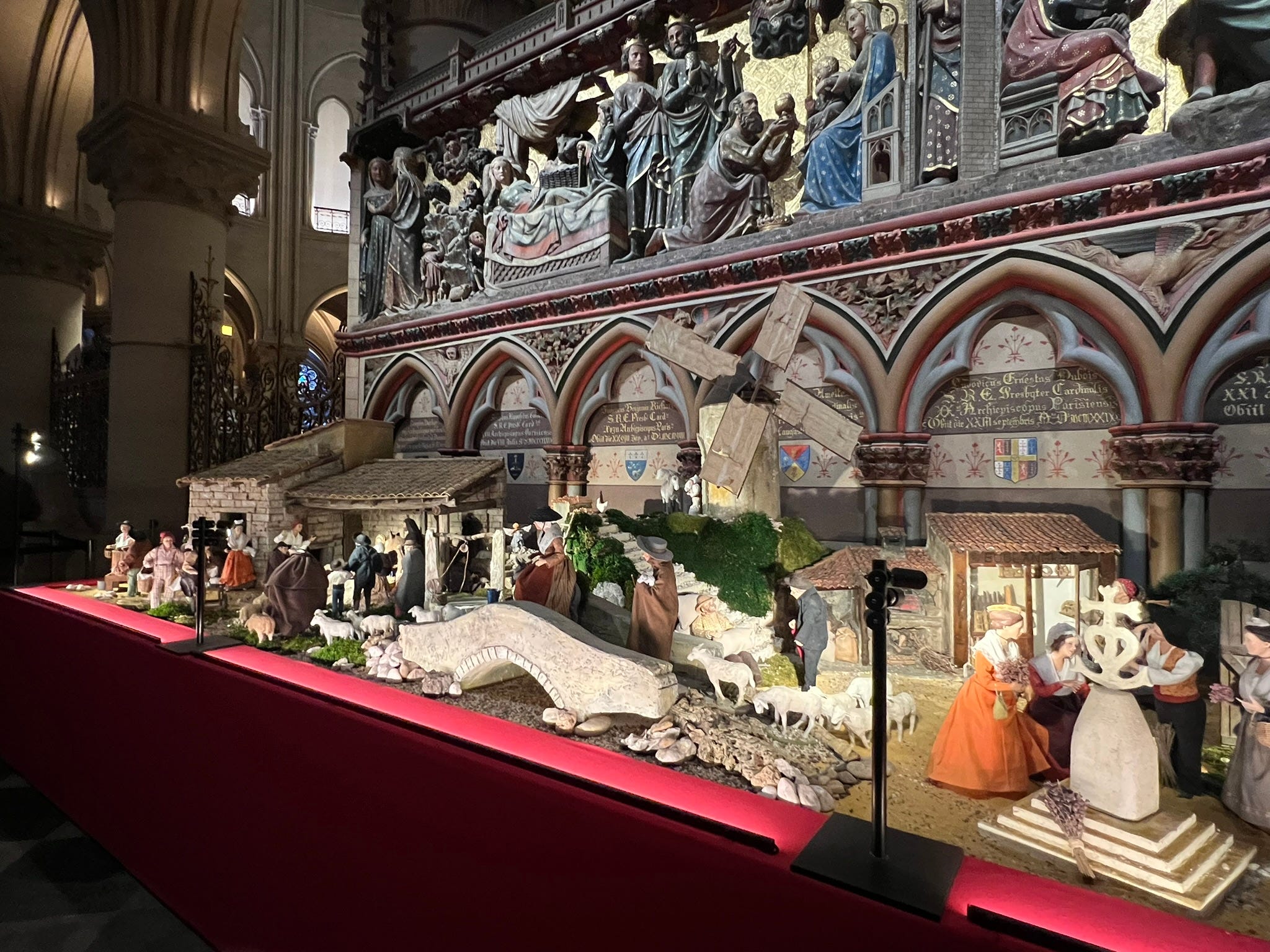
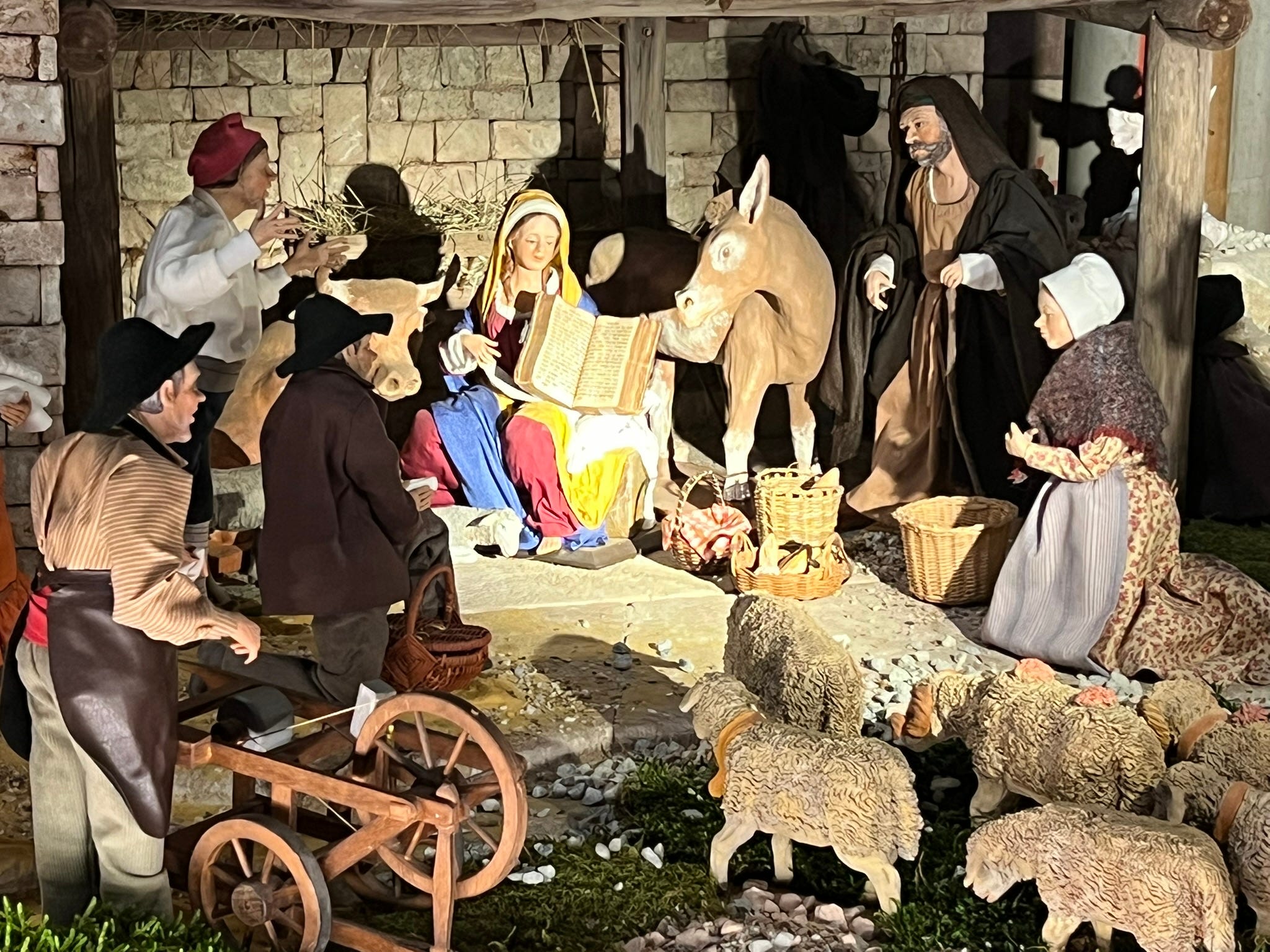
The north choir enclosure and Provençal “crèche” for Christmas. Photo credits: Lorie Teeter Lichtlen

Traffic jams formed near the north and south transepts – ie, the perpendicular arms that constitute the cathedral’s cruciform shape. Mobile phones aloft, hundreds of tourist pilgrims like me turned in circles, attempting to capture the reverential atmosphere distilled by the vaulted ceilings and famous rose windows.

Traffic jam at the north transept. Credit: Lorie Teeter Lichtlen

When the hum of collective admiration grew too loud, an ethereal “shhhhhhhhhhhhhhh … silence, please” floated from invisible speakers. This message played several times during my visit, once followed by an invitation to attend mass by heading to the reserved seating area. (Notre Dame celebrates three masses per day on weekdays and four on weekends.)

“The Cathedral of Notre-Dame de Paris is delighted to welcome you: pilgrims, believers or not, Christians, visitors from around the world, all men and women of goodwill!” – from the Notre Dame de Paris web site

I’m not Catholic but could have attended the mass. Instead, I continued to meander around the cathedral with the other tourists.

Another traffic jam soon formed, this time around the holy relics.

Who knew that Notre Dame houses what are believed to be relics from the Crucifixion of Jesus Christ? The Crown of Thorns, a Nail and a fragment of the Cross were purchased in 1238 by King Louis IX – later canonized as Saint Louis — from the Latin Emperor of Constantinople. Had I known, I might have been prepared to sit in thoughtful meditation before the holy crown in its crystal case within a large golden circle. Many others did so. Instead, I suddenly felt unworthy of occupying precious space there and just took pictures from a respectful distance.
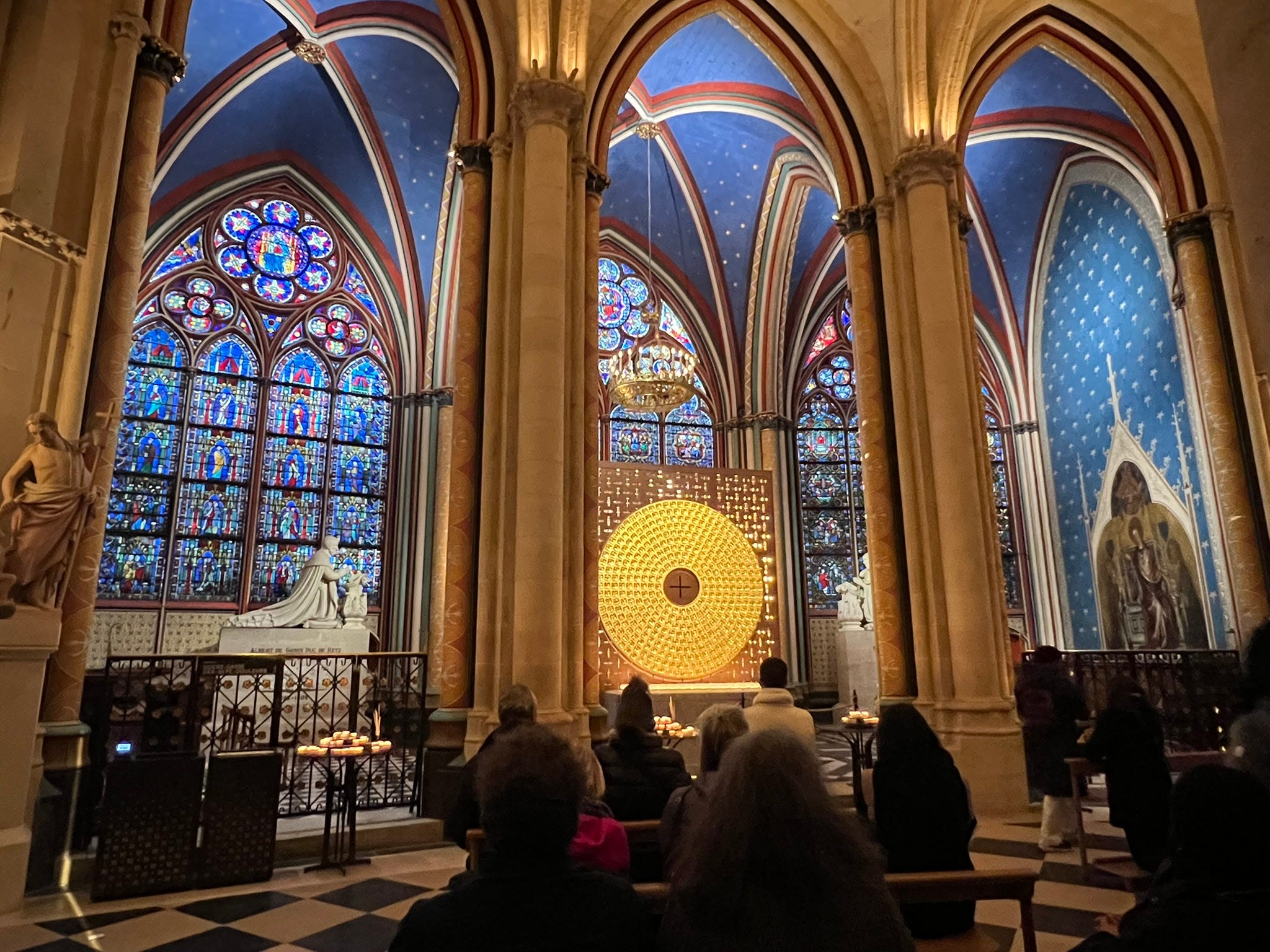
The Crown of Thorns in one of the holy relics housed at Notre Dame. It is displayed on Friday afternoons, in a crystal case within a golden circle. Photo credit: Lorie Teeter Lichtlen

My qualms turned out to be unfounded: the crown wasn’t on display the day of my visit. As I learned later, it was traditionally visible on the first Friday of each month; as of last week, it can be seen every Friday starting at 3:00pm.

Had I pored over the official Notre Dame web site and downloaded the mobile app, I would have been less clueless. As it was, I read every available description — and there are many!

The south aisle of the cathedral is lined with more chapels, including a new one devoted to Eastern Christians. The choir enclosure on this side offers another series of polychrome sculptures illustrating the apparitions of Christ. While the south enclosure is more recent than the north one, both were created by master sculptors in the 14thcentury.

By this time, I had been walking, studying and admiring the countless artistic and architectural masterpieces for over two hours. I wasn’t overwhelmed by all the beauty to the point of fainting, as the French author Stendahl was during a visit to Florence, Italy. I did need to sit down and process everything I was seeing and feeling, however.
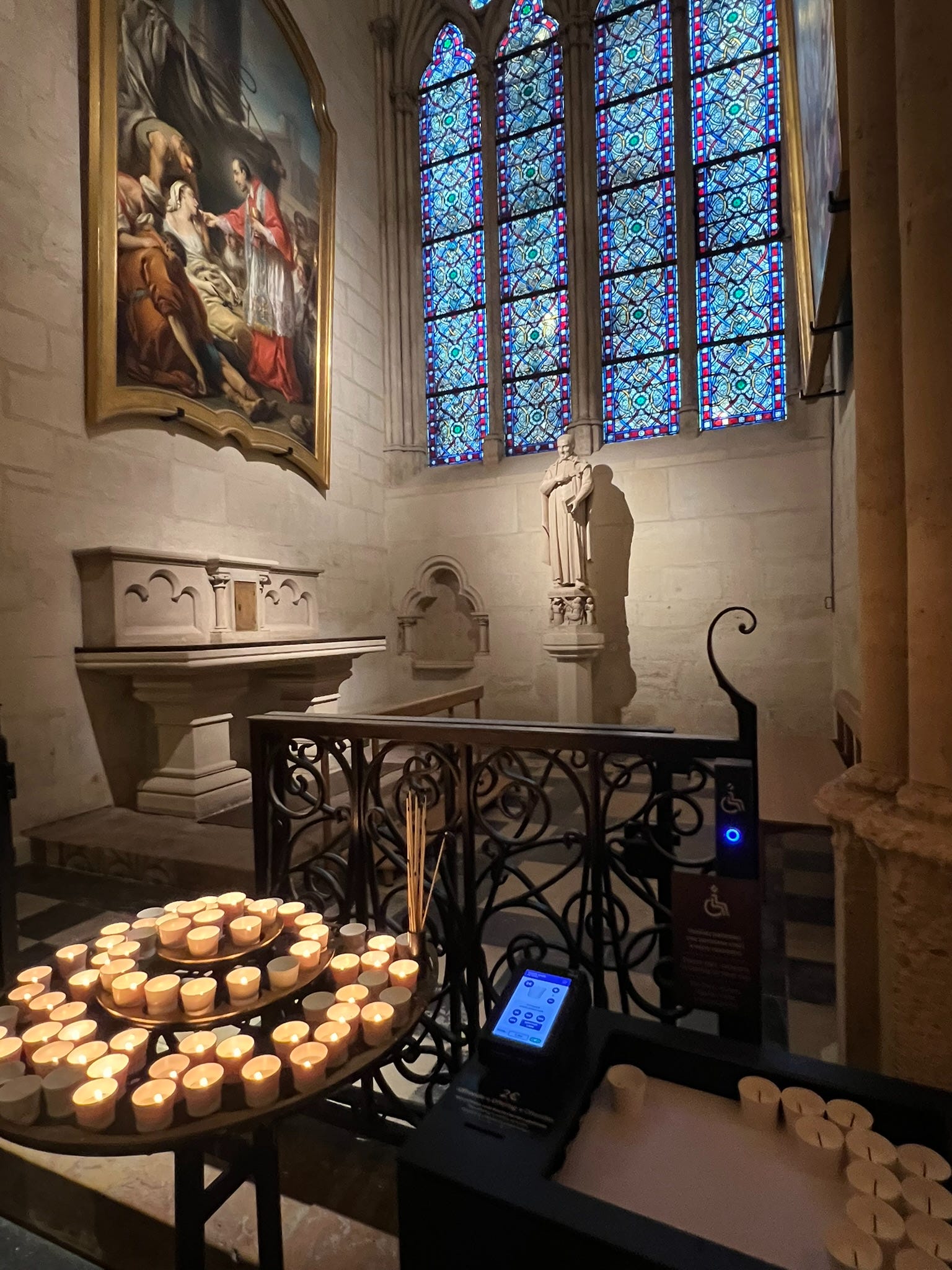
Mini lifts for wheelchair access and card payments for votive candles are among the enhancements at the “new” Notre Dame Cathedral. Photo credit: Lorie Teeter Lichtlen

I chose a seat in an empty section of the pews for the general public (as opposed to those reserved for worshippers) and started scribbling notes in my iPhone. Inspired by the atmosphere of Notre Dame, I was absorbed in poetic thoughts — until a group of tourists sat behind me and started happily chatting with each other.

I moved to another empty section but, within minutes, another chatty group arrived. I turned around a few times but, like the first group, they were oblivious to my frown. Should I have floated a “shhhh” of my own?

Instead, I saved the notes on my phone, put it in my pocket and went to the gift shops. The “shops” are actually four curved display cases forming a circle around the salesclerks; each case has its own cash register. Three of the counters sold similar items: a slim guide to the restoration works, notebooks, bookmarks, medals, necklaces, rosary beads, a Christmas music CD and decorations, etc. The fourth sold books, sculptures and more decorative items. I stood in line for two different cash registers to buy a few gifts. Had the line been shorter, I might have inspected that fourth counter’s wares. (Those items and many more are available at Notre Dame’s online boutique.)

I put on my coat and went outside, the fresh air feeling good after the crowds and hours indoors. The sun was low and the cathedral’s 21 bells were ringing. I love bells and it was great to hear them ringing, especially knowing they had been silenced for five years.

I was happy with my visit but wished I had focused less on getting through the front doors and more on studying all that the “new” cathedral has to offer. I’m determined to go back, once I have done my homework, to appreciate even more the miracle that is Notre Dame de Paris.

The bells of Notre Dame de Paris. Credit: Lorie Teeter Lichtlen

Those wishing to contribute to the continuing restoration of Notre Dame can find a way to do so at https://www.friendsofnotredamedeparis.org/

Thanks for reading Out My Window! Subscribe for free to receive new posts and support my work.

TIPS for getting the most out of your visit:

  • Read up on the history, art and architecture of Notre Dame before going!
  • Download the mobile app for tour guidance on-site in English, French and Spanish
  • Try to book your visit in advance through the official reservation site or attend a mass to avoid the long “no-reservation” lines
  • Check the practical information site for the opening hours, dress code, free guided tours, etc.
  • If you want to see the Crown of Thorns, aim to go on a Friday afternoon
  • Food and drink are not allowed on-site so have a bite before your visit
  • Bring a small umbrella for the wait in line, even on sunny days; small bottles of water are also a good idea
  • If you must bring a backpack, make it a small one; don’t bring bulky items
  • Ask for headphones at the welcome desk and use the app to better appreciate what you see
  • If you have to talk with others inside the cathedral, keep it short and whisper
  • The gift-shop counters offer a few items but can require standing in line multiple times; the official e-shop has a wider selection and you don’t have to carry heavy items or worry about breaking fragile ones. All proceeds go to the restoration effort.
  • Resist the temptation to head to the closest café or restaurant before or after your visit. A few blocks away in any direction, the fare and prices are less touristy. One exception: go for Berthillon ice cream on the Ile Saint Louis, behind Notre Dame. It’s a classic part of any visit to Paris!Let me know how it goes!
Little Lights on Rosa Happiness Street

A bientôt,

Sara
Ways to feel good during the holidays

Happy 1st of December. I hope everyone had a lovely Thanksgiving in the US and, those that live in France, that you celebrated with friends and family sometime over the weekend. I am late in wishing you a Merci Donnant as I managed to catch a cold. On Thursday, just a regular day here in Paris, I went to the 13th arrondissment to take advantage of a yarn sale by the company La Bien Aimée. They hold the once a year sale in a rented spot, calling in all their yarns, hoping, I assume, to get rid of the old and get ready for the new.

When my friend, Anjali, and I arrived at the posted address, there was a line that was half a block long, a very long half block. It was cold and had started to rain very quietly. Anjali and I had a lot to catch up on so the first 40 minutes went by quickly. Anjali had to get back to work and left after we’d been standing in the same spot—at least it seemed to me that we had not moved—for a long time. The rain had picked up, it seemed colder than the 44o posted on my iPhone and, by the time, I actually got in the store, I’d been freezing and wet for almost two hours. Not fun. 

I thought I had a plan but all plans went out of my head. I felt overwhelmed by all the beautiful yarn. I grabbed some that I was pretty sure I’d use though I had no patterns in mind and left having shopped just half the store. I took the metro back home and climbed in bed trying to get warm hoping I wouldn’t get sick. Oh well, I did get a cold and had to cancel on my Merci Donnant dinner Saturday evening.

Last year, at the same dinner, my host allowed me to read the famous Art Buchwald piece that he wrote for the Herald Tribune when he lived in Paris. I did not get through it without laughing so hard I had to keep repeating sentences. She was going to allow me to read it again. So, since that didn’t happen, I’m giving it to you, unedited.

“Le Grand Thanksgiving by Art Buchwald

This confidential column was leaked to me by a high government official in the Plymouth colony on the condition that I not reveal his name.

One of our most important holidays is Thanksgiving Day, known in France as le Jour de Merci Donnant .

Le Jour de Merci Donnant was first started by a group of Pilgrims ( Pelerins ) who fled from l’Angleterre before the McCarran Act to found a colony in the New World ( le Nouveau Monde ) where they could shoot Indians ( les Peaux-Rouges ) and eat turkey ( dinde ) to their hearts’ content.

They landed at a place called Plymouth (now a famous voiture Americaine ) in a wooden sailing ship called the Mayflower (or Fleur de Mai ) in 1620. But while the Pelerins were killing the dindes, the Peaux-Rouges were killing the Pelerins, and there were several hard winters ahead for both of them. The only way the Peaux-Rouges helped the Pelerins was when they taught them to grow corn ( mais ). The reason they did this was because they liked corn with their Pelerins.

In 1623, after another harsh year, the Pelerins’ crops were so good that they decided to have a celebration and give thanks because more mais was raised by the Pelerins than Pelerins were killed by Peaux-Rouges.

Every year on the Jour de Merci Donnant, parents tell their children an amusing story about the first celebration.

It concerns a brave capitaine named Miles Standish (known in France as Kilometres Deboutish) and a young, shy lieutenant named Jean Alden. Both of them were in love with a flower of Plymouth called Priscilla Mullens (no translation). The vieux capitainesaid to the jeune lieutenant :

“Go to the damsel Priscilla ( allez tres vite chez Priscilla), the loveliest maiden of Plymouth ( la plus jolie demoiselle de Plymouth). Say that a blunt old captain, a man not of words but of action ( un vieux Fanfan la Tulipe ), offers his hand and his heart, the hand and heart of a soldier. Not in these words, you know, but this, in short, is my meaning.

“I am a maker of war ( je suis un fabricant de la guerre ) and not a maker of phrases. You, bred as a scholar ( vous, qui tes pain comme un tudiant ), can say it in elegant language, such as you read in your books of the pleadings and wooings of lovers, such as you think best adapted to win the heart of the maiden.”

Although Jean was fit to be tied ( convenable tre emballe ), friendship prevailed over love and he went to his duty. But instead of using elegant language, he blurted out his mission. Priscilla was muted with amazement and sorrow ( rendue muette par l’tonnement et las tristesse ).

At length she exclaimed, interrupting the ominous silence: “If the great captain of Plymouth is so very eager to wed me, why does he not come himself and take the trouble to woo me?” ( Ou est-il, le vieux Kilometres? Pourquoi ne vient-il pas aupres de moi pour tenter sa chance ?)

Jean said that Kilometres Deboutish was very busy and didn’t have time for those things. He staggered on, telling what a wonderful husband Kilometres would make. Finally Priscilla arched her eyebrows and said in a tremulous voice, “Why don’t you speak for yourself, Jean?” ( Chacun a son gout. )

And so, on the fourth Thursday in November, American families sit down at a large table brimming with tasty dishes and, for the only time during the year, eat better than the French do.

No one can deny that le Jour de Merci Donnant is a grande fete and no matter how well fed American families are, they never forget to give thanks to Kilometres Deboutish, who made this great day possible.” — Art Buchwald

Thanks for reading Out My Window! This post is public so feel free to share it.

A Reason to Smile

Every Sunday, Dan Rather posts on his substack along with the YouTube address, a song that has made him feel good. He has wonderful taste and I look forward to the Sunday substack each week. This week, the duet of Tony Bennet and Lady Gaga sang Cole Porter’s I’ve Got You Under my Skin. (Click on the song to hear them).  After the first couple of weeks of his songs, I was shaking my head. ‘Who knew that Dan Rather had such great taste!”

Listen and then look forward to smiling on Sundays.

Finally Chop Wood, Carry Water by Jess Craven

My friend, Jane S. in Albany, California, told me about this wonderful Sunday substack written by Jess Craven. Sundays are for all the successes, feel goods, wonderful wins in the US and the world. She and her team root out everything (though she apologises that due to wifi problems, yesterday’s wasn’t as full as usual). Who cares. Nowhere that I know of will you find in one place all the successes to combat that numbing bad news of the rest of the week. On Sundays, she adds ‘extra extra’ to her headline. To read yesterday’s Nov. 30, click here

So that’s it. I’m giving thanks for the people who take the time to unearth all the ways to get me to smile and feel good each week.

I also give thanks to all of you who read this substack weekly and especially to those of you who comment and try to get discourse going: a rare commodity in this world of 50 characters. By the way, can someone explain to me the difference between those of you who become a Follower and those that subscribe. I thought followers were for social media sites and one could wear the number on your sleeve ‘see how many followers I have!’ Here on substack, I get a notice that I have a follower and that’s the end of that—what do the followers get? 

If you are a follower, please consider becoming a subscriber over on Substack. That way you support and encourage me. 

A bientôt,

Sara
Please read to find out what is happening.

Dear Subscribers,

The migration over to Substack is starting this week. Unless you have written to say you’d prefer not to go to Substack, you will be added as a subscriber to my substack: Out My Window sometime in the next month. You will receive a welcome letter from me.

As far as I know, you only have to receive the email. You do not have to have a Substack account unless you are interested in other substacks.

There is a good chance that you may receive both posts for a couple of weeks. I will try to not let that happen. Please forgive me if things get doubled up. I’ve heard this kind of migration is never easy.

Thank you, as always, for reading my words, making comments and suggestions, and encouraging my work. It means the world to me.

A bientôt (over on substack!)

Sara

Les pigeons

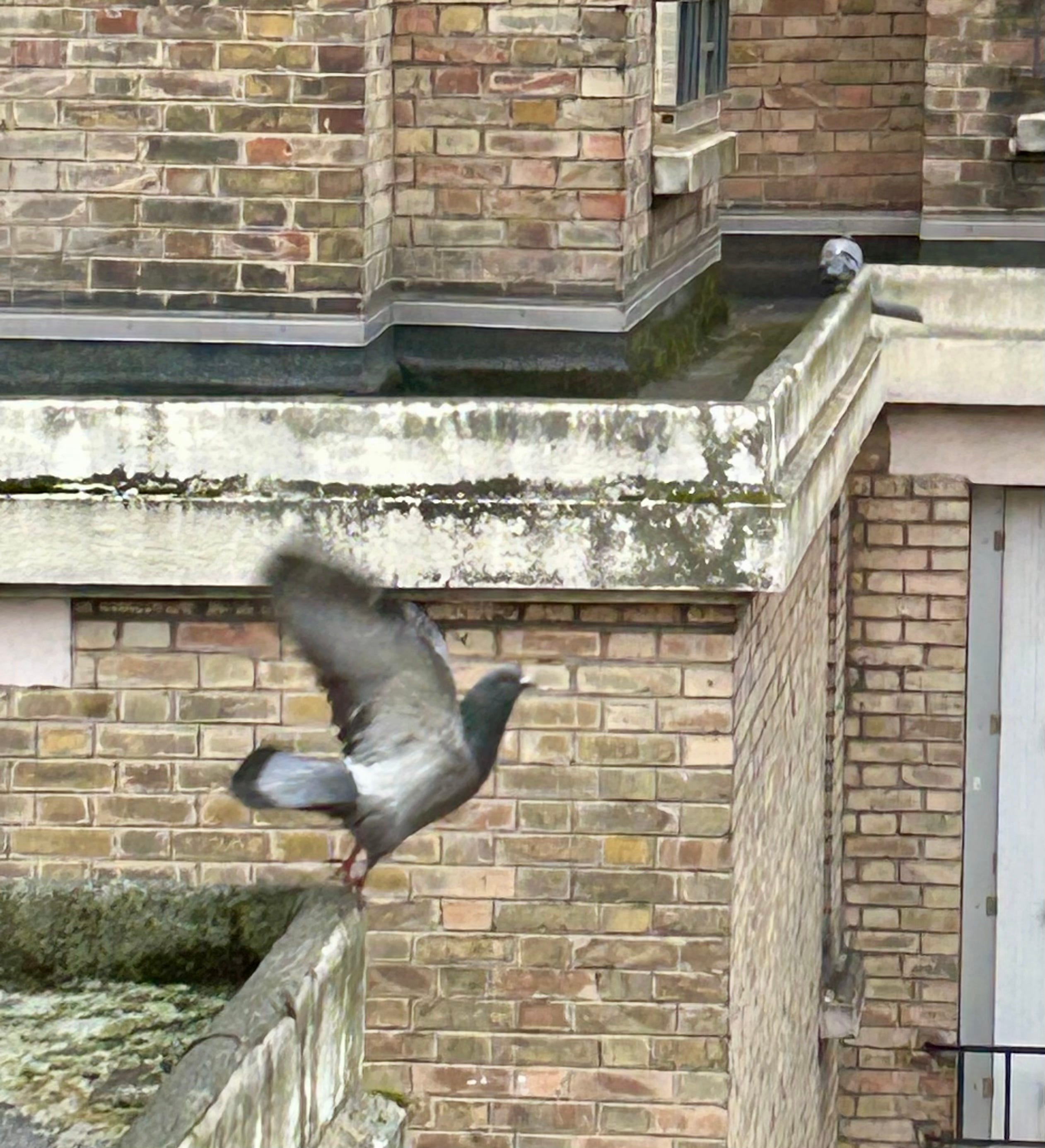
My home office, that also subs as a guest room with a twin bed/trundle bed, has one large window that overlooks one of the courtyards in my apartment complex. What I see when I’m sitting at my computer are the apartments across the way in the first building, and the two foot ‘shelf’ that circumnavigates my apartment. When I’m thinking ‘what should I write about?,’ I often look out and watch the Parisian pigeons land, investigate, play with each other, fly away, return. They are always there.

Except they aren’t. For the past five days, there have been no pigeons outside my window. One or two little birds, starlings maybe, flit around, fly more than land on the shelf. I miss the pigeons. I hadn’t really given them a lot of thought before. They aren’t messy. There aren’t hoards of them making a ruckus. There are six or seven every day who entertain me.

Where are they? Is it the cold? Has something happened in this area chasing them away? Pigeons don’t seem to be intimidated by much.

My fellow Substacker, Jenn Bragg, did a little research on pigeons a year ago. Click and you can read what she unearthed. She is not as fond of them as I am. I did like that the French army still raises carrier pigeons for just in case.

Parisian pigeon with sparkly necklace

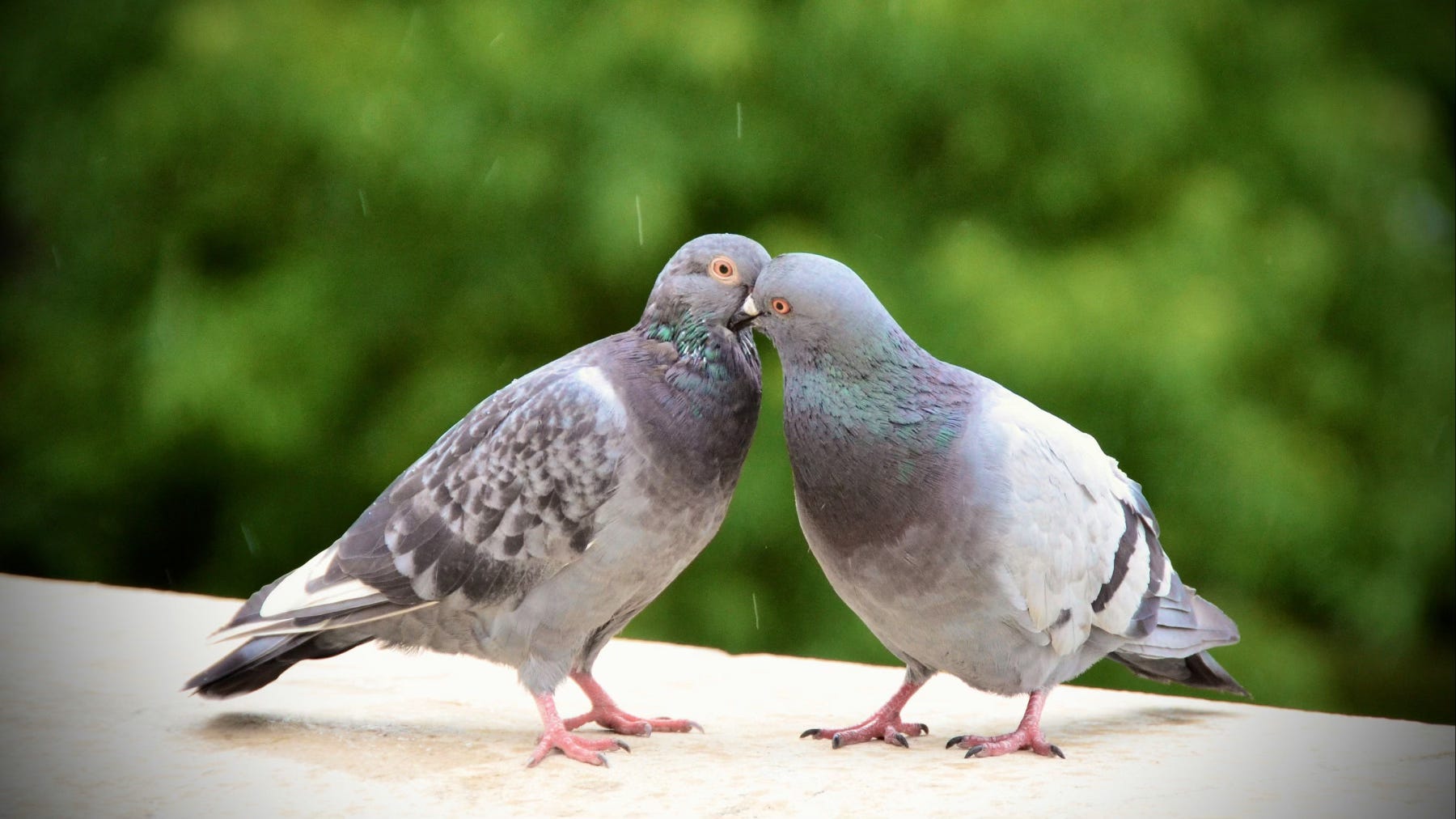
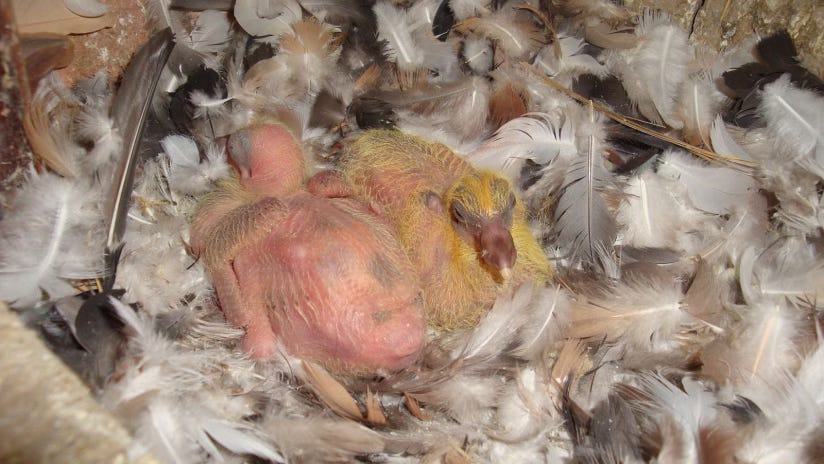
SortirAParis, an on-line site for tourists and English speaking exPats poses an interesting question: How come we never see baby pigeons? Where are they? “In the City of Light, there are generally three species of pigeon: the rock pigeon, also known as the passenger pigeon, the wood pigeon and the pigeon. The former is a rock species: it nests in rock faces or holes often built by man. The second is arboreal, nesting in trees. Lastly, the cavicole prefers to nest in tree cavities. 

So it’s not easy to come face to face with a pigeon nest. And yet that’s where their young are: they don’t leave the family cradle until they reach adulthood, after three weeks. That’s right, they’re fast-growing! And that’s why pigeons are never seen in the company of their young. Now we know you’ve got one more question on your mind: what does a baby pigeon look like? Find out below!”

Ahmed-Najib-Biabani-Ibrahimkhel—for SortirAParis

According to Ovocontrol, pigeons do not migrate. They are sedentary. “Instead, they remain in their urban or rural habitats year-round. In colder climates, they may search for shelter in warm, protected areas such as building attics, eaves, and other structures to escape the cold.”—Ovocontrol. Paris is definitely a colder climate. However, this fall, though chilly and rainy, hasn’t gone below 48o and that’s in the early mornings.

For more pigeon facts that may cause you to reexamine your attitude towards pigeons, go to. (Click). They are amazing creatures.

Two of My pigeons on the ledge around my apartment

But none of this answers my question. Where have MY pigeons gone? If you live in Paris and have any information, please write below in the comments section. If you know about pigeons wherever you live and have some information for me, I’d love your comments.

A bientôt,

Sara

PS A bloggers view on the difference between New York pigeons and Parisian pigeons. Click here

Dancing with Fred Astaire–backwards and in French

When we dream of moving to Paris, our heads (my head) are filled with romanticism: the beautiful architecture, the sky unencumbered by skyscrapers, the stores on every street bursting with color of seasonal fruits and vegetables, the cafés where one can order an expresso and then sit for hours, a city full of walkers-everyone walks and enjoys walking. What we don’t think of until we are here and in need is the strictness of French bureaucracy, black and white. Either you accept it or you drive yourself mad trying to figure out ways to make it move faster. And the fact that everyone speaks French. Which, depending on our schooling, when arriving in our adopted country, we come with different levels of fluency.

For the first three or four years, I would take someone with me when applying and reapplying for my one-year residency card, renewable yearly. I kept my US health insurance not realizing that I could apply for the social security and carte vitale after I’d lived here for over three months (That may change. The French parliament is proposing that US retirees pay a fee for their carte vitale). Once I got my Carte Vitale, I looked for doctors who spoke English again not realizing that they charged at least 50% more for that service. But I was too afraid that I would miss something crucially important if I depended on my B2 level of French.

Recently I have been struggling with a few issues: intense vertigo being the main health issue that I worry about. I’ve always had some form of vertigo although it would go away for years. It has returned with a vengeance. After I returned from the trip to Spain in September, it hit on a Monday, more of an attack. By Tuesday evening, I was crawling around on all fours. I’d had some neck pains before I left and thought I’d taken steps to deal with my neck. 

If you have never had vertigo, it is not only awful, it’s frightening, debilitating. The world spins around at high speed making most people nauseous. You start to vomit and can’t stop even when there is nothing left. Vertigo is not a matter of life and death (although I once got it while driving on the freeway from Walnut Creek to Oakland. I had to pull over and lie down on my front seats until it passed). Vertigo is isolating. With this last episode, I have had no idea when it would hit or what triggered it. Lying flat I knew was one culprit. I didn’t go to any of my gym classes. A heaviness like a cycle helmet of concrete hung around my head at all times. I was afraid to move my head from side to side. I probably looked to others like my spine extended through my head and I had abandoned all flexibility. 

How do you like this for a diagnosis??

My doctor, who speaks English, referred me to a Vertigo clinic but I couldn’t get in for four weeks. Everyone I knew who had had some experience with vertigo had advice for me. And I was willing to try anything. Now six weeks after the first onset, I don’t feel very educated on what’s wrong. I know it has to do with crystals in my right ear and getting them to return to their proper place. However, with age, crystals tend to get stuck and refuse to budge making balance a very precious commodity. The doctor at the vertigo clinic induced vertigo then sent me home. I was upset. And scared to do one of the maneouvers that is supposed to budge those pesky crystals back into their proper place.

This is probably what I have.

This week I went to a kiné. A kinesteologist but different from American kinestheologists. They are a combination of osteopath, massage, and physical therapy. Cédric, I was told, speaks English, I was told wrong. And once more I have found myself in the hands of a health professional communicating in French. The first time I went to a health professional who spoke no English, I used my translator, DeepL, to write out in English what the problem was and what I hoped for. DeepL would translate into French and I’d make a word document which I’d take to the professional. Today, I told myself to trust that I spoke fairly good French and just go. I couldn’t help but think of Ginger Rogers doing everything that Fred Astaire did but backward and in heels. That’s the way it feels. I’m going to my doctor. I’m going because I need the wisdom and expertise of a health professional. I’m doing it all in French.

We make our appointments through Doctolib, a wonderful site that makes it so much easier to do this ‘in French’

I’m told by French people that my French is fine. I think that means I get along. I couldn’t possibly go to a French movie without subtitles, enjoy it, then go to coffee with friends and have a discussion. Half the movie would be in argot (slang). The only place I know to hear pure French so I practice is the news. I prefer France 24. But I’m not a great fan of the news at the moment.

So I struggle along. If I were completely healthy, I think living in French is hard work, it’s tiring. I forget that. Now, dealing with vertigo, and living in French, I’m tired a lot. I don’t like being tired. I judge myself and feel old. My Irish doctor says vertigo has nothing to do with age—get over it. If only….

Would I trade all that in to return to the States and deal with that health care system and converse with doctors in English? Not on your life. This is a small price to pay. And truth be told, I need every kick in the ass I can get to keep practicing my french.

A bientôt,

Sara
Stalls and Stories: My Weekly Marché

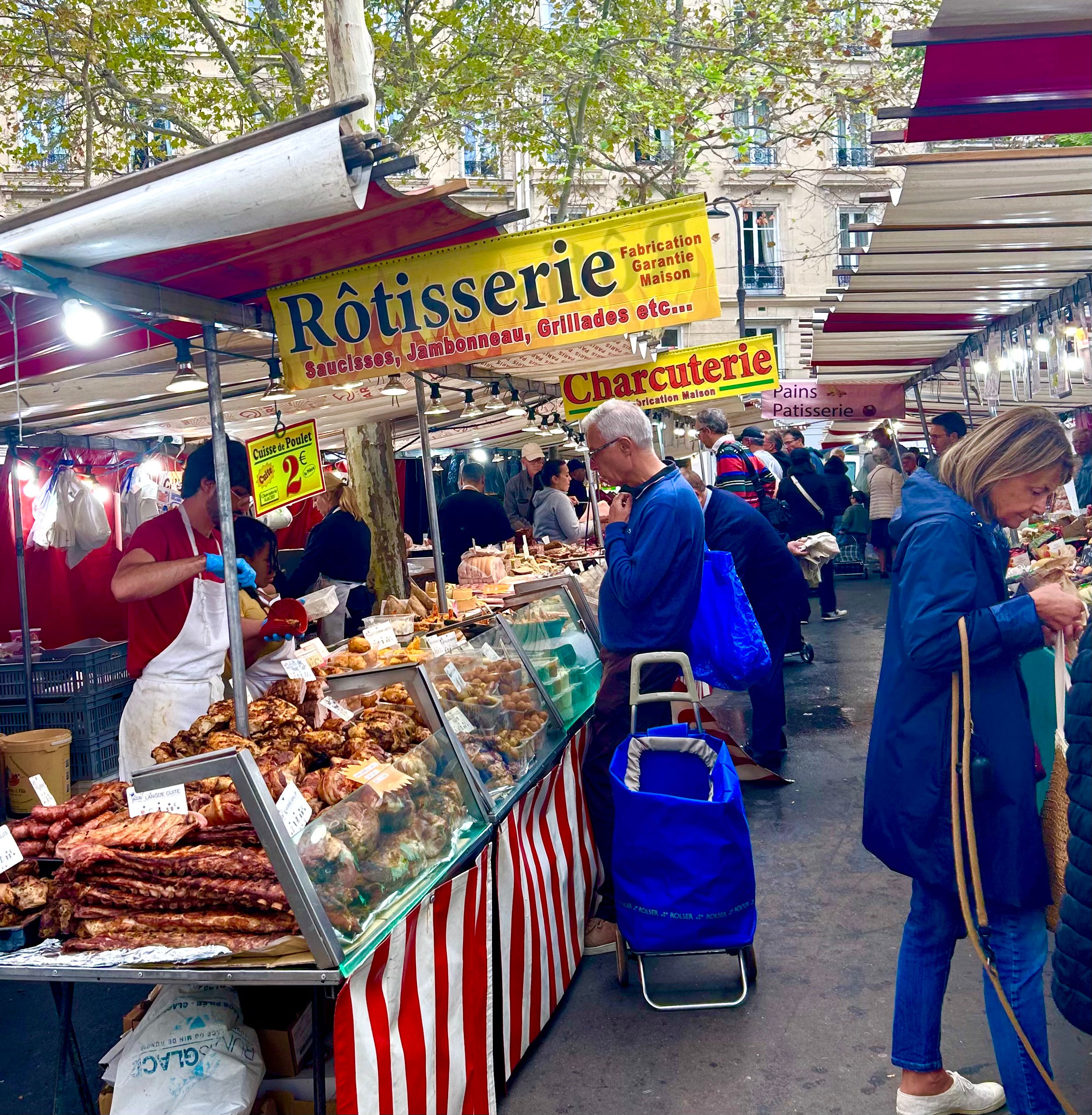
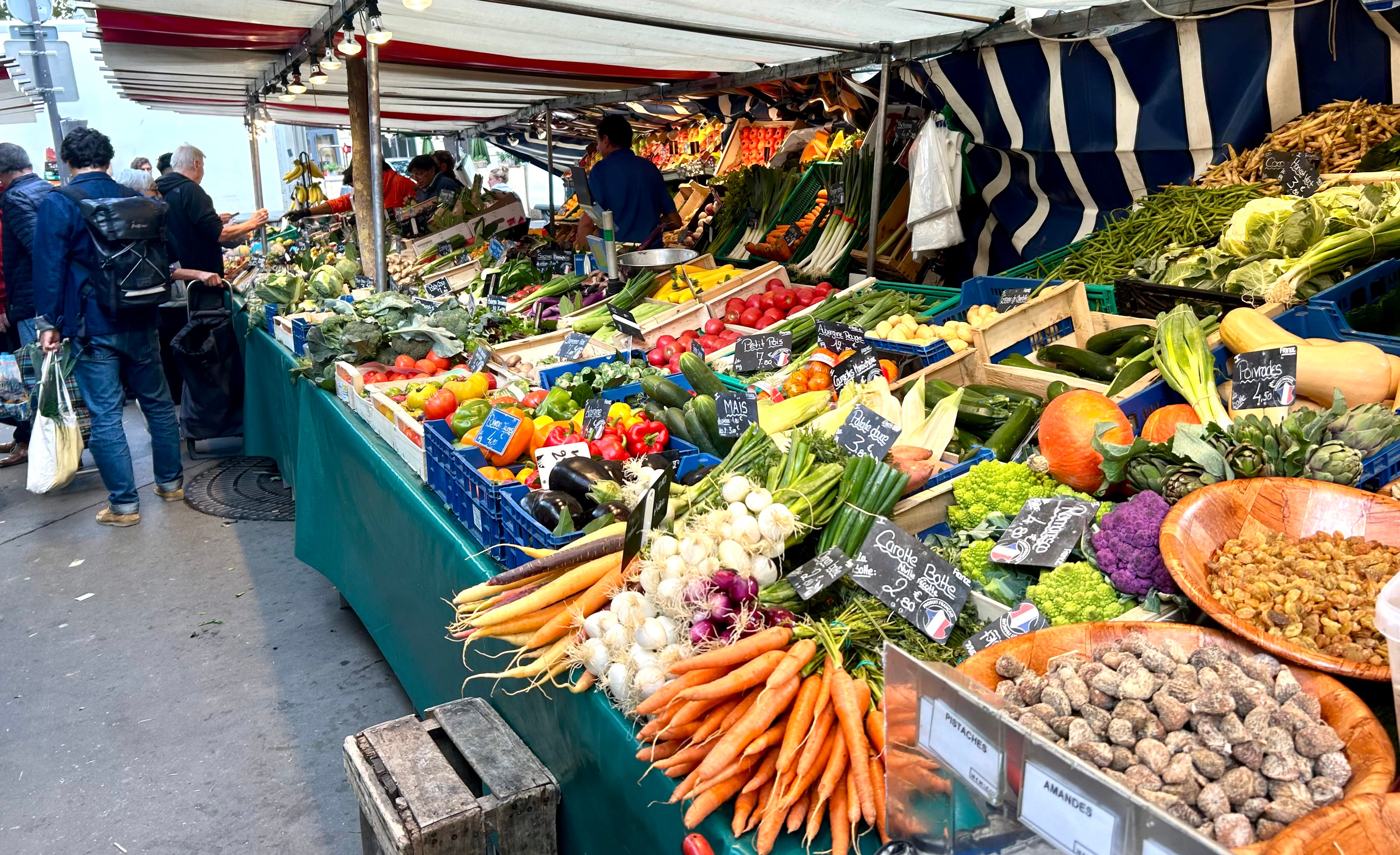
What a gift it is to live half a block from an open marché/market. I wake up on a Wednesday morning knowing that I can have fresh fish for dinner, poulet rôti for lunch – all accomopanied by fresh vegetables, and fresh flowers next to my bed. I’ve lived in Paris for 12 years and I’ve never had a marché this close, close enough that it has become a part of my week. I keep my rolling caddy in my kitchen and haul it out each Wednesday after I’ve had a cup of coffee and my breakfast.

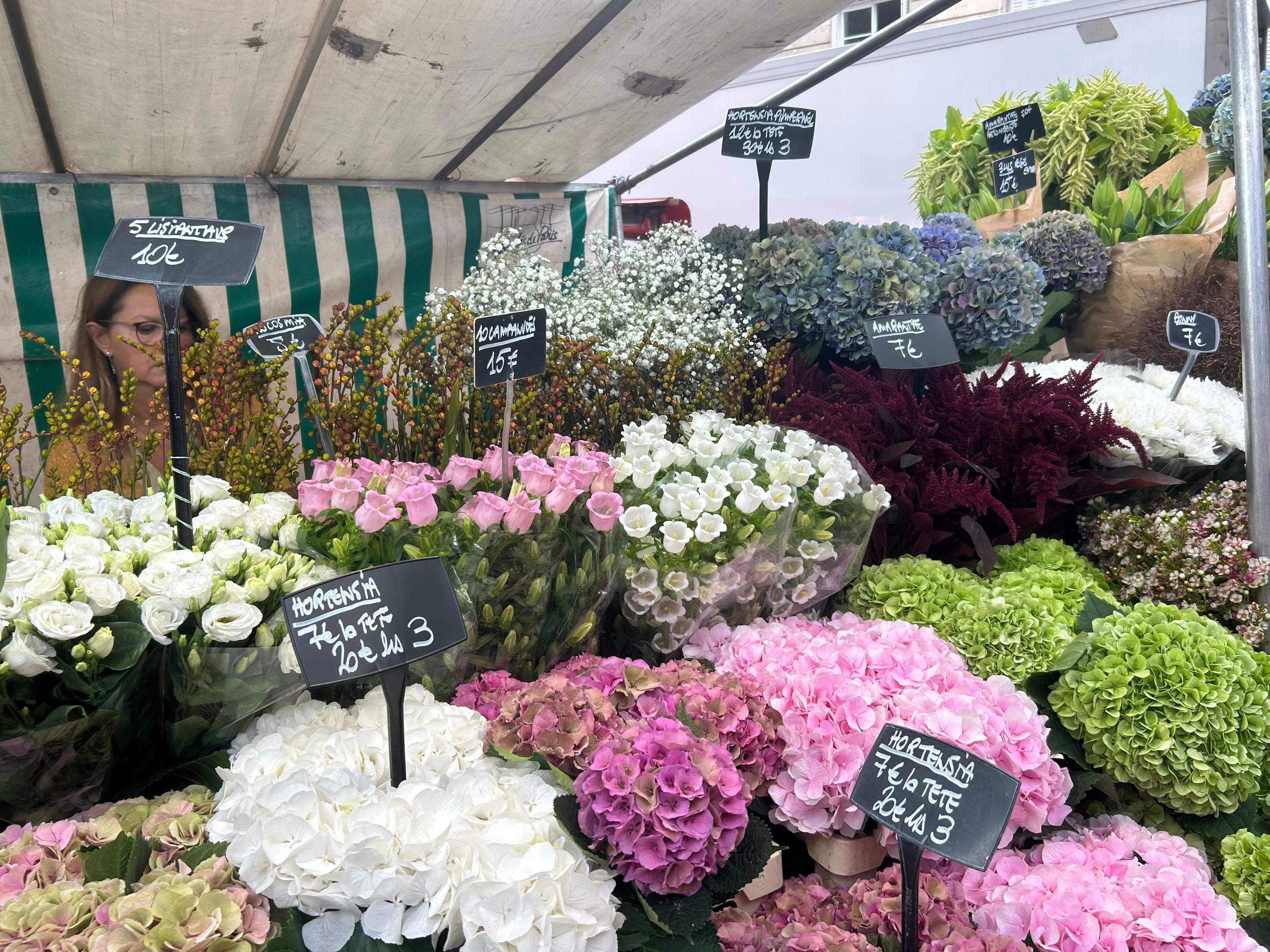
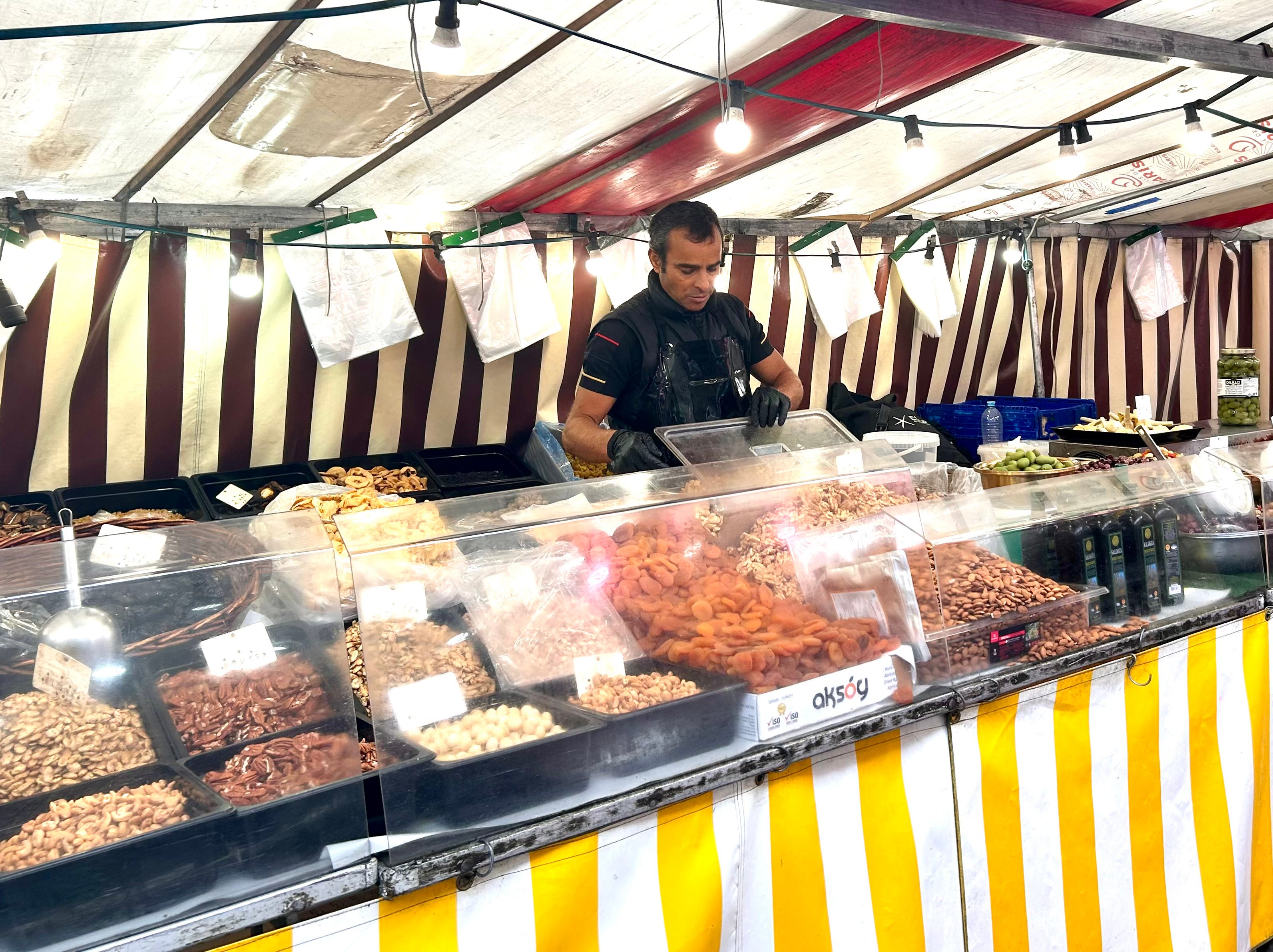
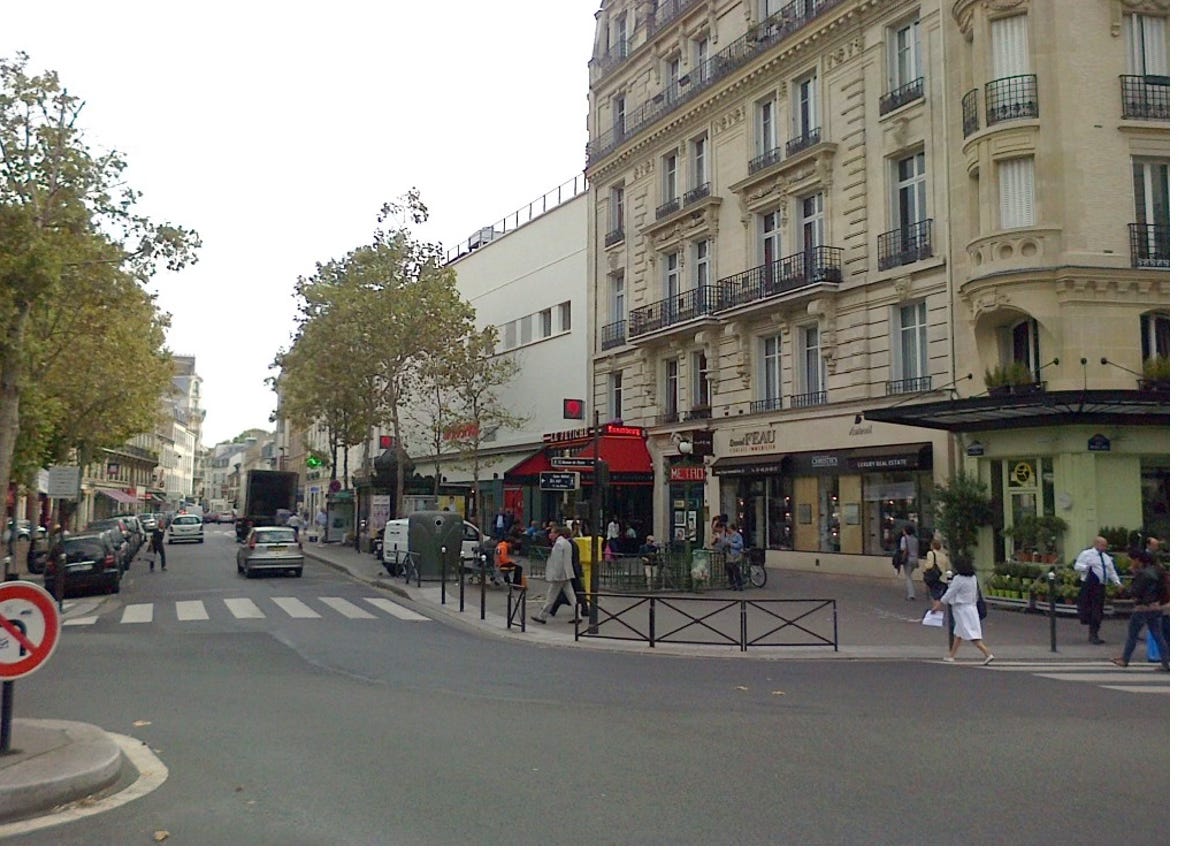
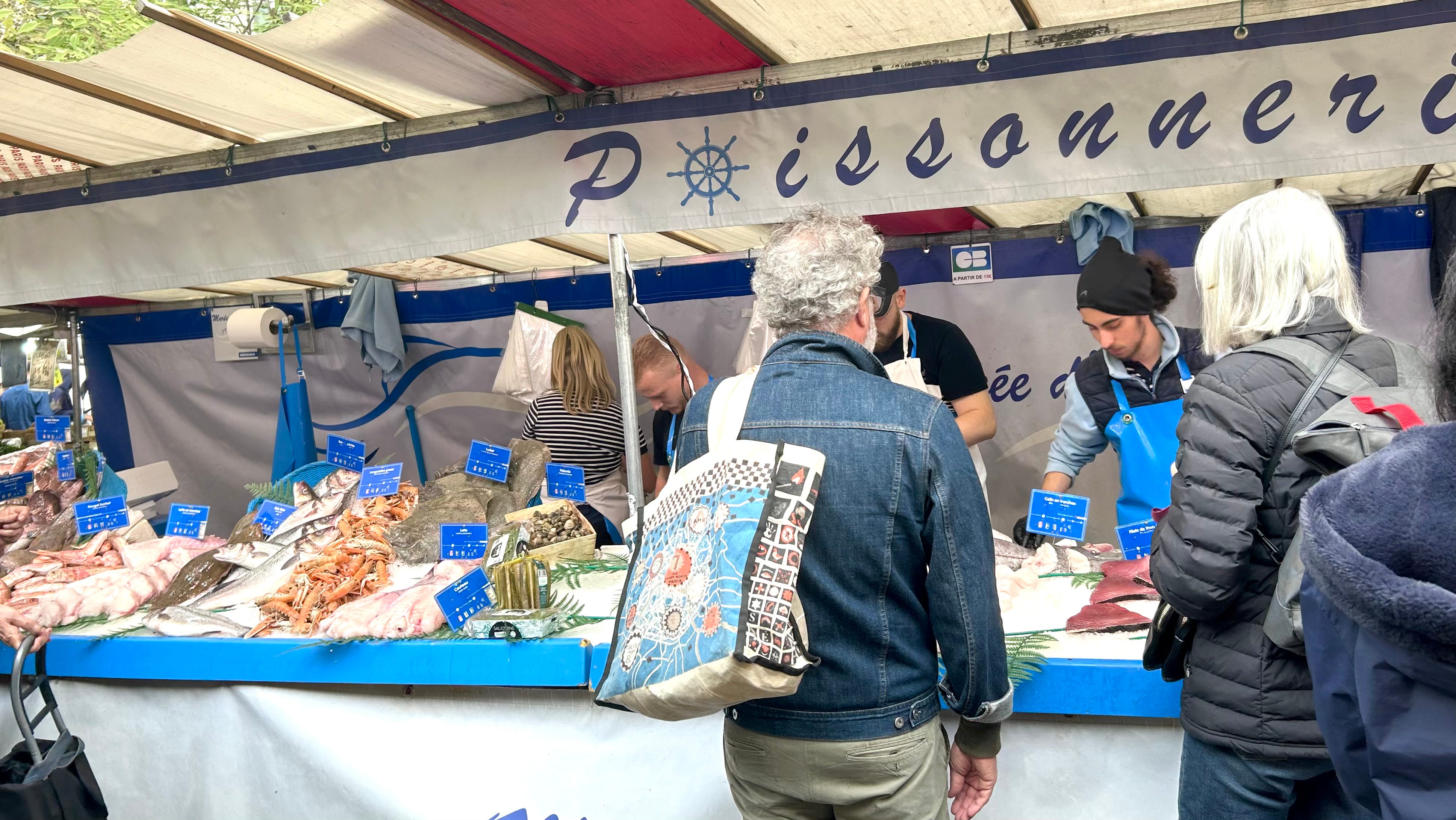
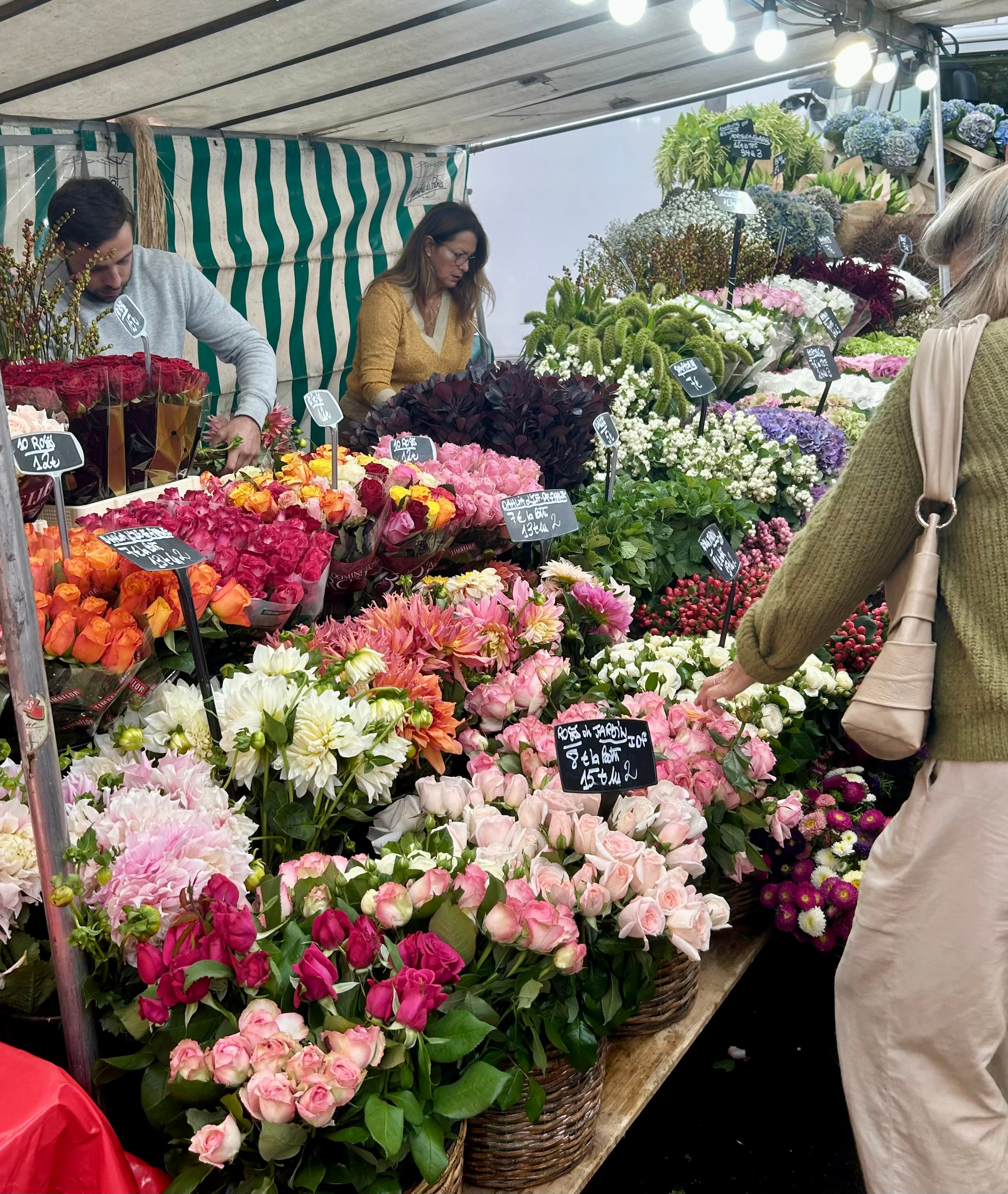
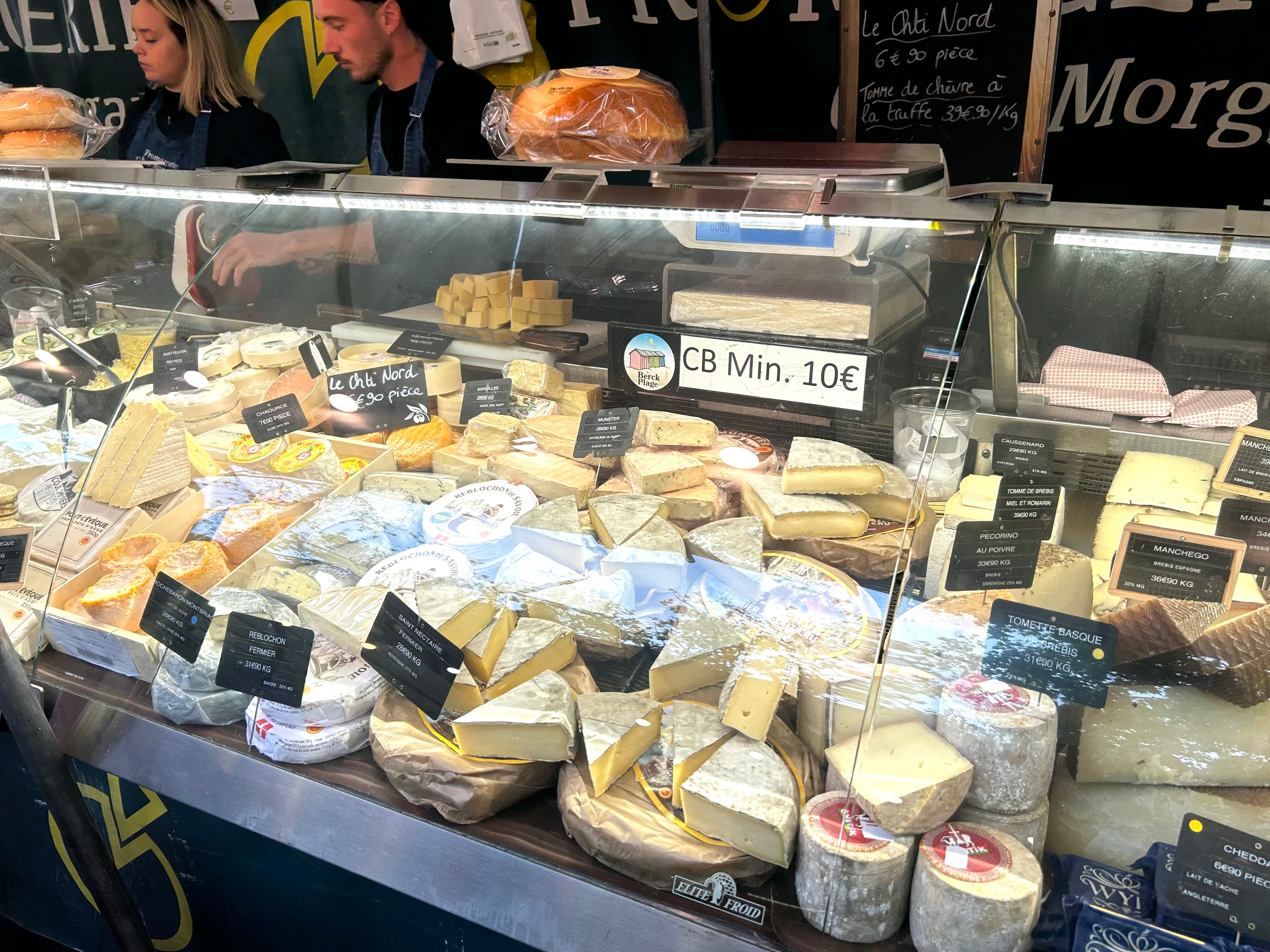
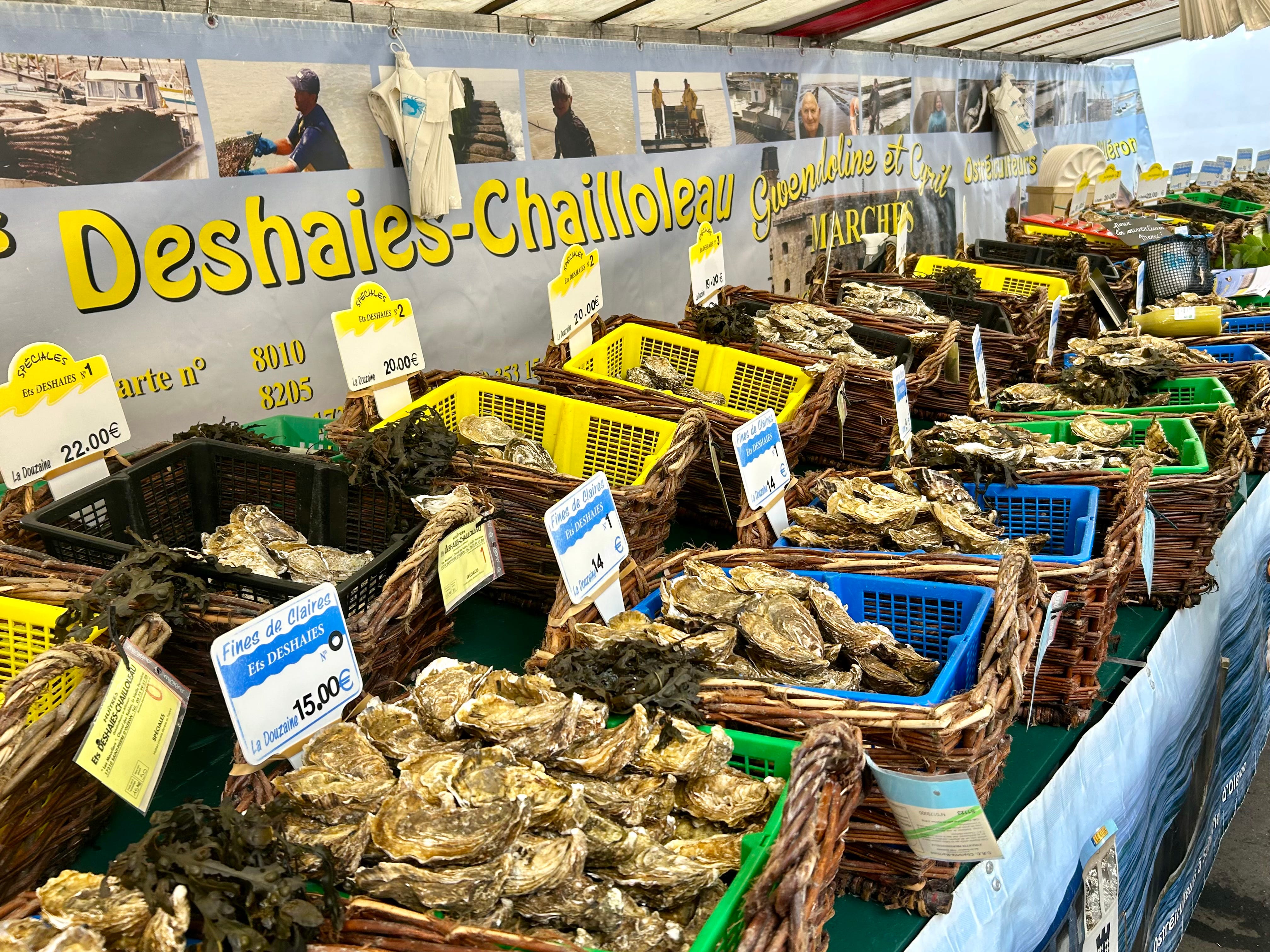
In the Bay Area where I used to live, there was a Sunday morning market that took up one block, stalls on the sidewalk on both sides of the street. Artists would also take advantage and, at last count, half the stalls were not food related. I was reminiscing about that market and how different it is from my small market down the block. In my neighborhood, the stalls push up against each other, no space in-between except the designated walkways to move from one aisle to the next. The small Place Jean Lorrain houses two fish markets, two cheese markets, two flower stalls, seven vegetable stands-one is Bio, two delis, two boucheries, a rotisserie, two specialty stands—one nuts and dried fruit, the other pre-made meals like Paella, and of course, two patisseries.

selling nuts and dried fruit

If you were to stand in Place Jean Lorrain at any other time of the week, you wouldn’t believe that that many stalls and stands can fit. They do. On Wednesdays, it is a manageable errand for an exPat like me who likes space, is slightly claustrophobic, and wants to get in and out. On Saturday mornings, when all the people who work explode on the scene, there are long lines for the favorite stalls. The French are used to it. They even bring dogs. Old folk use canes. Somehow there are no accidents, no screaming matches or bad humor (if there is, the person keeps it to themselves). 

Holes have been drilled into the cement ground. The night before each marché, workers from the 16th arrondissement come and put up the poles that will house the stalls. Sometime in the early wee hours, cloth overhangings are installed. The marché will go on no matter the weather.

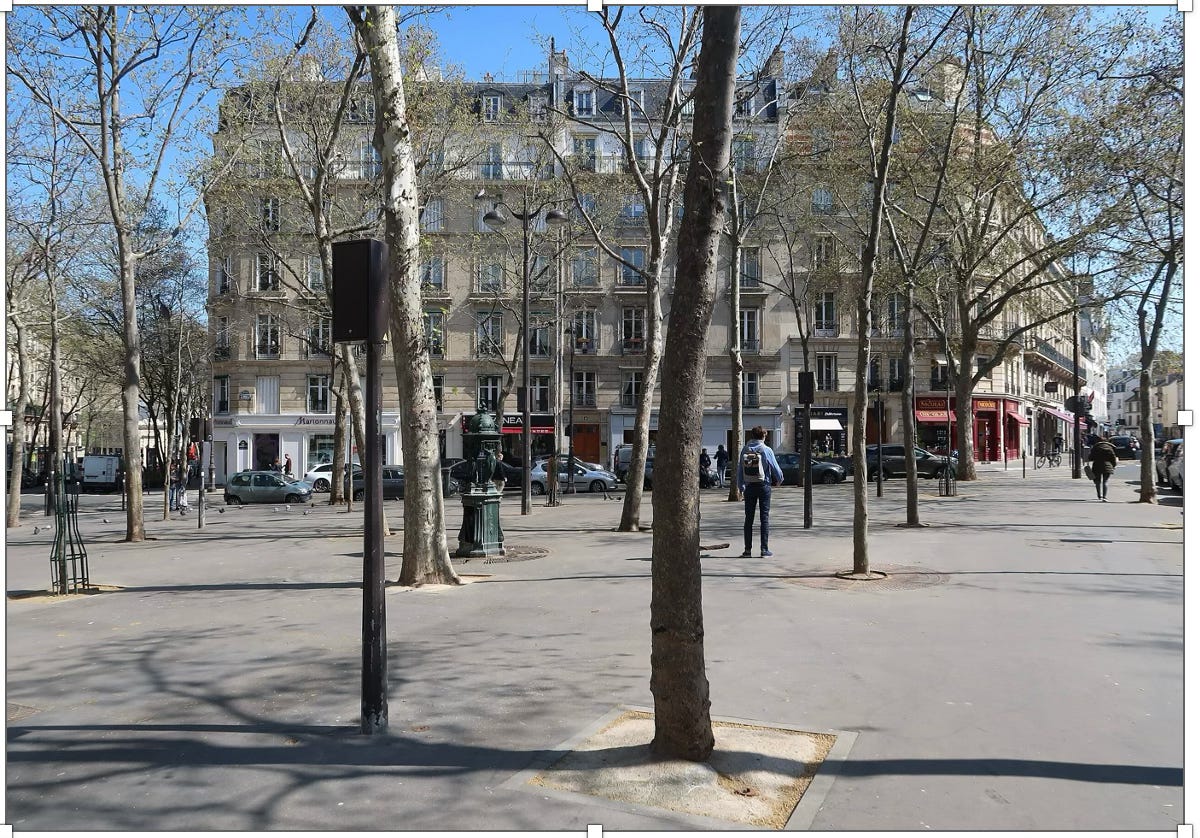
Place Jean Lorrain on a non-market day.

I tried to find some history and there isn’t much. The square itself is named for Jean Lorrain (1855-1906) who lived nearby. Before 1930, It was known as Place de la Fontaine, whose water was prized by King Louis XV when he resided in his nearby Château du Coq. In the middle of the square, you can see a Wallace fountain which works.

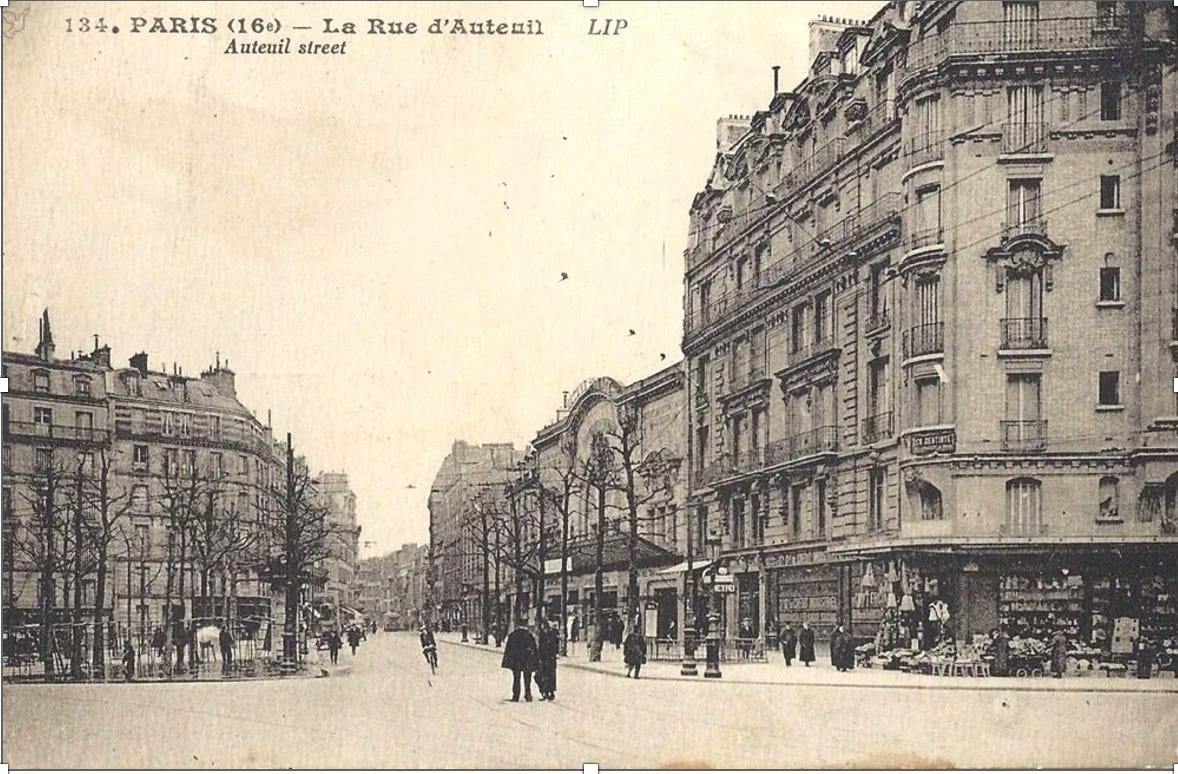
1920; Rue Auteuil. Note the theatre or cinema on the right.
Today, there is a large Monoprix where the theatre once was.

I’ve established a pattern in the fourteen months I have lived in this quartier. I rarely go on Saturday mornings. By 9:30am, it is too crowded for me. Wednesday morning is my time. I can go at 8:30am or 11:30 and I rarely have to stand in line.

My first stop is the rôtisserie where I buy my cuisse de poulet rôti. My ‘friend’ with longish blond hair, usually held back in a pony tail, greets me with a big smile. “Ça va?” she will ask me. “I’m great,” I respond and ask her how she is. On Saturdays she has four helpers. Today she mans the stall with one. The chicken is roasted, as only the French can do, in a large upright roaster that is brought in in the morning and taken away at 2pm.

She makes fresh ratatouille and on days when I want to treat myself, I will buy some. I have to eat it that day or the next or it goes bad. I found that out the hard way!

From there, I walk to one of the fish markets. There is always a line so the earlier the better. Each type of fish has a small sign with the price and where it comes from. Seasonality is important so a fish out of season will either not be available or priced very high. The poissonnier will clean, cut, do whatever is asked, even give you tips on the best way to cook. I’m slowly working my way through the fish that look interesting. My repertoire at the moment is salmon, monkfish and cabillaud. 

I fill up my caddy with all the fruit and vegetables I need then meander to the flower mart. I purchase fresh flowers every week. The stall is run by a family. The son is there every Wednesday along with a woman who may or may not be his wife. Last Wednesday, for some reason, I pulled out my phone and showed her a photo of Bijou. She immediately picked her phone up and showed me her two adorable cats.

The dahlias were magnificent. Three weeks of them…

When catnip is available, I buy some for Bijou. Last week, I bought pansies to plant on my terrace to have some color during the long Paris winter.

one of the many vegetable stands
One of the two cheese stalls. This one also sells eggs, yogurt, fresh milk
A stall just for oysters—from all over France

Well, it’s Wednesday so I’m grabbing my caddy and heading out. 

A reminder to all you subscribers. I am moving everything over to Substack by the end of the year. If you haven’t already, go to: sarasomers.substack.com and subscribe there to continue receiving my bi-monthly missives.

Thanks for reading Out My Window! Subscribe for free at sarasomers.substack.com to receive new posts and support my work.

A bientôt

Sara

To the women who write with skin unzipped

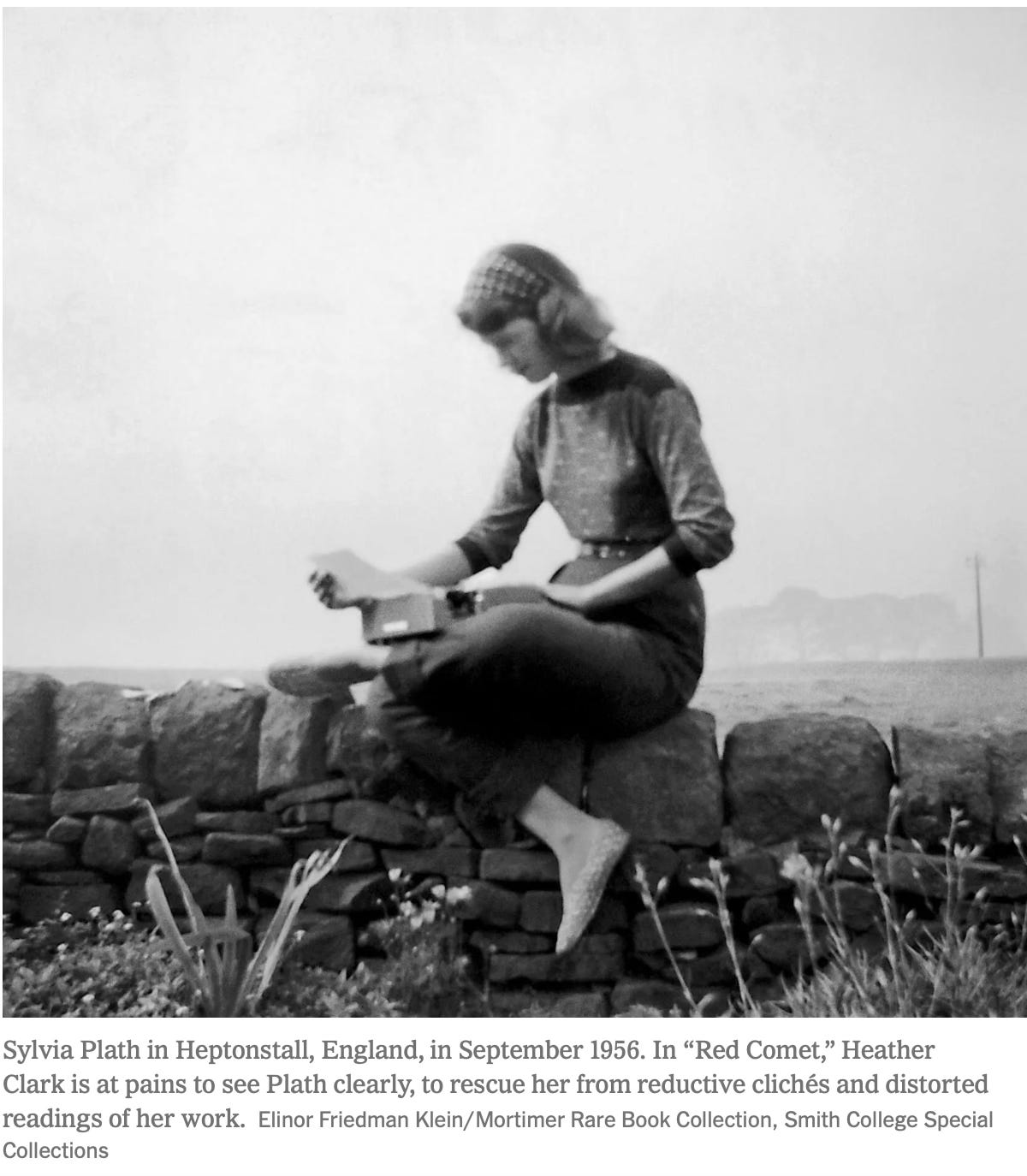
How could I, someone who loves to read, loves poetry, reach the age of seventy-seven and know so little about the life of Sylvia Plath? I knew “The Story”. That she struggled with suicide, moved to the UK and married Ted Hughes. She suceeded in killing herself when she was thirty. The underlying, always hinted at, current was that she was crazy and brilliant. 

When I picked up the Red Comet: The Short Life and Blazing Art of Sylvia Plath by Heather Clark, I’m fairly certain I hadn’t read a single one of her poems. Would I have picked it up (I listened to the audio) if I’d known it was just over 1100 pages? I’ll never know. A friend, a poet, had mentioned her love and admiration for Plath’s poetry in mid-June. I was about to leave on my self-imposed Writing Residency in Saint Jean de Luz (southwest France) and looking for something to accompany me on my train ride, I found Red Comet on Libby and started listening. In reviews that I read while I was listening to the book, it was unanimous that Ms. Clark was presenting the most objective, thorough, story of Plath’s life. Not the dramatic circumstances of her death. In the years since her death, “she has become a protean figure, an emblem of different things to different people, depending upon their viewpoint — a visionary, a victim, a martyr, a feminist icon, a schizophrenic, a virago, a prisoner of gender — or, perhaps, a genius, as both Plath and Hughes maintained during her lifetime.” —Daphne Merkin, New York Times.

Her life, her love of her father, the relationship with her mother who possibly projected all her desires and ambitions onto Plath, her teen years, her internship at Seventeen, and college years at Smith were a revelation to me. 

I loved every minute of listening to this audiobook. I found reasons to take long walks just so I could listen to more. The Sylvia Plath of this book was a determined, focused student then young woman who excelled at almost everything she did. She suffered depressive episodes as I did, as so many teens do, yet she remained true to her north star. I was stunned at her singlemindedness of purpose, write and get published. I paused at one point and listened to The Bell Jar.  If you ask me why I had never read that book, I couldn’t tell you. But I had avoided it. I found the writing to be lovely, simple, easy to enter into the story and root for the protagonist, Esther. I wanted to know how much was based on her real life. Red Comet told me.

Sitting at my computer in 2025, having lived through the Feminist revolution, the #metoo uprising, all the years where, because of leaders like Gloria Steinham and Betty Friedan, women have come a long way since the 1950s when Plath was writing and advocating for herself, it’s stunning to me how she was able to stand up for herself in the only way she knew how. Her sense of competition was so strong, it drove her forward, but also may have led to her death. She had few female inspirations to look up to. 

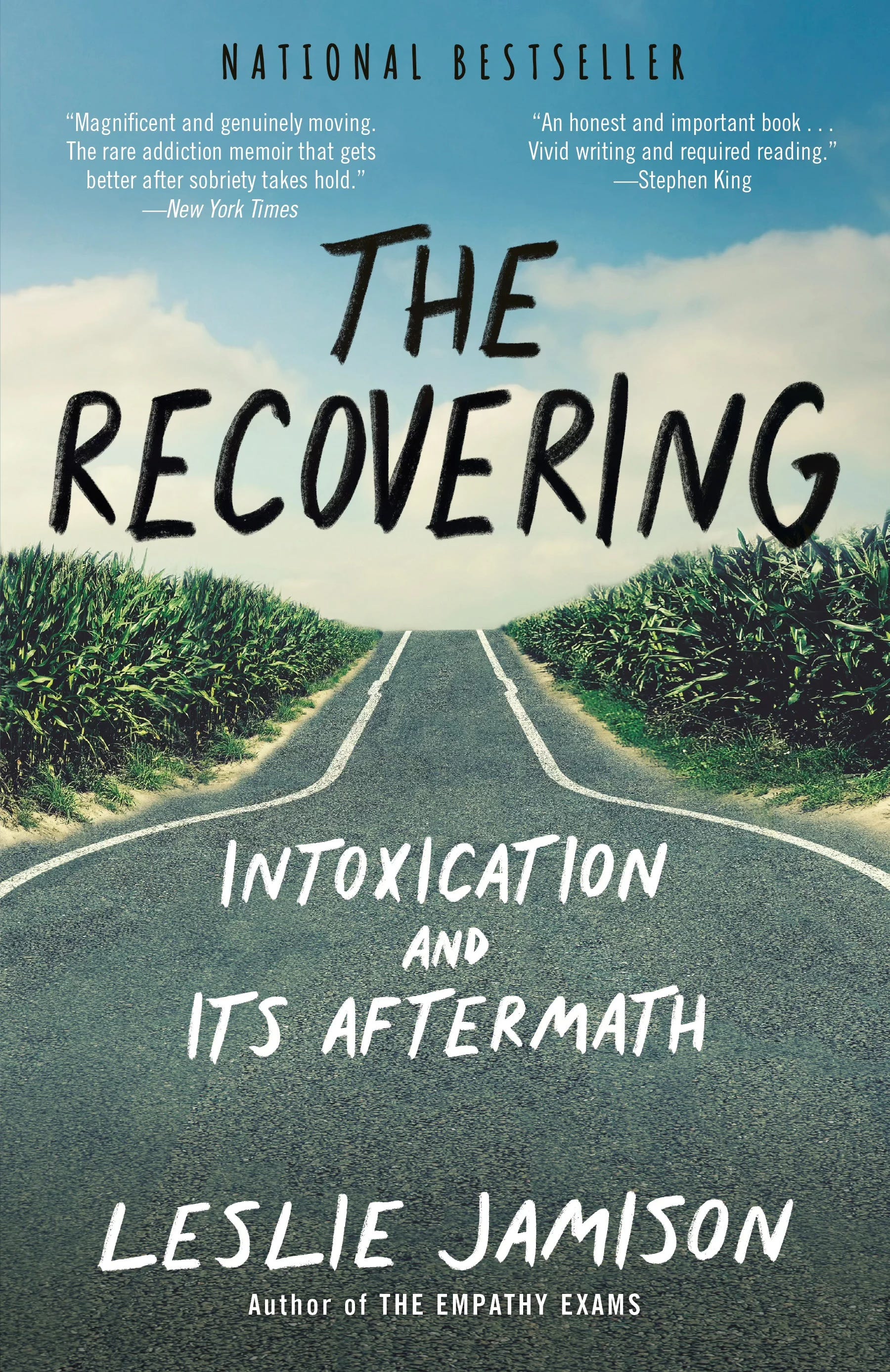
I hadn’t planned to make it a summer of reading feminist powerhouses. For various reasons: wanting to read more essays written by women in order to emulate them; meeting Melissa Febos at the American Library in Paris and getting some positive and encouraging feedback from her, I also read Leslie Jamison’s The Recovering: Intoxication and Its Aftermath (I read Splintering last summer) and Febos’ Girlhood and Abandon Me.  Like Plath, both these women take huge risks in their writing, exposing their vulnerabilities, writing from a deeply personal place. Jamison writes about tremendous pain. Febos writes about sex and loving women and her awful childhood of being teased and ridiculed because of her large breasts. Girlhood“dissembles many of the myths women are told throughout their lives: that we ourselves are not masters of our own domains, that we exist for the pleasure of others, and so our own pleasure is secondary and negligible.”—Melissa Hart, OprahDaily.com. Jamison writes about her alcoholism, her lousy choice of lovers and in Splintering, the demise of her marriage.

All three women became professors. Plath at her alma mater, Smith College; Febos currently works as a Full Professor at the University of Iowa, where she teaches in the Nonfiction Writing Program; and Jamison at the Columbia University MFA program, where she directs the nonfiction concentration. In other words, all three women, writing as they do, leave themselves very exposed, unzipped in the world. 

As a writer myself, I love knowing these women in depth. Febos and Jamison are alive, young, and headed towards higher accolades than they have already earned. I admire their style of writing. I am in awe of their willingess to expose such vulnerabilities. Jamison is in a twelve step program which encourages self-examination and, therefore, deep shovelling below the surface to face and admit why we do what we do and the consequences. Febos’s work asks us to question every single ‘myth’ we were raised with, every story we were told about who we are and should be, who holds the power in our world and do we, inadvertently, support that world while secretly wanting to have our own personal power. 

In the August 4th issue of the New Yorker, Jamison writes about the Pain of Perfectionism. I was struck by so much information, the kind where you smack yourself on the forehead and say “yes, that’s exactly it!”, that I was scrambling to locate on old therapist of mine from California to talk about my personal revelations. 

“To Flett and Hewitt (two psychologists she interviewed at length for the New Yorker article), the idea of perfectionism as a form of admirable striving is a dangerous misconception, one they have devoted three books and hundreds of peer-reviewed papers to overturning. “I can’t stand it when people talk about perfectionism as something positive,” Flett told me, as we sat at his kitchen table in Mississauga, a Toronto suburb where he has spent most of his life. “They don’t realize the deep human toll.” Hewitt, a clinical psychologist, has seen with his therapy patients how perfectionism can be “personally terrorizing for people, a debilitating state.” It’s driven not by aspiration but by fear, and by the conviction that perfection is the only “way of being secure and safe in the world.”—Leslie Jamison, The New Yorker August 4, 2025

Read the article.

This summer was an interesting digression for me, someone who loves to escape into mysteries and thrillers. I was revising three chapters of my forthcoming book to submit to a Writing Retreat. I was deep in an attempt to express myself without self-pity, with honesty, with self-reflection, and a desire to show my growth from one period of my life to another. I found inspiration from all three (four if you count Heather Clark, a remarkable writer and researcher) women. They guided me in going deeper, get to the real truth, the truth under what I thought was the truth, the truth that makes me squirm.

To all four of you, I say Thank You.

Thanks for reading Out My Window! Subscribe for free to receive new posts and support my work.

Please remember to go to sarasomers.substack.com and subscribe to Out My Window. I will be shutting down this WordPress blog by the end of the year.

A bientôt,

Sara

Happy Birthday, Sara

Last week, I celebrated a birthday—one that the number suggests officially makes me an old woman—seventy-eight years. What I feel on the inside doesn’t reflect what I’ve thought in the past the age of seventy-eight years means. ‘What does 78 look like?,’ I asked myself Thursday morning, August 28. ‘Look in the mirror,’ an inner voice responded. Maybe. But I’m always hoping that the response I’ll get when someone askes me how old I am, will be ‘OMG! you look so much younger.’ My response to that has always been “Well, I got my mother’s good genes. She also never looked her age as she got older.”

But, according to Eric Topol of the Washington Post (May 21, 2025) who spent six years sequencing the genomes of 1400 people 80 years of age and older, they shared very few, if any, genetic similarities.

The article goes on to share what ‘Super Agers’ do to maintain good health. That is not what spoke to me.

I have credited my good health and the fact that I don’t look my age to my mother. That through some amazing luck of the draw and, despite drug and alcohol abuse in the first half of my life; extremely poor eating habits which I have labeled food addiction andpoor self-esteem, that I might be responsible for where I am today. I am the one who, through those years, kept trying to exercise, eat right, and continue taking courses/learn new things. I didn’t know I had addiction issues. I thought I was weak. I look back and am amazed that I continued to fight a losing battle with all the suggestions Topol puts forward that lead to ‘Super Aging.’

When my perseverance landed me on the doorstep of 12 Step programs for alcohol and food, I fought the solutions with the same uninformed gusto that I’d fought the problems. Till I had no strength to fight anymore. I waved the proverbial white flag. In putting down, letting go, perhaps acceptance is the better word, of my addictive life style, I gave myself a better than fighting chance to stick to all the suggestions for a healthy lifestyle. 

It even turns out that my aptitude towards doing nothing, taking naps, reading on the couch, taking days where I don’t get out of my PJs and putter in my apartment, is now considered healthy.

It’s true that I’ve had surgeries: right hip replacement (2017); cataract surgeries (2024); carpal tunnel surgeries on both wrists (2024, 2025); and probably another hip replacement this coming winter. As I tell my friends, I’m like the Velveteen Rabbit—coming apart at the seams and need to be sewn back up—but my internal organs are in fine shape.

It has taken me eight years to celebrate my 70s. I couldn’t do it when I was 70. I was too undone by the number. I celebrated turning 70 on my 71st birthday. I had a picnic on my 74th or 75th. I got distracted by who didn’t come than on the fact I had lived longer than 1/4 of my High School graduating class.

Photo: Unsplash.com

This year, I felt the need to celebrate. Yes, my age, but also that I have successfully integrated and become a valued member of the exPat community here in Paris where I moved twelve years ago at the age of sixty-six; that I have the apartment of my dreams; that I am a published author; that I’m healthy and doing my best to learn how to age wisely.

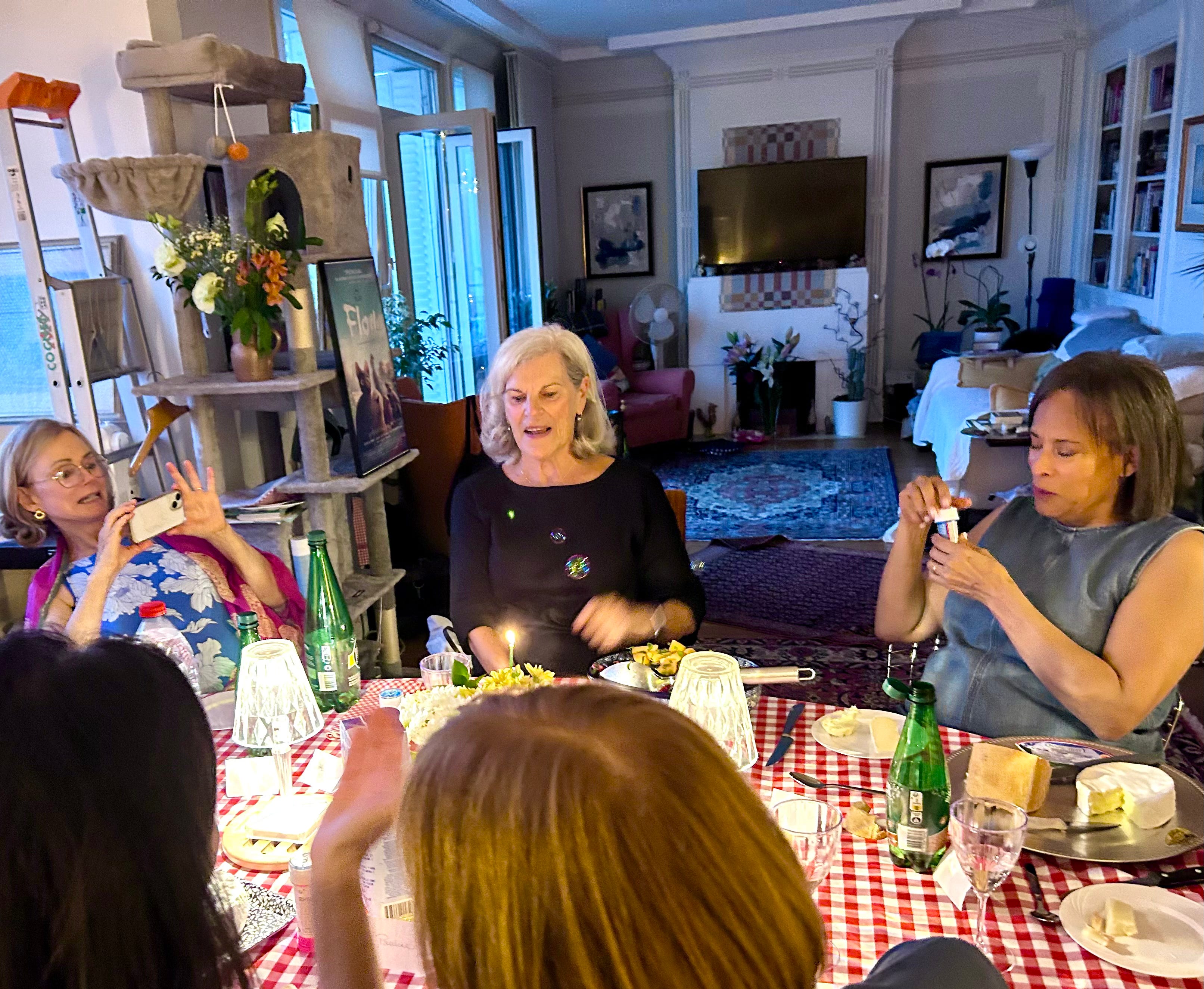
I invited a number of women who are special to me to come to a sit down dinner. One of those friends said, “if you really want to enjoy your party, have it catered. Let someone else do the work.” Me? Pay someone else to make my life easier when I could do it myself? I made the wise decision to not listen to my inner voices that have too often proved untrustworthy and followed her advice. I chose the menu (salmon and roasted vegetables). I decorated my table with red and white checked napkins and tablecloth. I picked the time to eat: 7:30pm. Then I sat back and bathed in the connections, the laughter, the camaraderie and, of course, some Sara roasting. One friend brought little bottles of bubble solution and before the fruit and cheese dessert, we all stood on my small terrace and blew bubbles into the darkening Paris sky.

Then, when we were all seated again, out came a piece of melon with a porcelain birthday cake and lit candle. I blew out my candle and felt well fêted.

Ever on the academic calendar, I’m now welcoming in a new year. Here in Paris, it’s La Rentrée when everyone returns from wherever they’ve been during the summer. Children started school this week, the Senior Sports program starts up on the 15th. I’m signed up for Pilates and Tai Chi. My six month sabbatical from this Substack is over.

Wecome to a new year of Out My Window. Nine years ago, I started this as a blog, as a letter to all my distant friends. I migrated over to Substack three and a half years ago. I will be terminating my Word Press connection by the end of 2025.

If you are reading this on WordPress, I encourage you to go to Substack and subscribe to Out My Window. sarasomers.substack.com. It’s free and it’s easy. I hope to bring all of you over by the end of the year. If you no longer want to received Out My Window, unsubscribe now. And thank you for reading my thoughts all these many years.

Thank you everyone for joining me and reading my words for nine years or, perhaps, one month. Please take the time to “like” below so that I know I’m reaching you and comment with anything that my writing has inspired. I read everything and so appreciate the time you give to me.

Thanks for reading Out My Window! Please go to sarasomers.substack to subscribe for free and receive new posts and support my work.

A bientôt,

Sara
Joy and Serendipity

I am interrupting my six month WordPress sabbatical to write about 1-being back in heavenly Saint Jean de Luz and 2—an amazing experience (amazing to me) I had last Saturday.

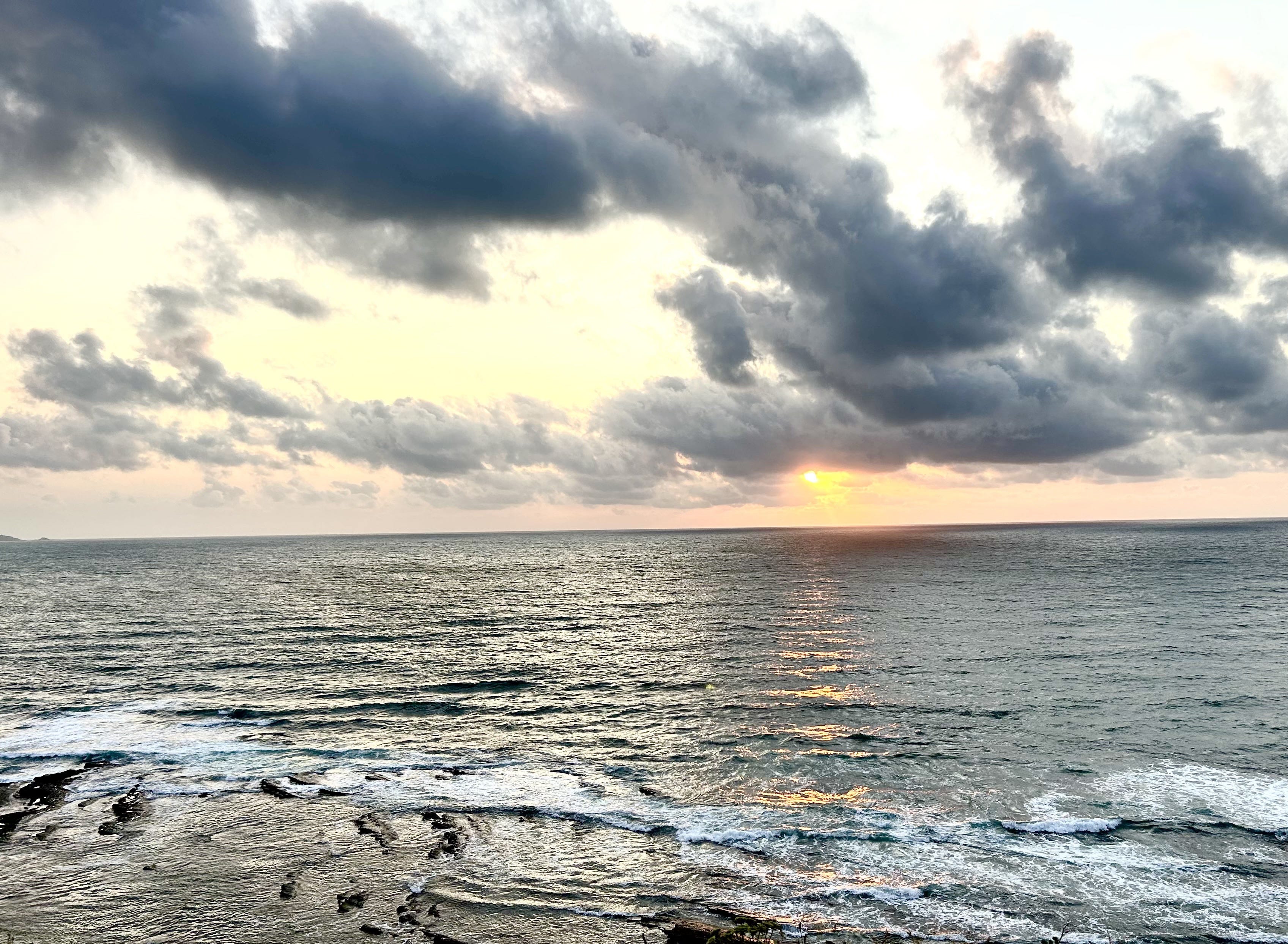
Sun setting over white caps after a very windy afternoon in Saint Jean de Luz

After being introduced to Saint Jean de Luz a number of summers ago, I have come down for two to four weeks each summer. This summer, I planned a self-imposed writing residency for myself to prepare submissions for a September writing retreat. Two or three months ago, my friend Jane from the Bay Area called to let me know she was hiking in the west of Ireland and would I like to meet up in Dublin at the end of her trip. Yes, I would love to but I had this trip to SJdeL planned, bought train tickets, paid for my rental. What did she think of coming to SJdeL? She had been here on my recommendation with her husband last summer and loved it. Needing a couple of days to figure it out, she made it happen. RyanAir from Dublin to Biarritz, taxi to SJdeL, stay 4 nights and then make the reverse trip in order to fly back to SFO. BUT….she needed to come on the 22nd and I had tickets for the 24th. I changed my train reservation and we have just spent four wonderful, heavenly days here in SJdeL. 

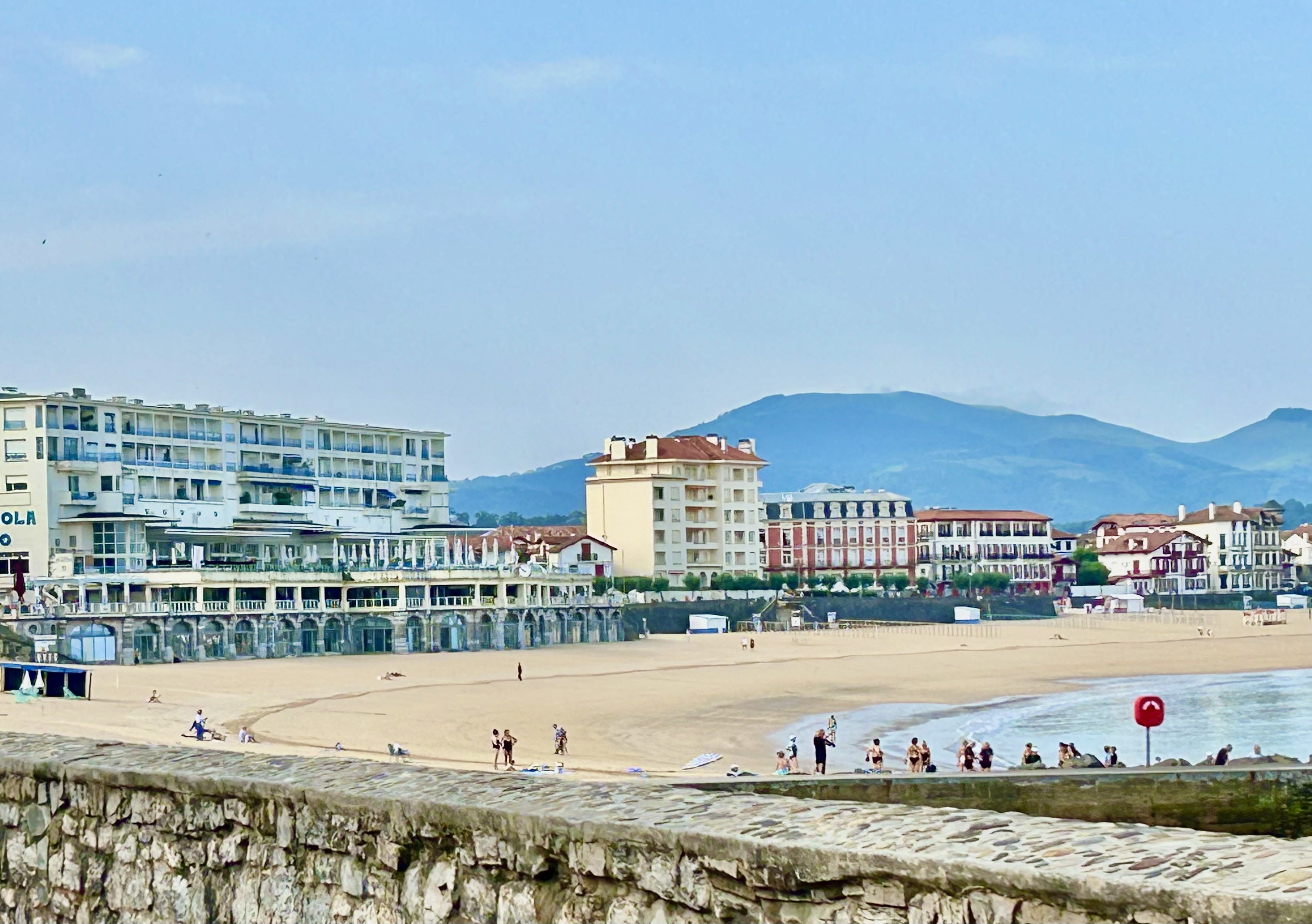
Looking at La Grande Plage from the Quai leading up to Saint Barbe

For me, it turned out to be a vacation before the writing started. I’ve been battling one thing after another health wise, none serious but all very annoying: vertigo, another carpal tunnel surgery that wanted to take its sweet time healing, etc. I slept in every morning, ate a leisurely breakfast, and then we walked the boardwalk to the marina, bought food at the marché, and shopped! I would leave Jane at the beach on our way back, and she swam while I came back to do I don’t know what. Jane stayed at a wonderful hotel at the top of the cliffs called La Réserve. A terrace extended off her bedroom and offered a view of the Atlantic Ocean that mesmerised. We’d make our dinner each evening and talk our way late into the night. Then walk to Saint Barbe and down the hill headed to my apartment. She’d leave me at the turn-off away from the beach. 

Sunset June 25, 2025

Jane and I have known each other for fifty years. We’ve gotten to be better friends as we’ve grown older and now, no matter the last time we were together, we fall into talking as if we’d been together a week ago. It’s very precious – the friendship with her and also with her husband. They have taught me a lot about thoughtfulness, open heartedness, curiosity about others just by living their lives, being examples of a life well lived.

Sharing SJdeL, one of my favorite places in the world, with Jane over these past four days has been so delightful—in the full sense of the word: full of delights. One evening as she walked back to La Réserve, she witnessed a lightning storm and took a video:

I had heard the thunder and went out on my little balcony to watch the sky explode with light. I don’t remember ever seeing such a sight. The next day after a lovely sunny morning, the wind picked up. Wind surfers gathered on the beach at the edge of the water raring to go. I was headed up to La Réserve and took this video of the sails flying by. If you turn the sound on, you can hear how loud the wind was roaring.

I’m now putting off feeling the sadness of her departure by writing about the last four days. 

*** ***

Last Saturday, my last day in Paris before leaving on this trip, I attended a poetry literature gathering. Our prof, Heather, had put together a number of poems for us to read and talk about. The first was Robert Frost The Road Less Traveled. Chatterbox that I am, I announced that Robert Frost had been the commencement speaker at my school, Baldwin School for Girls, when I was in 7th grade. The woman seated to my left, jumped and asked “What school did you say?” 

Baldwin School for Girls” I responded. 

“I graduated 1965,” she said. 

I told her that if I had stayed I also would have graduated 1965. “Did you know KV?” I asked. 

“Yes, she is a good friend of mine.”

By this time, it felt a bit Twilight Zone. In an apartment in the 15th arrondissement in Paris, France, what are the chances of sitting next to someone I probably knew but not well sixty-six years ago. When the salon had ended, we ran more names by each other. She knew them all. By the time I went to bed, that night, she had written emails to a number of them cc’ing me telling them what happened.

I had been writing a story that included skating in the afternoon when I attended Baldwin. I had been thinking of KV as she had looked then. A dreamy memory, more black and white than color. Monday morning, she wrote saying that she well remembered me. And my sister. And our thick hair—mine brunette, P’s red. 

There is something wonderful about accidents like these happening. I have unpleasant memories of being twelve, thirteen, and fourteen, actually most of my teens were not great. Here come witnesses to tell me if my memory is distorted or maybe just maybe, those times were not quite what I thought them to be. KV said she “always had fun when we got together.” I don’t think of myself as a fun person back then. It’s possible I still have some things to learn.

*** ***

My intention was to not write here until the end of the Writing Retreat in September. Time just didn’t allow for everything I wanted to do. Unless something jumps up and hits me in the face, I will stick to that resolution.

Thank you for reading and being there. Your support of my writing means the world to me.

Thanks for reading Out My Window! Subscribe for free to receive new posts and support my work.

A bientôt,

Sara
I am a daffodil

Reader: (this is my Jane Eyre moment)

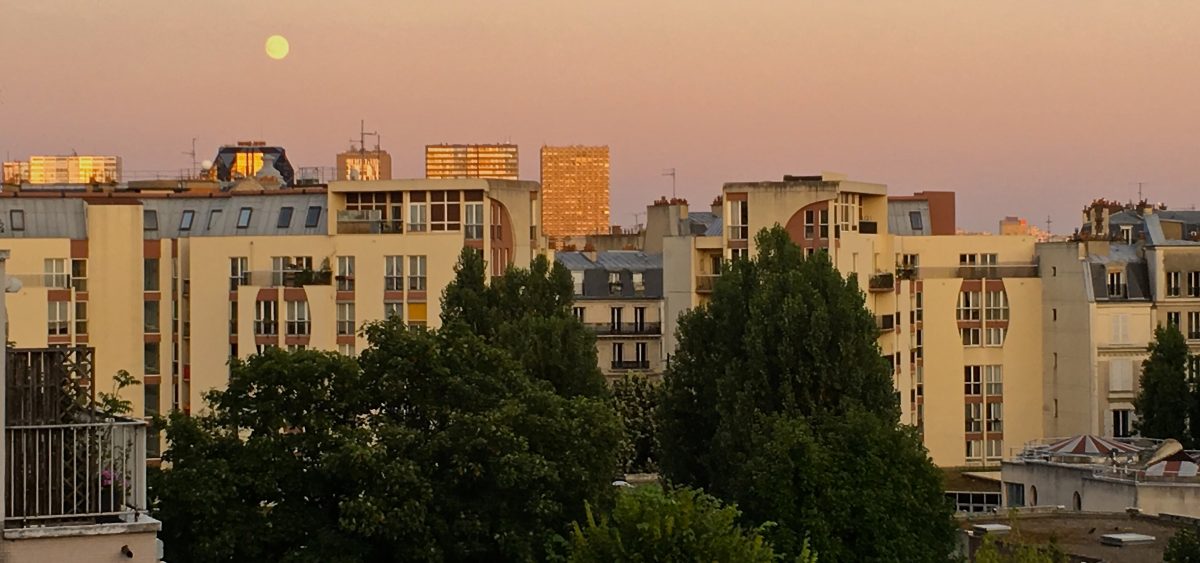
Over the past three weeks, I have had so much to write about but every morning, I read the headlines out of the US and, much like many others on Substack, it takes me most of the day to shake off the feeling of dread. Unless I’m writing fiction, writing brings me closer to whatever is going on inside my head and heart. I end up staring out the window in front of my desk, gazing at the Parisian rooftops, both grateful I live in France yet very aware that what happens in the US will affect us all.

I have also learned that I have to have a second carpal tunnel surgery on March 31. This time on my right wrist. This will dampen my writing 95% and I still am rubbish at dictating to my computer.

I have a deadline. I have to submit three chapters of my next book by sometime in June which means a lot of work. I have been viscious in axing many of the things I do on a volunteer basis and hoping that what is on my calendar now is the most neccessary appointments with myself and the things that keep my heart and soul healthy and growing. Not easy in this strange time of being alive.

Between now and September, I will only be writing sporadically. I’m suspending the paid subscriptions and everything will be free. Meanwhile, here are the things I’ve been thinking about, experiencing, and responding to:

THE BRUTALIST: I saw this movie last week. I rarely go to a cinema these days for no reason that I can explain. My friend, Elsie, said “It’s vacation here in France and I’d love to go a movie. Which one?” I didn’t even know what the word Brutalist referred to and fearing that it would be violent yet knowing it was nominated for every award possible, I thought this was my chance to see it and not go alone!!! Another friend had seen it the night before, loved it, and said the almost four hours flew by. I suggested going to it. We went to a 4pm showing. 

I thought the movie was stunning. Visually, it was a treat and not to be seen on a small screen. Adrien Brody plays what he does best—a long suffering Jew. His face was made for that role. My friend was right. The time flew by. The intermission is a welcome respite for those of us who need to stand up or go to the Toilettes during a movie. And the themes of the movie, whether you like it or not, make you think. Fascism vs Capitalism. Little educated guy vs power-hungry uneducated rich guy. Brutalism itself: which is the name of the school of architecture that came out of the Bauhaus movement in Germany. Immigration in North America: how immigrants get used and thrown away. Psychological violence vs physical violence.

I left the cinema wanting to read everything I could about the movie, about the writer and director. There was a similarity to reading a one thousand page book that has a profundity on every page. I couldn’t stop thinking about it. The next day, I had lunch with three friends and recommended they see it. All three looked at me in surprise. “Everyone I know who saw it, hated it,” they said. How could that be possible? More to think about. I came to my own conclusion that we are all overloaded and overwhelmed. During WWII, musicals became the rage as did Film Noir. Escapist movies that took the viewer away from the realities of their lives.  The Brutalist pushed issues in the viewer’s face. Many of us don’t want our movies to do that right now. When I’m at home, I want to watch All Creatures Great and SmallFather Brown, reruns of Miss Marple, old classic movies. Every part of me feels so sensitive that my tolerance for violence and too much suspense is nil. Yet, I loved The Brutalist. Go figure.

CLOCKS: REMINDER to all readers around the world: On March 9th, somewhere in the dead of night or early morning, the US will move clocks forward one hour. Here in Europe, we don’t have the luxury of late days until March 30. That is three weeks of mayhem if you don’t plan ahead. What is usually six hours difference between New York and Paris becomes five hours. If I have a scheduled phone call every Monday morning at 9am ET and the call originates in Michigan, I need to call at 2pm in Paris instead of 3pm. If a friend in California calls me each week on a Tuesday at 5pm in Paris, she would call me at 9am PT instead of 8am. 

The best thing to do is use your smart phone and look up the world clock and the times. I have missed many meetings because I couldn’t, on the spur of the moment, think correctly if I was to call one hour before or one hour after the normally scheduled time.

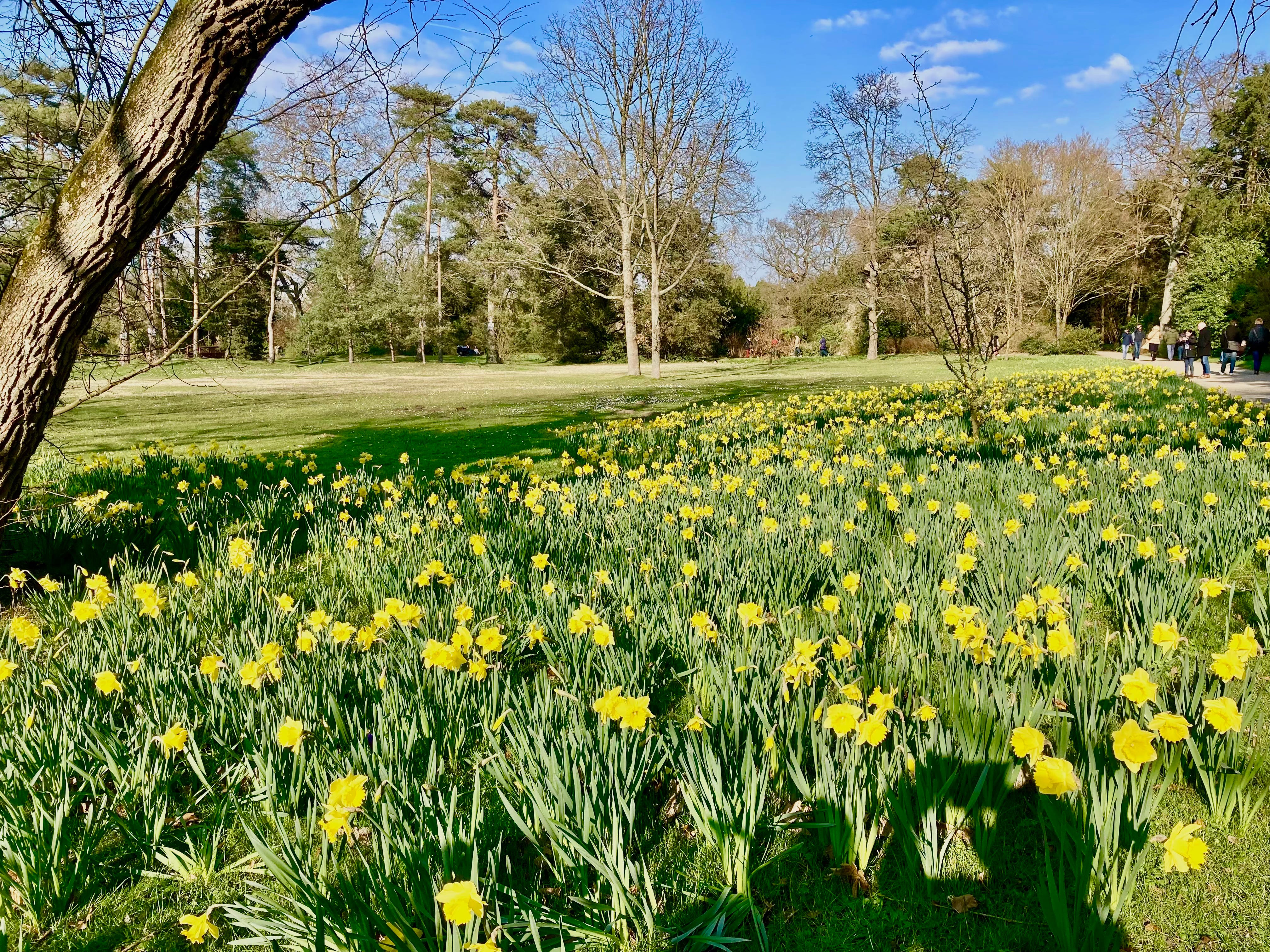
daffodils – Parc de Bagatelle 2022

PARC DE BAGATELLE: As long time readers know, I love to write about my favorite park at least once a year. The Parc de Bagatelle is situated in the upper north west corner of Bois de Boulogne. It is now a 50 minute walk for me instead of the 35 minute walk when I lived two stops higher on the metro #9. I strolled there two weeks ago to investigate the daffodils fields. These fields flower like a Wordsworth poem every February and March. It is a stunning sight if you hit it at the right time. Two weeks ago was not the right time. Maybe it is the cold of this winter, the amount of rain, the lack of sun—although none of those things is particularly unParisian—there wasn’t a bloom to be seen. Scraggly stems about three to five inches high were pushing their way up from the ground. The tulips, which usually follow daffodil season in mid March to mid April and love cold ground, the colder the better, were sprouting right on time. You can imagine the disappointment when rounding a corner and expecting to see YELLOW. Yellow everywhere. This time, just green shoots.

Today, I’m returning and taking some friends with me. The sun has been out a lot in the past two weeks and I’m crossing my fingers, hoping, hoping, hoping, to show them the glory of daffodil season at the Parc de Bagatelle. Truthfully, nothing can dampen the joy I feel when I’m there. Seeing the cats who gather very close to the majority of daffodil fields, the many peacocks who strut the grounds, barking and honking and showing off their gorgeous plumage, the lovely mallards who stroll around near the lakes they frequent, and the anticipation of tulip season, iris season, peony season, and the formal rose garden that has a yearly competition for the best rose in Paris for the year. If the daffodils are at a minimum, I will have to draw on every oral skill I have to paint a portrait of this parc that the City of Paris maintains so beautifully.

Thanks for reading Out My Window! Subscribe for free to receive new posts and support my work.

Until the next time,

A bientôt,

Sara