France’s snap elections

Dear Francophiles and Friends

The following is a reprint from an on-line journal that I subscribe to. All my friends in the US seem very confused by what is going on. I hope this helps.

“5-minute guide to the latest on France’s snap elections

written by Emma Pearson – emma.pearson@thelocal.com

Election news: 5-minute guide to the latest on France's snap elections

Protesters gather to demonstrate against the far-right in Paris. Photo by Zakaria ABDELKAFI / AFP

From party alliances to shock announcements and the emerging key figures, here’s your essential roundup of all the latest from France’s snap parliamentary elections.

France will head back to the polls at the end of this month for snap parliamentary elections – called by Emmanuel Macron on Sunday in the wake of his party’s humiliating European election defeat at the hands of Marine Le Pen’s far-right Rassemblement National.

The president’s announcement caught everyone off guard – even key members of his own party – so three days later, political groups are scrambling to get ready and fight the very short election campaign.

READ ALSO What do snap parliamentary elections mean for France?

Here’s a roundup of the latest election news:

Republican front

The most widely-heard call in France over the last three days has been for a Front républicain.

The concept of a ‘republican front’ is not a new one, it essentially means that when necessary mainstream parties put aside their differences in order to combat the extremists in the far-right movement.

Most recently it’s been seen in the second round of the presidential elections of 2017 and 2022 – the final two candidates were far-right leader Marine Le Pen and Emmanuel Macron and in that context plenty of people who detest Macron and all that he stands for cast their vote for him because they considered that the alternative – a far-right president of France – was much worse.

In the context of these parliamentary elections, the Front Républicain is more to do with political parties and essentially involves parties making agreements not to run candidates against each other in certain constituencies, in avoid to avoid splitting the vote and allowing in the Rassemblement National candidate.

Talks on these potential agreements are mostly still ongoing but it would involve, for example, the four left-wing parties who made up the Nupes group agreeing to run a single Nupes candidate in each seat – rather than diving the leftist vote by fielding one candidate from the far-left La France Insoumise, one from the centre-left Parti Socialiste, one from the Green and one from the Communist party.

It’s early days, but most of these agreements are far from being done deals, despite pleas for unity.

Eric effect

One politician who appears to be swimming against the republican tide is Eric Ciotti, leader of the right-wing Les Républicains who has announced that he would be open to an alliance with Le Pen’s party.

Les Républicains is one of the two parties that dominated French politics in the post-war period – the party of presidents Jacques Chirac and Nicolas Sarkozy.

Badly weakened since 2017 and at risk of fading into irrelevance, the party has been steadily drifting to the right for several years, electing in 2022 the very right-wing Ciotti as party leader. 

An alliance with Le Pen would not come as a surprise to anyone who had read his most recent manifestos and policies, but the thought of the political heirs of Charles de Gaulle getting into bed with the far-right has caused shockwaves in France and within the party itself.

Protests

There have been several protests, especially in Paris, this week but unions and left-wing parties have called for mass demos across France this weekend.

Intended as a show of solidarity against the far-right, the protests are intended to echo 2002 when million of people took to the streets after Jean-Marie Le Pen progressed to the second round of the presidential election.

READ ALSO What would a victory for Le Pen’s party mean for France?

Key figures

It’s not only opposition parties and the media who were taken by surprise by Macron’s election call, it also caught senior members of his own party off guard, with several saying privately (or less privately in the ear of friendly journalists) that they think Macron’s ‘grand pari‘ (big gamble) is a bad idea.

This number appears to include prime minister Gabriel Attal who was conspicuous by his absence for 48 hours after the announcement (even failing to post on his usually active Instagram account). However he’s now back and saying that he will do whatever it takes to “avoid the worst”.

Those of Macron’s ministers who are members of parliament – and in France it is not necessary to be an MP in order to be a minister – are also declaring their candidacy in these elections and so far there are no surprises . . .  

Key dates

Candidates have until Friday to confirm that they are standing. The formal campaign period begins on Monday, which is when election posters will start to go up and TV debates will be organised.

Voting takes place in two rounds; Sunday, June 30th and Sunday, July 7th.”

Thanks for reading Out My Window! Subscribe for free to receive new posts and support my work.

Please leave comments below with thoughts and questions and I will do my best to answer as the elections move closer

A bientôt,

Sara

RACISM | POLICE BRUTALITY | WILL PROTESTS ACHIEVE THE DESIRED RESULTS

A post by Kit Desjacques

A number of you have written to make sure I was okay since there is so much rioting, violence, and arrests here in France. Yes, I am fine. Inconvenience is the biggest issue for people like me. Transportation stops at 9 pm in an effort to discourage the rioters from going places.

My friend, Kit Desjacques, has written a column for Medium. I would like to share it with it. Kit is in my Paris writing group and writes regularly for Medium so please check her out.

A Traffic Stop Ended in a Police Shooting That Provoked Violent Protests in France

The headline ‘tension between rioters and law enforcement’ doesn’t quite capture what’s going on

Kit Desjacques

Kit Desjacques

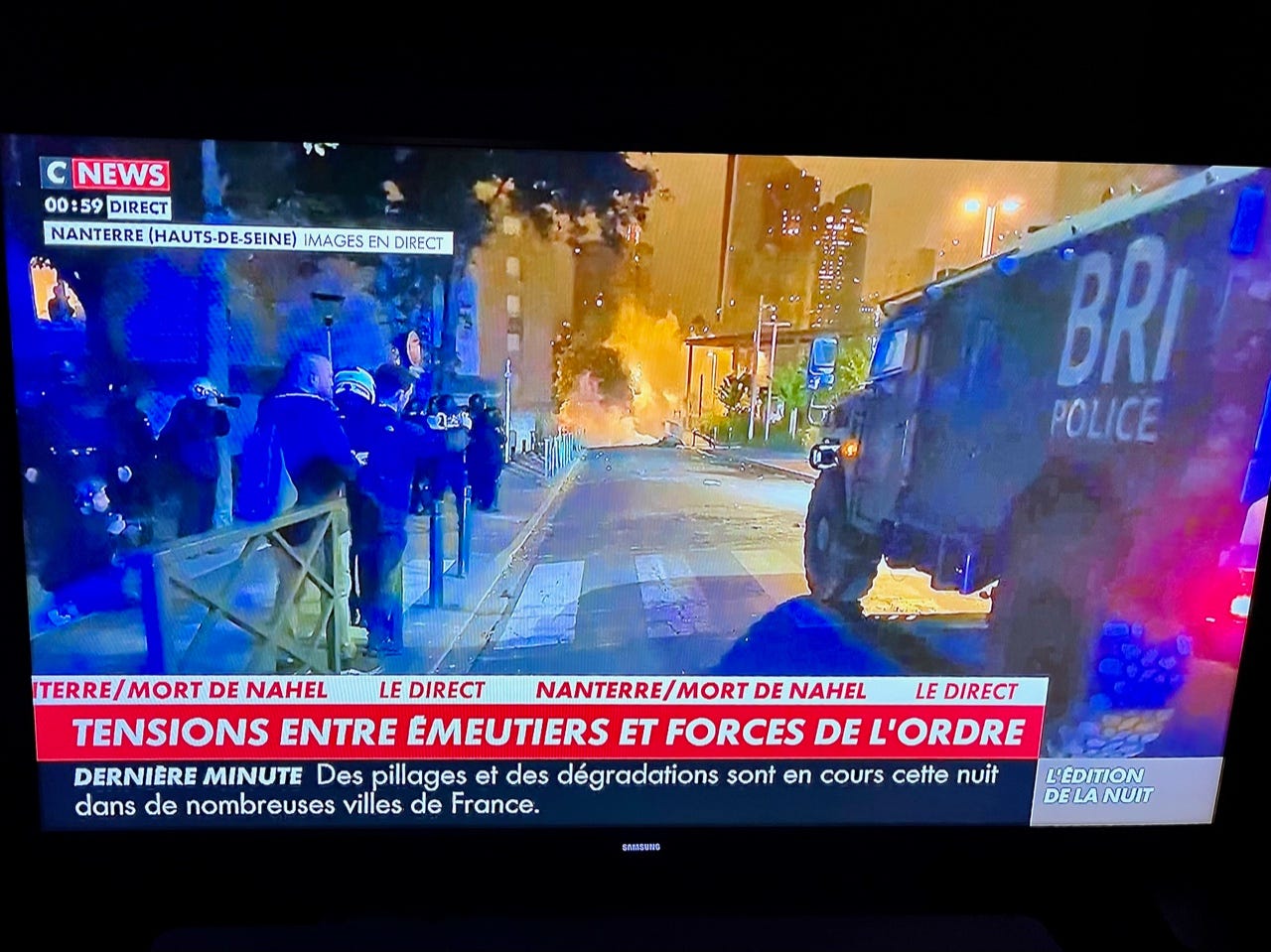
Photo of television coverage on Canal News France June 30, 2023 (Author’s photo)

At 12:15 am on Friday, we’re in bed but we can’t sleep.

“What’s that noise? Shh. Listen.”

It sounds like thunder, but there’s no storm. An explosion? A bomb? There’s a big sucking sound followed by a boom. Someone is shooting off giant commercial-grade fireworks, but there’s nothing visible in the sky.

The rockets are being launched at the police. On the ground.

Helicopters have been circling since nightfall. Despite the 9:00 pm curfew in Ile de France, the ring of suburbs that surround Paris, gangs of young French protesters are roaming the streets, launching rockets, and starting fires.

There’s a war going on, and it’s right next door.

It started on Tuesday with the shooting of a 17-year old boy from Nanterre, “Nahel M.” He and a couple of friends were stopped by police for driving in a bus lane. Witnesses say that the police got off their motorcycles and approached the car.

At that moment, Nahel hit the gas, apparently intending to escape.

An unidentified policeman fired his gun through the driver’s window hitting Nahel’s arm and chest. He died an hour later in a nearby hospital. The officer involved claimed Nahel was driving the car toward him.

An amateur video suggests otherwise.

It’s hard to maintain you were acting in self-defense if the other guy was fleeing. According to the lawyer for the officer who shot Nahel, his client was aiming for the driver’s legs but got bumped.

The lawyer said his (unidentified) client was “devastated” by Nahel’s death and didn’t mean to kill him.

Nahel’s mother disputes this version.

Appearing in TV interviews she was quoted as saying, “The policeman saw an Arab face, a little kid, and he wanted to take his life.” She asked residents of Nanterre to hold “a peaceful march” on Thursday afternoon.

By Thursday night, it had turned ugly.

Nahel was of Moroccan and Algerian descent. Protesters claim this is another case of police brutality and racial profiling. Are there policemen who are racist? Likely so.

Whether that was a factor, in this case, is unknown.

France prides itself on being colorblind, and the government goes to what seems (to my American perspective) extreme lengths to treat all citizens as “French,” prohibiting the collection of data on the racial or ethnic composition of its citizens.

The last time that kind of data was collected was when the Nazis occupied France.

It’s too early to know what happened. No one has any answers, but everyone has an opinion.

A number of public figures, including President Macron, have weighed in on the event. Macron was initially quoted as saying the shooting was “inexplicable and inexcusable,” but he later condemned the protests as “absolutely unjustifiable.”

He may be right on both counts.

French actor, Omar Sy, (star of the popular Lupin series), said, “May a justice system worthy of its name honor the memory of this child.” Popular Paris Saint-Germain soccer player Kylian Mbappe tweeted, “I am hurting for my France. An unacceptable situation.”

Meanwhile, we’re in our fourth day of violent protests—all over France.

Last night, 40,000 police, gendarmes, and the Anti-Gang Brigade were dispatched all over France to try and maintain order. Despite their efforts and the arrests of over 800 people, there was enough burning, looting, and destruction to leave everyone feeling skittish.

It feels like there is a civil war going on in France.

Earlier in the evening I had gone to a friend’s house with a few of her journalist friends for cold drinks and to admire her rooftop view of the Eiffel Tower. A journalist friend was on call to meet an incoming news team from London.

She had her phone nearby, awaiting developments. Everyone shared information—and misinformation—about the incident. The cop was a veteran who had served in Afghanistan, “not a hothead,” someone ventured.

“That’s true,” said another person. “There were no prior complaints about him. In fact, he got a couple of commendations as a policeman.”

We know that at age 17, Nahel M. didn’t have a driver’s license since the minimum age for one in France is 18. Further unconfirmed reports suggest that Nahel M. was known to police, but his record was clean.

Just then, my phone buzzed. It was my husband letting me know to come home early because public transportation was shutting down. It was only 7:30 pm, but we don’t live in central Paris.

We’re in a small suburban town that adjoins Nanterre, where the shooting occurred.

The Metro was still running, but all surface transportation was shutting down by 8:00 pm because of the curfew.

I was lucky to find a train that got me within walking distance of home.

We live in a white-bread bedroom community that was built as an affordable alternative to expensive Paris real estate when the car factories that previously occupied this bank of the river shut down.

It’s a slice of petite bourgeoisie that borders the working-class town of Nanterre.

Nanterre, a town of 100,000 people, is home to a large university and a sizeable immigrant population. It is where Nahel and his mother lived, and where the shooting took place.

My husband and I gave up trying to sleep and got up to watch the TV news.

The protesters have put up barricades and are shooting off fireworks from behind them. There are armored vehicles and troops in riot gear and fires everywhere.

The news resembles war footage with armed soldiers stepping over the burned skeletons of what used to be cars. There are buses on fire. A tram. A school. A community center. A bank.

Our neighborhood usually quiets down around midnight, but everyone is awake. Up and down the courtyard, building lights and TVs are on. People silently watch the war unfold on TV, less than three miles from our apartment.

The police officer has been charged with homicide intentional.

As the only lawyer at the party earlier, I was asked to translate the term for one of my reporter friends and the American network she works for.

“Voluntary manslaughter, I think.”

It was a guess. I know very little about American criminal law and even less about its French counterpart. I saw later that the New York Times called it “voluntary murder,” and wondered if I’d given her bum information.

Is there a such thing as involuntary murder? Sounds like an oxymoron.

Tension continues to build. There is a curfew again tonight. We canceled our weekend plans. Everyone is watching and waiting to see what will happen.

On the one hand, violent protests get important issues like racial profiling and police brutality on the table for people to discuss.

Will these discussions have the desired effect or will they just push more people into Marine Le Pen’s anti-immigrant camp in the next presidential election?

It remains to be seen.

Please consider Following me by clicking Follow above. You will be supporting my work and my weekly blogs will come right to your mailbox. Thank you.

A bientôt

Sara