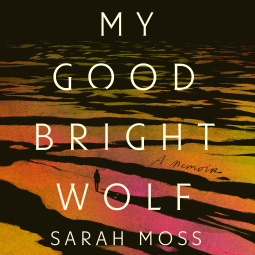
Sarah Moss writes novels. I haven’t read any of them but have read The Immortal Life of Henrietta Lacks for which she wrote the Introduction. I don’t think that really counts. So I’m not sure why I picked up her memoir My Good Bright Wolf, which came out yesterday, knowing nothing about her. Except I loved the title.
There are people who say there are no coincidences. Sarah Moss is anorexic. She has written a memoir that brings the illness of anorexia so intimately to the reader that I felt myself catch my breath several times. When I wrote my book Saving Sara A Memoir of Food Addiction, I wanted to do what I had never read in all the literature of eating disorders. Bring the reader into the mind, insanity, and horror of binging. Until I read My Good Bright Wolf, I never comprehended anorexia. I thought it a completely different animal than binging or bulimia. After reading this memoir, I don’t feel very different from Sarah with an ‘h’.
Thanks for reading Out My Window! This post is public so feel free to share it.
At the end of the memoir, Ms. Moss tells us how hard the book was to write, not just because it is so intimate but because she comes from a good background, had a great education, has a successful profession, and owns real estate. Which, to my mind, only confirms that eating disorders have no bias. Rich, poor, black, white, American, European, these diseases don’t discriminate.
This memoir is beautifully written, courageously written. She is able to convey the dialogue that goes on in our minds when “under the influence.” The part of her that convinces herself that she isn’t really sick, and even as she is inches away from death, she tried to convince a doctor that there are really sick people in the hospital and he should be attending to them.
She writes about the cult, the politics of being Thin. I related to everything she said: the judgments that thin people were better people. I hated my body because I was fat. She hated her body because she wasn’t thin enough. Her last chapter is entitled “My body, my home.” Just those four words gave me a severe jolt. I’ve always been looking for home. What if home is the shelter we carry with us all the time. Like a turtle, we can go to safety by pulling into our homes.
I listened to My Good Bright Wolf. It was narrated by Morven Christie. “”Morven Christie’s limpid, Scottish-inflected voice and gentle, enticing tone combine to lure listeners into Sarah Moss’s astonishing (memoir) as effectively as mermaids tempt sailors into the sea” —AudioFile on Summerwater (Earphones Award winner). Morven’s voice is strong and she enunciates with beauty. It is as if she had written the book, she knew just when to inflect, when to emphasize, when to talk to herself (as Moss) with contempt.
There is an emerging breed of memoir writer: Sarah Moss, Maggie Smith, Leslie Jameson who write poetically, lyrically. Who bring us into their worlds in a soft rocking manner but the subject matter is so serious, the self-talk so vicious and this style makes everything much easier to bare and also to relate to.
I’m not great at book reviews. And wish I could do this memoir justice. If you are at all interested in disordered eating, at the insanity behind the disease, and how one anorexic describes it and dealt/deals with it, I urge you to read this book.
Thanks for reading Out My Window! Subscribe for free to receive new posts and support my work.
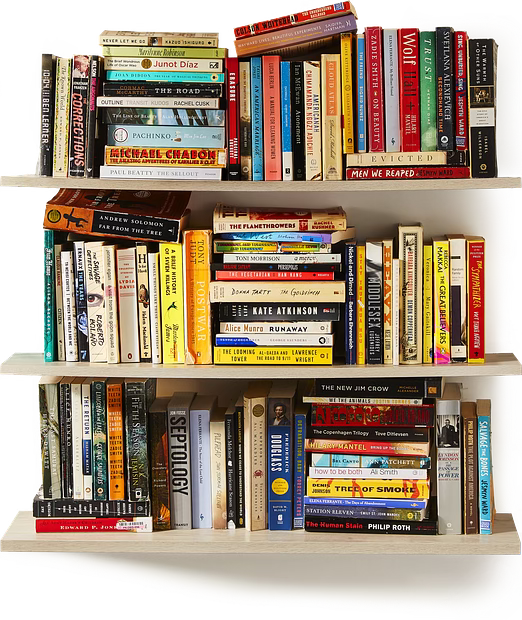
You may have noticed that many Substacks this month have focused on books. The release of the 100 Best Books of the century (yikes, did they have to use that word?) by the NY Times has many people talking about what was included and what wasn’t. As voted on by 503 novelists, nonfiction writers, poets, critics and other book lovers — with a little help from the staff of The New York Times Book Review.—from NYTimes website.
I have read a number of posts in which the author groused about a book missing from the list. And how could George Saunders be on it not twice but three times!!! The most amusing thing I saw was the book that was No. 1: My Brilliant Friend by Elena Ferrante; translated by Ann Goldstein 2012. I chose this book for my bookclub two years ago when I wanted to read it a second time. Not one person in the book club liked it—except me! No 9 is Never Let Me Go by Kazuo Ishiguro 2005. I picked this book for my book club three years ago and the same thing happened. I was the only reader to enjoy it!
The New York Times is not the end all be all as we have certainly seen with their political stance lately. It is a revered publication (though if it doesn’t watch out, it will suffer a very painful falling out amongst intelligent people). Many, many people disagree with this book list. Reading all the lists that have been inspired by the Times, has caused me to think about the books I’ve read this summer. I thought I’d tell you about some and why I liked, or didn’t like them. So here we go in no particular order.
1 Tianammen Square—Lai Wen Thirty years after Lai Wen survived the Tianammen Square uprising and massacre, she has written a lovely book about her childhood and teen years leading up to the revolt. It is called a novel. It is a snapshot of life in China under two different regimes, neither particularly encouraging to an intelligent young girl wanting to succeed in life. We are privy to her relationships with both mother and father and a boy that she was sometimes girlfriend/boyfriend with but was constantly questioning.
2 Tell Me Everything—Elizabeth Strout The world of Elizabeth Strout is a world that reminds me of Our Town or It’s a Wonderful Life, small towns where everyone knows everyone and, in each of her books, we learn about a different resident. This book is about Bob Burgess. She tells us that on the first page. Lucy Barton meets Olive Kitteridge in this book. It’s a bit like going back and revisiting old friends who have grown and changed since last seeing them but their essential natures never change. The plot isn’t as important as how people relate to each other. Strout writes in simple language, short sentences and, if you are open to it, wallops you in the end with some truths that are good to hold onto in our own lives.
3 A Woman of No Importance: : The Untold Story of the American Spy Who Helped Win World War II (2019)—Sonia Purcell My sister told me to read this book. She loved it. I loved it. Reading any story of the resistance in France is stirring. The courage, the belief in what was right is impressive and most of us don’t have that kind of physical or moral courage. This story is particularly fascinating because the woman in question, Virginia Hall, a Baltimore socialite, became one of the most targeted spies by the Gestapo. She lost part of a leg in an accident early in her life and managed to walk the Pyrenees, out manoeuvre Nazis, and lead an ever changing team of resistance fighters. Thirty or forty years later, no one knew her name.
4 TheMarlow Murder Club—Robert Thorogood There are three books in this series. I stumbled on the second one in a little free library box near my apartment building. I recognised Thorogood’s name because he writes the series Death in Paradise and it’s off-shoot Beyond Paradise—both of which I enjoy. These are just plain fun books. Like the Thursday Murder Club, the “detectives” are older and have to find a way to work with real detectives and not ruffle their feathers. I’ve now read all three books in the series and what entertainment! I believe the BBC has serialized the first book with Samantha Bond in the starring role.
5 The Women—Kristen Hannah Kristen Hannah has written two dozen books. She spoke recently at the Sun Valley Writers Conference and her event was live-streamed. She said that for the last fifteen years, she’s been writing about women whose voices get lost or forgotten. The Women, published this year, is about the nurses who went to Vietnam, worked hard, and returned to the US to be told, when seeking help for PTSD, that 1) there were no women in Vietnam or 2) she couldn’t possibly be suffering as she didn’t see combat. It is a beautifully written description of both Vietnam and the emotional and mental falling apart that followed.
6 The Bird Artist—Howard Norman I had never heard of Howard Norman until this year when my writing teacher, Jennifer Lauck, assigned us I Hate to Leave this Beautiful Place, a small book of five essays, to read for class. I fell in love with him. Jennifer suggested The Bird Artist, published in 1994, the first book of his Canadian trilogy. Written in spare sentences, the book concerns Fabian who wants to be a bird painter. Set in Newfoundland (where my aunt came from adding to my love of this book), we follow Fabian through relationships with his parents and various women. It has a haunting quality because of the writing style. Though we are distanced from the narrator, by the end of the book, it is hard to forget the story, the landscape, and the characters that make up this wonderful tale.
7 The Self is the Only Person—Elisa Gabbert Like Howard Norman, I had never heard of Elisa Gabbert until recently. If I wasn’t writing my own book of essays, I don’t think other essayists would jump out at me when I’m reading book reviews. The review I read of this book, loved it and who wouldn’t with a title like that? Elisa Gabbert loves books, she loves libraries, and she loves to discuss books. These well-researched essays talk about books. How her husband and she, along with friends, started the Stupid Classics Book Group. They picked classics to read that were under 450 pages. Gabbert tells us what she thinks of Fahrenheit 451 and a couple of other picks. She doesn’t like any of the choices until she gets to Frankenstein by Mary Shelley. She talks about the part of the Library she likes the best. Macmillan Publishers says “Contagiously curious essays on reading, art and the life of the mind.” Yes!
8 Splinters: Another Kind of Love Story—Leslie Jamison Splinters is Jamison’s most recent book, about the dissolution of her marriage and raising her daughter on her own. She is a recovering alcoholic and, though not drinking, she finds herself in addictive relationships constantly self-examining her motives, her choices, and her priorities. I have read some of Jamison’s earlier essays. This book is the most vulnerable she has made herself. She doesn’t gloss over her behaviours nor rush through to what she learns as a result. At one point I thought to myself ‘this is brilliant writing but I don’t think I’d like her as a friend’.’ She probably felt the same way. By the end of the book, she is learning about self-love, experiencing grief and joy at the same time, and her descriptions of the love she feels for her daughter will leave you breathless.
Thanks for reading Out My Window! Subscribe for free to receive new posts and support my work.
I was thirteen years old the year, 1960, that John F. Kennedy ran against Richard Nixon for President of the United States. My family lived on the Main Line west of Philadelphia which was republican country. At that point in my life, I had no interest in politics. One of the main reasons being that I had to compete with the goings on in the world for attention from both my parents. I wanted to be seen and to be heard and hated the competition.
In the summer and fall of 1960, a lot of that changed. JFK was stirring up passionate feelings in his supporters who were doubling and tripling with each of his planned campaign stops. When he came to Philadelphia, I don’t remember where, my father took me with him to stand in the glow of this 43 year old man who had captured the attention of a nation with his movie star good looks and his fresh opinions. This may be a faulty memory, but I remember being in a large parking lot. He was standing higher than us, his adoring fans-probably in a car or makeshift stand of some sort. My father and I made it to the front of the crowd and JFK shook my hand. I don’t remember anything else.
I have another memory of bicycling from Haverford, where we lived, to Ardmore the next town over. We, my friends and I, usually went there to buy 45s (If you remember those, you are as ancient as I am!). Across the street, an enterprising person was selling Democrat buttons and trinkets. With my own money, I bought a gold donkey. Of course, it was rubbish stuff but it was my rubbish stuff! I pinned it on whatever blouse I was wearing and sensed my parents would approve.
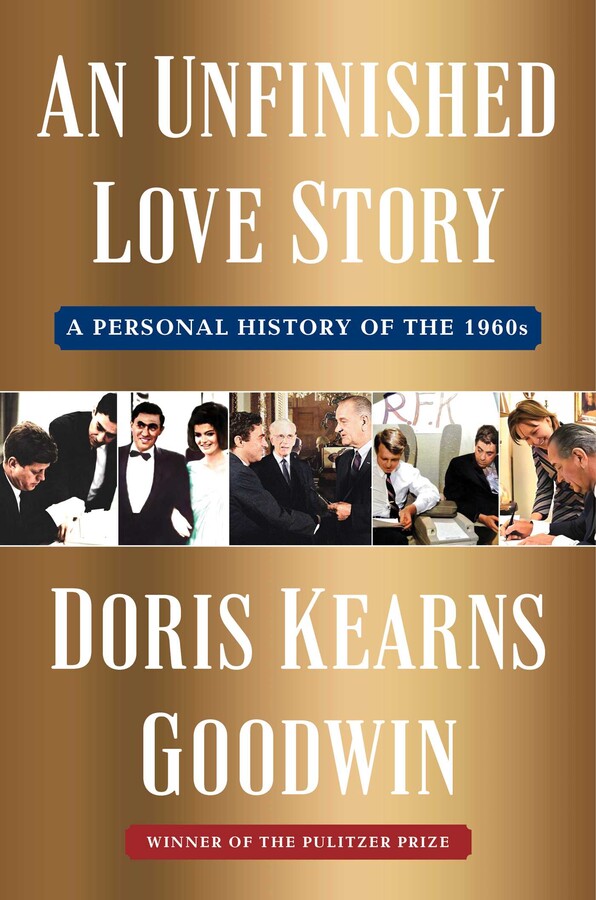
I have thought a lot of that time during the past week as I’ve been reading Doris Kearns Goodwin’s latest book: An Unfinished Love Story: A personal history of the 1960s (2024). Goodwin was married to Dick Goodwin for forty-two years and “married to American History” even longer. Doris worked under President Johnson, helped him with writing his memoirs, and wrote a biography of him after he died. Dick Goodwin was a speech writer for JFK and Johnson and then became very close friends with Robert Kennedy as he contemplated and then decided to run for President.
DKG is such an engaging writer that I felt yanked back to the 60s but witnessing it as an adult as well as through the eyes of the two Goodwins. Anyone who lived through the 60s knows what an amazing decade it was. One of such hope and possibility then tragedy after tragedy. I have tended to look back on that decade as one that failed us. That my generation somehow screwed up. By the end of reading An Unfinished Love Story, I was willing and happy to view it from DKG’s eyes—much more positively.
This book came to exist because Dick collected every piece of paper that he ever held. He carted around 300 boxes of his letters, journals, speeches, and memorabilia but would never open them. On his 80th birthday, he told Doris that he was ready to see what was there. It took them two and a half years to get through all the boxes. By then, Dick was ill and eventually died. It took her several years of grief and moving her home, to take up their project again. She felt she had to write the book as she watched what was going on in the country.
The two met in 1973 after most of the events in the book had taken place. She takes us through the boxes, through those years before they met, and tells us how they discussed each event, their reminiscences. I listened to the audio version of the book and was treated to a number of speeches made by JFK, RFK, and Johnson. What a jolt hearing those voices again.
What makes this book so interesting for me, aside from the fact that it is so well-written and engaging, is that it fills in details that I didn’t know about because I wasn’t especially political. I began to appreciate why Goodwin is so interested in leadership (She has also written a book entitled Leadership). She lays out the qualities of these men that were trying to guide our country to live as a democracy. The decisions they made and how they made them. It is such a contrast to much of what is going on today. The two of them would often argue the traits of JFK and Johnson.
When I finished the book, I wondered about President Biden. How would they describe his leadership qualities? I am now a person who reads a lot about politics in the US. There is a different perspective watching and listening when living in France. We don’t get the 24 hour loop on TV that people in the States get – if they watch TV. Most of my information comes from reading and I am choosy about what publications I read. I have wondered out loud why Biden’s ratings are so low when he has done so much for the citizens of the United States—all citizens. In fact, I believe he is on record as getting passed more laws that help the ordinary man and woman of the US than any president since FDR. I’ve watched his State of the Union speeches and chuckled out loud as he cleverly led MAGA Republicans into traps that were hard to get out of. Famous for his gaffs, I’ve noticed very few in his years as President. He works hard at being a leader for everyone.
In general, leadership qualities are not valued in the US anymore. The media rarely reports an event where Biden has spoken with skill and compassion (I was amazed at how often Bobby Kennedy used that word in all his speeches while running for President) when referencing us as a population or an event that needed interpretation by the President. The media believes that the US population is far more interested in all the hate speeches, all the threats of violence, and the fascist ramblings of the other candidate.
These are my thoughts only. I ponder while I walk around Paris and the Parc de Bagatelle. To me, Biden has grown into a leader. He is a leader in a world that no longer wants his kind of leadership. More and more, the world seems to want Fascist leadership, authoritarian leadership. A Big Brother who tells us what to do and will punish severely if we trespass. So is Biden a leader? Has he taken the temperature of the whole country and finessed how to lead us through this ‘valley of the shadow of death’? I don’t know. I don’t read the polls, which are usually wrong, anymore. I have no way of predicting since so many Americans have very short-term memories and vote passionately.
I would be very interested if you, my readers, would put your thoughts in the comments below. And then go get yourself a copy of An Unfinished Love Story by Doris Kearns Goodwin. You’ll thank me.
Thanks for reading Out My Window! Subscribe for free to receive new posts and support my work.

 Out My Window