Dancing with Fred Astaire–backwards and in French

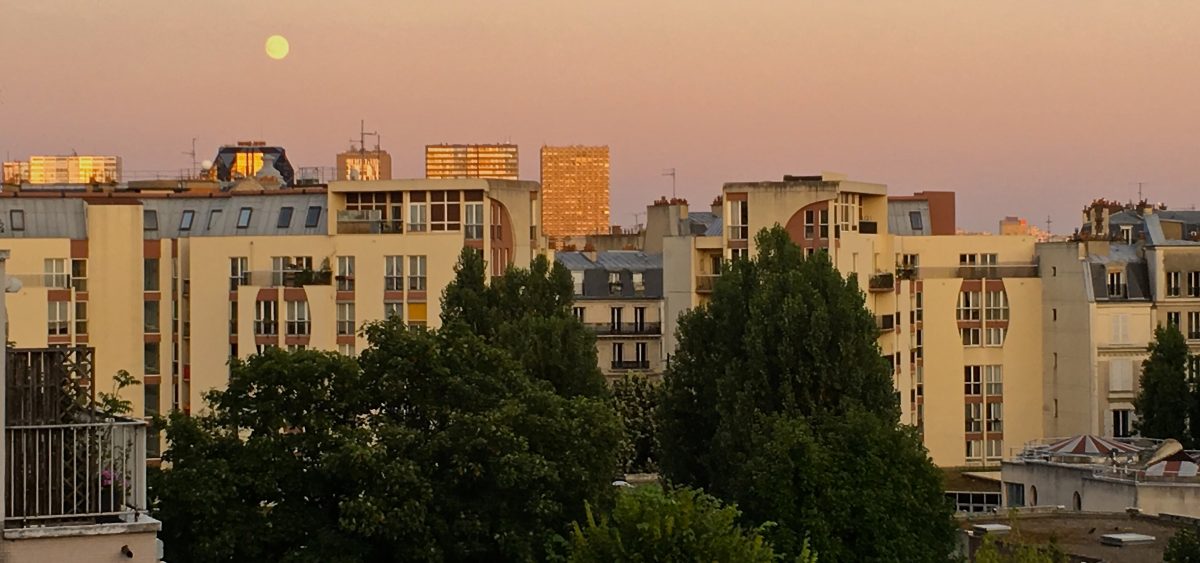
When we dream of moving to Paris, our heads (my head) are filled with romanticism: the beautiful architecture, the sky unencumbered by skyscrapers, the stores on every street bursting with color of seasonal fruits and vegetables, the cafés where one can order an expresso and then sit for hours, a city full of walkers-everyone walks and enjoys walking. What we don’t think of until we are here and in need is the strictness of French bureaucracy, black and white. Either you accept it or you drive yourself mad trying to figure out ways to make it move faster. And the fact that everyone speaks French. Which, depending on our schooling, when arriving in our adopted country, we come with different levels of fluency.
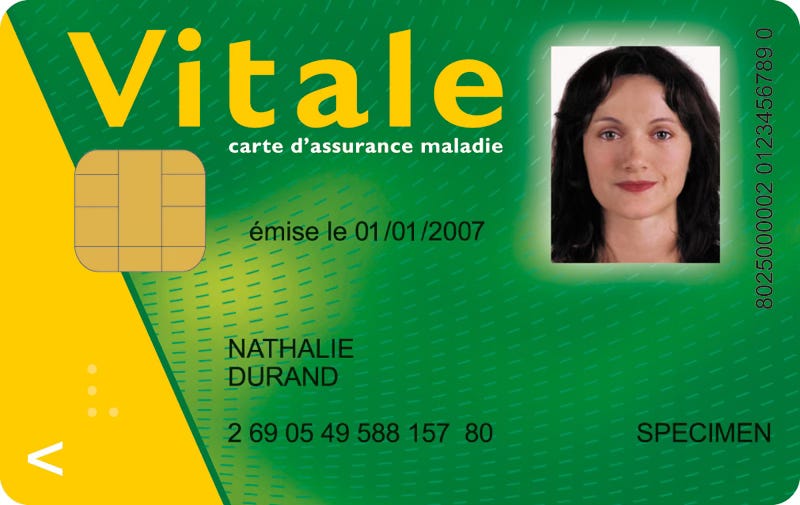
For the first three or four years, I would take someone with me when applying and reapplying for my one-year residency card, renewable yearly. I kept my US health insurance not realizing that I could apply for the social security and carte vitale after I’d lived here for over three months (That may change. The French parliament is proposing that US retirees pay a fee for their carte vitale). Once I got my Carte Vitale, I looked for doctors who spoke English again not realizing that they charged at least 50% more for that service. But I was too afraid that I would miss something crucially important if I depended on my B2 level of French.

Recently I have been struggling with a few issues: intense vertigo being the main health issue that I worry about. I’ve always had some form of vertigo although it would go away for years. It has returned with a vengeance. After I returned from the trip to Spain in September, it hit on a Monday, more of an attack. By Tuesday evening, I was crawling around on all fours. I’d had some neck pains before I left and thought I’d taken steps to deal with my neck. 

If you have never had vertigo, it is not only awful, it’s frightening, debilitating. The world spins around at high speed making most people nauseous. You start to vomit and can’t stop even when there is nothing left. Vertigo is not a matter of life and death (although I once got it while driving on the freeway from Walnut Creek to Oakland. I had to pull over and lie down on my front seats until it passed). Vertigo is isolating. With this last episode, I have had no idea when it would hit or what triggered it. Lying flat I knew was one culprit. I didn’t go to any of my gym classes. A heaviness like a cycle helmet of concrete hung around my head at all times. I was afraid to move my head from side to side. I probably looked to others like my spine extended through my head and I had abandoned all flexibility. 

How do you like this for a diagnosis??

My doctor, who speaks English, referred me to a Vertigo clinic but I couldn’t get in for four weeks. Everyone I knew who had had some experience with vertigo had advice for me. And I was willing to try anything. Now six weeks after the first onset, I don’t feel very educated on what’s wrong. I know it has to do with crystals in my right ear and getting them to return to their proper place. However, with age, crystals tend to get stuck and refuse to budge making balance a very precious commodity. The doctor at the vertigo clinic induced vertigo then sent me home. I was upset. And scared to do one of the maneouvers that is supposed to budge those pesky crystals back into their proper place.
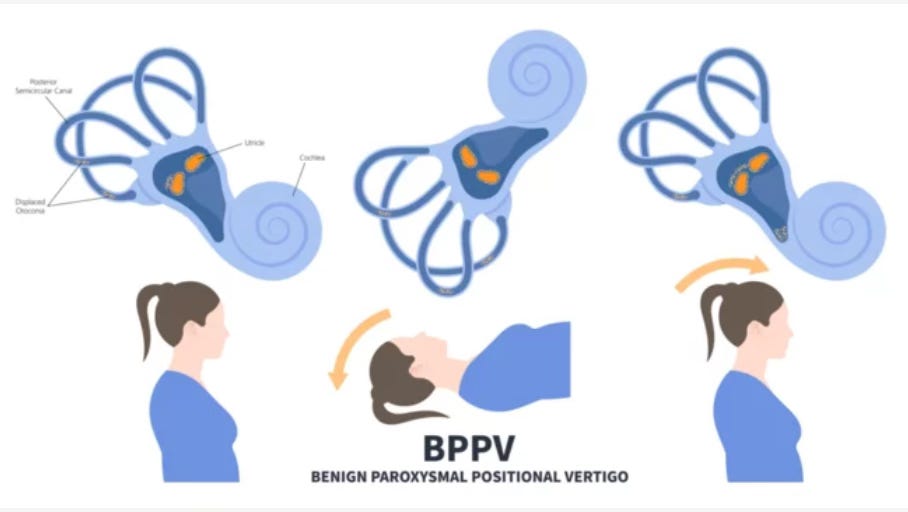
This is probably what I have.

This week I went to a kiné. A kinesteologist but different from American kinestheologists. They are a combination of osteopath, massage, and physical therapy. Cédric, I was told, speaks English, I was told wrong. And once more I have found myself in the hands of a health professional communicating in French. The first time I went to a health professional who spoke no English, I used my translator, DeepL, to write out in English what the problem was and what I hoped for. DeepL would translate into French and I’d make a word document which I’d take to the professional. Today, I told myself to trust that I spoke fairly good French and just go. I couldn’t help but think of Ginger Rogers doing everything that Fred Astaire did but backward and in heels. That’s the way it feels. I’m going to my doctor. I’m going because I need the wisdom and expertise of a health professional. I’m doing it all in French.

We make our appointments through Doctolib, a wonderful site that makes it so much easier to do this ‘in French’

I’m told by French people that my French is fine. I think that means I get along. I couldn’t possibly go to a French movie without subtitles, enjoy it, then go to coffee with friends and have a discussion. Half the movie would be in argot (slang). The only place I know to hear pure French so I practice is the news. I prefer France 24. But I’m not a great fan of the news at the moment.

So I struggle along. If I were completely healthy, I think living in French is hard work, it’s tiring. I forget that. Now, dealing with vertigo, and living in French, I’m tired a lot. I don’t like being tired. I judge myself and feel old. My Irish doctor says vertigo has nothing to do with age—get over it. If only….

Would I trade all that in to return to the States and deal with that health care system and converse with doctors in English? Not on your life. This is a small price to pay. And truth be told, I need every kick in the ass I can get to keep practicing my french.

A bientôt,

Sara

Finding Balance: of surgeries and Life

October 21, I had carpal tunnel surgery on my left wrist/hand. The pain attacked me out of the blue in early September right after I moved apartments. It was initially misdiagnosed as a pinched nerve located near my neck at my left shoulder blade. I would wake up at 2/3am each morning with the tingling of a limb going numb starting at my left elbow running down to my fingers. My baby finger stayed free from the pain. I wasn’t able to go back to sleep unless I got out of bed and stayed standing for at least twenty minutes. The relief would only last an hour or two. After six weeks of pain, sleep deprivation and stomach sickness due to an anti-inflammatory that was prescribed but didn’t help at all, I was sent to a hand and foot clinic where it was finally confirmed that I had carpal tunnel and needed surgery. 

The first week after the surgery passed with me mostly sleeping. Friends came over to help me shop and chop veggies. Some helped with the apartment as I was still living surrounded by too many boxes and decisions to make about where to put what. When I actually made it to my computer to write, I had that experience that I’m told many writers get of staring at a white space and unable to type a word. My brain would not work.

Monday, Oct. 28, the cast came off and tomorrow, Nov. 4, the stitches will come out and, for the first time, I will be able to stand under a shower and get my entire body wet. When I told people I was having carpal tunnel surgery, I heard consistently “easy peasy” “in and out in ten minutes”. That may be so but the recovery is not easy peasy. It is probably much shorter than other recoveries but it was a serious operation and following directions for the recovery was also serious. 1—Keep your hand up near your heart so that fluid drains away from the wound. I learned that the hard way when my wrist/hand swelled from inflammation so much, the cast felt incredibly tight. I ached from the pressure and thought I had done something wrong. A call to the clinic told me everything was fine but keep that hand up. 2—Don’t use that arm. I don’t know about others but doing nothing seemed impossible. The energy it took to pay attention to when I was using that wrist/hand and stop whatever it was that I was doing was exhausting. 

I was able to take sponge baths but couldn’t wash my hair. I broke down and made an appointment with the salon that cuts my hair and asked for a wash and dry. While there, I remembered that my mother (and probably most women of that era who could afford it) went to “have her hair done” once a week. To me it seemed such a luxury. To my mother, it was part of her weekly routine. It saved her time so that she could work. She was self-employed until the last ten years of her career when she taught at Rutgers School of Medicine. When I went last week, I was in and out in thirty minutes. It really got me to thinking about doing it more often. Just like having my apartment cleaned, perhaps having “my hair done” was something I could give myself. It’s a thought anyway.

I thought I was saving money by putting together bookcases bought at Ikea. Anyone who has shopped at Ikea for anything that needs to be assembled at home knows that the instructions, which have no words so that anyone in any country supposedly could assemble it, are impossible to follow. A friend and I got one bookcase finished but the rest raised my frustration level to a high pitch. With my poor left paw out of commission, I hired Task Rabbit to come finish what I had started. It wasn’t cheap, it wasn’t outrageously expensive. What it saved me in emotional energy was worth everything penny. Fifty years after I burned my hippie card, I still think of myself as a poor student who can’t afford to pay for help that makes life easier. Life is hard enough without voluntarily choosing to add to it.

When I asked the surgeon at the time my cast came off, what I could and couldn’t do, he responded by telling me that I had to find the balance between using and not using the left hand. It was important to use it so that it didn’t stiffen up on me. And yes, I could type at the computer. (I was learning how to dictate e-mails, texts, and some writing but I didn’t get comfortable at it). I shouldn’t use it too much as that would cause pain. It was up to me to find the balance. Isn’t that true of life in general? There are no set rules, no structure, nothing that arrives on our birthday telling us how to maintain balance as we live, as we age. We each learn by doing and by making mistakes. Something I have to remind myself of constantly. Making mistakes is good, it’s a learning tool. Just don’t make the same one over and over, that isn’t learning, that is stupidity. 

So I move into week three post surgery. I have mental energy back and I’m getting outside to walk more to get some physical energy back. The weather in Paris was awful in the summer and has stayed awful this autumn—meaning lots of rainy days and cold. Two days ago, I walked outside for forty minutes. I hadn’t brought gloves with me. My hands were frozen when I returned. It’s Nov. 3rd and winter is upon us here in Paris. In my more metaphorical moments, I think even the weather is reacting to the political climate. Nothing sunny, nothing to smile about.

Two days until the election in the US. The end of the lead-up and the beginning of what many of us suspect will be a horror show of warring sides claiming that once again the election was stolen. Elections boards refusing to confirm a winner in many states. Violence. We all pray for some sanity. But that would require that all our leaders know how to lead and that hasn’t been the case for a very long time. When I speak to friends in the US, I hear the anxiety. If I ask ‘how are you?’, the first response is usually something about election fear and fatigue. Here in France, the distance dulls the edges a bit. But we all know that this election will impact the world. France and all of Europe waits on tenterhooks to see what the American people think of democracy. Even the Serenity Prayer that suggests we accept the things we cannot change gives me no peace. So many have worked for change. Will it make a difference?

Thanks for reading Out My Window! Subscribe for free to receive new posts and support my work.

A bientôt,

Sara