Surviving a California Firestorm

With love to everyone in Los Angeles

October 22,1991: I’m standing at the top of Swainland Road in the Oakland Hills looking down at where my home stood yesterday morning. All around me, a war zone. Everything is dead. What is left of the mostly oak trees still burns, little puffs of smoke sliding out from within the trunks. Chimneys stand like sentinels guarding nothing. Stone and brick staircases climb up to nowhere. The air is still, no birds, no animals, no sounds at all. It’s like the earth has stopped breathing. The ground is charred, black, brown, russet.
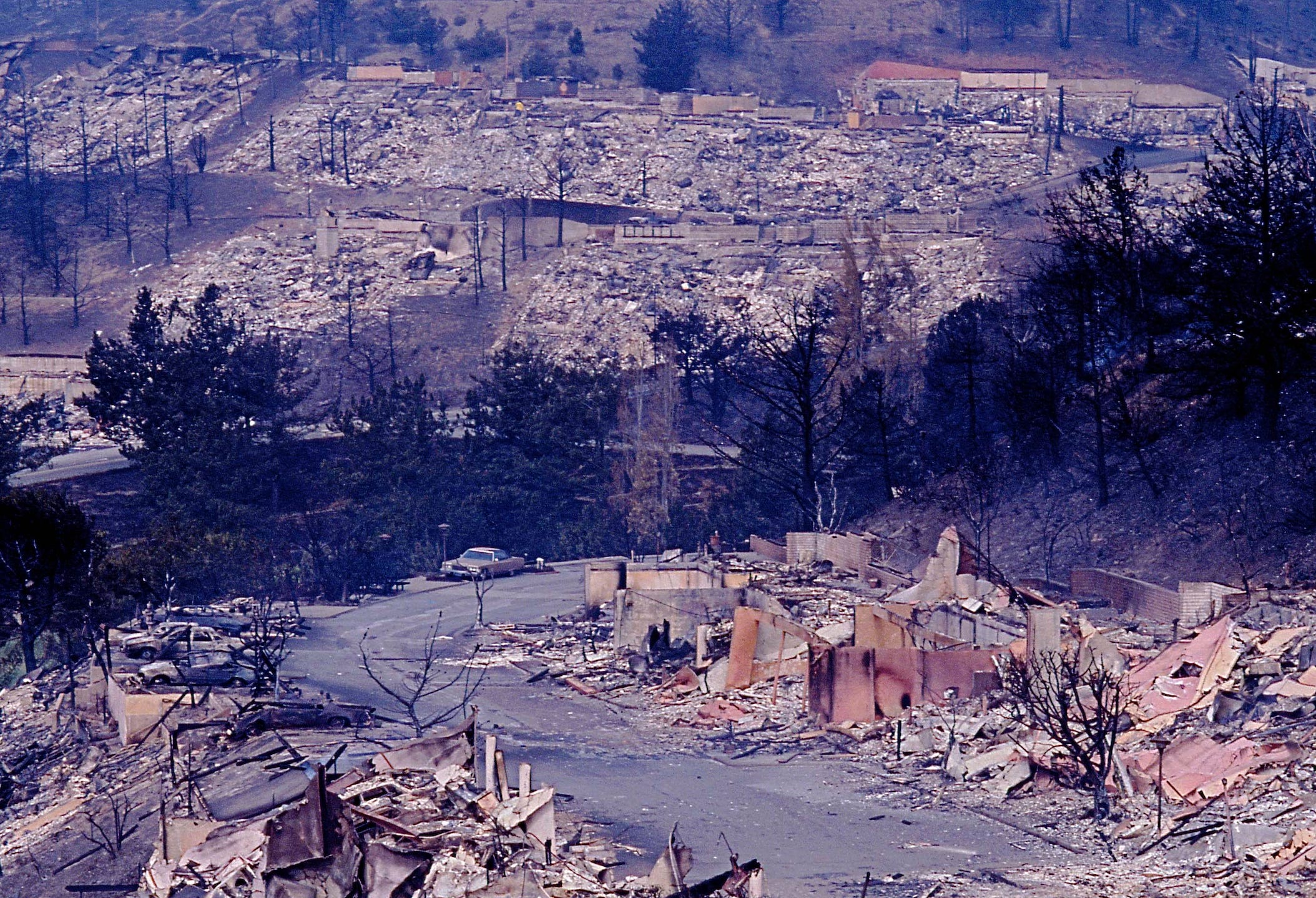
Photo taken by anonymous

Less than twenty-four hours ago, I was told to evacuate. I stare down the long winding block of Swainland Road from where I stand on Broadway Terrace 1000 yards away. I’ve been robotic doing what I was told. Packing the car, though I couldn’t think clearly what to take with me. Driving to safety along with the rest of the neighborhood; a long meandering snake that had to keep adjusting as the fire jumped from hill to roadside to median.

My home is gone. Tears fill my eyes but I don’t have time to cry. There is no one else around. I snuck behind police lines desperate to return and find my second cat, Squeak, who didn’t make it out with me. I couldn’t find him. My home, my first home that I’d bought with my own money, that I’d lovingly decorated with anything I could find that made it mine, was gone. Burned to the ground.
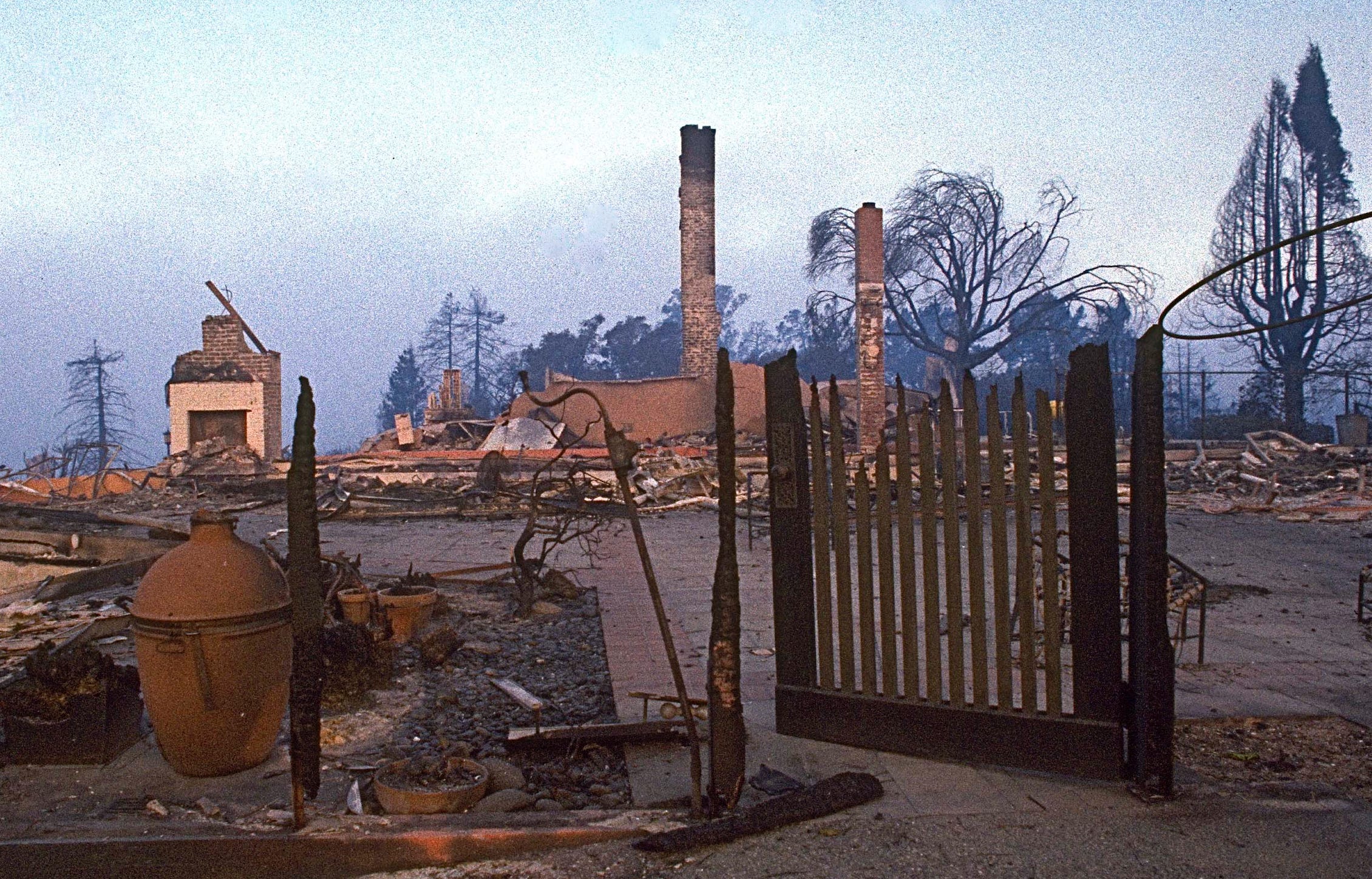
Photo by Anonymous

I walk down Swainland, passing one lone house that stands on the righthand side of the road. It seems in perfect condition, blue with grey trim, a child’s bicycle at the front door. Only later, do I find out that it had a new up-to-date roof, three months old. These fires jump from roof to roof. I can smell wood smoke, usually one of my favorite smells. At my property, I find my bike and an old wooden milk wagon under my large oak tree. The fire jumped over them. I walk up the sixty stairs (this is the Oakland Hills) to where my front door should have been. The railing had been wooden. Nails lie side by side on the left of the stone steps all the way to the top as if someone had arranged them in perfect symmetry. Near where my bedroom had been, tree trunks were burning. Red-orange coals are visible when I look down inside. Looking up, I can see for miles. San Francisco and the Bay to my right. Only two years earlier, the 1989 Earthquake had destroyed part of the Bay Bridge. Downtown Oakland and Lake Merritt in front of me. There is nothing to block my view.

I find the dishwasher and nudge the door open. Broken plates and some pots in good condition lie within. Ashes look like sculptures. I see a long line of books that I know were once my journals. In perfect shape except they are ash. I reach out my right index finger and lightly touch one. The whole structure collapses. Thirty years of recording my joys, my sorrows, my breakups, my love affairs. Poof. Gone like smoke and ash. Literally. Funny elongated pieces of silver show up on the ground. It takes me a few seconds to realize this is the remains of the silverware my mother had sent last month.

I walk around in ever widening circles calling Squeak’s name though I know that the likelihood of surviving the 2000 degree heat is nil. I see small blue tiles scattered all over that had been stored in the basement. I pick up distorted glass perfume bottles that look beautiful in their bizarre shapes.

I’ve had enough. I want to leave. I hear a ‘meow’. Squeak emerges from seemingly nowhere covered in the tan liquid that had been dumped out of helicopters yesterday in an attempt to slow the fire’s progress. I scoop him up and, standing atop my lonely hill, I hug him. I finally sob my heart out.

*** ***
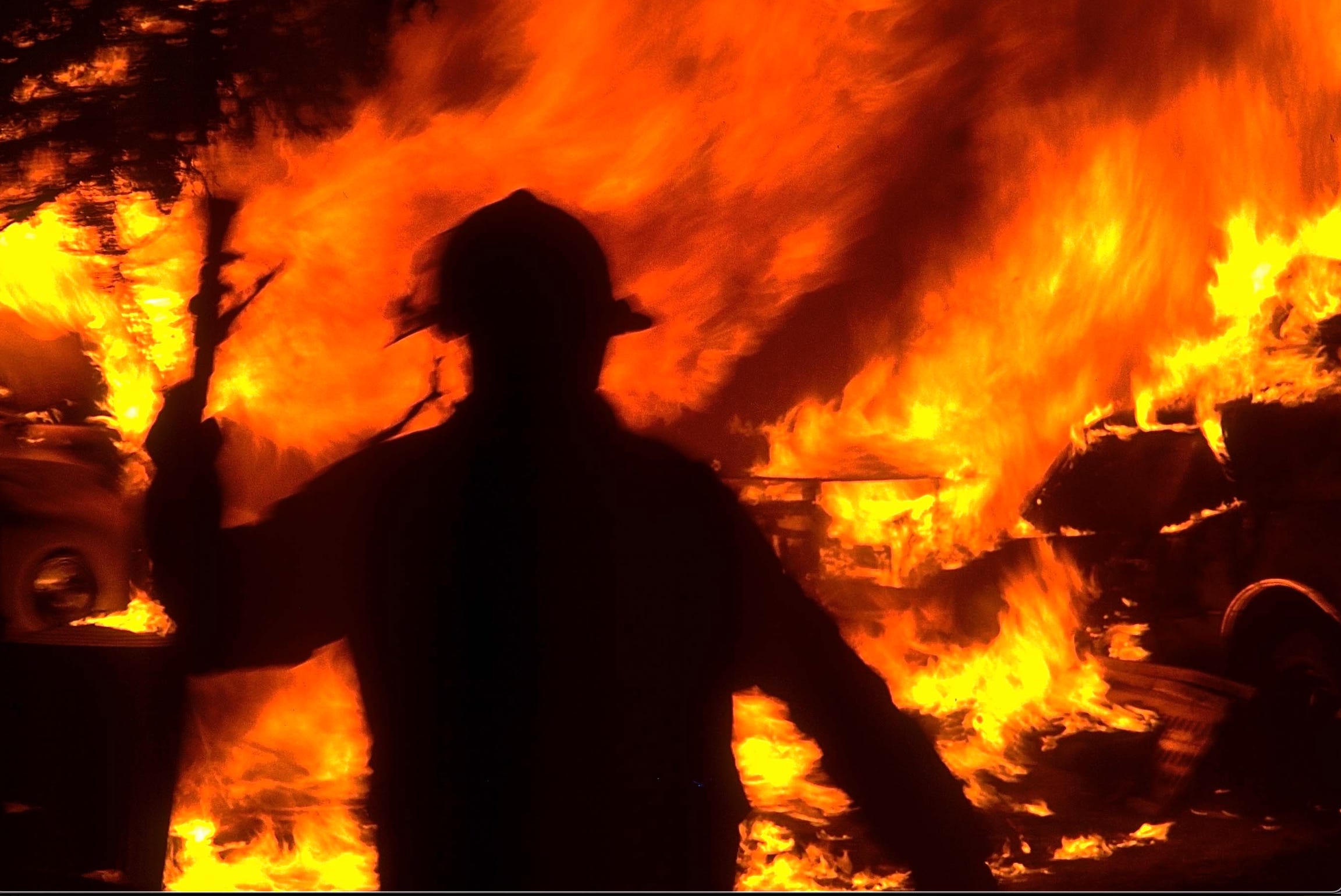
Photo by anonymous

People always want to know about the day of the Firestorm. There is no doubt that it was dramatic, exciting in the worst sense of the word. The papers and TV were filled with Hollywood-like photos of firefighters vs nature. And losing. I filled a scrapbook with a year’s worth of news, mostly for me to remember, to slow down and integrate that this had happened to me. But the real horror didn’t begin until a few months later. In 1991, California fires of this magnitude happened every twenty years or so. Now they seem to occur every twenty minutes. Insurance companies have all but abandoned California to disasters, natural or otherwise. My fire was the beginning of their trek out of state.

I was insured by Allstate. The afternoon of October 22, I called my friendly insurance guy who made sure I got $5000 to replace clothes. I learned through the Survivor grapevine that FEMA (Federal Emergency Management Agency) was setting up posts all over Oakland. We were to show up, be interviewed and advised what to do next. In the weeks leading up to Christmas, my community of Montclair Village, was generous. People donated clothes and utensils to the Montclair Presbyterian Church. We fire survivors were invited to go “shopping”. Their largest meeting hall was filled with hundreds of racks of clothes in every size for every need. Clothes had been cleaned and were hanging beautifully as if in a store. The same church invited the entire community to celebrate Thanksgiving dinner. No one was asked if they were a believer or what faith they practiced. They loved us, cared for us as we traipsed through unknown roads trying to figure out who to call or who to write. We were held in the arms of our community.

Christmas and New Year’s came and went. 1992 began and the world moved on. They left us behind. Insurance companies were balking. Some of us were lucky enough to find rentals within the community. Many of the homeless had to move into neighboring towns or even further. We were on hold at the mercy of the insurance companies. I didn’t hear anything that resembled a resolution until the end of August 1992, ten months after the Fire.

After six months, friends remarked on the fact that my emotional state was not getting better. I was depressed, I was stuck. The husband of a friend of mine told me “You’ve been depressed long enough. It’s time for you to get over this.” What I heard was: “we are tired of feeding you meals, entertaining you. You are a freeloader”. I, like so many of the other survivors, withdrew from those people and only communicated with new friends, other Fire Survivors, who understood what we were going through. FEMA had provided for support groups, but that money ran out pretty quickly. Six of us formed a group of our own and told stories of our lives from week to week to week. We talked about the hell of having to fill out long lists of what we had lost and the approximate worth. Of waiting, always waiting, on insurance companies. The weight of making the decision to rebuild or to move and to where. We accompanied each other to endless meetings often led by the leaders in our communities who rose like cream in milk to explain to us shell-shocked Californians what to do next. We let each other know if we learned of a discount that a store or organization was offering to survivors and helped each other shop. We laughed with each other as our worlds got smaller. And we drank a lot.

The day of the Firestorm was dramatic, a day you do your best to survive, a day your emotions get tossed up in the sky like a high flying kite and you hang on for dear life. You rescue what you can then follow the long line of cars driving to safety.

But it’s the next two, three, four years that make or break you. Like with a surgery when all your helpful friends tell you about the day of the surgery and what to expect but neglect to tell you about the recovery, how hard it is, how long it takes, how you have to do exactly as instructed or it gets harder and longer. That you can’t make time move faster, that you don’t know if you’ll ever feel whole again, that decisions have to be made on a dime when often your brain feels too fatigued to even hear the options.

When I saw the fires the day they broke out in Los Angeles, my first thought was “Thank goodness I don’t live in California anymore. I don’t think I could live through that again.” Then my heart started breaking for what the next days, months, and years will be like for all those Fire Survivors.

I wish I could say to all Fire Survivors, something I learned, something that would make their recoveries easier. What I learned is that I can survive a disaster like this. I do not want to ever find out if I could do it again.

Out My Window is a reader-supported publication. To receive new posts and support my work, consider becoming asubscriber.

A Bientôt,

Sara

Spring arrives in Paris

On Thursday evening, Macron’s government announced on French TV, that there will be a slow lifting of all our restrictions. The 7pm curfew will probably not change for awhile, but the distance that we are allowed to travel will. We’ve been under a “no more than 10km” boundary unless there is a very good reason and one has to carry written proof of that.

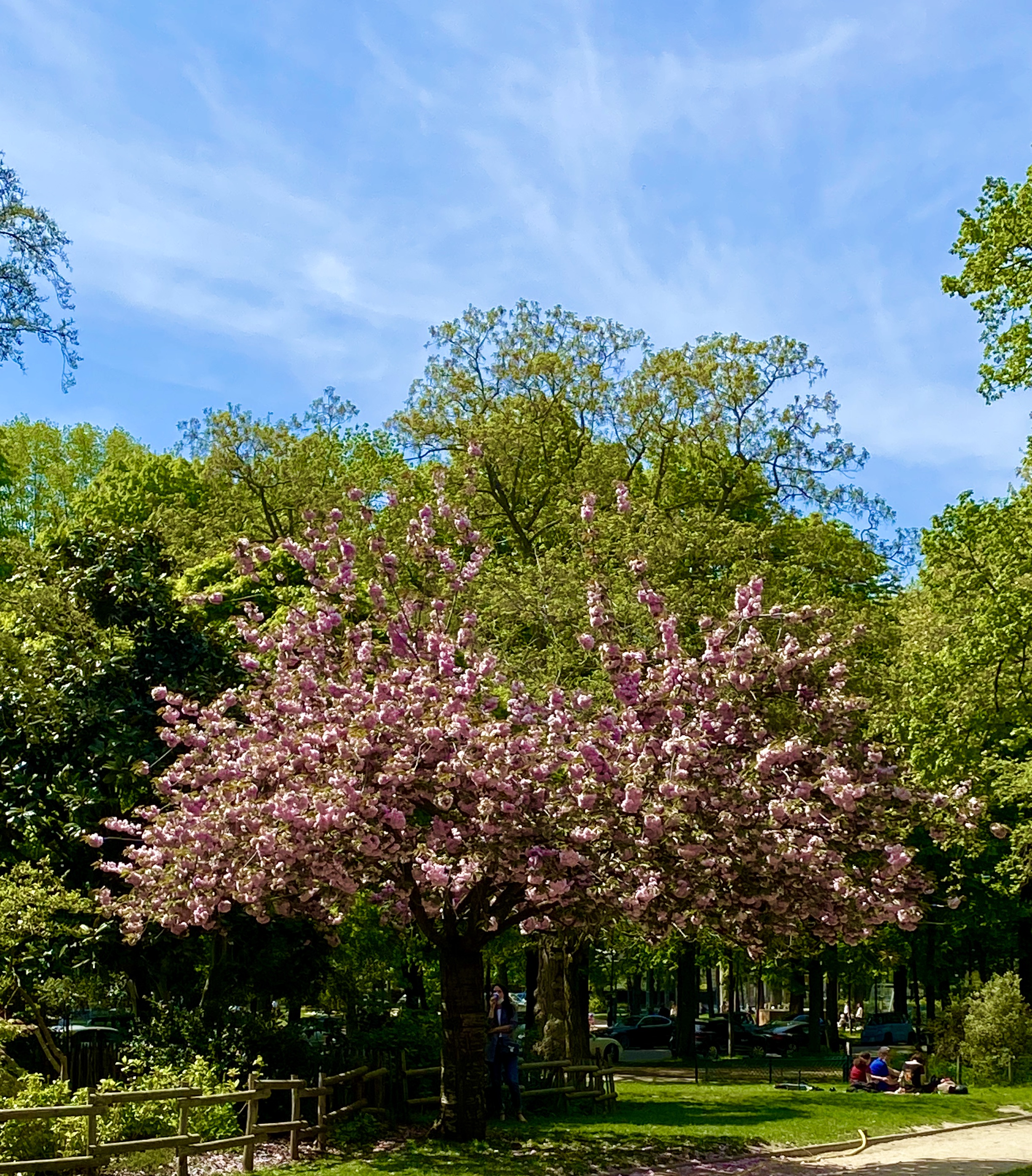
Jardin du Ranelagh

The government also said that the lifting of restrictions will depend on where one lives and how rampant the virus is. Possibly in mid-May, we will have restaurants and bars open again but serving outside. Possibly sports events will return. We’ve been told that Roland Garros will definitely take place.

Walking in the Petite Ceinture near my home

The problem as I see it is: Spring is coming to Paris quickly. Now that we’ve changed our clocks, it doesn’t get dark until 9/9:30pm. Yet we have a 7pm curfew. For those who live in the countryside, it’s not as big a problem. They can eat outside, enjoy their outside gardens, and probably visit their neighbours. As a friend of mine said “They aren’t going to send a cop out here where there are ten houses to make sure we are all on our own property.” She is right.

Yesterday I went out walking and only had a light jacket on. It felt exhilarating. This past week, the NYTimes had an article in their Well Section about ‘languishing.’ It’s not a word I use much. The article written by Adam Grant, began “At first, I didn’t recognize the symptoms that we all had in common. Friends mentioned that they were having trouble concentrating. Colleagues reported that even with vaccines on the horizon, they weren’t excited about 2021. A family member was staying up late to watch “National Treasure again even though she knows the movie by heart. And instead of bouncing out of bed at 6 a.m., I was lying there until 7, playing Words with Friends.

It wasn’t burnout — we still had energy. It wasn’t depression — we didn’t feel hopeless. We just felt somewhat joyless and aimless. It turns out there’s a name for that: languishing.https://www.nytimes.com/2021/04/19/well/mind/covid-mental-health-languishing.html

Lilac tree in bloom in Jardin du Ranelagh

I’ve been calling it the Blahs. The most exciting thing I do is walk outside for an hour. That is not to say that I don’t love the other things I do. I love to write and write every day. I love to connect with friends and am on Zoom at least once a day. But nothing has touched the feeling of waking up in the morning and hearing the birds, not having to bundle up because it’s cold, and walking outside where the world seems brighter, full of color, warmer, and friendlier. I’m not naive enough to think this is over. I’m with those who are guessing we’ll have a respite in warmer weather and, in the Fall, things will probably get worse. If not earlier. As I write, there is real terror in India as the virus skyrockets. The EU has announced that Americans can visit all countries in Europe this summer. Can they guarantee that no form of the Indian virus will arrive with the tourists? I’m hoping governments are planning on the fact that we will all need booster shots and they will be providing enough vaccines once again.

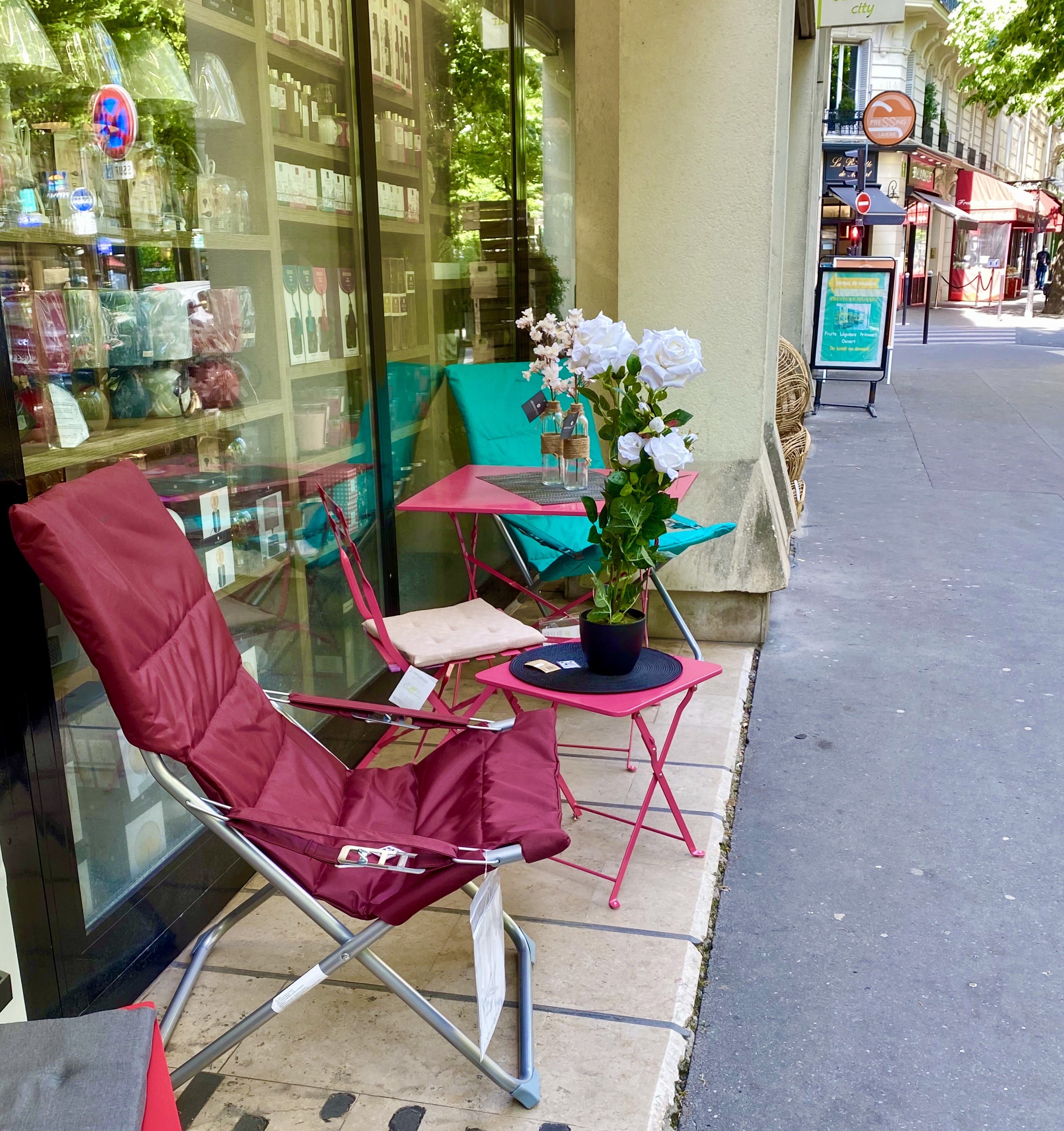
Store on Av. Mozart selling chairs for enjoying Spring weather on the terrace

With my exhilaration came recurring thoughts of visiting California where I lived before moving to Paris. I still own a home in Oakland. I miss my home. I built it after I lost my home in the 1991 Oakland FireStorm back when devastating fires didn’t happen three or four times a year. I tell anyone who asks that if I could have that home in France, I’d be in heaven. Thoughts of getting on a plane and flying eleven hours to San Francisco–I’m tired already. What does it mean? There are so many things to find out. How do I get back into France, what do I need? What will I do with Bijou? Take her with me or have her stay with a friend or have a friend stay here? I stop daydreaming at about that point. It all seems too complicated. If it weren’t for my friend Barbara, I would probably still be trying to figure out how to get vaccinated.

Bijou enjoying Spring and new buds on my terrace in the 16th

So I think I’ll spend a week or two just enjoying Springtime in Paris! Do my best to not worry about the things I can’t control. The Dalai Lama once said; “If a problem is fixable, if a situation is such that you can do something about it, then there is no need to worry. If it’s not fixable, then there is no help in worrying. There is no benefit in worrying whatsoever.” And maybe, some of you will have some suggestions for me. They say many heads think better than one (well, that’s not quite what they say but, hey, whatever works).

Spring on the Champs de Mars
The epitome of Paris

A bientôt,

Sara

The Washington Decree

Jussi Adler-Olsen, author of The Washington Decree–a stand alone book, has written seven books in the Department Q series ‘starring’ lead detective Carl Morck (in Danish, that o has a line through it!).  I reviewed one of them last Fall.  They are definitely Danish Noir, gripping and full of social commentary.  Often they are laugh out-loud funny which makes them real page turners in spite of the sometimes shocking murders.  If you haven’t read them, I highly encourage you to read them in order but read them!!

Unknown.jpeg
Jussi Adler-Olsen

The Washington Decree is Adler-Olsen’s latest social commentary and he takes on the United States and it’s government.  In fact, it is an American horror story.  Although the way things are going in the US, it sometimes felt too close for comfort.

In the Epilogue, he explains some of his motives for writing the book.  FEMA (Federal Emergency Management Agency) was created during the Nixon administration primarily to deal with the effects of a nuclear war but also meant to be useful in the event of any natural catastrophe.  When I lost my home in the Oakland Firestorm of 1991, FEMA was the government agency that came in and created different organisations to help us survivors out.  Included were three months of support groups for those that wished to attend. At three months, we were told the money had run out and we were on our own.

According to Adler-Olsen, FEMA  has a huge amount of funds, enough to build underground facilities, internment camps, train personnel to take over duties of elected officials and, it seems, an entire non-elected governing system could be established with a shadow cabinet and a shadow president.

The Washing Decree is Adler-Olsen’s attempt to describe the quick journey from Democracy to Autocrocy should such an event happen.  In this book, the event was the murder of the incoming President’s wife.  If it weren’t for the fact that he describes in detail all that FEMA can do and the Executive Orders at FEMA’s disposal, this book would seem fantastical, thrilling and a wonderful read but fantastical.

wd-us-1-1.jpg

The book opens with a trip to China that brings five very different people together and then-Senator Bruce Jansen. After the murder of Jansen’s wife, the book jumps sixteen years and Jansen is the Democratic contender for President.  All five of the people on the China trip have stayed close and stayed loyal to Jansen. One of them, Doggie Rogers, arranges for Jansen’s victory party to be celebrated at her father’s upscale hotel.  Jansen is re-married to a beautiful and very pregnant wife who has charmed the American public.  During the  party, Jansen’s second wife is murdered.  Doggie’s father is arrested and awaits sentencing.  Shortly thereafter, President Jansen goes on TV and issues a Law and Order Decree that becomes known as the Washington Decree. It takes away civilian rights and installs a police state.  From there, life in America descends into chaos.  The vice-president resigns in protest and the chief-of-staff becomes VP. Militia groups start hoarding guns and ammunition. People in Jansen’s cabinet are being murdered.  With each new event, another executive order is declared.  America shuts down, no one knows who is friend and who is foe.

This is a thriller with a very bad guy.  There is also a love story.  One at a time, the five friends from China start getting suspicious and wonder if Doggie’s father is really guilty and if not him, who?  It is a huge jig-saw puzzle to put together and each one of them starts fearing for his or her life.

I found the book slow going in the beginning.  But this is Jussi Adler-Olsen!  I was very willing to hang in there.  And after the scenes were set, the pace picked up and things moved rapidly as I turned the pages.  And always in the back of mind was the question “Could this really happen with a bad guy in charge?” It is all the more upsetting now that we have an unstable man in charge of the country.

I have looked up several websites to learn when Adler-Olsen began writing this book or if there was a particular purpose or statement he wanted to make.  I couldn’t find anything.   Having read all his Department Q series and one other stand alone, it is no stretch of the imagination to write that Adler-Olsen has a lot to say about the state of affairs in the world today.  I find him an acute observer, an elegant writer and possessed of an amazing ability to make up stories that go right to the heart of what is happening in the world today.  I am already looking forward to his next book.

A bientot,

Sara