“Reading is an act of resistance”

Last Friday, I had the pleasure of meeting Jennifer Egan, the Pulitzer Prize winning author of A Visit from the Goon Squad. She was in Paris to celebrate the launching of her latest book The Candy House in French, as well as participating in Festival America. I belong to a writing group through AAWE (Association of American Women in Europe). Through a unique partnership of AAWE, Editions Robert Laffont, and AAWE, Jennifer spoke at the beautiful American Center for Art and Culture in the 16ème. My writing group had the honor of being volunteers at the event on Friday.

Lorie Lichtlen, interviewer. Jennifer Egan, author, Margueritee Cappelle, translator

I’m embarrassed to admit that before this summer I had not read any of her books. When I learned she was making a special appearance at ACAC, I read three of her books backwards! First the Candy House (2022), then Manhattan Beach (2016), and finally A Visit from the Goon Squad (2011). My overall impression was that this was one brilliant woman who had an ultra creative mind and was also very complex. I wasn’t sure I understood The Candy House very well and resorted to reading reviews in the NYTimes and New Yorker. I was a bit afraid that I wouldn’t be able to follow her thinking.

Signing both French and English language books

I had absolutely nothing to be afraid of. Jennifer walked into the venue with a backpack slung over her shoulder, a simple black top, a short skirt, and knee high boots. She greeted everyone with a huge smile. The room filled up with a large Franco-American crowd of at least one hundred people. Answering questions posed by the interviewer, she gave generous, thoughtful answers and captured everyones’ hearts. When someone asked her “Do you think young people are still reading?” her response got a rocking spontaneous applause. “Reading is the only way that someone can step into someone else’s head. The world now is full of devices. My sons have told me that apps are built to be addictive, but looking at the phone keeps you on the outside. I say put your device in another room and read for pleasure. Nobody is selling you anything when you read a book. Reading is an act of resistance!”

When asked about her favorite books, she responded, House of Mirth by Edith Warton and The Invisible Man by Ralph Ellison. “To me, they describe America.” When she signed the book I bought, she was as generous with her dedication as she was with her responses. It was clear to me that Jennifer was having fun. She used that word multiple times in describing her writing, how she wrote, what inspired her, how her thought processes went.

Opening Night Ceremony of Festival America

I mentioned that she was here as a part of Festival America. FA was founded twenty years ago by a Frenchman who wanted to shine a light on American writers who were under-represented by the media. African American authors, indigenous authors, Asian-American authors. It has evolved into an every other year celebration of American authors. “An unparalleled event, the AMERICA festival (invites), every two years in Vincennes (Val-de-Marne, France), around 70 authors from North America (United States, Canada, Quebec, Mexico, Cuba, Haiti). Since 2002, it has set itself the goal of celebrating diversity on the other side of the Atlantic – a cultural mosaic that is Indian, Hispanic, African, Anglo-Saxon, French and Francophone – and giving the public the opportunity to better understand their cultural realities.”-actes-sud.fr

Leila Mottley

I had read recently that a nineteen year old young woman from Oakland, Leila Mottley, was long-listed for the Man Booker prize. Her book, Nightcrawling, has been applauded everywhere, translated into French, and won the Festival America prize at the end of the festival. I was so surprised to see her on the stage with the other authors. Afterwards, I saw her and told her that I was probably the only other person in the building from Oakland. She didn’t seem particularly impressed!

“A news item inspired Leila Mottley to write her novel, the first manuscript that she dared to intend for publication” writes Le Point, a french magazine, “In 2016, the media talked a lot about the rape of a young girl by the police and I was struck to see that we knew nothing about it. (Yet) they kept showing how the police lived the case. Women of color are particularly the target of violence because the law does not protect them in the same way. By imagining Kiara, I wanted to give the visibility she didn’t have at the time to this young black woman, to her world. And, to follow her into the night of prostitution, she had herself reread by a sex worker.”

I haven’t read the book yet but am so proud of her, a follow Oakland resident. A friend told me that the Bay Area Book Festival, in conjunction with the Oakland Museum, is planning an event for her in April, on the launch date of the paperback. Leila was asked to say something at the Opening Ceremony and she giggled like the teenager she is and spoke eloquently about what matters to her. She is something.

To finish this blog, I’m including a video of the Native Americans who performed a drumming concert for us.

A bientôt,

Sara
Once more with feeling

Before I go any further, I have to eat a little crow. The tone of my blog last week made it sound like I thought Spain was ugly and disappointing. By the time the week was over, I thought the area we were in was quite lovely (with the exception of the A7). I have a bad habit of seeing things in the negative when I’m new at something. A class, a group, first day on a trip. Any discomfort I feel translates into something wrong with the person, place, or thing. I left Paris in a state of exhaustion and overwhelm. I took it out on the Costa del Sol which had never done anything to me! So any Spain lovers out there, I apologize.

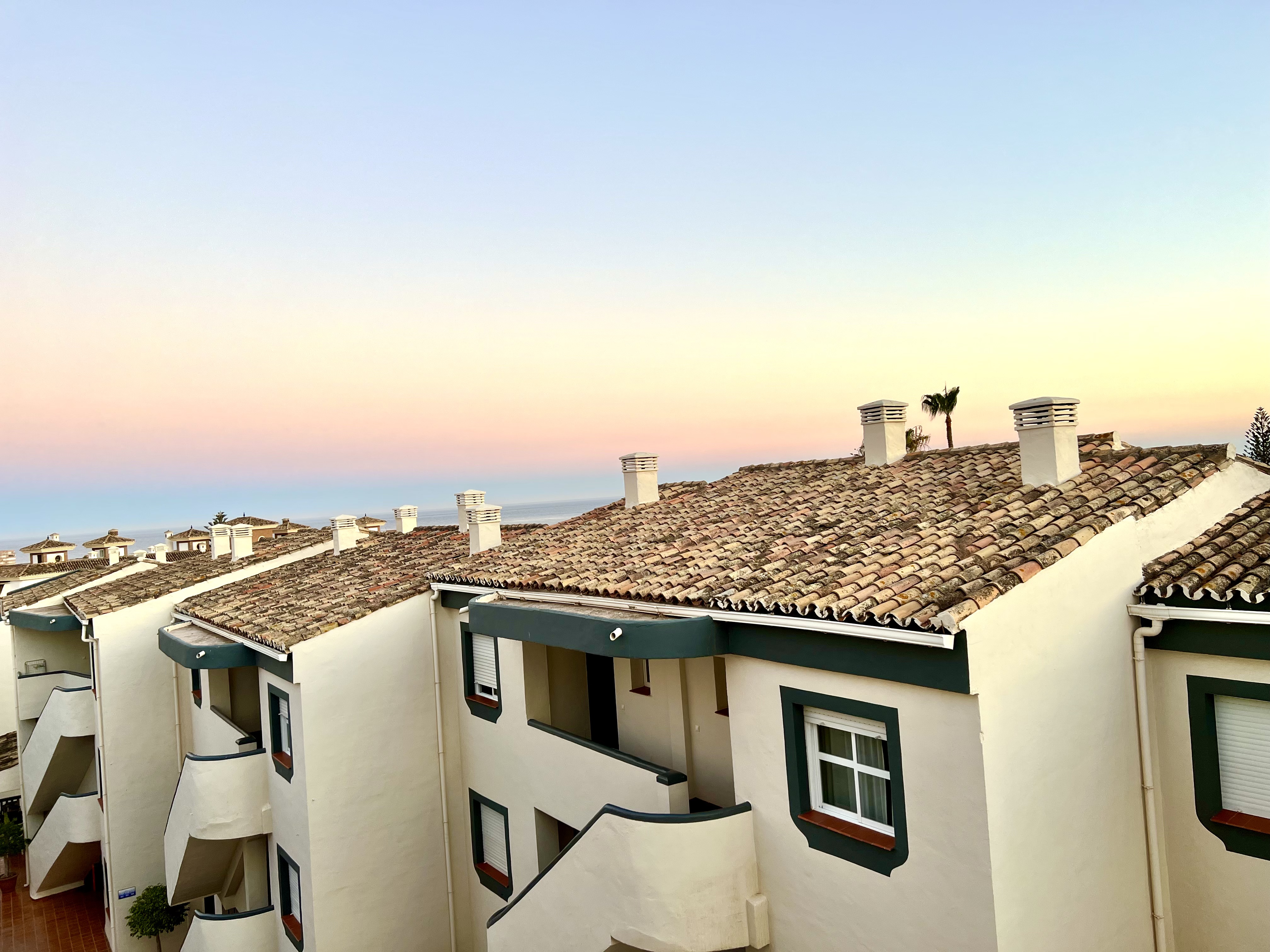
View from the balcony off my bedroom

One reader wrote me to say that a reason that Spain and France are so different is that Spain was governed by the Moors for a very long time and historically Islam has had the greatest influence on Spain. Today, Islam is growing again, especially in younger people, and is the second largest religion after Catholicism. Whereas France, since the time of Charlemagne, has been the most Catholic country in the area we know as Europe until the 16th century when Protestantism began to appear. Even then, Protestantism flourished in Germany, Switzerland, and other parts of Europe, more so than in France. When one adds the weather and the proximity of the Mediterranean sea, it can be expected that the two countries will appear very different. That is what I saw and felt when I first arrived.

Looking out on the sea from the timeshare (photo: Susan Johnson)

Andalusia, which includes the Costa del Sol, is the second largest of the eight communes of Spain. High in the mountains behind Marbella are a circle of villages known as the White Towns because of their white-washed walls and houses. On Thursday last week, we drove to Ronda, the largest and most popular of these towns. Although only 40 km from flat land to town, the road is so curvy through the National Park, that it takes over an hour to get there. Susan did the driving and I was the navigator. I had the help of my Apple map on my iPhone and a voice I called Fred. Fred is terrific. He gives plenty of warning when a turn is coming up or having to take an off-ramp. He even told us when we were approaching a radar for speed. We discussed all the radar and decided that, unlike the US, they were not out to trap us and make money, but trying to regulate traffic. Even so people whooshed by us at top speeds. We never saw much traffic anywhere except on the A7. Nor did we see any police or traffic cops deterring these drivers. Everything is being done on-line these days.

The white washed houses of Ronda (photo: Susan Johnson)

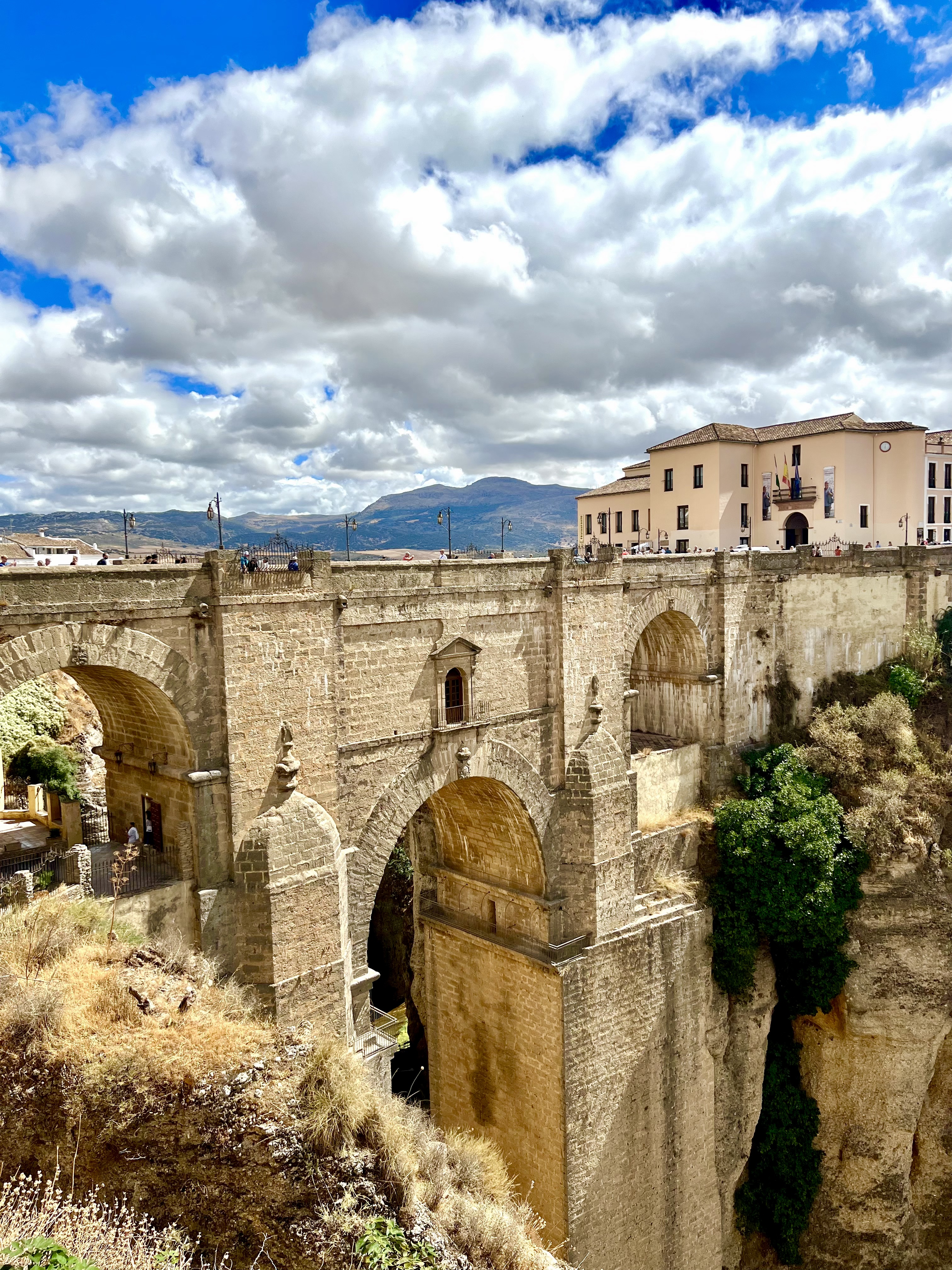
Ronda is famous for the bridge that traverses over a 380 foot ravine connecting the old town with the new as well as its cliff side location. It is the largest of the White Towns with a population of 35,000. From our one afternoon there, I’d say 34,950 live in the new town. There was a large and well-organized carpark where we left the car, and a lengthy pedestrian street from the carpark to Plaza de Toros de Ronda, the oldest bullring in Spain. “American artists Ernest Hemingway and Orson Welles spent many summers in Ronda as part-time residents of Ronda’s old-town quarter called La Ciudad. Both wrote about Ronda’s beauty and famous bullfighting traditions. Their collective accounts have contributed to Ronda’s popularity over time.”-Wikipedia

The drama of the bridge connecting the two parts of Ronda

We had lunch on a balcony overlooking the bridge and wondered how the it was built (I had visions of the movie, Ben Hur and the slaves pulling huge boulders to build Pyramids). Known as Puente Nuevo, it is the youngest of the three bridges that cross the river that separates the two parts of town. It was finished in 1793, 42 years after construction began. Looking over the cliff edge, one can see the Guadalevin river and the other two bridges much lower down. There is a large archeological site (around the city are prehistoric settlements dating to the Neolithic Age, including the rock paintings of Cueva de la Pileta) and Arab baths (dating from the 13th and 14th centuries), both requiring a walk down into the ravine and a walk back up. We chose to pass that up! Once past the bridge, it was quiet. Only tourists walking the town, learning about old Ronda. Even the touristy shops selling linen dresses, brand new tiles, and leather goods petered out as we moved deeper into the old town. Without a map from the Tourist Office, it would have been impossible to know what was what. The overall feeling was one of huge expanse in all directions from the top of a hill well fortified for just in case. We walked the length of the old town and back towards the bullring, the pedestrian street and to our car. We arrived ‘home’ at 7:30pm wanting nothing more than a quick salad and bed!

One of the smaller bridges traversing the chasm-(Photo: Susan Johnson

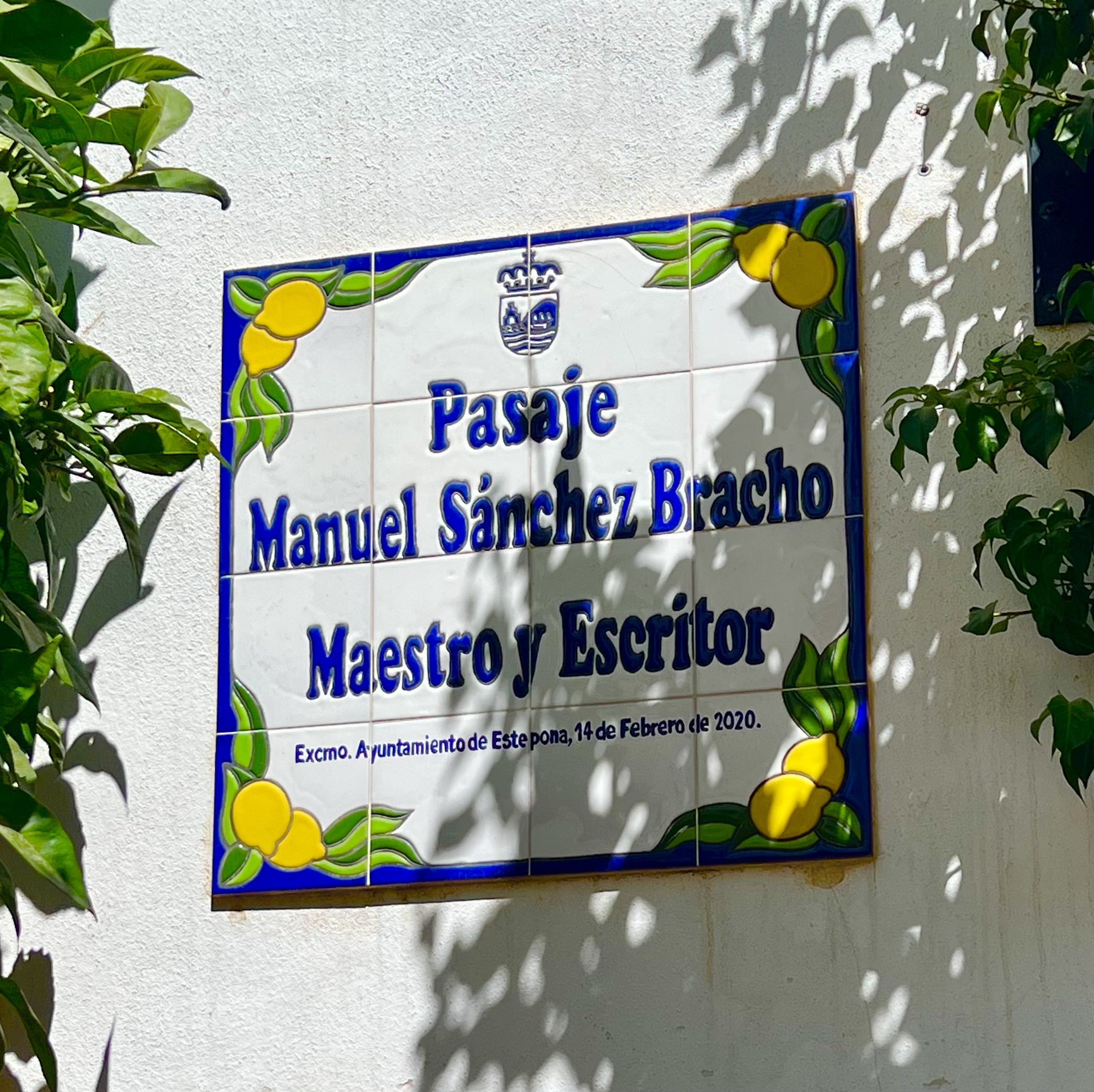
Susan and I decided that we should return to Estepona and find the old town and the narrow streets that the guidebooks gushed over. This time, I asked Fred to take us to the Centro Historico and he got us pretty close. We even found parking two blocks away. What made the old town so lovely was more than the narrow streets, there were flowers and plants everywhere. Pots hanging off walls, flower bushes on either side of doors, and large tall decorations of flowers on the shopping streets. There was also tile. Most entryways had the regular what I call ‘Mexican tiles’. Thoughtfully placed were smaller tiles of animals, angels, and symbols. I wanted to buy masses of the artisan tiles and bring them home with me but where would I put them in my rented apartment?

Walking in the old town of Estepona
Looking in a door at tiling and iron work door

This part of Spain takes a siesta from 2:30pm-5:30pm–at least that is when all the stores close, even the small vegetable markets on the corners. Without people, old Estepona gave off a feeling of a Hollywood set, perfectly assembled and just waiting for some life to happen. It was an eery feeling. We didn’t have too far to walk when one of the streets opened up onto the Plaza des Flores. We found seats at a café and, along with a number of other tourists, had a drink before attempting the walk back to find our car.

Aerial view of Plaza des Flores–photo in the bathroom of a café

One interesting fact: in the 1990s, the Walt Disney Corporation chose Estepona as the site for its EuroDisney project. However, Paris ended up with the installation.

Another use for the beautiful tiles

As we walked, and I was walking with my head down, I was thinking about the fact that I had written that there was no town planning along this part of the Costa del Sol. At my feet were brown and grey stepping stones surrounded by smaller grey stones all placed in a pleasing pattern for the length of a block. The next block over would have a similar pattern. Clearly this town had given a lot of thought to planning. And the flowers and plants were all thriving. Most of Europe has suffered terrible heatwaves this summer. Someone was taking care, watering these plants. And those someones were probably paid by the city. I was far off base. Lesson learned.

Seen on the wall of one of the narrow streets we walked down.

I write this from Paris thinking back on the week. The absolute best part of the week was the rest I got. They say that mediterranean countries move slower and are more laid back. Perhaps the three of us caught the southern bug. We moved slowly, only went places we really wanted to see, and made simple dinners every evening. That felt like a luxury. And what a vacation is supposed to be.

A bientôt,

Sara

Toto, we aren’t in France anymore

Spain is so close yet so far away. It is a short plane ride or train ride but the culture is so different. Feelings about color are different, the art is different, the cities are different. Paris is considered the most beautiful city in the world. I don’t think any city in Spain would be on a list of the top ten. Going to Spain feels like a journey of a much greater distance.

I flew to Seville from Charles de Gaulle airport last Saturday in two hours. I am with two friends who have rented a timeshare in Marbella on the Costa del Sol. A quick exit through the airport and finding the rental car, off we went south-east to find the ocean. For the first hour, the landscape was not inviting. Arid land populated with what we think are olive trees and not much else. About two thirds of the way to our destination, the landscape became hilly with deep arroyos. This was much more interesting. There was nothing on this land. Nada. No people, no other roads, no structures. We made a mistake with our directions and had to go back the way we came for 30 minutes. There were no off-ramps, nowhere to go in this landscape of hills and ravines except forward. We finally were able to turn around and head back towards the ocean.

We are staying in Mijas, close to Marbella. The A7, a four lane highway, runs along the coast from Malaga to Algeciras. It is busy at all times of the day. There is no demarcation between towns (or cities–it’s confusing as to what they are) and reminds me of Route 1 on the East Coast where one city runs into another.

I can think of many words to describe the villages of France: quaint, piccaresque, charming, etc. None of these words apply to this part of Spain that you can see from the A7. No thought has been given to town-planning. Monstrous timeshares litter the sides of the large hills looking like cruise ships plastered against the golden brown background. Billboards of all sizes line the A7 giving a sense of a very large population. One has to know where to find the good walking beaches as many have stones galore and hurt your feet as you test the temperature of the water.

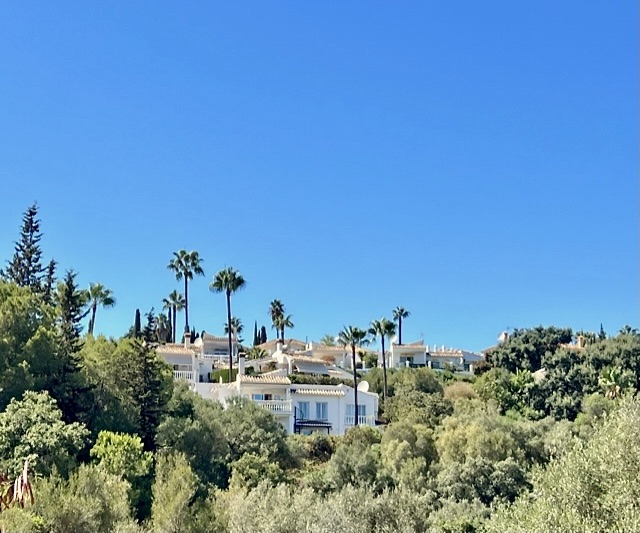
Homes high up in the hills of Mijas or Marbella

However, following streets upwards into the hills, one can see what attracted people to this part of the world before it became so popular. The houses are white, large, gated, with flowers everywhere. The hibiscus is the most popular this time of year. Views of the ocean pop up at many turns and there is no sign of the A7 or the hundreds of billboards,

Promenade along the beach at Estapona

On Sunday, we drove to the town of Estepona south of Mijas. My apple map on my iPhone took us to the port where we found a parking place. Our intention was to find the old town and wander the small streets where no present day car could possibly go. We stumbled on the closing of the Sunday outdoor market and my friend bought a skirt. We then asked directions to the old town. We strolled along a promenade that clearly had been thought out, had flowers planted along the side closest to the road and an overhang that balanced out the railing on the beach side. The beach, not crowded, was wide as a football field and people were lying under umbrellas. There were par courses along the way. Children were taking advantage of them, climbing on walls, swinging on foot machines. We never did make it to the Old Town so we have yet to see the tiny streets of old Spain.

South of Spain, a short ferry ride of 40 minutes from the town of Tarifa, lies Tangiers, a city that seems mystical. A city beloved by Kerouac and Matisse and many artists of the 20s through the 50s who spent time there. We couldn’t miss a trip to Tangiers! So we left the timeshare at 6am in order to catch the 9am ferry. After standing in a line to get tickets, a line for passport control, a line to go through security, we lined up to get on the ferry where we stood in another line to have our passports stamped by the Moroccon police. Only after every passenger had done that, did the ferry start to move and make the trip out of Europe towards Africa.

Getting ready to go to Africa

Every guide book will warn you of every thing that can go wrong in Morocco. I remember visiting the old city of Jerusalem my first year out of university. The Arab world is a culture shock. I wasn’t wise enough to be scared but I felt lost. I couldn’t speak the language, women were not encouraged to be traveling on their own, and small children begged constantly. Yet, I was mesmerized. Everything was colorful, I’d never seen goods hanging on doors, from the ceilings, baskets and baskets of spices or eggs or jewelry. I imagined Tangiers, the old city, would be much the same. Leaving the taxi that took us to a gate to enter the old city, we immediately came to a market. We wandered around not sure what we were doing, grown men begging to be our guide stopping us every ten minutes. We finally found our way into the Medina, the most interesting part of the old city and found a very old man, Salam, had attached himself to us. He spoke French. The streets were like a maze leading us deeper and deeper into a warren. The open air shops turned into regular shops where we would step inside and see beautiful tile work or men weaving rugs. The dirty streets changed into lovely white streets with houses surrounded by bougainvillia. We were headed to the Kasbah and were climbing. Salam pointed everything out to me, where a famous American lived and died and later the garage where he kept his Rolls Royce. After hundreds of steps, we arrived at a wall with an arch. Walking through the arch, we got a view of the port, new Tangiers and a huge expanse of ocean. It is breathtaking.

The Kasbah is a large living area with a mosque that is now a museum, shops and little alley ways that reminded me of Santorini. We had been on our feet for five hours at that point and we were all feeling it. We were planning on a 4pm ferry ride back to Spain but thought we’d go early in case of an earlier time. There wasn’t. We descended into the lower market areas that reek of poverty. It seems a small thing to give some man or student a couple of euros to guide us around and tell stories. But Americans are warned off.

selling chickens on the street.

We made it back to our car by 6:30pm CET (Morocco is an hour behind Spain) and drove the hour and a half back to the timeshare. All three of us made a salad, ate it silently, and went to bed.

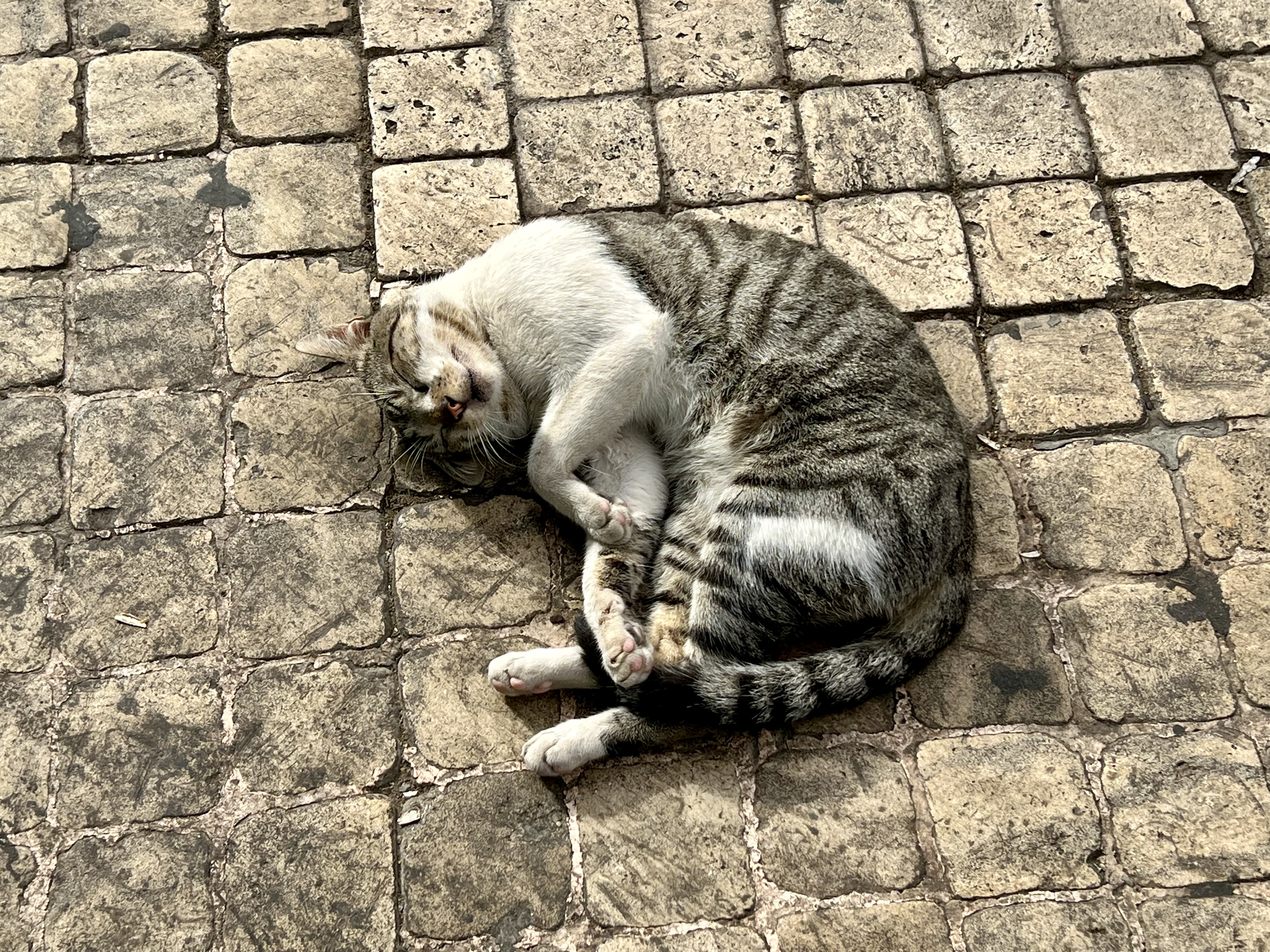
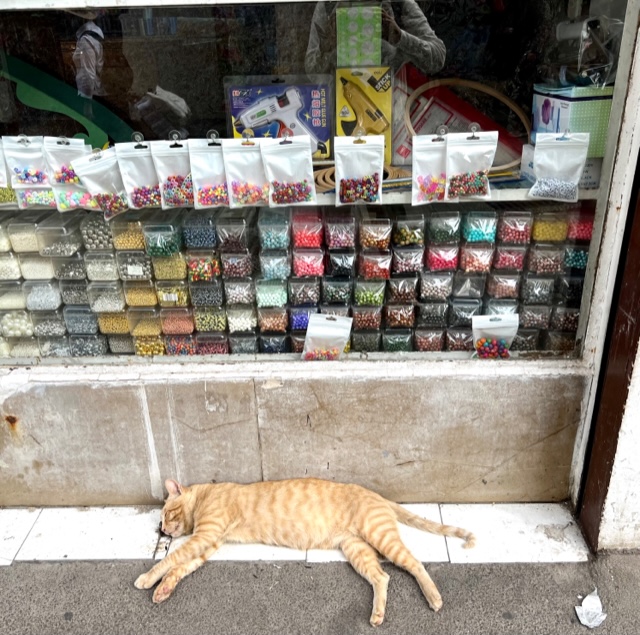
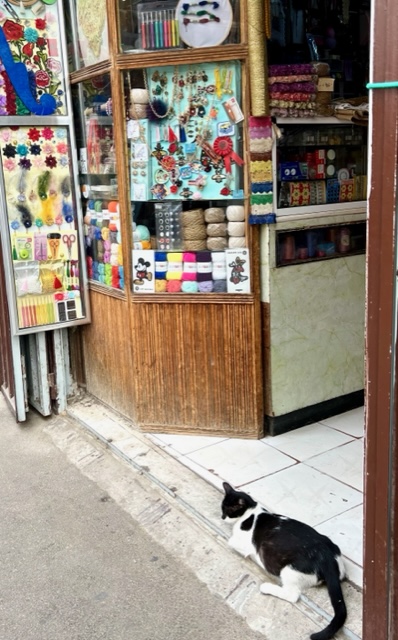
One thing I haven’t mentioned is the cats of Tangiers. They are everywhere. They are gentle, clean, friendly, have no fear of people. Almost every store had a cat near it. The parks had cats, the cats took naps in the middle of sidewalks, the cats looked longingly at you if you held out a finger and said “Cou cou.” I asked one of our guides if people had cats as pets. He said yes some families do. Mostly the cats hung out in the Medina.

Cats, it seems, have been revered for centuries in Muslim culture. So much so, that one of Prophet Muhammad’s companions was known as Abu Hurairah (Father of the Kittens) for his attachment to cats. The Prophet himself was a great cat-lover– Muezza was the name of his favourite cat.–The Guardian.

As the days have gone by, the area around the timeshare seems to have gotten prettier! I think I am so spoiled by living in Paris that I’m far too hard on other areas in Europe. Next week, I’ll share about the white hill towns of Andalucia.

A bientôt,

Sara

La Rentrée

Most of us know there are four seasons in the year. In France, there is a minimum of five seasons. The one we are in presently is known as La Rentrée. Literally the word mean ‘The Return’. It’s the time when all Parisians come home from wherever they spent August, and in some cases, July and August. Children prepare for school, and, even though the weather may still feel like summer, it’s the beginning of Autumn.

To understand “La Rentrée”, one has to understand the month of August. During August, almost everything stops. More than half of stores shut down. Restaurants, that are not in the tourist center, close for the month. The trains all do whatever repair work needs to be done. Many of the lines do not run. In August, the government is not to be found. As friends part for the summer, you can hear them say “A la rentrée” which loosely translates to “See you in September.” In other words, every single person in France knows that if you include ‘la rentrée’ in a sentence, you are referring to that season beginning September 1 when everything starts anew. Clothing stores have fresh stock. Children are back in school. The government gets back to work. And every supermarket has huge sections of space dedicated to schoolwork, creative work, and office work. If you have a favorite pen and haven’t been able to find another just like it, chances are very good, you will find it at the Carrefour or Monoprix during La Rentrée. It is a time of celebration and many parents will hang around their children’s school catching up with a drink or two in their hands.

I love it when every store stocks up on notebooks, paper products, pens of all different sizes, tips, and comfort. I will stand far too long in front of these aisles telling myself I don’t need anything (I have enough journaling notebooks to last me well into the next decade), and still end up at the cash register with a new pen and perhaps a folder. I love to write on paper. The computer is fine but pen to paper…there is nothing like it.

And … Writing. I did not make it into the Stanford Certificate Program. When I received the e-mail, my first feeling was of disappointment. My second was relief. I had started a summer course at Stanford Continuing Education in Short Story writing. I was beginning to get an idea of how much time just one course requires. I had no trouble finding the time. I was like a human vacuum cleaner sucking up all the knowledge that was available. So, along with reading published short stories and commenting on them, we each wrote a short story, had a workshop and every student commented on every other students writing. It was terrifying and glorious. When I magnified the work out two years, I wasn’t at all sure. Did I have it in me to write this novel I want to write. Or perhaps I should be sticking to what I do well, non-fiction writing. Since it was August and no one thinks in August, I put off any contemplation until September. I’ve signed up for another Stanford course and cannot wait for it to begin. And, by the way, I got an A+ in my class. I believe it is the first A+ I’ve ever gotten in my life!!!

Female and male peacock after mating season has ended. The male has shed his tail.

Lastly, and I’m taking huge license with this one, even Parc de Bagatelle and some of its creatures are starting anew. The male peacocks are molting which means they are shedding their gorgeous tail feathers!! I had no idea. After mating season ends, since tail feathers are not regenerating, they slowly fall out. When I was there this past Sunday, there were only a few colorful feathers on the backs of the males I saw. Here is some fascinating information from a website called: peacocksuk.com

Male peacock last week in August

“The peacock has around 150 to 175 long tail feathers or long covers which sit over shorter strong tail feathers. These shorter feathers  support the weight of the long tail covers which grow to three to four feet long. As the peacock matures to five or six years old, the peacocks tail feathers grow in size and the number. As the peafowl reaches maturity the eyes on the tail feathers become larger. At maturity the peacocks tail will be constant each year as long as the peacock is in good health. If several males are kept together we have found that the subservient males will not grow or develop a tail as striking or large as the dominant peacock.  If these birds are removed from the pen with the dominant male the upper tail feathers then develop! After the peacocks long tail covers have moulted the new tail begins to grow in the autumn, reaching maturity in time for the next mating season in the spring.”

A bientôt,

Sara