The Red Wheelbarrow Bookstore

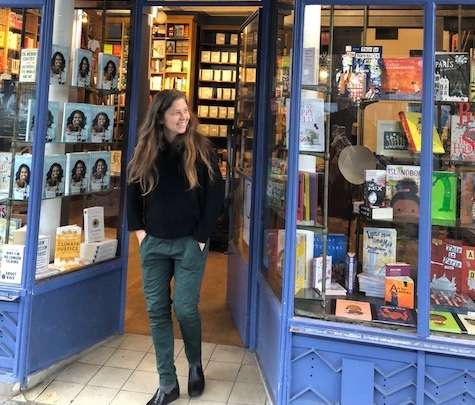
Penelope Fletcher at the door of her bookstore, The Red Wheelbarrow

Before I moved to Paris in 2013/14, one of the most popular English language bookstores closed in 2009. Penelope Fletcher assures friends that it was for personal reasons and had nothing to do with Internet competition. Now that it has reopened nine years later, the outpouring of love and gratitude for the return of the Red Wheelbarrow got me investigating Penelope and her bookstore.

The name comes from a sixteen word poem by William Carlos Williams entitled The Red Wheel Barrow. I have yet to learn what the significance is. I sense it is important. When Penelope and her associates first opened the bookstore, it was located in the Marais. It has now re-opened at 9, Rue de Medicis across from the Luxembourg Gardens in the 6th arrondissement. “People like Umberto Eco lived here,” says Fletcher. “There’s this very rich community of writers and characters here. I didn’t realize it still exists.” This location is poignant in Paris’s bookstore canon; the store’s building has been a bookshop since 1930, and before Fletcher and her associates acquired it last year it was the last remaining secondhand science bookshop in France.–Paris Update, Nov. 6, 2018
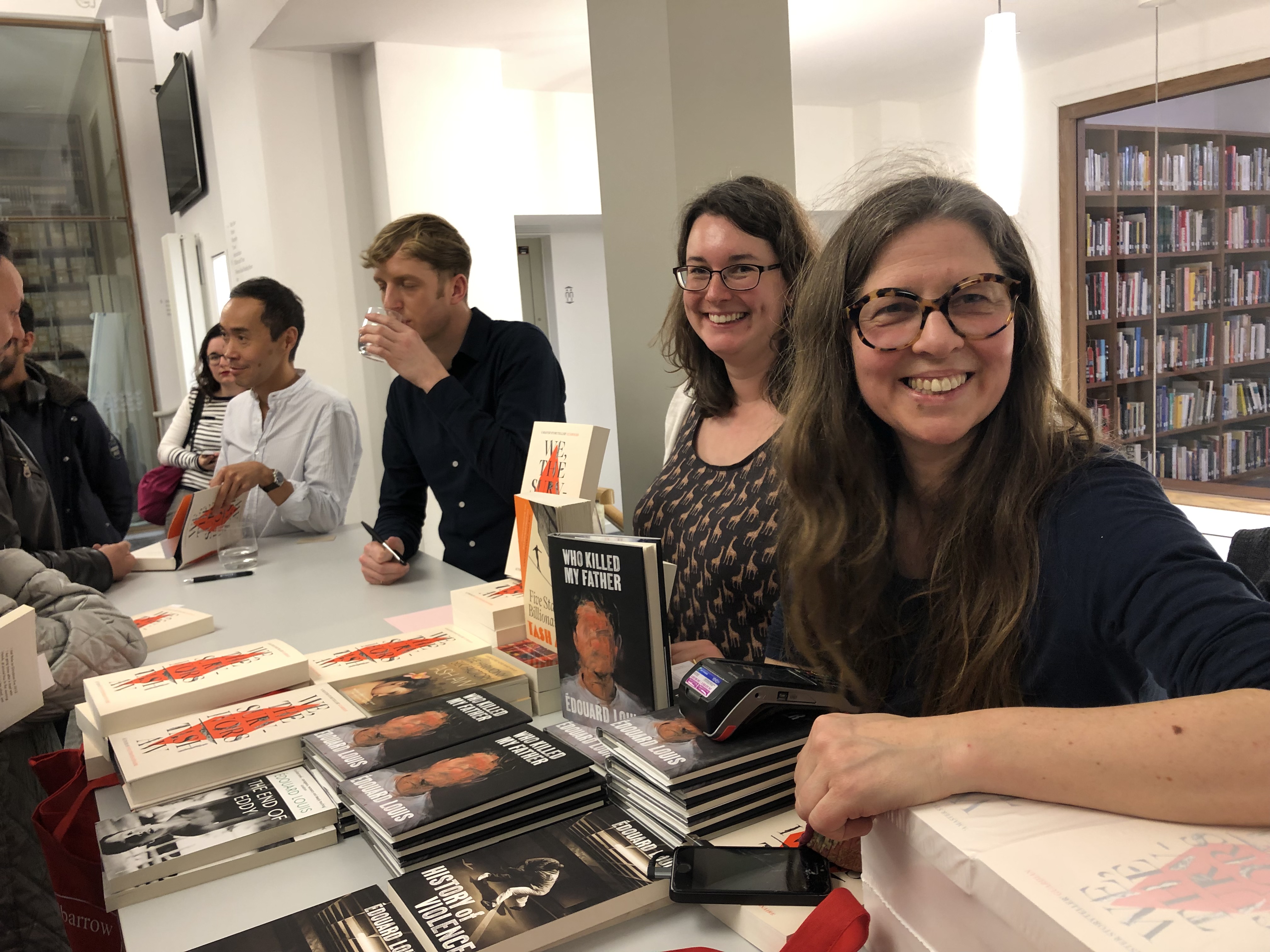
Tash Aw, Edouard Louis signing books at the American Library with Penelope and a volunteer selling the books.

I first learned about TRW because, from the minute it re-opened, it became the partner bookstore for the evening events at the American Library in Paris. One or two times a week, Penelope shows up on her bicycle with bags full of books to be sold and signed by the spotlighted author of the evening. The respect and admiration that surrounds Penelope and the many articles that have been written about the re-opening have made me extremely curious. I thought the most well-known Anglophone bookstore in Paris was Shakespeare and Company. It has resided in one form or another in Paris since 1919. I had stopped by a couple of times when I lived close to it but found the used books to be so expensive that I stopped going. After reading a lovely book about the Tumbleweeds (students and travellers with no where to spend the night and stay at Shakespeare in exchange for work) that have stayed there over the years, I returned about two years ago. I walked through the space which is a delight but was not greeted by anyone and when I tried to talk to the owner Sylvia Whitman, daughter of 2nd owner, George Whitman, and someone manning the cash register, I was greeted with total silence as if I was invisible. I haven’t returned since. My Anglophone bookstore of choice became San Francisco Book Co. I could buy and sell used books there and have a lively discussion with one of the two owners if I had the time.
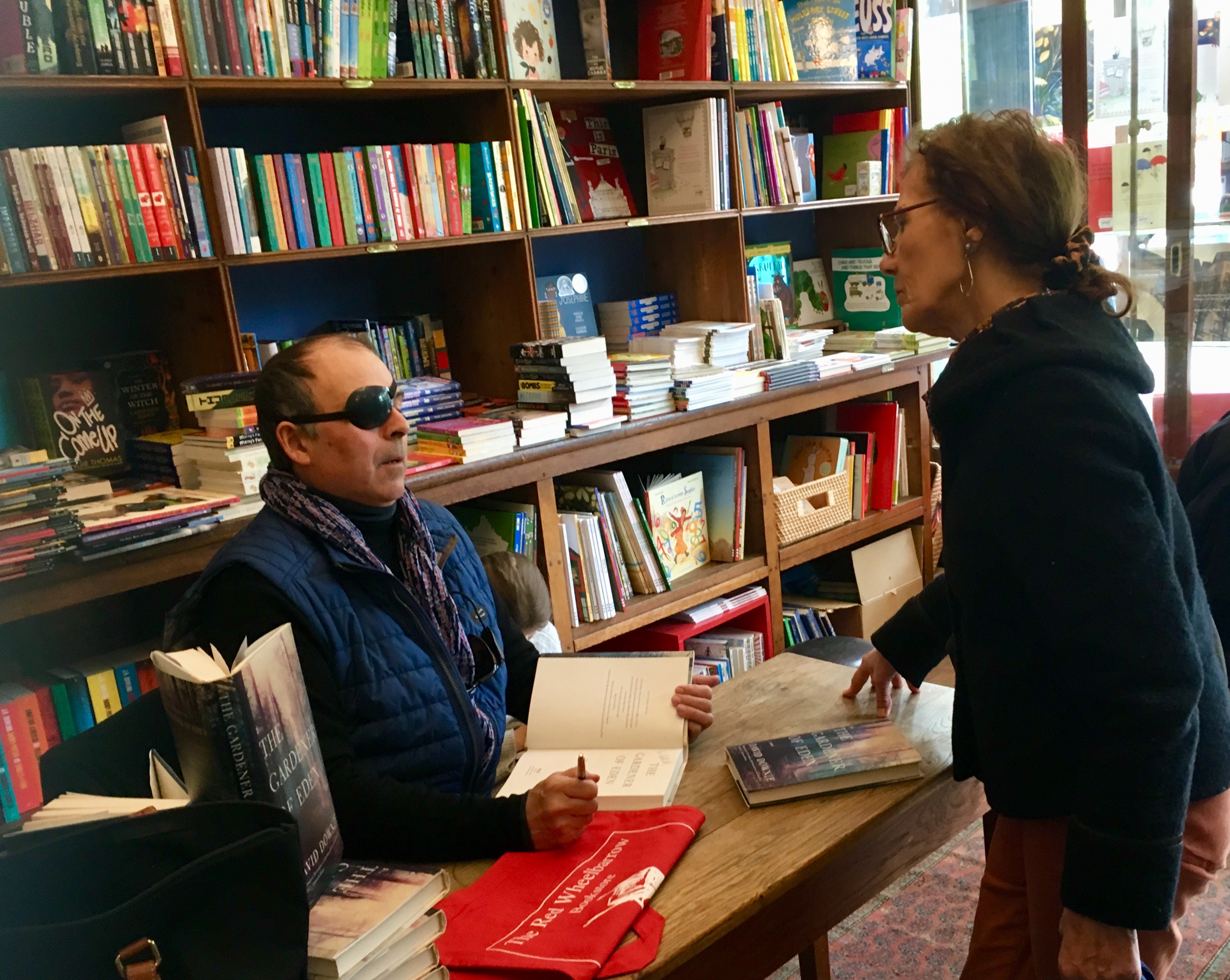
David Downie signing books on a Sunday morning in April.

In April, I went for the first time to The Red Wheelbarrow for a book signing by an author I like: David Downie. My sister and Nancy MacLean will be doing an event there on July 3 and I wanted to see the space and how it might work. Peggy and Nancy are speaking at the Library the night before and I wanted to make sure that the 3rd would be low-key and very casual. I needn’t have worried at all. David was seated at a table and signing books and I knew almost everyone who walked in. I also ran into Michael Ondaatje which got my ‘groupie gene’ activated. There were ladders next to the walls and Michael was climbing up one checking out books that were very high, close to the ceiling. The bookstore is small and filled with books. The windows in front tell an immediate story of who Penelope and her associates are and what the bookstore is.
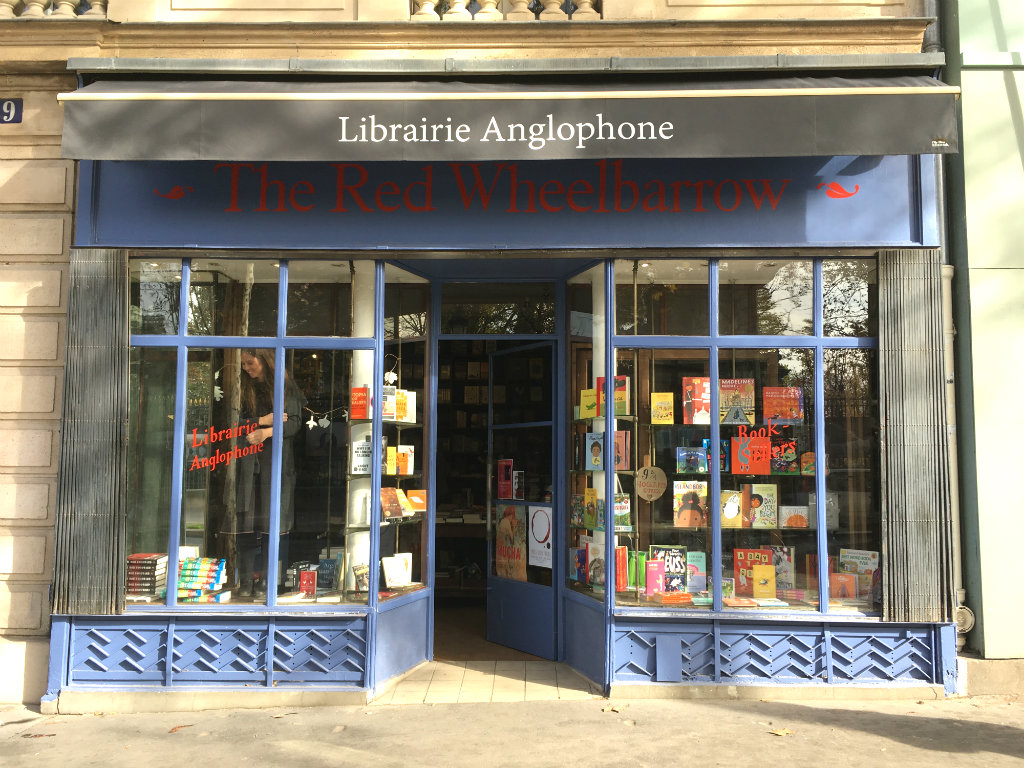
Penelope in the window still organising the windows in the first months of the re-opening.

At the old bookstore in the Marais, Penelope had created a ‘neighborhood’ of book lovers. Visitors to the bookstore became friends and Penelope would introduce new visitors to old. When this bookstore opened last Fall, the ‘neighborhood’ moved with her. Penelope has a dream of community. She wants to serve as a refuge of positivity in uncertain times. According to the Paris Update article I read: “The shop window makes the store’s politics clear: on display are Innosanto Nagara’s A is for Activist and Jason Stanley’s How Fascism Works. An upcoming event with James Baldwin’s nephew Tejan Karefa-Smart will promote the reissue of his uncle’s book Little Man, Little Man: A Story of Childhood. These choices are especially relevant, and perhaps brave, as right next door to the Red Wheelbarrow is an extreme-right bookstore.

“You never know what’s going to happen with a bookshop,” says Fletcher. “You have to roll with the haywire. Because we have the extreme-right bookstore next door, we have to be extremely attentive to what we’re doing and be an opposition, and be more powerful, and be more positive, and be cleverer than them. Which is a challenge, because they’re very clever.”

She feels a responsibility to oppose the kind of hatred represented by the shop near her peaceful little store. “One of our co-owners survived the Holocaust, so of course her whole life has been dictated by this. Another one is African American – we are all directly impacted by what their intention is.”
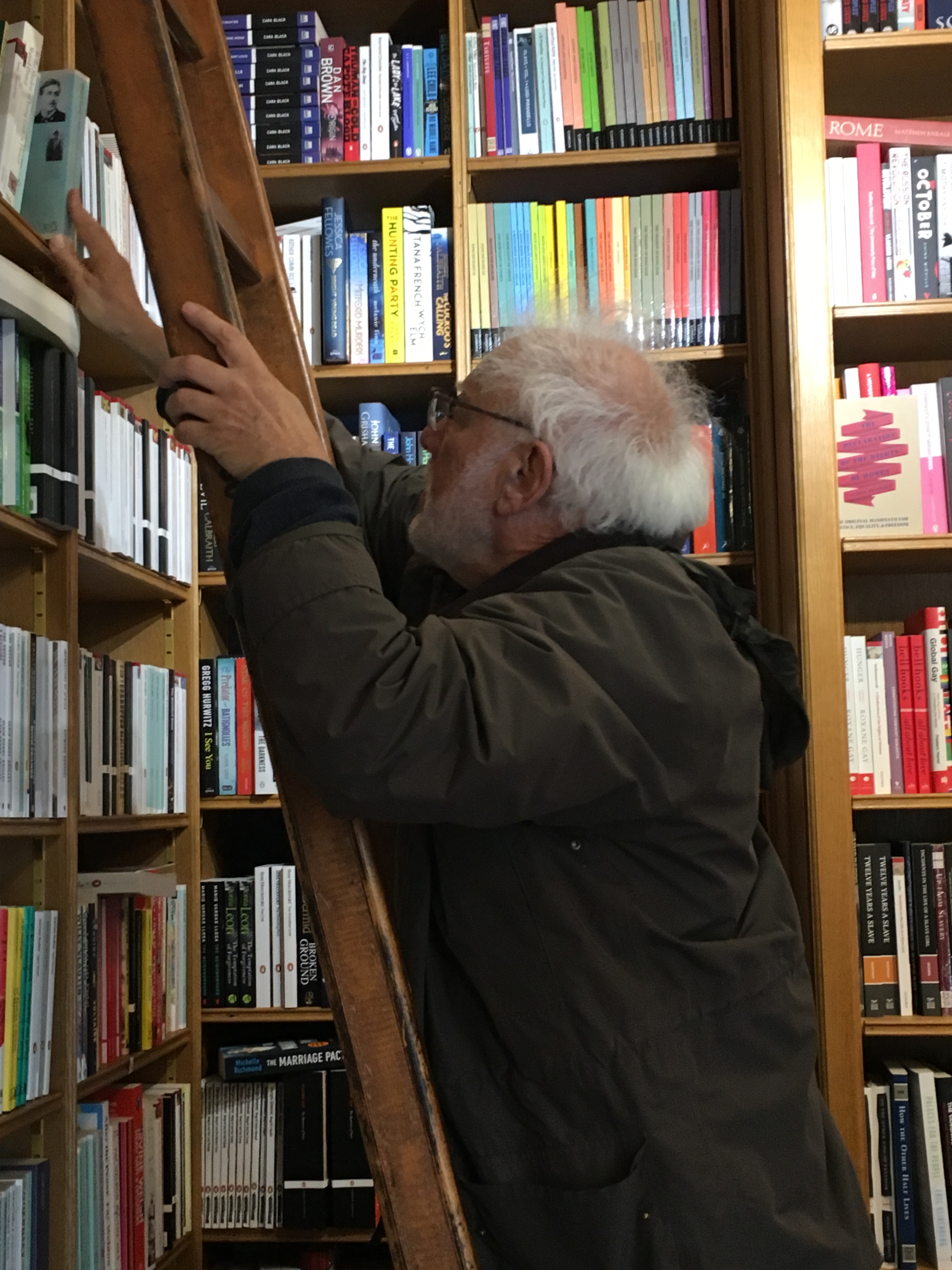
Michael Ondaatje

Paris Update article: https://www.parisupdate.com/red-wheelbarrow/
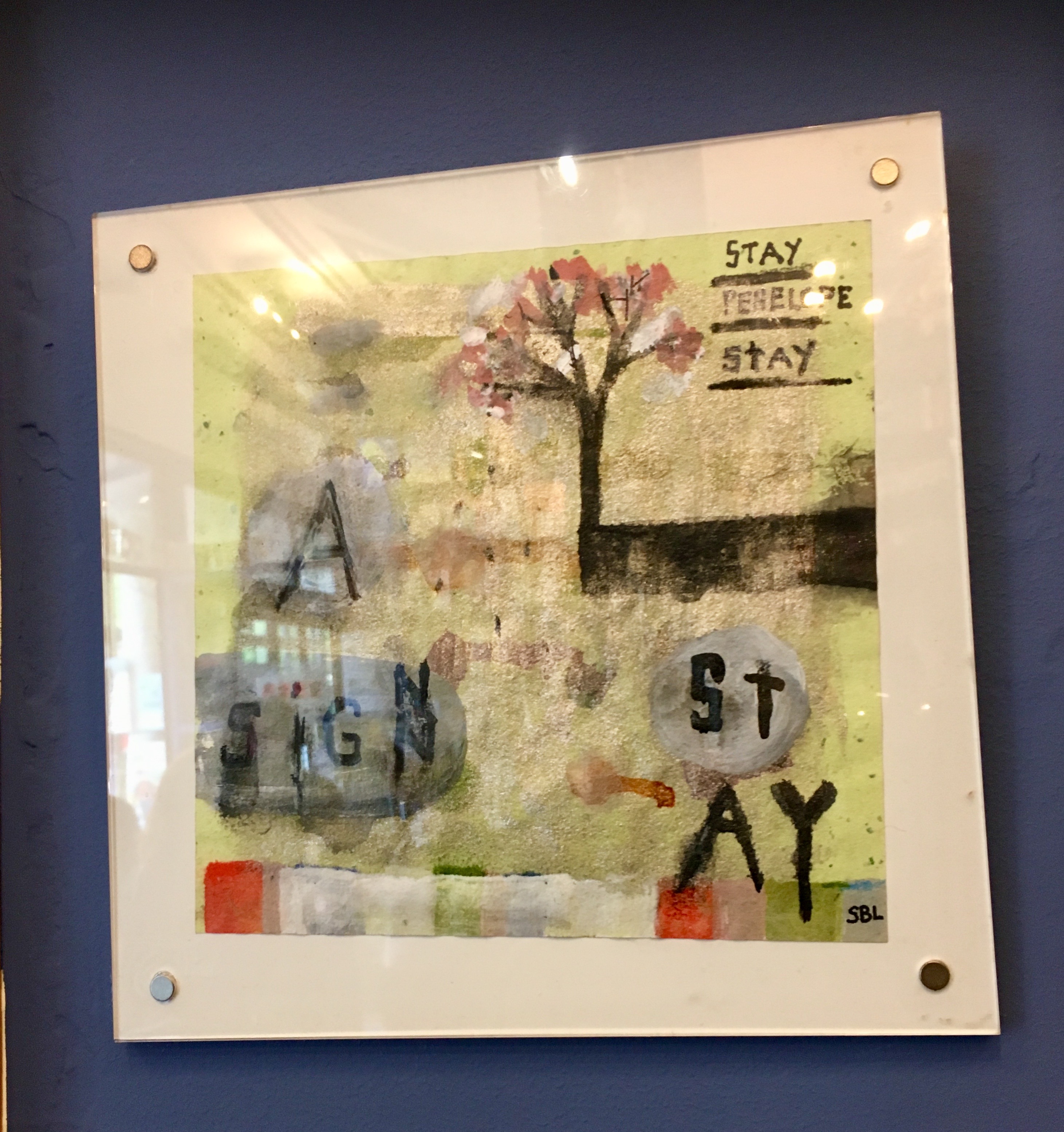
Artwork hanging in the re-opened bookstore

I urge residents and visitors alike to support this wonderful bookstore that is more than a bookstore.

The Red Wheel Barrow

so much depends

upon 

a red wheel

barrow 

glazed with rain

water 

beside the white

chickens. –William Carlos Williams

Canadian Penelope Fletcher, the founder of the English bookstore, has found new partners and is again dedicated to providing one of the best English literary experiences in Paris. The location is pure Paris postcard with large, bright blue picture windows overlooking the park. Afterwards, head to the park to spend the afternoon reading.

  • 9, Rue de Médici
  • 6th Arrondissement
  • Metro – Saint Sulpice
  • Website

A bientôt,

Sara

Grabbed my journal, rushed for the C train (Notre-Dame part 2)

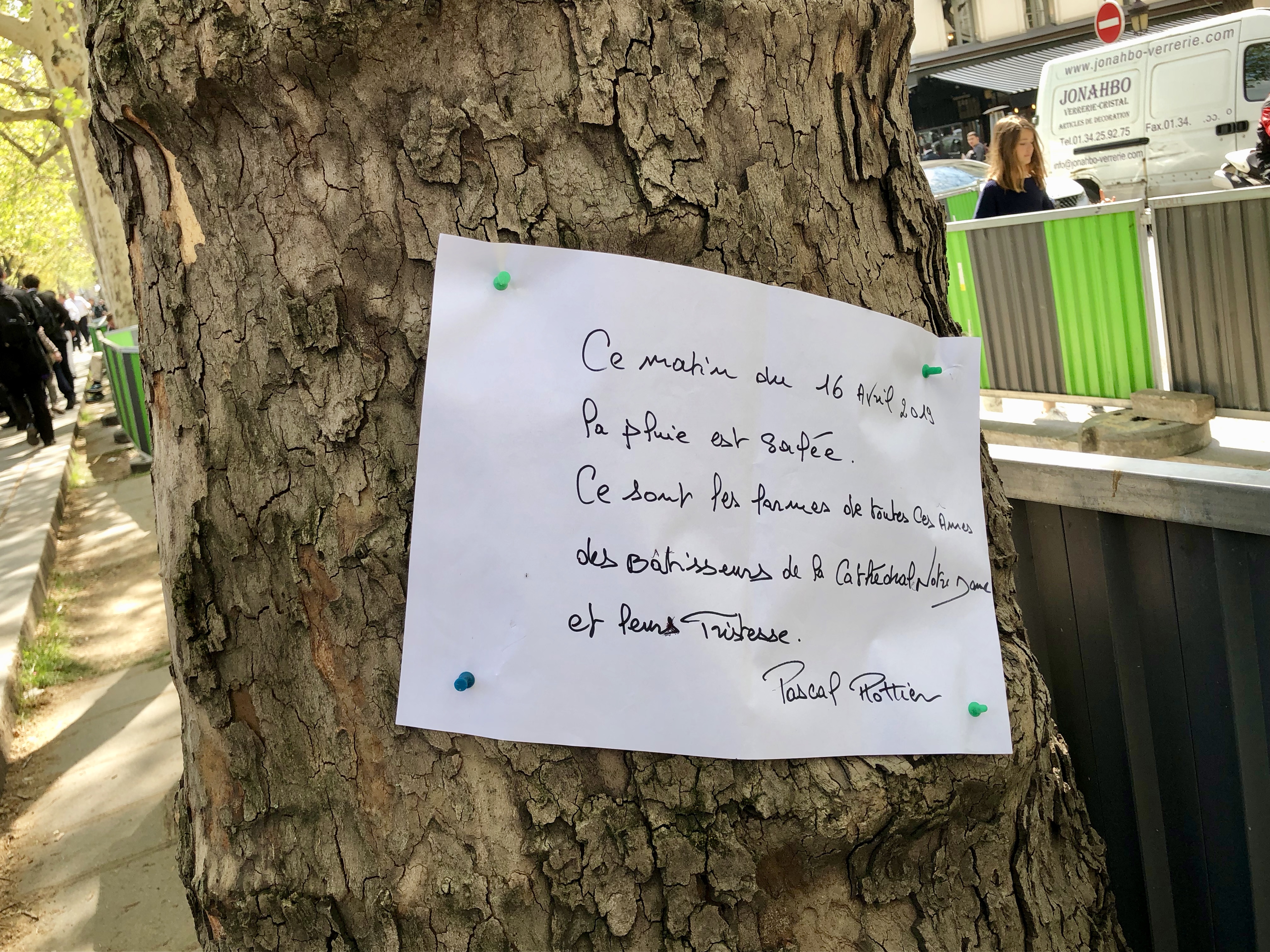
Only it didn’t happen that way. My plan had been to go to ground zero, Notre-Dame de Paris, Tuesday. I needed to see the devastation, the people, the burned debris on the ground. The day was cold, the sky was grey, Paris was in mourning. My body, exhausted from lack of sleep and anxiety, refused to move.

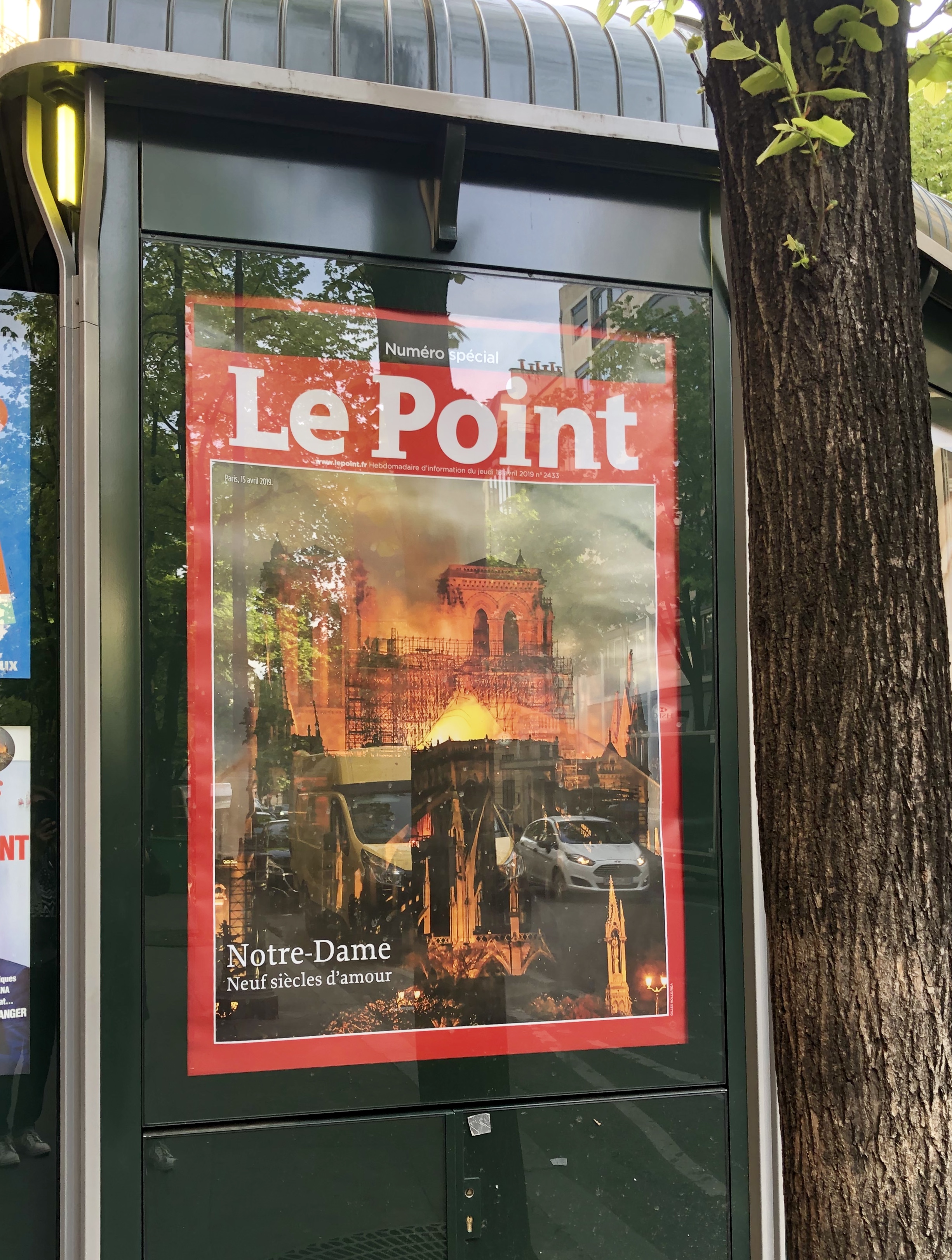
The final little fires were put out early Wednesday morning. Five hundred firefighters fought through Monday night into Tuesday morning containing the flames. One hundred of them made a long relay line and carried out precious art pieces. Tourists and Parisians alike came down in the morning hours, in the light of day, to see the devastation and saw that the main structure had been saved. The news told us that there was about an hour in the early morning when it could have gone either way. Thanks to the work and determination of five hundred pompiers (firefighters), we still have our Notre-Dame albeit in a very wounded state.

That morning, I made up my mind to join the throng of people. But every god conspired against me. I couldn’t find my walking shoes. My apartment is small enough that things get hidden away when I have company. Well hidden it turns out. My jeans didn’t fit, my lunch carrots had gone slimy bad. I didn’t even know that carrots could get slimy. One thing after another for forty-five minutes challenging my desire to get down there.

Finally I was on my way to RER C. I slide my Navigo over the turnstile and ran down the stairs. The electric billboard said the next train was coming in twenty-six minutes. “No, not another obstacle?” I muttered in English. A few elderly ladies turned to look at me. I made the walk to metro 9, got on, changed to metro 1 and got off at Pont Neuf.

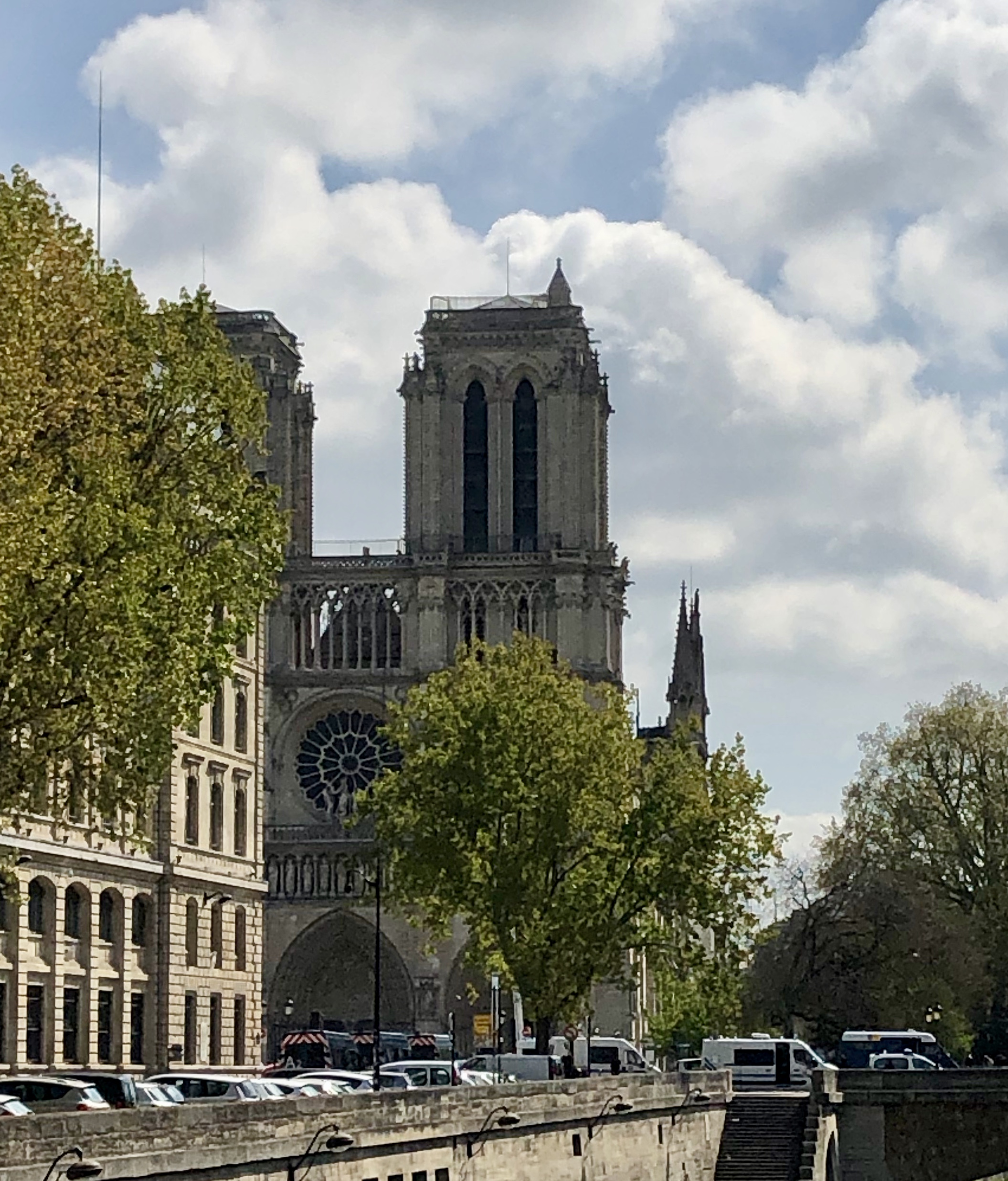
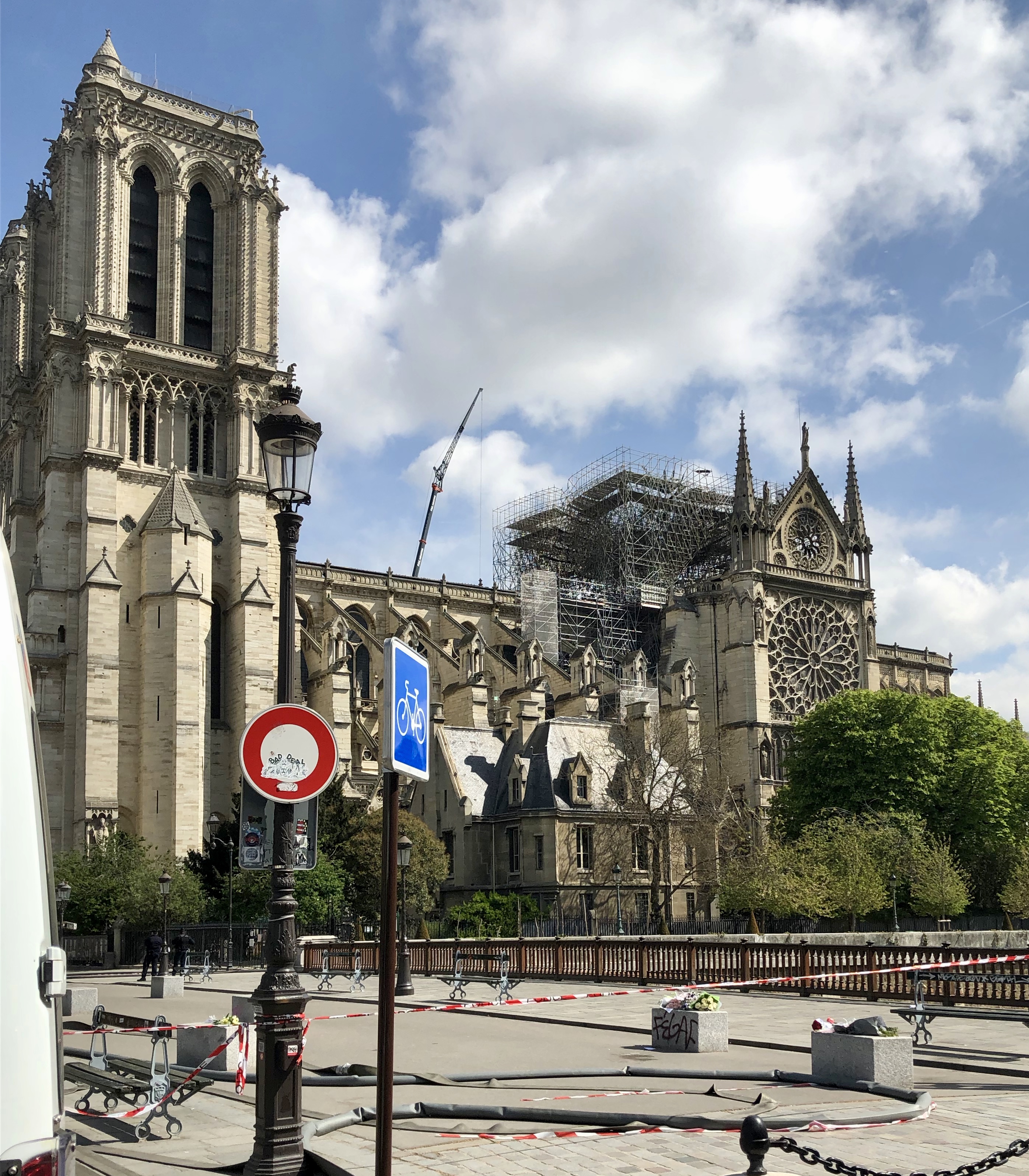
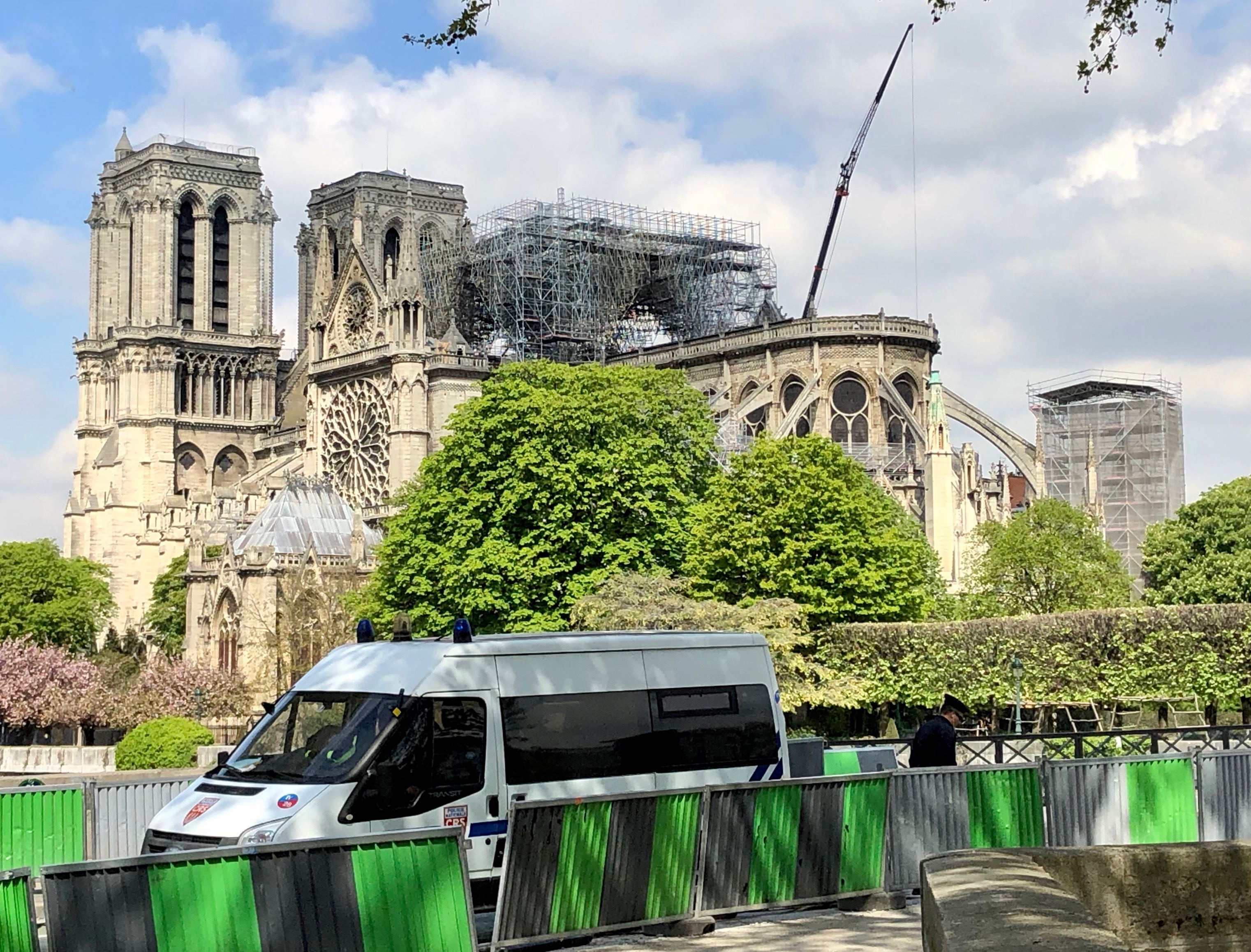
I crossed the Pont St. Michel and got my first glimpse of Notre Dame: the right bell tower. I burst into tears. It looked exactly the same as before the fire from that angle but eighteen hours of holding back my ‘tristesse‘ opened the flood gates. I couldn’t stop crying. I walked by tourists who seemed unaware of the drama that had unfolded there Monday night. I turned left on Quai St. Michel and, as I approached le Petit Pont, more and more people were gathered gazing at the cathedral. Everyone seemed solemn, no one was pushy or aggressive. Some could see well, others couldn’t. The police had cordoned off everything from Pont St. Michel down as far as Pont de l’Archeveche. Firehoses snaked over the ground in front of us. The Gendarmes stood like sentries at the plastic red and white tape that separated us from them. The Station St Michel/Notre Dame was closed for both the RER C and M4. Cité must have been closed because no one was allowed entry to the parvis in front of the Prefecture.

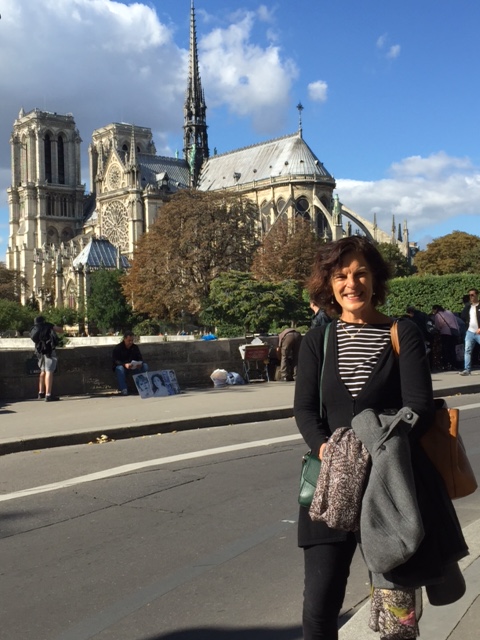
I wanted to walk to Pont de l’Archeveche. I was hoping to take a photo at the exact same spot as the one that was taken of me three or four years ago. Some of the bouquinistes were open. I bought two sepia postcards of the view of the back of Notre-Dame. When I got to the bridge, it, too, was cordoned off. Patiently I waited for a spot to open up and I was able to get close enough to get my photo.

I stood there for awhile, just looking and my tears came and went. I was listening to Joan Baez on Spotify and she started singing ‘Amazing Grace‘. As I was listening and gazing at this beautiful structure that has stood on Ile de la Cité for 850 years, I realized just how much of it was still standing. The firemen DID save her. The sadness started to transform into hope. A friend of mine wrote me and said “it’s like she’s been horrendously wounded and stands suffering for all to see.” Wounds heal, suffering passes.

Almost the same spot as a photo of me (in the last blog) was taken 3 years ago.

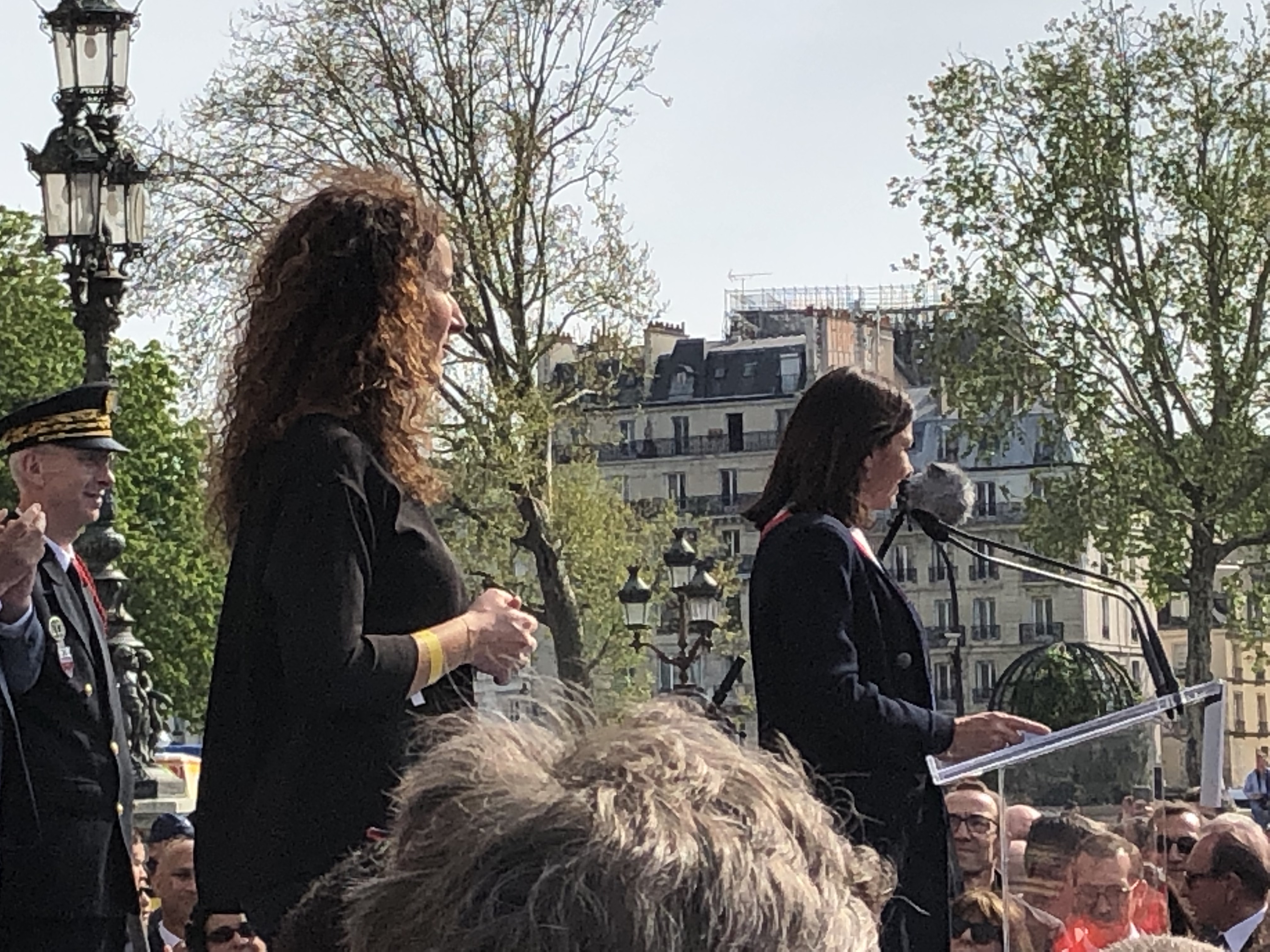
Yesterday, Thursday, Mayor of Paris, Anne Hidalgo invited all citizens and ex-Pats to Hotel de Ville (City Hall) for a ceremony to thank the Pompiers for risking their lives, working through the night and saving Notre-Dame. After she told us that she would be requesting that the pompiers be accorded honorary citizenship of the city of Paris, the actor, Nicolas Lormeaux, read an excerpt from Victor Hugo’s Hunchback of Notre-Dame.

Mayor Hidalgo and signer for the deaf

In the novel, Hugo, one of France’s most acclaimed writers, describes, in 1831, flames in the Cathedral when Quasimodo uses fire and stones to attack Truands in order to save Esmerelda.

“All eyes were raised to the top of the church. They beheld there an extraordinary sight. On the crest of the highest gallery, higher than the central rose window, there was a great flame rising between the two towers with whirlwinds of sparks, a vast, disordered, and furious flame, a tongue of which was borne into the smoke by the wind, from time to time. Below that fire, below the gloomy balustrade with its trefoils showing darkly against its glare, two spouts with monster throats were vomiting forth unceasingly that burning rain, whose silvery stream stood out against the shadows of the lower façade.

As they approached the earth, these two jets of liquid lead spread out in sheaves, like water springing from the thousand holes of a watering-pot. Above the flame, the enormous towers, two sides of each of which were visible in sharp outline, the one wholly black, the other wholly red, seemed still more vast with all the immensity of the shadow which they cast even to the sky.

Their innumerable sculptures of demons and dragons assumed a lugubrious aspect. The restless light of the flame made them move to the eye. There were griffins which had the air of laughing, gargoyles which one fancied one heard yelping, salamanders which puffed at the fire, tarasques which sneezed in the smoke. And among the monsters thus roused from their sleep of stone by this flame, by this noise, there was one who walked about, and who was seen, from time to time, to pass across the glowing face of the pile, like a bat in front of a candle.

Without doubt, this strange beacon light would awaken far away, the woodcutter of the hills of Bicêtre, terrified to behold the gigantic shadow of the towers of Notre-Dame quivering over his heaths.”

Translation by Isabel F. Hapsgood

If you wish to donate to the rebuilding of the Cathedrale de Notre-Dame, Please go to this site: https://don.fondation-patrimoine.org/SauvonsNotreDame/~mon-don

A bientôt,

Sara

The Fire at Notre Dame

I had just arrived at the American Library when I was told there was a fire at the Cathedral of Notre Dame. I envisioned a small fire–not to worry about. I didn’t respond with much drama. We were walking on the sidewalk of rue General Camou in search of our two speakers for the evening. She stopped me and said ‘Look’. She had her iPhone in her hand and after a bit of a wait–it turned out everyone in Paris was on Wifi at that moment–showed me a photo of the fire at the back of the Cathedrale. NOT a small fire. As I often do at moments like that, I freeze a bit. I could tell by her face that she was very upset. I had yet to get there.

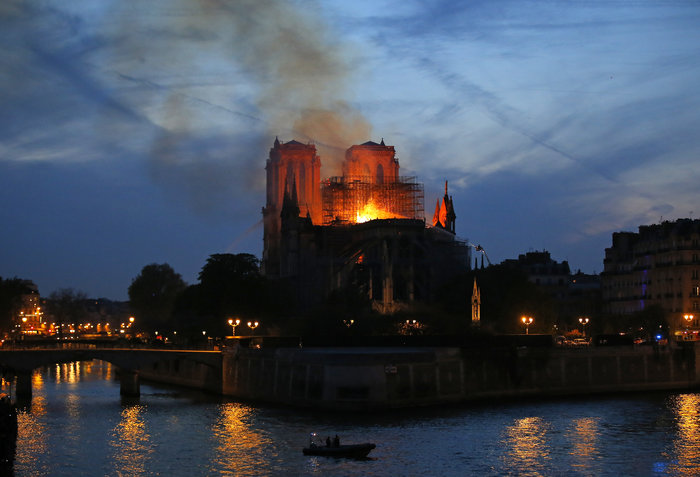
I was volunteering at an author event at the Library. I often get the job of greeting people as they walk in the door, asking them to sign in and showing them the donation box. All the events are open to the public and there is no charge. The library is completely dependent on donations so, with a big smile on my face, I ask them for their 10 euro donation. For a few minutes, I completely forgot about the drama taking place in the 4th arrondissement. Then I turned around and saw one of the other volunteers who was manning the drinks table in tears. She also had her phone in her hand. I walked over and she showed me a live BBC broadcast that she was watching. The fire had doubled in size in the 25 minutes since I’d been out walking to get our speakers. The 13th century spire was engulfed in flames.

I realize most of you know all of this already. I wanted to write about it but it’s not new news. This is my perspective on losing a friend. For two and a half years, I lived on the Quai des Grands Augustins. I had only to open my living room window, and look right and there was that magnificent lady that has/had stood there for over 800 years gracing Paris and being her symbol to the world. She had survived a Revolution and two World Wars. In the mornings, I could see the sun rising behind her and in the evenings, when the sun was setting over the Pont Neuf, the rays would bounce, red and purple, off the round stain glass window between the two towers. One afternoon, after a rain storm, I saw a double rainbow dome the towers. It was a magical moment. I have been to Christmas Eve mass there. I have walked up the left tower to see the gargoyles and the famous bell. The first time I took that walk I was 20 years old and a student at Lake Forest College. The last time was two years ago when my friend Barbara and I climbed it on what turned out to be one of the coldest days of the year. Never in my wildest imagination did I think I would ever lose her.

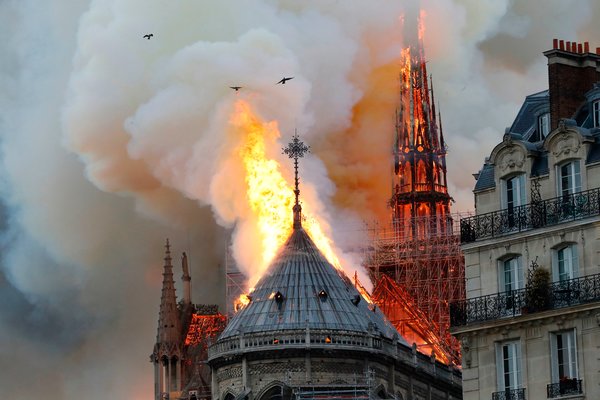
The Spire in flames and about to collapse

Then I moved to the 16th arrondissement in August of 2017. I don’t see Notre Dame on a daily basis anymore. Which makes her all the more stunning when I have to cross the parvis to get to the right bank or am standing on one of the bridges further down the river just gazing at her simple beauty and steadfastness. In history classes or in historical novels that sweep through the centuries, one reads about the destruction of a famous structure and then its rebuilding which takes over 200 hundred years. That will all be told in a couple of pages. As I walked home from the Library last night, I thought “I am part of history. I will never in my lifetime be able to climb the stairs in that tower or walk up the Quai behind Notre Dame, my favourite view, and see the flying buttresses holding up and holding down her flaring skirts.” Notre Dame will be rebuilt but I probably won’t see it.

Sara in 2016. My favorite view – coming up behind the Cathedral, seeing the Spire and the flying buttresses. Photo: Mike Weintraub

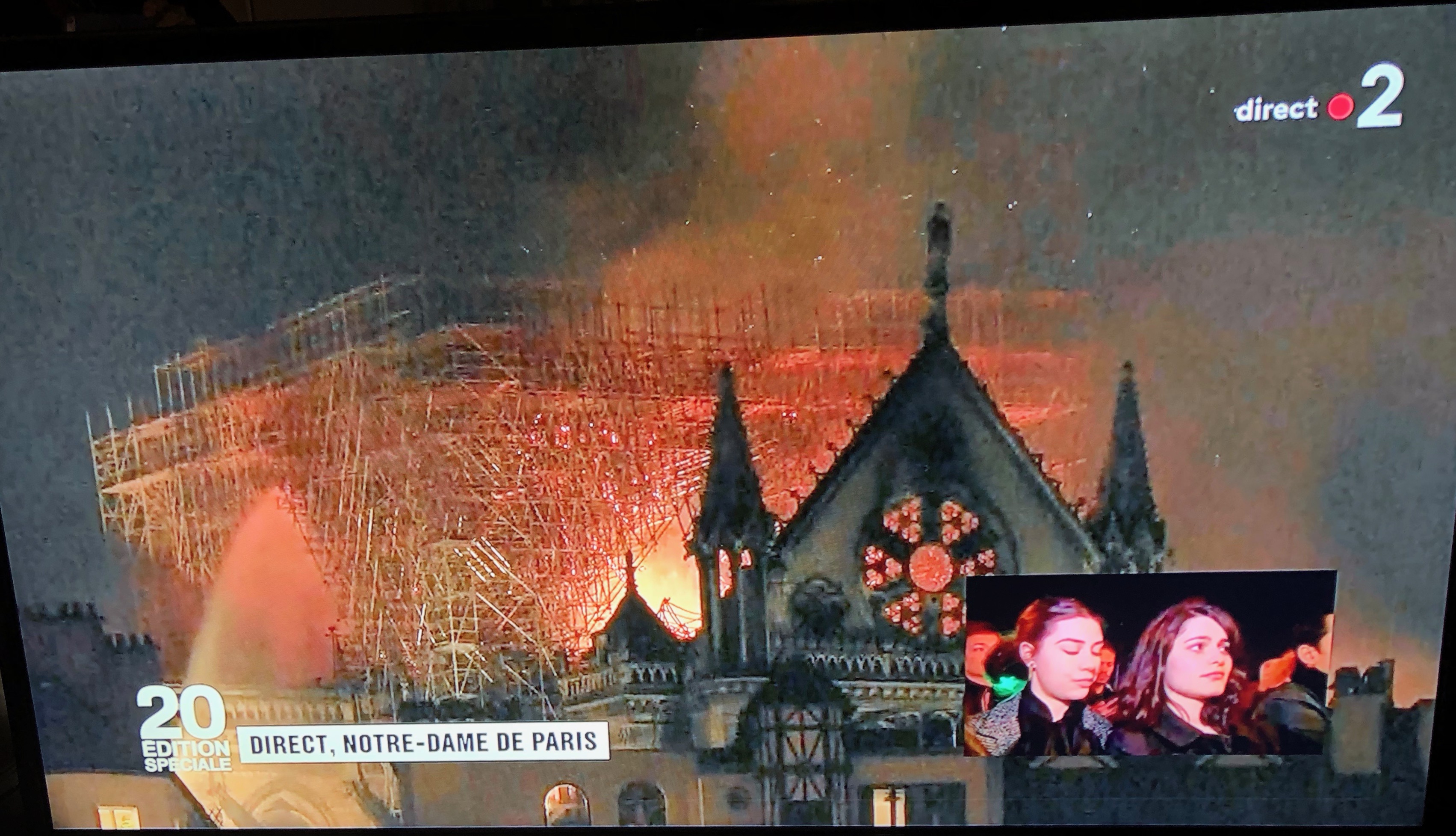
At home, I watched the news until it wasn’t news. As with all huge dramas, the newscasters start interviewing bystanders to get their reaction while showing the fire in a corner of the screen. When I went to bed, it wasn’t clear if any part of the Cathedral would be saved. The Fire Chief was optimistic. I had spent an hour responding, in very short sentences, to all my American friends who had written to me expressing their grief in general and their grief for me. I was extremely touched. Paris has become my home and my friends know that. One e-mail just said “So sad”. Another “I grieve with you”. They didn’t need to say more.

Watching the news at 10:30pm. The Spire is gone, the roof is gone. The Cathedral had started renovations which were badly needed and you can see the steel structure that had been holding the spire in place. The renovation was to take 20 years.

This morning, I didn’t want to get out of bed. I felt as if a great good friend had died and I was miserable. Bijou stood by my bed and cried and cried. She was hungry and didn’t care about something 3 kms away. So I was forced out of bed. After giving her her very favourite food, I got on the computer and learned that the main structure had been saved and some of the most valuable art work had been rescued. No one was injured or killed. Macron warned that little fires were still burning and they expected that for the next couple of days. I plan to walk down there this afternoon and pay my respects. I’m pretty sure that I am not at all prepared for what I’ll see. After the twin towers came down, I flew to New York. I wanted to make it real. Watching some news on TV is not so different from watching an action movie. I have to see it with my own eyes to know it happened and have my own private experience.

Photo: Julien Mattia/Le Pictorium
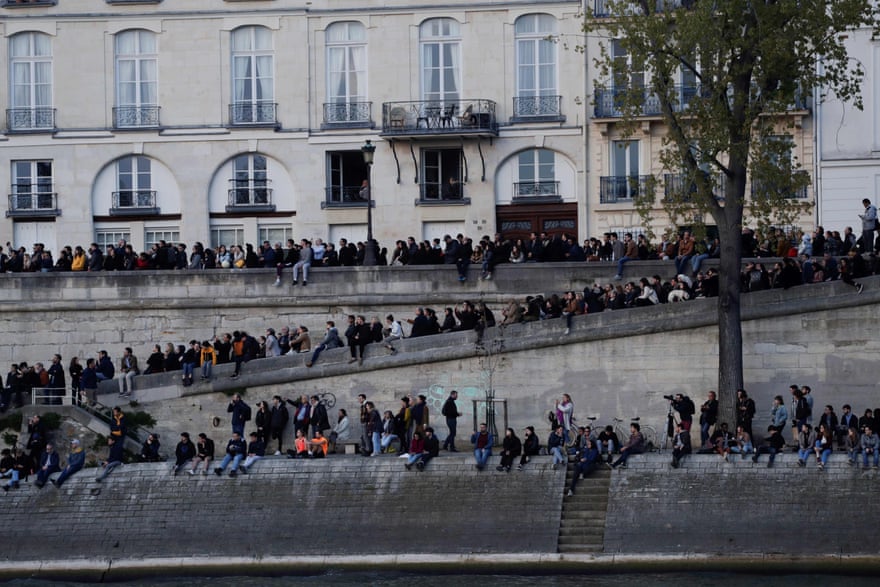
Crowds gather opposite the cathedral on the bank of the Seine to watch the fire
Photograph: Thomas Samson/AFP/Getty Images
The cathedral’s steeple collapses
Photograph: Geoffroy van der Hasselt/AFP/Getty Images
IF you’ve been to Paris, this one will make you cry. Flames and smoke are seen billowing from the roof at Notre-Dame Cathedral
Photograph: Veronique de Viguerie/Getty Images

I hope these photos are helpful for you to grasp what Paris, the citizens of Paris, the country went through last night. The country is already devastated by billions of euros loss because of the Gilets Jaunes protests. Now this. I believe Macron is hoping to appeal to the International world to raise funds to rebuild this beautiful Cathedral.

A bientôt,

Sara

London: Eurostar, Brexit and Theatre

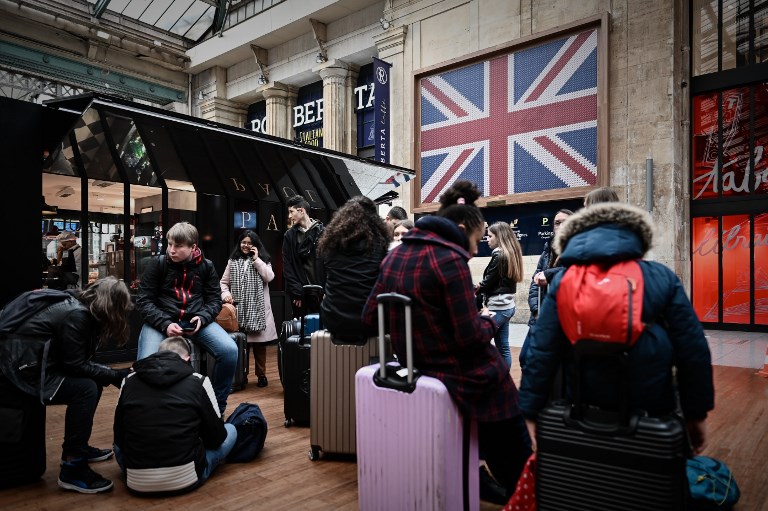
Since March 4, the French Border Control have been “on strike” to protest the upcoming Brexit. Work was not stopped 100% but slowed down 90%. They feared much more work if Brexit actually happened saying they would have to treat UK citizens as any non-EU country therefore requiring more work, extended hours, etc. “The customs agents are demanding an increase in overnight pay, a danger allowance, and more staff and resources to help with greater controls that will be put in place once Britain breaks away from the European Union, currently scheduled in just over two weeks.” The Local/France. People traveling to London on the Eurostar were queued up four to six hours for the trains. By last week, when I was due to go to London, Eurostar had managed to organise the lines somewhat but also had to cancel three or four trains a day. So last Friday, I arrived at Gare du Nord, lengthy book in hand, ready to sit on the floor and wait whatever time it took to get through all the security, passport checking, etc. This process usually takes about 50-60 minutes in Paris and 30 minutes in London.

Passengers wait in front a British flag depiction near the entrance of the Eurostar terminal at the Gare du Nord railway station in Paris on March 15, 2019 a day after British MPs voted massively in favour of asking the EU to delay Brexit. – The British Parliament on March 14, 2019 voted by 412 in favour and 202 against on the government’s proposal — a rare respite for British Prime Minister following a chaotic week. (Photo by Philippe LOPEZ / AFP)

I arrived at Gare du Nord at 10am on Friday and…..voila, no queue at all. I had arrived 130 minutes early and it still took 90 minutes to get through all the hoops but so much better than 5 hours. People were calm, no big upsets, very accepting. Eurostar even held the train back 30 minutes to make sure that everyone ticketed for the train actually was on the train. Then everything ran smoothly as it usually does with Eurostar. I’ve heard interviews from tourists saying they will never take Eurostar again as if this was Eurostar’s fault. So sad. Eurostar did an amazing job of trying to manage an extremely difficult situation. Brexit has been extended three weeks so for a short time, things are back to normal.

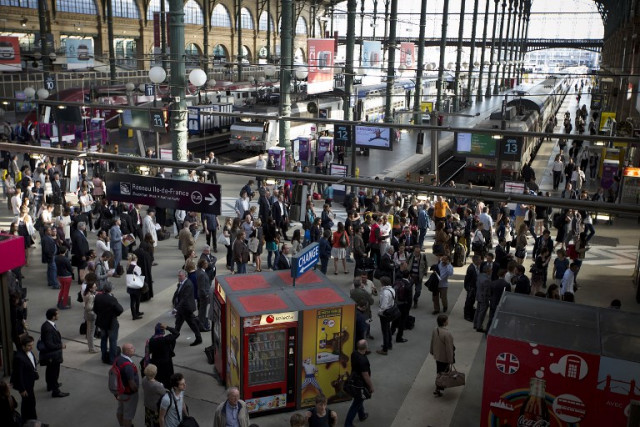
Queue on the left wrapping around Gare du Nord before going up escalator to Eurostar

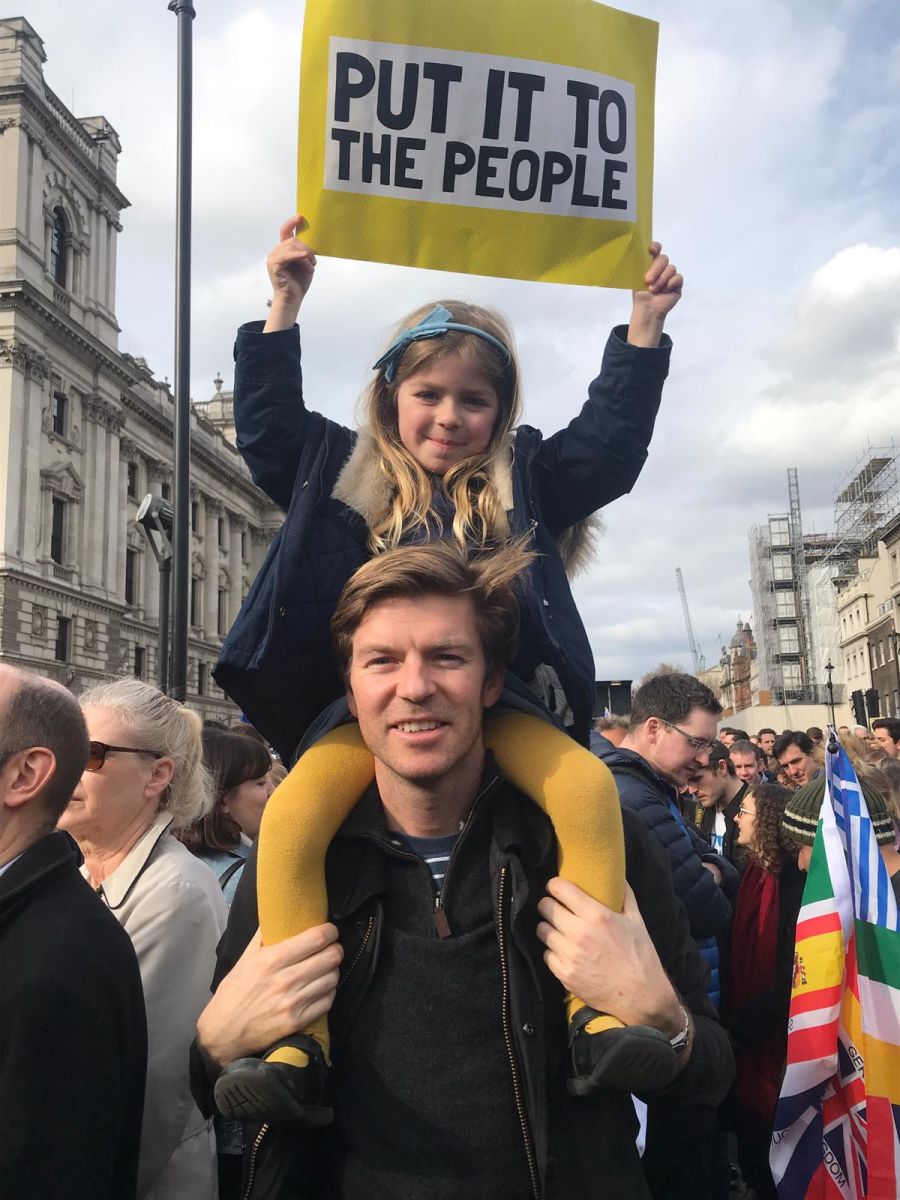
Saturday morning, I took the Northern line to Bond St. A huge protest against Brexit had been planned. Over a million people coming from all over the UK, met at Hyde Park, marched through Picadilly Circus and other tourists highlights and ended at Parliament. It was called “Put it to the People” march as these protestors and many more people vehemently want a second referendum. According to Reuters, it was the second largest protest since a march against the Iraq war in 2003.

Protesters taking a break.

Everywhere I went, I saw protesters. Little kids carried wonderful placards begging “No Exit”. I saw no violence, people seemed happy to live in a place that allowed freedom of speech–more and more a threat these days. The crowds were massive and one had to plan extra time to get anywhere. I didn’t mind, I’m a supporter of these people. Brexit, to my mind, is not only a stupid plan, but a dangerous one for a wonderful people. I love living so close to London. I love having the Eurostar available and to be able to jump over here for a long weekend of theatre and seeing friends. What will happen is as much a mystery to me as all the shenanigins going on in the US.

Jonty Graham with daughter PoppyAnna Stewart, CNNAnna Stewart, CNN

I’m in London to celebrate my friend, Barbara’s, birthday! For the first time in three years, I found tickets to HAMILTON and grabbed them immediately. We will see it tonight. We made a long weekend of it and Saturday night went to see a musical I had never heard of (I think I’m one of the few people in the world who hadn’t) called COME FROM AWAY. A lovely, uplifting, brilliant story of the friendships that grew out of the forced landings of thirty four planes in Gander, Newfoundland on Sept 11, 2001.

From humble beginnings at the La Jolla Playhouse in California in 2015, COME FROM AWAY has taken theatre goers in the US by storm, won a couple of awards along the way and arrived at the Phoenix Theatre in London in February after spending Christmas in Dublin. The writers Irene Sankoff and David Hein, a Canadian couple, decided to spend a month in Gander on the 10th anniversary of 9/11. A large percentage of the original people were celebrating in Gander the amazing kindness, friendship and love that were extended both ways during that week in September 2011. The writers experienced the same kindness, generosity and love that the 7000 people stranded in September 2001 experienced.

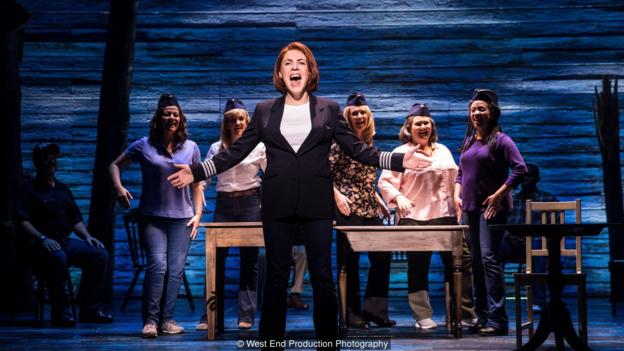
The characters in Come From Away are based on real people – including Beverley Bass, American Airlines’ first female captain (Credit: West End Production Photography)

Though it has been dubbed the 9/11 musical, Sankoff and Hein prefer to call it the 9/12 musical. Most of the passengers on the diverted planes were not allowed to leave the planes for 12-24 hours. Can you imagine being held on a plane not knowing what was going on, why you were in God knows Where and hearing all sorts of rumours. It’s about time these people were celebrated.

The people of Gander offered comfort, hospitality and friendship in a time of crisis (Credit: West End Production Photography)

At the end of the show, something happened that I have never before witnessed. The entire audience jumped to their feet, en masse, as if it had been pre-planned. They cheered and yelled for five minutes while all the musicians came on stage and played until finally everyone left the theatre.

If you live anywhere near a production of COME FROM AWAY: https://comefromaway.com I urge you to go see it. As a reviewer wisely said it is an uplifting story of art for our times. A celebration of the best of humankind. – Tim Teeman, The Daily Beast.

A bientôt,

Sara

Gloria in Paris

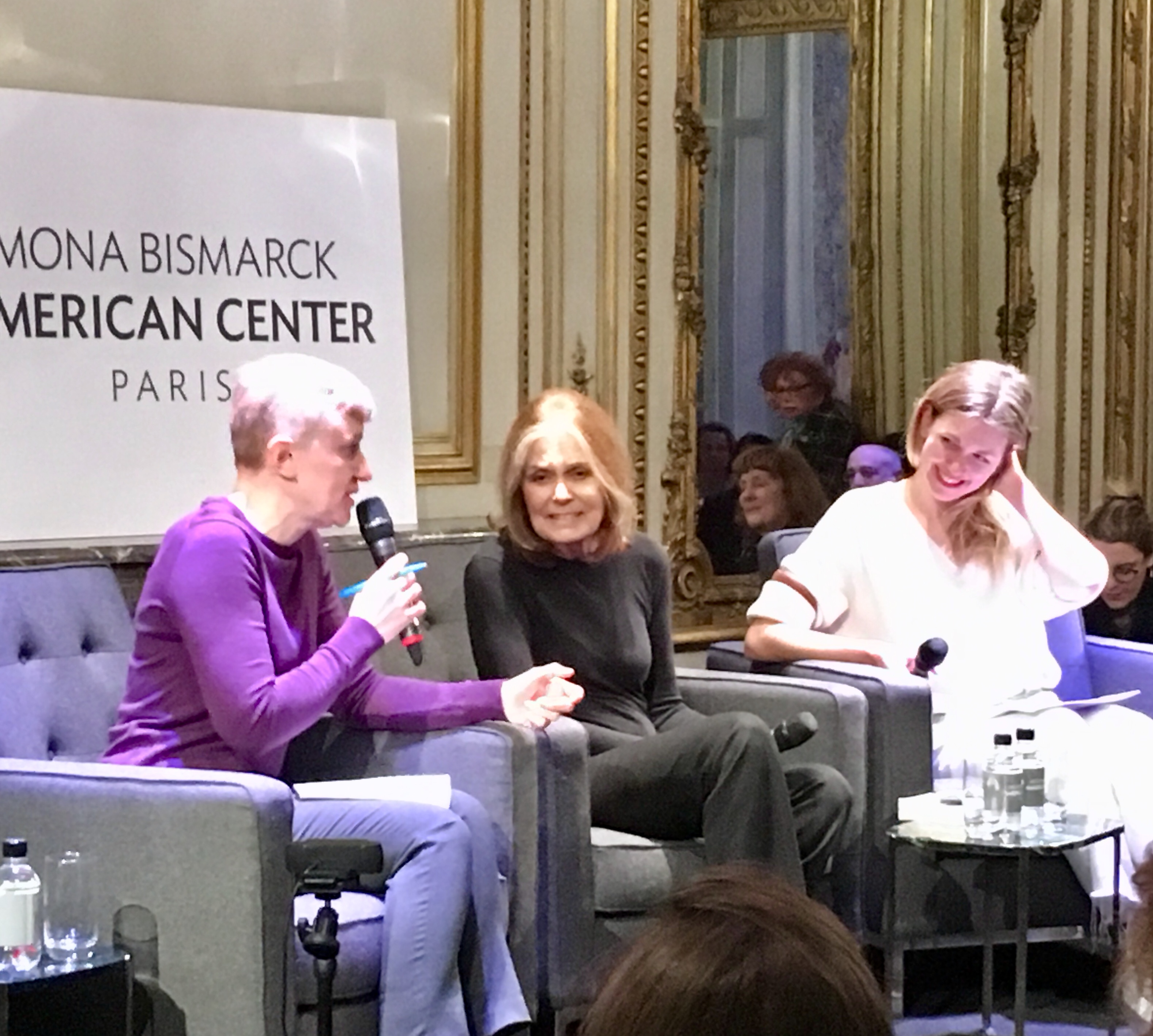
Fabienne Gondrand (translator), Gloria Steinem, Lauren Bastide (Interviewer)


In honour of Women’s History Month (is there a Men’s history month or is that just called history?), Gloria Steinem was invited to speak at the Mona Bismarck American Center for the Arts in Paris. I was one of the lucky few invited to hear her be interviewed. In spite of the fact that I wrote my dissertation on a particular organization in the Bay Area of women helping women, I realized on Tuesday night that I knew very little about her.

First of all, she is eighty-five years old! Or about to be the day after next. Yes, that woman you see in the photo is eighty-five years old. She doesn’t look it and her voice certainly doesn’t sound it. She has a strong voice, not a shake in it and she is just as clear a thinker as I remember her back in the 70s when she started MS magazine.

She wrote her book, My Life on the Road, in 2016. The french translation (Harper Collins) arrived in time to celebrate Women’s History Month. The book is riveting (I’m reading the English version) and centres around the fact that she is always traveling and cannot see her life any other way. She grew up on a farm in Michigan and her family would probably have been called gypsies if they had lived over here. Her father made his living by going to flea markets, trying to find good jewellery and then selling it to stores. They never had a dime to their name. Gloria didn’t go to school until her teens but instead wandered around with her father. She says her traveling to India, ending up as a journalist, much of her twenties were what she considered “things I was doing before I settled down, got married and had children” As she turned thirty, she began to realize that she was her father’s daughter. She liked life on the road. She wasn’t waiting to start her life. This was her life and she loved it. To this day, she spends more days each year traveling than she does in her apartment in New York.

Gloria Steinem and Lauren Bastide

So with traveling as the theme, she tells her story and what a story it is. How she became the symbol of feminism even though black women were far more active in the beginning of the feminist movement than white women. How she dealt with being “pretty”; how she learned to overcome her fear of public speaking and how the Lakota Indian women became so important to her.

English version

Towards the end of the interview, Lauren said she had to ask her a personal question. She had mentioned many times that Gloria was a heroine to her. She prefaced her question by saying her heart breaks when she sees the pain and cruelty in the word, she never sees her children because she works so much, she is getting a divorce and that she has only been a journalist for three years. With tears, she imploringly looked at Gloria “How did you do it, how do you still do it?” Many of us leaned forward to hear the answer. Gloria is the epitome of equanimity. There is a quietness and humility about her. I’m sure we were all wondering how she stays so calm when she deals with so much injustice every day. She shook off the question as unanswerable. She seemed to be saying “It’s just what I do, who I am.”

I left the evening having had my eyes prodded open one more time. Someone in the audience asked her about being a privileged white woman and yet she was the perceived head of the feminist cause. She took a breath and said “yes, privilege is an interesting concept. White women have the privilege to be dominated by men” which took me aback. And yet when I think about it, how many of my friends and I spent years and years of our lives looking for a man we could marry and who would take care of us.

A bientôt,

Sara

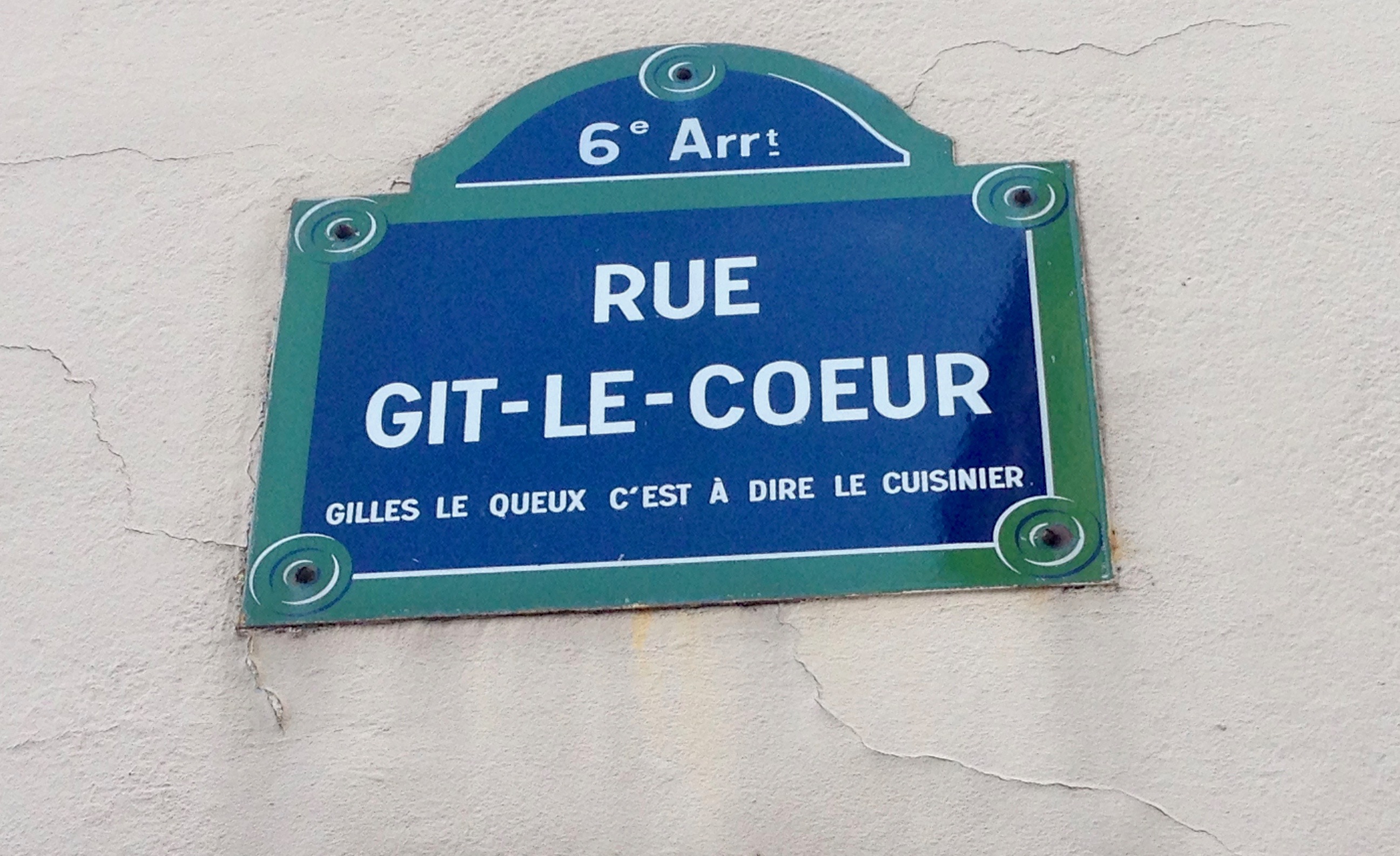
Remembering Rue Git-le-Coeur

Before Elodie, my downstairs neighbor, went on a rant to tell me I was once more doing something illegal, I tried to have a window garden in my apartment at Git-le-Coeur. My window was quite large and looked out over the Seine to Pont Neuf. I had an arm chair pulled close and would sit there for at least twenty minutes every morning filled with gratitude at living in this beautiful city I call home. I’m sure I didn’t need the garden but, as an adult, I have always had green things growing, something to care for. I certainly didn’t need Elodie as the Apartment Police pointing out the laws I was breaking. I want to be clear that I never set out to break the law! I didn’t know better and french administration being what it is…… It seems there truly is a law in Paris that no one can have a window garden that has the remotest chance of falling on the sidewalk and hurting someone. I can’t help but look up in my wanderings around Paris to see who is committing a window garden felony!

My apartment building on Git-le-Coeur sat on the corner of Quai des Grands Augustins. There is one apartment per floor. Elodie lives on the first floor, I lived on the second floor, the apartment on the third floor is rented by a family living in Brussels who visit Paris once every other month or so. The fourth and fifth floor is one apartment owned by Mr. and Mrs. X. Everything that happens in the building has to be voted on by the owners. Elodie and the Xs hate each other so Elodie always loses as she has one vote to the Xs two votes.

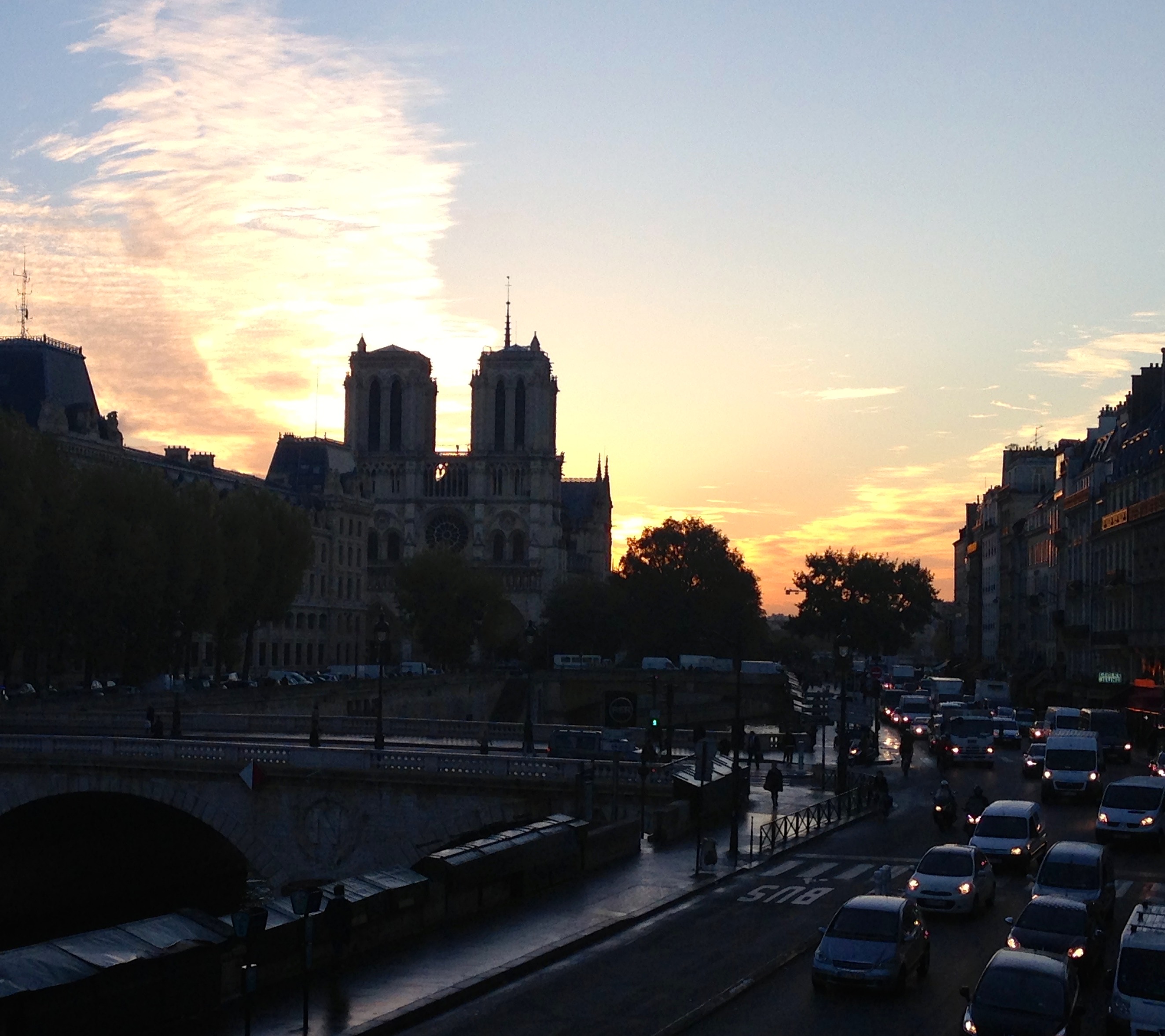
Notre Dame at sunrise

My living room was huge for a Parisian apartment. Two windows looked north, over the Seine to 36 quai des Orfèvres where the infamous Paris Homicide Unit resided until a year ago. If I leaned out one of those windows and looked right, I had a full view of Catedrale de Notre Dame. I took dozens of photos of the sun rising behind the cathedral. Once I caught a full rainbow hanging over the spires gracing a dark grey sky. It was magical.

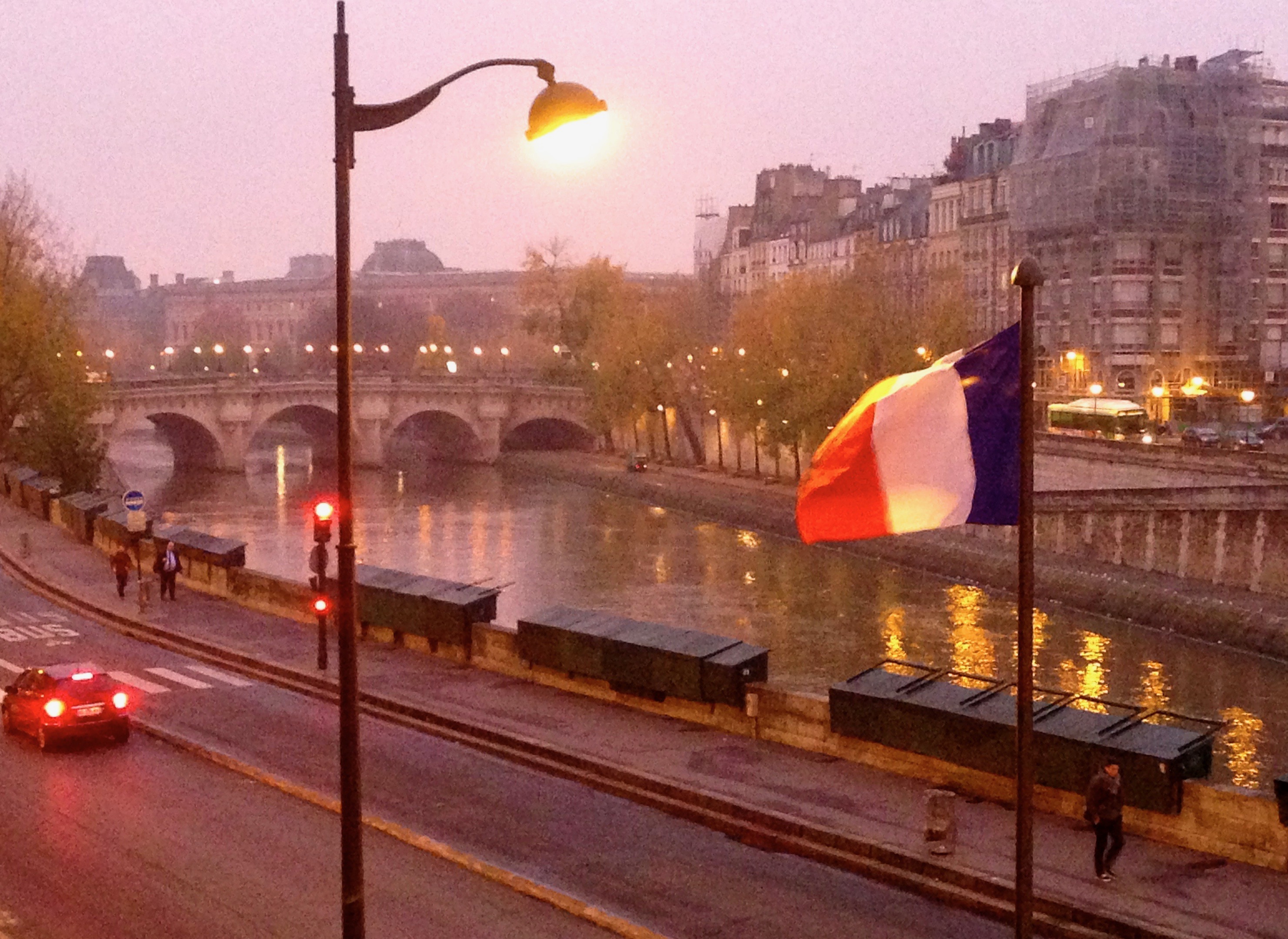
Le Seine and Pont Neuf from my window

Two windows looked out on Git-le-Coeur, the Canadian Pub and Pont Neuf. It was this view that became my North Star for the almost three years that I lived at Git-le-Coeur. Everyone knew how I loved that view. Artist friends would draw it and give the drawings to me as presents. After Elodie and I made our peace with each other, she presented me with a copy of a painting of our building and the Seine. She had seen the painting at an Expo at the Musee d’Art Moderne although it was painted in 1904. She went to great trouble to get it copied and then had it framed for me.

Elodie is truly the only person I know who speaks no English at all. Befriending her was a challenge. She is a very bobo frenchwoman. My friend, F, says she always has her nose just slightly in the air. I decided to kill her with kindness. After the tenth leak from my bathroom down to her apartment (three happened while I lived there), I wanted to help her confront the owner of my apartment. He lives in Madrid and is a lazy owner, only wanting money and ignores all pleas to fix the many things wrong. I bought her a small present at BHV and wrote her a note saying that we would figure this out together. She melted slowly even inviting me to coffee one day. Because my french is mediocre, I would find myself avoiding opportunities to talk with her. Now that I live in the 16eme, we have developed a schedule of meeting every other week for coffee so that I can practice my french. She still plays police only now she is the Academie Police. I wrote her an e-mail this winter beginning “Salut Elodie”. When I arrived at her apartment a couple of days later, she sat me down telling me one never ever uses Salut in writing. It just isn’t done. It is for waving and greeting a friend on the street. Of course, that evening, I saw it used in writing by someone of a much younger generation.

Av. Mozart, Paris 16eme

I miss Git-le-Coeur sometimes. I love my new neighbourhood but it took months to adjust. I will dream of that large living room and my window gazing out on the Pont Neuf. Elodie tells me the apartment is still empty. Little strings get tugged in my heart but then I remember my lazy landlord, my nasty, greedy agent and think how wonderful it was to live there and that I now live in a real Parisian neighborhood.

A bientôt,

Sara

A month later……

Since my last post, I contracted the common cold and was laid low for two weeks. It is beyond my comprehension that we can cure so many ills but the common cold still does most of us in and it just has to run its course. It starts so slowly and shows no sign of being menacing. Blowing my nose every five minutes. In Paris, my nose starts running Nov. 1 and lasts until March 31st. It seems to be the price of walking outside so much–to get the metro, see friends in cafes, etc. So who knew that that day turned into two weeks of misery. I had to cancel almost everything. I had a scheduled flight to San Francisco and anyone who has flown with a congested head knows how miserable and painful that can be. I was determined to be well before the flight even if it meant never moving from my couch.

I planned a month long trip to Oakland to see doctor’s, do my taxes, clean and organise my home and probably do repairs. I wasn’t looking forward to the trip. Paris is my home now and going to Oakland is work not a vacation. I still find it painful to wake up there with the news in your face 24 hours a day and none of it good. Scandal after scandal. Who’s going to jail for what financial or political conspiracy? There was one piece of great news that made me jump up and down. Congress and Senate, both I believe, voted to protect millions of acres of National Park land, land that the Trump administration has been trying to get it’s hands on and destroy the protections that have been in place for years. When I ask friends ‘how do you stand it?, the news?’ They inevitably respond, ‘I no longer listen to the news.’ I understand BUT…..how many of us that want things different aren’t listening anymore or reading anymore? How do we stay informed when the media just eats up all the distractions and twittering? My way was to record The Late Show with Stephen Colbert each night and watch it the next day. He always has some political person on and makes it funny enough to be palatable. It helps that he and I are on the same side of the fence.

Then there is the matter of the weather. I picked February and March to be in Oakland in hopes that I would miss the worst of Paris winter. And what happens? Oakland has not had weather higher than 54o and rain most of the time. Not just a little rain, but gales and flooding and high winds. I’ve been dressed like a ski bunny most of the time. And Paris?—gorgeous weather — 20o/21o. I saw a photo of people sunbathing in the Place de Vosges! My timing is impeccable.


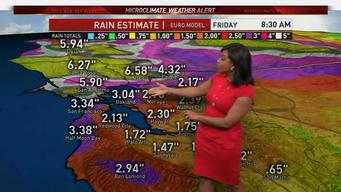
Gusty winds and rain will move across the Bay Area in time for the evening commute. Meteorologist Kari Hall has the details in the Microclimate Forecast.

I was in Oakland one week when I learned that a very good friend of this blog, Philippe Melot, had died suddenly. He was fit, rode his bike regularly and hard, ate well, didn’t smoke, didn’t drink. I was just stunned. I still am. But it reminded me to tell everyone I know how grateful I am for their presence in my life, their friendship. You just never know. It will be a shock all over again when I get back to Paris and realise I will never see Philippe again. It just breaks my heart. He loved Americans and was so kind and generous to all of us. He was, in my opinion, a very special man and special Frenchman.

RIP Philippe

The Gilets Jaunes have not slowed down. I am dependant on my friends in Paris to keep me informed of all the activities. One would think nothing happened in the rest of the world if only watching American news. Even NPR only gives the highlights. I subscribe to The Guardian and keep up with the Brexit antics but Les Gilets Jaunes just get small print. A week ago, my friend Barbara wrote: “Violent protests again in Paris on Saturday. Went to the library to return your book and could hear explosions everywhere and smoke everywhere. My eyes were burning at Rue General Camou. Of course the library was closed. I could see gilets jaunes and CRS everywhere. Losing all hope that this is ever going to end.” Now I’ve come to understand that the gilets jaunes are attacking jews. This just keeps getting worse. https://www.theguardian.com/world/2019/feb/24/alain-finkielkraut-winds-of-antisemitism-in-europe-gilets-jaune

So for the time being, the rain falls in Oakland, the sun shines in Paris. Brexit may not happen until 2021, if at all. The Gilets Jaunes are being courted by the far right of Marine LePen and the Italian President and Prime Minister (both financially supported by Putin??). Meanwhile, they continue to destroy Paris and cost the French government billions of dollars. I do not think this is the way to win friends and influence people. But France is the land of protest. Life goes on except for my dear friend, Philippe, who I will miss terribly.

A bientôt,

Sara

Demystifying the French

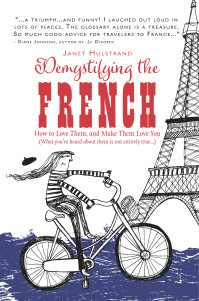
As I told you in my last blog about la politesse, while finishing it up, my friend, Janet Hulstrand, asked me if I would read and review her latest book: Demystifying the French. How to Love Them and Make them Love You (What you’ve heard about them is not entirely true….).  I love reading most anything and, as it turned out, this was a very special read. I learned a lot. The book is small and can be read quickly. You can earmark pages you want to return to and give more thought to it. I highly recommend that anyone visiting France for the first or the twentieth time, read this book. I think that means I give it five stars!

The book is broken down into two parts. The first part is made up of what she calls: Essential Tips for Even Very Brief Encounters. Saying Bonjour is Tip #1!! Only five of them but five that will make a huge difference in how you perceive the French while you are here. The second part: Understanding the French Mentality solved some real issues for me. Ah ha moments, oh that’s why so and so did that.

The following is an interview that I did with Janet. Warning: this is longer than a four minute read. If you have the time, it is well worth it.

When I think of you, Janet, and your writing, writing a “primer” for us étrangers is not the first thing that comes to mind.  Why did you write Demystifying the French, and when did you start? 

I wrote this book because it really makes me sad to hear people from the U.S. and other countries talk about the bad experiences they have had in France, with its “unfriendly” people. The students who come from New York to study literature in Paris with me each summer are often warned by friends and family that the French are “rude, arrogant, and they hate Americans.” This is just sonot true! But it is true that Americans (and other foreigners) often get off to a bad start in their interactions with French people because there are a few simple rules of etiquette that they simply don’t know about; and knowing them can make all the difference in the world. 

I wanted to write a book that would explain what those rules are, and show how easy they are to follow, so that the experience of traveling (or living) in France can be a really good one, even if you don’t speak a lot of French. 

I actually started the book a few years ago, as a few posts on my blog, though I wasn’t thinking of it as a book then. I was teaching a class at Politics & Prose bookstore in Washington DC, called “Demystifying the French.” Last year I realized that this topic could be expanded into a very useful and fun book, and have a wider audience. And so now here it is! 

I love the subtitle of your book (“What you’ve heard about them is not entirely true”).  I love the French, and I have discarded so many preconceived notions that I had before moving here.  How much damage do we inflict on ourselves by not making French culture as important as sightseeing when we are planning a visit?

For me the richest part of a travel experience is always human interaction, much more than sightseeing. I added that second subtitle because as I was working on the book and I told friends and family the subtitle (“How to Love Them and Make Them Love You”), a few people said, “Why should I want to love them, and why do I care if they love me?” I realized these people were a bit resistant to my main message, and were not necessarily natural francophiles. So the added subtitle was an attempt to intrigue those people who weren’t necessarily inclined to care about pleasing the French, and to let them know that I do realize that sometimes the French can “require special handling.” This is NOT the same thing saying that they are rude, or arrogant, nor is it an indication that someone is unfriendly. It’s just that they’re operating according to a different code of behavior. We alloperate according to a particular code of behavior. Often we’re not really aware of this until our code of behavior collides with someone else’s. Which often happens when Americans find themselves in France.

When I finished reading Part 1: Essential Tips for Even Very Brief Encounters, I thought to myself “If everyone read this, they’d have a course in Basic Diplomacy 101!!”  We Americans get away with so much these days, but the French don’t let us slide at all.  How did you pick these five basic tips?

I tried to pick five things that seem to me to be of truly fundamental importance to the French, and also things that, if you don’t know them it can cause unpleasant misunderstandings, or at least uncomfortable interactions. The first tip is one that almost everyone who writes about this topic stresses: that is, the importance of remembering to greet someone properly before launching into conversation. This is really hard for Americans to remember, because we have a tendency to go straight to the business at hand, and we don’t necessarily give a lot of thought to social niceties like saying “Bonjour” first. But in France, you can’t skip over that without being considered rude. So it’s important to know! 

Part 2 is a deeper, more complex look into how, as you say, the French “tick.”  I found it rich and thorough.  You must be quite pleased with how you have presented the French as interesting human beings worthy of being known as they are, not as we think they are. Are you getting a favourable response from expats and from your French friends?

The book has just been released so I haven’t had a chance to get very much feedback yet. The few expat friends I have heard from have been very favorable in their responses, and that makes me happy. I am anxious to hear what my French friends think too, because of course they are coming from an entirely different perspective. I hope they will like the book, though it’s not really written for them; and I hope that it will indirectly help them understand Americans a bit better too, though that is not the purpose of the book. 

I think they will probably be intrigued. The French tend to be very interested in analysis, and in human psychology; and I think they will be interested to see themselves from a different point of view. I hope it will be clear to them how much I love French people and their culture, even though I make a few jokes at their expense. I make plenty of jokes about myself and about Americans in general too, though. Hopefully it’s pretty well balanced in that way. 

When I finished your book, I found myself wishing someone had either handed me a book like this or taken me aside to explain to me the really important social aspects of living here in France before I came. Do you have any suggestions that might encourage prospective visitors to pick up a book like this as well as their sightseeing books on France and Paris?

I actually require the American students in my literature classes who come here each summer to read up on this topic before they come, and I tell them there will be a quiz! And the reason I do this is because I reallywant them to have the best possible chance to have a good time while they’re here, and to have not only positive experiences with the French people they encounter, but experiences that will show them that all the negative things they’ve heard about the French are just simply not true. I guess from now on I will require them to read my book! J

After five and a half years of living here, I have learned much of what is in your book —usually by trial and error and much embarrassment.  Chapter 4 was an eye opener: “The Importance of Stability, Order and Being Correct.” As your friend, Ellen Hampton says, “Because the French are so socially progressive and liberal about relationships, they are often mistaken for liberals.”  I now understand much better why the French administration drove me crazy in the first couple of years I was here.  Do you think there is any way around the frustration of that emphasis on “correctness?” Or is that one of the important parts of our education of living here?

Well I think one of the most important things that can be learned in living in any foreign environment is patience for the fact that things are often not done the way you feel instinctively they should be. This is in the nature of experiencing a different culture. And I think that patience is probably the best cure for frustration with those other ways we encounter when we’re not living in our own culture. It’s certainly better, and more effective, than wishing others were more like us, or trying to change them. 

Your chapter on “The Importance of Food” is so true.  Because I follow a strict medical regime that excludes alcohol and bread, the French have a hard time relating to me and how I eat.  I’ve been invited to four French dinner parties and never invited back a second time!  Your chapter helped me understand them better, and not make it personal to me.  But I constantly wonder if there is a way to explain my regime that would allow me to have more encounters of eating with the French.  Do you think it’s possible? 

Well, I think things are slowly changing in France in this regard. I was surprised to read just the other day about the number of vegan restaurants in Paris, which was apparently one of the factors that pushed it to the top of someone’s “healthiest cities” list. I think I also just heard something about a Meatless Monday effort in France, which is aimed at improving planetary health. So I think things are slowly but surely changing. It’s certainly a lot different now than when I was first bringing student groups here back in the 1990s and asking if they could make some accommodation for vegetarian students. “Oh, yes, we have a lovely quiche lorraine,” my contact at one restaurant said, very enthusiastically and kindly. When I gently reminded her that quiche lorraine does have meat in it, she said, “Well, just a little bit! They won’t mind that,will they?” And when I said, mmm, yes, they probably will, she sighed and said. “Well, okay…We can make it without meat, but that will be so sad!!!”  

I think today things are getting better for people who have particular dietary restrictions, whatever the reasons may be. If you can find a way to explain briefly what your restrictions are, and assure them that this situation is not “sad” for you, maybe that will help. Because the French really do want you to enjoy your meals! 

Is there anything else you want to add? 

Well, maybe just one thing. I hope people will read the glossary of Demystifying the French through from beginning to end. Unlike most glossaries, it’s really part of the book, and it’s one of my favorite parts.

When will your book be available for purchase? In the US? in France? The book is available for purchase now, and this link to my blog will let readers know where they can purchase it.  Thank you so much, Sara, for letting people know about it! 

If by any chance, the above link did not work, try this: https://wingedword.wordpress.com/demystifying-the-french/

Let both Janet and I know how you like the book. Welcome to enjoying the French!!!

A bientôt,

Sara

La Politesse

After I had been in Paris for about 6 months, I started listening carefully to how my friend, Barbara, addressed everyone. Her friends, the shopkeeper, the man on the street for directions. She always said to people she didn’t know “Bonjour, je suis désolée de vous déranger….”. I figured out that she was saying “Good morning, I’m so sorry to disturb you but…….” Barbara has excellent manners so I decided just to copy her.

Then one day, I was looking for a bus and felt completely lost. The wrong bus came along and stopped in front of me, As the doors opened, I leaned inside and asked the driver if he knew where #37 was. He looked at me slowly, then said “Bon…Jour Ma..dame” long and drawn out. I knew immediately I’d made a curtesy mistake, a big one. I apologised and started over again. I said “Bonjour, that I had juste une petite question..” and could he help me find my bus. He gave me directions without blinking an eye or giving a smile. I was just doing what I should have done in the first place. I felt about two inches high. The last time I was scolded like that, I was probably twelve years old. I’ll say one thing, once it’s happened to you, you never forget to say “Bonjour” again. It doesn’t matter who it is. It’s la politesse. I always say “Bonjour Madame or Monsieur”. When leaving, I always say ‘Au Revoir’ and ‘Bonne Journée’. Even if someone stepped in the elevator and you rode only three floors with them.

Most of us ride by public transportation. We spend a fair amount of time out on the street or in public places. One can always tell if there is an American new to the country near by. Their voice is at least three decibals louder than anyone else’s. After awhile, I find myself hoping I look french when I hear Americans talking so loudly and not caring whose space they are invading. French, in general, speak quite softly. They text all their messages. They are constantly with their phones as is most everyone but the French do it more quietly. It was strange to me when I first arrived that so few people used their phones as phones. Then I figured it out–the noise factor.

Yesterday, I was shopping at Picard ( best frozen food store in the world. Another blog!!) A woman speaking Spanish spent her entire time at the store on the phone, walking around, talking very loudly. Everyone was looking at her. It wasn’t a mean look, it was a look to say “You might consider speaking softer.” When she got to the cash register, the fellow taking her money was so kind. He tried to speak Spanish with her. She just glared at him. He asked if she spoke English, she nodded her head. Then he told her how much she owed in Spanish. She looked at him like she had no idea what he was saying. Here he was, a young french boy, trying to make this woman less wrong by joining in on her language but she wasn’t having any of it. I felt bad for him. She left without a goodbye, a thank you or any indication that he had been helpful. So it’s not just Americans.

I have two friends, both named Sylvie, who I meet with each once a week to practice my conversational french. When I was confirming a date with Sylvie #1, I started my text by saying “Salut, Sylvie.” When I arrived at her home two days later, the first thing she said to me was one never, ever, ever uses ‘Salut’ in writing. “We, the french, only use it if you see a friend on the street and wave Hi/Salut!”. Well yes and no. Sylvie is my age, old school, and it probably was a strict rule at one time. My younger french friends say people do use it among close friends in writing. However, I hate breaking these rules of politesse especially when I’m not even sure I know many of them. So to be on the safe side, I’m sticking to Bonjour or Bonsoir.

La Politesse is no small thing. Children are taught it from a very young age. If children seem ‘bien élevé’ (well brought up) when you see them out on the street or on the metro, that is why. There are rules. If you as the visitor or the Ex-Pat living here or the tourist passing through, respect these rules you will find the French very easy to get along with. However, if you just blunder your way around in English not attempting to be polite, you will find yourself getting some strange looks. It would be easy to misinterpret those looks as the French looking down their noses at you. In fact, they will just be wondering why you are not ‘bien élevé”!

While I was finishing up this blog, my friend Janet Hulstrand, sent me a copy of her brand new book: Demystifying the French: How to Love Them and Make Them Love you. It is an extension of everything I’ve written here. I will be interviewing her and putting it in my next blog.

A bientôt,

Sara
Bonne Année 2019

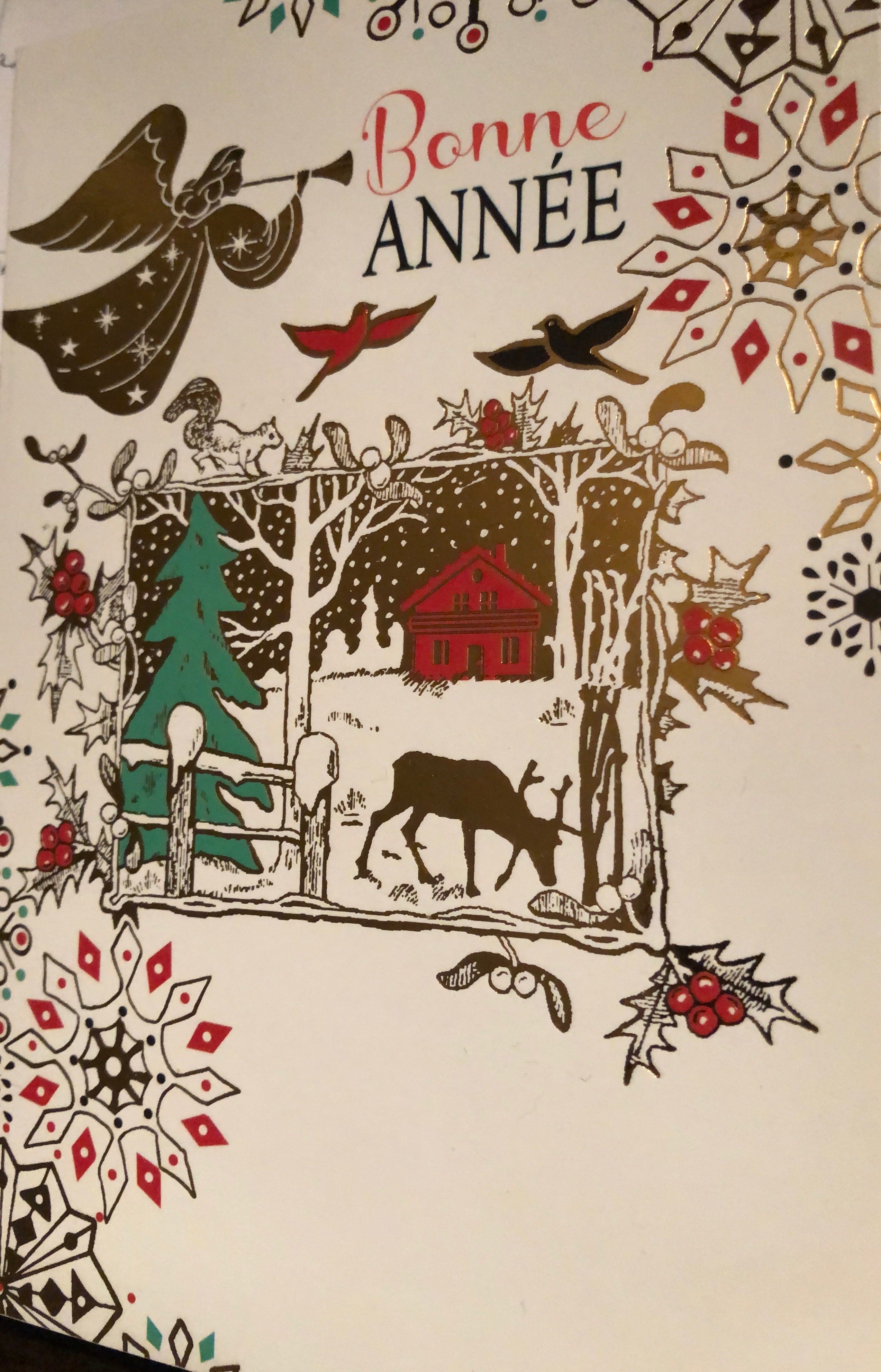
With the French tradition in mind, this blog is my New Year’s card to all of you.

The French have a tradition that I really like.  Instead of sending Christmas cards, they send New Year’s cards.  They can send them any time during the month of January. If you tip a service person, you put it in your New Year’s card. So what happens is that here in France people prepare for Christmas with the presents and the parties and going to Galleries Lafayette to see the windows without the fuss of writing Christmas cards. Then, after you take the tree down, put it out on the sidewalk for pick-up, you have the rest of the month to write cards. People are still saying Bonne Année to me. It’s nice. I feel like I’m slowly moving into 2019 with the daily reminder to make it a good year.

The French have a tradition that I really like.  Instead of sending Christmas cards, they send New Year’s cards.  They can send them any time during the month of January. If you tip a service person, you put it in your New Year’s card. So what happens is that here in France people prepare for Christmas with the presents and the parties and going to Galleries Lafayette to see the windows without the fuss of writing Christmas cards. Then, after you take the tree down, put it out on the sidewalk for pick-up, you have the rest of the month to write cards. People are still saying Bonne Année to me. It’s nice. I feel like I’m slowly moving into 2019 with the daily reminder to make it a good year.

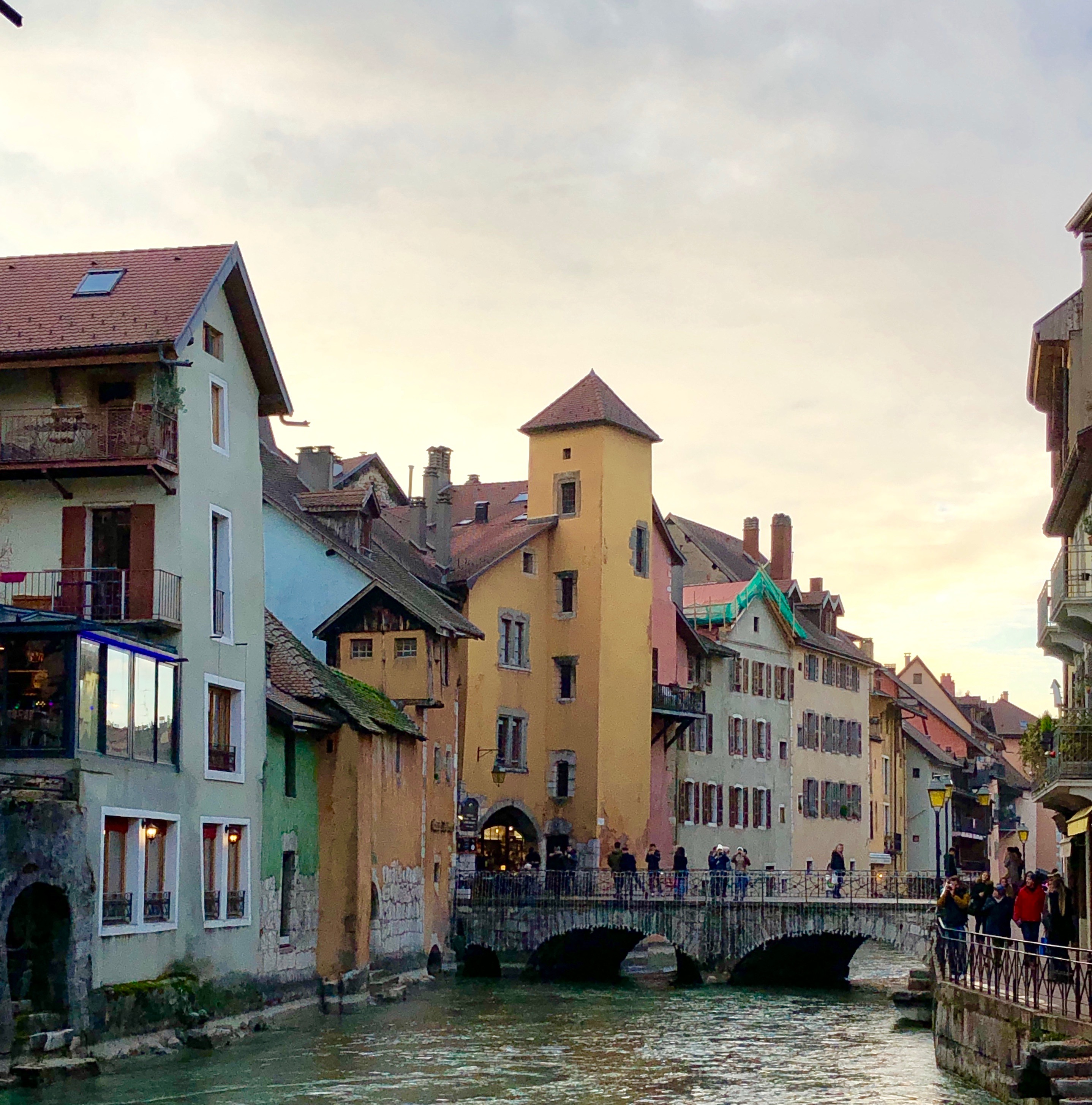
I spent New Year’s Eve in the town of Annecy in the Haute-Savoie region of France. Annecy sits at the north end of Lac d’Annecy, a lake that has a 32 kilometre circumference that one can walk, run or bike easily.

Pier just south of Annecy

My friend, Barbara, and I spent four nights there. What for me is the most amazing part of traveling at any time of the year in France is the transportation. Annecy is southeast of Paris, about an hour south of Geneva. By car, the fastest driving route takes five and a half hours if you don’t stop. By TGV (fast train–often going up to 200 km per hour), the trip is a bit over three hours. Marseille, in the south of France, is just over three hours. Bordeaux is two hours. Even the small towns along the Côte d’Azur where the train stops at every famous spot, one wouldn’t spend more than five or, at the very most, six hours on the train. These are comfortable trains with tables to write at or play games. There are always one or two “Bar” cars that sell sandwiches, drinks and sweets. There is every kind of discount card imaginable. A senior card that often has first class fares that are lower than second class fares for the under 62 years old set. A weekend discount card, a weekday discount card, a youth discount card, a student discount card.

The old city of Annecy

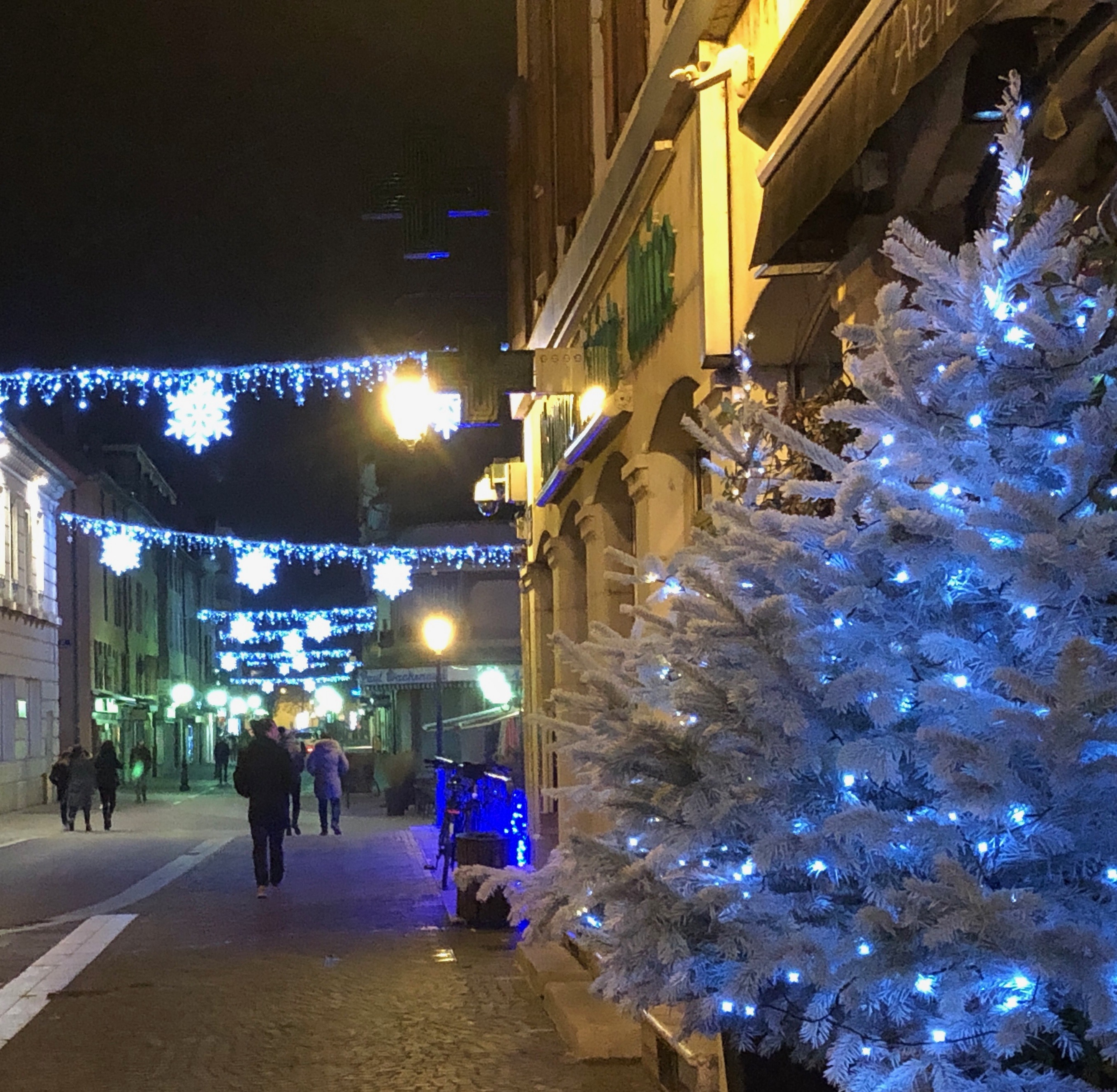
To go such a distance for only four nights is easy. Our AirBnB was a five minute walk from the station. We spent one day just walking around the town of Annecy, especially Le Centre Historique and Vielle Ville with cobbled streets, winding canals and pastel-colored houses. The Marché de Noel was alive and well and open until January 6. We took a bus ride up to La Closaz, a ski area, hoping to ride the chairlift to the top of the mountain. We were told that the winds were quite bad that day and the lifts weren’t operating while we were there. So we took the bus back and went to a movie!

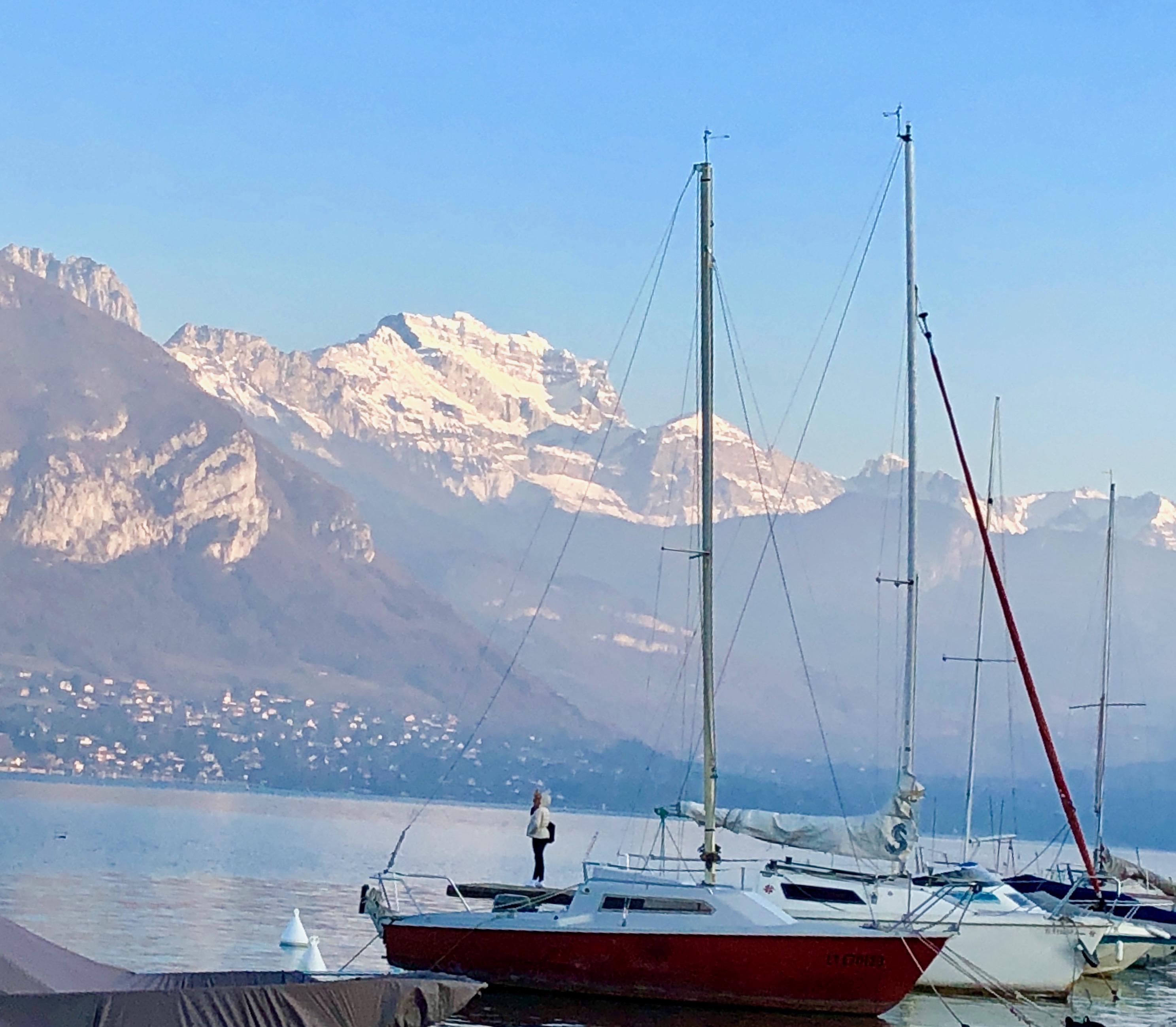
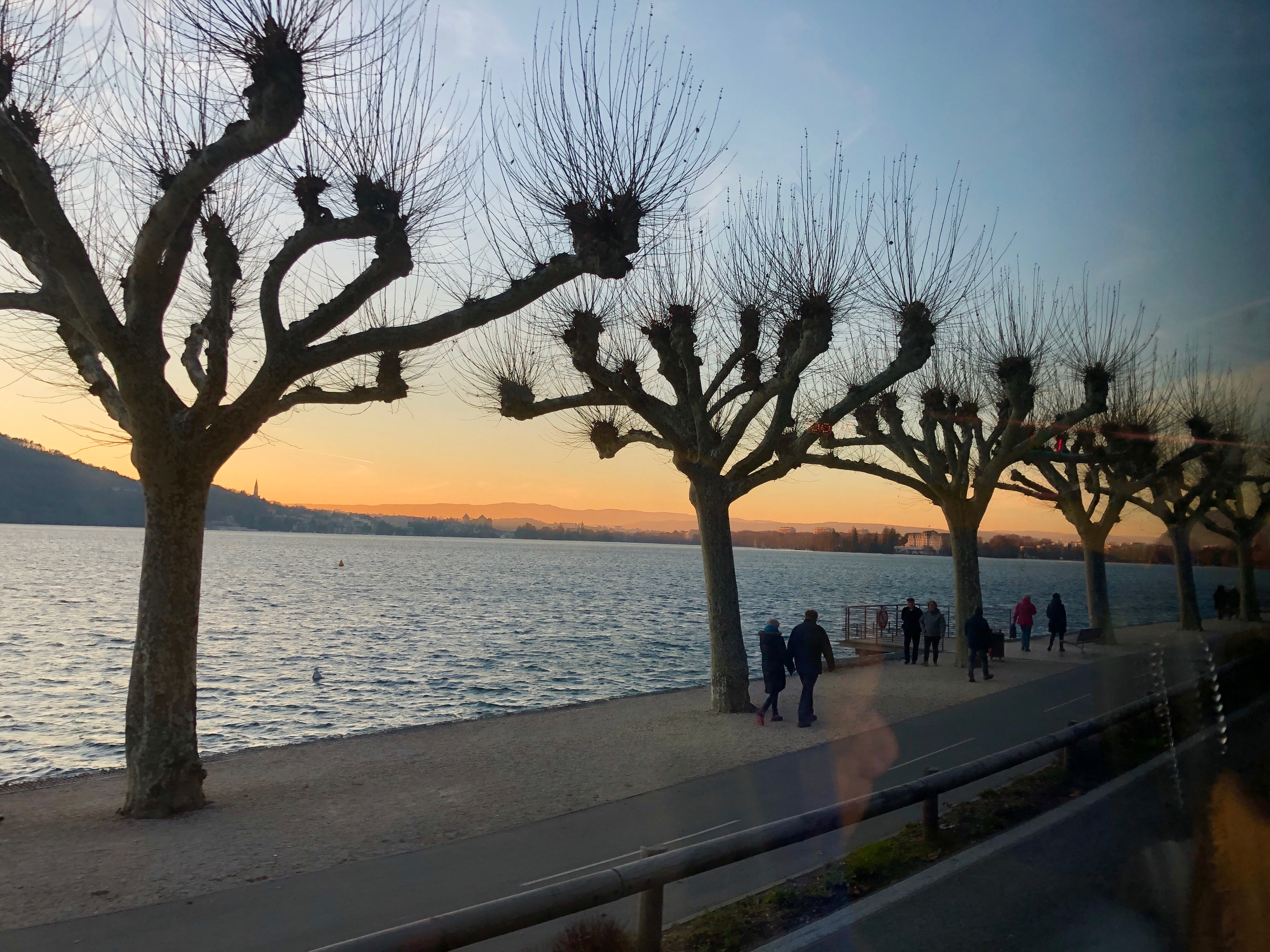
On our last full day, New Year’s Eve day, we started on a walk down the west side of the lake. We stopped for a coffee in Sévrier, about 7km south of Annecy, and ended up eating lunch. We walked out of the Café to blue skies and a warm sun, the first we had seen of the sun during our trip. It transformed the lake and everything around it. We now could see what everyone was raving about when they told us how much we would love Annecy, how beautiful it is. Indeed, with the sun bouncing off the snowy white mountains and reflected in the lake with it’s multitude of sailboats, it was dreamlike.

We stopped in a store as we walked home and Barbara asked about fireworks. The salesperson looked at her and said “This is Annecy. We don’t have fireworks here.” “Completely calm and quiet?” Barbara said. “Oh yes.”

We leaned out the living room window just before midnight and heard people counting down the minutes to midnight at the top of their lungs. At midnight, we saw a few fireworks very far off in the distance. It was hard to tell if it was a suburb or where they were originating from. After a few screams and yells, a siren or two, all was quiet by 12:30am!!

East side of Lake Annecy at sunset

As we got off the train at Gare de Lyon the evening of January 1, 2019, Barbara and I looked at each other and said almost at the same time, “This is so easy. The train ride flies by in no time. I got so much done!!!” And we both went towards our separate routes home. The metro for me and the train to the suburbs for Barbara.

Welcome to 2019. I hope to see you in Paris this year.

A bientôt,

Sara