A Touristic Pilgrimage to Notre Dame de Paris


There are a lot of substacks about Paris and France. Little Lights on Rosa Happiness Street is worth your investigation. Lorie is a great writer and journalist. 

Here is her post this week on Cathedrale de Notre Dame:

“You could spend a day, a year, even a lifetime exploring this hallowed place. You could also learn from my mistakes.

LORIE TEETER LICHTLEN

DEC 12, 2025


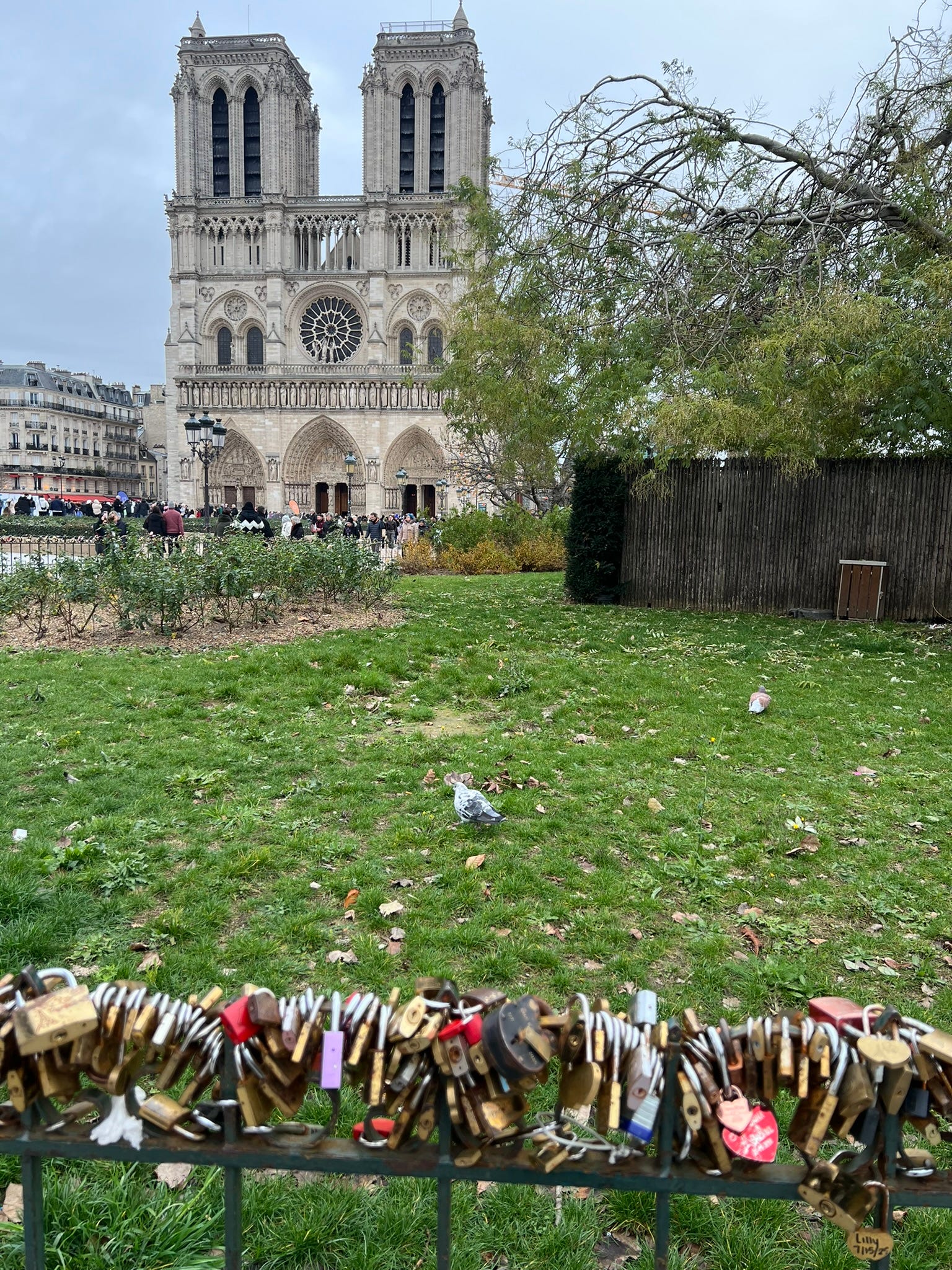
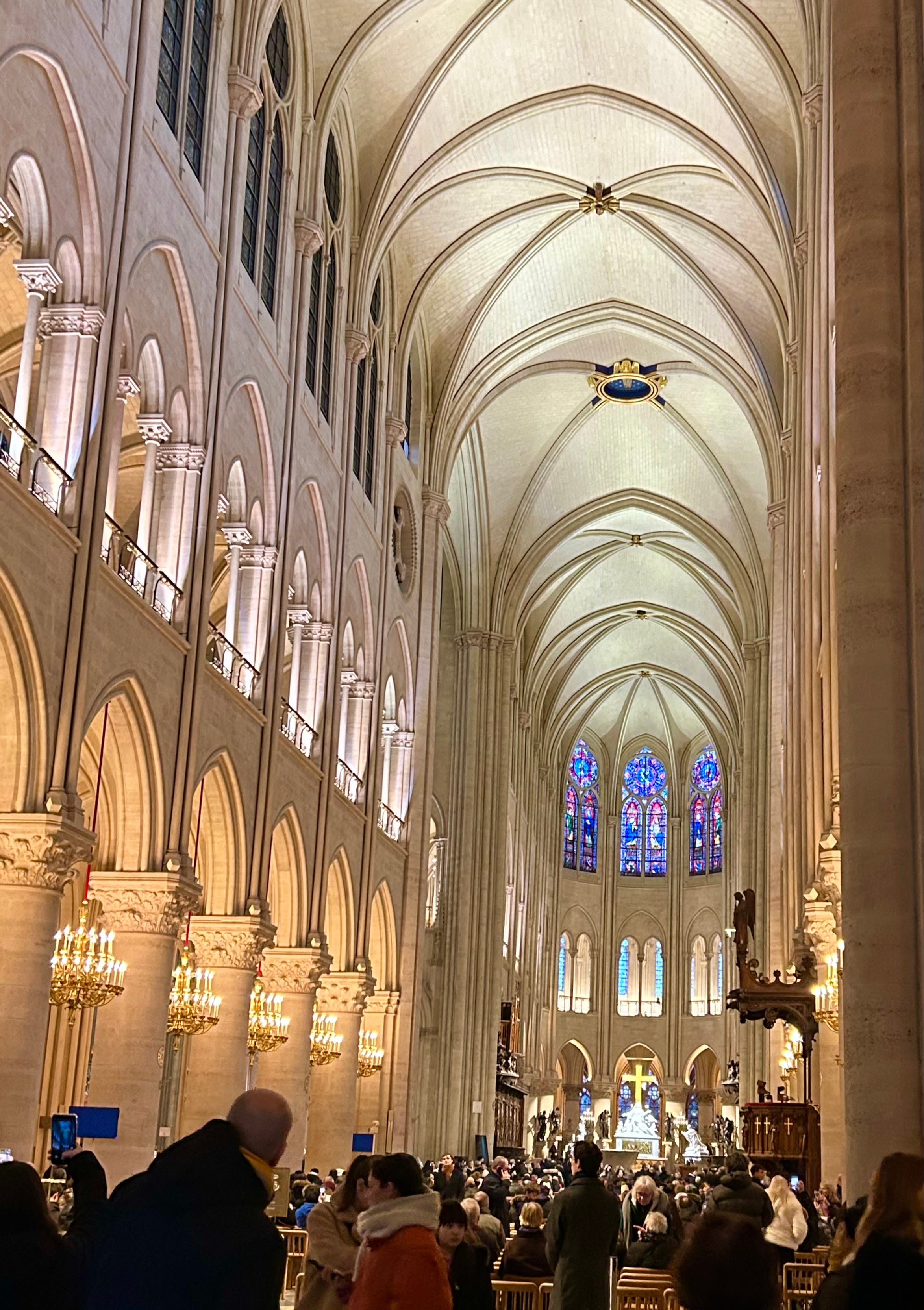
Notre Dame Cathedral on a blustery December day. Photo credit: Lorie Teeter Lichtlen

This week marks the first anniversary of the resurrection of Notre Dame Cathedral.

After the mass for heads of state, which was broadcast around the world, on December 8, 2024, the masses were allowed to visit. They flocked in numbers as monumental as the cathedral itself.

Over the past year, Notre Dame has hosted:

  • 11 million visitors – or more than 30,000 per day, every day, for a year
  • 1600 celebrations – for Lent, Easter, the death of Pope Francis, election of Pope Leo XIV, Advent, Christmas, etc.
  • more than 650 pilgrimages – of which one-third from outside of France
  • 600 official delegations, and
  • 44 groups of “vulnerable, isolated or disabled” people

Meanwhile, the renovations have continued apace. It’s now possible to climb to the towers, visit the crypt and admire the treasures in the sacristy. Thirty priests take turns staffing the two new confession chapels.

Much remains to be done. Designs for new stained-glass windows went on display in Paris this week; the windows themselves will be installed in Notre Dame in 2026. Other projects – notably involving the gargoyles and flying buttresses – will reportedly keep skilled artisans busy until 2030.

With all this exciting activity underway, why did it take me a year to finally visit the “new” Notre Dame?

Well, it took me that long to wait for the crowds to wane or, rather, to work up the courage to face them. I have walked by the cathedral many times over the past year and seen huge lines of people along the concrete forecourt. I have seen them drenched in the rainy spring and fall, and fried in the summer sun. I imagined them travelling from around the world for their dream vacation in Paris, only to find themselves in a very long line, kids whining, and cowering under the makeshift shelter of a scarf. The well-prepared will have brought umbrellas or bought plastic ponchos from the nearby shops.

Admission is free but advance reservations are recommended (there is direct access for the cathedral’s worship services). I tried for months to book and found few slots that would allow me to go in with family or friends, so finally decided to go alone. The evening of Sunday, November 30th, I booked a slot for one person the next afternoon.

Those who haven’t yet made the journey may benefit from my experience.

On this blustery December day, the lines were the shortest I had ever seen. My “reserved” line had about 20 people in it when I joined. After our QR code reservations were scanned, we were all allowed in at precisely 2:45pm. The “no-reservation” line was moving briskly, too.

We passed through the central doors under the 13th century Portal of the Last Judgment, hardly noticing its sculpted scenes of heaven and hell. Pristine statues of the 12 apostles watched quietly as we filed by.

Inside, as my eyes adjusted to the dimmer light, I was struck by the scent of wood smoke. Was it a remainder or a reminder of the tragic fire that nearly destroyed this hallowed place on April 15, 2019?

Many visitors did not heed the request to come without bulky backpacks. There are no lockers or coat check desks at Notre Dame. (No cafeterias or drinking-water fountains either.) Add in throngs in winter coats and it can get congested. At least no one seemed to be lugging luggage when I visited.

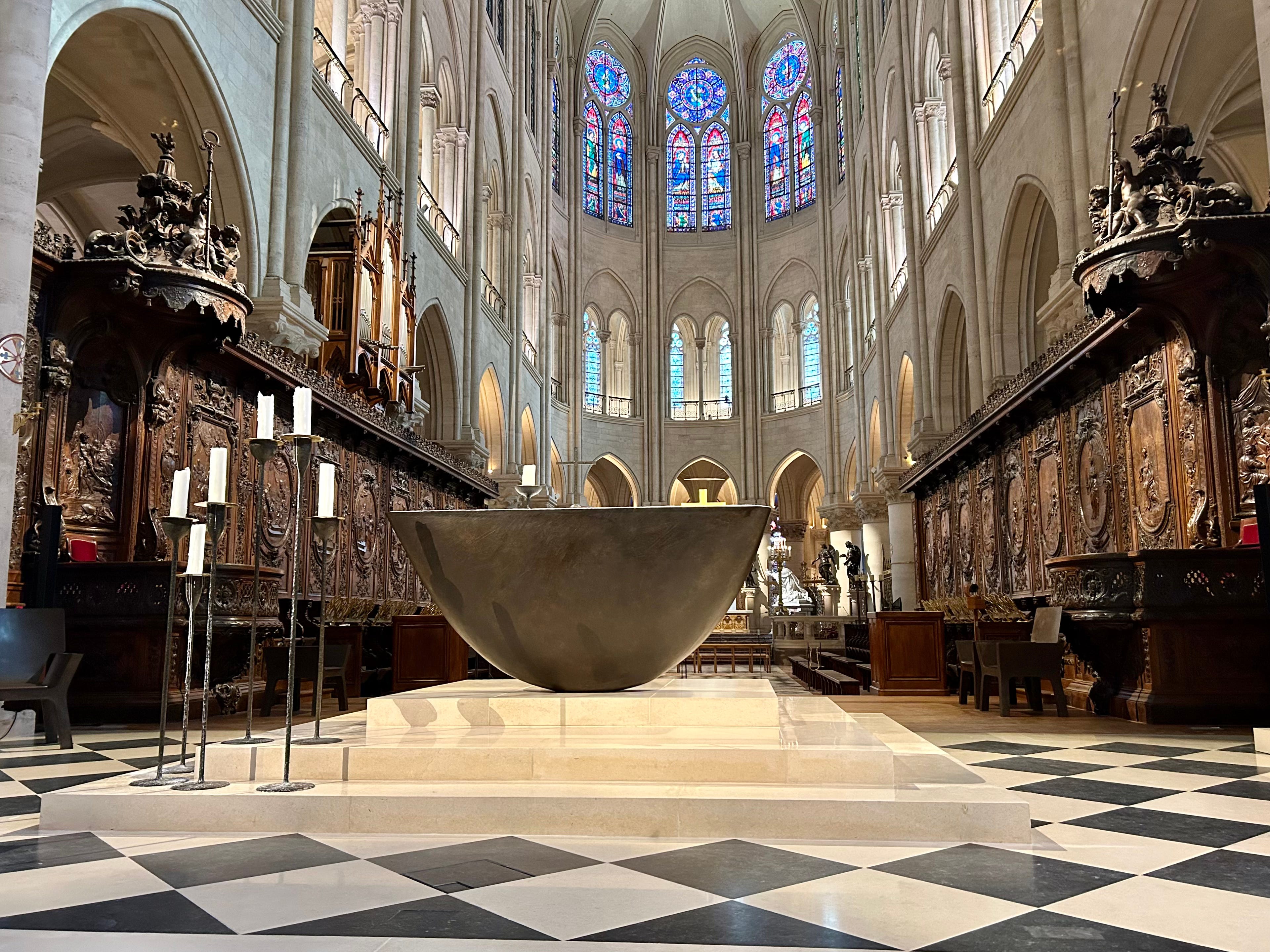
A year ago, some said the “new” Notre Dame seemed too new: too bright and shiny for its 860 years. Today’s lighting bathes the cathedral in a gentle golden glow. The result underscores the grandeur of the interior while allowing visitors to marvel at the artistry on display.

The visit is organized clockwise, starting with a welcome desk offering free headsets for guided tours via a mobile app and ending with a small gift shop area. Throughout the cathedral, votive candles can be purchased via credit card and vending machines offer commemorative medals. Proceeds from these and the shop help finance the restoration efforts.

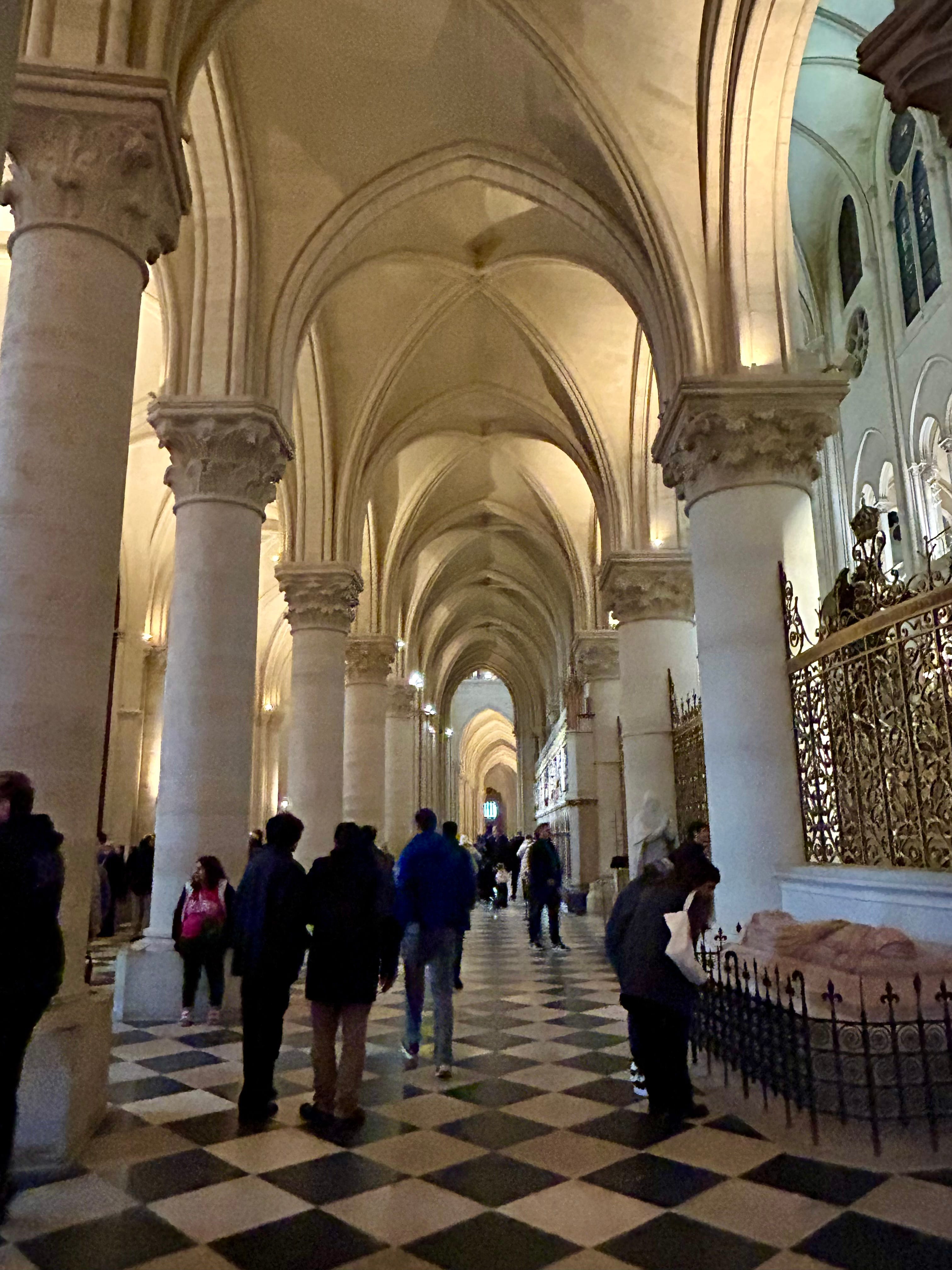
Along the left (north) aisle, a series of chapels represent the stages in the history of Christian revelation, from Adam, Noah and Moses to Solomon and Elijah. Each has its own distinctive style, and each is more stunning or elaborate than the next. The chapels are adorned with precious paintings and frescoes, hand-woven tapestries, decorative tiles, and sculptures in wood, marble and other materials. Some are equipped with mini elevators to allow wheelchair access.
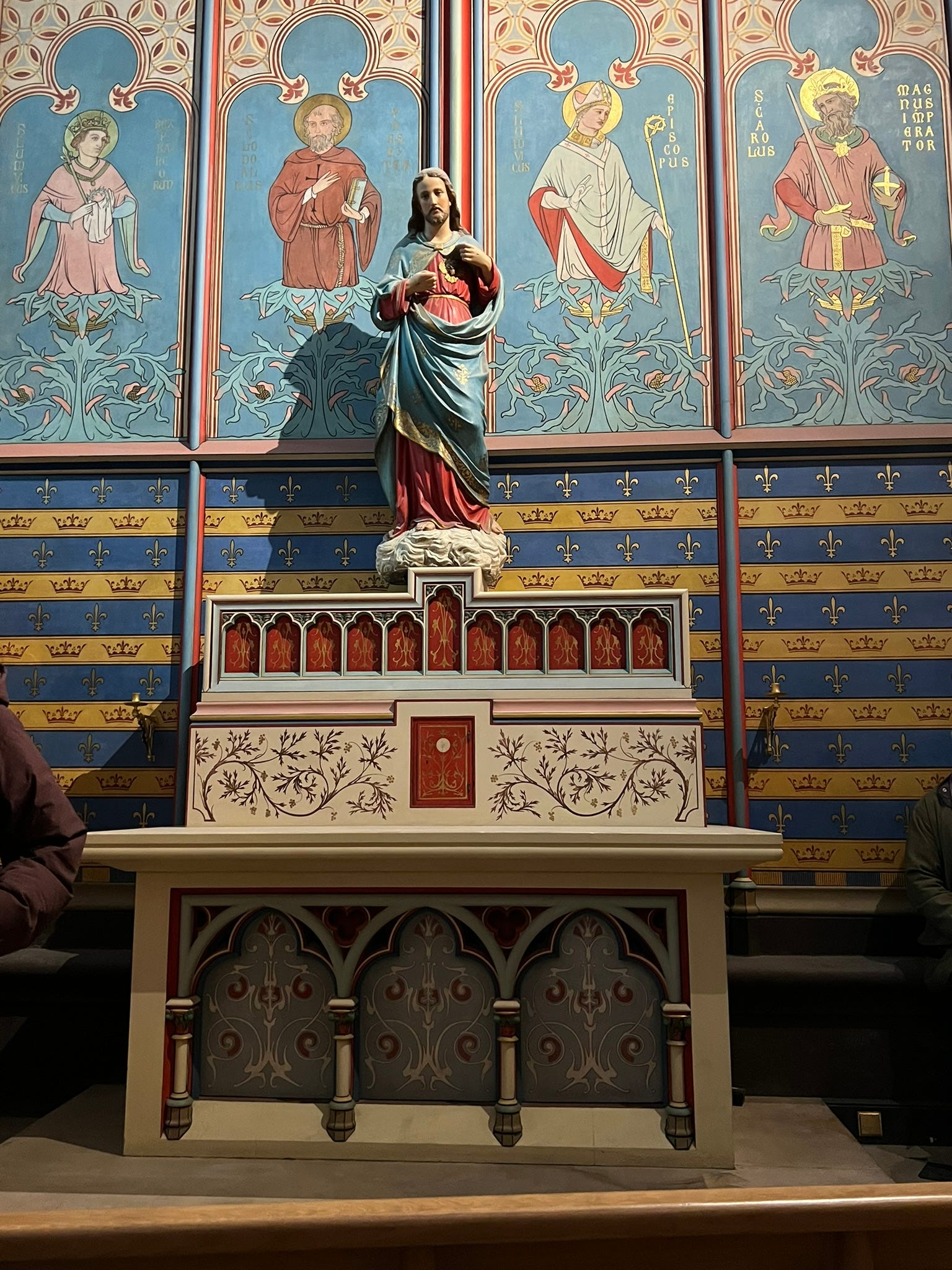
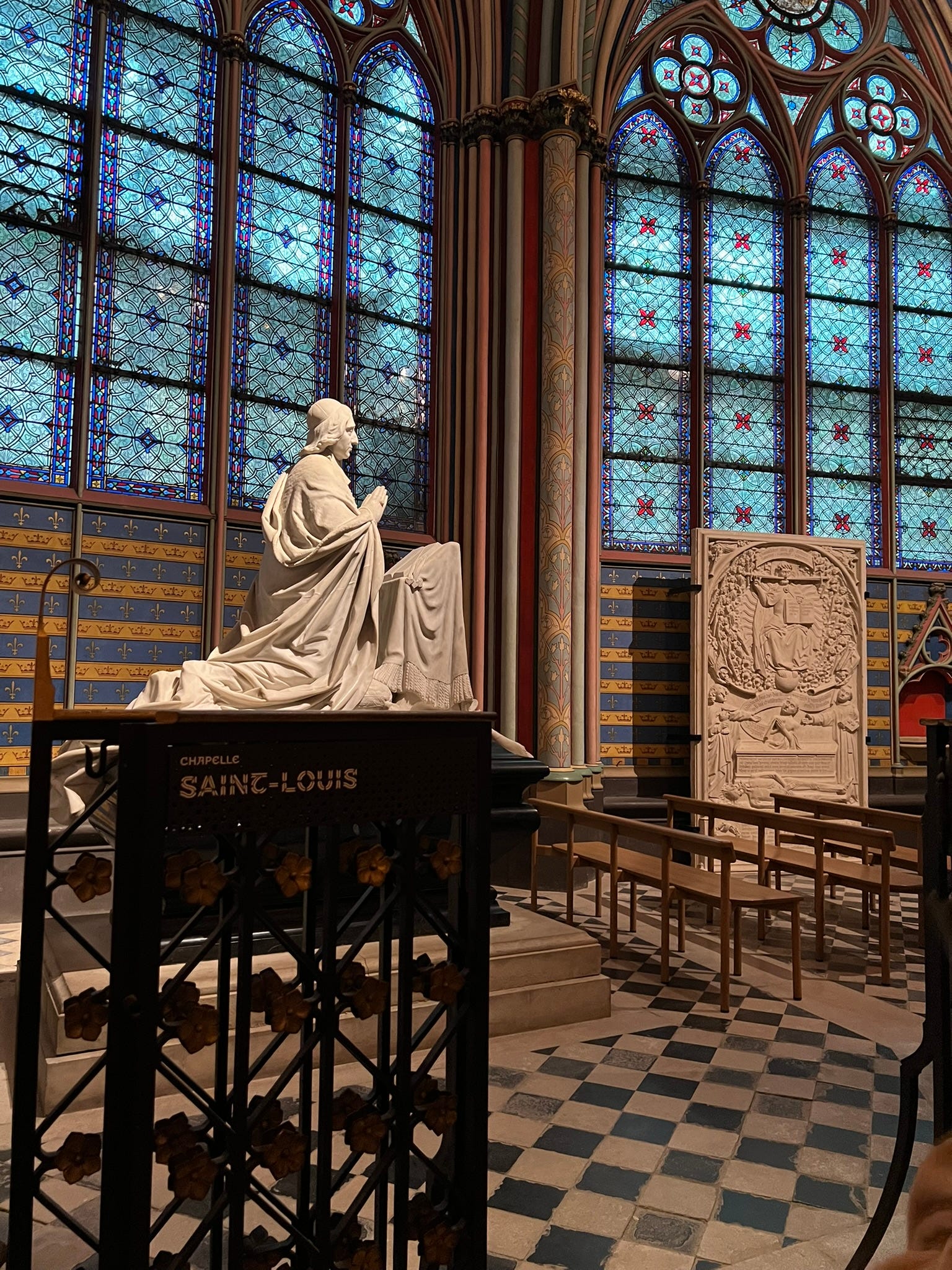
My favorite among the chapels is dedicated to Saint Louis: a beautifully simple space, twice the size of the others, with wooden benches that invite contemplation. Photo credits: Lorie Teeter Lichtlen

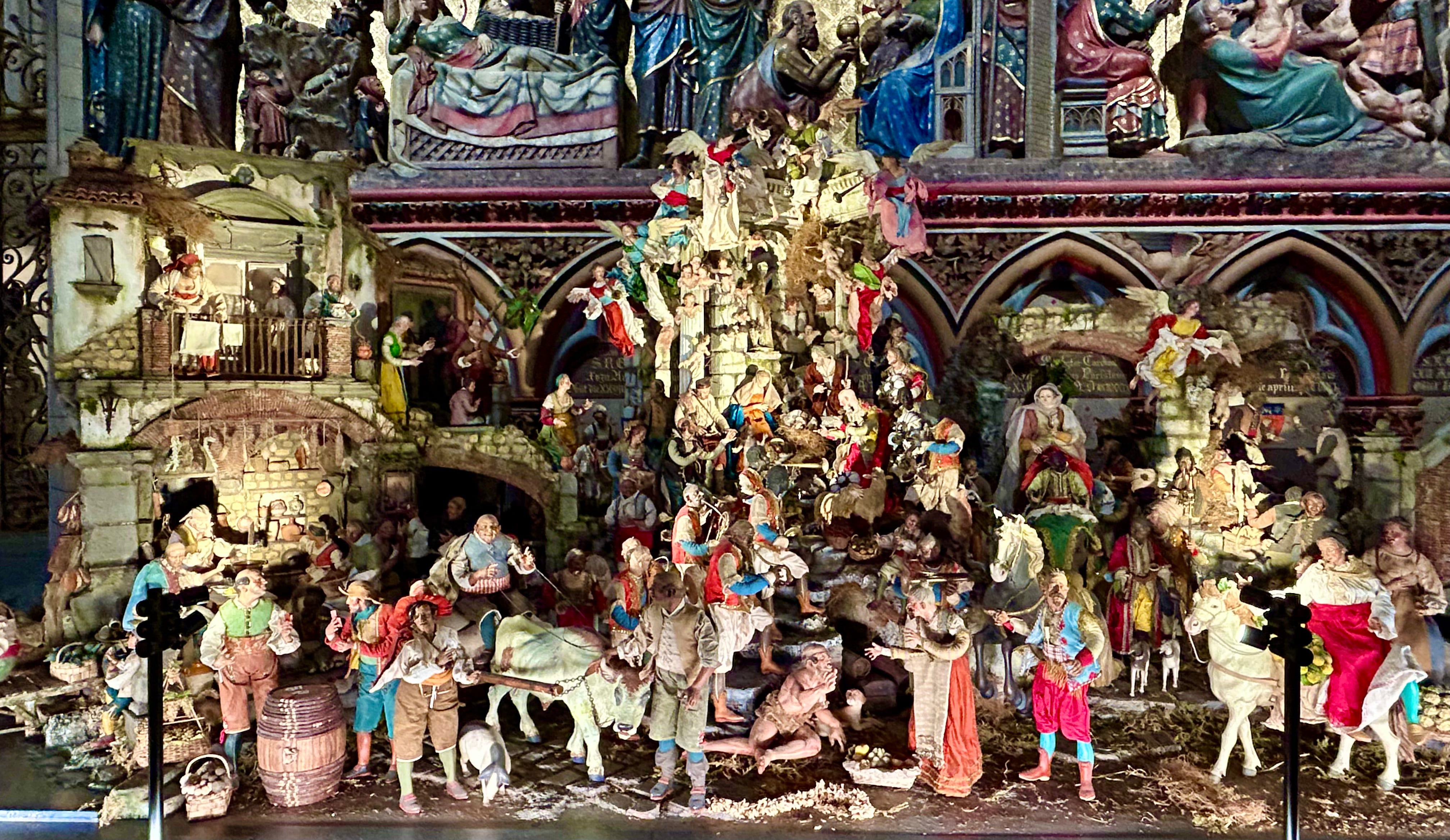
Across the aisle from the chapels, the north wall of the choir enclosure is lined with scenes from the life of Christ in polychrome stone. For this Christmas season (until February 2), this area also features a large “crèche” or nativity scene, with traditional Provençal figures and a terracotta village.
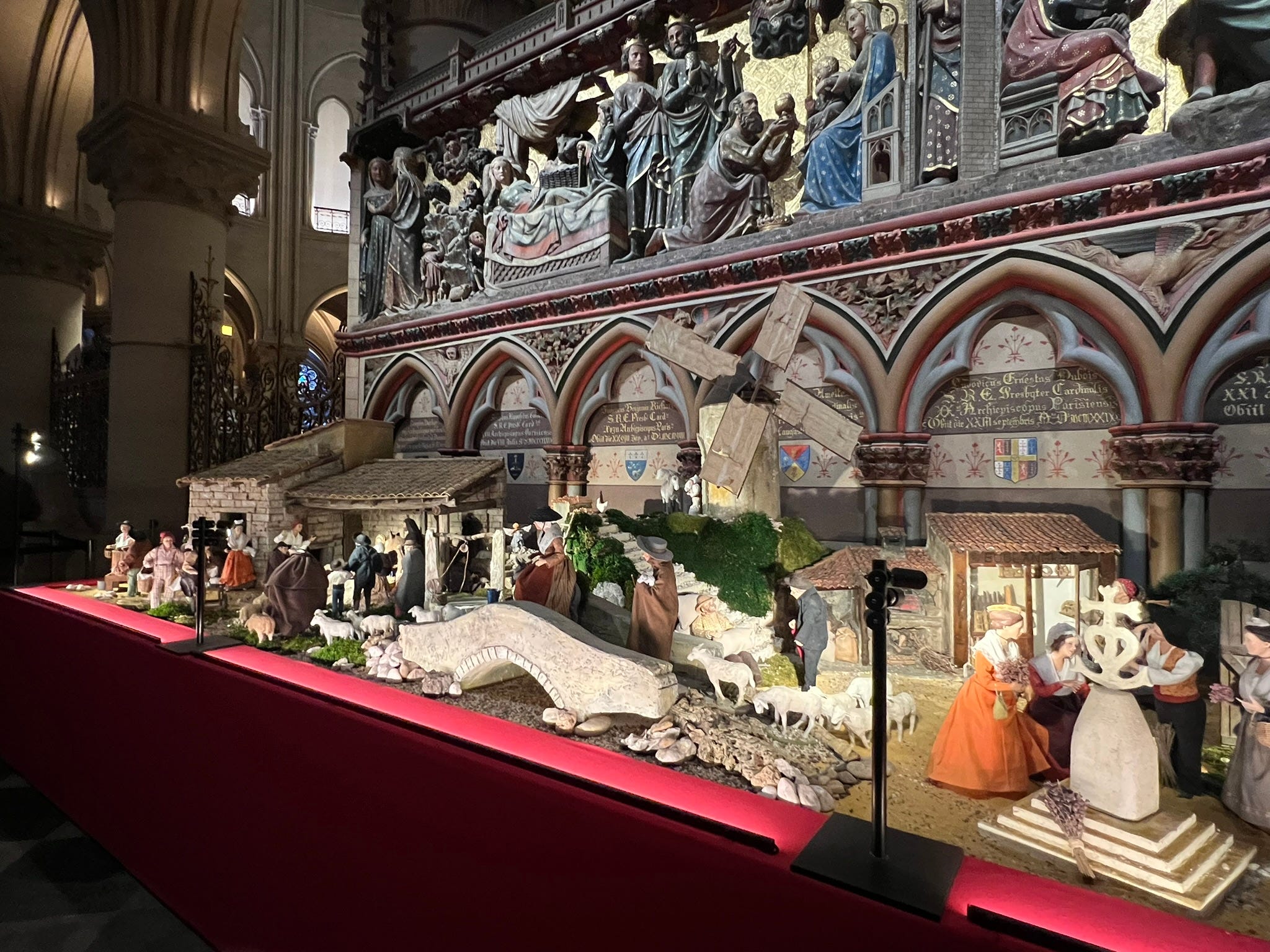
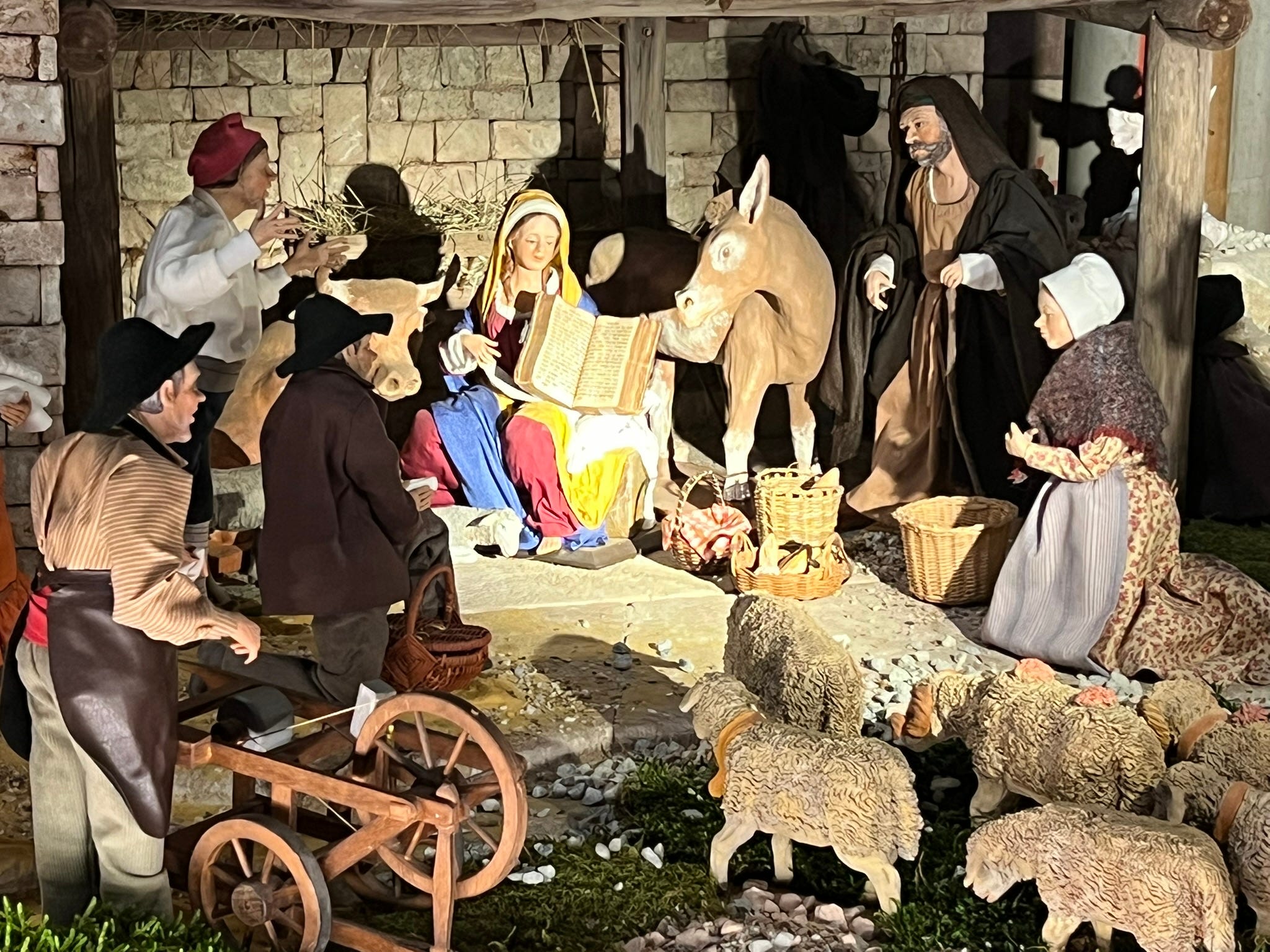
The north choir enclosure and Provençal “crèche” for Christmas. Photo credits: Lorie Teeter Lichtlen

Traffic jams formed near the north and south transepts – ie, the perpendicular arms that constitute the cathedral’s cruciform shape. Mobile phones aloft, hundreds of tourist pilgrims like me turned in circles, attempting to capture the reverential atmosphere distilled by the vaulted ceilings and famous rose windows.

Traffic jam at the north transept. Credit: Lorie Teeter Lichtlen

When the hum of collective admiration grew too loud, an ethereal “shhhhhhhhhhhhhhh … silence, please” floated from invisible speakers. This message played several times during my visit, once followed by an invitation to attend mass by heading to the reserved seating area. (Notre Dame celebrates three masses per day on weekdays and four on weekends.)

“The Cathedral of Notre-Dame de Paris is delighted to welcome you: pilgrims, believers or not, Christians, visitors from around the world, all men and women of goodwill!” – from the Notre Dame de Paris web site

I’m not Catholic but could have attended the mass. Instead, I continued to meander around the cathedral with the other tourists.

Another traffic jam soon formed, this time around the holy relics.

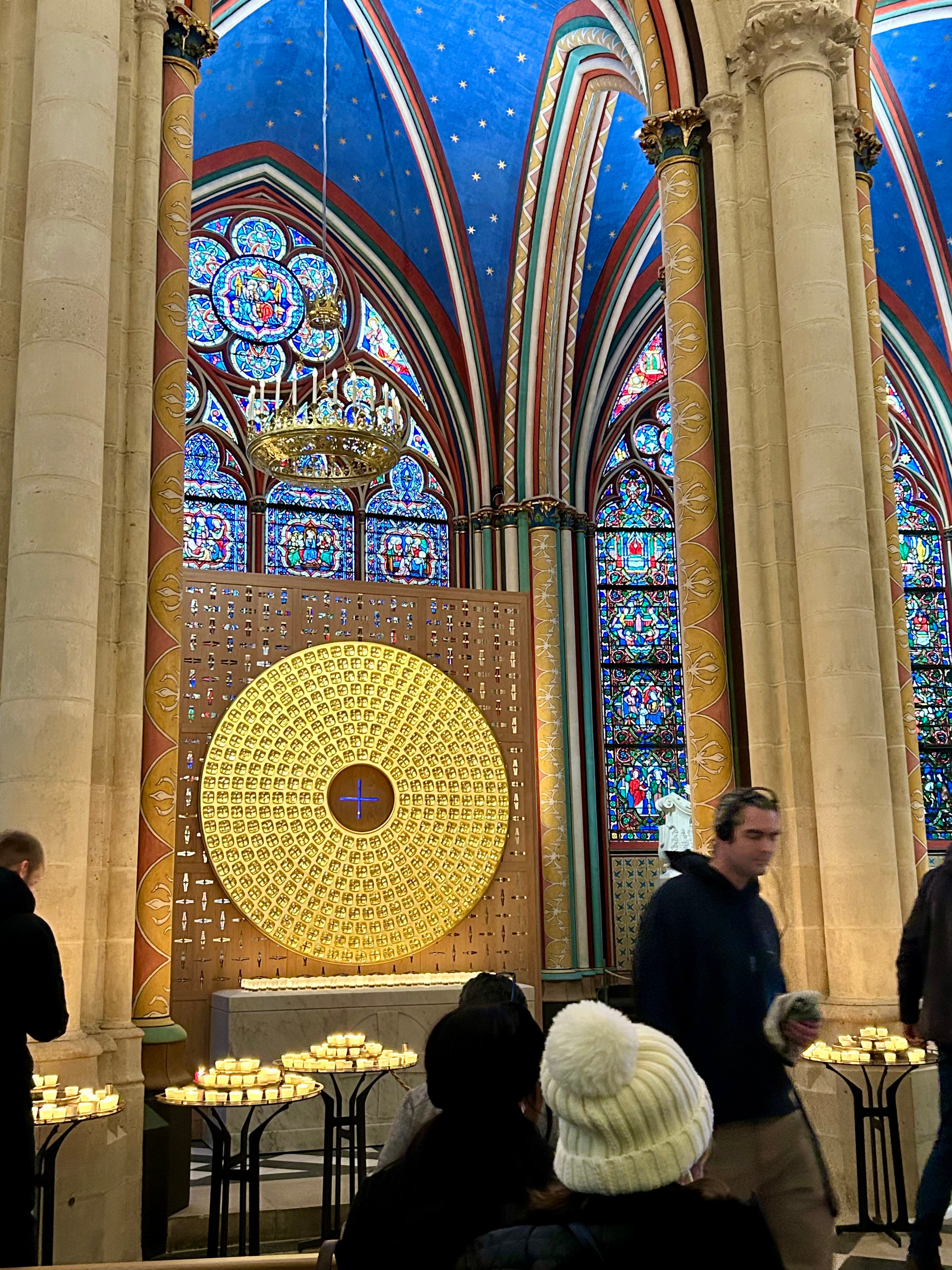
Who knew that Notre Dame houses what are believed to be relics from the Crucifixion of Jesus Christ? The Crown of Thorns, a Nail and a fragment of the Cross were purchased in 1238 by King Louis IX – later canonized as Saint Louis — from the Latin Emperor of Constantinople. Had I known, I might have been prepared to sit in thoughtful meditation before the holy crown in its crystal case within a large golden circle. Many others did so. Instead, I suddenly felt unworthy of occupying precious space there and just took pictures from a respectful distance.
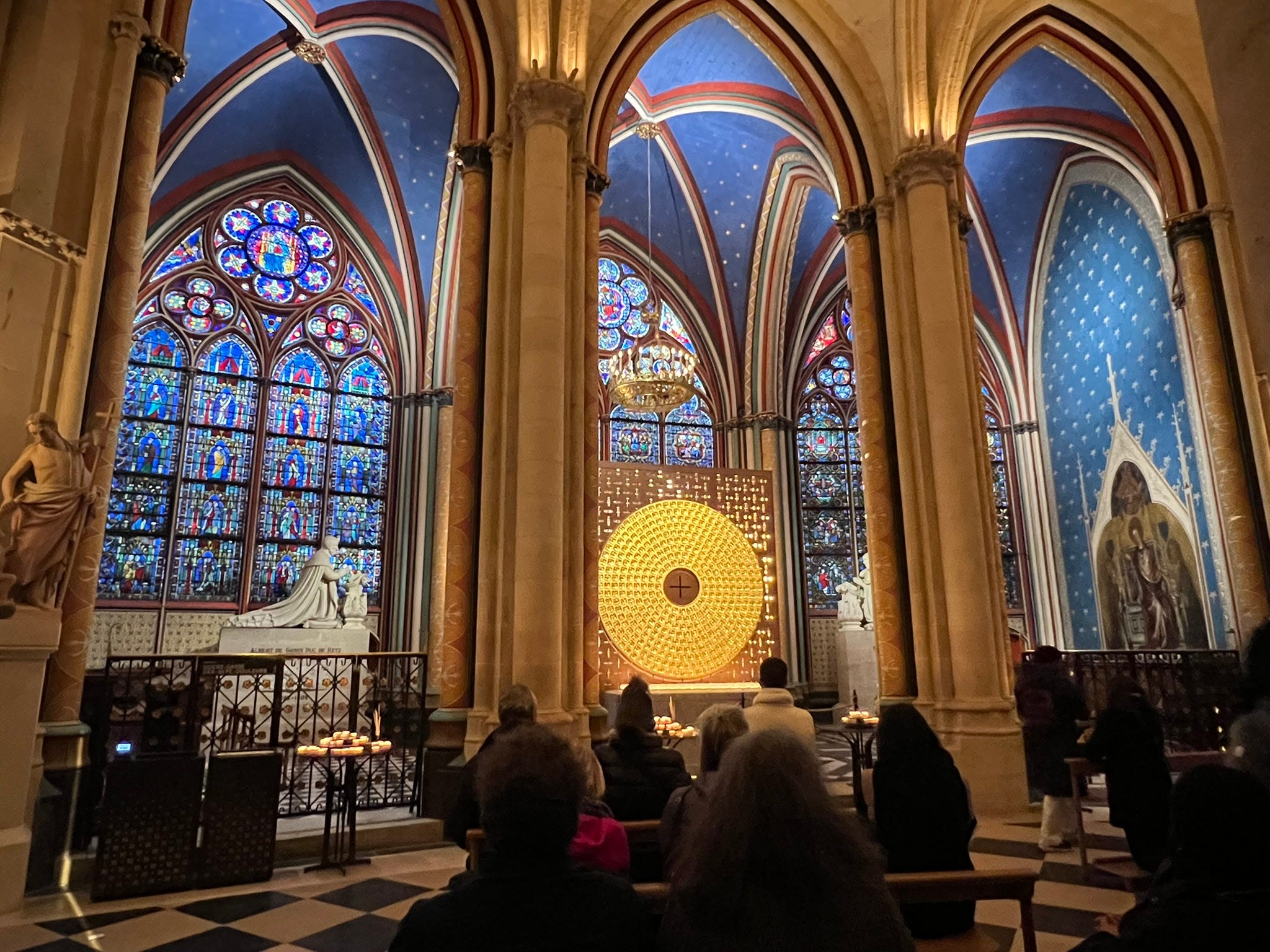
The Crown of Thorns in one of the holy relics housed at Notre Dame. It is displayed on Friday afternoons, in a crystal case within a golden circle. Photo credit: Lorie Teeter Lichtlen

My qualms turned out to be unfounded: the crown wasn’t on display the day of my visit. As I learned later, it was traditionally visible on the first Friday of each month; as of last week, it can be seen every Friday starting at 3:00pm.

Had I pored over the official Notre Dame web site and downloaded the mobile app, I would have been less clueless. As it was, I read every available description — and there are many!

The south aisle of the cathedral is lined with more chapels, including a new one devoted to Eastern Christians. The choir enclosure on this side offers another series of polychrome sculptures illustrating the apparitions of Christ. While the south enclosure is more recent than the north one, both were created by master sculptors in the 14thcentury.

By this time, I had been walking, studying and admiring the countless artistic and architectural masterpieces for over two hours. I wasn’t overwhelmed by all the beauty to the point of fainting, as the French author Stendahl was during a visit to Florence, Italy. I did need to sit down and process everything I was seeing and feeling, however.
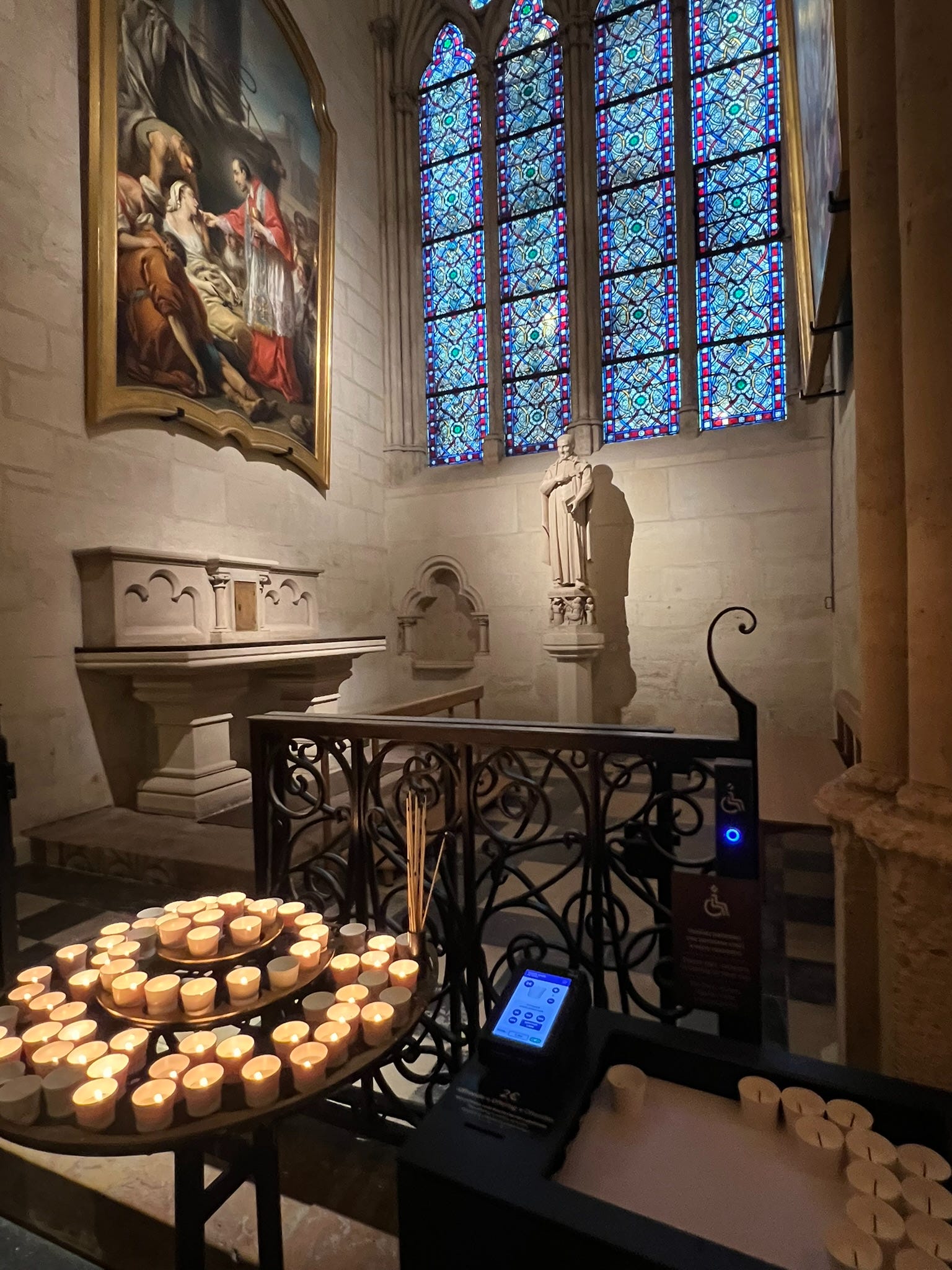
Mini lifts for wheelchair access and card payments for votive candles are among the enhancements at the “new” Notre Dame Cathedral. Photo credit: Lorie Teeter Lichtlen

I chose a seat in an empty section of the pews for the general public (as opposed to those reserved for worshippers) and started scribbling notes in my iPhone. Inspired by the atmosphere of Notre Dame, I was absorbed in poetic thoughts — until a group of tourists sat behind me and started happily chatting with each other.

I moved to another empty section but, within minutes, another chatty group arrived. I turned around a few times but, like the first group, they were oblivious to my frown. Should I have floated a “shhhh” of my own?

Instead, I saved the notes on my phone, put it in my pocket and went to the gift shops. The “shops” are actually four curved display cases forming a circle around the salesclerks; each case has its own cash register. Three of the counters sold similar items: a slim guide to the restoration works, notebooks, bookmarks, medals, necklaces, rosary beads, a Christmas music CD and decorations, etc. The fourth sold books, sculptures and more decorative items. I stood in line for two different cash registers to buy a few gifts. Had the line been shorter, I might have inspected that fourth counter’s wares. (Those items and many more are available at Notre Dame’s online boutique.)

I put on my coat and went outside, the fresh air feeling good after the crowds and hours indoors. The sun was low and the cathedral’s 21 bells were ringing. I love bells and it was great to hear them ringing, especially knowing they had been silenced for five years.

I was happy with my visit but wished I had focused less on getting through the front doors and more on studying all that the “new” cathedral has to offer. I’m determined to go back, once I have done my homework, to appreciate even more the miracle that is Notre Dame de Paris.

The bells of Notre Dame de Paris. Credit: Lorie Teeter Lichtlen

Those wishing to contribute to the continuing restoration of Notre Dame can find a way to do so at https://www.friendsofnotredamedeparis.org/

Thanks for reading Out My Window! Subscribe for free to receive new posts and support my work.

TIPS for getting the most out of your visit:

  • Read up on the history, art and architecture of Notre Dame before going!
  • Download the mobile app for tour guidance on-site in English, French and Spanish
  • Try to book your visit in advance through the official reservation site or attend a mass to avoid the long “no-reservation” lines
  • Check the practical information site for the opening hours, dress code, free guided tours, etc.
  • If you want to see the Crown of Thorns, aim to go on a Friday afternoon
  • Food and drink are not allowed on-site so have a bite before your visit
  • Bring a small umbrella for the wait in line, even on sunny days; small bottles of water are also a good idea
  • If you must bring a backpack, make it a small one; don’t bring bulky items
  • Ask for headphones at the welcome desk and use the app to better appreciate what you see
  • If you have to talk with others inside the cathedral, keep it short and whisper
  • The gift-shop counters offer a few items but can require standing in line multiple times; the official e-shop has a wider selection and you don’t have to carry heavy items or worry about breaking fragile ones. All proceeds go to the restoration effort.
  • Resist the temptation to head to the closest café or restaurant before or after your visit. A few blocks away in any direction, the fare and prices are less touristy. One exception: go for Berthillon ice cream on the Ile Saint Louis, behind Notre Dame. It’s a classic part of any visit to Paris!Let me know how it goes!
Little Lights on Rosa Happiness Street

A bientôt,

Sara
Dancing with Fred Astaire–backwards and in French

When we dream of moving to Paris, our heads (my head) are filled with romanticism: the beautiful architecture, the sky unencumbered by skyscrapers, the stores on every street bursting with color of seasonal fruits and vegetables, the cafés where one can order an expresso and then sit for hours, a city full of walkers-everyone walks and enjoys walking. What we don’t think of until we are here and in need is the strictness of French bureaucracy, black and white. Either you accept it or you drive yourself mad trying to figure out ways to make it move faster. And the fact that everyone speaks French. Which, depending on our schooling, when arriving in our adopted country, we come with different levels of fluency.

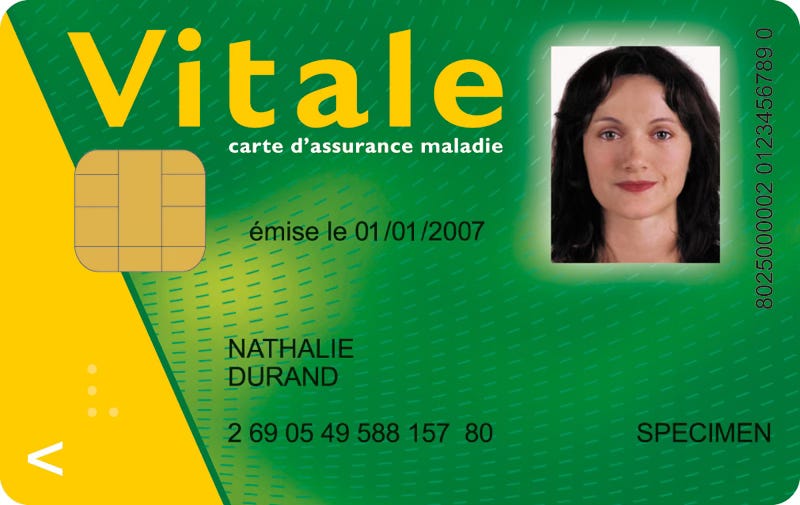
For the first three or four years, I would take someone with me when applying and reapplying for my one-year residency card, renewable yearly. I kept my US health insurance not realizing that I could apply for the social security and carte vitale after I’d lived here for over three months (That may change. The French parliament is proposing that US retirees pay a fee for their carte vitale). Once I got my Carte Vitale, I looked for doctors who spoke English again not realizing that they charged at least 50% more for that service. But I was too afraid that I would miss something crucially important if I depended on my B2 level of French.

Recently I have been struggling with a few issues: intense vertigo being the main health issue that I worry about. I’ve always had some form of vertigo although it would go away for years. It has returned with a vengeance. After I returned from the trip to Spain in September, it hit on a Monday, more of an attack. By Tuesday evening, I was crawling around on all fours. I’d had some neck pains before I left and thought I’d taken steps to deal with my neck. 

If you have never had vertigo, it is not only awful, it’s frightening, debilitating. The world spins around at high speed making most people nauseous. You start to vomit and can’t stop even when there is nothing left. Vertigo is not a matter of life and death (although I once got it while driving on the freeway from Walnut Creek to Oakland. I had to pull over and lie down on my front seats until it passed). Vertigo is isolating. With this last episode, I have had no idea when it would hit or what triggered it. Lying flat I knew was one culprit. I didn’t go to any of my gym classes. A heaviness like a cycle helmet of concrete hung around my head at all times. I was afraid to move my head from side to side. I probably looked to others like my spine extended through my head and I had abandoned all flexibility. 

How do you like this for a diagnosis??

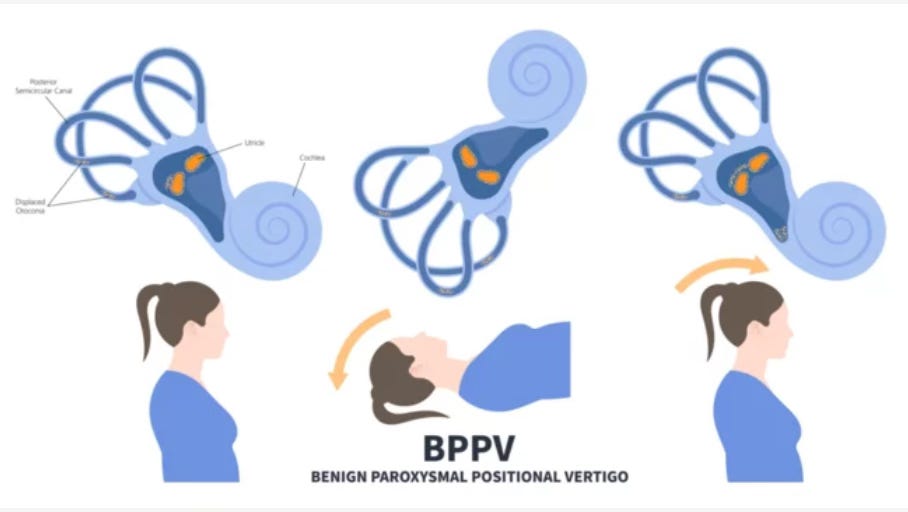
My doctor, who speaks English, referred me to a Vertigo clinic but I couldn’t get in for four weeks. Everyone I knew who had had some experience with vertigo had advice for me. And I was willing to try anything. Now six weeks after the first onset, I don’t feel very educated on what’s wrong. I know it has to do with crystals in my right ear and getting them to return to their proper place. However, with age, crystals tend to get stuck and refuse to budge making balance a very precious commodity. The doctor at the vertigo clinic induced vertigo then sent me home. I was upset. And scared to do one of the maneouvers that is supposed to budge those pesky crystals back into their proper place.

This is probably what I have.

This week I went to a kiné. A kinesteologist but different from American kinestheologists. They are a combination of osteopath, massage, and physical therapy. Cédric, I was told, speaks English, I was told wrong. And once more I have found myself in the hands of a health professional communicating in French. The first time I went to a health professional who spoke no English, I used my translator, DeepL, to write out in English what the problem was and what I hoped for. DeepL would translate into French and I’d make a word document which I’d take to the professional. Today, I told myself to trust that I spoke fairly good French and just go. I couldn’t help but think of Ginger Rogers doing everything that Fred Astaire did but backward and in heels. That’s the way it feels. I’m going to my doctor. I’m going because I need the wisdom and expertise of a health professional. I’m doing it all in French.

We make our appointments through Doctolib, a wonderful site that makes it so much easier to do this ‘in French’

I’m told by French people that my French is fine. I think that means I get along. I couldn’t possibly go to a French movie without subtitles, enjoy it, then go to coffee with friends and have a discussion. Half the movie would be in argot (slang). The only place I know to hear pure French so I practice is the news. I prefer France 24. But I’m not a great fan of the news at the moment.

So I struggle along. If I were completely healthy, I think living in French is hard work, it’s tiring. I forget that. Now, dealing with vertigo, and living in French, I’m tired a lot. I don’t like being tired. I judge myself and feel old. My Irish doctor says vertigo has nothing to do with age—get over it. If only….

Would I trade all that in to return to the States and deal with that health care system and converse with doctors in English? Not on your life. This is a small price to pay. And truth be told, I need every kick in the ass I can get to keep practicing my french.

A bientôt,

Sara
Stalls and Stories: My Weekly Marché

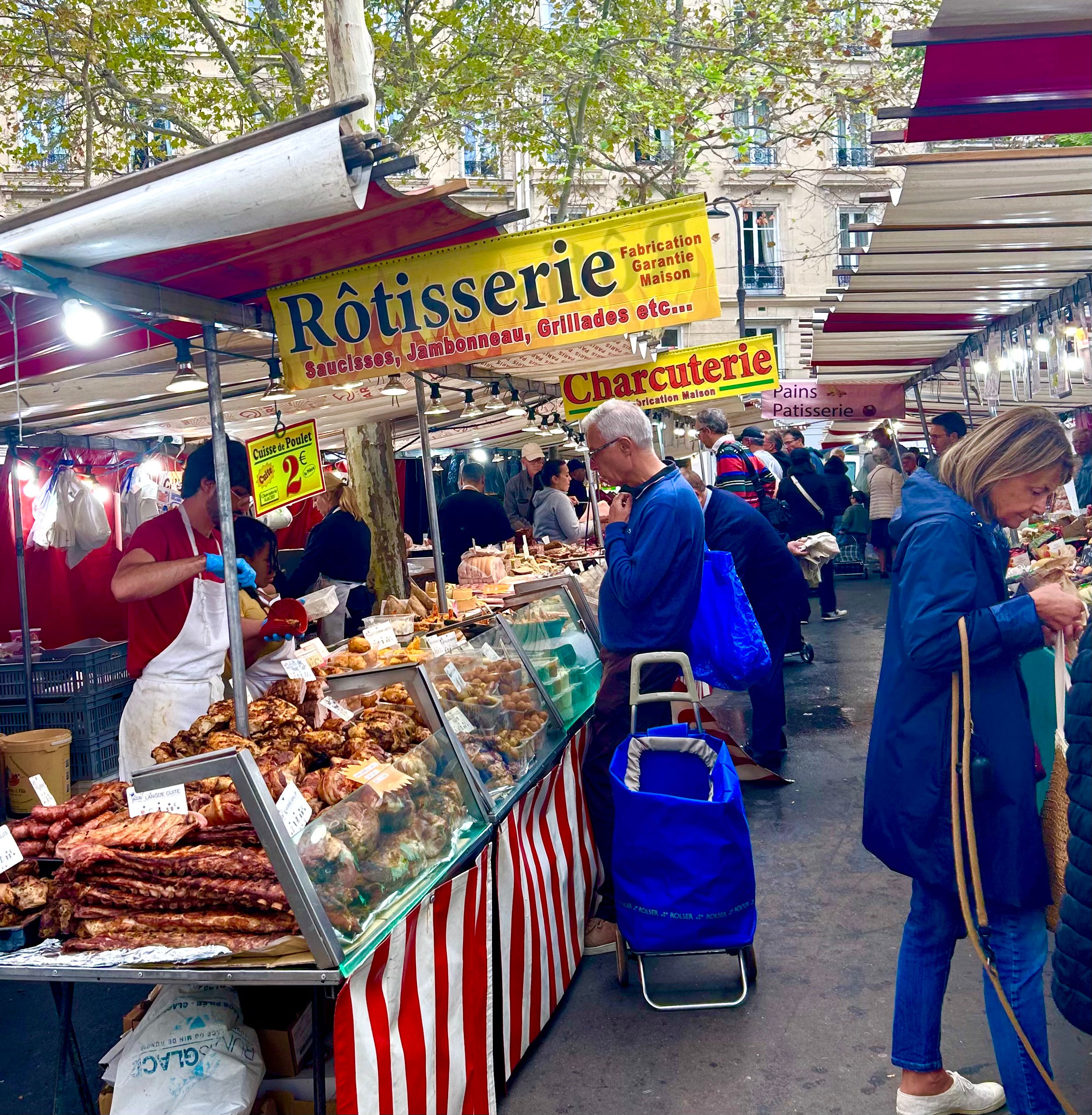
What a gift it is to live half a block from an open marché/market. I wake up on a Wednesday morning knowing that I can have fresh fish for dinner, poulet rôti for lunch – all accomopanied by fresh vegetables, and fresh flowers next to my bed. I’ve lived in Paris for 12 years and I’ve never had a marché this close, close enough that it has become a part of my week. I keep my rolling caddy in my kitchen and haul it out each Wednesday after I’ve had a cup of coffee and my breakfast.

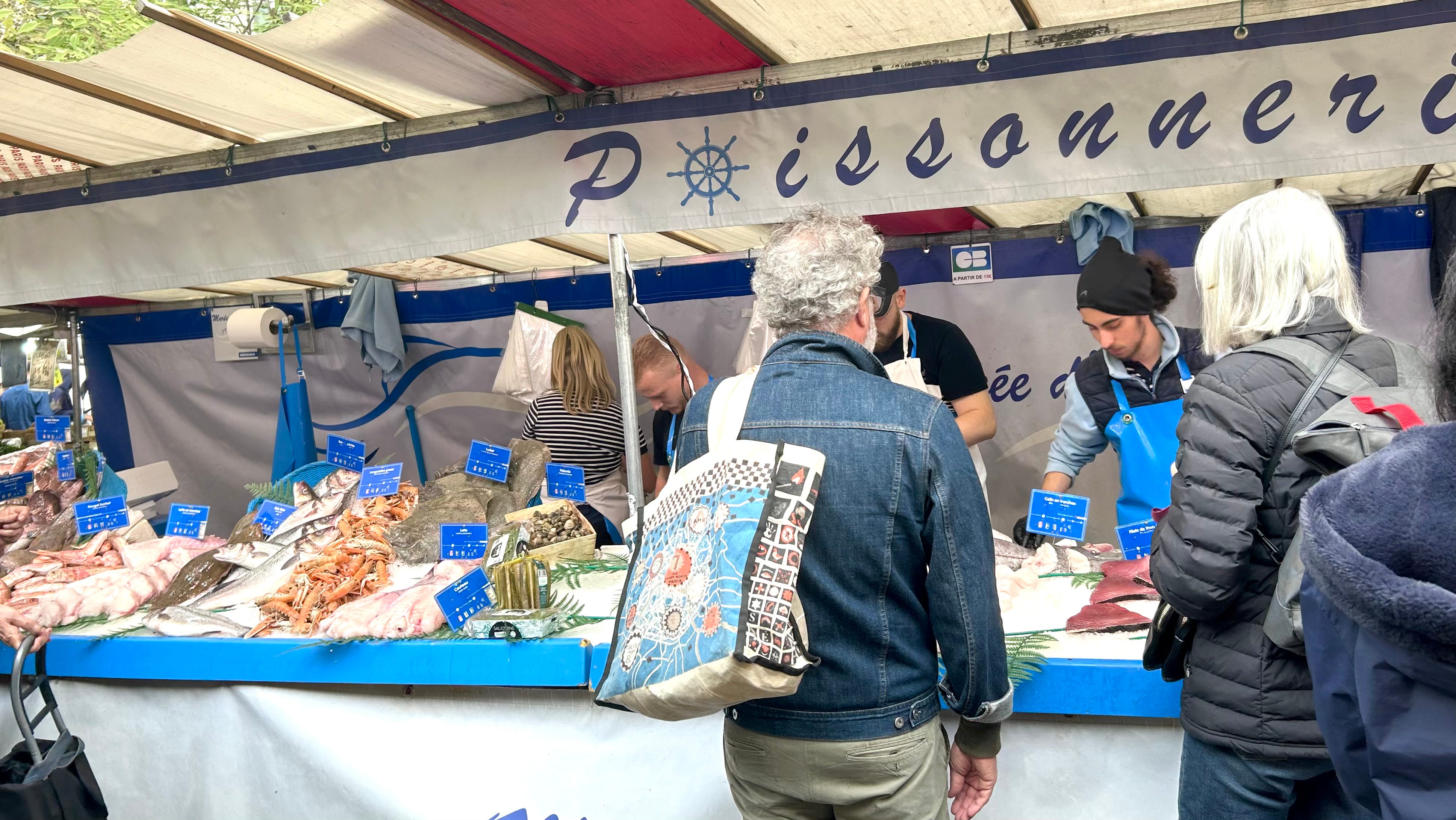
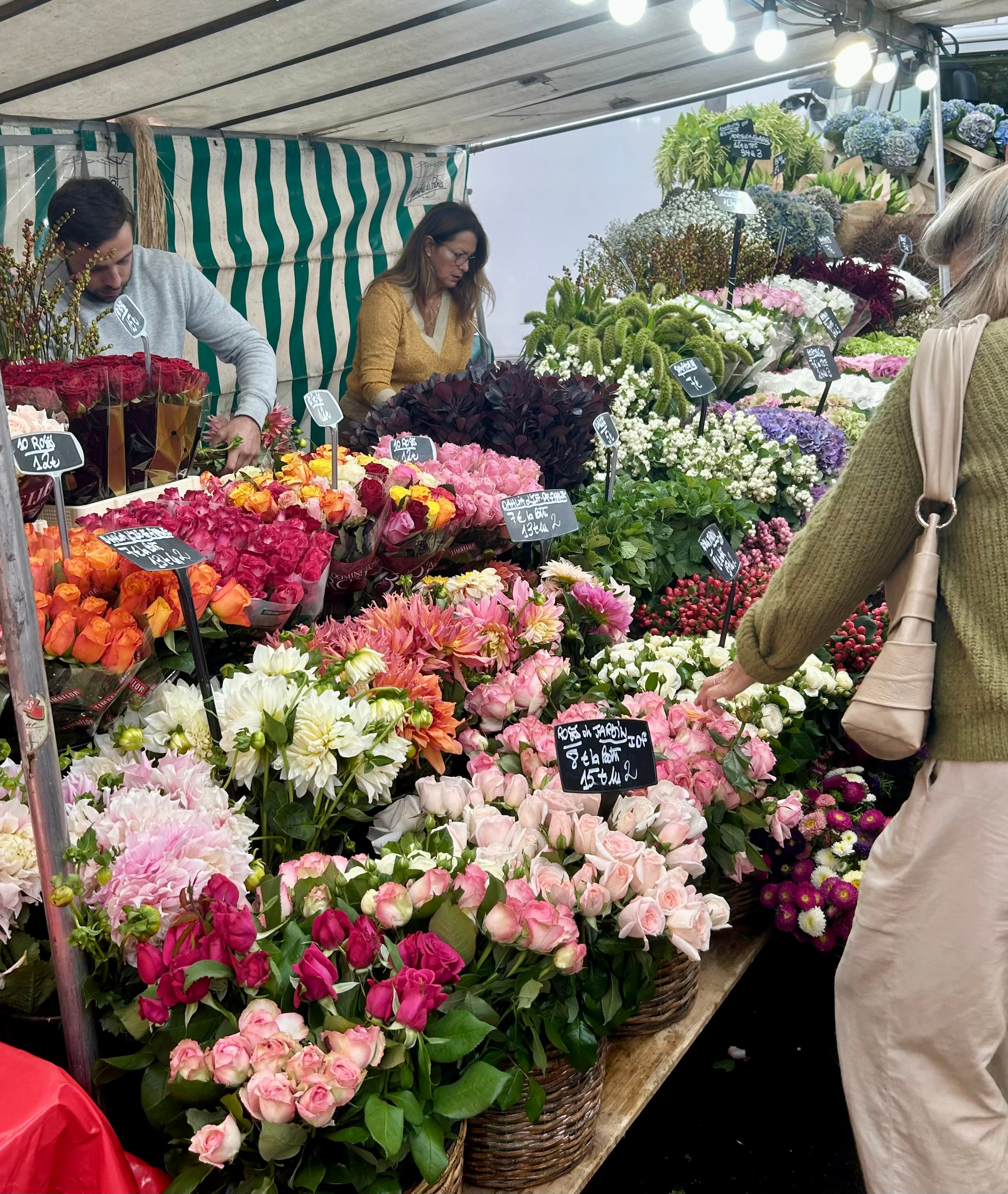
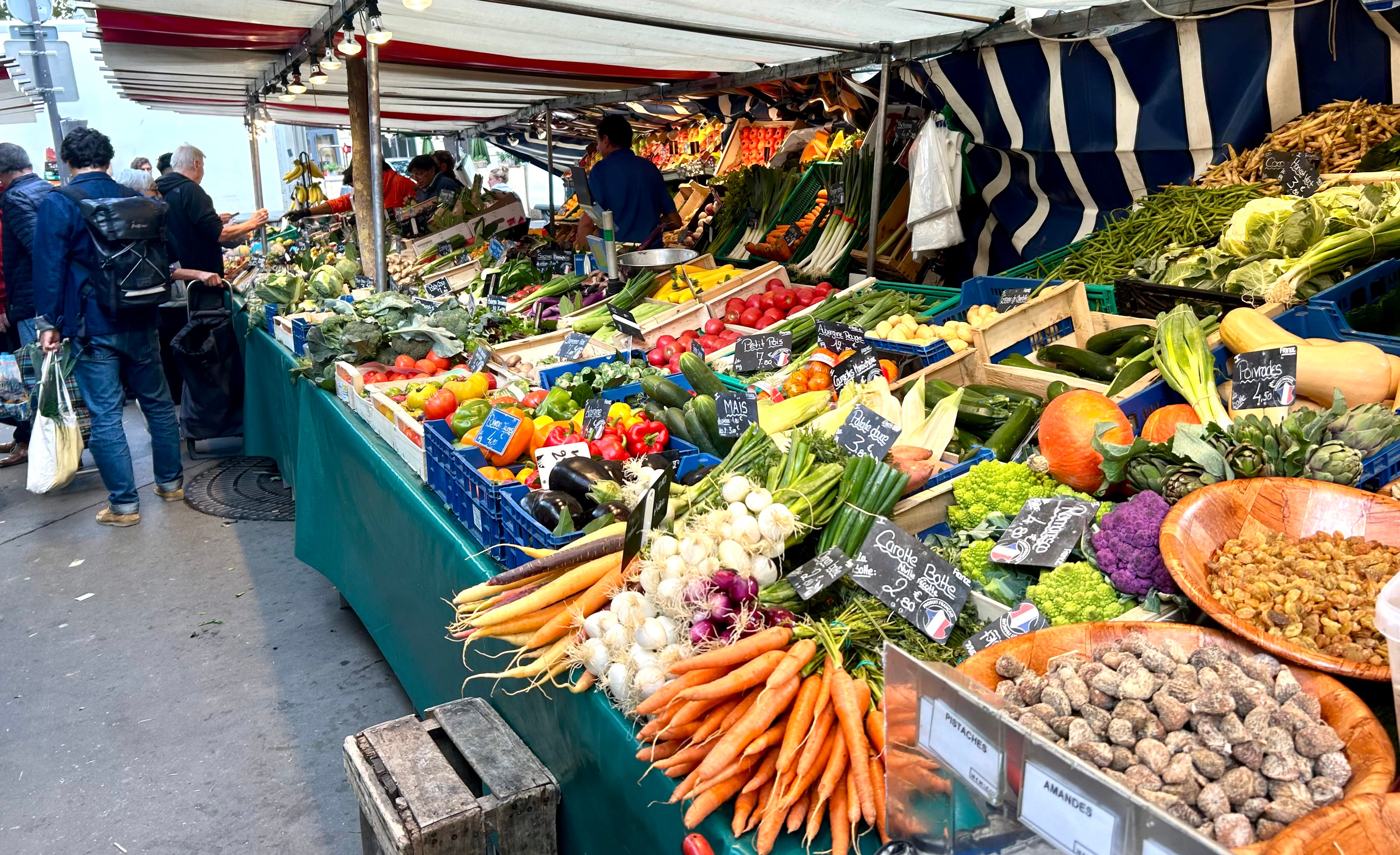
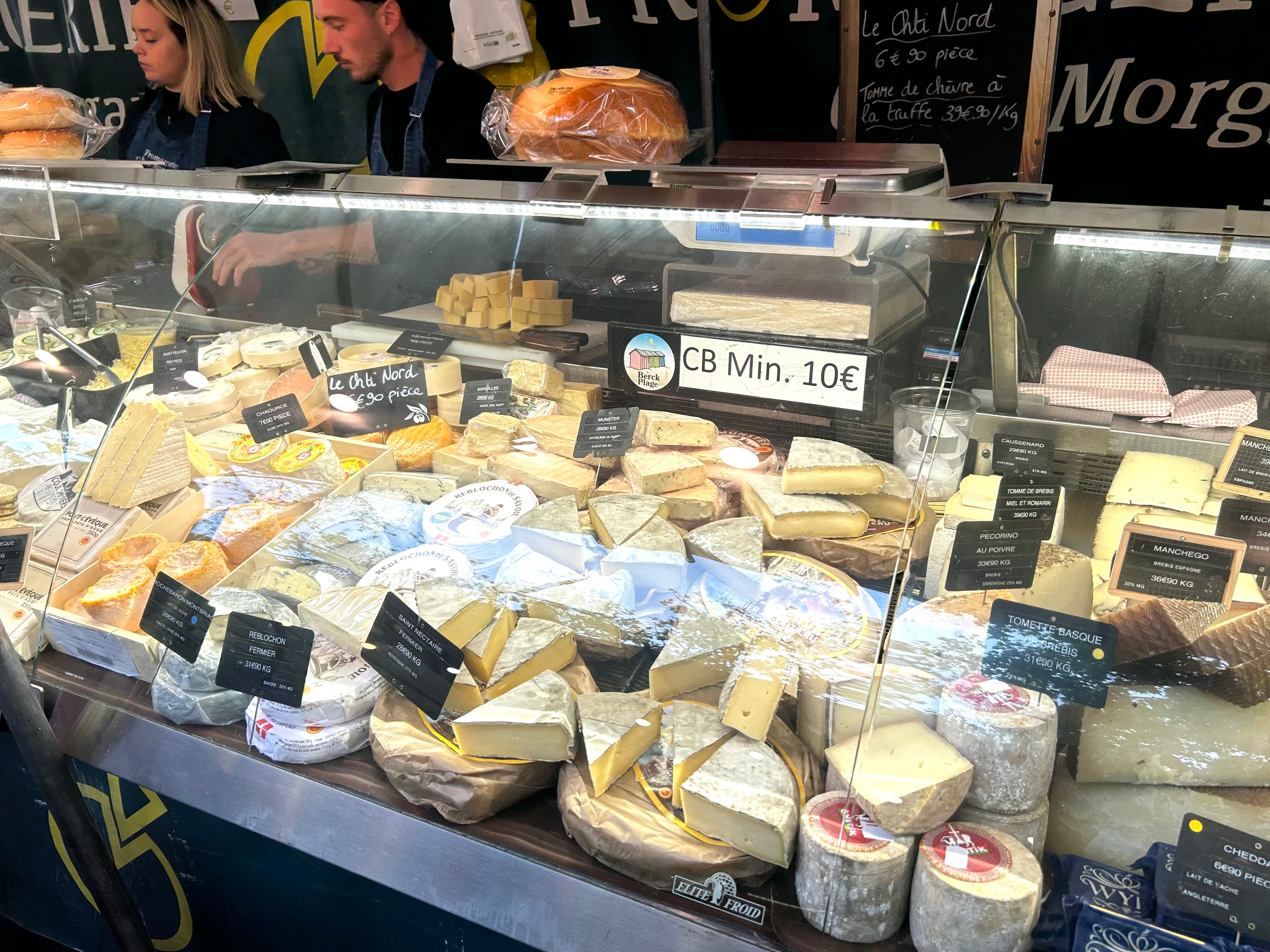
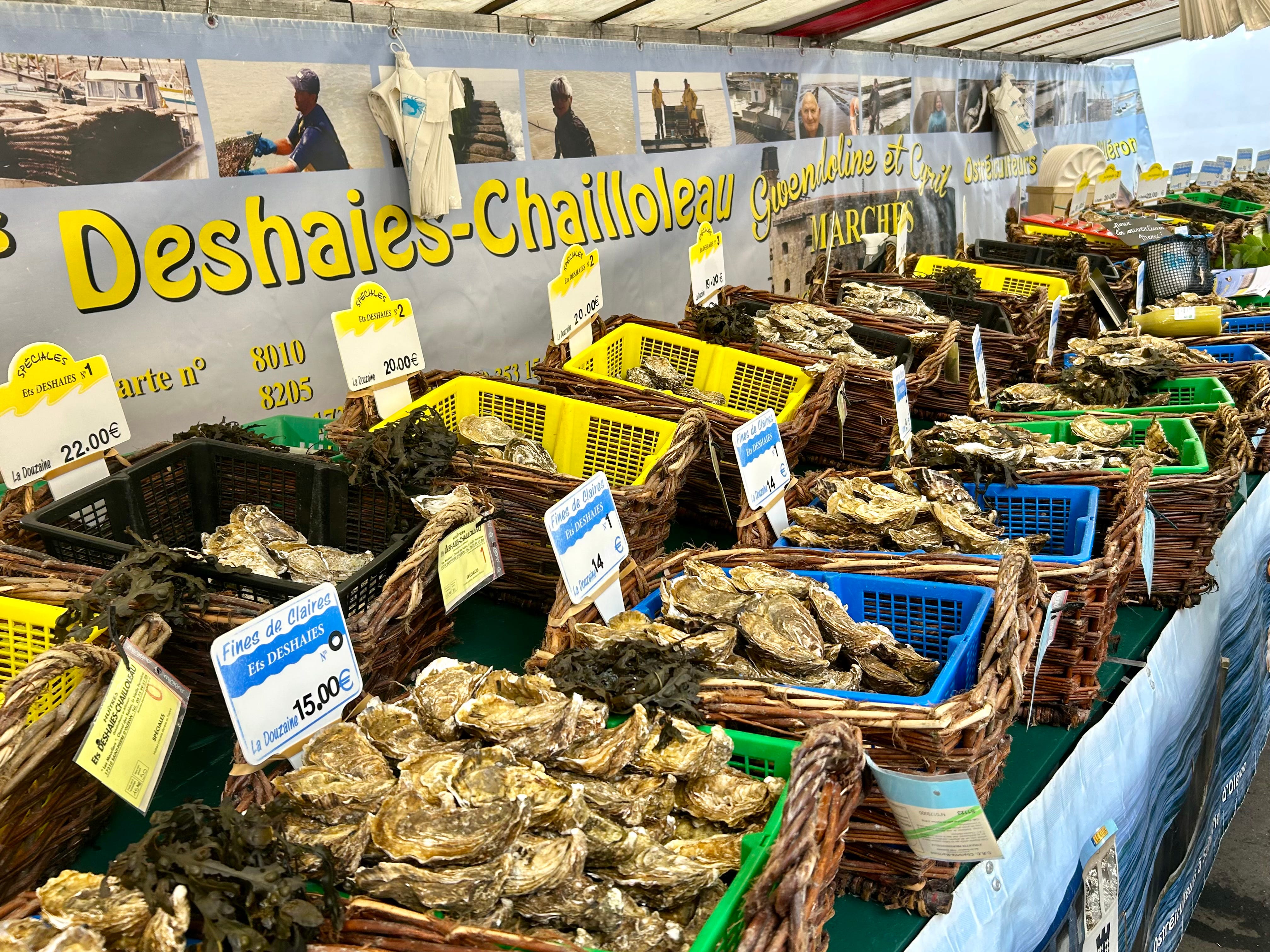
In the Bay Area where I used to live, there was a Sunday morning market that took up one block, stalls on the sidewalk on both sides of the street. Artists would also take advantage and, at last count, half the stalls were not food related. I was reminiscing about that market and how different it is from my small market down the block. In my neighborhood, the stalls push up against each other, no space in-between except the designated walkways to move from one aisle to the next. The small Place Jean Lorrain houses two fish markets, two cheese markets, two flower stalls, seven vegetable stands-one is Bio, two delis, two boucheries, a rotisserie, two specialty stands—one nuts and dried fruit, the other pre-made meals like Paella, and of course, two patisseries.

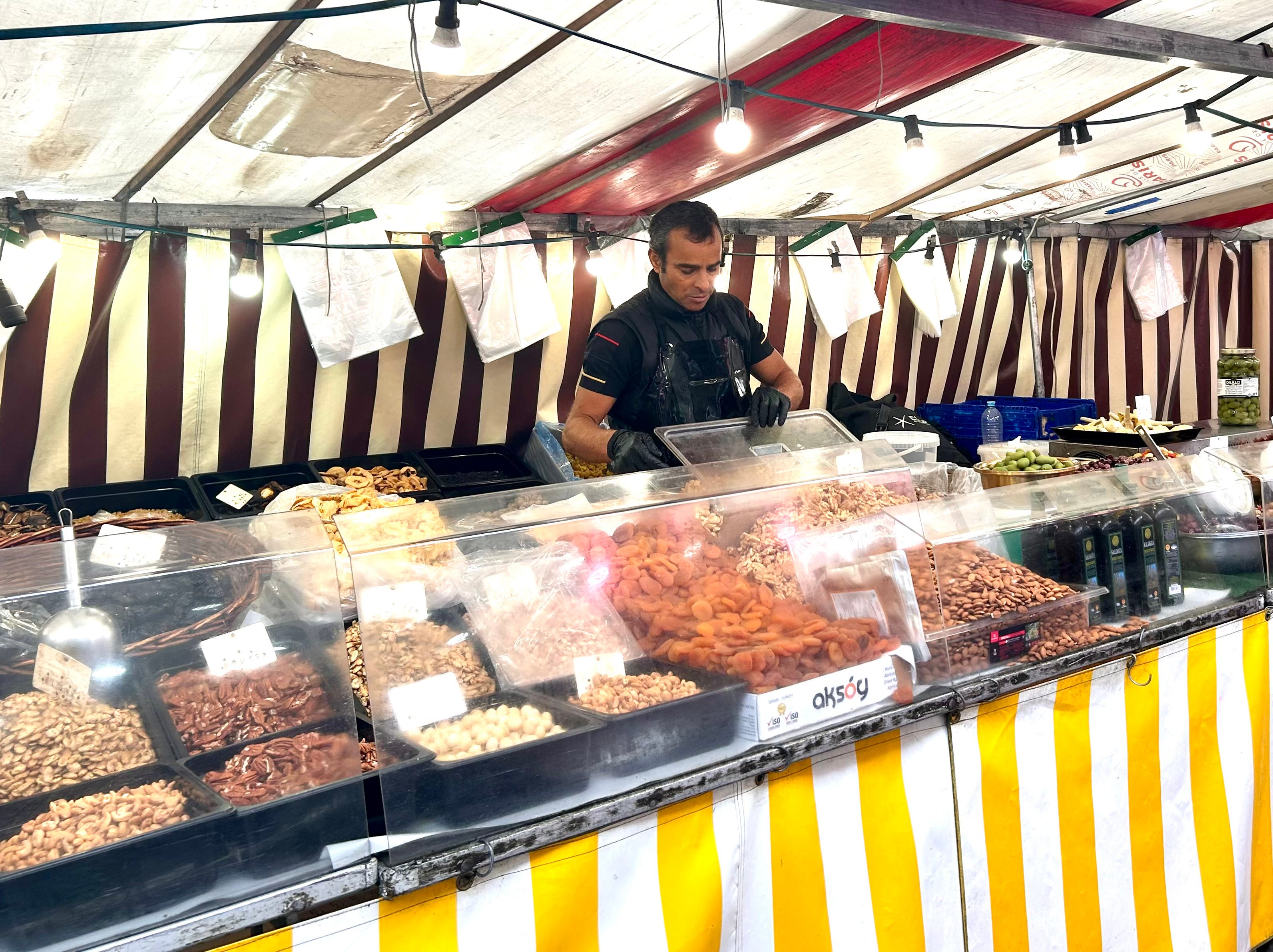
selling nuts and dried fruit

If you were to stand in Place Jean Lorrain at any other time of the week, you wouldn’t believe that that many stalls and stands can fit. They do. On Wednesdays, it is a manageable errand for an exPat like me who likes space, is slightly claustrophobic, and wants to get in and out. On Saturday mornings, when all the people who work explode on the scene, there are long lines for the favorite stalls. The French are used to it. They even bring dogs. Old folk use canes. Somehow there are no accidents, no screaming matches or bad humor (if there is, the person keeps it to themselves). 

Holes have been drilled into the cement ground. The night before each marché, workers from the 16th arrondissement come and put up the poles that will house the stalls. Sometime in the early wee hours, cloth overhangings are installed. The marché will go on no matter the weather.

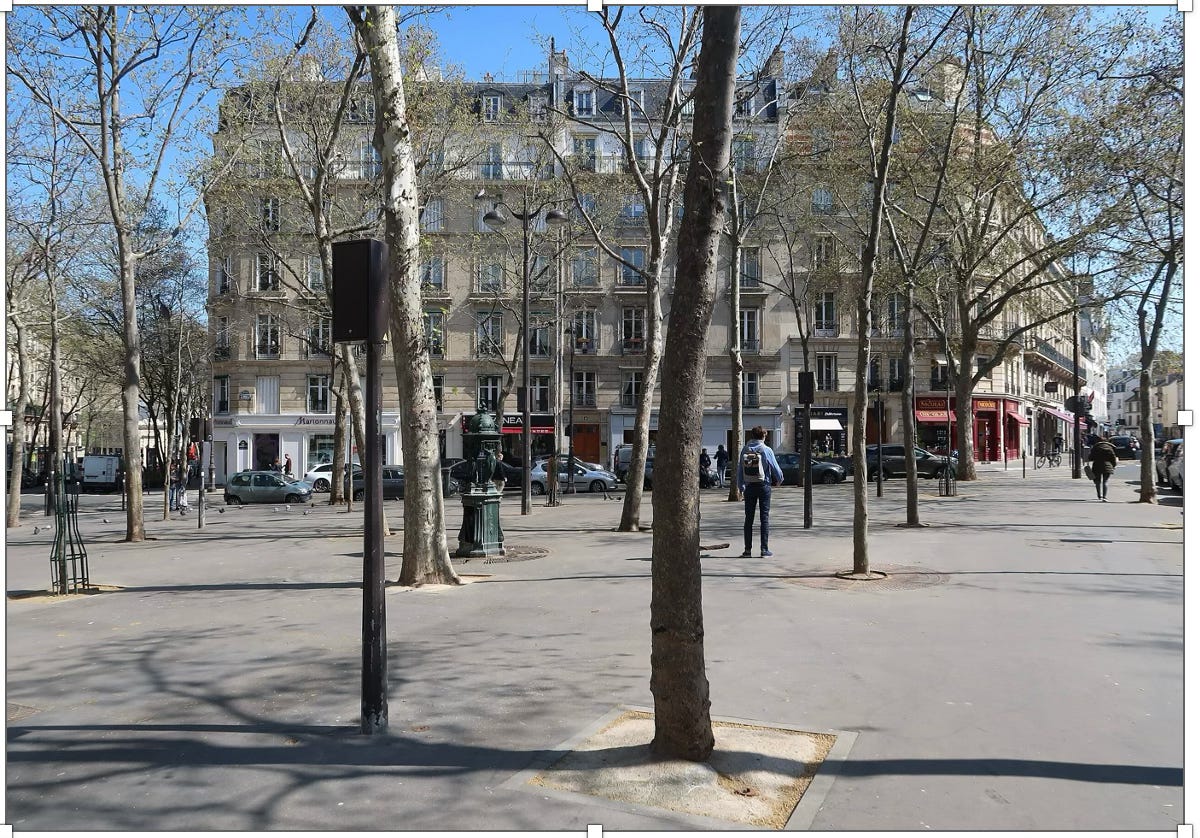
Place Jean Lorrain on a non-market day.

I tried to find some history and there isn’t much. The square itself is named for Jean Lorrain (1855-1906) who lived nearby. Before 1930, It was known as Place de la Fontaine, whose water was prized by King Louis XV when he resided in his nearby Château du Coq. In the middle of the square, you can see a Wallace fountain which works.

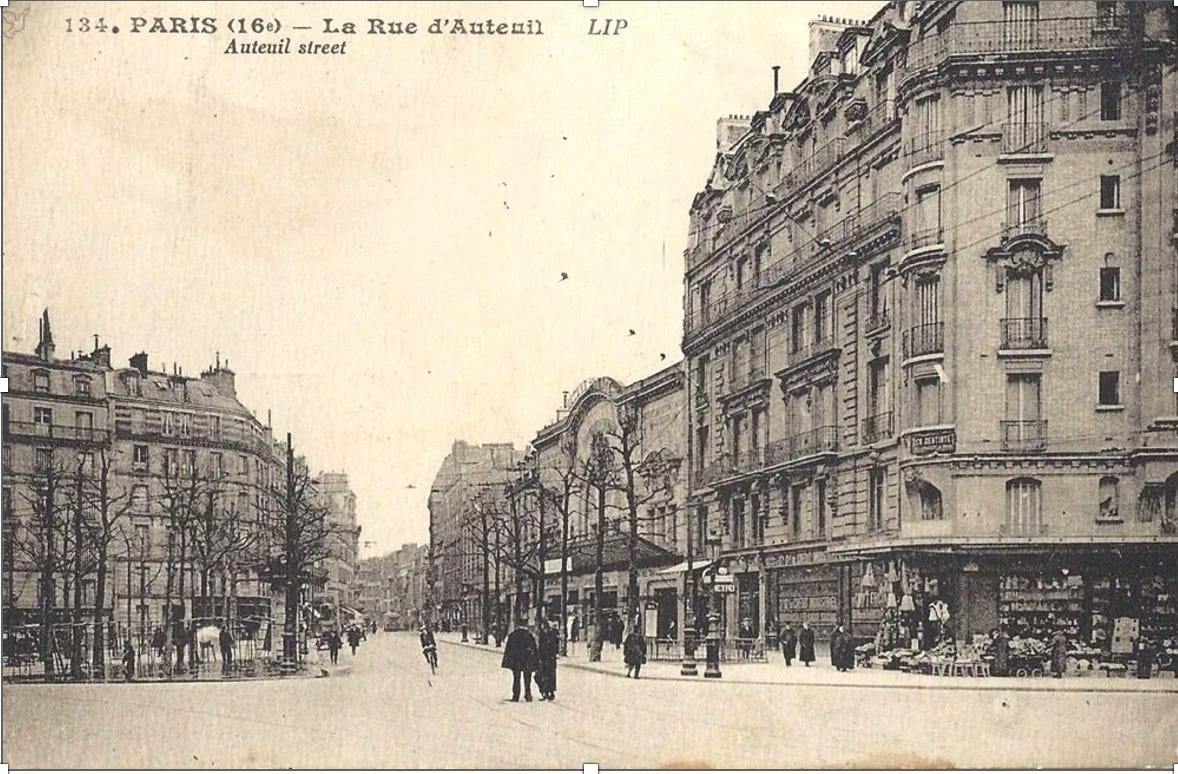
1920; Rue Auteuil. Note the theatre or cinema on the right.
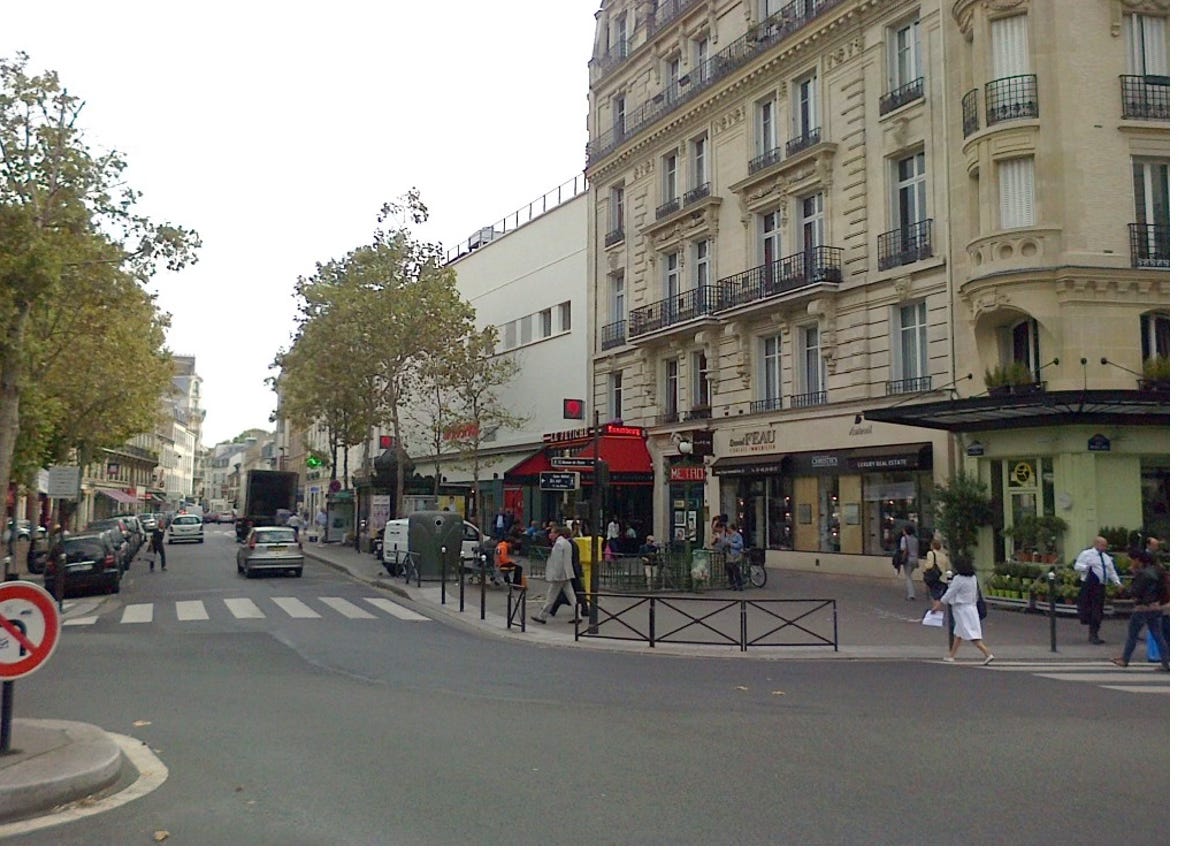
Today, there is a large Monoprix where the theatre once was.

I’ve established a pattern in the fourteen months I have lived in this quartier. I rarely go on Saturday mornings. By 9:30am, it is too crowded for me. Wednesday morning is my time. I can go at 8:30am or 11:30 and I rarely have to stand in line.

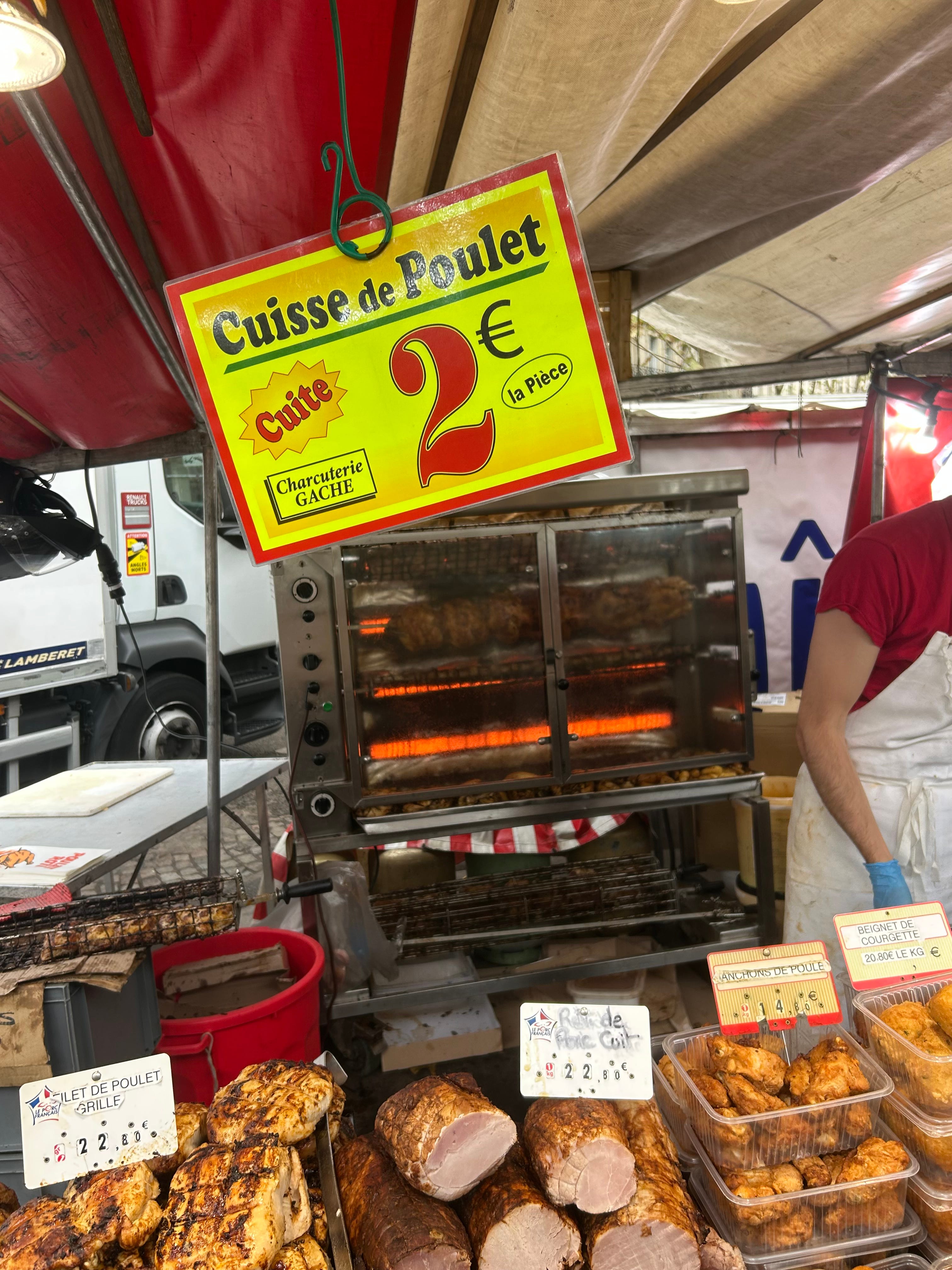
My first stop is the rôtisserie where I buy my cuisse de poulet rôti. My ‘friend’ with longish blond hair, usually held back in a pony tail, greets me with a big smile. “Ça va?” she will ask me. “I’m great,” I respond and ask her how she is. On Saturdays she has four helpers. Today she mans the stall with one. The chicken is roasted, as only the French can do, in a large upright roaster that is brought in in the morning and taken away at 2pm.

She makes fresh ratatouille and on days when I want to treat myself, I will buy some. I have to eat it that day or the next or it goes bad. I found that out the hard way!

From there, I walk to one of the fish markets. There is always a line so the earlier the better. Each type of fish has a small sign with the price and where it comes from. Seasonality is important so a fish out of season will either not be available or priced very high. The poissonnier will clean, cut, do whatever is asked, even give you tips on the best way to cook. I’m slowly working my way through the fish that look interesting. My repertoire at the moment is salmon, monkfish and cabillaud. 

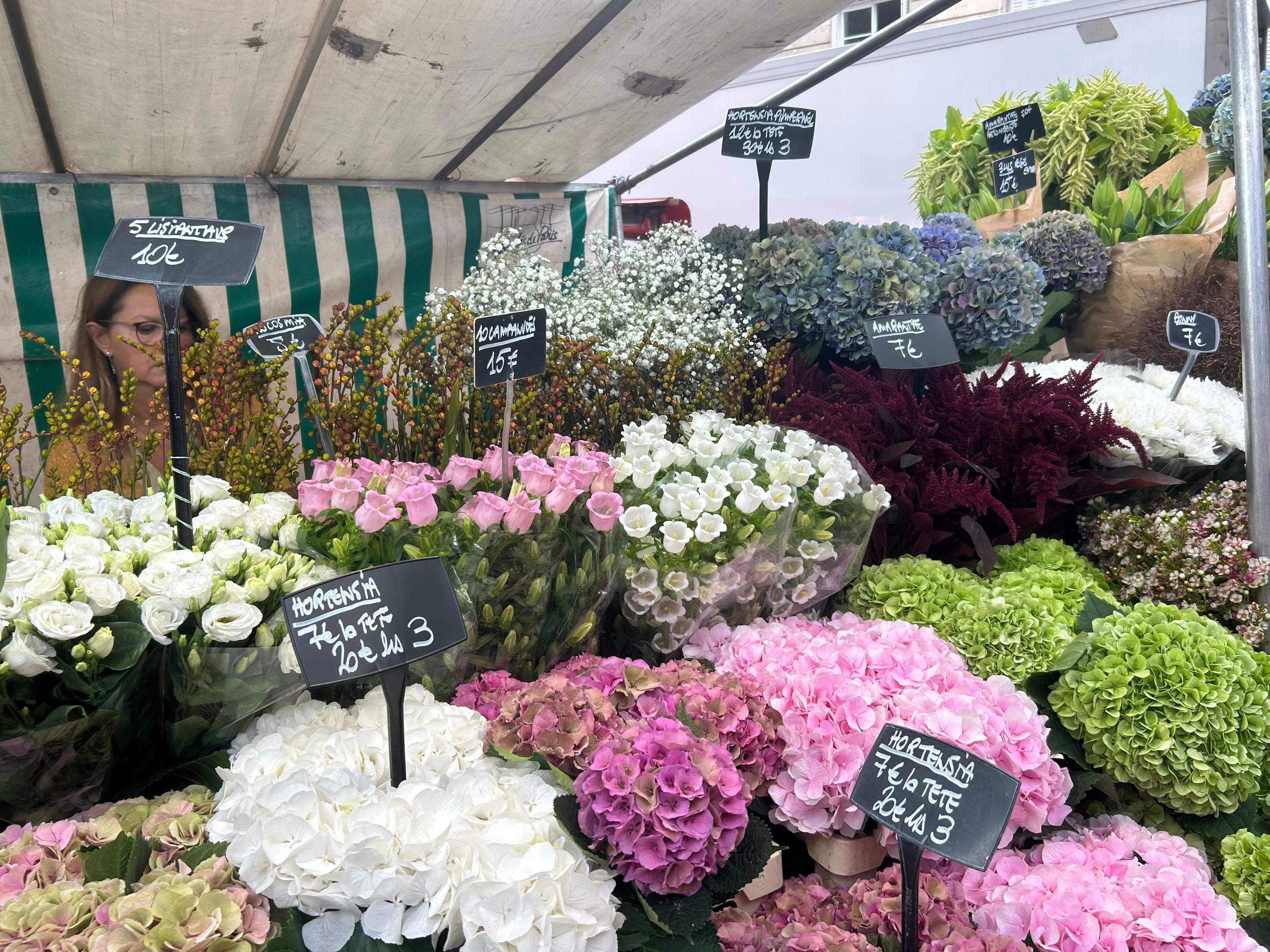
I fill up my caddy with all the fruit and vegetables I need then meander to the flower mart. I purchase fresh flowers every week. The stall is run by a family. The son is there every Wednesday along with a woman who may or may not be his wife. Last Wednesday, for some reason, I pulled out my phone and showed her a photo of Bijou. She immediately picked her phone up and showed me her two adorable cats.

The dahlias were magnificent. Three weeks of them…

When catnip is available, I buy some for Bijou. Last week, I bought pansies to plant on my terrace to have some color during the long Paris winter.

one of the many vegetable stands
One of the two cheese stalls. This one also sells eggs, yogurt, fresh milk
A stall just for oysters—from all over France

Well, it’s Wednesday so I’m grabbing my caddy and heading out. 

A reminder to all you subscribers. I am moving everything over to Substack by the end of the year. If you haven’t already, go to: sarasomers.substack.com and subscribe there to continue receiving my bi-monthly missives.

Thanks for reading Out My Window! Subscribe for free at sarasomers.substack.com to receive new posts and support my work.

A bientôt

Sara

Joy and Serendipity

I am interrupting my six month WordPress sabbatical to write about 1-being back in heavenly Saint Jean de Luz and 2—an amazing experience (amazing to me) I had last Saturday.

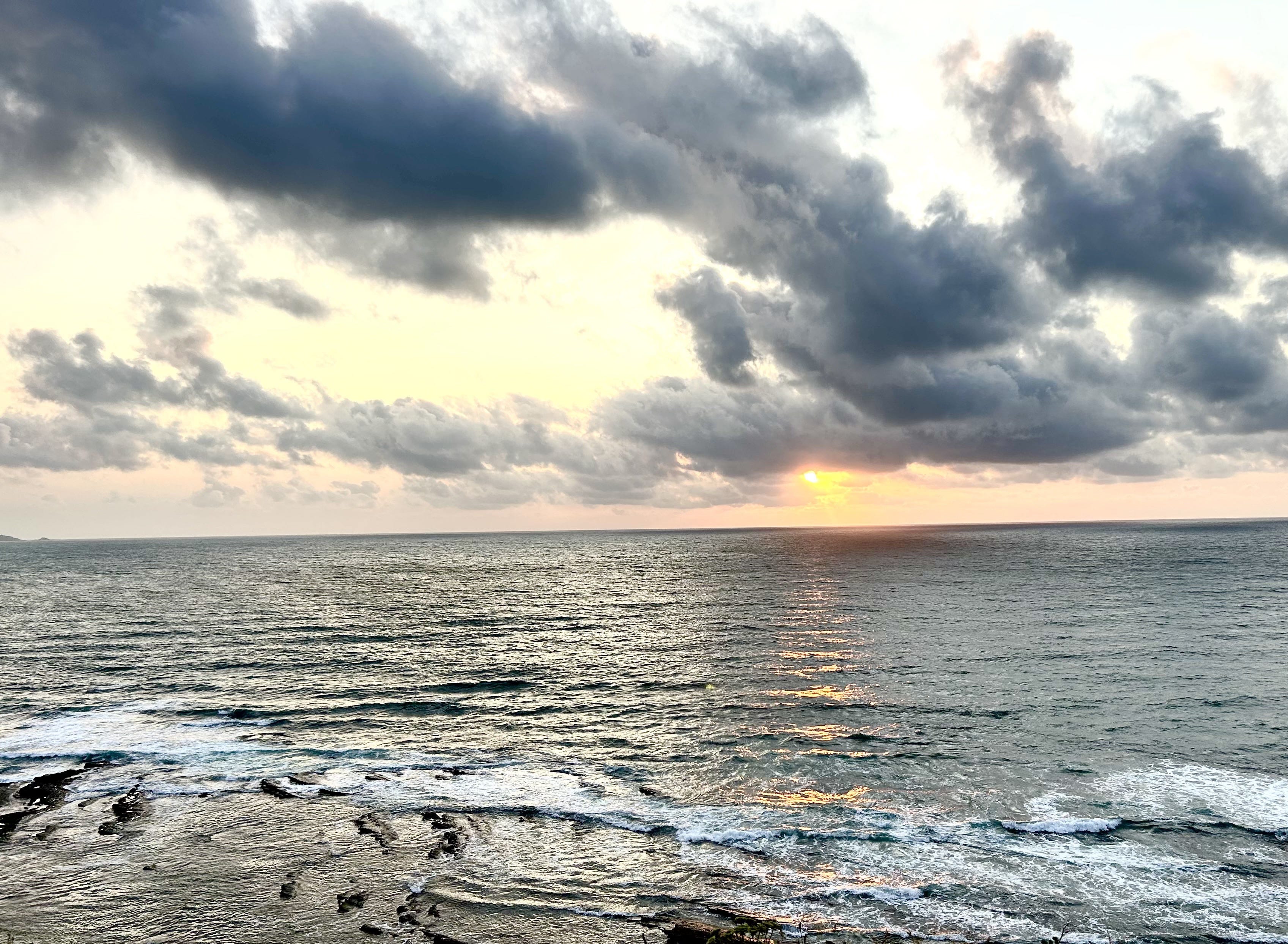
Sun setting over white caps after a very windy afternoon in Saint Jean de Luz

After being introduced to Saint Jean de Luz a number of summers ago, I have come down for two to four weeks each summer. This summer, I planned a self-imposed writing residency for myself to prepare submissions for a September writing retreat. Two or three months ago, my friend Jane from the Bay Area called to let me know she was hiking in the west of Ireland and would I like to meet up in Dublin at the end of her trip. Yes, I would love to but I had this trip to SJdeL planned, bought train tickets, paid for my rental. What did she think of coming to SJdeL? She had been here on my recommendation with her husband last summer and loved it. Needing a couple of days to figure it out, she made it happen. RyanAir from Dublin to Biarritz, taxi to SJdeL, stay 4 nights and then make the reverse trip in order to fly back to SFO. BUT….she needed to come on the 22nd and I had tickets for the 24th. I changed my train reservation and we have just spent four wonderful, heavenly days here in SJdeL. 

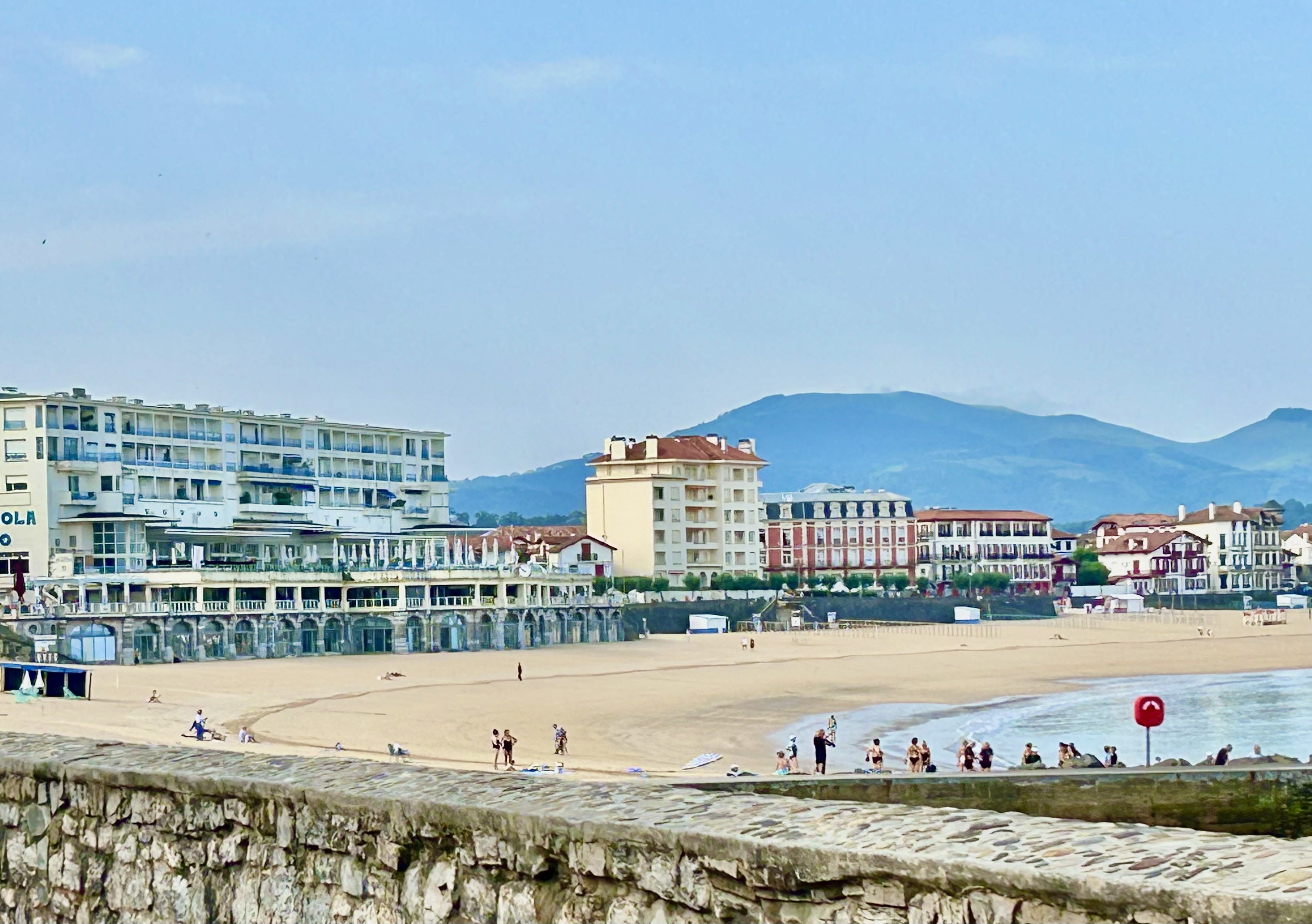
Looking at La Grande Plage from the Quai leading up to Saint Barbe

For me, it turned out to be a vacation before the writing started. I’ve been battling one thing after another health wise, none serious but all very annoying: vertigo, another carpal tunnel surgery that wanted to take its sweet time healing, etc. I slept in every morning, ate a leisurely breakfast, and then we walked the boardwalk to the marina, bought food at the marché, and shopped! I would leave Jane at the beach on our way back, and she swam while I came back to do I don’t know what. Jane stayed at a wonderful hotel at the top of the cliffs called La Réserve. A terrace extended off her bedroom and offered a view of the Atlantic Ocean that mesmerised. We’d make our dinner each evening and talk our way late into the night. Then walk to Saint Barbe and down the hill headed to my apartment. She’d leave me at the turn-off away from the beach. 

Sunset June 25, 2025

Jane and I have known each other for fifty years. We’ve gotten to be better friends as we’ve grown older and now, no matter the last time we were together, we fall into talking as if we’d been together a week ago. It’s very precious – the friendship with her and also with her husband. They have taught me a lot about thoughtfulness, open heartedness, curiosity about others just by living their lives, being examples of a life well lived.

Sharing SJdeL, one of my favorite places in the world, with Jane over these past four days has been so delightful—in the full sense of the word: full of delights. One evening as she walked back to La Réserve, she witnessed a lightning storm and took a video:

I had heard the thunder and went out on my little balcony to watch the sky explode with light. I don’t remember ever seeing such a sight. The next day after a lovely sunny morning, the wind picked up. Wind surfers gathered on the beach at the edge of the water raring to go. I was headed up to La Réserve and took this video of the sails flying by. If you turn the sound on, you can hear how loud the wind was roaring.

I’m now putting off feeling the sadness of her departure by writing about the last four days. 

*** ***

Last Saturday, my last day in Paris before leaving on this trip, I attended a poetry literature gathering. Our prof, Heather, had put together a number of poems for us to read and talk about. The first was Robert Frost The Road Less Traveled. Chatterbox that I am, I announced that Robert Frost had been the commencement speaker at my school, Baldwin School for Girls, when I was in 7th grade. The woman seated to my left, jumped and asked “What school did you say?” 

Baldwin School for Girls” I responded. 

“I graduated 1965,” she said. 

I told her that if I had stayed I also would have graduated 1965. “Did you know KV?” I asked. 

“Yes, she is a good friend of mine.”

By this time, it felt a bit Twilight Zone. In an apartment in the 15th arrondissement in Paris, France, what are the chances of sitting next to someone I probably knew but not well sixty-six years ago. When the salon had ended, we ran more names by each other. She knew them all. By the time I went to bed, that night, she had written emails to a number of them cc’ing me telling them what happened.

I had been writing a story that included skating in the afternoon when I attended Baldwin. I had been thinking of KV as she had looked then. A dreamy memory, more black and white than color. Monday morning, she wrote saying that she well remembered me. And my sister. And our thick hair—mine brunette, P’s red. 

There is something wonderful about accidents like these happening. I have unpleasant memories of being twelve, thirteen, and fourteen, actually most of my teens were not great. Here come witnesses to tell me if my memory is distorted or maybe just maybe, those times were not quite what I thought them to be. KV said she “always had fun when we got together.” I don’t think of myself as a fun person back then. It’s possible I still have some things to learn.

*** ***

My intention was to not write here until the end of the Writing Retreat in September. Time just didn’t allow for everything I wanted to do. Unless something jumps up and hits me in the face, I will stick to that resolution.

Thank you for reading and being there. Your support of my writing means the world to me.

Thanks for reading Out My Window! Subscribe for free to receive new posts and support my work.

A bientôt,

Sara
Visiting the renovated Cathedrale de Notre Dame

Here in France, christmas cards are hardly ever sent. Starting Jan 1, les Français send New Year’s cards. The rule of thumb is that one has the entire month of January to send these cards. Which, if you think about it, makes so much sense. Christmas shopping, parties, craziness, family get togethers are in the rear view window. Only taking down the tree and putting away ornaments remain. There is more relaxed time to send a card and even a letter of yearly catch-up.

So I am not late in wishing everyone Happy New Year.  For me personally, I’m happy to say good bye to 2024. It wasn’t a bad year. In fact, if I were to write down all the successful things that I did or happened to me, it was a good year. But it was an emotional year. It was like grabbing on to the tail of a kite and hanging on for dear life during a raging storm. Among the bigger things that happened, I sold my home in Oakland, California, I had cataract surgery on both eyes, I had carpal tunnel surgery on my left wrist, the Paris Olympics came to town, and I joined a year long writing Studio making a commitment to write a first draft of a second book.

In December, I spent three weeks in very cold Ann Arbor, Michigan (where exists one of the most wonderful bookstores ever: Literati) with my sister and returned in time to celebrate New Year’s eve with friends in the Marais. For me, flying west to east produces much worse jet lag than flying the other way and it seems that I lost a number of days last week, getting my feet back on the ground.

Each day since my return, I went to the Cathedrale de Notre Dame website to get a reservation to see the renovation. It was clear that no one needed a reservation but if you didn’t want to wait in a long line in the cold, it was recommended. The site gives you three days: the day you are looking and the following two days. Even though the reservations/billets are free, every day, each day said ‘Sold Out’. Until yesterday. I was so surprised to see a possible reservation for 2pm that I thought I was seeing things. I confirmed that I wanted the ticket, printed it out, invited my friend, Cherilyn, to join me, ate some lunch, and off I went to see this miracle of rebuilding.

We have all seen photos of the new inside. Because of spot lights, it all looked so WHITE, so BRIGHT, so unNotre Dame, even though it looked spectacular. I wasn’t sure I would love it the way everyone else had. 

When I got there, there were two very long queues, blocks long. I went up to a number of people and asked in French if they were in the reservations line. Not one of them spoke French. They just looked at me vacantly. So I asked in English and managed to piss at least one person off. She kept insisting that I had to go to the end of the line. It seemed that the majority of tourists had no idea that there was the possibility of reserving a ticket and a time. I found the reservations line, ten people in it, and was inside in less than two minutes even with the TSA-like security before entering. Cherilyn met me inside.

My first impression was deep relief. It wasn’t bright white, hurting your eyes bright. The renovators had managed to give all the columns and the ceiling a tone of ‘wear’, of having been around for awhile. All the artifacts had been saved and some of those were cleaned up to a just finished white. 

All images are photos taken by me

In spite of the lengthy lines on the Parvis, inside was not packed with people. It was easy to move around with the exception of seeing the crèche that is put up each December for Christmas. There the crowds were huge and not moving. It was the only time during the 90 minutes I spent inside the cathedrale that I was annoyed and wanted to jab a few people with my elbow.

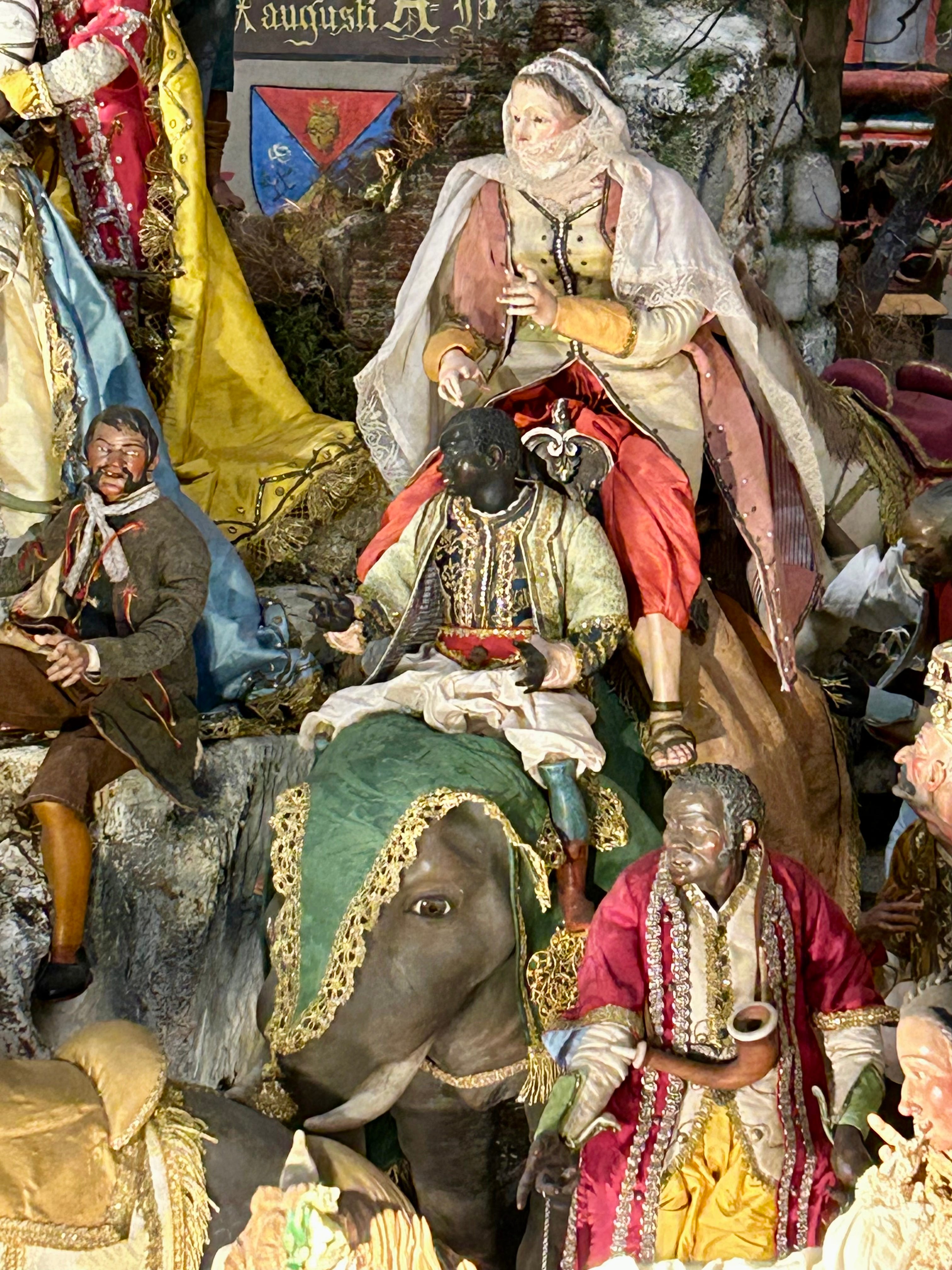
Because I love elephants, here is a small photo of the contingent from India.

To get to the crèche, you walk down the left side of the sanctuary. Passing the crèche takes you to all the chapels where one can pray to a specific Saint. Most did not have finished stain glass windows but instead a pattern that was a holding place. My understanding is that the stain-glass, the gargoyles, and the spire will all be continuing work for the next couple of years. At the back was a large chapel dedicated to the Crown of Thorns that has been in Paris since Louis IX acquired it. It was orignially housed in the Cathedrale but moved to Saint Chapelle which Louis IX built specifically to house the artifact. During the renovation, it has been on view in the Louvre.

Chapel for the Crown of Thorns.

Votive candles were everywhere for 2 euros. 

We then walked up the right side of the sanctuary stopping to sit for about 30 minutes just to let the feel of the place saturate us. President Macron is one of the most unpopular men in France at the moment but this five year project that he pulled off, the renovation of the Cathedrale, is stupendous. Once inside and looking at every detail, it is hard to imagine that it was all done in this time period. It justifiably will be the most visited tourist “attraction” in Paris this year.

Many of the windows were saved from the fire.  The BBC has a wonderful video describing the process of renovating the cathedrale. Click the link to watch it

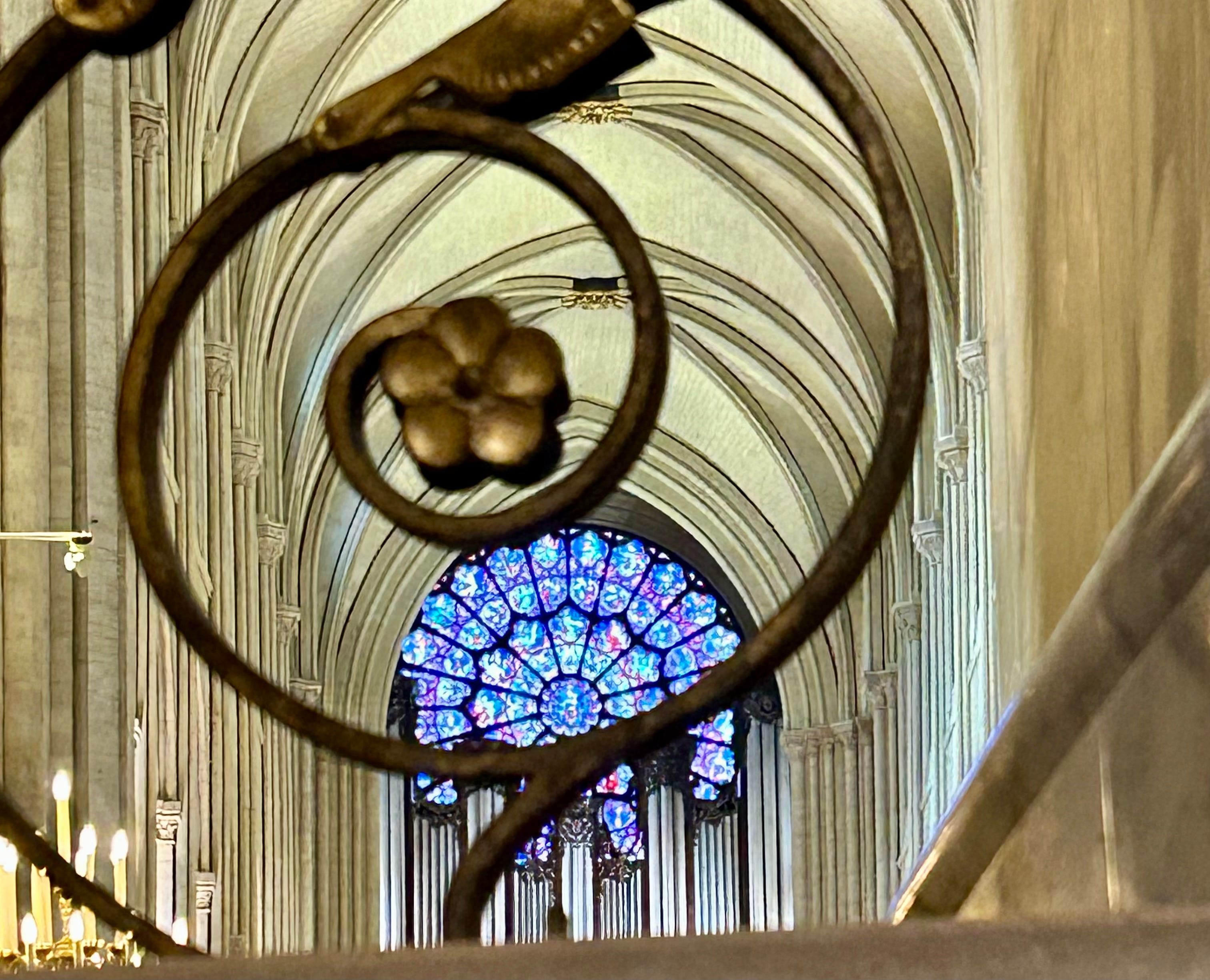
The Rose window at the front of the cathedrale partially hidden by the magnificent organ.

Also up on the website is the calendar of musical events happening in Notre Dame for 2025. Many are already sold out but those of you living in Paris can have a look on the site. Click here.

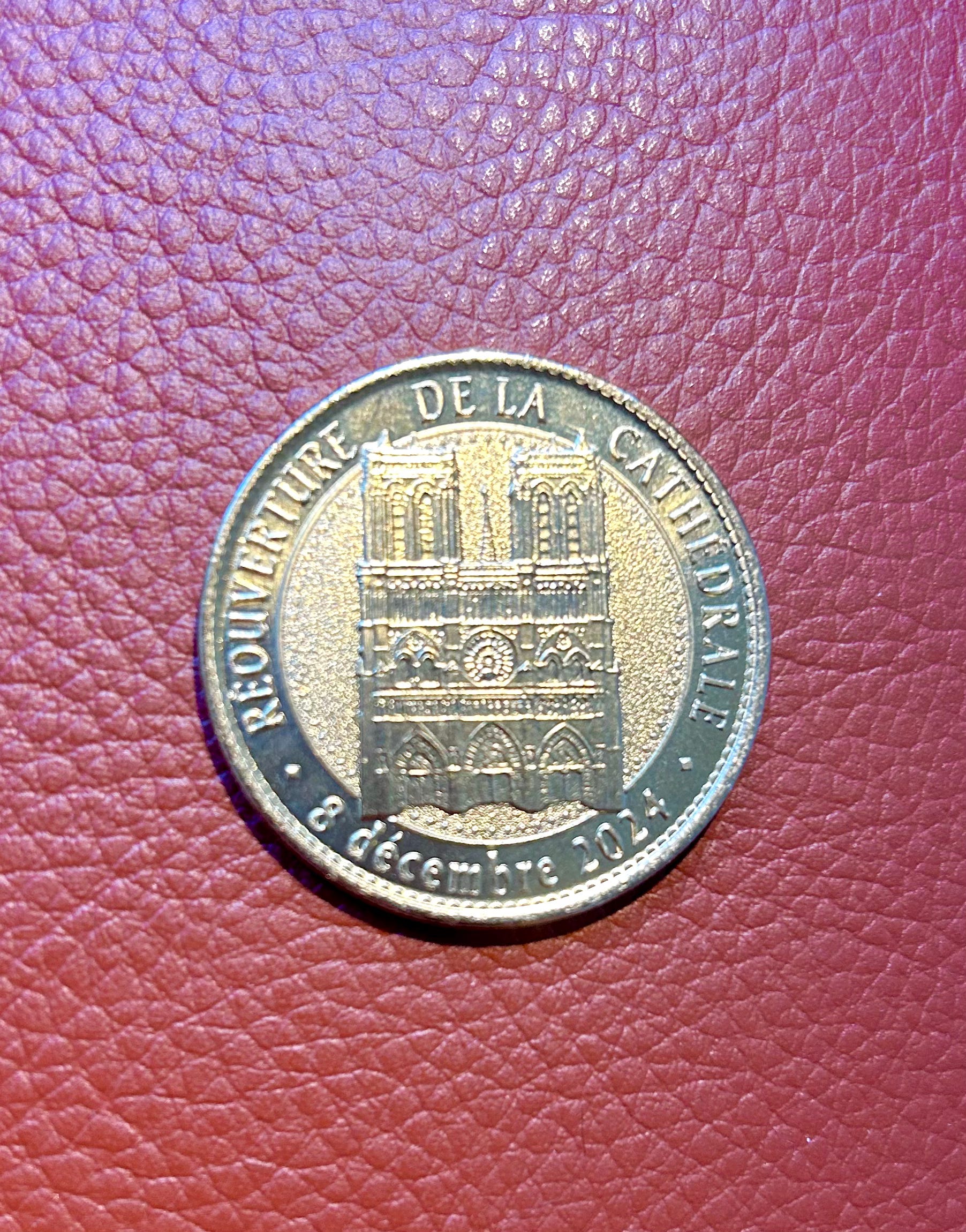
As we made our way to the exit doors, we passed a machine of souvenirs. For three euros, I received a ‘gold’ coin that says Reouverture de la Cathedrale 8 décembre 2024.

I walked into the cold afternoon a very happy visitor to the new and restored Cathedrale de Notre Dame.

Thanks for reading Out My Window! Subscribe for free to receive new posts and support my work.

A bientôt,

Sara
For the love of the metro

Because of an Australian, le Bulletin 🇫🇷by Judy MacMahon, who loves all things French and writes a wonderful Substack, many of us who live and write about Paris and France have come to know and read each others’ Substacks. One of the newest writers I’ve learned about is Jenn Bragg who writes For The Love of France. Under her heading, she says “My life’s work is observing the nuances of different cultures that you may not otherwise notice. I write mostly about French culture.”

I tend to write emotionally, how what I see and do hits me where I live. Jenn does her homework. When she writes about something that has caught her interest, she researches it and the reader, me, gets a history lesson about the city I love so much. 

Thanks for reading Out My Window! This post is public so feel free to share it.

We all ride the metro almost every day (unless we can walk but recently it has been raining every day so the metro is it!!!). This week, Jenn wrote about the metro line #6 – one that goes from Etoile at the Arc de Triomphe in the 16th to Nation in the east of Paris, the 12th arrondissement. I’ve never thought about it much as I haven’t had to take it very often. I asked Jenn if I could share her wonderful writing with you:

One of my favorite Paris Metro lines

Line 6 delivers people to destinations and happiness to moi

JENN BRAGG

OCT 06, 2024

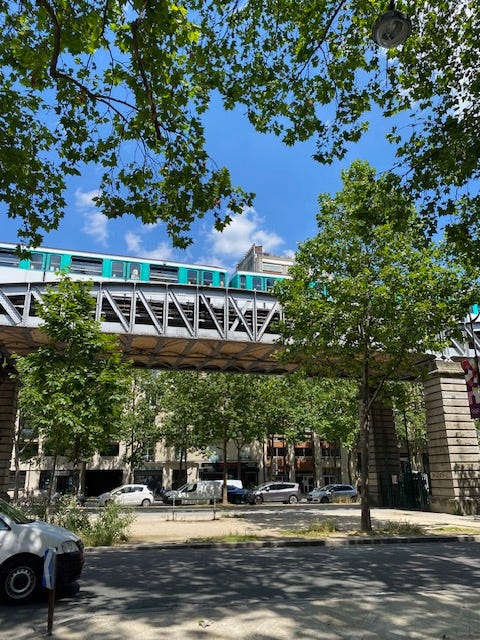
the glorious above-ground metro Line 6. Source: parissecret.com

How do I love thee, Paris metro line 6? Let me count the ways.

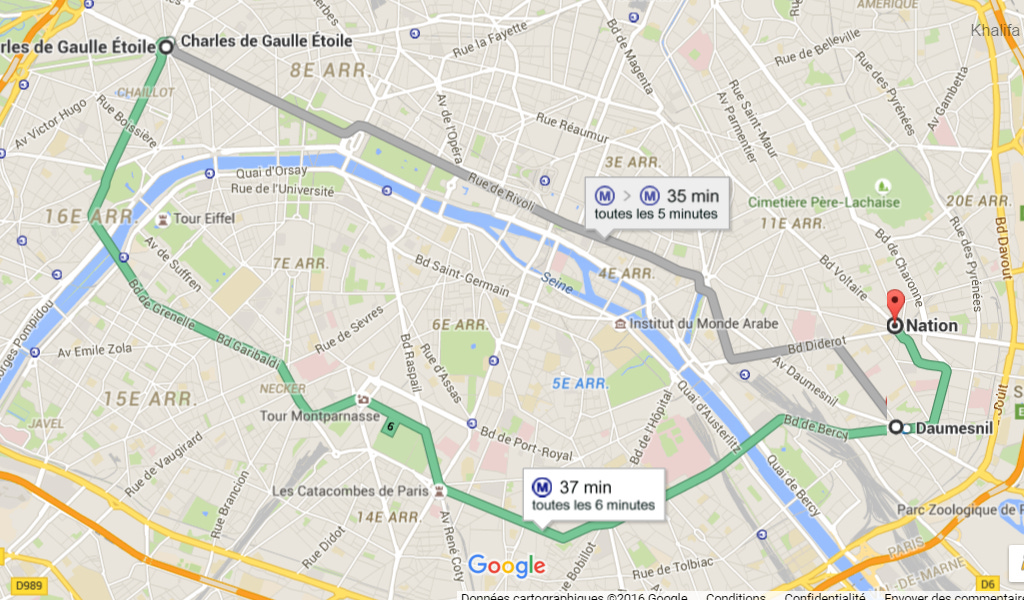
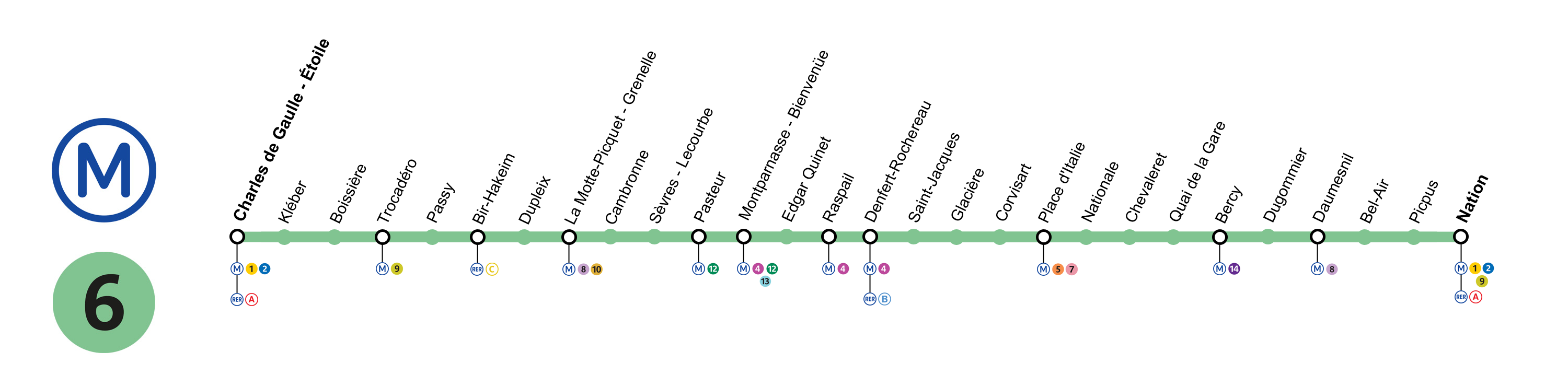
In Paris, each metro line has its own ‘vibe’, but Line 6 is one I really appreciate. It traverses the southern side of Paris, connecting Nation in the east to the Charles de Gaulle – Etoile station in the west, shown as a green line in the image below:

My favorite stretch of Line 6 is between Corvisart and Denfert-Rochereau. Those stops mostly cover above-ground views of Boulevard Saint-Jacques which turns into Boulevard Auguste Blanqui and ends at Denfert-Rochereau, known as the stop for the Paris catacombs.

I went out on Line 6 last week and recorded this video just to give you an idea of its loveliness:

Jenn’s video wouldn’t transfer so I encourage you to go to her Substack For The Love of France and watch it.

Now let’s just do a round-up of some of the interesting things about Line 6:

Open-air stations

Much of Line 6 features above-ground stations. When the track was built, it traced along an old city wall that was demolished in 1860. By building stations above ground, it reduced the need to dig tunnels for the trains. As a result, nearly half the 28 stations along Line 6 are raised platforms and feature glass canopy ceilings.

It’s old

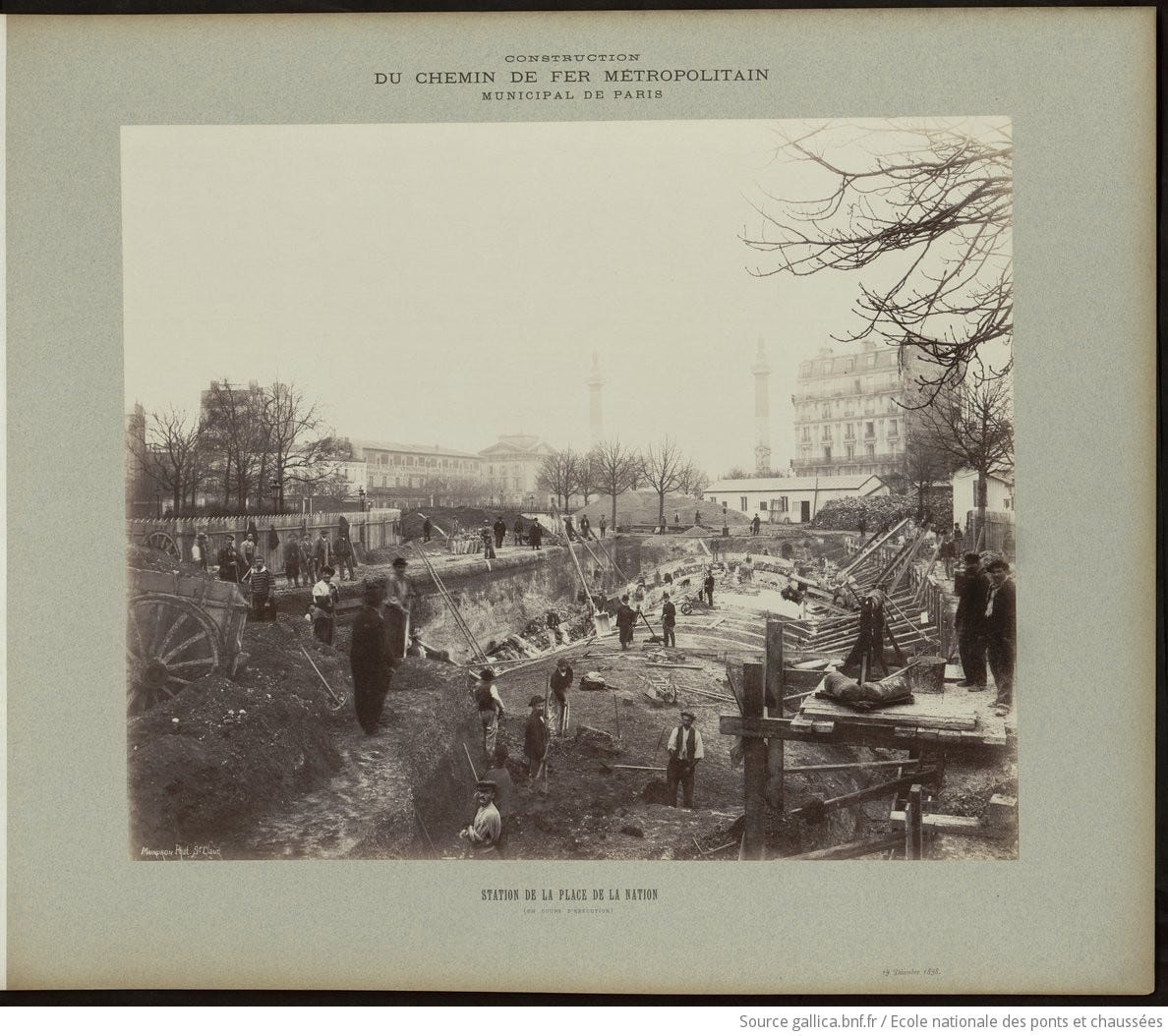
The first iteration of Line 6 was completed in 1900. It was one of the main ways of reaching the area around the Eiffel Tower when Paris hosted the world’s fair that year. Later, more track and stations were added to expand the line so that it became the far-reaching, city-crossing stretch we know today.

Left: construction of the metro/right: and old metro train

Interesting WW2 history

Line 6 even has an interesting connection to the Second World War: a number of station names were used as code names for prominent members of the French Resistance. These code names were designated for several agents under the military leadership of General Charles de Gaulle to help with efforts against the Nazis to retake control of France.

Here are the code names that were assigned:

  • Passy – Andre Dewavrin was known as ‘Colonel Passy’ – he had a leading role in military intelligence and helped organize the French Resistance under the stewardship of Charles de Gaulle.
  • Saint-Jacques – the man who took this code name was Maurice Duclos, who also helped found the French Resistance. He created several Paris-based intelligence networks.
  • Corvisart – Alexandre Beresnikoff was born in Russia but was given the name by de Gaulle from his base in London to help with secret missions for the French Resistance.
  • Bienvenüe – this moniker was given to Ramond Lagier, who joined de Gaulle’s secret service in 1940.

Bir Hakeim Bridge

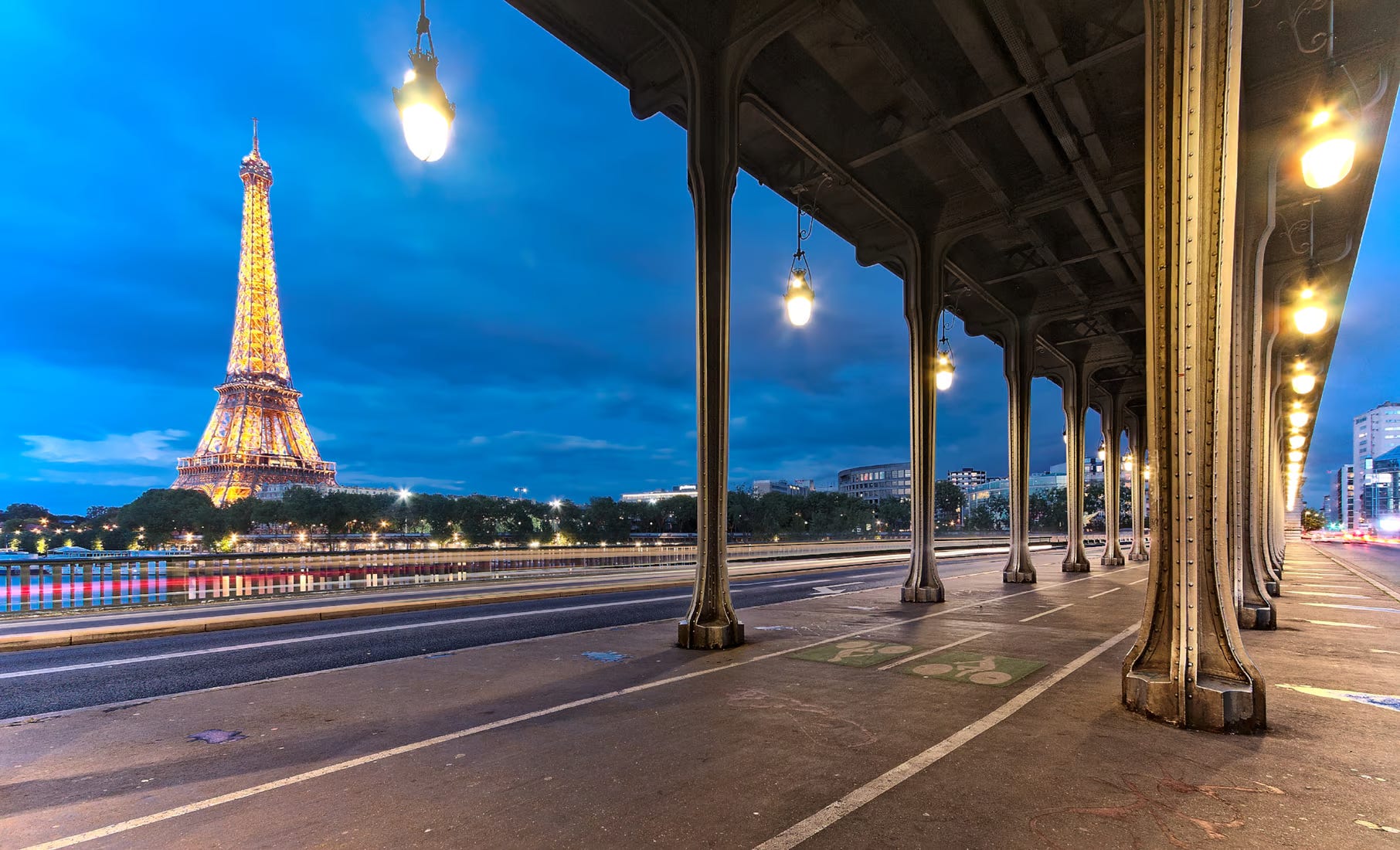
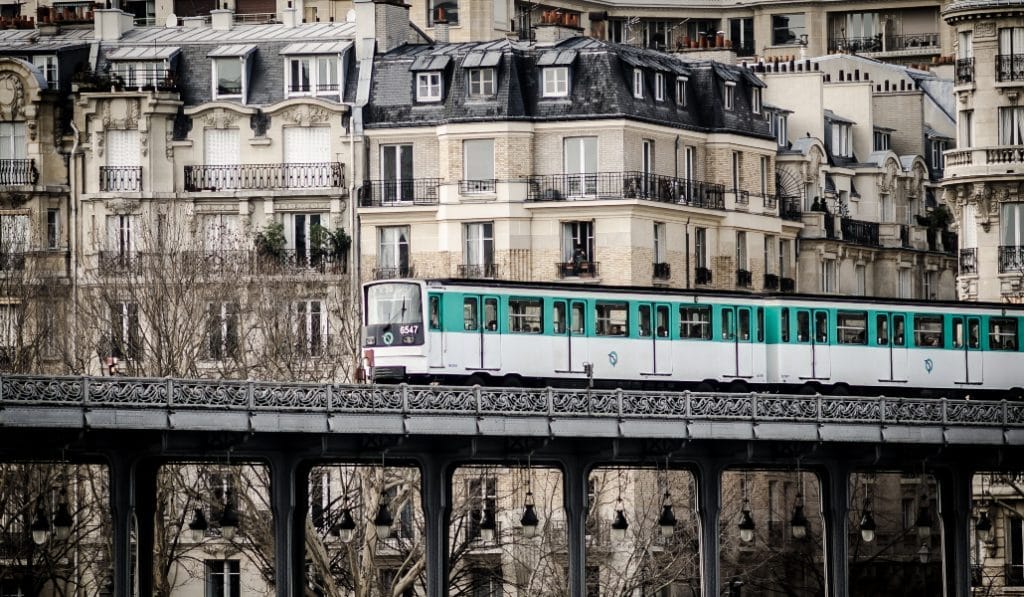
If you are heading west on Line 6, you will ride on top the Bir Hakeim Bridge – made famous by that horrible movie, Last Tango in Paris. I went there for the first time (!!) last December and it really is a gloriously beautiful bridge, with an unparalleled view of the Eiffel Tower. The best way to access the bridge is to get off at the Passy stop.

Bir Hakeim Bridge: I told you it was pretty!

So, if you’re coming to Paris with an open agenda (the way I recommend to travel), grab line 6 and ride it through the southern side of Paris. If you go from one side to the other, you’ll see:

  • Great street art on the buildings in the eastern end of the line
  • The Eiffel Tower on the Western end of the line approaching Passy station, which is absolutely breathtaking
  • Gorgeous leafy neighborhoods between Corvisart and Denfeert-Rochereau

Yes, what I’m suggesting is that the next time you come to Paris, add ‘riding the metro’ as one of your activities. You won’t regret it!


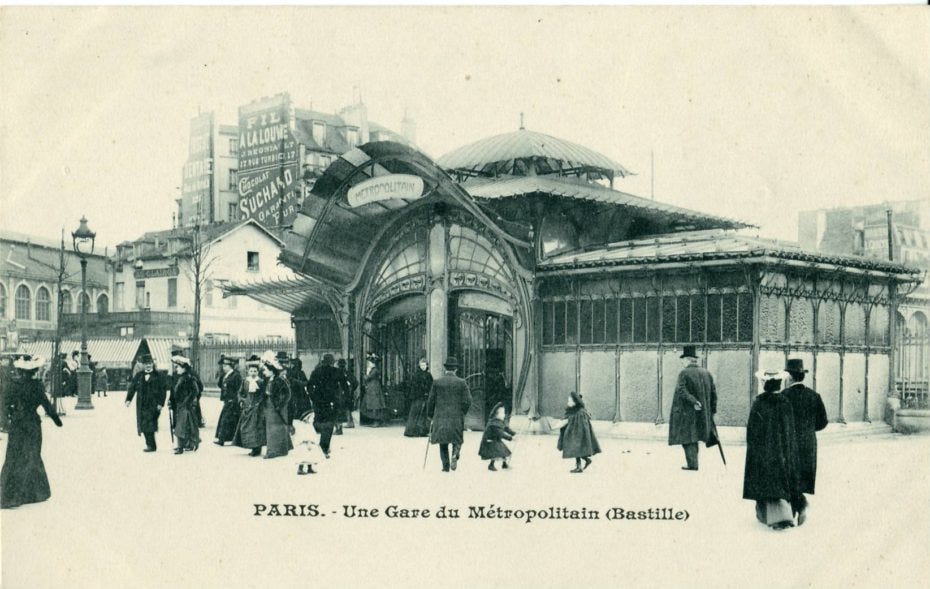
Before I really leave you, in doing my research I stumbled on an old photo of this gorgeous Art Nouveau station at the Bastille metro stop. (Bastille is not on Line 6 but I love this pic so much, I’d be remiss not to share it.)

Beautiful, non?

Sources: Metro line 6: a line and its history | Culture (ratp.fr)

Betty Carlson: I watched the video, which I rarely do on Substack, and definitely recognized some of the buildings going by.

Something you might be interested in: when I was teaching high school French in the States, I used a book called “Le Monstre dans le Métro” for my second-year classes as a supplement to our textbook. I looked it up this evening, and it appears to have been written in 1977, which means it was quite modern when I started teaching in 1982. The action takes place on Line 6, and that is where I learned the names of many of the stations.

I later led two trips to France with students, and we rode line 6 the way you suggest, as an activity in and of itself. My students loved seeing the actual stations referred to in the book. I’m quite sure it contains a line something like “Corvisart! Glacière! Saint-Jacques! Le monstre se dirige vers la station Denfert-Rochereau!”

Lindsey Johnstone: Such a gorgeous post! I haven’t been on the 6 for years and you’ve inspired me to take it just for the ride.

7 more comments…

Thanks for reading Out My Window! Subscribe for free to receive new posts and support my work.

If you are interested in other Substacks about Paris and France, check out Judy’s FranceStack. She has listed each of us who wish to be included in her list of Substack’s on all the many wonderful aspects of France. “Savvy Francophiles read ‘le Bulletin’ newsletter: a luscious immersive weekend of Francophilia, including recently published articles from MyFrenchLife.org by me, Judy MacMahon, Fondatrice, MyFrenchLife™ Magazine”

A bientôt,

Sara
Discussion about this post

Comments

Restacks

Jenn BraggFor Love of France19 mins agoSara, thank you so much for your very kind review of my work. I’m honored to be able to share this platform (and a love of France) with you and Judy and all the others who write about France! 🇫🇷 LIKEREPLYSHARE

The Year of Living Dangerously

or What I did on my summer vacation.

I’m 77 years old, retired for 15 years, yet still think in terms of the Academic year.  So, I still think of summer vacation and that real vacation time is always in the summer.  Here in Paris, Parisians, (ones who can afford it), take the entire month of July off or the entire month of August.  They stay in the same place, a country house in Normandy, an apartment near the water in Brittany. I envied that and this year arranged to spend a month in my favorite town: St. Jean de Luz, ten miles north of Spain in southwest France.  I barely remember being there. 

And then there was the Olympics which I loved and someday I will look at photos and read reminiscences. The most emotional event this summer, however, was, as I was signing the papers letting go of my home in Oakland, California, I found and moved from a one bedroom apartment to a two bedroom apartment in the 16th arrondissement—the physical sign that I am taking my writing seriously and needed a room for an office.  I was tired of spreading books, my journal, and my many (some unneeded) accoutrements over my dining room table and eating meals on the couch.

When I moved to Paris in 2013, I came for one year.  The taxi dropped me off in front of 1, rue Gît le Coeur with three suitcases and a cat, Banya.  It didn’t take me long to fill up the closets and rooms with ‘stuff’.  And here I still am, in Paris, eleven years later having had one of the most turbulent years of my life. None of it produced by consuming alcohol or sugar. I sold that Oakland home by Zoom and WhatsApp thanks to a realtor with the patience of a saint. I had moved one other time but, like giving birth, I don’t remember it being especially traumatic.

I had visited five apartments before I came to see this apartment halfway through the Olympics.  I walked in and saw HOME. It is gorgeous with a living room/dining room larger than the totality of my last apartment.  It has a terrace, something Parisians would give their right arm for.  The two bedrooms are spacious and light. To top it off, there is a cave, a huge room in the basement for storing unneeded stuff.  The only thing in it when I opened the door was a wine rack six feet high.  Perfect for a recovering alcoholic.

It is expensive.  I had been telling myself the entire time that my Oakland home was getting ready to be put on the market that I could now afford a more expensive apartment.  It’s one thing to think it and know I deserve it.  It’s landing on another planet writing out a check for xxxx euros a month. 

I was excited. I planned well. I arranged for help in moving necessities so they wouldn’t get lost while my world consisted of nothing but boxes, and I hired a moving company.  I couldn’t have done anything more.  When I stood in the apartment my first night, alone with Bijou (cat #2), who has adapted beautifully I might add, my head was bobbing in a sea of boxes.  Boxes on top of boxes.  I didn’t sleep well that night.

I knew I wanted to start with the living room. I hauled the white couch that came with the apartment and weighed 10,000 pounds from the center of the room to the wall that faces the terrace and the Parisian roof tops. I put down my two Persian (are we allowed to say that?) rugs on the floor. I placed the two armchairs that just happened to accentuate the colors of the rugs facing the couch. I placed the only two table lamps I own on the seats of chairs so that they lit up the room. It was 8:30pm. I sat down on one of the armchairs and breathed it in. In its messy disorder, it was beautiful. This was my home. This was not an apartment for someone trying to make up her mind whether to stay in Paris or return to Oakland. This gorgeous,’ I can’t quite believe it’s happening to me’, apartment was mine, where I was going to live from now on.

*** ***

I’m told that moving is number #2 on the Stress List. If that’s true, I’m doing very well. But I’m actually not. One of the three days of moving, I pinched a nerve that resulted in the lower part of my left arm and entire left hand falling asleep with electric pizzassing and waking me up every morning around 3am. No matter how I tossed or turned, I couldn’t stop it. I would have to get out of bed and walk around until it stopped. It seemed only to be problematic when I was lying down. I couldn’t get an appointment with my kiné (kinestheologist) for anther five days. By the time I arrived at his office, my eyes felt that they had moved to the back of my head. I was sure I looked haunted and I was so sleep deprived that there was no doubt in my mind that should I ever be terrorised for information, I would cave on the first night. I felt some relief after that first meeting but it all returned four days later. I went back and he honestly said that probably I needed more than he could give me. A prescription for high strength anti-inflammatories, and a friend told me I had to go to her osteopath. I also was given some mild sleeping pills. It all has been working and I had such high hopes. Yesterday, I forgot to take the anti-inflammatory and, voilà, I was woken up with arm pain at 3pm. 

This is just like sciatica. And just like sciatica, it will take its own sweet time in healing. And I don’t like not being in control of things. I want to believe I can go to the doctor and he/she has the answer. I will never be a good Buddhist. The arena of “not knowing” and accepting it if it’s uncomfortable, is hell for me. Yet, what can I do? Right now, I am so grateful for my aparment, my beautiful new home: where I’m typing at my brand new IKEA desk and IKEA office chair. I live in my Living Room, the one room I have made so lovely and looks exactly like the place I always want to come home to. And I’m upright for more hours of the day than I’m lying down. So it’s true, it could be a lot worse. And one of these days, it will be a lot better.

A bientôt,

Sara
Even Tom Cruise: Who would have thought! Notes from the Closing of Paris 2024 regular Olympics

The regular Olympics are over. Sigh! My friends and I gathered in the Marais Sunday evening to watch the Closing Ceremony, held in the Stade de France, north of Paris in Saint Denis. The evening before I watched one of the most exiting basketball games I’ve ever seen: Team USA vs Team France, a rematch from the Tokyo Olympics that the Americans won, a fourth Olympic win for Team USA. This year’s team was made up of Steph Curry, Lebron James, Kevin Durant, a handful of others, and coached by the Warrior’s Coach, Steve Kerr. Team France was captained by Wemby, short for Victor Wembanyama, who was a rookie in the NBA this year for the San Antonio Spurs. I didn’t recognise other French names although there were two other NBA players. Team France was rabid to beat USA and it showed. At times, they were like gladiators circling each other, poking at each other, butting up, not “quite on purpose,” against each other. There were many fouls and many free throws. The score stayed close until the last quarter when Curry shifted up a gear and started throwing three-pointers. The US went ahead and France couldn’t catch up.

I was waving a French flag. I really wanted to be for my adopted country. But I knew all the American’s names and caught myself cheering with each basket before I could pull the words back. By half-time, I couldn’t keep up the pretence and cheered the US on. By the end of the game, with each three-pointer Curry shot, I was out of my seat screaming “unbelievable.” Each shot followed by his trademark sign, putting both hands up to one check implying ‘night, night’. The final score was 98-87. Team France looked devastated. Wemby was distraught. One of the American players came up and hugged him then whispered in his ear for 90 seconds. Wemby sat down on the bench and cried. Only in France.

I didn’t see either team at the Closing Ceremony.

Earlier that day, six of us had “billets libres” to Concorde where all the “Street” events were taking place: BMX, Skateboarding, Breaking (still known in the US as Breakdancing). Our tickets didn’t allow us seats at any of the competitions but we were free to wander the entire space, attend all demonstrations, and be seated in front of DiamondVision when the competitions were taking place. We mostly focused on Breaking. It is a sport no matter who says differently. A breathtaking, energetic, athletic sport that seemed to me to be as skilful as the artistic gymnastics. This was the first time it was in the Olympics and, unfortunately, the last time. It will not be present at LA28. 

My friends and I lost each other in the undulating crowds. I stayed with Cherilyn. We found a curb in the shade (it was close to 90o) that looked up at the DiamondVison in the competition area. Our responses to each contestant were emotional. Scores went up on the board but we couldn’t read what was scored or how it was scored. What we did know is that two Breakers at a time entered the platform and lent energy to each other while also competing against that person. There were two DJs who picked the sound (not known to the contestant in advance) that each contestant moved to. Each man then improvised. The strength in the arms, their fingers, the way they landed flips on their backs, or their knees, or on toes ready to jump into another flip was stunning. They never stopped moving, flipping, swirling, back and forth swinging their legs from side to side while changing arms, and that arm was all that was connected to the ground. I’m no good at describing this exhilarating sport. I hope the Olympic Committee reconsiders its removal at the next Olympics. Here in Paris, it was one of the more popular sports.

Thanks for reading Out My Window! This post is public so feel free to share it.

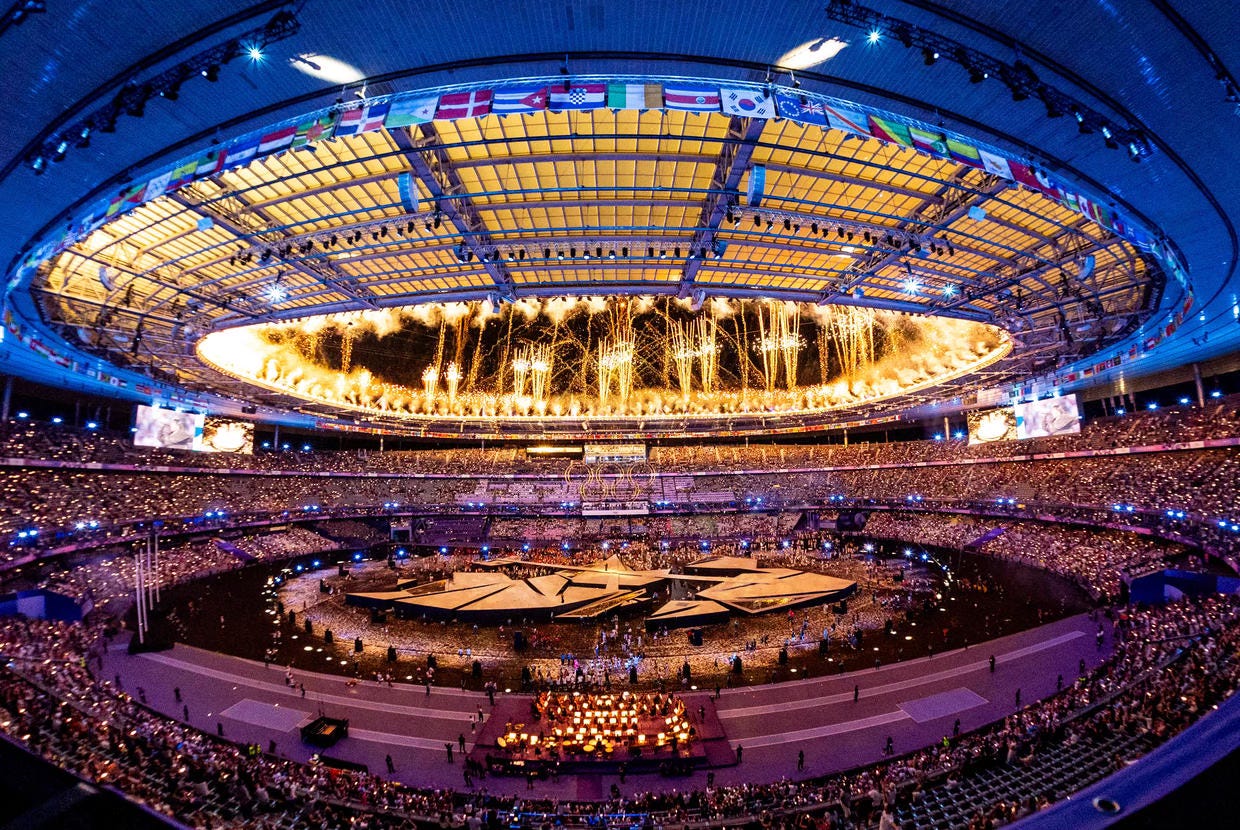
Then it was Sunday night. I was tired. But I wasn’t going to miss the Closing Ceremony. It was supposed to be two hours and fifteen minutes but we learned at the Opening Ceremony, that France doesn’t run by the clock. The evening began with the flag bearers then the teams all pouring into the Stade de France, all happy and letting out alot of adrenaline. We got to see the champions act like children as they waved their medals at the camera. They were having fun and we loved it.

The women’s marathon had ended just before the ceremony so we were treated to a medal ceremony with the Dutch woman taking Gold, Ethiopia taking silver and Kenya taking bronze. Then everything went dark. The people who had tickets were given wrist bands when they entered and, as the lights went down, the wrist bands lit up. I turned to a friend and said “once upon a time, we just flicked on our cigarette lighters. Now it’s phones and, this time, we have techno wrist bands connected to some mother load somewhere.” Those my age nodded remembering.

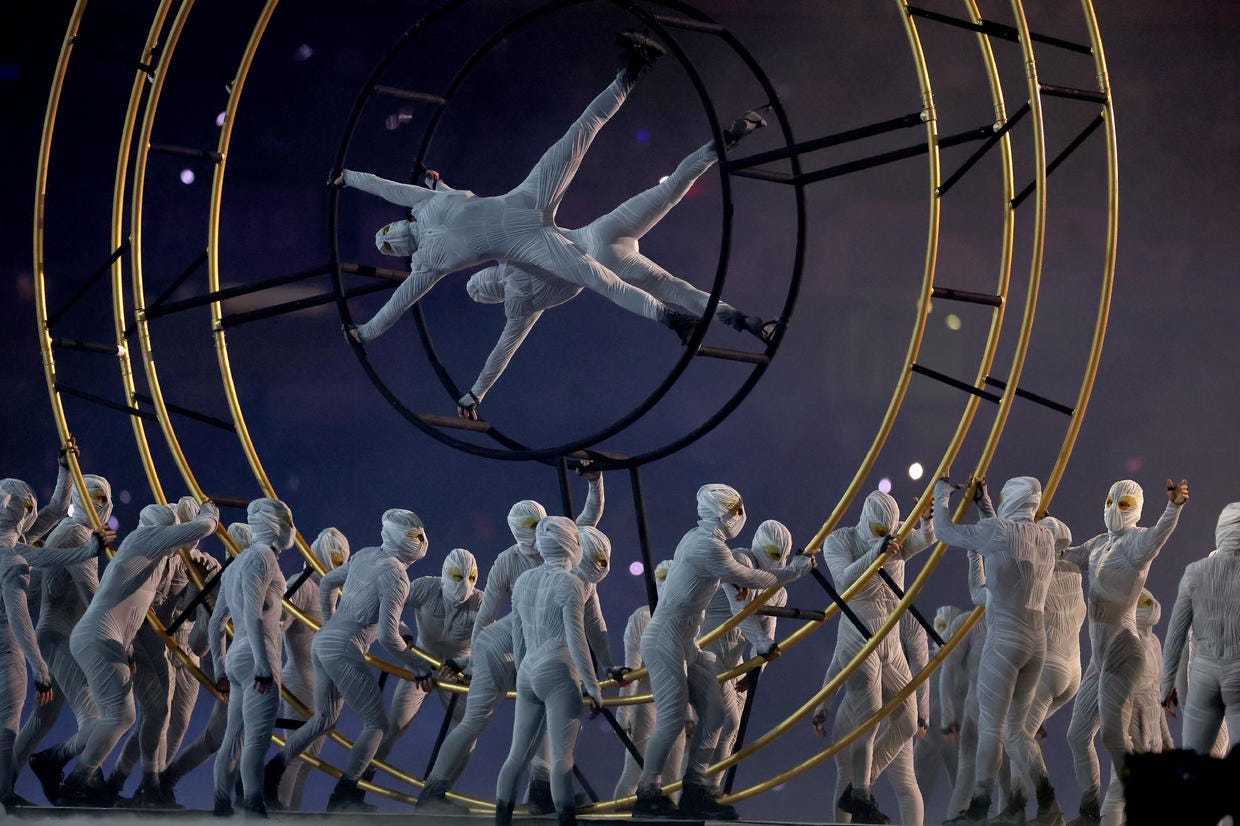
There was a narration that was barely audible on the TV. I made out that we were starting in Greece at the first Olympics and then thirty or forty mummies emerged doing spectacular feats of bending, jumping, flipping all extolling the possibilities of the human body. Slowly huge circles appeared until there were finally five of them. The mummies climbed on them, did handstands, leaned out like we’d seen at Notre Dame at the Opening Ceremony. A red piano hanging in the air appeared with the pianist also hanging and, don’t ask me how, playing. I’m told that all who were present at the Closing Ceremony, were handed a program of explanation and a menu of what was happening and what it meant. We didn’t have that luxury and could only guess at the metaphorical imagery if that was what it was. The dance lasted twenty-two minutes, ending with the mummies pushing the circles in the air till they hung like the Olympic Circles. The mummies made a hill of people, that people climbed on until there was just one person, the Golden Voyager. It was a remarkable accomplishment of modern dance, hydraulics, and lights.

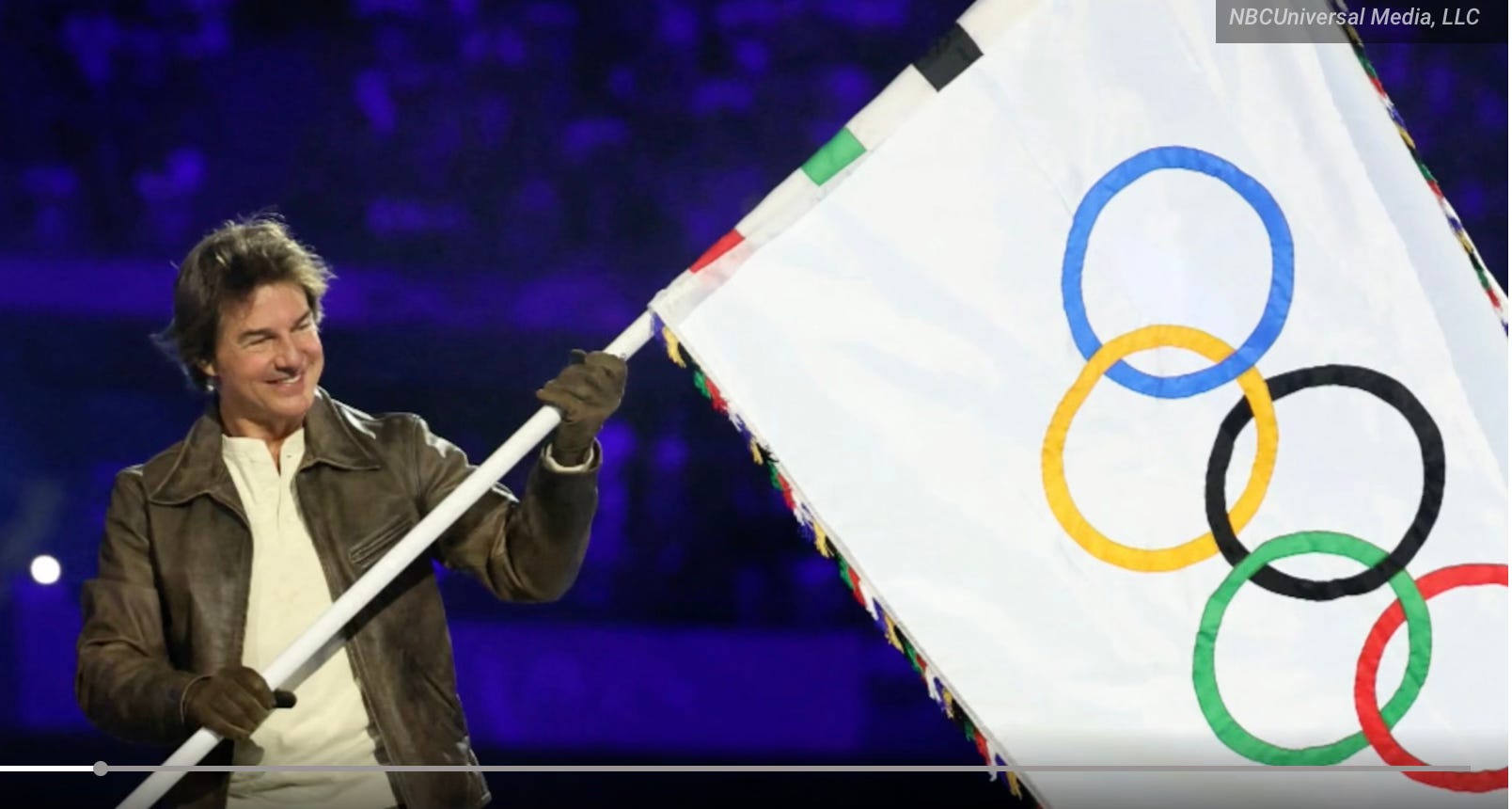
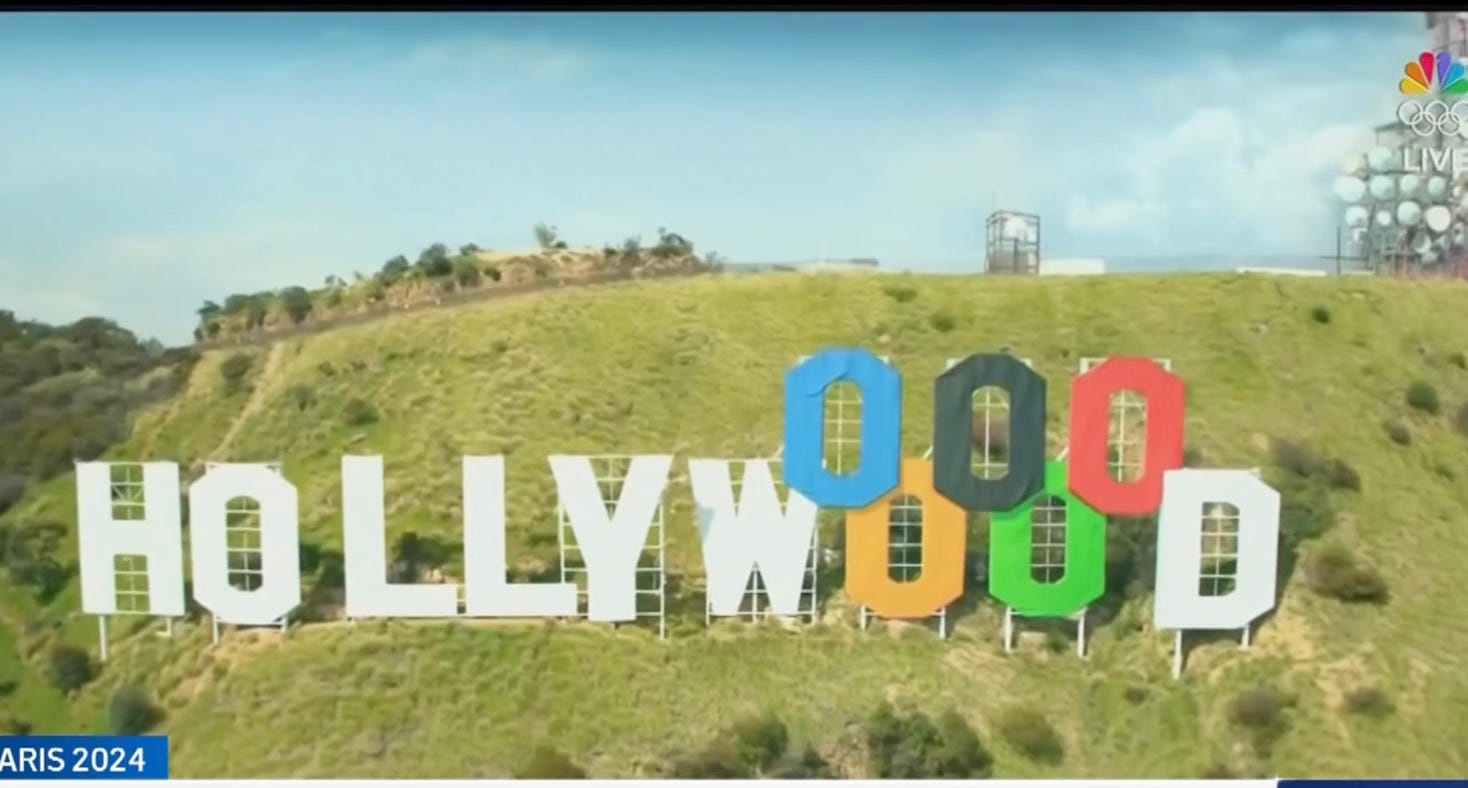
After two lengthy speeches by the President of the Olympic Committee, Tony Estanguet,and Thomas Back, President of IOC Refugee Olympic Team, people like me who, for no reason at all except to have an opinion, kept repeating: “please, no Tom Cruise.” Then Tom Cruise appeared at the top of the stadium, the very top, on what little roof there is. At 62 years of age, he still does many of his own stunts and today was no exception. He is one of the most well know faces of Hollywood here in France and the Top Guns and Mission Impossibles are the movies. He jumped from the top, repelled his way down into the crowd of athletes who grabbed their phones to take selfies. The Mayor of LA and Simone Biles handed him the Olympic flag and off he went. He jumped onto a motorcycle and cycled out into the streets of Paris. The rest had been video’d in advance. He cycled down the Quais along the Seine and into the back of a waiting plane. Two minutes later, he jumped out above Hollywood, took off his jumpsuit, parachute, and got his bearings. Then he began wacking away at a metal project. Soon an athlete came upon him and he handed her the Olympic flag. As she pulled away from him, we saw that he had added three more circles to the two in WOOD so the sign revealed the Olympic circles on the precious, never to be touched, Hollywood sign.

Ok, I had to admit, that was fun. The best of Tom Cruise: The Mission Impossible Handover!

What followed only underscored the difference between Paris and LA. We were taken to a beach shack on a beach that we weren’t sure really existed. The Red Hot Chilli Peppers sang and looked so American, Snoop and Dr. Dré, Billy Eilish all standing next to or on little stands and huts next to a huge ocean with fake palm trees. I didn’t say anything at the time but I’d bet 95% of us watching in Paris were glad we’d been to the Paris Olympics and had no excitement for the LA Olympics if that was a prevue.

Thanks for reading Out My Window! Subscribe for free to receive new posts and support my work.

A Bientôt,

Sara
PS:

Another report from the Paris Olympics

Your email box is full of more opinions and descriptions of the first week and a half of the 2024 Paris Olympics than you thought possible. The Games are known over here as the Jeux Olympics 2024. It seems a bit redundant to give my perspective. But I’m going to anyway! As well as give you links to some of the more interesting posts I’ve read.

This from a woman who has been excited and looking forward to the games from the beginning: hannahmeltzer.substack.com/an-impossibly-ambitious-opening

I wrote about the lead up to the Olympics a while ago then decided to stay away from writing more as I was feeling negative and inconvenienced. It’s safe to say that most of the inhabitants of Paris felt as I did. Then came the last ten days before the Opening Ceremony. a third of the metro stops in inner Paris were shut down. Detours were set up for cars, taxis, and buses. Police, Gendarmes, and police from other countries stood on every corner. There were designated zones: red zone-very close to the event, grey zone- further away but still close, and the rest of Paris. As it turned out, my doctor’s office is in a grey zone. I had an appointment on July 18-nine days before the Opening Ceremony. I usually walk as it’s only a 25 minutes walk. As I got close to Trocadero, I was stopped by five gendarmes. FIVE! Just for me? Well, no, but for anyone walking towards Trocadero. One woman was practically in tears. She also had some kind of appointment but I couldn’t tell what without getting in her face. I explained to one of the men that I had a doctor’s appointment. I showed him the address on my phone and the confirmation of the appointment. He explained it was in a forbidden zone and I had to back-up and walk around the zone and come up from another direction. I said “But my appointment’s in 5 minutes.” Not quite true but I would never have made it if I’d done the detour. He looked at my phone again and said “OK, but you have to go around from now on.” 

At that point, I thought these precautions were for the entire Olympics and possibly the ParaOlympics. I wasn’t going to be in my apartment for the three weeks of the regular Olympics but apartment sitting for a friend up in Montmartre. I was pretty sure these regulations wouldn’t affect me up there. But still,…it was all part of the communal negative complaint of the Parisian trying to live a life.

I had tickets for a Rugby Sevens qualification event on Thursday, July 26, the day before the Opening Ceremony. This would be my first taste of how well the organization of the Olympics was going to be. I walked to Gare du Nord and took the RER D to the Stade de France. I met my friend, Fatiha, on the platform. The very informative Olympic website had advised NOT taking the RER B (which stops there but goes on to Charles de Gaulle) or the metro 13. These would be too busy and crowded. The D took 10 minutes and the cars had plenty of seats. As we left the RER station, there were volunteers to show us the way. There were plenty of signs. And there were footprints on the ground guiding us to the Stade de France. As we got close to the entrance, security checked our packs. All very orderly. Then we were inside. Still no back-ups or blockages. We looked for our gate and were inside quickly. I was amazed. It was streamlined. 

Rugby Sevens, for those who don’t know, is a different game than regular Rugby. It is 14 minutes long with a two minute break. It is fast, intense, and fun. The stadium was full. We saw four games with the US winning one and France wining one. The crowd, probably half French people, were into it and screaming their approval. That kind of excitement is contageous. That evening, France won again and the US lost. France won the gold. The US didn’t place. I had so much fun I actually said to a friend “I could see Rugby replacing baseball as my sport.” But, of course, they aren’t even in the same ballpark. Baseball is history, a culture, has more cliché sayings that any other sport as proved by my last sentence.

That trip was the beginning of my rethinking the 2024 Olympics. Friday night, I was invited to a friend’s apartment to watch the Opening Ceremony. And it started to rain. We had so much fun watching everything, oooing and ahhing. But mostly just glad we were inside with a roof over our heads. Here is another take on that night: 

courtneymaum.substack.com/what-the-Paris-Olympics-opening-can-teach-us-about-first-drafts. 

Scroll down past the interview to her take on the Ceremony.

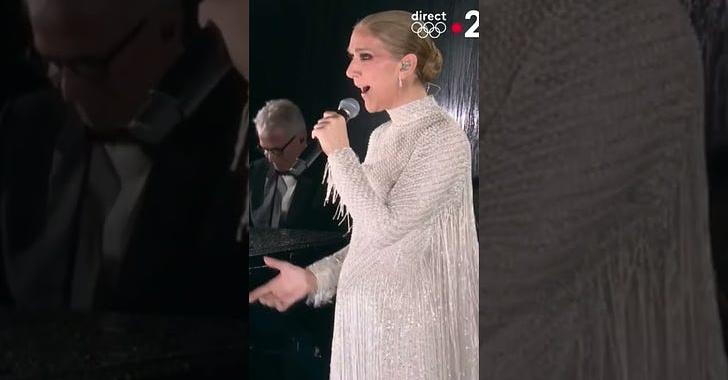
About fifteen minutes after the incredible ending of listening to Celine Dion make her huge comeback since becoming very ill four years ago, I left to walk to the metro. The rain had stopped. Not a drop. The TV later said it was the worst July downpour in Paris history (it rarely rains in July). I’ve chatted with several people who were there and no one minded the rain. They knew that history was being made. And they were having fun. The whole thing was smiling, laughing, high-fiving fun. 

I had a moment when the camera scanned buildings in the third arrondissement, behind the many spectators. I caught my breath. The beauty of Paris never ceases to bring the true meaning of wonder to my heart.  I live here, I thought to myself.  This is my home, this gorgeous city. After more than eleven years, I feel the miracle that is Sara living in Paris.

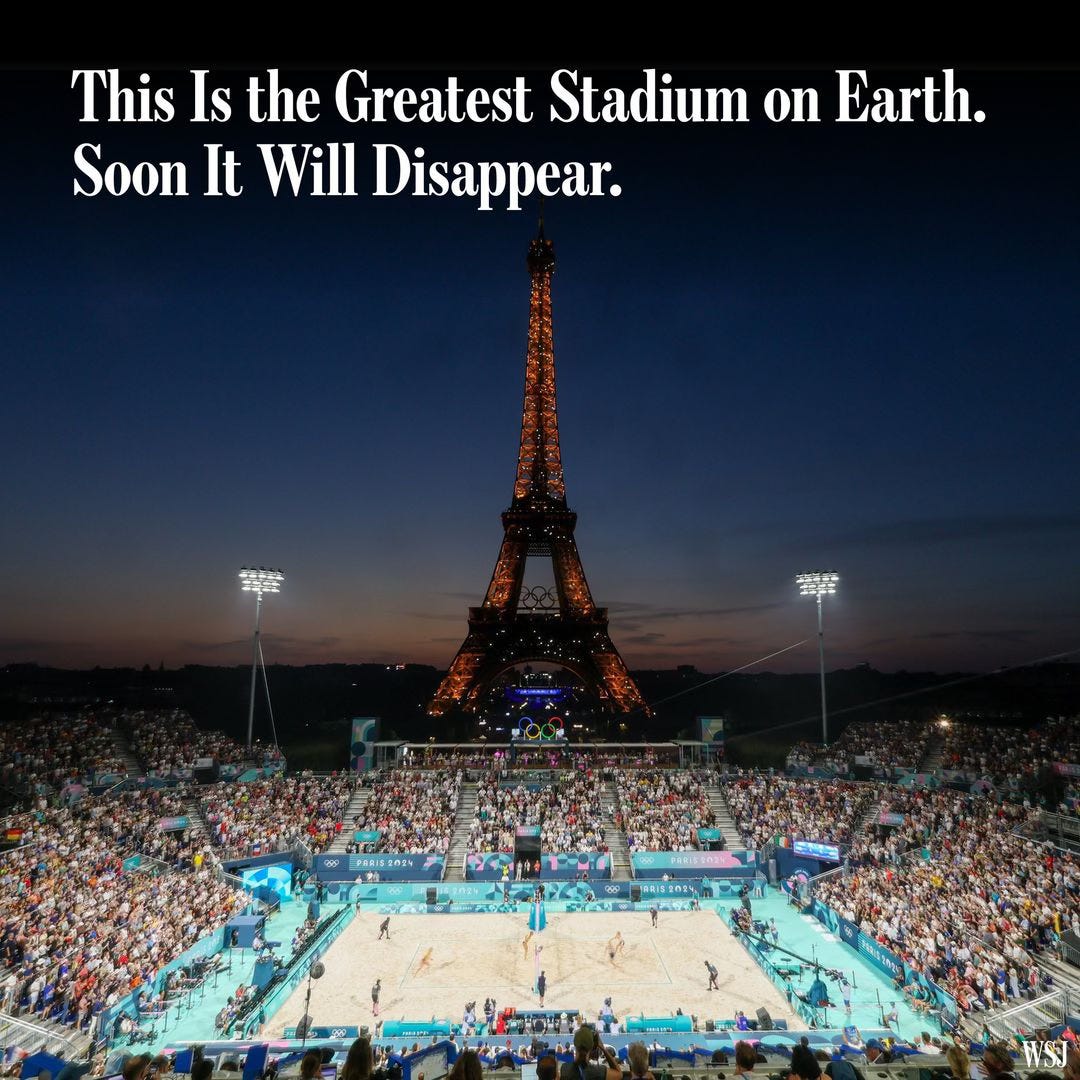
The next day, most of the metro stations opened. A few roads were still diverted but that is because the city has built stadiums at Trocoadero, at Concorde, and on the Champs de Mars. It was easy to get around again. In fact, it seemed to me that there were very few people around. Normally in August, most Parisians leave the city for a vacation. Half of the stores will shut down. This year, many Parisians left because of the Olympics. They were feeling the same dread I was feeling. It was eery how few people were in the streets. It’s possible that because the events are spread all across the city, and many events are in Lyon and Marseilles, that there truly aren’t that many people here when events are going on.

I started feeling sad that I hadn’t tried harder to get tickets. I was catching the Olympic fever. One friend called to ask if I’d like a ticket on August 10 to the street events at Concorde. BMX, skateboarding. I didn’t have to think about it. Yes! so I get to go to a few more events on the same day. I found the resale page and tried for tennis tickets and those little guys move faster than any of the Olympic runners. Yesterday, Barbara and I went to one of the Fan Zones. The city has set up a Fan Zone in every arrondissement with huge screens, picnic tables, the selling of drinks, and things for children to do. I had passed one in the 19th where I saw children playing on swings, running around having a wonderful time while their parents watched the events. We went to the 9th yesterday. For the second day in a row, I got caught in a bicycle race. Streets closed off. How to get to the other side? Take the metro!

Today, a friend called and said she was trying to buy more tickets. Was I interested? Yes, I said. We set a number for ‘don’t go over this, it’s too expensive.” We are going to men’s water polo on Friday. And then Sunday it will all be over. At least for a couple of weeks. On August 28, the ParaOlympics will begin.

Thanks for reading Out My Window! Subscribe for free to receive new posts and support my work.

A bientôt,

Sara
My favorite French photographer. The man who captured ‘vieux Paris’ captured my heart with his images

Those of you who have been reading me for awhile know that many of us who write about France are in a FranceStack that was organized by Judy MacMahon. This week I’d like to introduce you to Jenn Bragg and her recent post about her favorite photographer. Jenn writes For the Love of France.  You can find her substack by putting either her name or the name of the Substack in Search.

I hope you enjoy her post as much as I did.

“Something I have come to learn about France is that it puts a very high value on those who engage in literary or artistic endeavors. This is something I love about this country. And as many of us know, some of the best artists and creatives in history come from France.

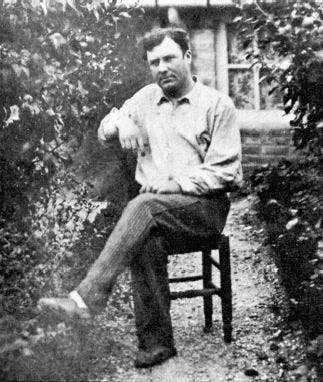
love old photographs, especially of Paris, so this week I wanted to tell you about one of my absolute favorite French photographers – Eugène Atget.

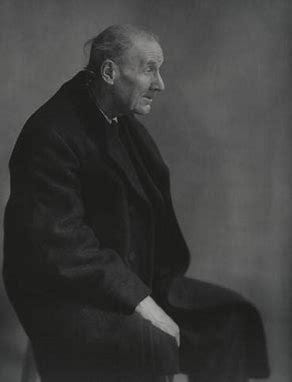
Eugène Atget, young and old. The photo on the right was taken by Berenice Abbott.

Atget always seemed destined for the arts.

Born in 1857, he was raised by his grandparents after being orphaned at the age of five. In his 20s, he worked as a cabin boy on passenger ships destined for South America. He returned to France and became an actor in the theater until he had problems with his vocal cords. Then he tried his hand (literally!) at painting. Not finding much success, he pursued photography.

Towards the end of the 19th century, Atget’s work mostly served as images on which artists could base their paintings.

But things started rapidly changing in Paris.

Industrialization began to change the city, which was being torn down and rebuilt by a man named Georges-Eugene Haussmann. Haussmann was tasked with cleaning up grimy old Paris. He did away with the narrow, rickety old streets and dilapidated buildings to create a more open, ‘breathable’ city.

Atget foresaw the disappearance of ‘vieux Paris’ (old Paris), so he decided to devote the next 30 years to documentary photography. Thank goodness, because without his work, we wouldn’t have much to go on.

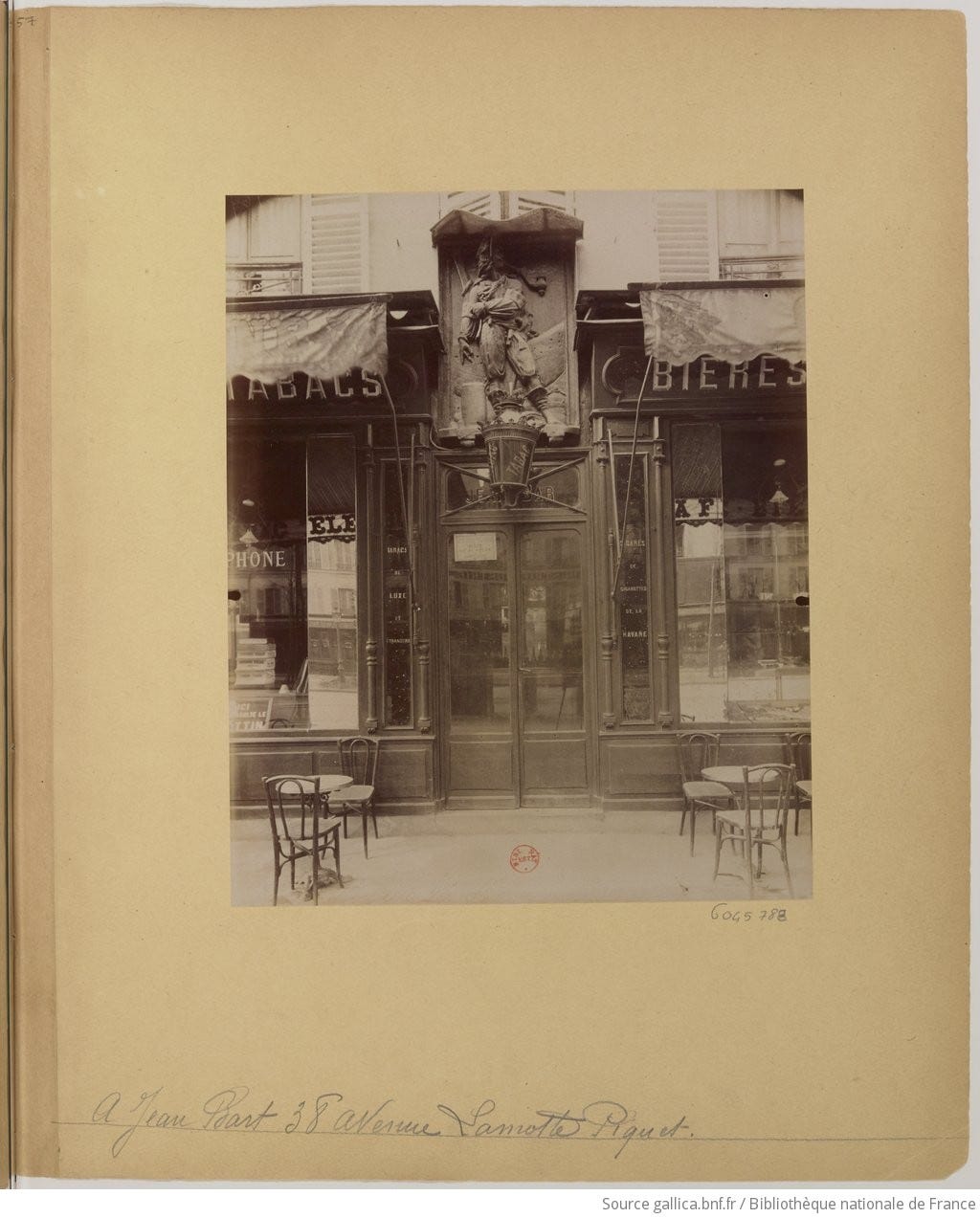
Photos of old Paris boutiques by Eugène Atget

Eugène Atget took photos of streets, storefronts, private hotels, and people. He traveled far and wide, from central Paris to the outskirts, which were entirely undeveloped.

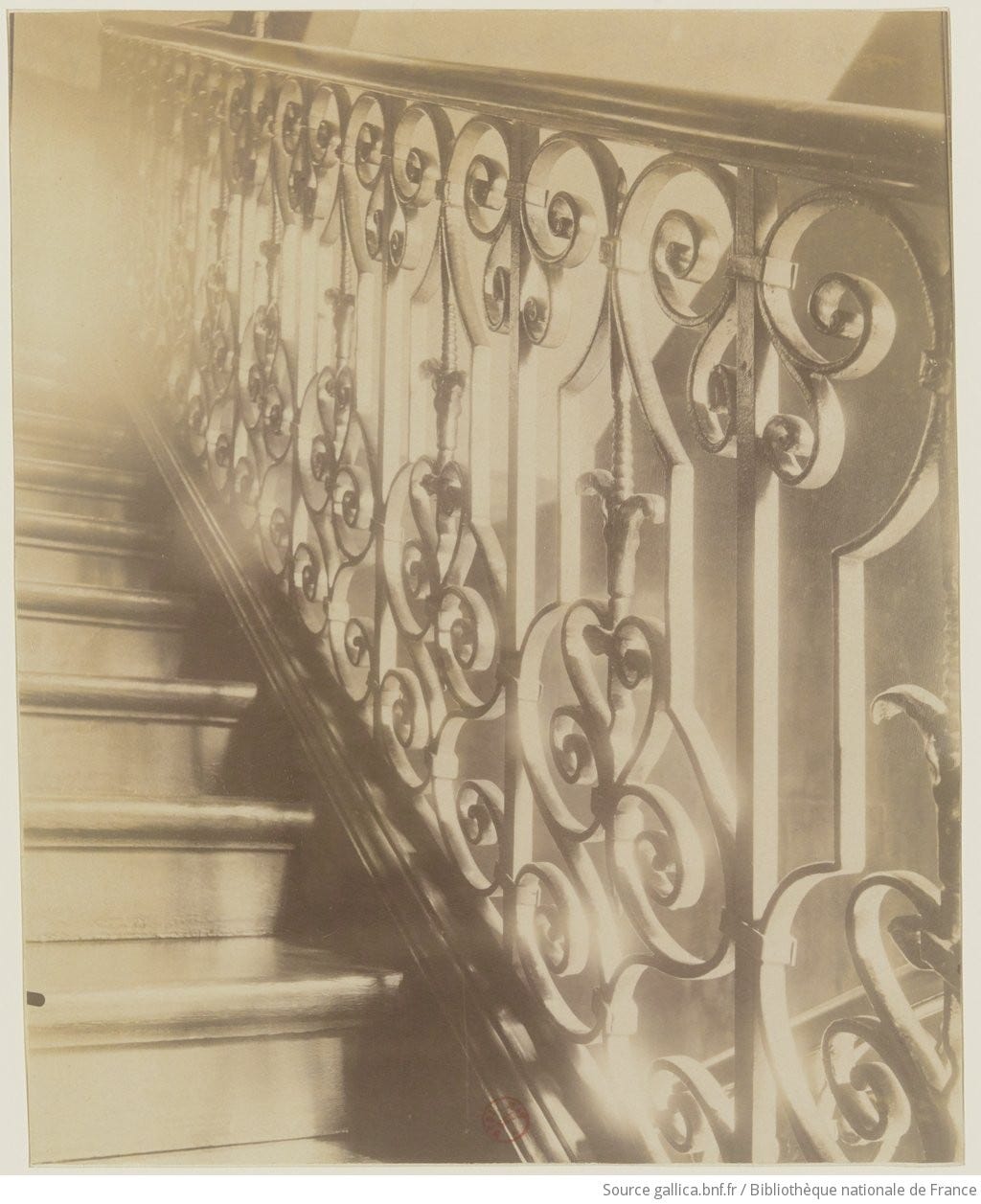
Photos capturing hotel design details. Source: BnF Gallica/Eugène Atget

Those undeveloped areas were along the periphery of Paris, an area that was known as The Zone. (Today it’s known as ‘la péripherique’ and it’s fully developed and more affordable than central Paris.)

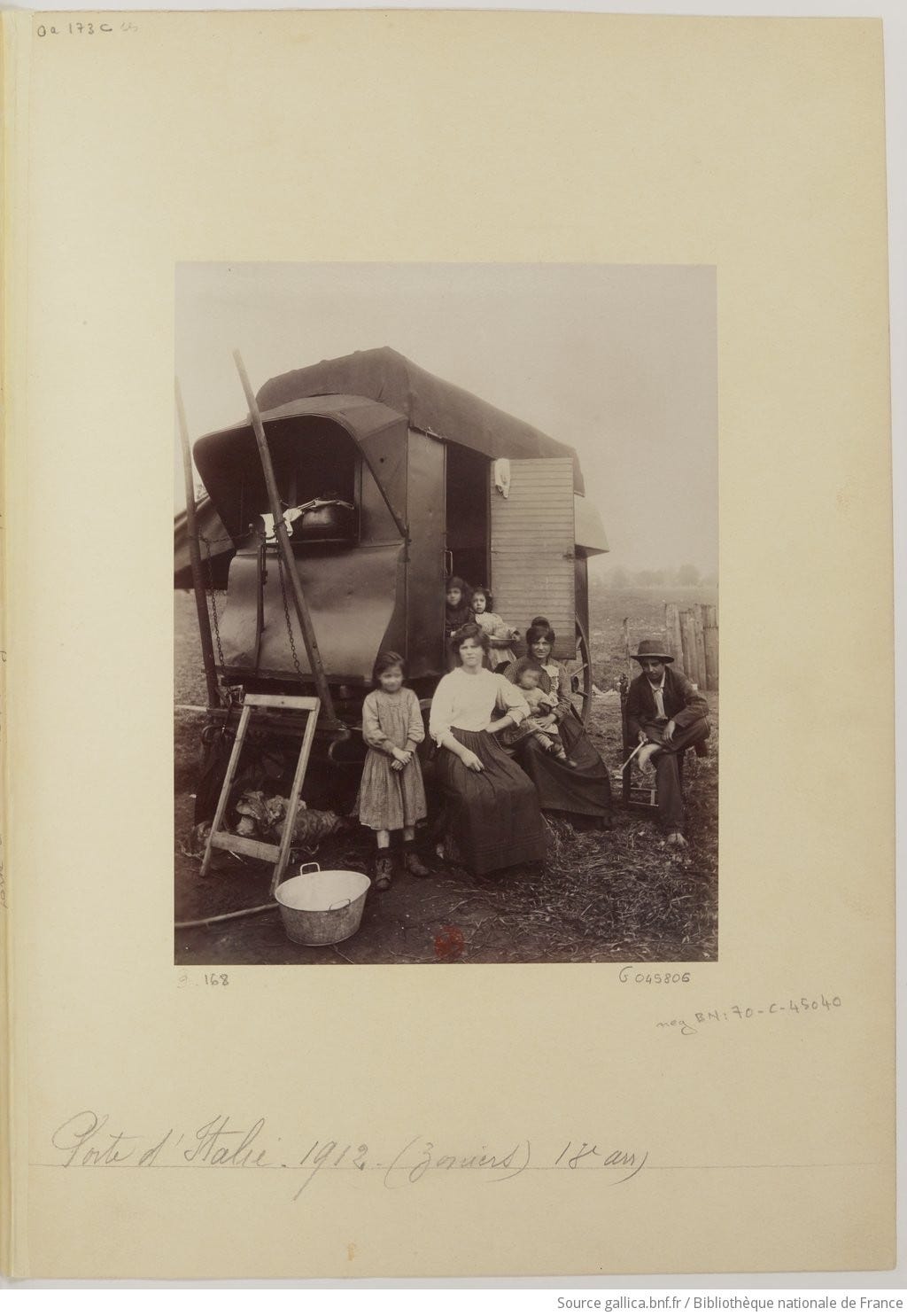
By the turn of the 20th century, the people living in la Zone were very poor, often in ramshackle, makeshift dwellings surrounded by trash. They were known as les zoniers. Their living conditions were unhygienic to say the least. It only got worse with Haussman’s project, which drove up real estate prices in Paris. (An entire article could be devoted to les zoniers, but I’ll leave that for another time.)

Atget did well to document the lives of les zoniers. When I see their images in his photos (below), they remind me of the scenes described in John Steinbeck’s ‘Grapes of Wrath’.

Except this was Paris, not the United States during the Dust Bowl.

Photos of people on the edges of Paris. Source: BnF Gallica/Eugène Atget

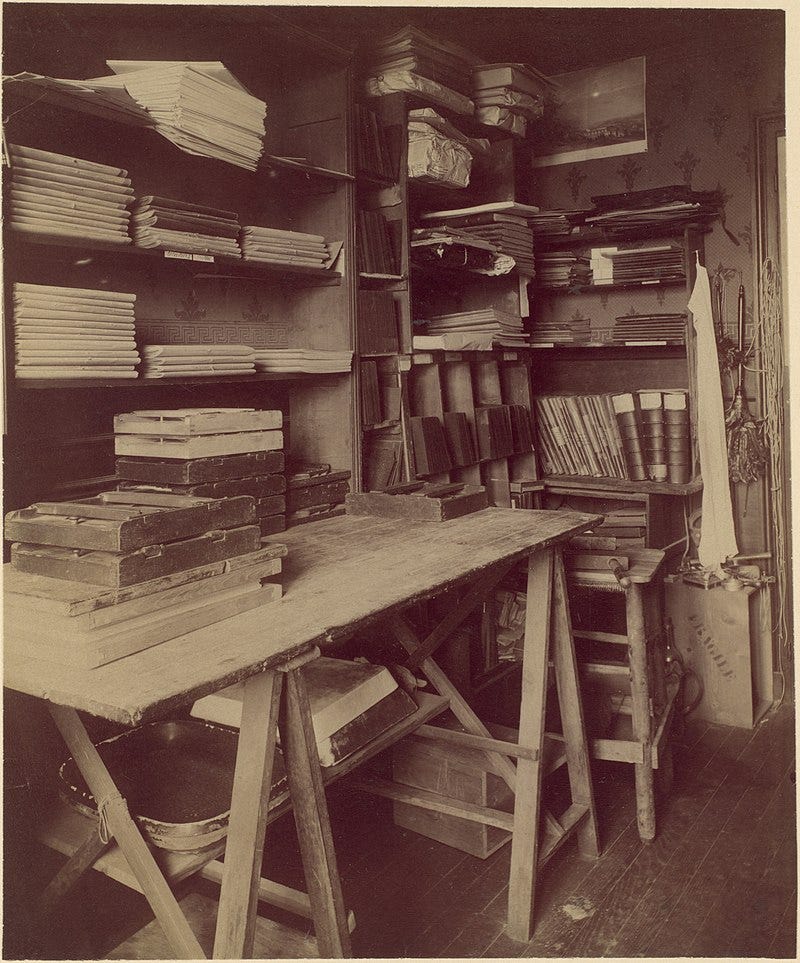
Over the years, Eugène Atget took more than 15,000 photographs, meticulously documenting exact locations and dates on his photos. He even captured his own studio (below), but identified it under a different name to create some distance between the artist and his subject.

Atget’s studio around 1910; photo: Metropolitan Museum of Art, New York

A few years before Eugène Atget died in 1927, he became acquainted with an American photographer named Berenice Abbott. At the time, Abbott was working for Man Ray in his Paris studio. (Man Ray and Atget lived on the same street in the Montparnasse neighborhood of Paris.)

Atget and Abbot shared a love for documenting (and preserving) the magic of their modernizing cities – New York for her, Paris for him. Abbott took his portrait photos before he died. Sadly, she learned about his death when she returned to Paris to show them to him.

Eugène Atget by Berenice Abbott; photo of Berenice Abbott

Seizing the opportunity to tell the world about Atget’s work, Abbott spread the word among her New York circles. She also acquired thousands of his photographs, which gave to the Museum of Modern Art. (Separately, the National Library of France also has thousands of Atget’s photographs.)

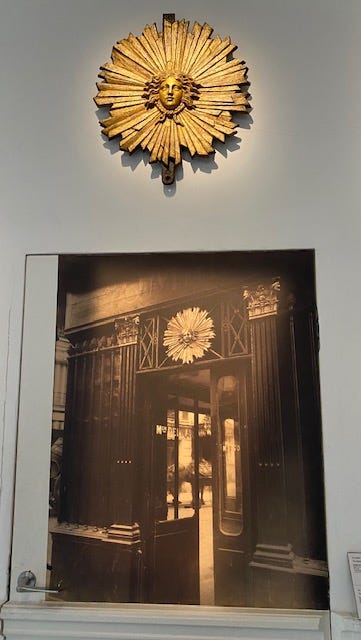
If you’re coming to Paris and have an interest in Atget’s work, you MUST visit the Musée Carnavelet, which is entirely devoted to Paris’ history. One of the best depictions of ‘vieux Paris’ is through Atget’s photography.

‘Au soleil d’or’ photo by Eugène Atget (1912) & the actual ‘golden sun’ sculpture above the door of Maison Delmas, displayed at the Musée Canavalet in Paris

Leave a comment

Sources:

Fondation Henri Cartier-Bresson: Eugene Atget

Museum of Modern Art: Eugene Atget

Bibliotheque Nationale de France

Chicago Tribune article about Atget and Abbott (from 1991)

Before you leave me, I would really appreciate if you would share my article, or my Substack, with anyone you think might be interested. I just know there is an audience out there for these ‘different’ kinds of stories from France! Thank you.”

Thanks for reading Out My Window! Subscribe for free to receive new posts and support my work.

A bientôt,

Sara