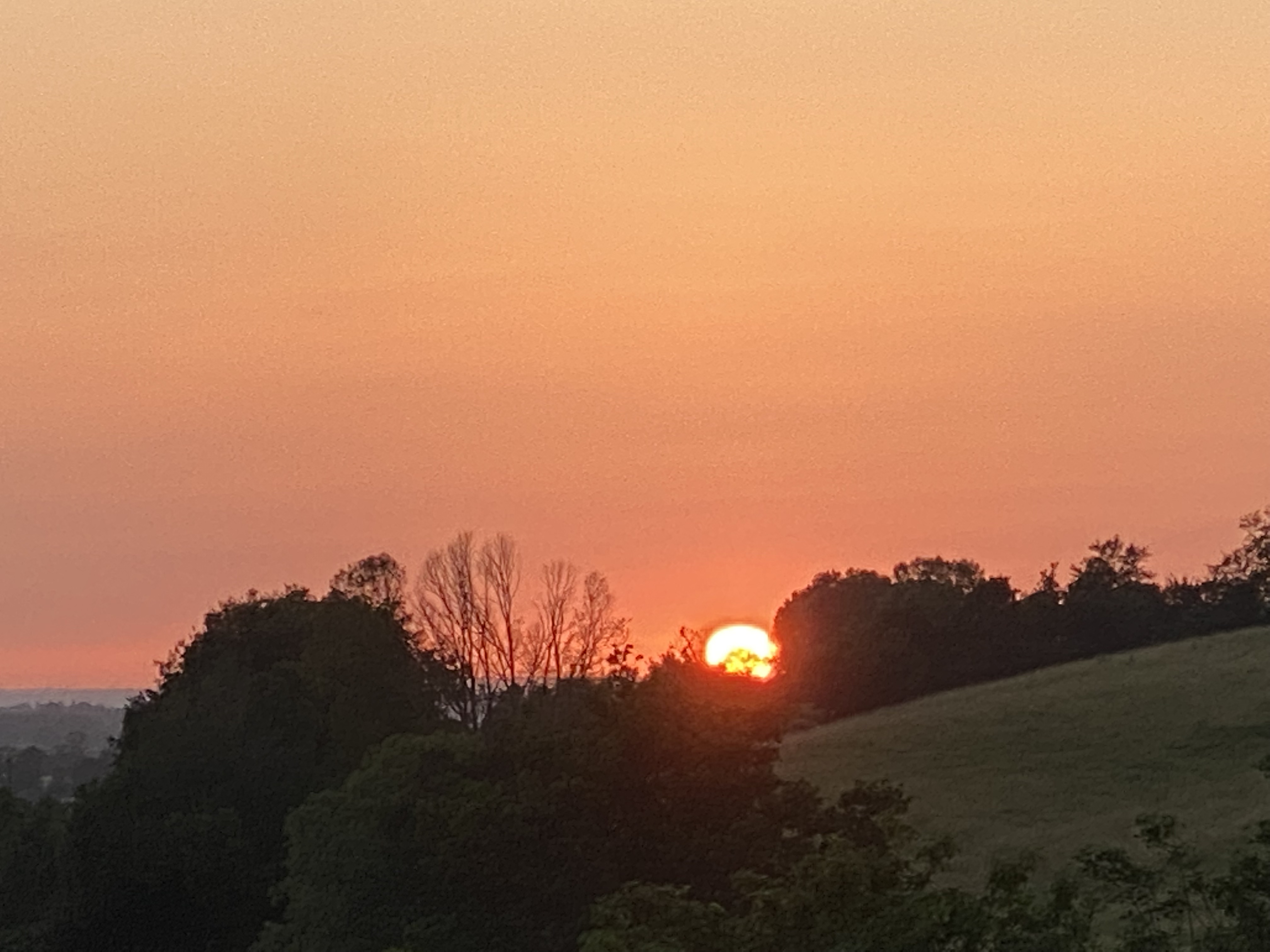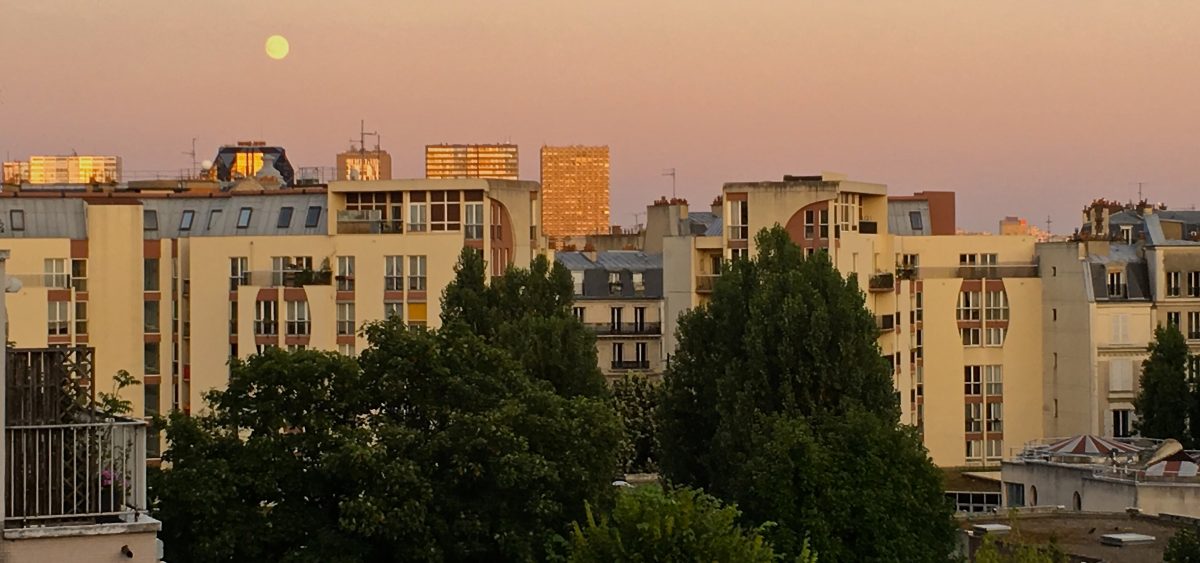
AWP 24 in Kansas City

I’m sitting in the Long Beach airport waiting for a plane back to Oakland. The weather is beautiful, the airport is small, and I could pretend I’m at some beach airport in a foreign country. It has that feel. On the TV is the Super Bowl. I’ve come from Kansas City which, it turns out, is a huge sports town. Everywhere was red and yellow. People walking in swag, banners hanging off lamp posts, signs in business windows. Now going up to the Bay Area where I imagine most everyone is rooting for the Forty-Niners. I once flew during the World Series and asked the pilot if he would give us the score periodically. He kindly accommodated me. Many others were very happy!
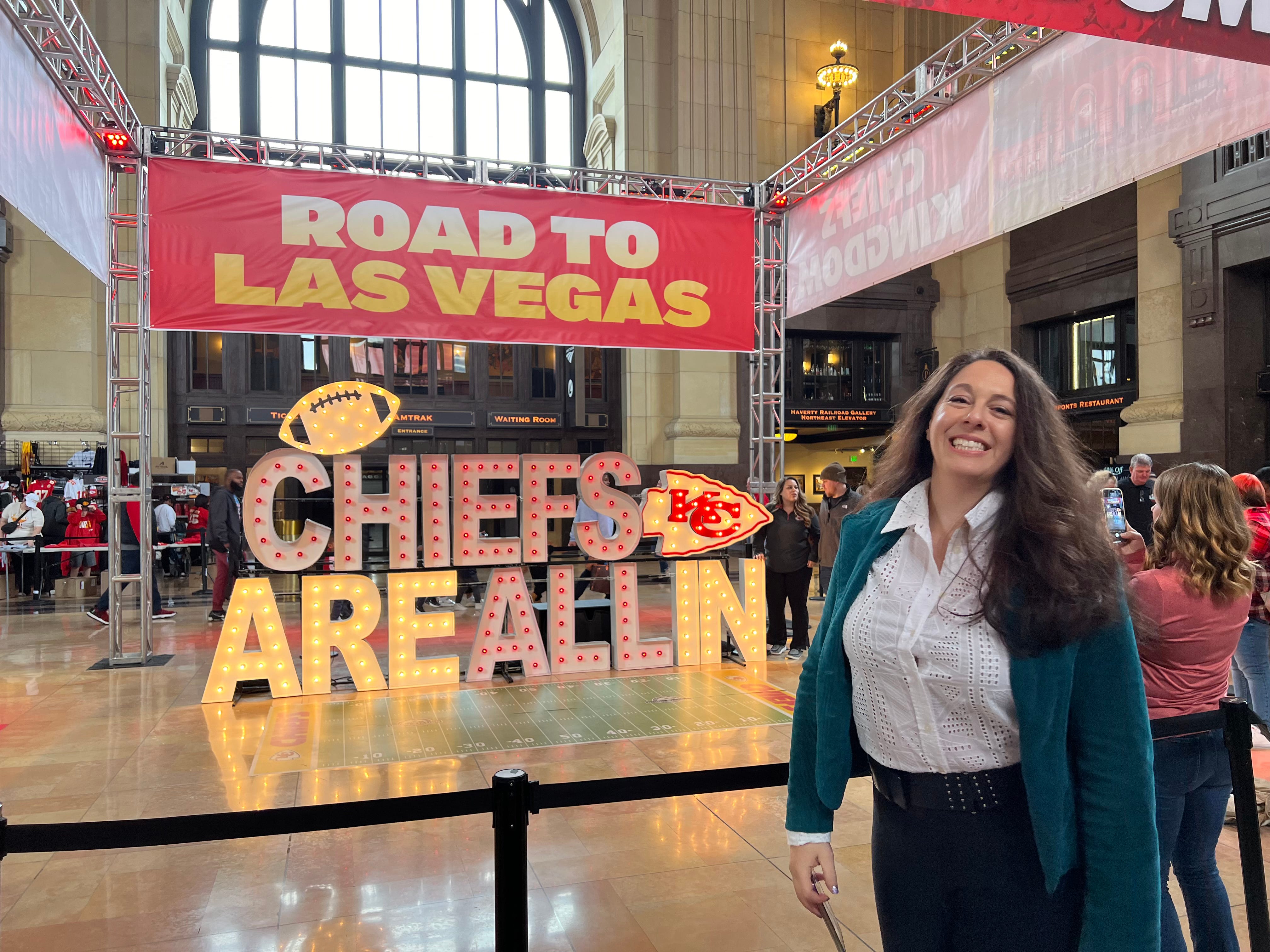
Angela, on our visit to Union Station where all things Chiefs was happening!

I went to Kansas City with four members of my writing group to attend AWP 24 (Association of Writers and Writing Programs). Most people register Wednesday afternoon. The panels officially start on Thursday morning and last until Saturday evening. There are so many panels, up to fifty every hour, that it is overwhelming. Last year, I looked at the titles and attended ones that sounded good. This year, I looked at the presenters and went to panels where I knew the presenters. Jeannine Ouellette, who writes Writing in the Dark, was on the first panel that I attended Thursday morning.. It was a craft panel on How to write trauma so that it doesn’t overwhelm your reader. Jeannine did not disappoint. In 15 minutes, she gave a Masterclass in trauma writing using excerpts from her book The Part that Burns to illustrate her points. She is easy to listen to and her students who have her for longer IN PERSON are very lucky, in my opinion. Those of us who subscribe to her Substack are treated to masterclasses every week. She is a generous teacher and interacts with those who are vulnerable enough to write what they have written.
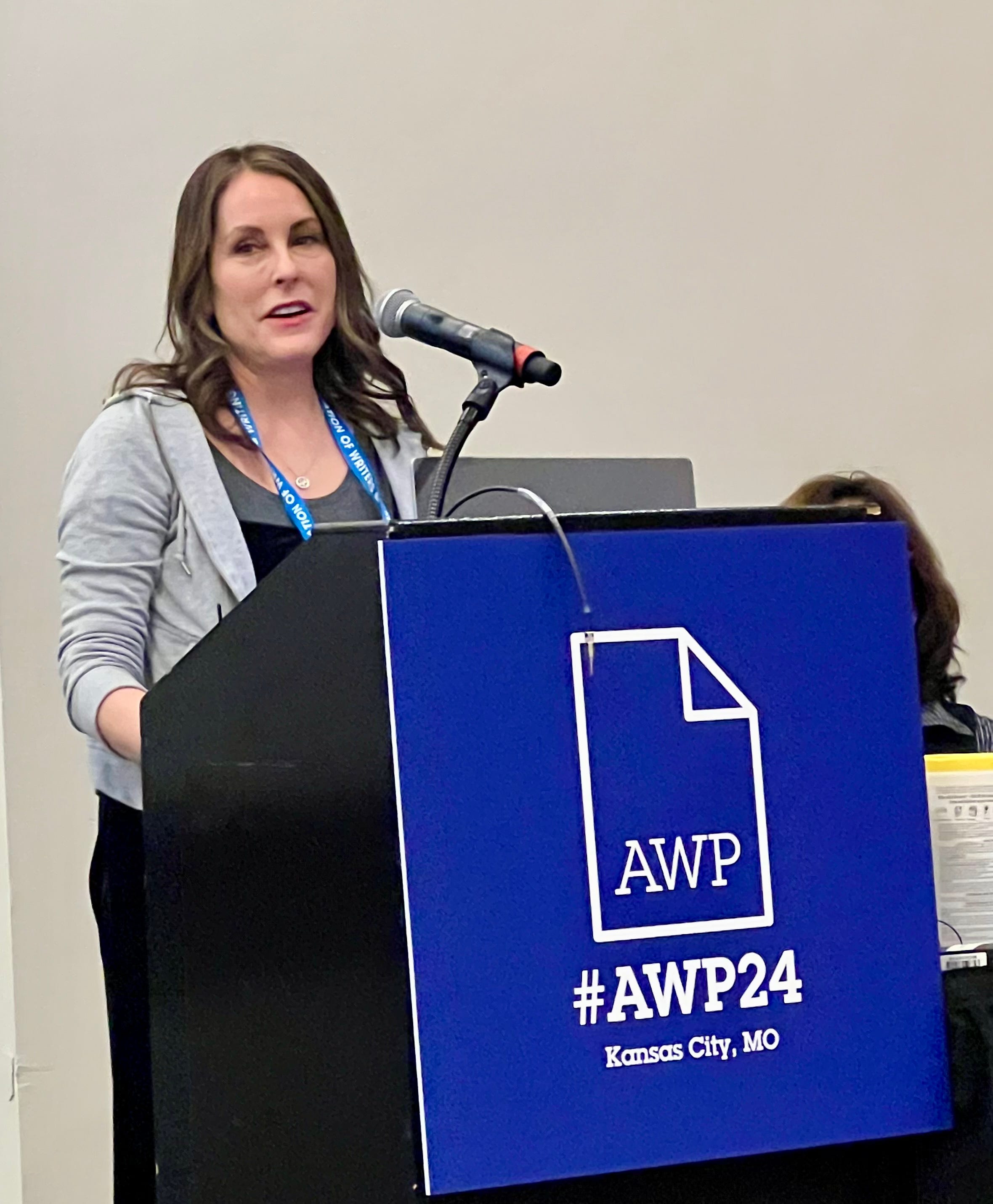
Jeannine Ouellette

Thanks for reading Out My Window! Subscribe for free to receive new posts and support my work.

My next panel was an homage to James Baldwin. I believe Thursday would have been his 100th birthday. The moderator had chosen people who “commune” with Baldwin. I was touched by both panelists. Unfortunately, two other panelists had to cancel last minute because of illness. It didn’t make any difference to me. I was so moved by the love and dedication he still inspires in people. I consider myself an essayist and look to his writings as examples of terrific essay writing. 

Baldwin struggled with his love of living in France with his guilt that he should be home……That hit a nerve with me. My mother, if she were alive, would look down on my choice of living in Paris. She would tell me to come back to the US and fight for democracy.

Friday was a wonderful day for panels. But the panels, as interesting as they are, aren’t the main reason that many of us attend the Convention. It’s a chance to meet and talk with publishers, meet and talk with the editors of journals, emerging and established, and to meet other authors. Last year, I met the editors of the Under Review. I liked them and they liked me. Eleven months later, they have published my story The Perfect Game. They had a small celebration at a place called Sinkers on Friday night and six of us read our stories. It was thrilling. This year I’ve set my sights on a Canadian Journal called Brick.

The highlight of the Convention was the Opening Keynote Speech given by Jericho Brown. All five of us in my writing group were tired even though only one day of the Convention had passed. Just navigating one’s way around the Kansas City Convention Center, without a map in hand, was an exhausting experience. I figure that three of the Seattle Convention Centers, where AWP was held last year, could fit in the KC one. The Center took up three long city blocks with bridges over the streets. A long underground unfinished walkway. It was daunting.
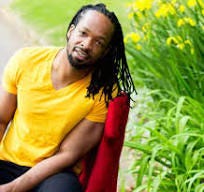
The Keynote speech was virtual and the AirBnB we stayed at had a smart TV! So we ate a wonderful home cooked meal of chicken, butternut squash, and salad. Then we piled onto the living room couches to listen to Jericho. I have only read his poems. I had never heard him speak. He is funny. He is passionate. He is smart. And he cares about this country. I don’t think I could find the words to do justice to his 20-30 minute talk so please know that whatever I say here, it was 1000% better. So far, the video is only available to convention goers so I can’t even refer you to that. I can start by saying he has a smile that would light up any room. He has a smile that is warm and sunny and in no way gives away the violent childhood he suffered and writes about in his poetry. He opened by making us laugh and slowly, word in hand, moved us to our responsibilities as writers and as Americans. He did this by citing many of the books that have been banned in the state of Florida: five versions of the Dictionary, the Encycopedia, the Bible (the Bible????), to mention a few that students need just to progress in school. He brought home that we writers are being banned. We aren’t spectators, we are victims if we want the freedom to express ourselves. As I’m a fairly new author, I had not made the connection that I could be banned if someone thought I used a wrong word. 1984 should be renamed. Images of Nazis burning books in the street came to mind. Jericho Brown kept at it. making sure we got it. This is happening, it can happen to you, it is happening to many of us.

By the time he finished, I was breathless. I was paying attention.

A bientôt,

Sara
Snow and…..

Ann Arbor

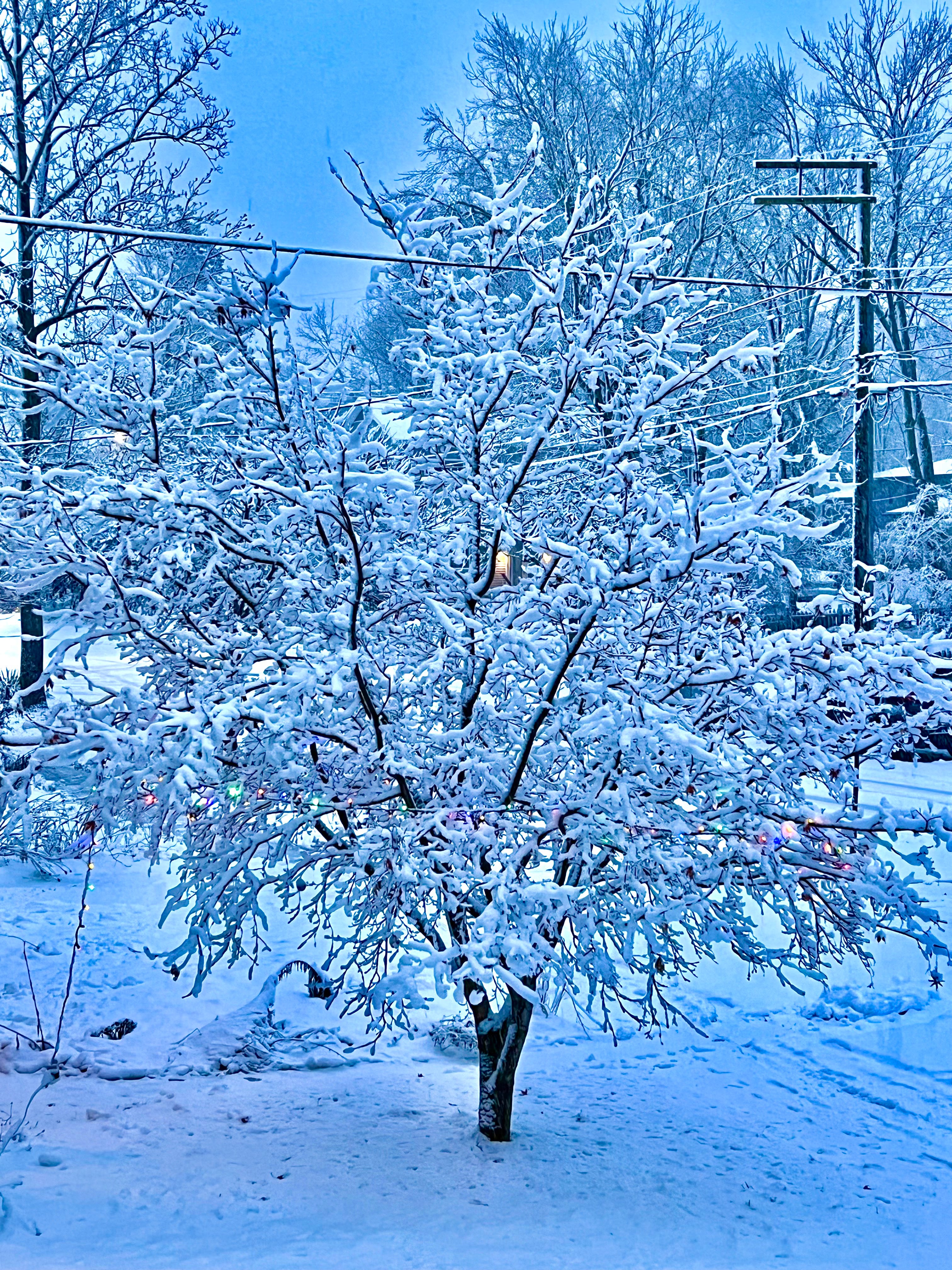
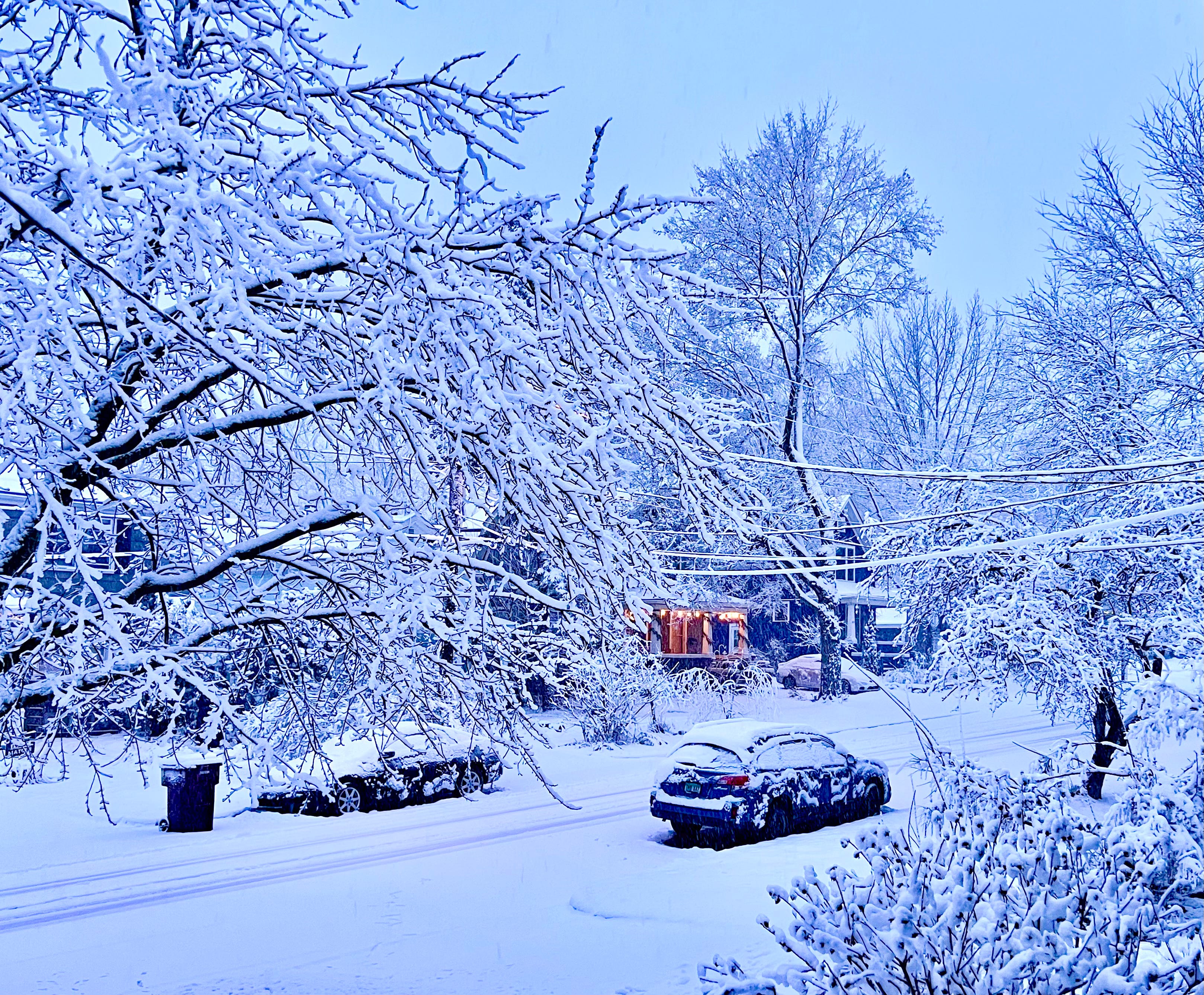
Friday night, January 12, just as the sun was beginning to descend behind the trees, big fat snowflakes began to fall in Ann Arbor, Michigan. The kind that stick to the ground. Within an hour, I walked to the front door of my sister’s home and peeked out. Then I stepped out onto the porch. In front of me was a white winter wonderland. The snowfall was at least 6 inches and still going. The snow was light, light enough that it comfortably sat on tree limbs without forcing the branch to bow to the ground. Neighbors hadn’t taken down their Christmas lights. Across the street was a tree decorated in only blue lights. Without snow, in the dark, it looked dramatic. With the snow, it looked like a thousand dollar window in Macy’s or Magnins. Windows that were so magical adults as well as children were enchanted.

My sister’s next-door neighbor had started to take his outdoor lights down but couldn’t finish because of the snow and cold. The tree was sprinkled with red, yellow, green, and white tiny lights. They lighted up the lower branches of his snow filled tree. Cars parked on the side of the road had almost disappeared. No one was out. The snowfall was pristine. Even knowing that the morning would probably bring ice, cars that wouldn’t start, dirty brown tracks on the streets as people attempted to go to work or do errands, the sight of the snow Friday evening filled me with wonder. It was moments of pure joy.

I cannot remember last seeing snow like that. Living in California, we might get a sprinkle on Mt. Diablo that was gone by mid-day. On ski trips, it was rare to be lucky enough to get fresh snow for the next morning. In the ten years I’ve lived in Paris, I’ve seen snow fall five or six times. Usually flurries. Everyone gets excited but the snow doesn’t stick. The one time it did stick, the snow removers were out in record time making sure all the parked cars on every street could move.

When I was young, in college, Paris often got a foot or more of snow. Foot traffic tapped down paths on the sidewalks so people could stroll. Les marchands de marrons(roasted chestnut sellers) brought their stoves, huge iron apparatuses, and several bushels of chestnuts. They’d set themselves up at the foot of a bridge, then barbecue the chestnuts till they became soft. I’d buy a newspaper cone full of the piping hot chestnuts for two francs. Buying and eating those chestnuts became the definition of winter in Paris for me. I think I’ve seen three chestnut sellers in the last five years.

It seems I’ve only been to Ann Arbor in the winter. People say I have to come in the summer when trees are in bloom and flowers of every color are flowing off porches. The weather is warm often verging on very hot. But for my money, the experience of witnessing an untouched field of snow that goes as far as the eye can see is a wonder to behold. Of course, I don’t have to live there and suffer all the problems that are sure to happen for the next week or two.

Ann Arbor is a great town. Most important to me, if I lived there, is the fact that there isn’t a rush hour. My sister asked me to go to Plum Market for a few things for our dinner. Since it was 5:15pm, I assumed I’d have to take side roads. “No, no,” she said. I drove down Miller, turned left on to Maple, a major thoroughfare, and soon I was at Plum Market. Same amount of time as if I’d driven at 1pm. Same amount of cars. Heaven!!

It’s a walking town. The Huron River runs very close to the town and provides walkers with many lovely tow paths. The University of Michigan is right smack dab in the middle of town. I’d even go so far as to venture that the town of Ann Arbor grew up around the University. Wonderful stores line State St, Huron St and Hill St. After Michigan won the National Football Championship last Monday, the M den was packed with people buying T-shirts declaring Michigan the best at 15-0 ( I just had to get that in. It was very exciting and I love the excitement of Championship games!)

Ann Arbor is a bookstore town. There are a minimum of eight bookstores that sell both used and new books. There is even a map showing where all the bookstores are. One can make a walking tour out of a search for all the bookstores. The love of books and bookstores is very Parisian! My sister took me to Literati which sells new books. The ground floor is floor to ceiling fiction. It looks like an old timey academic library, There are even ladders. Below, on the lower floor, was non-fiction and the first floor (second in US) was the best book floor I’ve seen in a long time. Children’s books, jigsaw puzzles, beautifully crafted dolls, cards and stickers, and a collection of old typewriters on display. All this was managed by Vicky who knows every book in the store and is so personable that I found myself buying books and cards even though I almost always get my books from the Library.

I’m writing this sitting on a plane two hours out of Detroit. Thanks to all the snow that, indeed, became ice, the plane left two hour late. I’m flying west so maybe I’ll still see some daylight when we land. Meanwhile, it’s lovely to revisit Ann Arbor.

A bientôt,

Sara
Thanks for reading Out My Window! Subscribe for free to receive new posts and support my work.

Saint-Jean de Luz Redux

I wonder if it’s my personality or if it’s an American trait or … could it besomething else? Whenever I go somewhere and fall in love with the place, I start looking at the Real Estate windows that decorate the main streets of every beautiful place. Some part of me wants to own a piece of heaven. It’s completely nonsensical. Not living in heaven but thinking one can own a spot in heaven. I still own my home in California and I rent an apartment in Paris, and the last thing I need is another responsibility. I’m too old to think in terms of investment possibilities. I nearly bought a little home in Normandy last summer (2022). I didn’t because the inspector I hired to do a thorough investigation told me not to. My rational brain knows it’s far less expensive to rent a place wherever I go. This past summer it was Saint Jean de Luz.

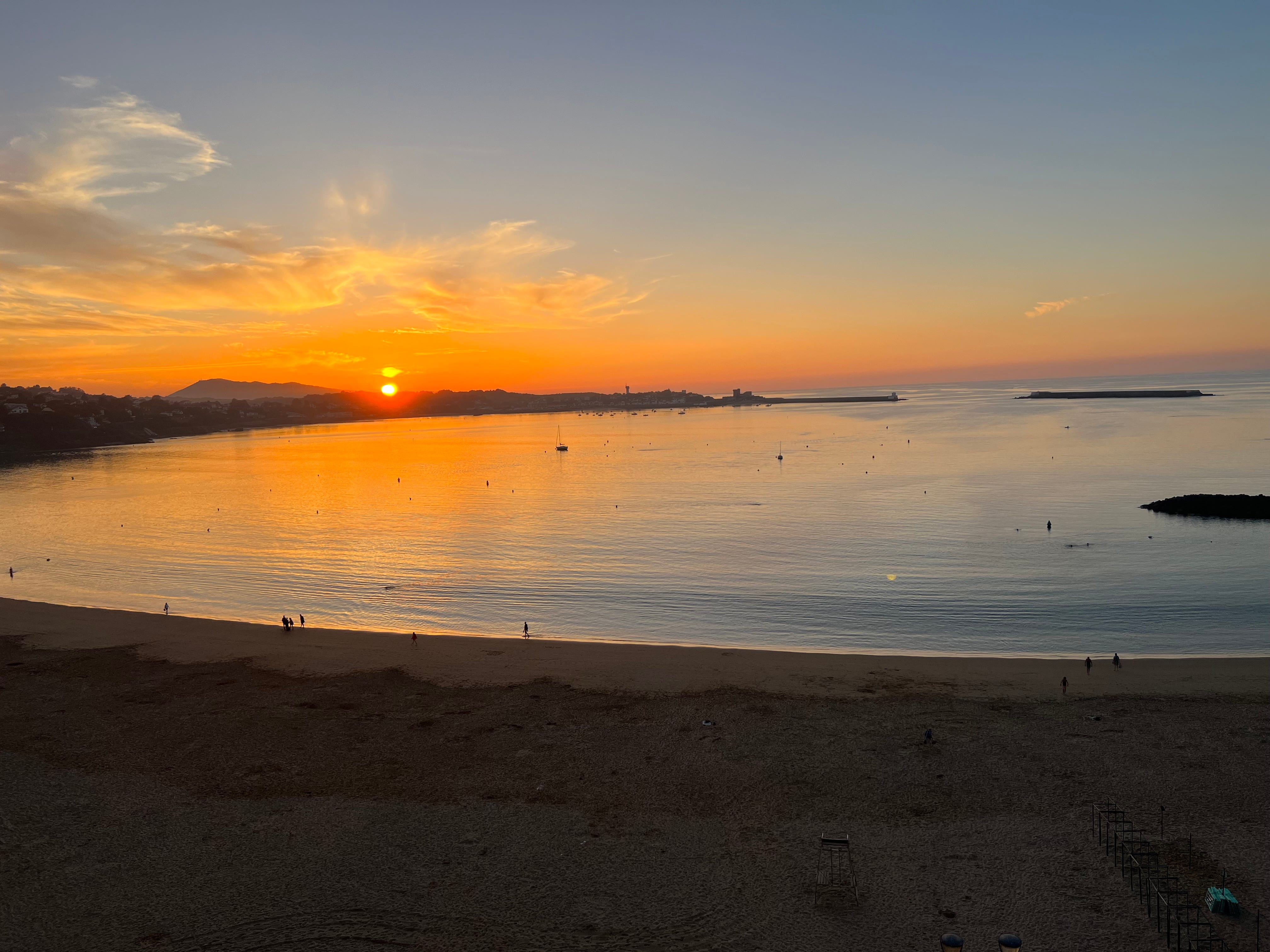
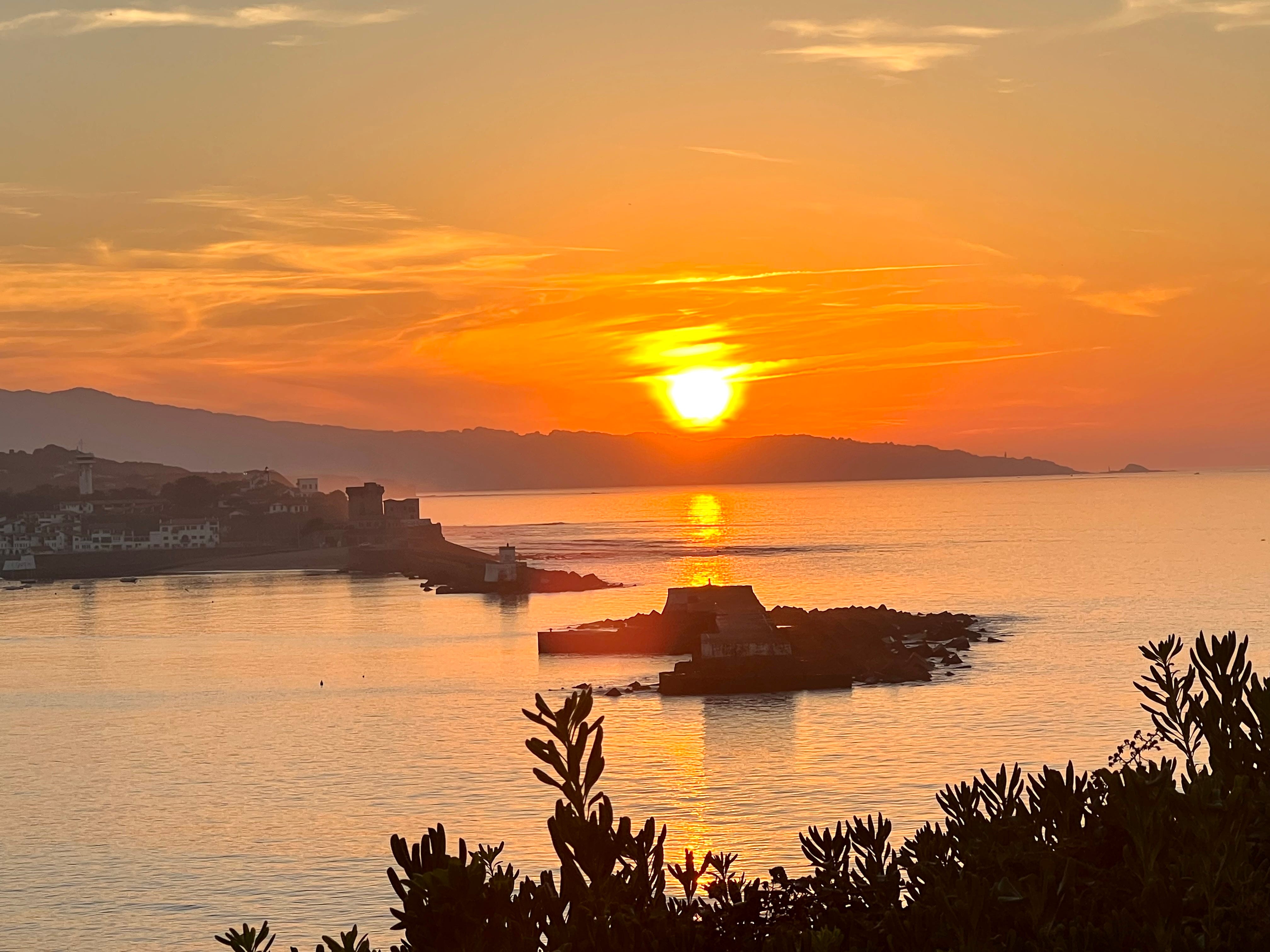
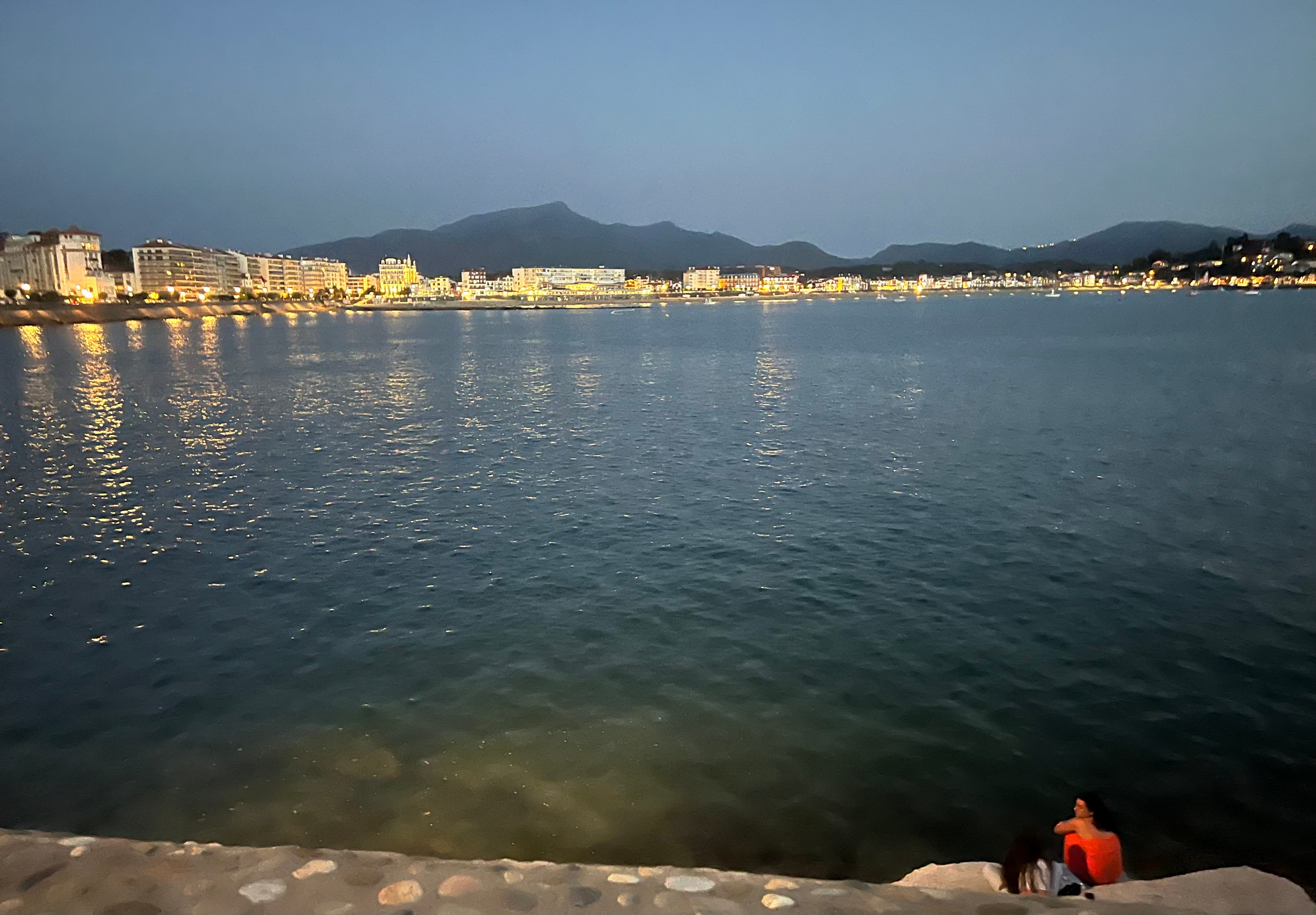
Sunset from the window of my little studio

I was in Saint-Jean de Luz for the last four days. I tacked it on to a trip to Biarritz for a conference. Little did I know that the weather would grace us with summertime warmth. I felt as if I was given the last drops of summer. The ocean water was warm, people in bathing suits and colorful umbrellas dotted the beach, and the sunsets were as dramatic as they were last July. The sun just set further south.

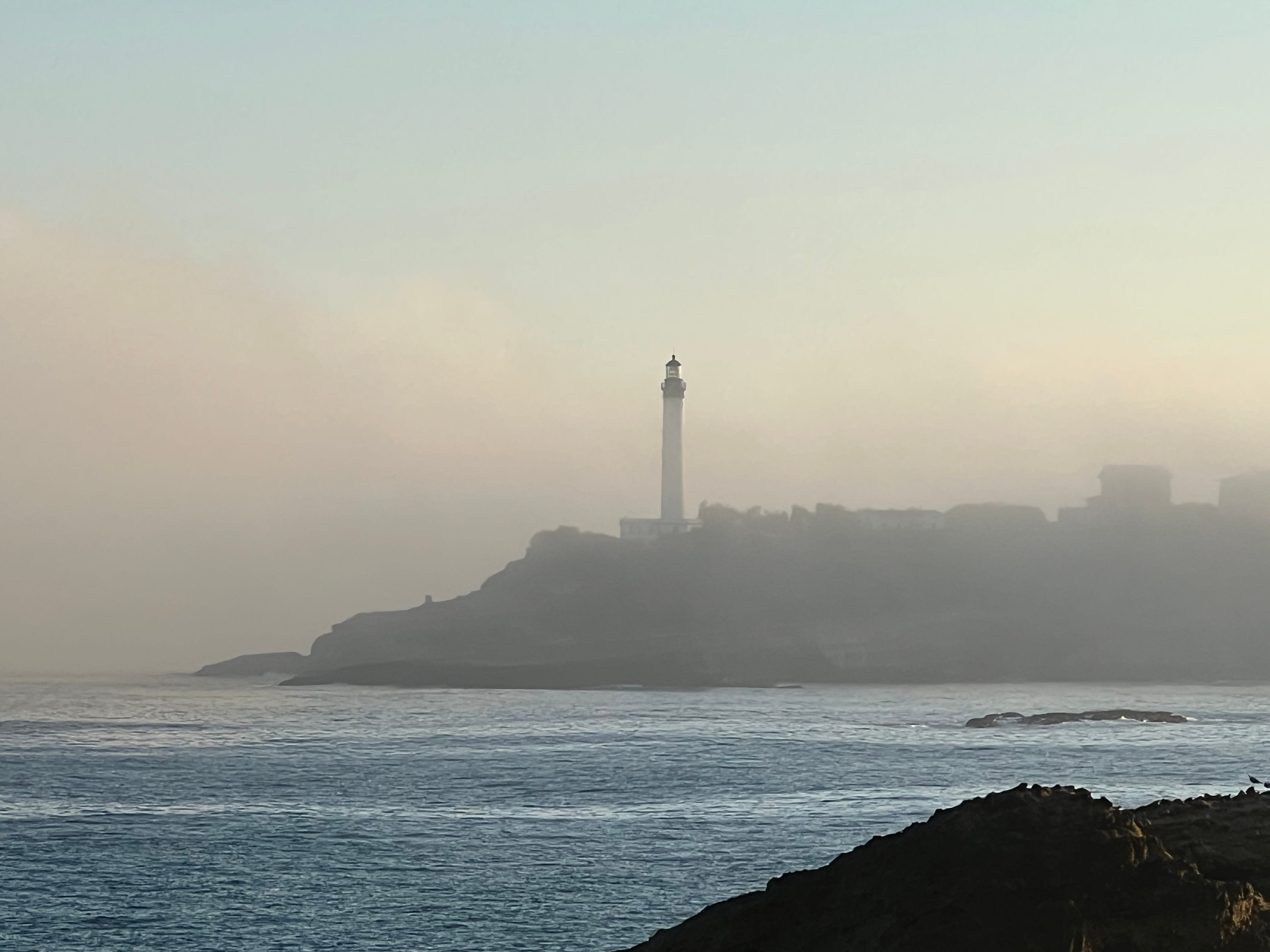
Biarritz lighthouse in the early morning mist

Share

Biarritz surprised me. I was holding a prejudice about the city. Probably because it attracts the rich, as in over-the-top wealthy, and infamous. One of my fellow #FranceStackers, Mike Werner, wrote about it here and here/Part 2. I really enjoyed my three days there. I stayed at the Residence Le Grand Large which is half a block from the ocean, high up on a cliff. It’s a ten-minute walk on a pleasant downhill slop to the closest beach, La plage Port Vieux. Biarritz is large and sprawls into Anglet the next city in a similar way that cities on the East Coast of the US morph into each other with no demarcation. But I wasn’t there to discover Biarritz. I was attending a conference that allowed me plenty of time to wander from the Plage Port Vieux to an outcropping with a white sculpture of the Virgin to the Grand Plage with its casino and onto the Lighthouse at Point Saint Martin. 

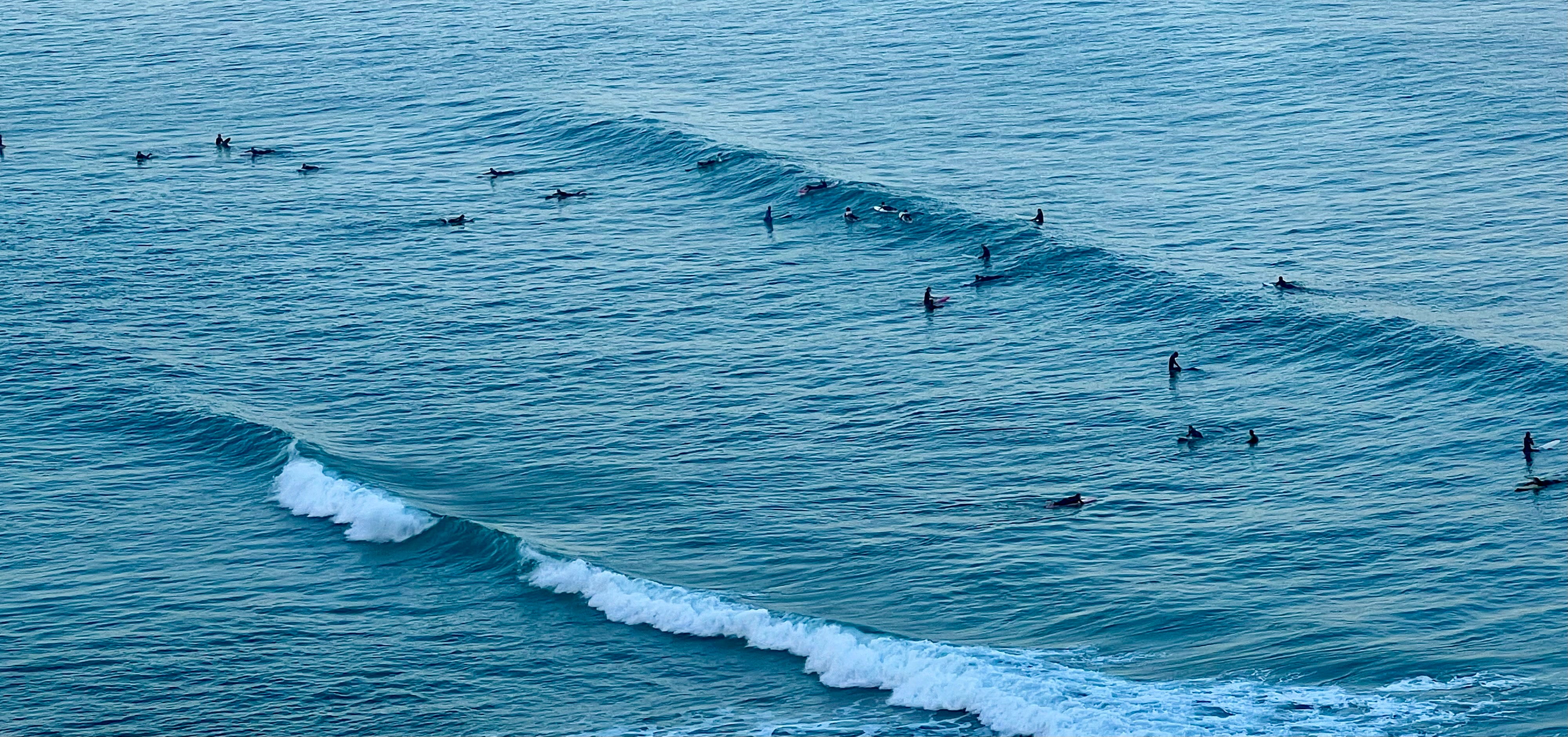
Surfers first thing in the morning-Plage de la Côte des Basques

In the early morning, I could see a hundred surfers looking to find a wave. My little tourist map told me that when the film The Sun Also Rises was filmed near Biarritz, Peter Vertel, one of the scriptwriters, a Californian, brought surfing to Biarritz. Now there are at least twenty schools to learn surfing and an International Competition is held there each year.

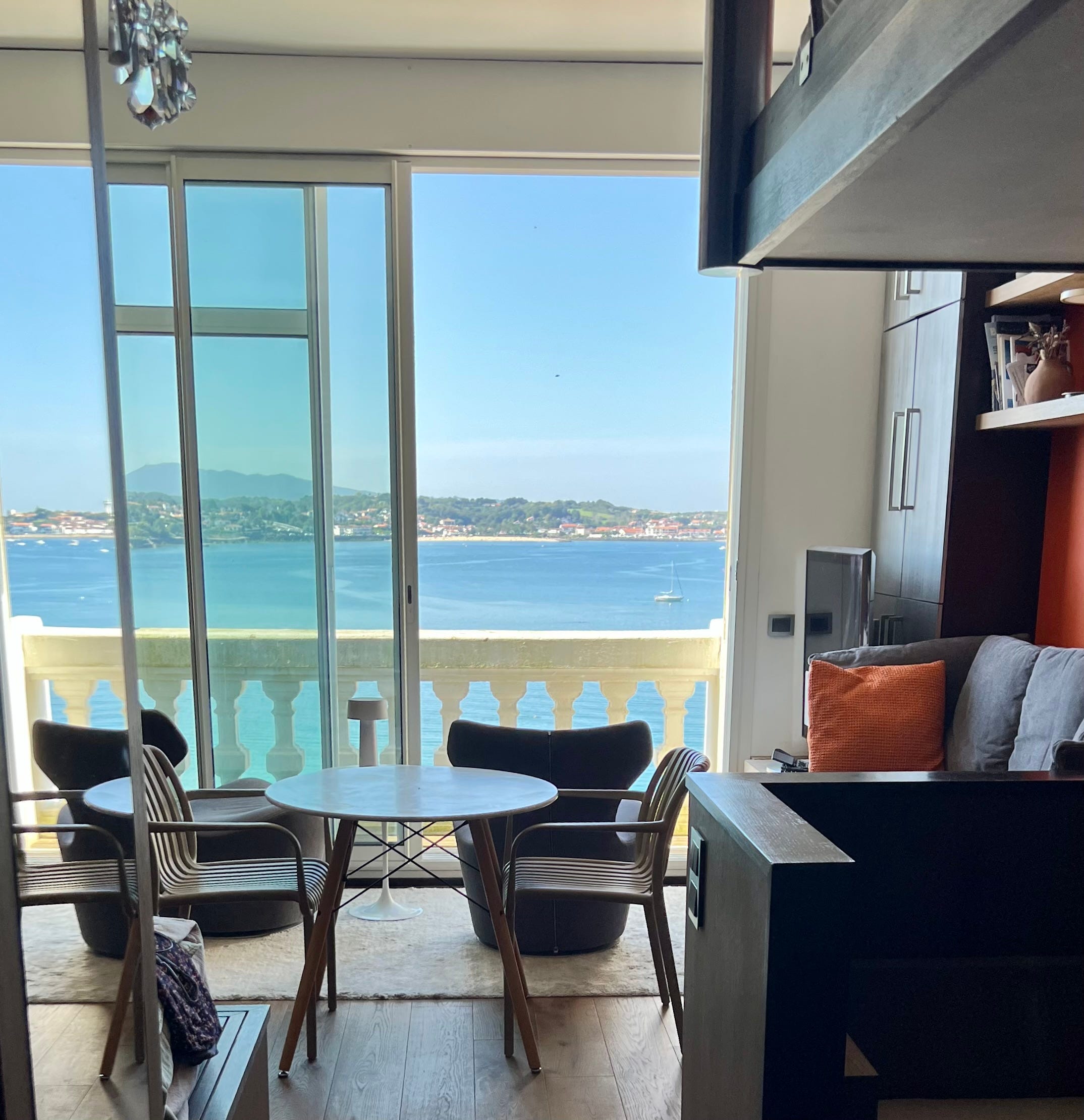
View from my window of my rental studio.

From Biarritz to Saint-Jean de Luz is a train ride of fifteen minutes. When I got off the train Sunday afternoon, it was as if I’d been there yesterday instead of early July. I wheeled my valise to my cute little studio rental navigating the streets by heart. The window in the studio overlooked the entire Baie de Saint Jean, with the three-hundred-meter beach. I was greeted with afternoon entertainment: a military flyover similar to the Blue Angels. A helicopter lifted off a stone pier and did somersaults in the air. A yellow and orange small two propeller plane that I probably should know the name of but don’t, flew up and back, upside down and rightside up, and sprayed water which I’m guessing is normally done on land for fires. The best part was six planes flying in formation. Two had tails of white stream, two with a red stream, and two with a blue stream behind them. They made hearts in the sky, they flew straight up and then down in the design of a harp. The sky looked as if a blue, red, and white waterfall was falling down into the sea below. The planes would break apart, three going one way, three another way, turn around and fly towards each other, zigging and zagging, creating fascinating designs. 

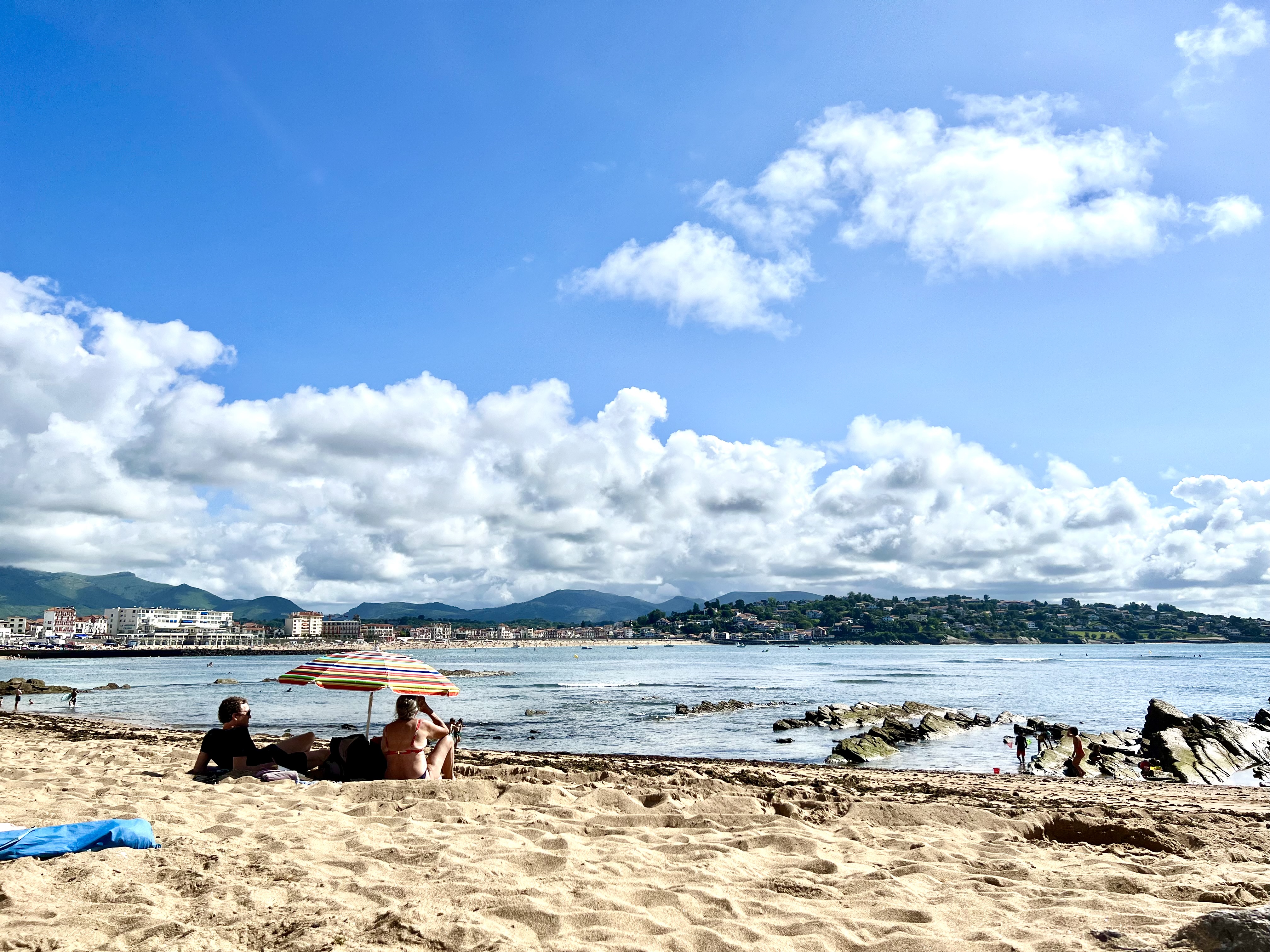
The beach which, at this time of year usually has a scattering of people, was packed. Everyone had come from miles around for the afternoon. They’d planted colorful umbrellas to get some shade on an afternoon that peaked at 80o/27o. Looking down from my window, I saw an enchanting montage of circles of every color in the rainbow. 

My anxieties that it “just wouldn’t be the same” because the sun set at 7:30 pm instead of 10:30 pm quickly disappated. It was different but just as good. The gazebo was quiet and many of the stores were closed for the season but there was plenty going on. Because of the weather, people were out and about. Women walked the promenade dressed in sundresses made for July and August. Men were in shorts and T-shirts. And, of course, there were dogs everywhere. Small dogs, large dogs, happy dogs, dogs swimming in the water, and dogs that watched suspiciously while their people went swimming. The water was warm. A group of older people swam from one end of the beach to the other every morning around 8 a.m. Being one of the first to plant my bare feet in sand was enough reason for me to get up early.

Walking the beach in the morning with swimmers already at it and typical Pays Basques house in Ciboure as my backdrop

Tuesday night, I went to investigate the one movie theatre: Le Select. Turns out to have five screens, a café, and an International Film Festival was finishing up on the evening of my arrival. I decided to see the new Woody Allen movie: Coup de Chance (Stroke of Luck). I hadn’t read any reviews except the beginning of one that said it was good, reminiscent of his movies of ten and twenty years ago. I should have read further. I assumed since it was Woody Allen,it would be in English with French subtitles. Ha! It was completely in French. Not dubbed. French actors speaking their own language. Does WA speak French? Woody Allen has lost all favor in the US. At the Cannes Film Festival this year, half of the audience stood up to clap for him. People followed him around for selfies. I understood three-quarters of it which made me proud. And I enjoyed it. I would like to see it again with English subtitles. To read a review, click here

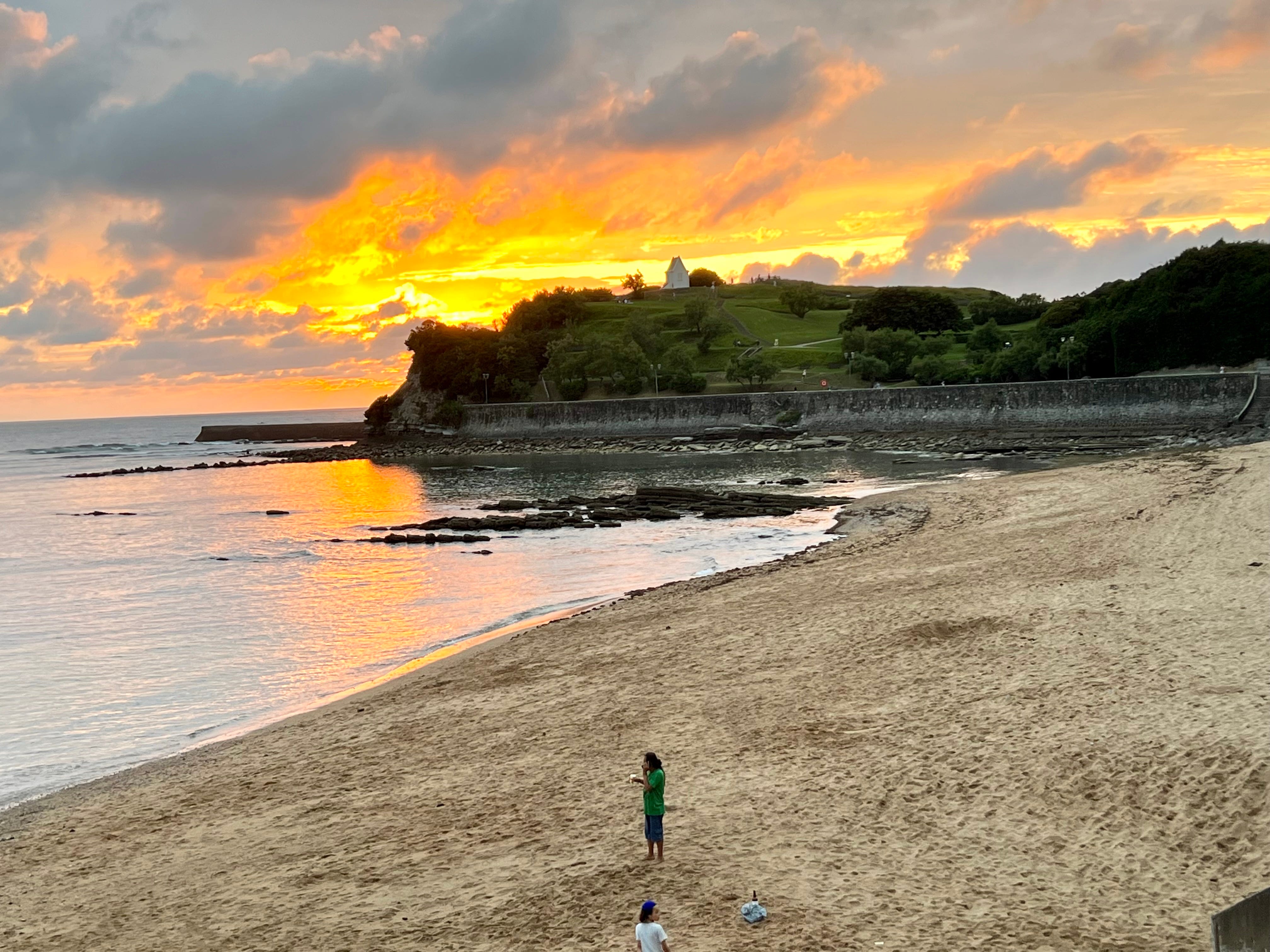
Final sunset until next summer (or not if I’m lucky!)

This is not the end. Just a pause until my next visit to Saint-Jean de Luz, as lovely a spot on earth as I can imagine.

A bientôt,

Sara
Thanks for reading Out My Window! Subscribe for free to receive new posts and support my work.

Saint Jean de Luz, Pays Basque

I watched the sun slowly fall into the ocean, her long orange reflection on the silvery blue water pulling back until there was no more orange disc, only a horizon of pinks, purples, and deep blues scattered like toffs of cotton candy over the darkening orange sky.

Sunset behind Saint Barb

Every evening was similar in Saint Jean de Luz, a small fishing village in the southwest of France, ten miles from the Spanish border. We had come on vacation for two weeks and been given perfect weather. It was the beginning of July. School vacations had not yet started in France so, though the boardwalk and beaches had plenty of people, it was still easy to navigate one’s way from one end of the boardwalk to the other. The dense crowds would arrive starting Quattorze Juillet.

The bay of Saint Jean de Luz with the Pyrénées in the background

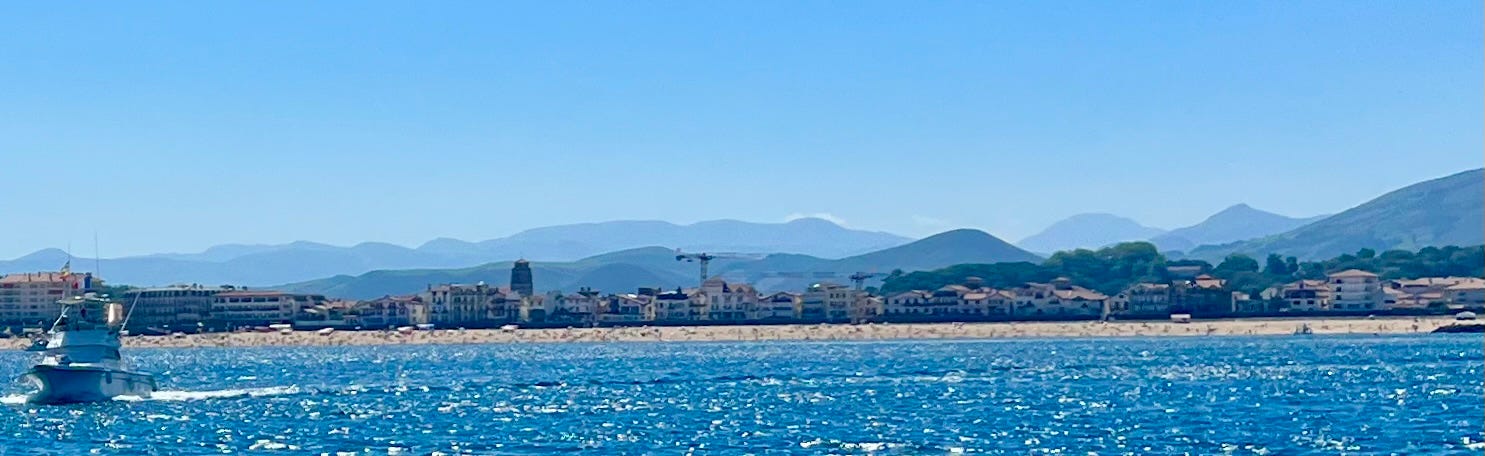
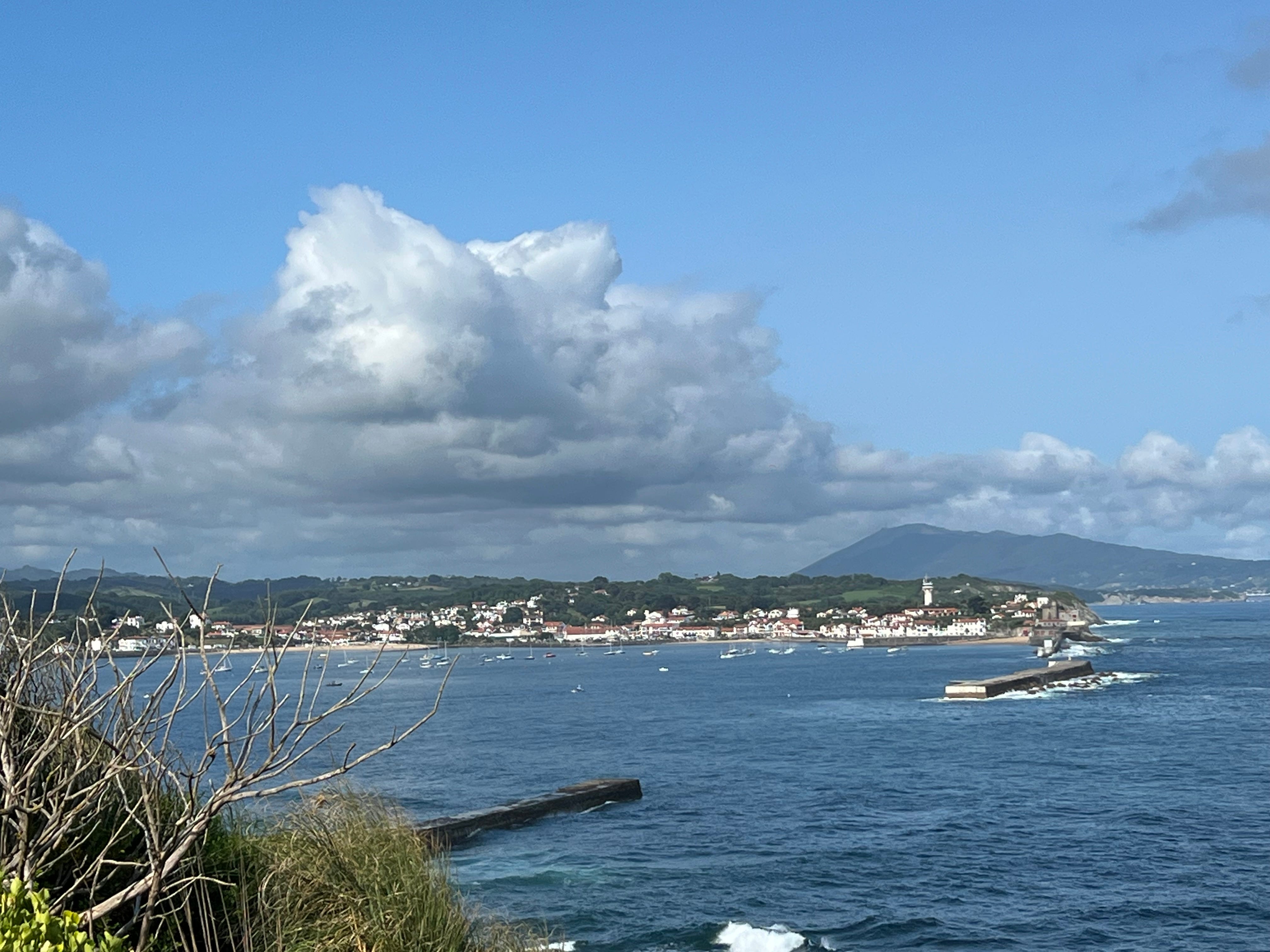
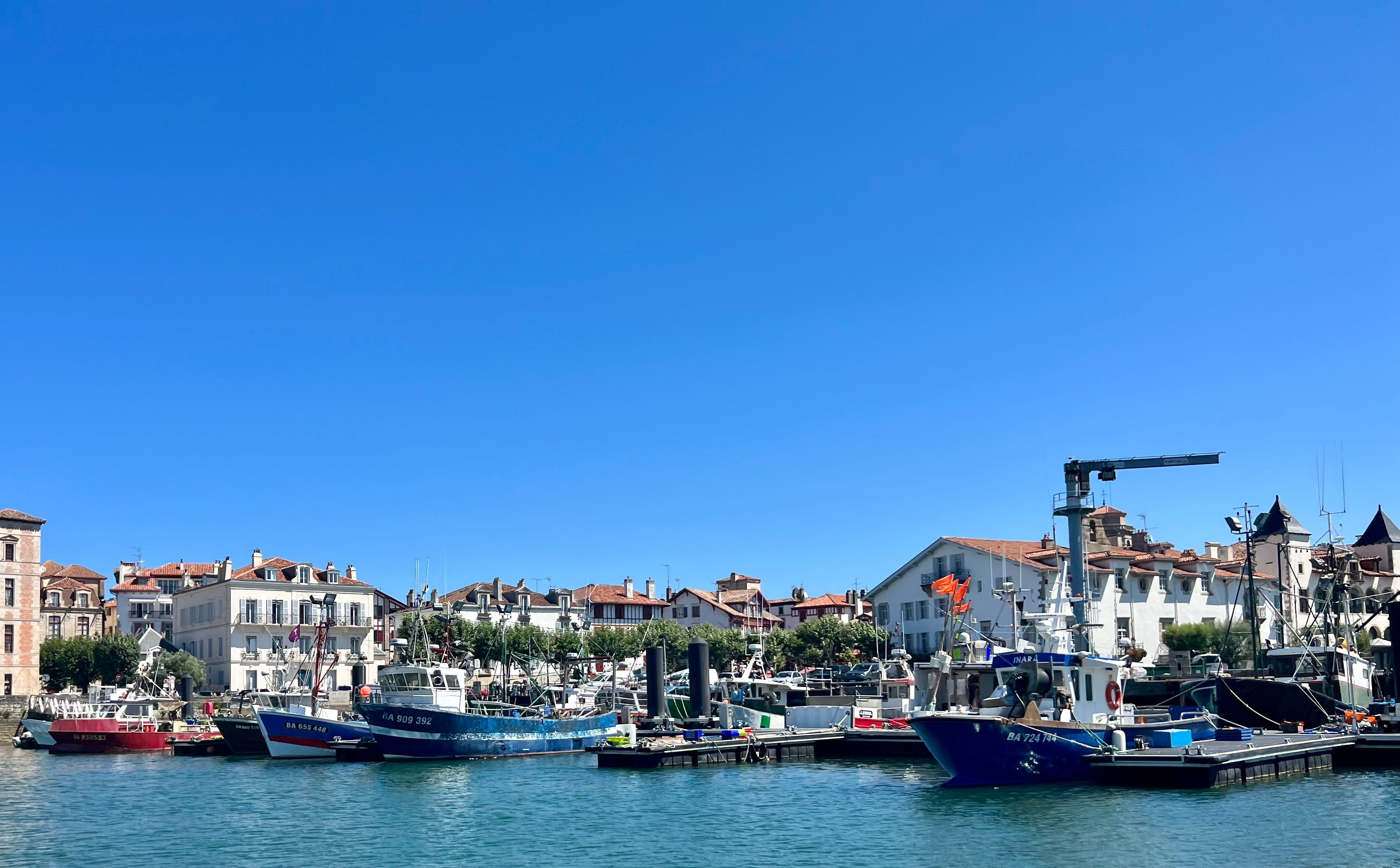
To some, Saint Jean de Luz is a resort beach town not just a fishing village. The Pyrénées is a majestic blue-grey backdrop that is a constant reminder of the geography between France and Spain. Sea walls have been built at the mouth of the Baie of Saint Jean to protect the town from the devastating floods that have wiped out the entire place several times. The Baie is a large U with one tip being the Chapel of Saint Barb situated on a cliff that is the beginning of the twenty-five-mile trail that goes north in the direction of Biarritz. The other tip is the small town of Socoa with its ancient fort and the route that takes one to Hendaye and then into Spain. The bottom of the U is La Pergola, a casino and boardwalk, built in the 1920s. Behind the boardwalk is the central village with its many boutiques, and the Port of Saint Jean where the fisherman board boats to fish for tuna, trout, and mackerel at one or two o’clock every morning, returning around 4 am with fresh fish for me to buy at Les Halles, the covered market in the center of the Port Area.

View of the bay from Saint Barb, Socoa is at the far end of the Bay

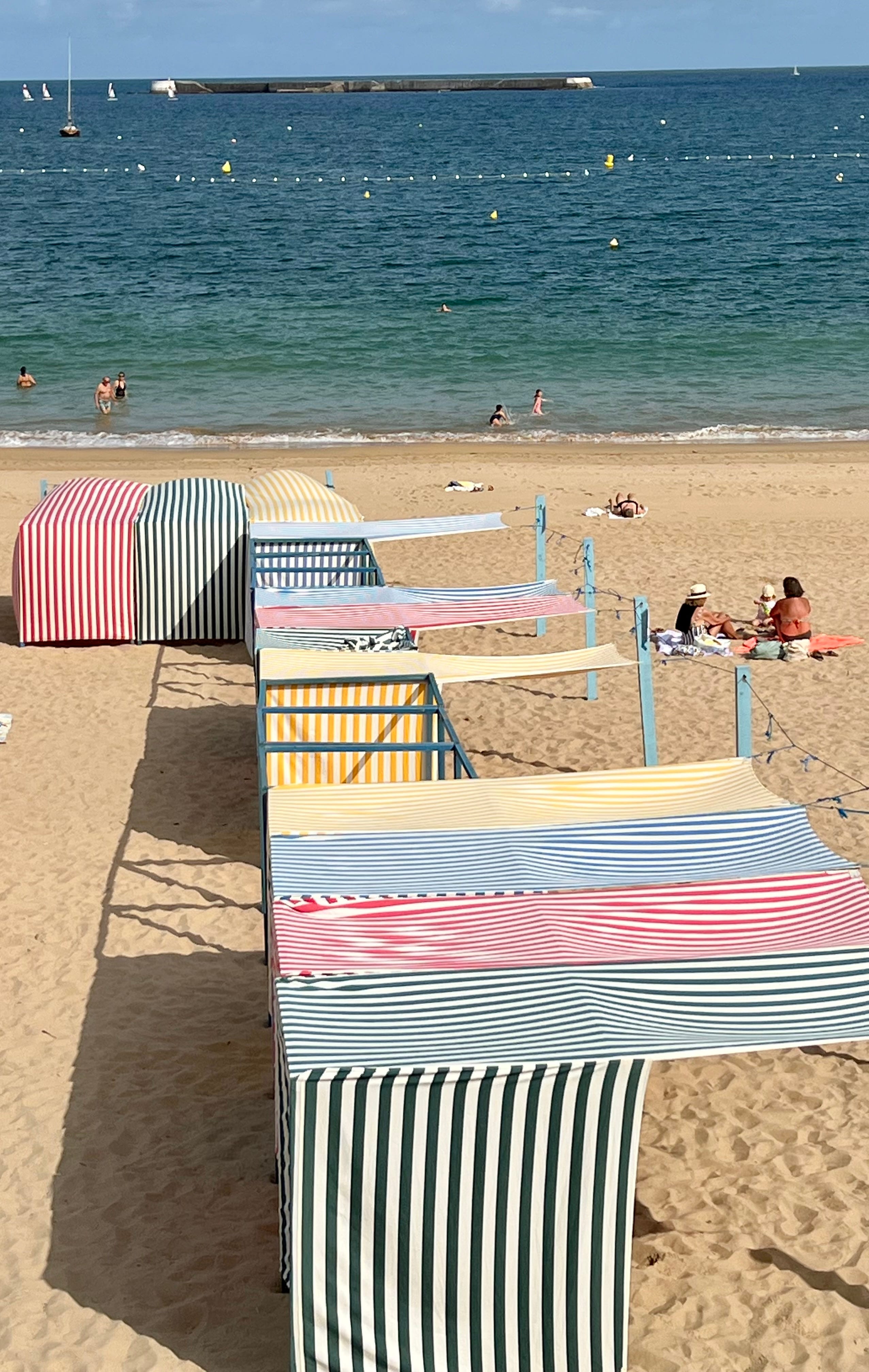
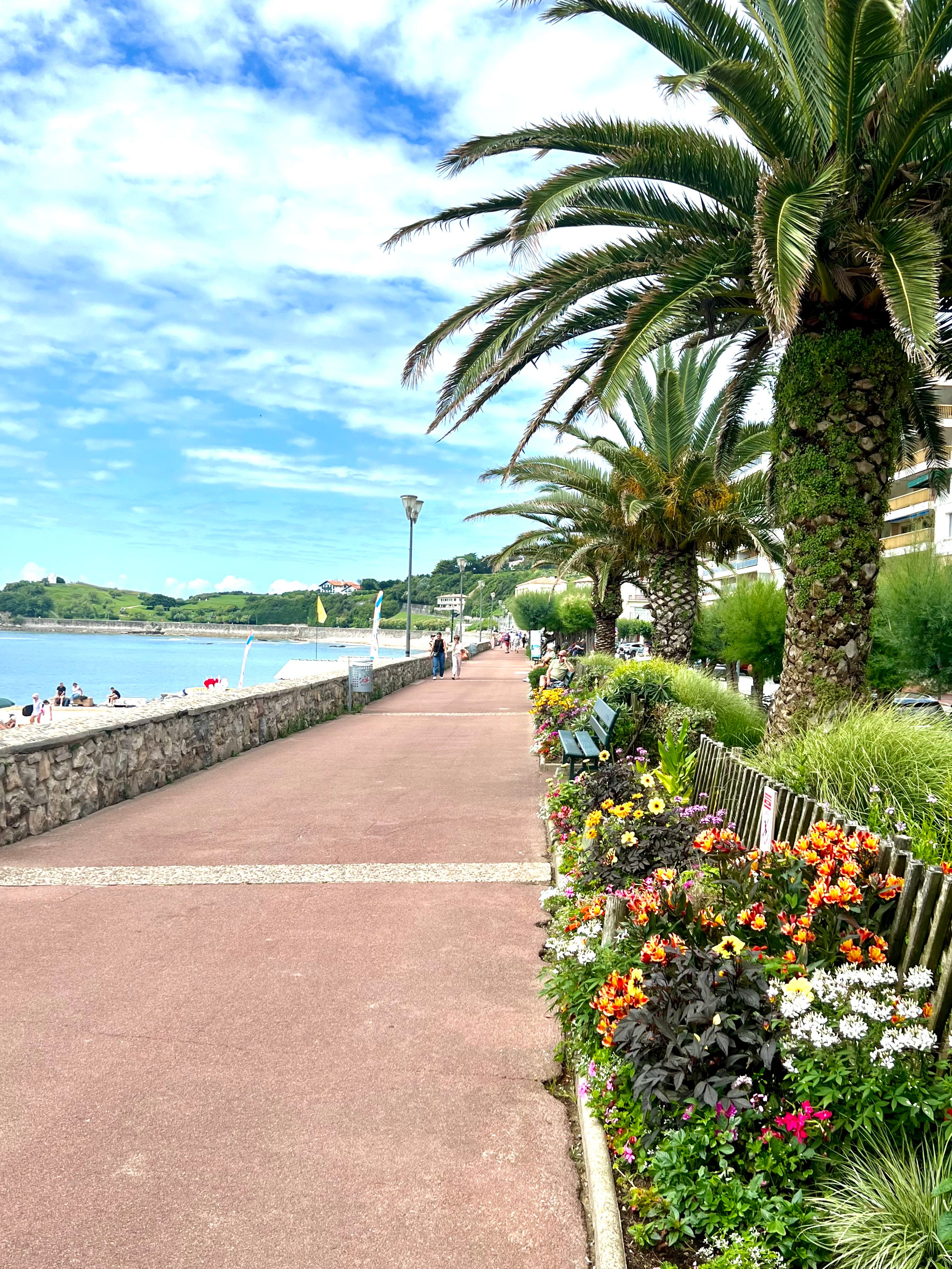
Every morning, my friend, Fatiha, and I, either together or separately, walked from our rented apartment, up to the Sentier (the cliff trail), turned left toward Saint Barb, and then were greeted by the vast expanse of the Atlantic Ocean. For an American, raised with the certainty that the Atlantic ocean was and always would be the East Coast, each time I saw the ocean, I would shake my head to remember that this is the same Atlantic Ocean, the same body of water, that washes up on Massachusetts and New York. We’d follow a new path, with the ocean on our right, and the beaches below us, that made its way down the pristine grass of Saint Barb until we found ourselves on the far end of the promenade. We’d head towards La Pergola, watching the beach boys setting up the little “rooms” that people could rent to get out of the sun and rest in a lounge chair. At La Pergola, we’d turn right and wander the boardwalk full of touristy attractions, selling striped marine T-shirts, linen dresses and pants, and espadrilles, the shoes that the farmers wear daily whether in the field or climbing in the Pyrenees. We’d eventually reach the end of the beach and the end of the boardwalk, walk down some stairs, and turning backward, walk past the Port harbor with her colorful boats. We’d arrive at Les Halles.

Places people can rent to escape the sun.

Tuesdays and Saturdays (and Sundays during July and August) an outdoor marché surrounds Les Halles on all sides. There is an abundance of fruit and vegetables. Cheese made from goat’s milk is sold everywhere and to get cow’s milk cheese, one has to go inside the covered market. Each morning, we left with fresh fish for our dinner and an accompanying veggie to cook, and all our salad makings. 

Beach

Then we’d make our way to rue Gambetta, the pedestrian street that goes south to north and has boutiques on each side as far as one can see. Another favorite for the tourist, me! is the colorful linens in the stripes of Pays Basque colors. Table cloths, napkins, washcloths, towels, cooking gloves, place settings, and bed linens. It’s a plethora of greens and reds and cream colors. I found it all so beautiful, I wanted to take everything home with me.

Port of Saint Jean de Luz

At the end of Gambetta, we found ourselves at the intersection with Boulevard Thiers. We would normally turn left there to head home. However, if we walked straight, crossing Thiers, we’d come to Monoprix and Carrefour. Carrefour has everything you can’t get at the Marché. And the Monoprix?…. Well, it happened to be the summer sales in France and Monoprix has some of the best clothes at the best prices, especially during the sales. It was irresistible not to go in there every couple of days and see what new things had been put on sale. I had to purchase a new over-the-shoulder bag to get all my purchases home to Paris!

Fatiha and I did this walk two or three times a day. For Fatiha, it included an afternoon at the beach, pulling out her blanket made of straw, a cloth to go on top, her earphones, and music on her iphone. I usually joined her for an hour or two. When the tide was out, we would splash around in the saltwater, swimming out towards the seawalls but always able to put our feet on the bottom. I spent my afternoons on schoolwork in the apartment. In the evening, I loved to walk down to the port where there was music from 9:30pm to 11:30pm in the large Rotonda. Everyone came out. Kids bought bags of confetti, threw it up in the air, and danced. They threw it on strangers’ heads who usually laughed. Couples danced old 50s swing to the music. Every night was something different. My favorite evening was a group playing Bob Dylan songs. I felt as if I was 25 years old and danced as I would have at a concert long ago. It all came back so easily. I thanked the lead singer who turned about to be British and lived in France, so he could sing the songs in English and in French. 

Saint Jean at night

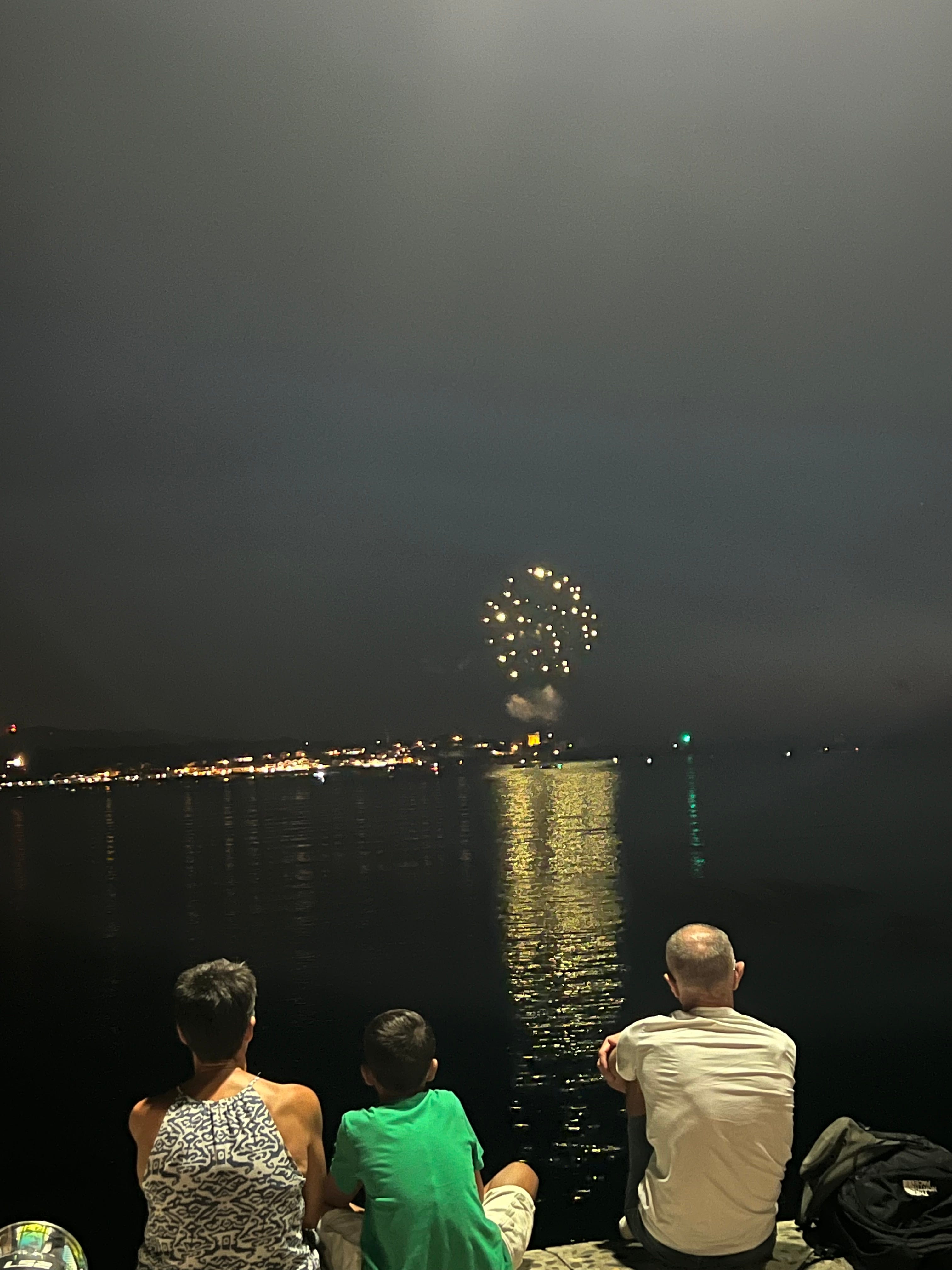
We were there for Quattorze Juillet. It didn’t get dark till late and fireworks wouldn’t start until 11 pm. So we walked, taking photos of the clouds reflecting all the colors of the sunset, and found places to sit on a wall of the Promenade. Promptly at 11 pm, fireworks started shooting skyward above Socoa. We were too far away to appreciate them. Then at 11:15 pm, the fireworks started at Saint Barb. We were right under them. It was a spectacular show—not the Eiffel Tower show that I got to watch last year—but here I was in a sun dress, sitting on a wall with hundreds of other people. We had just witnessed yet another stunning sunset, the air warm, the laughter all around me (I never once heard a harsh word coming from anyone the entire time I was there), watching fireworks that hissed and sizzled and sighed and popped in all the Pays Basque colors and I thought “It doesn’t get better than this.”

Fireworks from Socoa
Fireworks from Saint Barb

We were in Saint Jean de Luz for two weeks. It passed in a flash. This small fishing village is fifteen minutes south of Biarritz. Biarritz has bling, glamour, very expensive hotels and restaurants and attracts the wealthiest of the rich. Saint Jean is simple. I didn’t see any glitz, nothing flashy. Even the popular brand stores were not there. Every person we met was friendly and helpful if help was needed. 

Promenade along the beach. Saint Barb in the distance on the left.

Ah if only summer would last and last.

Thanks for reading Out My Window! Subscribe for free to receive new posts and support my work.

A bientôt,

Sara
Paris..1..2..3

Today, I want to show you photos I’ve taken over the past couple of weeks, tell you some of the highlights of coming events in Paris, and for those of you traveling to Paris and France, how to find out about any strikes involving airports and trains.

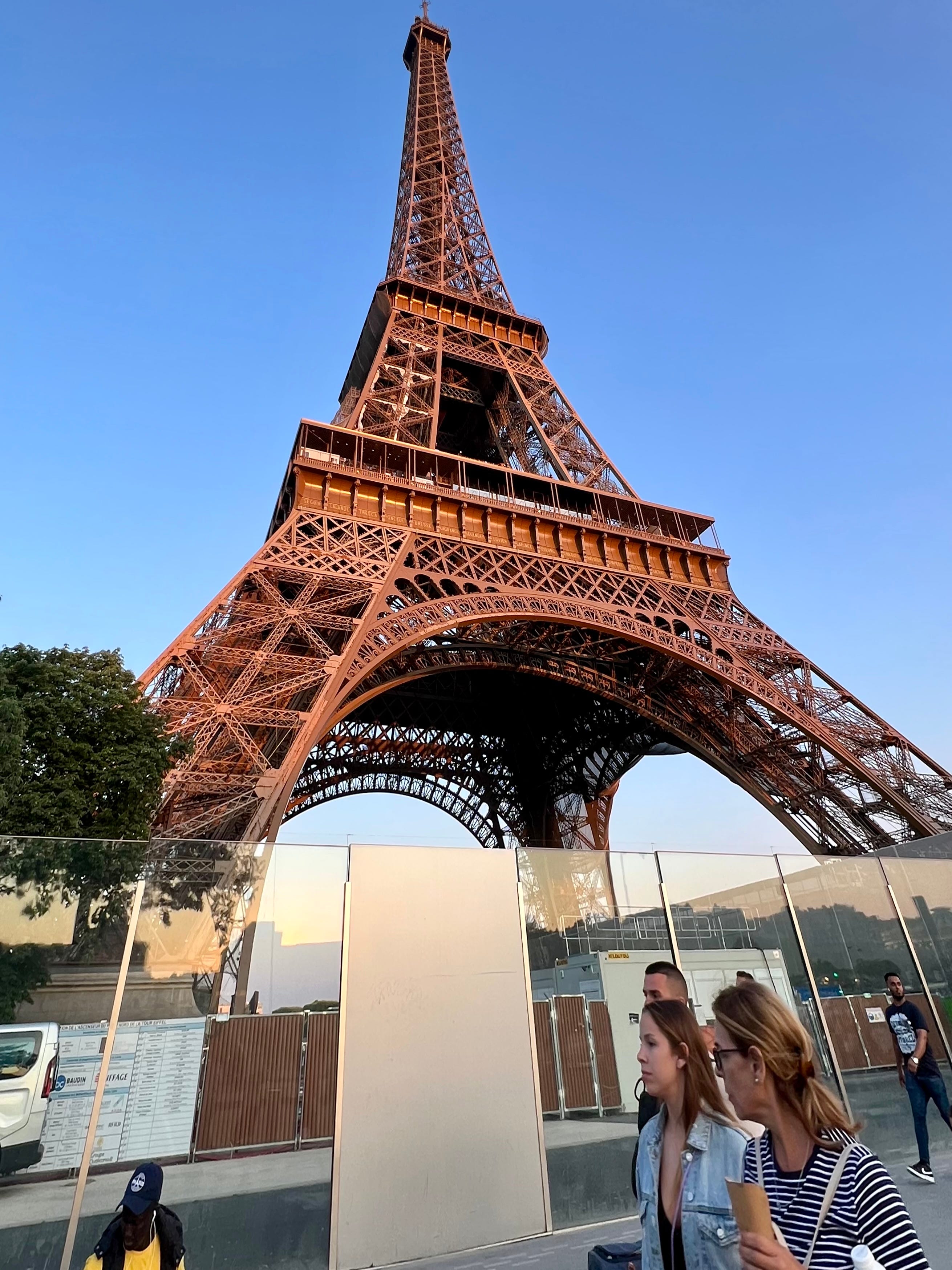
Eiffel Tower in the setting sun

1—For three weeks, we have had glorious weather: anywhere between 75o to 84o. Yes, that’s hot, but it’s not canicule (heatwave) weather. Most homes and apartments in Paris do not have air conditioning. We buy up all the fans during the winter and have them going all summer! Most apartments also have window and door shutters that can be closed during the highest temperatures of the day. That brilliant invention keeps the room dark and cool. In California, where I am from, the temperature climbs until about 2/2:30 pm when it reaches its peak. Then comes down and, before climate change got so bad, evenings in Northern California were cool. Mark Twain famously said: “The coldest winter I’ve ever spent was a summer in San Francisco.” That’s about right. I always envied people who lived in places where they could eat outdoors and stay long into the evening and not have to put on a coat or sweater. Now, one of those people is me!

Walking home Saturday evening

Here in France, the mornings are cool. The temperature climbs and reaches its peak around 6 pm, staying there for awhile, then slowly goes back down.  Unless there is a thunder storm ahead. Summer evenings in France are heavenly. So many of the districts have music festivals all summer long and one can lie in the grass, with a picnic dinner, and just enjoy!

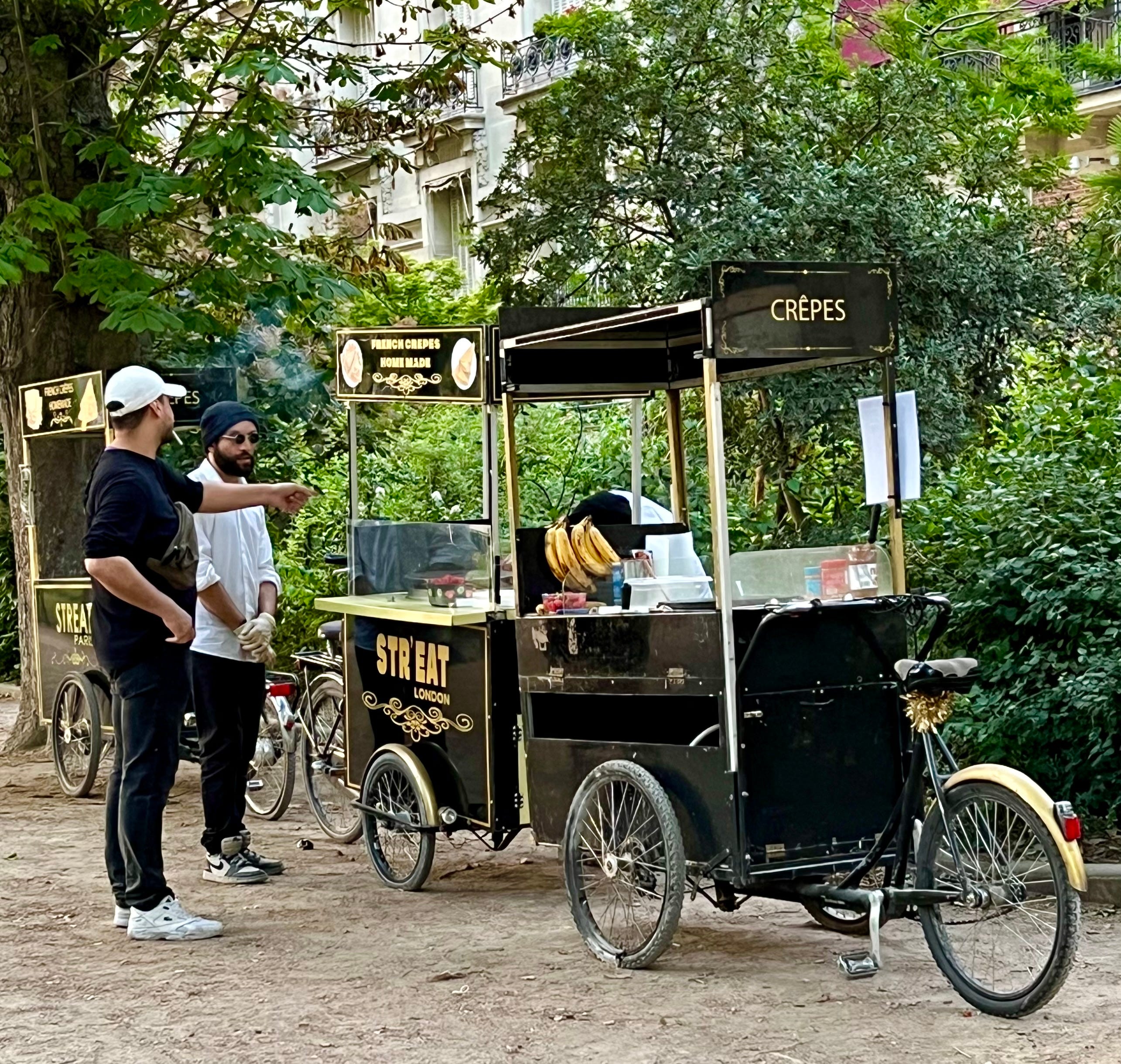
US has pop-up food vans, Paris has Crepes by Bicycle

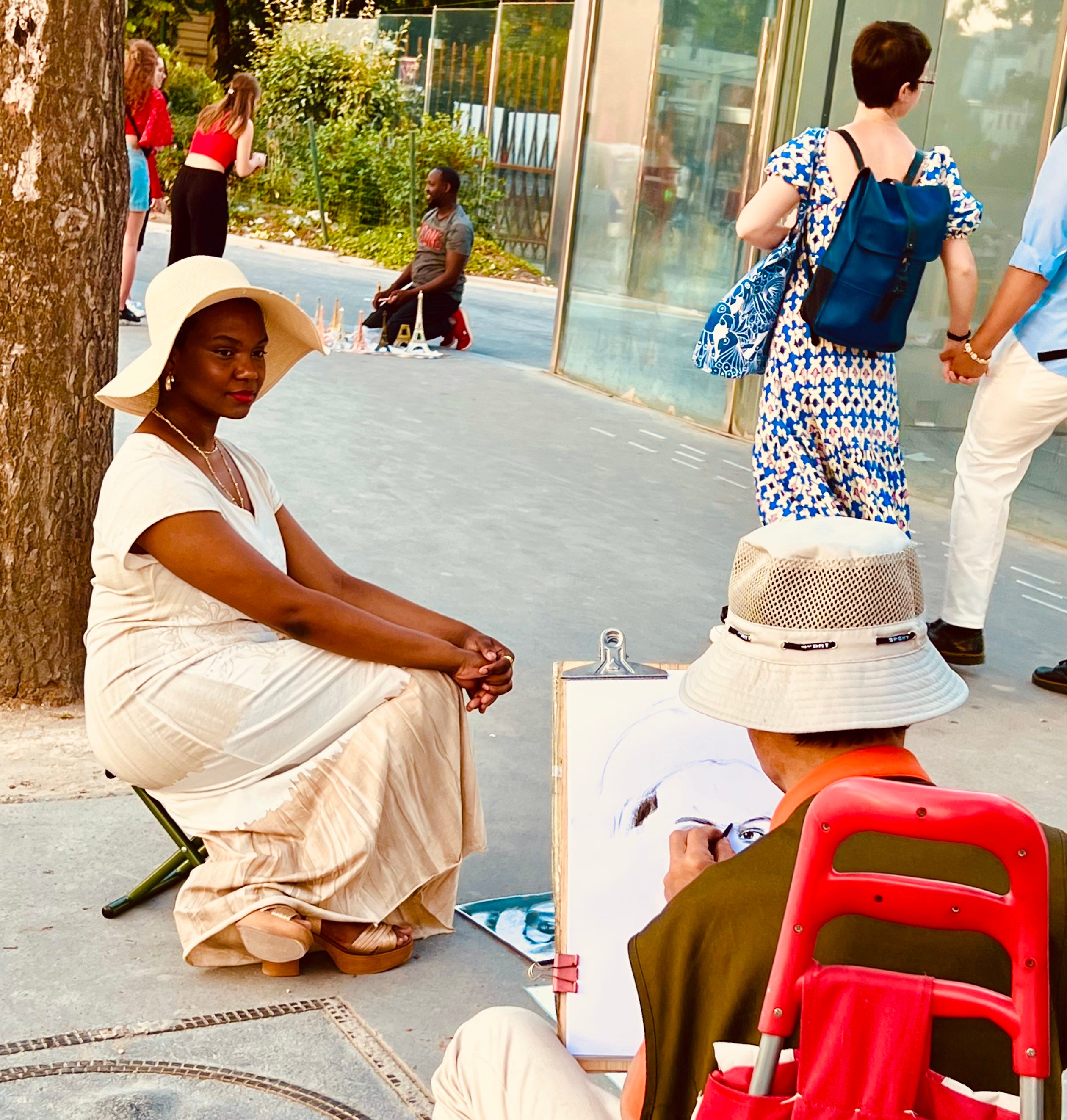
One of the thousands of artists who will draw your facial image. They are usually pretty good.

Saturday, Paris had a surprise thunder storm. I was with a friend and we were going out. She told me to bring my umbrella and a collapsable raincoat I could stick in my backpack. I checked my iPhone which said ‘no rain’. To appease her, I grabbed my umbrella. We got on the metro #9 and got off at Alma-Marceau. We could barely get past all the people huddled in the walkways leading to the exists. It was raining. No. It was pouring. We climbed the stairs, opened our umbrellas, and within a minute, both of us were soaked completely-head to toe. Umbrellas basically non-functional as the wind blew them the wrong way. I ran back down into the station and she followed me. After about 8 minutes when it didn’t look like it would slow down, I told her I was going to take a bus. We had planned on walking because it is such a short distance. Lucky me, I got to the #63 bus stop and the bus was there!!! She walked. Can I defend myself by saying she is a decade younger and walking in the rain is still fun?! This morning, the news said the winds were so high, the rains so bad, that trees were blown over, the coastal town of Dieppe flooded, and there was much damage. There are still storm warnings out. My iPhone now says: “moderate thunderstorm warning until 00.00 Wednesday, June 21.

2—My iPhone (with the untrustworthy weather predictions) says that there will not be rain on Wednesday. No sun either. Cloudy and warm. Wednesday is La nuit de la Musique. All over Paris, street musicians will be out playing till midnight, some arrondissements are planning actual concerts. All public and private venues will be open and are free. My arrondissement is doing something in-between. There is one concert in the chapel of a church, another at Place Jean Lorrain in front of the Monoprix which will have music and story telling, and near the street of Rue d’Auteuil—African musique by students of the Francis Poulenc Conservatory and more, much more.

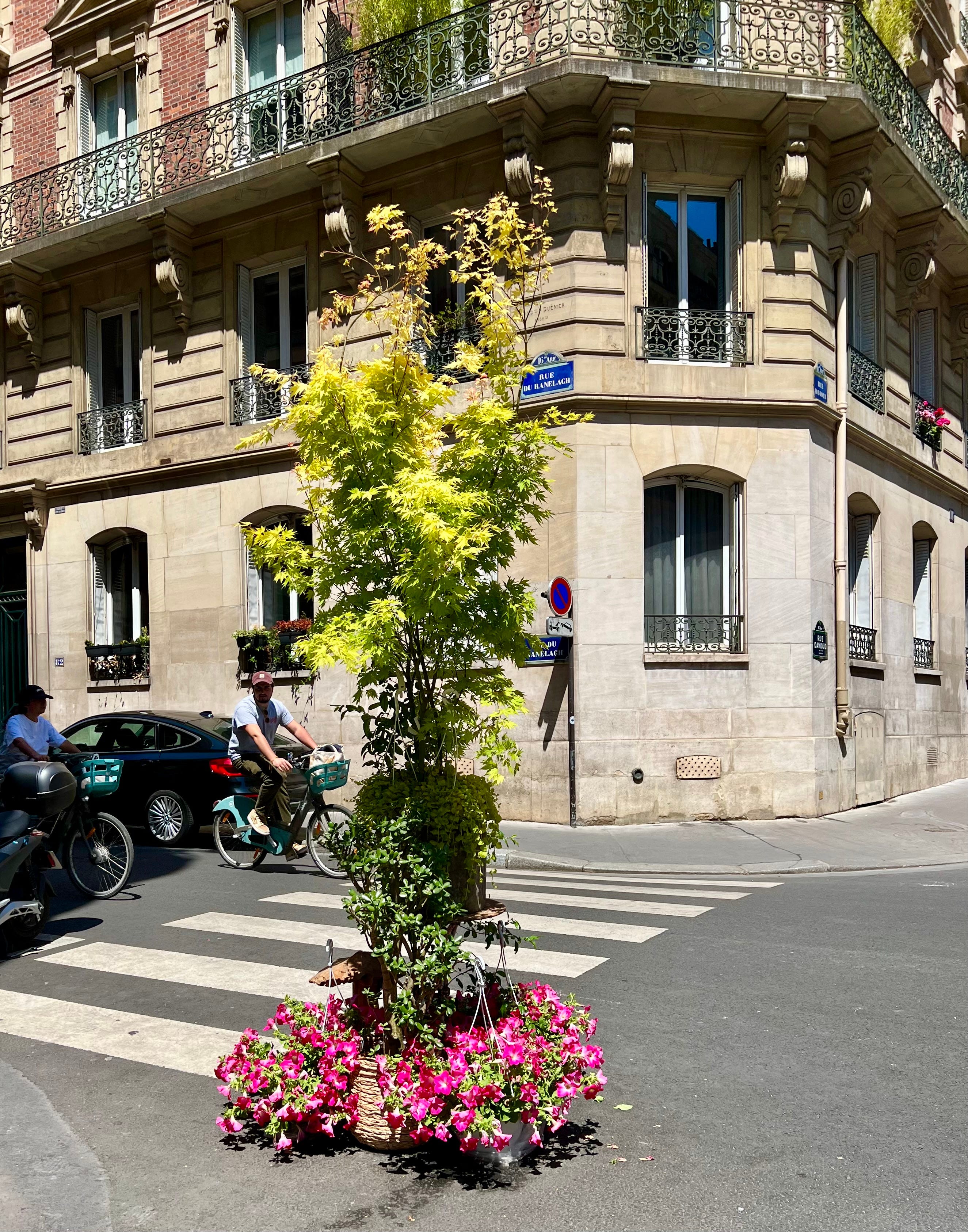
On rue de Ranelagh, a flower store put this up in the middle of the street!

June 21st is also the first day of summer. Parisians and tourists alike are happy. School vacations aren’t far away. A large percentage of Paris leaves for the summer. August is so quiet that about 50% of stores, that aren’t in the very center of Paris, close for the month. So, there is dancing in the street, big smiles everywhere, and a fleeting sense that all is good in the world. Oh those precious moments when we can forget.  La Nuit de la Musique started in Paris, quickly spread thoughout France, then to Europe, and I’m told is celebrated in most countries in the world.

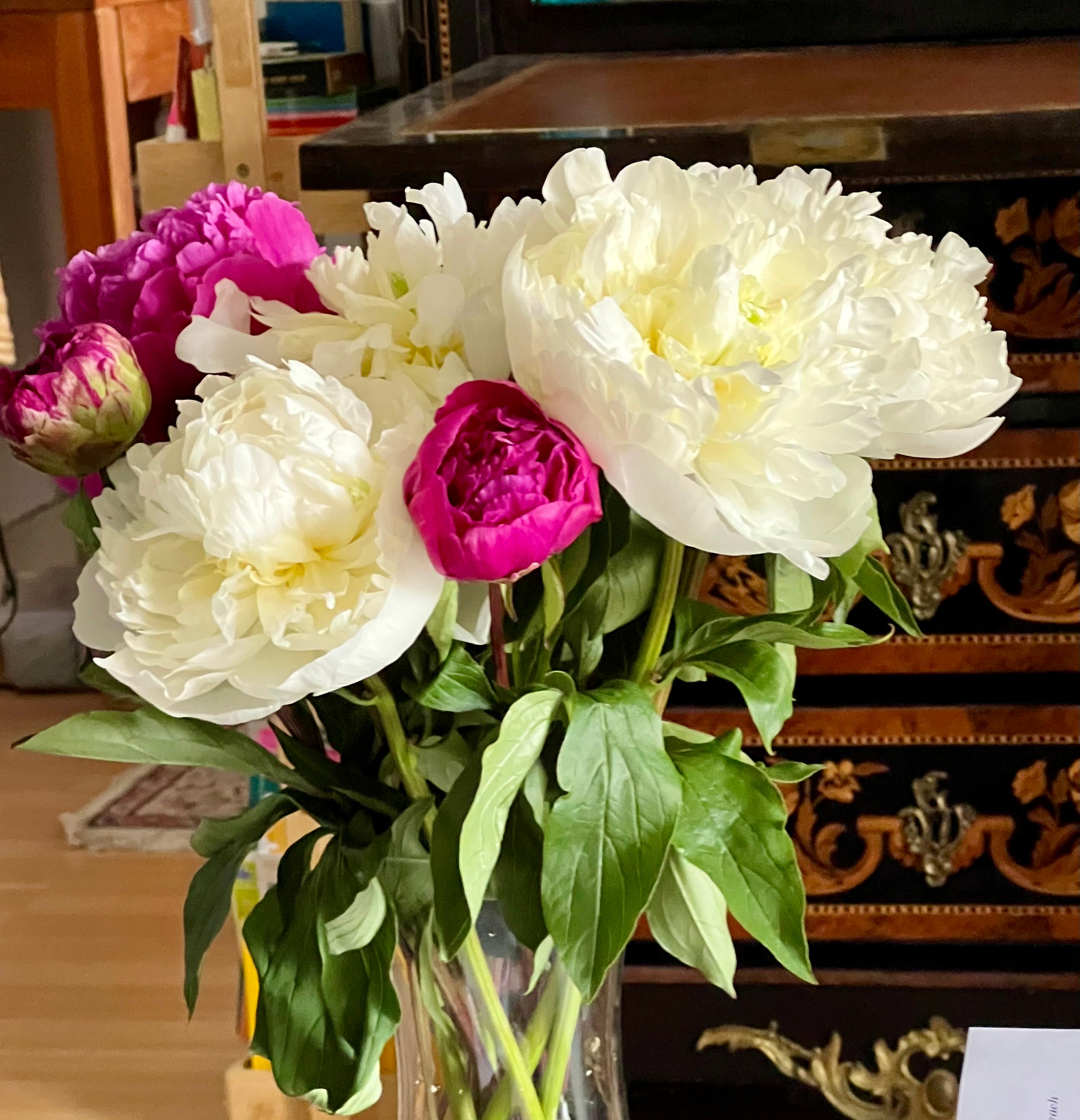
I’ve fallen in love with peonies over here—-but the seasong is far too short.

3—If you are traveling to France this summer, keep an eye out for possible transport strikes. One source to read is Euronews.travel or thelocal.fr. No strikes have been announced for France by the French. But…“travellers to and from France from the UK should be aware of the security staff strikes at Heathrow Airport which will affect British Airlines flights to Paris, Toulouse, Nice, and Mulhouse airports on some dates. There is also potential for a strike at Edinburgh Airport, which could affect flights to France run by several airlines, including Air France.”—TheLocal.fr

I will not be writing this blog on a regular schedule from now until the beginning of September. Just thought I’d give you a heads up. I’m not sick or playing hookey just trying to enjoy as much of the summer weather as I can. Thanks for reading this newsletter. It means a lot.

A bientöt,

Sara

Thanks for reading Out My Window! Subscribe for free to receive new posts and support my work.

Spring Training, Arizona

After being mostly housebound and sick for about 5 weeks, suffering in the coldest and wettest Bay Area winter in a long time, I have made it to Scottsdale, Arizona. I am staying with two wonderful friends that I met in Paris! The sun is out and the temperature is pure heaven: 70o Saturday, 71o yesterday, and 72o today. I cannot remember when I last saw those numbers on the weather app of my phone.

I flew Southwest Airlines from Oakland Airport Saturday morning. Somehow I’ve lost my TSA pre-flight status and had to stand in line for 45 minutes to get through security. When you are in a line for that long a time, you eventually start talking to people around you. No one could figure out why the long line on a Saturday morning. It seemed to me to be too early for Spring Break but who knows. People who fly SWA more than I do said it was unusual. People behind me were going to miss their flight and I urged them to walk ahead as if they knew what they were doing and get to their gate. They felt a bit bad. I asked ‘Would you let someone in your position through?’ They said ‘yes, of course.’ So off they went. At that point, I thought I had plenty of time. As it turned out I didn’t, and I also had to cut in front of some people to make it to the gate. Ah, the joys of flying.

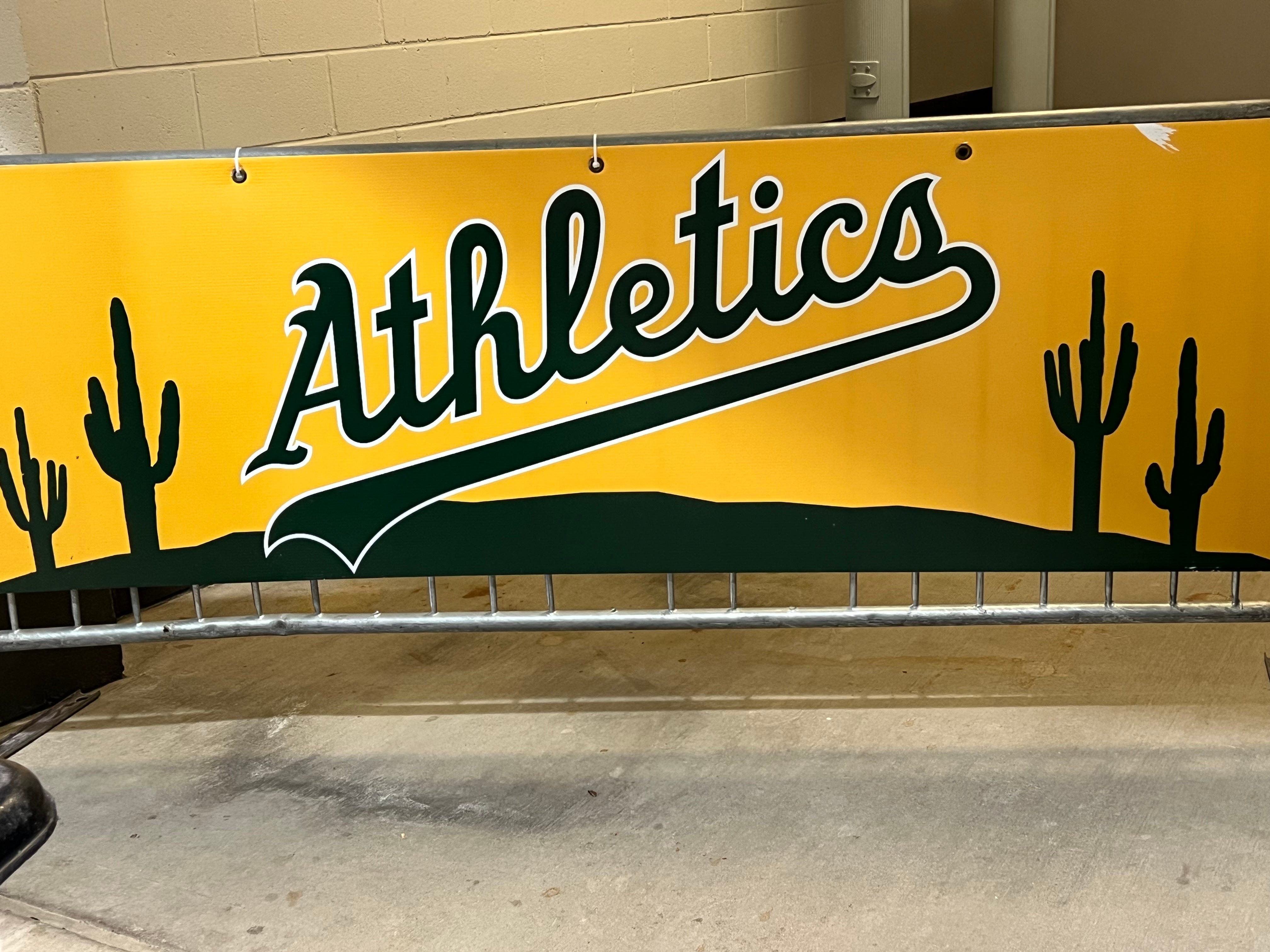
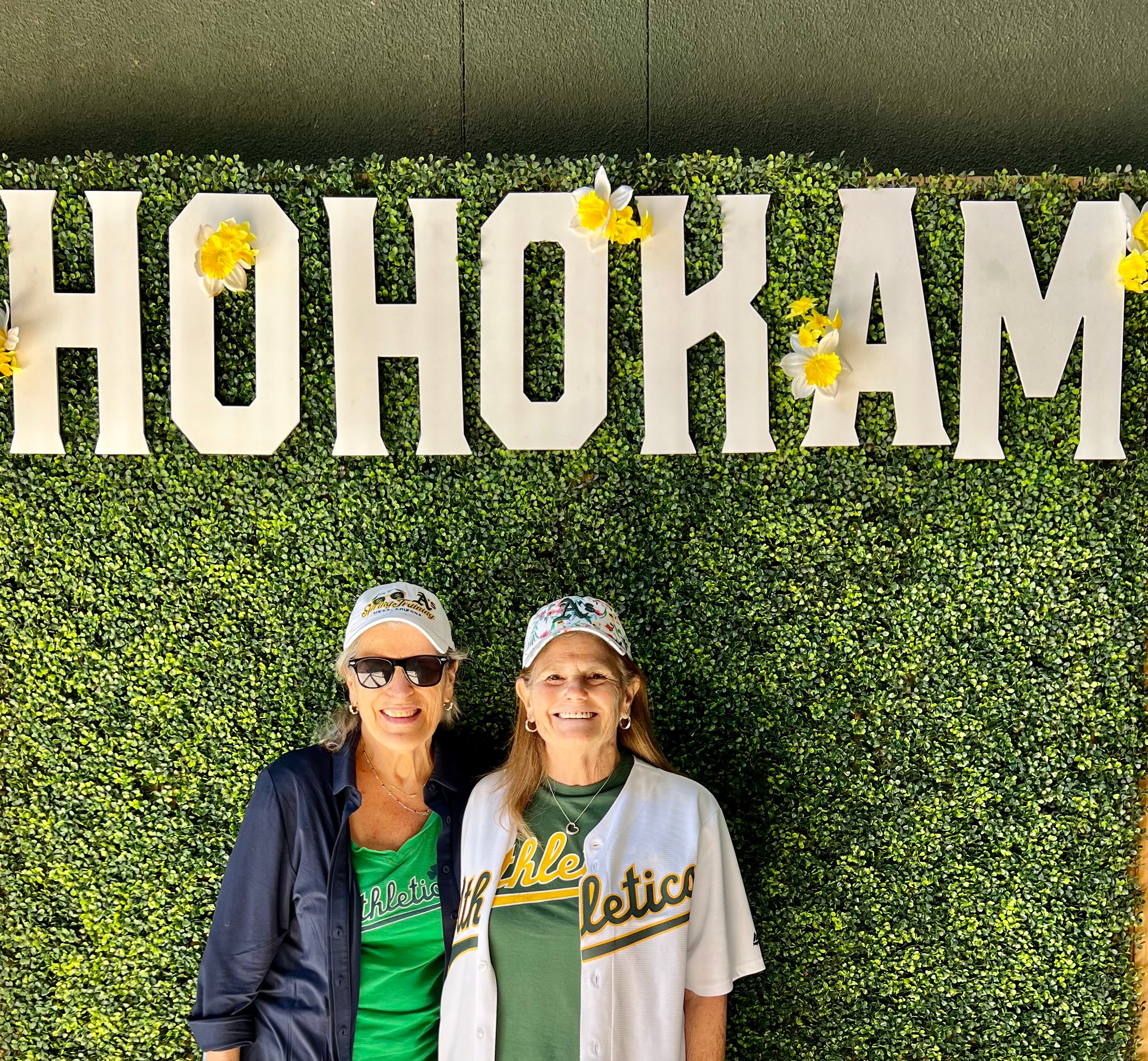
I was with two baseball buddies that I have known from pre-Paris years when I was a season ticket holder for the Oakland Athletics. In those days, my ‘baseball family’, made up of people who sat in similar sections at the Ballpark, would go down to Phoenix for 4 days, a week, sometimes 2 weeks. We’d see baseball in the sunshine, meet many of the players, hike in the hills around Phoenix and Scottsdale, and have a glorious time. In 2015, the Oakland A’s moved from their Phoenix home at Papago Park to Hohokam park in Mesa. The Chicago Cubs had played there for years and been the most sold-out ballpark during Spring Training. They built themselves a beautiful new ballpark up the road still in Mesa.

Sara and Jeanni

My friends and I landed in Phoenix, picked up their rental car, and drove to Hohokam. My first Spring Training game in nine years. In those days, I would have brought many baseballs and baseball paraphenalia that I hoped to have autographed by the players. As I sat down in my seat, I looked over at the autograph seekers and couldn’t remember why the urgency to get the autographs. From my spot in section 107, it seemed too much energy to get up and fight my way to the front of a small crowd of people that included children, to get an autograph. Maybe I’d grown up a bit and was going to leave that stuff to the children. It was fun I must admit.

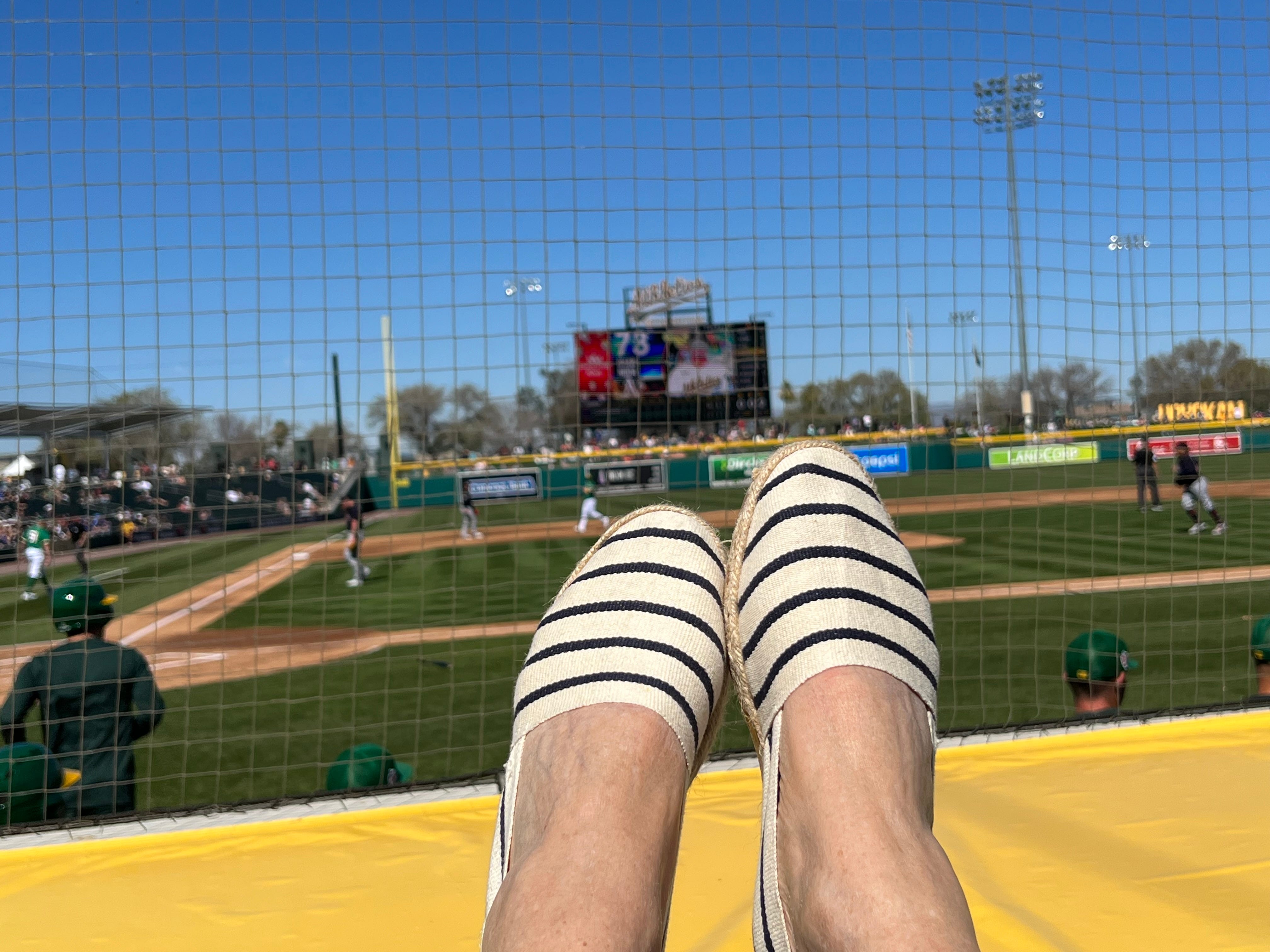
Stretching out at Spring Training

That game was my chance to watch the new rules that MLB has regulated for the majors so that the game will go faster, more runs will be scored, and the hope that it will bring fans back to Baseball. I’m not sure why it hasn’t occured to them to lower prices and that might bring fans back. My Spring Training ticket cost $35. For a family of four to go to a regular season game, it would cost $200 or more for good seats and that is without buying any food. Baseball used to be America’s pasttime. According to The SportingNews Blog:  The Most popular Sports in the United States 

  • American Football – 74.5% American football takes the crown when it comes to popularity, and this is the most-watched sport in the US. …
  • Basketball- 56.6% …
  • Baseball- 50.5% …
  • Boxing- 23.4% …
  • Ice Hockey- 22.1% …
  • Soccer- 21.6% …
  • Golf- 19.7%

So back to the new rules.  The time clock. Just as in basketball, baseball now has a digital clock that players and fans can see that counts down the seconds that the pitcher holds the ball. He has 15 seconds to throw the ball if the bases are empty, 20 seconds if a player is on base. If he goes over that number, the batter is given a ball. If the batter takes longer than 15 seconds to get himself ready, he gets a strike. The game did seem to go faster. The first three innings were over in thirty minutes. Then it slowed down.

No more shift. At all times, two players have to be on either side of second base. This is so the batting team has a chance for more runs.

Bases are bigger. From 15’“ across, they are now 18” and they are lower to the ground.

Pick offs. If a pitcher doesn’t pick off the player on first base (or any base) on his third try, the player is awarded an extra base. Pitchers used to attempt pick offs to stall the game for whatever reason. No more.

These games were clearly spring training for the umpires as well as the ballplayers. I saw an ump go up to a brand new pitcher and check his ball for substances. I asked my seatmate why he would do that at ST game. The answer was that the umps are doing everything they will need to do at a regular season game.

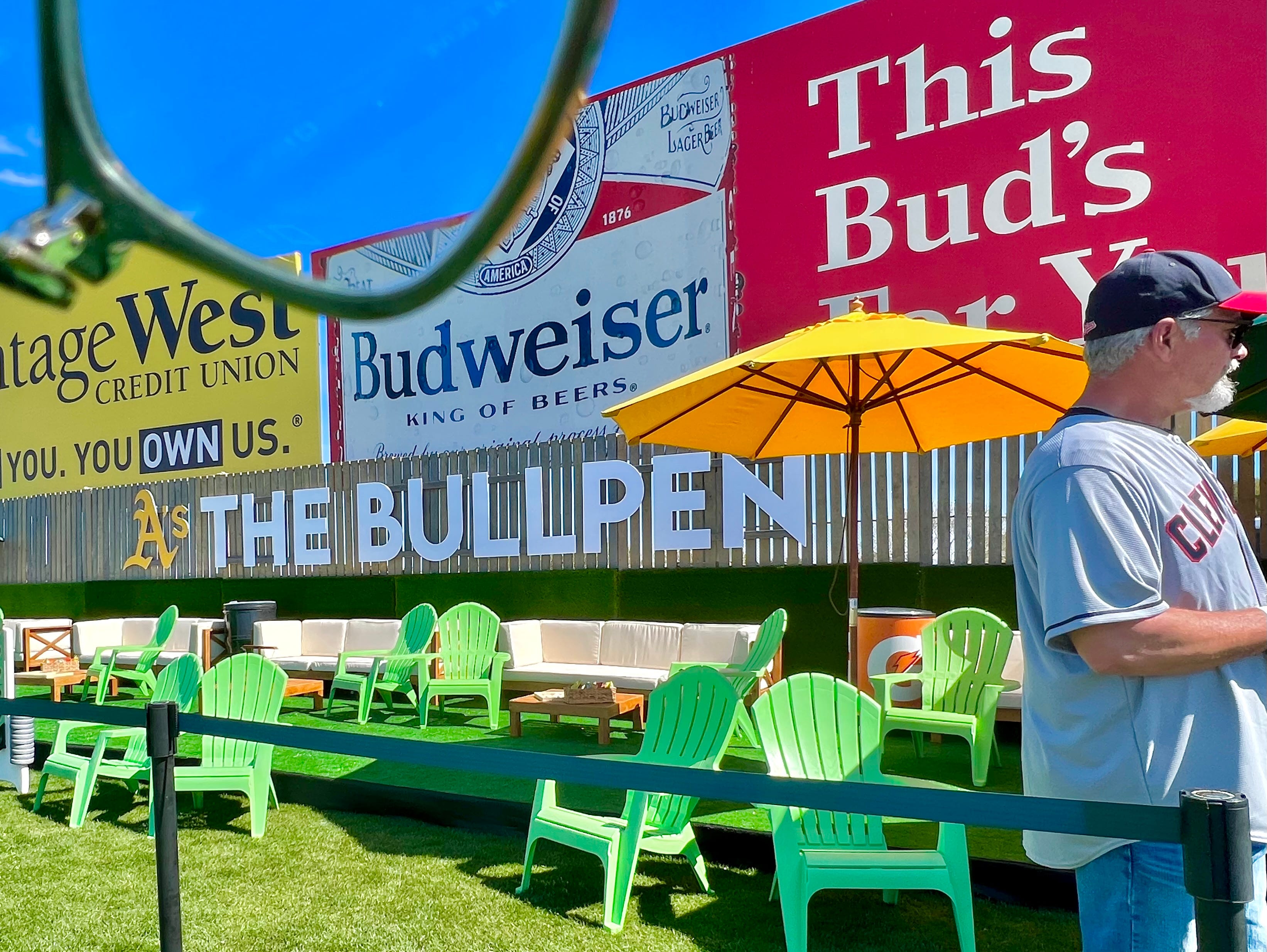
new seating area in the grassy area behind the outfield at Hohokam.

The game tied at 4-4 at the bottom of the ninth. Game over. Spring Training knows how to keep games shorter! What heaven sitting in sunshine for almost three hours. But being the first sun of the year for me, it was hard on my skin. I started itching and scratching. I had to wear a long sleeve blouse but still…..Sun and baseball!

A bientôt,

Sara
Happy New Year — from Oakland, Ca.

On December 29, 2022, I flew from Charles de Gaulle airport to San Francisco airport-a trip of 11.5 hours. When adding in getting to CDG, checking in and then waiting, arriving in SF, and getting myself from there to my home in Oakland, and, for fun, throwing in crossing nine time zones, it is a very long day. Sleep on airplanes is hit or miss. So give or take a few hours of snoozing, someone traveling from Paris to Oakland is usually awake for twenty-four hours. Wisdom on how to deal with jet lag suggests to try and adapt to your destination time zone as quickly as possible. I stayed awake until 8 pm PT which was 5 am the next day in Paris. Exactly 24 hours.

I’m not a fan of cold winters. Not in Paris, not anywhere. I had hoped that by being in Oakland for the winter, I might escape COLD. I was greeted by a huge storm over New Year’s weekend. Raining cats and dogs and very cold weather. It was warmer in Paris. Then on Wednesday, California went into a state of emergency as expectations grew of a ‘bomb cyclone’ hitting the Bay Area and other areas up and down California. There was flooding in the streets as storm drains that hadn’t had much use in these severe drought years were not able to cope with the amount of water falling torrentially from the sky. Winds reached 40-50 miles an hour blowing trees around. Unused to this kind of weather, people kept driving and were not preparing their homes for possible emergencies. I’m not sure of the total number of deaths but there were at least four drownings, and a two-year-old died when a huge tree limb fell on a mobile home. 

I was completely unprepared. Of four flashlights I have around the house, only one worked and it was feeble. I had no backup batteries. I could charge my mobile phone but I’d brought the wrong cord to charge my backup phone battery. I had been in Oakland for five days when I was walking around the outside of my house trying to gather everything as close to the house walls as possible, bringing anything that could fly into windows if picked up by a cyclone gust inside, and filling bottles of water. All for just in case. 

As it turned out, I was one of the lucky ones. I didn’t lose electricity except for 30 seconds. Wi-Fi stayed on for the most part. The next morning I saw that the trash bins had been blown around and the top of my mailbox had somehow blown off. That seemed to be the extent of the damage. Now, two days later, the water is disappearing from the streets. I have a renewed energy to ‘adopt a storm drain’ as there is one right in front of the house that certainly needs cleaning and care. However, we are in for at least ten more days of rain.

You may well ask “Aren’t you happy? This may put a huge dent in the drought.” Maybe a small dent, maybe larger. Those in the know say days of light rain that can actually seep into the soil are so much better than these wild copious downpours. And, they remind us, until the snow melt starts in the Spring, no one knows how much better off the reservoirs will be. The happiest people, at the moment, are those that have planned skiing trips for this week and the next.

There is an old adage: We make plans, God laughs! Just another reminder that it isn’t the plans or lack of them that brings us peace or contentment but how we deal with the hand life deals us at any given moment. So I’ve been cooped up in the house which has made me homesick for Paris. On the other hand, I think jet lag has passed much quicker as I haven’t had to deal with “things to do and people to see.”

To Mask or not to mask….

A huge surprise is that 80% of the people I see are wearing masks. California is taking the rise of Covid very seriously. Medical buildings have never stopped requiring the wearing of masks. Now, it is mandatory in all government buildings. I went to the Library on Tuesday and didn’t bring a mask as I’m not in the habit. I was handed a mask as I walked in the door. In grocery stores, the majority of people are wearing masks and about 40% are ‘masking’ on the street. I have a strong feeling of relief, of safety. It’s pretty obvious to everyone that one can still get Covid even with all the shots including boosters. Just when you think you understand how it’s spreading, it changes. Some are getting it severely, and some just have a minor cold. I’m in the minority. I haven’t gotten Covid yet. I stocked up on home tests as my doctor says they are reliable. I wasn’t so sure anymore.

In Paris, in France, Covid doesn’t make the news much anymore. It’s easy to do research and see that it is on the rise there too. Macron has retirement age and pensions on his plate and I don’t think he is willing to take on Covid. It has become a way of life, and each person is to take care of themselves. During the last week that I was there, I noticed that more people were wearing masks in the metro. That means that 10% of the riders in one car might be masked—me included. I wasn’t taking any chances, not when I had a plane to catch on the 29th of December. I left CDG so early in the morning, there weren’t that many people around and it was easy to keep at least a two-foot distance in that covered walkway between showing your ticket and actually stepping onto the plane. I have been told that is where the majority of people catch Covid. My Kaiser doctor tells me that more people have the flu right now than have Covid. She also said there are a hundred varieties of flu going around. Our flu shot ‘protects’ is from the latest variant—maybe.

Welcome to 2023!!! I have watched the news for twenty minutes, long enough to know that the US of A is in for a very interesting and bumpy ride for the next two years. So, stay dry, stay warm, stay healthy, and I’ll see you next week.

Thanks for reading Out My Window! Subscribe for free to receive new posts and support my work.

A bientôt,

Sara
Leave a comment

Once more with feeling

Before I go any further, I have to eat a little crow. The tone of my blog last week made it sound like I thought Spain was ugly and disappointing. By the time the week was over, I thought the area we were in was quite lovely (with the exception of the A7). I have a bad habit of seeing things in the negative when I’m new at something. A class, a group, first day on a trip. Any discomfort I feel translates into something wrong with the person, place, or thing. I left Paris in a state of exhaustion and overwhelm. I took it out on the Costa del Sol which had never done anything to me! So any Spain lovers out there, I apologize.

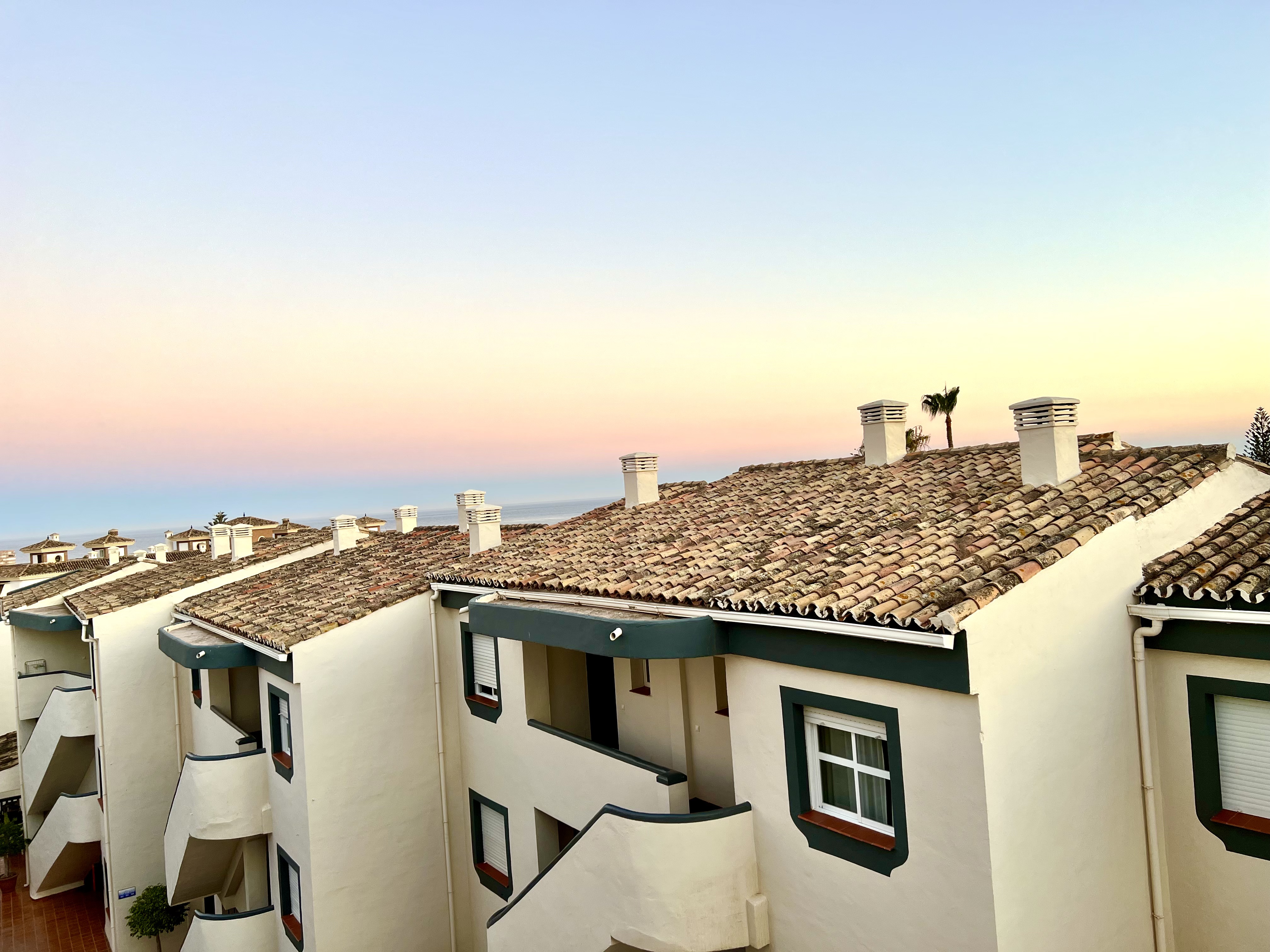
View from the balcony off my bedroom

One reader wrote me to say that a reason that Spain and France are so different is that Spain was governed by the Moors for a very long time and historically Islam has had the greatest influence on Spain. Today, Islam is growing again, especially in younger people, and is the second largest religion after Catholicism. Whereas France, since the time of Charlemagne, has been the most Catholic country in the area we know as Europe until the 16th century when Protestantism began to appear. Even then, Protestantism flourished in Germany, Switzerland, and other parts of Europe, more so than in France. When one adds the weather and the proximity of the Mediterranean sea, it can be expected that the two countries will appear very different. That is what I saw and felt when I first arrived.

Looking out on the sea from the timeshare (photo: Susan Johnson)

Andalusia, which includes the Costa del Sol, is the second largest of the eight communes of Spain. High in the mountains behind Marbella are a circle of villages known as the White Towns because of their white-washed walls and houses. On Thursday last week, we drove to Ronda, the largest and most popular of these towns. Although only 40 km from flat land to town, the road is so curvy through the National Park, that it takes over an hour to get there. Susan did the driving and I was the navigator. I had the help of my Apple map on my iPhone and a voice I called Fred. Fred is terrific. He gives plenty of warning when a turn is coming up or having to take an off-ramp. He even told us when we were approaching a radar for speed. We discussed all the radar and decided that, unlike the US, they were not out to trap us and make money, but trying to regulate traffic. Even so people whooshed by us at top speeds. We never saw much traffic anywhere except on the A7. Nor did we see any police or traffic cops deterring these drivers. Everything is being done on-line these days.

The white washed houses of Ronda (photo: Susan Johnson)

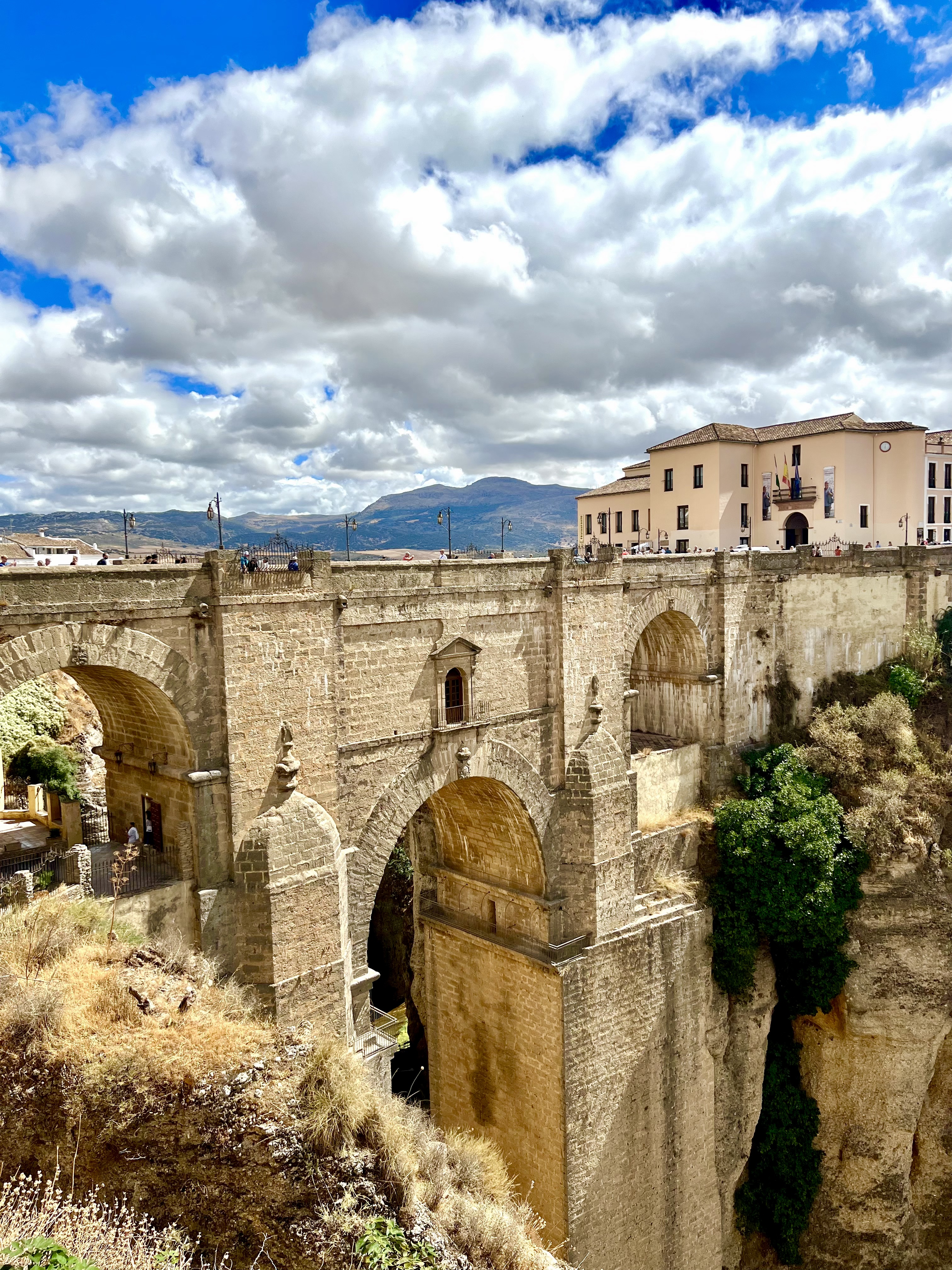
Ronda is famous for the bridge that traverses over a 380 foot ravine connecting the old town with the new as well as its cliff side location. It is the largest of the White Towns with a population of 35,000. From our one afternoon there, I’d say 34,950 live in the new town. There was a large and well-organized carpark where we left the car, and a lengthy pedestrian street from the carpark to Plaza de Toros de Ronda, the oldest bullring in Spain. “American artists Ernest Hemingway and Orson Welles spent many summers in Ronda as part-time residents of Ronda’s old-town quarter called La Ciudad. Both wrote about Ronda’s beauty and famous bullfighting traditions. Their collective accounts have contributed to Ronda’s popularity over time.”-Wikipedia

The drama of the bridge connecting the two parts of Ronda

We had lunch on a balcony overlooking the bridge and wondered how the it was built (I had visions of the movie, Ben Hur and the slaves pulling huge boulders to build Pyramids). Known as Puente Nuevo, it is the youngest of the three bridges that cross the river that separates the two parts of town. It was finished in 1793, 42 years after construction began. Looking over the cliff edge, one can see the Guadalevin river and the other two bridges much lower down. There is a large archeological site (around the city are prehistoric settlements dating to the Neolithic Age, including the rock paintings of Cueva de la Pileta) and Arab baths (dating from the 13th and 14th centuries), both requiring a walk down into the ravine and a walk back up. We chose to pass that up! Once past the bridge, it was quiet. Only tourists walking the town, learning about old Ronda. Even the touristy shops selling linen dresses, brand new tiles, and leather goods petered out as we moved deeper into the old town. Without a map from the Tourist Office, it would have been impossible to know what was what. The overall feeling was one of huge expanse in all directions from the top of a hill well fortified for just in case. We walked the length of the old town and back towards the bullring, the pedestrian street and to our car. We arrived ‘home’ at 7:30pm wanting nothing more than a quick salad and bed!

One of the smaller bridges traversing the chasm-(Photo: Susan Johnson

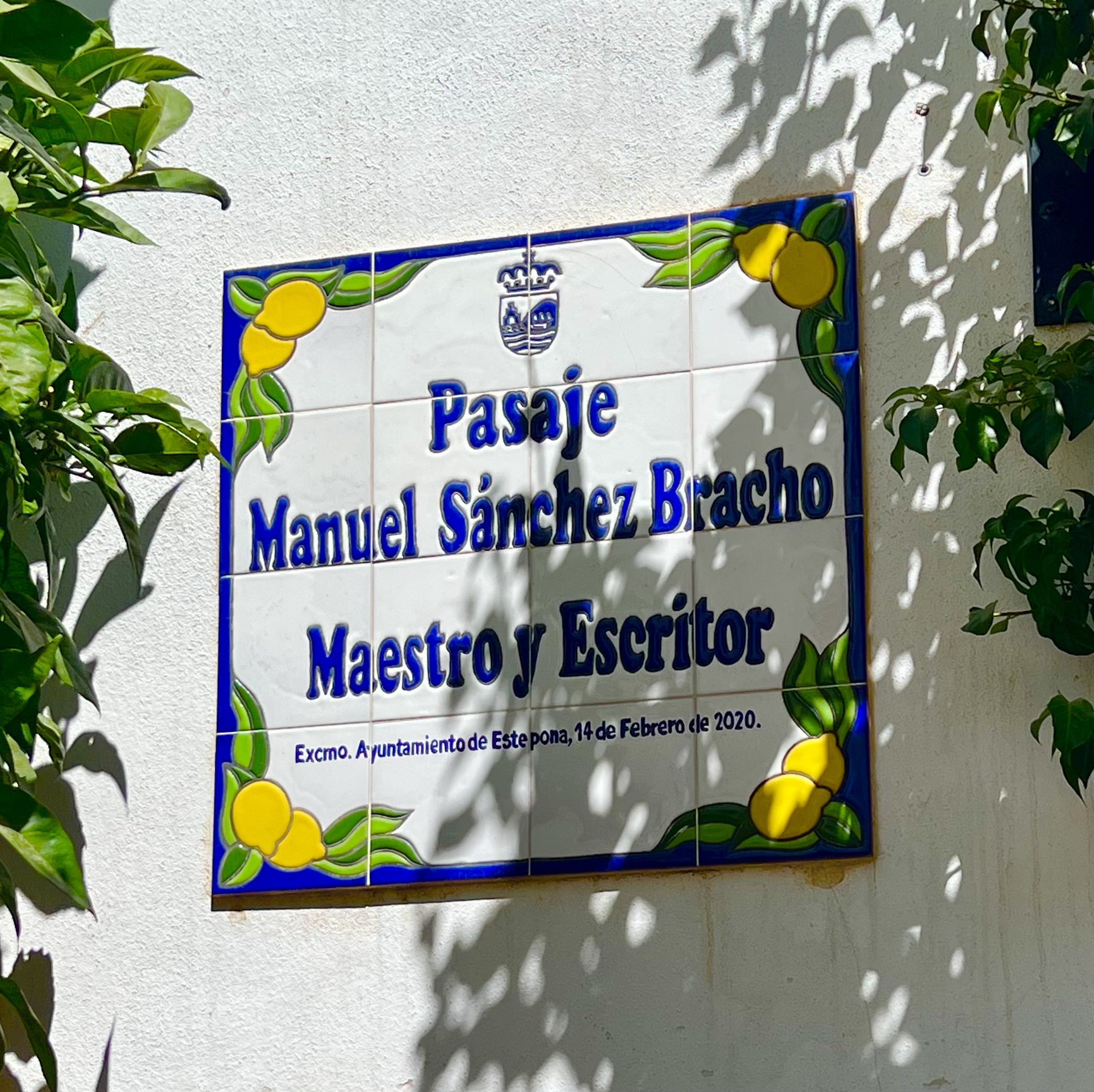
Susan and I decided that we should return to Estepona and find the old town and the narrow streets that the guidebooks gushed over. This time, I asked Fred to take us to the Centro Historico and he got us pretty close. We even found parking two blocks away. What made the old town so lovely was more than the narrow streets, there were flowers and plants everywhere. Pots hanging off walls, flower bushes on either side of doors, and large tall decorations of flowers on the shopping streets. There was also tile. Most entryways had the regular what I call ‘Mexican tiles’. Thoughtfully placed were smaller tiles of animals, angels, and symbols. I wanted to buy masses of the artisan tiles and bring them home with me but where would I put them in my rented apartment?

Walking in the old town of Estepona
Looking in a door at tiling and iron work door

This part of Spain takes a siesta from 2:30pm-5:30pm–at least that is when all the stores close, even the small vegetable markets on the corners. Without people, old Estepona gave off a feeling of a Hollywood set, perfectly assembled and just waiting for some life to happen. It was an eery feeling. We didn’t have too far to walk when one of the streets opened up onto the Plaza des Flores. We found seats at a café and, along with a number of other tourists, had a drink before attempting the walk back to find our car.

Aerial view of Plaza des Flores–photo in the bathroom of a café

One interesting fact: in the 1990s, the Walt Disney Corporation chose Estepona as the site for its EuroDisney project. However, Paris ended up with the installation.

Another use for the beautiful tiles

As we walked, and I was walking with my head down, I was thinking about the fact that I had written that there was no town planning along this part of the Costa del Sol. At my feet were brown and grey stepping stones surrounded by smaller grey stones all placed in a pleasing pattern for the length of a block. The next block over would have a similar pattern. Clearly this town had given a lot of thought to planning. And the flowers and plants were all thriving. Most of Europe has suffered terrible heatwaves this summer. Someone was taking care, watering these plants. And those someones were probably paid by the city. I was far off base. Lesson learned.

Seen on the wall of one of the narrow streets we walked down.

I write this from Paris thinking back on the week. The absolute best part of the week was the rest I got. They say that mediterranean countries move slower and are more laid back. Perhaps the three of us caught the southern bug. We moved slowly, only went places we really wanted to see, and made simple dinners every evening. That felt like a luxury. And what a vacation is supposed to be.

A bientôt,

Sara
Toto, we aren’t in France anymore

Spain is so close yet so far away. It is a short plane ride or train ride but the culture is so different. Feelings about color are different, the art is different, the cities are different. Paris is considered the most beautiful city in the world. I don’t think any city in Spain would be on a list of the top ten. Going to Spain feels like a journey of a much greater distance.

I flew to Seville from Charles de Gaulle airport last Saturday in two hours. I am with two friends who have rented a timeshare in Marbella on the Costa del Sol. A quick exit through the airport and finding the rental car, off we went south-east to find the ocean. For the first hour, the landscape was not inviting. Arid land populated with what we think are olive trees and not much else. About two thirds of the way to our destination, the landscape became hilly with deep arroyos. This was much more interesting. There was nothing on this land. Nada. No people, no other roads, no structures. We made a mistake with our directions and had to go back the way we came for 30 minutes. There were no off-ramps, nowhere to go in this landscape of hills and ravines except forward. We finally were able to turn around and head back towards the ocean.

We are staying in Mijas, close to Marbella. The A7, a four lane highway, runs along the coast from Malaga to Algeciras. It is busy at all times of the day. There is no demarcation between towns (or cities–it’s confusing as to what they are) and reminds me of Route 1 on the East Coast where one city runs into another.

I can think of many words to describe the villages of France: quaint, piccaresque, charming, etc. None of these words apply to this part of Spain that you can see from the A7. No thought has been given to town-planning. Monstrous timeshares litter the sides of the large hills looking like cruise ships plastered against the golden brown background. Billboards of all sizes line the A7 giving a sense of a very large population. One has to know where to find the good walking beaches as many have stones galore and hurt your feet as you test the temperature of the water.

Homes high up in the hills of Mijas or Marbella

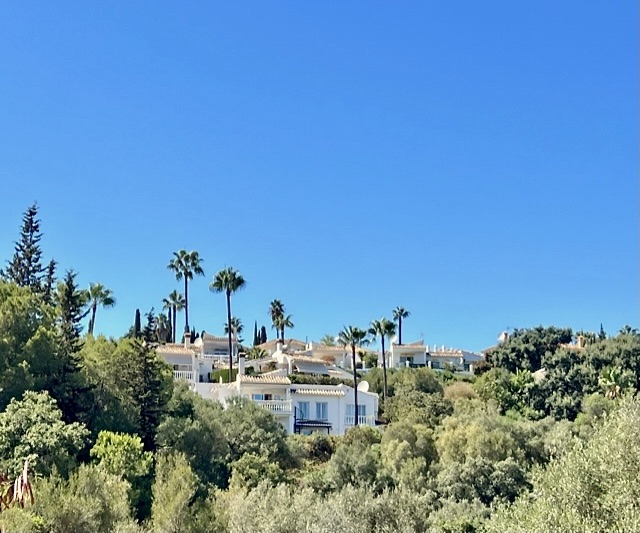
However, following streets upwards into the hills, one can see what attracted people to this part of the world before it became so popular. The houses are white, large, gated, with flowers everywhere. The hibiscus is the most popular this time of year. Views of the ocean pop up at many turns and there is no sign of the A7 or the hundreds of billboards,

Promenade along the beach at Estapona

On Sunday, we drove to the town of Estepona south of Mijas. My apple map on my iPhone took us to the port where we found a parking place. Our intention was to find the old town and wander the small streets where no present day car could possibly go. We stumbled on the closing of the Sunday outdoor market and my friend bought a skirt. We then asked directions to the old town. We strolled along a promenade that clearly had been thought out, had flowers planted along the side closest to the road and an overhang that balanced out the railing on the beach side. The beach, not crowded, was wide as a football field and people were lying under umbrellas. There were par courses along the way. Children were taking advantage of them, climbing on walls, swinging on foot machines. We never did make it to the Old Town so we have yet to see the tiny streets of old Spain.

South of Spain, a short ferry ride of 40 minutes from the town of Tarifa, lies Tangiers, a city that seems mystical. A city beloved by Kerouac and Matisse and many artists of the 20s through the 50s who spent time there. We couldn’t miss a trip to Tangiers! So we left the timeshare at 6am in order to catch the 9am ferry. After standing in a line to get tickets, a line for passport control, a line to go through security, we lined up to get on the ferry where we stood in another line to have our passports stamped by the Moroccon police. Only after every passenger had done that, did the ferry start to move and make the trip out of Europe towards Africa.

Getting ready to go to Africa

Every guide book will warn you of every thing that can go wrong in Morocco. I remember visiting the old city of Jerusalem my first year out of university. The Arab world is a culture shock. I wasn’t wise enough to be scared but I felt lost. I couldn’t speak the language, women were not encouraged to be traveling on their own, and small children begged constantly. Yet, I was mesmerized. Everything was colorful, I’d never seen goods hanging on doors, from the ceilings, baskets and baskets of spices or eggs or jewelry. I imagined Tangiers, the old city, would be much the same. Leaving the taxi that took us to a gate to enter the old city, we immediately came to a market. We wandered around not sure what we were doing, grown men begging to be our guide stopping us every ten minutes. We finally found our way into the Medina, the most interesting part of the old city and found a very old man, Salam, had attached himself to us. He spoke French. The streets were like a maze leading us deeper and deeper into a warren. The open air shops turned into regular shops where we would step inside and see beautiful tile work or men weaving rugs. The dirty streets changed into lovely white streets with houses surrounded by bougainvillia. We were headed to the Kasbah and were climbing. Salam pointed everything out to me, where a famous American lived and died and later the garage where he kept his Rolls Royce. After hundreds of steps, we arrived at a wall with an arch. Walking through the arch, we got a view of the port, new Tangiers and a huge expanse of ocean. It is breathtaking.

The Kasbah is a large living area with a mosque that is now a museum, shops and little alley ways that reminded me of Santorini. We had been on our feet for five hours at that point and we were all feeling it. We were planning on a 4pm ferry ride back to Spain but thought we’d go early in case of an earlier time. There wasn’t. We descended into the lower market areas that reek of poverty. It seems a small thing to give some man or student a couple of euros to guide us around and tell stories. But Americans are warned off.

selling chickens on the street.

We made it back to our car by 6:30pm CET (Morocco is an hour behind Spain) and drove the hour and a half back to the timeshare. All three of us made a salad, ate it silently, and went to bed.

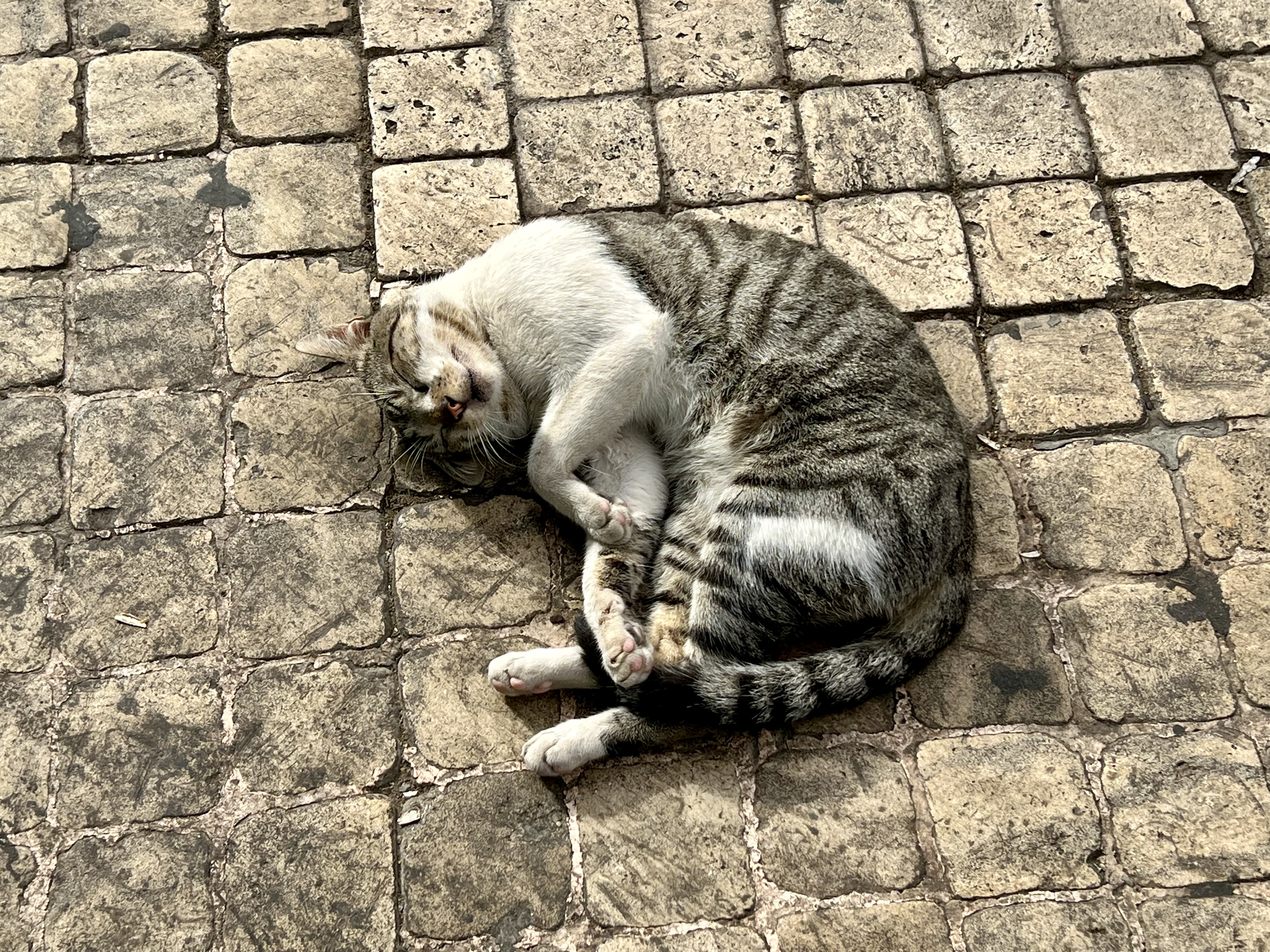
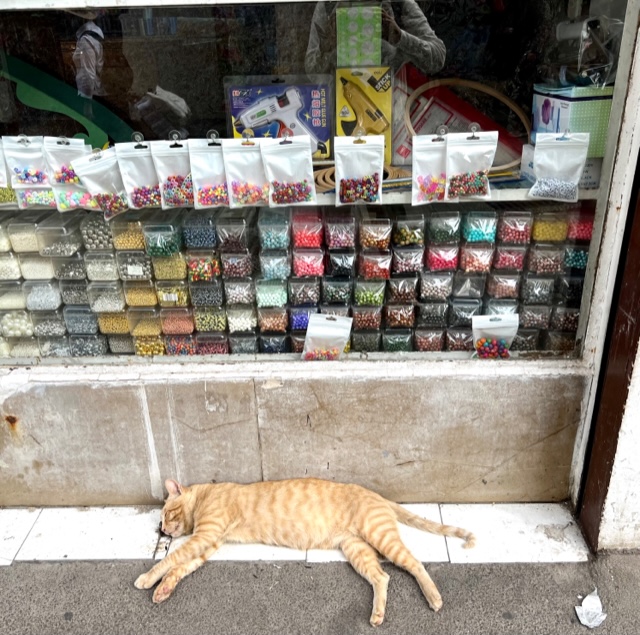
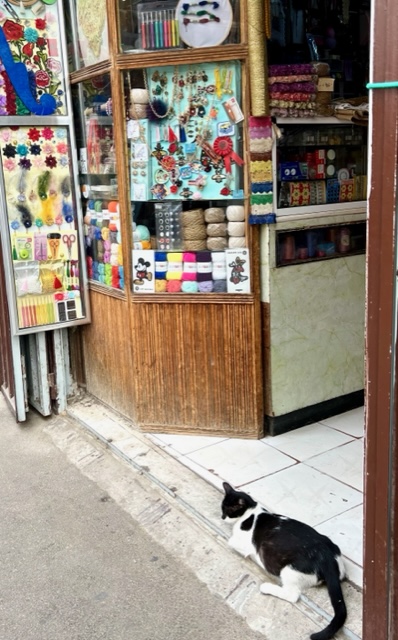
One thing I haven’t mentioned is the cats of Tangiers. They are everywhere. They are gentle, clean, friendly, have no fear of people. Almost every store had a cat near it. The parks had cats, the cats took naps in the middle of sidewalks, the cats looked longingly at you if you held out a finger and said “Cou cou.” I asked one of our guides if people had cats as pets. He said yes some families do. Mostly the cats hung out in the Medina.

Cats, it seems, have been revered for centuries in Muslim culture. So much so, that one of Prophet Muhammad’s companions was known as Abu Hurairah (Father of the Kittens) for his attachment to cats. The Prophet himself was a great cat-lover– Muezza was the name of his favourite cat.–The Guardian.

As the days have gone by, the area around the timeshare seems to have gotten prettier! I think I am so spoiled by living in Paris that I’m far too hard on other areas in Europe. Next week, I’ll share about the white hill towns of Andalucia.

A bientôt,

Sara

I get by with a little help from my friends

Trying to save money, I borrowed a car, actually a van, from a friend in Paris. As has happened in the US, car rental prices have doubled, even tripled in some areas, and it can be very difficult to find a car. The van gets great mileage she told me and it certainly seemed to. I drove from my apartment in Paris to Lessard-et-le Chêne, a distance of 200 km/125 miles, this past Monday on less than a quarter tank of gas. The van drives well and I was comfortable. I had left Paris at 9am in an attempt to beat the heat. All of France was suffering a second heatwave of the summer, and predictions said that Paris would top out at 102o and Lessard at 105o. When I arrived at 1pm, it was a mere 92o.

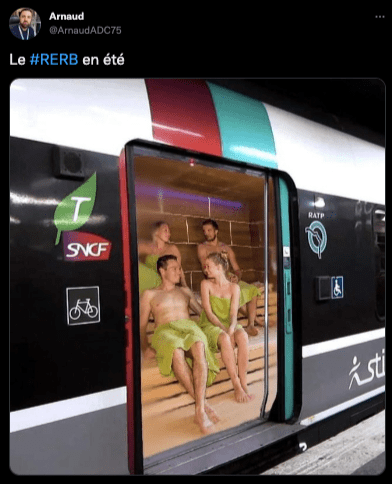
A meme depicting the Paris metro in the heat this past week!

Tuesday morning, I thought I’d fill up the tank before it got too hot and be ready to go anywhere. So off I went, sure of where I was going, but got lost. Not having anywhere to be, it was ok to get lost, and I had my phone with me. Soon I saw a familiar landmark, the LeClerc supermarket that also has a large gas station. I pulled in and filled up the tank. Then off I went again headed to the Intermarché for a few groceries. I was inside for thirty minutes.

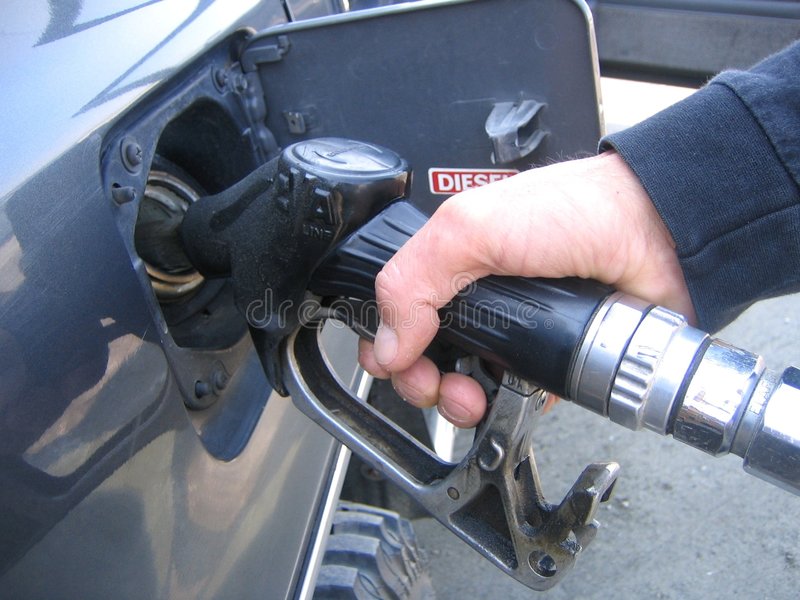
Back in the car, I turned the key and nothing happened. Well, something happened. The van made that sputtering noise telling me it was trying very hard to start but it wasn’t turning over. I tried three times. Then I sat there and a familiar anxiety settled over me like a heavy blanket. I had no idea where to go or who to call. My friends had not yet left for the airport but they were packing and I didn’t want to disturb them if at all possible. I felt like the ugly American who doesn’t know how to cope in a foreign country and resorts to panic out of habit. I saw a well dressed adult male pull up in front of me. I jumped out of the van, crossed over to him, and as he opened his door, I told him in my best french that my car wouldn’t start, I had checked everything, and could he help me. He followed me to the van. I turned the key but again the van would not start. After checking the obvious, he asked me who put the gas in the car. I told him that I had. He motioned me to step out of the car and we walked to the gas tank. He pulled open the cover and there in nice big letters was the word DIESEL. I must have looked like a cartoon character as I slapped my forehead, groaned, and my anxiety turned quickly into deep embarrassment if not shame.

I immediately wanted someone to blame. Why hadn’t my friend told me it only took diesel? Yes, dummy, and why hadn’t I checked to see what kind of gas the van took especially as someone was so kind as to write in large letters….. Even I, who knows little about the inner workings of cars and vans, knows that you don’t put gas in a diesel van. Even I know that the damage can be extensive. I thanked the man and he went on his way.

I had to call my friends–who rightly were annoyed with me. Not nearly as annoyed as I was with myself but, hey, who’s measuring. The husband came and got me. Did I mention they were leaving for the airport in less than three hours? On the way home, M reminded me that it is July, and could be very hard to find a mechanic, and it could be very expensive, and it could be in the garage three weeks. Leave it to the French to come up with the worst case scenario. All I could sputter out was that it never once occurred to me that the van took diesel. In the US, very few cars take diesel. Here in France, I don’t know anyone who owns a diesel car and I’ve never rented one. It’s just not on my radar. It should have been. Ninety-five percent of cars in France are diesel. It used to be far cheaper than gasoline. Farm workers and low income people were encouraged to buy diesel cars. Then Macron decided that diesel was damaging to the environment and told everyone to buy regular gas cars. The price of diesel went up. Incentives were given for buying gas cars. I have no idea how many sold their diesels. It’s asking a lot of a worker who is 100% dependent on her car for her living especially if she lives in the south of France.

Le marché des véhicules de loisirs va prendre un tournant majeur dans les prochaines décennies. L’interdiction de la vente de véhicules thermiques est prévue dans les calendriers d’ici 2040. Alors qu’aujourd’hui 95 % des véhicules vendus roulent à l’essence ou au diesel, quel avenir pour nos vans et fourgons aménagés ? Quelles alternatives possibles face à l’interdiction du diesel en France ?

Back at the house, I texted my friend who owns the van. She happens to be in the US at the moment which is why she was kind enough to make the loan. She is six hours behind me. She received my information and contacted her insurance agency immediately. She let me know that a tow truck would meet me at the van at 10 the next morning. Meanwhile, everyone in the house was talking about solutions for me. My head was swirling. I still felt both helpless and ashamed. Like an old record player, I replayed me at the gas station hundreds of times, seeing the word DIESEL, and putting it in the gas tank. It’s like waking up from a nightmare. The ending is always the same. I’d made a mistake and I had no idea what the consequences would be. I was at the point where I wasn’t sure if it would be ready when I had to go back to Paris. I went on the internet and rented the last car in Lisieux from an obscure place with the original name of Rent A Car.

The afternoon and evening passed. My friends left for Charles de Gaulle to fly to California the next morning. The not so friendly voices were whirling around in my head having a good time with my sanity. I asked a friend of theirs, John, for a ride and promptly at 9:40am he showed up and we went to Intermarché. The tow truck was already there. I watched as this skilled man pulled down the ramp on his truck, moved my van that wouldn’t start into a perfect position to roll up the ramp, attach one cable, and pulling a lever, up the van went. All of this with a friendly smile. Then he looked at me and asked me where he should take it? Huh? I didn’t know and said so. Kindly, he said, he’d take it to his garage and await further instructions.

John came out of the store just at that point and off we went to Rent A Car. I drove home and texted all this info to my friend in the US. By that evening, I knew it would be repaired at the garage it was at and possibly could be ready by Friday! Really!! That meant that little or no damage had been done to the motor. I had also talked to quite a few people, all lending support to help me feel better. One person actually said that everyone she knew who has owned or rented a diesel has done the same thing. I don’t think any French person would do it so she must have meant Americans.

Noon the next day, Thursday, US called and told me the van was ready for pick-up AND it would cost one hundred and fifty euros. Forty of that was filling the van with twenty liters of diesel. The fact that I couldn’t get a ride until this morning (Friday) meant little. This unintended but ultimately huge mistake I made was turning out to be ok. That means it didn’t break my piggy bank and the motor wasn’t damaged, all the affected parts just had a bath, and I have the van back in forty-eight hours. And probably/hopefully, I didn’t lose the friendship which was on my mind the whole time.

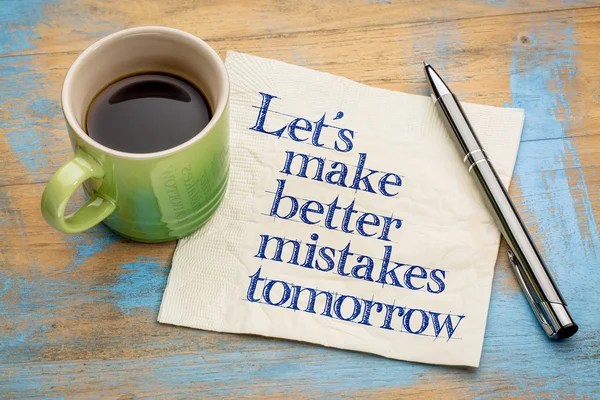
So here’s the final thing. I’m a good student. I do my homework and learn my lessons. But there are some lessons that I only seem to learn the hard way–by making a mistake. This one I thought was going to be a dilly. It was hard enough though it had a happier ending than I expected. I will ALWAYS look to see what kind of gas or diesel or otherwise a car takes (by the time I ever own a car again, they’ll all be electric!) All the cliché inspirations, that many of us are inundated with, remind us how important mistakes are and how to learn from them. They forget to mention that sometimes you want the world to stop, that the feelings can often be overwhelming. But…life ticks on and the consequences show themselves. And infuriatingly, the clichés are all true. Mistakes are the greatest teacher of all.

The end of the day, the end of the story

A bientôt,

Sara