Happy Birthday, Sara

Last week, I celebrated a birthday—one that the number suggests officially makes me an old woman—seventy-eight years. What I feel on the inside doesn’t reflect what I’ve thought in the past the age of seventy-eight years means. ‘What does 78 look like?,’ I asked myself Thursday morning, August 28. ‘Look in the mirror,’ an inner voice responded. Maybe. But I’m always hoping that the response I’ll get when someone askes me how old I am, will be ‘OMG! you look so much younger.’ My response to that has always been “Well, I got my mother’s good genes. She also never looked her age as she got older.”
But, according to Eric Topol of the Washington Post (May 21, 2025) who spent six years sequencing the genomes of 1400 people 80 years of age and older, they shared very few, if any, genetic similarities.

The article goes on to share what ‘Super Agers’ do to maintain good health. That is not what spoke to me.

I have credited my good health and the fact that I don’t look my age to my mother. That through some amazing luck of the draw and, despite drug and alcohol abuse in the first half of my life; extremely poor eating habits which I have labeled food addiction andpoor self-esteem, that I might be responsible for where I am today. I am the one who, through those years, kept trying to exercise, eat right, and continue taking courses/learn new things. I didn’t know I had addiction issues. I thought I was weak. I look back and am amazed that I continued to fight a losing battle with all the suggestions Topol puts forward that lead to ‘Super Aging.’

When my perseverance landed me on the doorstep of 12 Step programs for alcohol and food, I fought the solutions with the same uninformed gusto that I’d fought the problems. Till I had no strength to fight anymore. I waved the proverbial white flag. In putting down, letting go, perhaps acceptance is the better word, of my addictive life style, I gave myself a better than fighting chance to stick to all the suggestions for a healthy lifestyle. 

It even turns out that my aptitude towards doing nothing, taking naps, reading on the couch, taking days where I don’t get out of my PJs and putter in my apartment, is now considered healthy.

It’s true that I’ve had surgeries: right hip replacement (2017); cataract surgeries (2024); carpal tunnel surgeries on both wrists (2024, 2025); and probably another hip replacement this coming winter. As I tell my friends, I’m like the Velveteen Rabbit—coming apart at the seams and need to be sewn back up—but my internal organs are in fine shape.

It has taken me eight years to celebrate my 70s. I couldn’t do it when I was 70. I was too undone by the number. I celebrated turning 70 on my 71st birthday. I had a picnic on my 74th or 75th. I got distracted by who didn’t come than on the fact I had lived longer than 1/4 of my High School graduating class.
Photo: Unsplash.com

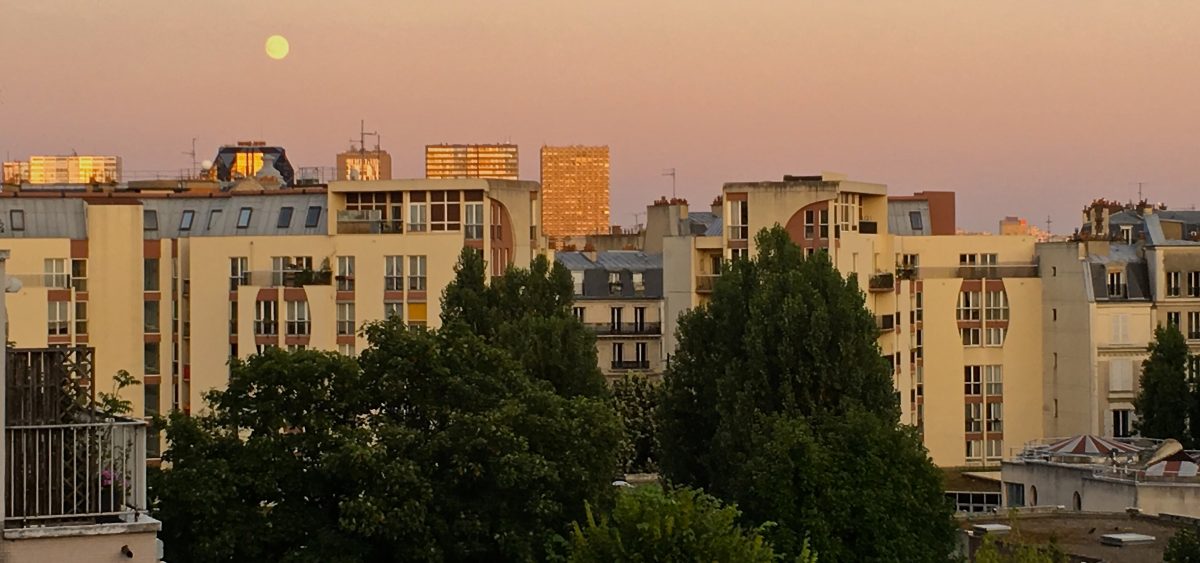
This year, I felt the need to celebrate. Yes, my age, but also that I have successfully integrated and become a valued member of the exPat community here in Paris where I moved twelve years ago at the age of sixty-six; that I have the apartment of my dreams; that I am a published author; that I’m healthy and doing my best to learn how to age wisely.

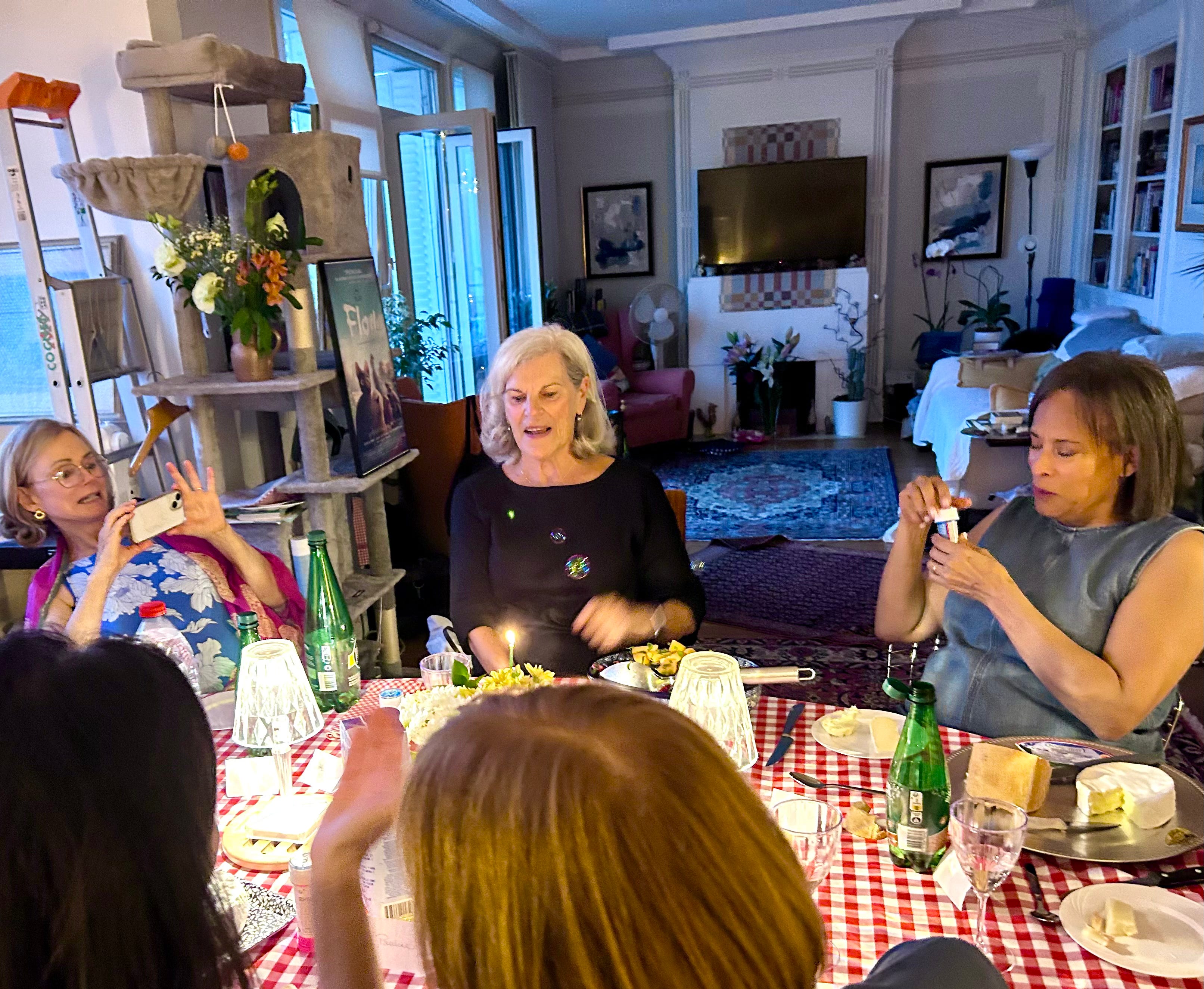
I invited a number of women who are special to me to come to a sit down dinner. One of those friends said, “if you really want to enjoy your party, have it catered. Let someone else do the work.” Me? Pay someone else to make my life easier when I could do it myself? I made the wise decision to not listen to my inner voices that have too often proved untrustworthy and followed her advice. I chose the menu (salmon and roasted vegetables). I decorated my table with red and white checked napkins and tablecloth. I picked the time to eat: 7:30pm. Then I sat back and bathed in the connections, the laughter, the camaraderie and, of course, some Sara roasting. One friend brought little bottles of bubble solution and before the fruit and cheese dessert, we all stood on my small terrace and blew bubbles into the darkening Paris sky.

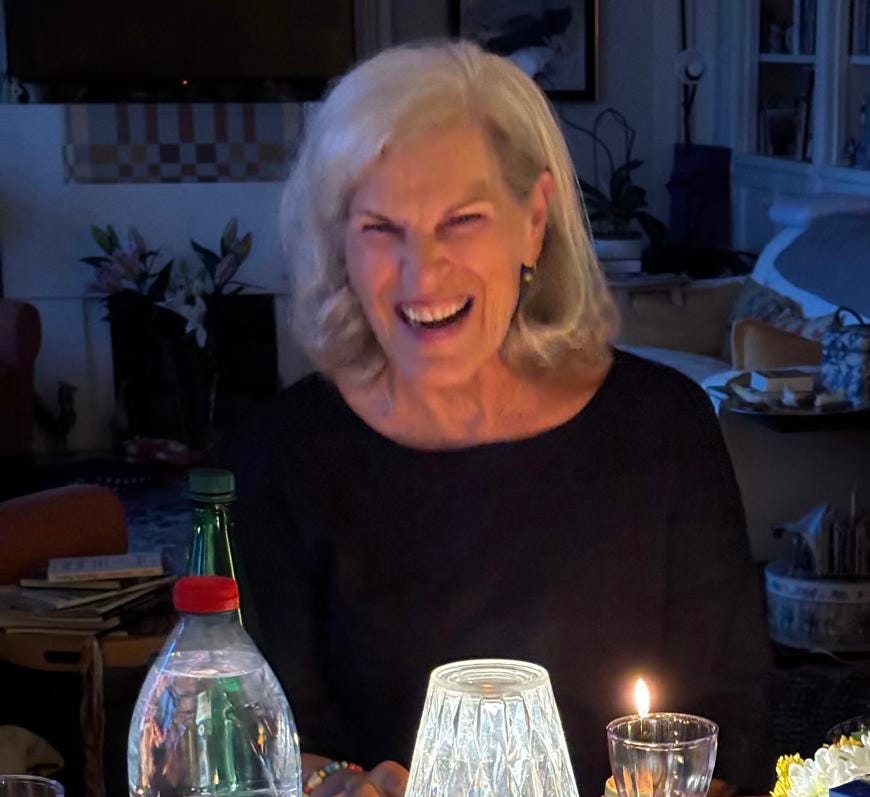
Then, when we were all seated again, out came a piece of melon with a porcelain birthday cake and lit candle. I blew out my candle and felt well fêted.
Ever on the academic calendar, I’m now welcoming in a new year. Here in Paris, it’s La Rentrée when everyone returns from wherever they’ve been during the summer. Children started school this week, the Senior Sports program starts up on the 15th. I’m signed up for Pilates and Tai Chi. My six month sabbatical from this Substack is over.

Wecome to a new year of Out My Window. Nine years ago, I started this as a blog, as a letter to all my distant friends. I migrated over to Substack three and a half years ago. I will be terminating my Word Press connection by the end of 2025.

If you are reading this on WordPress, I encourage you to go to Substack and subscribe to Out My Window. sarasomers.substack.com. It’s free and it’s easy. I hope to bring all of you over by the end of the year. If you no longer want to received Out My Window, unsubscribe now. And thank you for reading my thoughts all these many years.

Thank you everyone for joining me and reading my words for nine years or, perhaps, one month. Please take the time to “like” below so that I know I’m reaching you and comment with anything that my writing has inspired. I read everything and so appreciate the time you give to me.

Thanks for reading Out My Window! Please go to sarasomers.substack to subscribe for free and receive new posts and support my work.

A bientôt,

Sara
Substack–What is it?

I remember back in 2007 (only sixteen years ago) when some people logged on to FaceBook and some went to MySpace. My memory says that MySpace was difficult to navigate and FaceBook looked nothing like it does today. No one had any idea that our privacy was being stolen away from us without permission. I think I ended up using FaceBook, not because I liked it better, but because all my buddies preferred it. If the Oakland Athletics were having an Away Game, many of us sat in front of our TVs watching the game, computers on our laps, “talking” to each other on FB. It felt exciting, and fun, and we were all together—a baseball family—chatting away and enjoying the game while sitting separately in our homes.

A similar thing seems to be happening with blogging/newsletter platforms. When I started my blog in 2016, I chose the platform WordPress. I didn’t do much research. I wasn’t sure how long I might be writing it. I just wanted something that would be fairly easy and not frustrate me. I had moved to Paris three years earlier and I wanted a way to let my friends and family know what I was up to without writing separate e-mails to everyone. A few years later, Medium appeared which attracted many different kinds of writers: health gurus, Apple computer geniuses, the best apps to download and how to use them. Periodically, there was some serious writing.

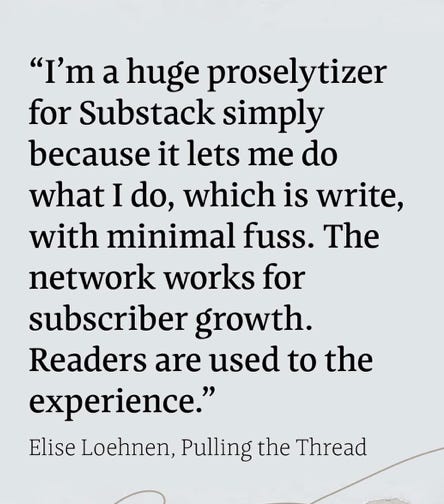
A year and a half ago, my sister, knowing I admire the writing of George Saunders, sent me a link to Story Club with George Saunders. He was writing on the brand new (new to me) platform Substack. I could choose to be a free or paid subscriber. Since George was essentially teaching a course on how to read and appreciate short stories, I immediately signed up as a paid subscriber. Generous human that he is, I’ve gotten my money’s worth many times over.

Something interesting was happening at Story Club that I hadn’t experienced at WordPress or Medium. The readers were interesting, articulate, and also very generous. The give and take amongst the highly motivated subscribers was, for me, like attending one of George’s graduate courses at Syracuse. As I read the comments, I’d check the photo or avatar of the writer and learn what other substacks that person read. I discovered Heather Cox Richardson, whom I wrote about earlier this year. Her substack is now required reading with my breakfast. As of today, I’m signed up for twenty substacks and I’m a paying subscriber to four of them.

Substack attracts writers. It was founded in 2017 by Chris Best, Jairai Sethri, and Hamish McKenzie. I believe initially it was to give journalists a place to write as printed media was dying out of our world. The majority of the substacks, however, offer personal writing, opinion pieces, and research. Moderation of what is written is done by the founders. For authors, Substack is a way to make money writing. Which is VERY hard to do. A Substack is not expensive. Ten percent of the earnings goes to the founders. Initially, the founders reached out to well-known authors and provided “scholarships” to start writing on this platform. A writing community has been founded. I can read writings by some of my favorite authors: Rebecca Makkai, Jami Attenberg, Roxanne Gay, Katherine May, Joyce Carol Oates, and Matt Bell among others.

I wanted in and eighteen months ago, I started writing my own Substack: Out My Window. I also post it on my WordPress site also called Out My Window. I wasn’t sure if I was ready to get all my WordPress followers to migrate over to Substack but I was sure I wanted to be a part of this literary community. Writing about Substack this week is partly to prepare my WordPress followers to contemplate the move!

I’ve met and made friends through Substack. As I wrote last week, a new ‘friend’ I’ve not yet met, Judy MacMahon, created #FranceStack. She has collected together many of us who write about France and Paris, and created “a list” now known as a Stack! Rather than competing with each other, we can repost something that our readers would probably find interesting, AND bring attention to other writers who love and write about France.

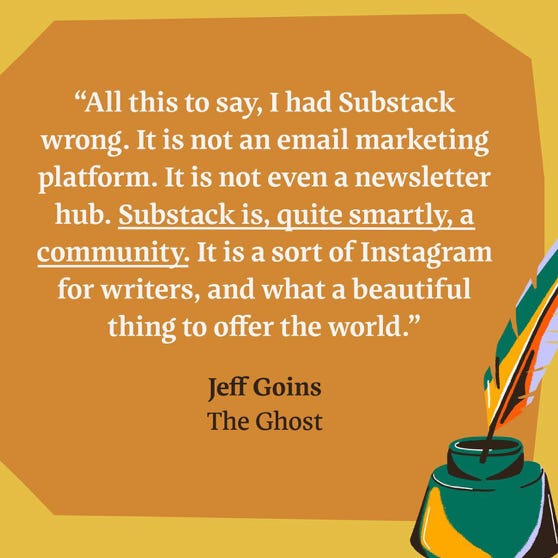
For now, Substack is a wonderful idea that has brought well-known authors into our living rooms and made it possible for writers whose names are not Steven King or John Grisham to make a living doing what they love to do.

I did see this morning that someone has started #SobrietyStack and is charging for it which goes against all the traditions of Twelve Step programs. Recovery is free if you’re willing to do the work. 

So nothing is perfect—big surprise! For now, we have a booming literary society available to everyone. And it’s a wonderful way to support the authors you enjoy—especially if you are a library patron as I am and don’t buy that many books. If you are a WordPress follower of mine, go to SaraSomers.substack.com (click this link) and subscribe for free. Then look around Substack and find other publications that might interest you. Now is a great time to do it. Like FaceBook, like so many things in our technological world, most everything gets too big and the underbelly shows. The Internet is still the Wild, Wild, West.

A bientôt,

Sara

Thanks for reading Out My Window! Subscribe for free to receive new posts and support my work.

May is Mental Health month in the US

During this past week, I read two pieces of writing, a substack essay by Mary Gaitskill and a novel by Abraham Verghese.Both hit the same place in my gut for very different reasons. I finished the novel a day before I read the substack so I had time to meditate on one of the messages the book held for me. Verghese’s novel, The Covenant of Water (due May 2), spans seventy-five years, revolving around a family living in what is now Kerala, in southwestern India. The family is not poor but not wealthy by any means. Most of it takes place while India was under the rule of the British Empire. Without going into too much of the story, the family suffers a lot of death, many of the characters suffer misfortune, and there is an air of sorrow throughout the book. As I was reaching the end of the book, I was struck by the sense of “Shit Happens” and “We Move On”. How best to describe that? In my life, a child of 1950s optimism and Father Knows Best TV, I believed that if bad things were happening to me, there was something wrong with me. I almost always saw the glass half empty and found ways to escape my reality as I was hurting all the time. In Verghese’s book, ‘reality’ was that ‘bad’ things happen – to everyone. It’s normal. Those that moved forward accepted life on life’s terms. Those that didn’t, go through some very tough times. No one had to like the hand they were dealt. They mourned but they didn’t end up in therapy wondering what was wrong with ‘them’. They weren’t the center of the universe. Love wasn’t bartered on how good a person was or was not. Hardship befalling one was not a moral issue. The matriarch of this family loved everyone in her family and everyone who became part of the family. They knew they were loved. Yet shit still happened. Many of the characters found purpose in their suffering and found a way to turn their sorrow and grief into something that was of use to the larger world. This is a very simplistic summary and I recommend reading the book.

Gaitskill’s essay, entitled The Despair of the Young…. and the madness of academia, (search on the substack search engine) is a heartbreaking look, from a creative writing teacher’s experience, at the nihilism that so many between the ages of ten and thirty suffer from today. In her writing classes, students wrote about suicide, murder, serial killing, rape, and violence of the most extreme sorts. Often from the first-person point of view. She has taught long enough to see the trend get worse over the years. Political correctness, lawsuits, and lack of “safety” have seemingly tied Academia’s hands to handle this trend in a way that might actually be helpful to a student. I am in my 70s. I felt despair in my teens and early twenties. Nothing I felt compares to what I was reading in her essay. Though I often contemplated suicide, I never would have followed through. It was a way out that I always had in the back of my mind that kept me from believing I was in a prison of misery with no exit doors. And there was a revolving circle of adults (not my immediate family) who listened to me, empathized, and allowed me to be seen no matter how self-centered my despair was. 

I have little first-hand knowledge of what Gaitskill was writing about. The closest I’ve come is my reading the news of mentally unstable young people being allowed to buy guns, and taking their despair out on schoolmates and whoever was near them. I would never doubt Gaitskill. She is a brilliant writer, able to translate much of her life experience into very readable, though not always pleasant, short stories. I’ve also watched many of my friends go into therapy since White Supremacy and Hatred have crawled out from under the carpet in the years leading up to Trump’s election and the seven years since. Most of my friends are adults and know ways of trying to cope. Some have fallen sick. None that I know of have resorted to self-violence or other violence. I, myself, have chosen to distance myself from the insanity of what’s going on in the US by living much of the year in France. 

Where am I going with this writing? The contrast between the fictional story of a family that managed to convey that things do pass and there was no belief that whatever was happening was so acute that the only way to stop the pain was suicide or homocide, and in the USA of today, where violence is a reasonable option to deal with despair. It is an option supported by the very same people that say killing a fetus is a crime. 

Gaitskill further says that her students are being let down by their schools. She gave some examples of times when she, the professor, or another staff member could be available to talk to a student. She was told not to. “The only thing I can say for sure is that the young deserve better.  It has become standard to complain about how inept and spoiled the young are but—my students were in some ways pretty great.  Their stories confronted not only suicide and violence but also dilemmas of artificial intelligence, gender animus, caring for a sick parent and sibling during the pandemic, the tenderness of asexual love, the awfulness of age, the timelessness of war—they were ambitious, humorous and bright in the face of everything.”

When I finished reading The Covenant of Water, I didn’t want it to end. I felt so satisfied and full from having read about generations of people coping with life. When I finished Gaitskill’s substack, I felt so powerless over this despair that is spreading amongst young people like the black plague. Covid didn’t help but it’s not an excuse for why adults are letting young people down, why treating the mental health of our young isn’t available everywhere. It’s needed now more than ever.

According to the Suicide and Crisis Center of North Texas, suicide is the third leading cause of death of young people between the ages of 15 and 24.

  • 5,000 young people complete suicide in the U.S. each year.
  • Each year, there are approximately 10 youth suicides for every 100,000 youth.
  • Each day, there are approximately 12 youth suicides.
  • Every 2 hours and 11 minutes, a person under the age of 25 completes suicide.
  • In the past 60 years, the suicide rate has quadrupled for males 15 to 24 years old, and has doubled for females of the same age.
  • For every completed suicide by youth, it is estimated that 100 to 200 attempts are made.
  • Firearms remain the most commonly used suicide method among youth, accounting for 49% of all completed suicides.

There’s not much more to say except to hope that mental health counseling in schools, universities, and everywhere gets better and becomes more accessible. What is happening today should be unacceptable.

A bientôt

Sara

Thanks for reading Out My Window! Subscribe for free to receive new posts and support my work.

Know the warning signs

Learn the common signs of mental illness in adults and adolescents.

LEARN MORE

Mental health conditions

Learn more about common mental health conditions that affect millions.

LEARN MORE

Find Your Local NAMI — National Alliance on Mental Illness

Call the NAMI Helpline at

800-950-6264

Or text “HelpLine” to 62640