Reposting from The Local-Nov. 29, 2023
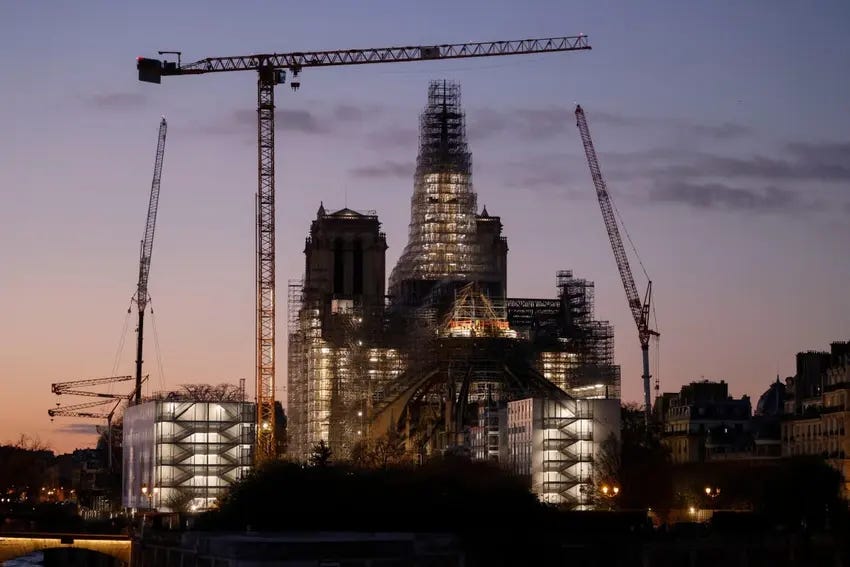
This photograph taken on November 28, 2023 in Paris shows the wooden structure of the new spire in place at Notre-Dame de Paris Cathedral on the Ile de la Cité in Paris during reconstruction work. Photo by Ludovic MARIN / AFP
Scaffolding still surrounded the new spire, captured by an AFP photographer, and officials did not wish to comment while they await the finishing touches.
The authority overseeing the rebuilding told AFP last Friday that the oak structure of the spire, which reaches 96 metres (315 feet) high, would be visible “before Christmas”.
It is identical to the previous one, designed by the 19th century architect Viollet-Le-Duc, which collapsed in the fire of April 15th, 2019.
The scaffolding will remain to allow the installation of its cover and lead ornaments early next year, the authorities said.
The cathedral is due to reopen on December 8th, 2024, President Emmanuel Macron announced in August.
The frames of the nave and the choir of the cathedral, which were also destroyed, are due for completion in 2024, after which the construction of the roof can begin.
The final stages include cleaning the interior – an area that covers some 42,000 square metres – and installing new furniture.
—published in The Local/France Nov. 29, 2023
April 15, 2019, a long ago time before the pandemic, I was at the American Library in Paris waiting to meet Edouard Louis, a well-known young French author. He would be speaking on his latest book: Who Killed My Father. It wasn’t like in the movies when suddenly everyone is looking at their mobile phones and you know Something Bad Has Happened. Someone mentioned that they thought Notre Dame was on fire. No one believed it so we were checking all our respective news sources. It was true, as we all now know. It was 6:50pm CEST. I went outside and down to the corner of Rue du Général Camou and Avenue Rapp. I couldn’t see anything, not a wiff of smoke in the sky. Notre Dame is 5.2 kilometres east of the American Library. A drive of 20-25 minutes or a metro ride of the same amount of time. The fire began at 6:20pm CEST, but alarms didn’t go off until the same time that I was searching the sky.
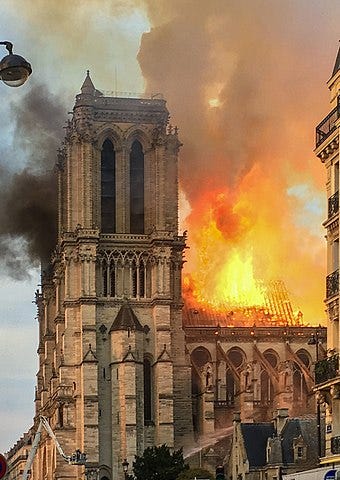
In no time, I was caught up in the Drama of Notre Dame in Flames (there is a fairly good thriller/documentary out called Notre Dame Brûle*). I watched on my iPhone as crowds began to gather, many people weeping, all being kept at a safe distance by the gendarmes. Slowly word spread around the world and scenes of Paris were interrupted by reporters in US or UK announcing that the heart of France, the literal and metaphorical center of the country, was burning. The big question was: Could any part of the beautiful centuries old cathedral be saved? All the structure was wood, some wood over 600 years old. At the time of the fire, renovations were being done on the roofing. It’s never been clear how the fire started but guesses were that one of the workmen had thrown down a cigarette that wasn’t completely out. It is and was illegal to smoke there.
I wanted to meet with Edouard Louis. I had heard him speak a year earlier and told him about the book I was writing on my history with food addiction. He was fascinated and asked me to keep him posted. At the time of the fire, I had finished writing the book and a publication date had been set for May 2020. I wanted to talk to him. At the same time, like many people, the draw of a Drama happening on my turf, a reason for everyone to be on the same side of an issue, to feel the universality of something pulling the city together, a crowd reacting as one person, crying together, hugging strangers, I found the pull almost irresistable.
I did resist and stayed at ALP to meet Edouard and to listen to his talk. I went home after and watched the news, glued to every word, every picture. Just like the day Kennedy was shot, and RFK was shot, and the Towers came down. Fascinated by the drama, fascinated by public grief when everyone is given permission to cry and wail. This wasn’t just a tragedy, it was my tragedy as a citizen of Paris.
I was never much of a Princess Diana fan so, until the actual day of her funeral and the famous walk of the sons and Charles, I hadn’t watched much TV. I had lost a cat that I’d had many years and, after much searching, I decided he must have been caught by a coyote. But when I watched the royal procession, I cried and cried. I knew I was crying for Yaz, my lost cat, but this permission to cry all day long, in public, with everyone else, it is something that doesn’t often happen.
Before midnight, Paris learned that the cathedral would be saved. Firefighters and gendarmes had formed a long line and, hand over hand, taken everything out of the ground floor. “Shortly before the spire fell, the fire had spread to the wooden framework inside the north tower, which supported eight very large bells. Had the bells fallen, it was thought that the damage done as they fell could have collapsed the towers, and with them the entire cathedral.”-Wikipedia As far as I know, no artifacts were lost though many were damaged. I walked to Notre Dame a couple of days later. People were still gathering. We weren’t allowed anywhere within spitting distance of the Cathedral. The damage was visible from anywhere that one stood.
Over the next days and months, a contest was held for the best design for the new roof and spire. In the end, the decision was to keep it the same. President Macron swore that it would be finished and open by the Summer Olympics of 2024. No one saw Covid coming. Plywood walls were built to surround the cathedral both to keep people away from the construction but also to exhibit extraordinary photos that had been taken the evening of the fire, the rescue of the artifacts, and the progress of the renovation. One month, there were children’s drawings on the wall in front of the facade depicting Notre Dame on Fire.
Now the end of the construction is closer than the evening of the tragedy. It’s hard to believe that it was almost five years ago. Edouard Louis has written three more books, developed Who Killed My Father into a play on Broadway, and continues his rise in French Literature. The summer Olympics are seven months away. It feels as if the entire city has been under construction getting ready for the Olympics. Some people are excited and many are terrified that the city will be unliveable for four weeks.
And this week, we have been told that the spire might be visible by Christmas. I haven’t read of citizen reactions to that news. Not because there haven’t been any but because I still read English language newspapers and am lax about keeping up with French news publications. But something will happen I’m sure of that. Though the rebuilding of Notre Dame hasn’t been front page news for much of the last five years, it is still the ‘heart’ of Paris and France. If the Cathedral does open to the public in December 2024, I expect much festivity.
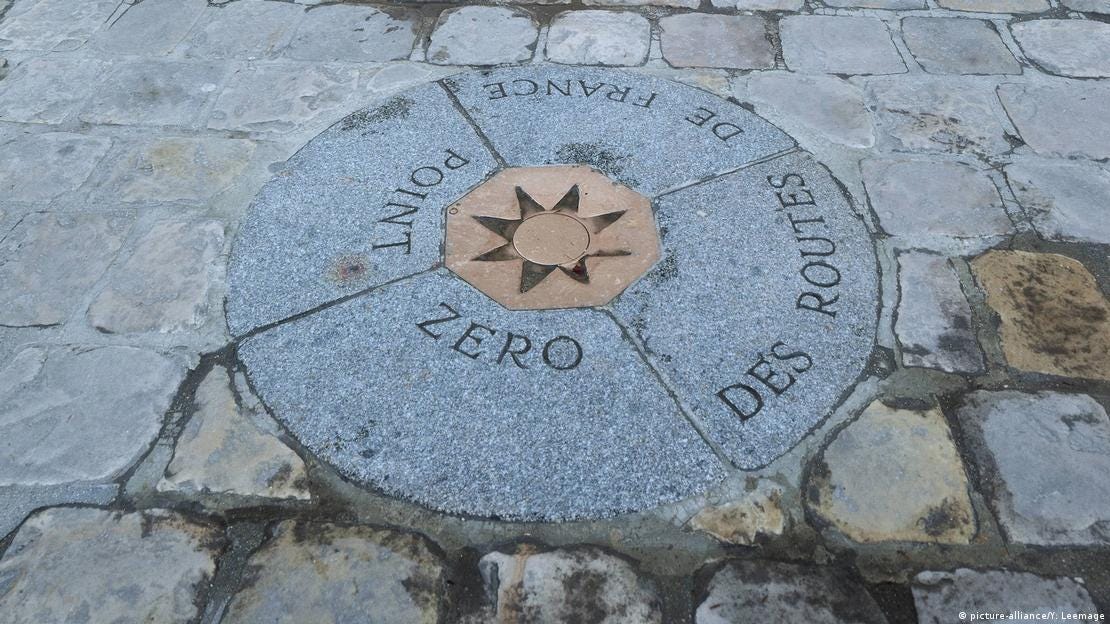
For more very interesting information of Notre Dame and the Fire, Wikipedia has a wonderful page with many specifics that weren’t known during the first months after the Fire. You’ll find it here
A bientôt,
Sara
*The feature film by Jean-Jacques Annaud, reconstructs hour by hour the incredible reality of the events of April 15, 2019 when the cathedral suffered the most important disaster in its history. And how women and men will put their lives at risk in an incredible and heroic rescue.
Thanks for reading Out My Window! Subscribe for free to receive new posts and support my work.


 Out My Window