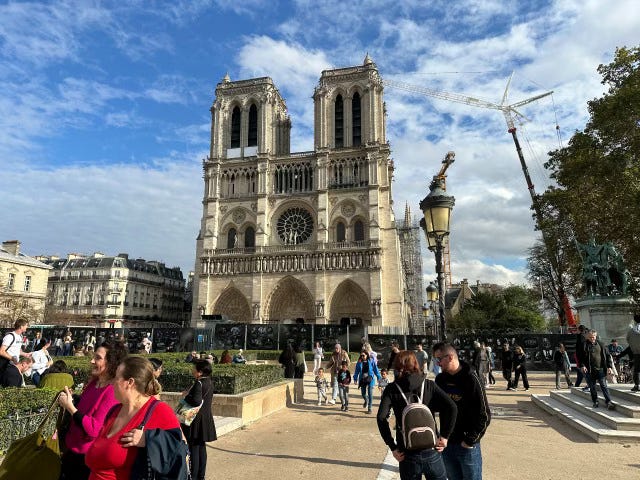
The big news today in Paris is that the dates for the reoopening of Cathedrale de Notre Dame (which many of you will remember burned in a horrendous fire in 2019) have been set.
“Christians and non-Christians around the world watched in horror almost five years ago when flames engulfed the rooftop of the beloved 800-year-old Cathedral of Notre-Dame de Paris. When the spire toppled over in the early evening of April 15, 2019, crashing through the roof’s nave and sending billowing, ominous smoke into the Parisian skies, we all wondered if the cathedral would survive. Yet, here we are five years later, waiting with bated breath for Notre-Dame’s grand reopening and comeback. Rebuilt and restored. And word has it, the cathedral is more beautiful and transcendent than ever.”
Thanks for reading Out My Window! This post is public so feel free to share it.
“Our first look inside the restored Notre-Dame will be on November 29, 2024 when President Macron makes his seventh and last visit to the worksite inside the cathedral before it is officially handed back to the Paris Diocese in early December. The state was responsible for the full restoration of Notre-Dame after the fire, which it entrusted to the Notre-Dame Restoration Committee. Remember, the French President expressed his determination that the landmark would reopen its doors five years after it suffered serious damage to its structure.”
“December 7, 2024..(is the day). The President of the French Republic returns to Notre-Dame in the evening for the official reopening. On the square in the forefront, he will deliver a short, emotional speech before declaring the handover of the cathedral to the Archbishop of Paris. Monseigneur Laurent Ulrich will knock on the medieval doors of the cathedral three times with a crozier, his special staff. The cathedral, which had been silent, then “answers” him by singing Psalm 121 three times – resounding again with the song of praise. On the third time, the doors open. The eight bells of Notre-Dame will also ring again, beckoning everyone to come in.
On this occasion, 100 world leaders, dignitaries, religious leaders and the faithful have been invited to the official ceremony that will be broadcast live by France Television and shared with international media. Inside, vestiges and prayers will be delivered.”
“The following day on December 8, Msgr Ulrich will oversee the inaugural mass at 10:30 a.m. Paris time. The rector, Msgr Olivier Ribadeau-Dumas, will be by his side. The religious procession will be filled with color and emotion. The liturgical vestments worn by the clergy have been designed by Jean-Charles de Castelbajac, a fixture on the French fashion scene. The capes recall medieval chivalric style with golden crosses surrounded by bursts of shards in primary colors, reflecting nobility and simplicity, modernity and joyful outreach. The President is expected to attend mass with over 1,200 guests representing various religious and charitable associations, workers, and donors who contributed to Notre-Dame’s restoration.
A second public mass is scheduled for the evening at 6 p.m. local time. France Television will cover the two masses live, and international media will be able to broadcast their images as well.”
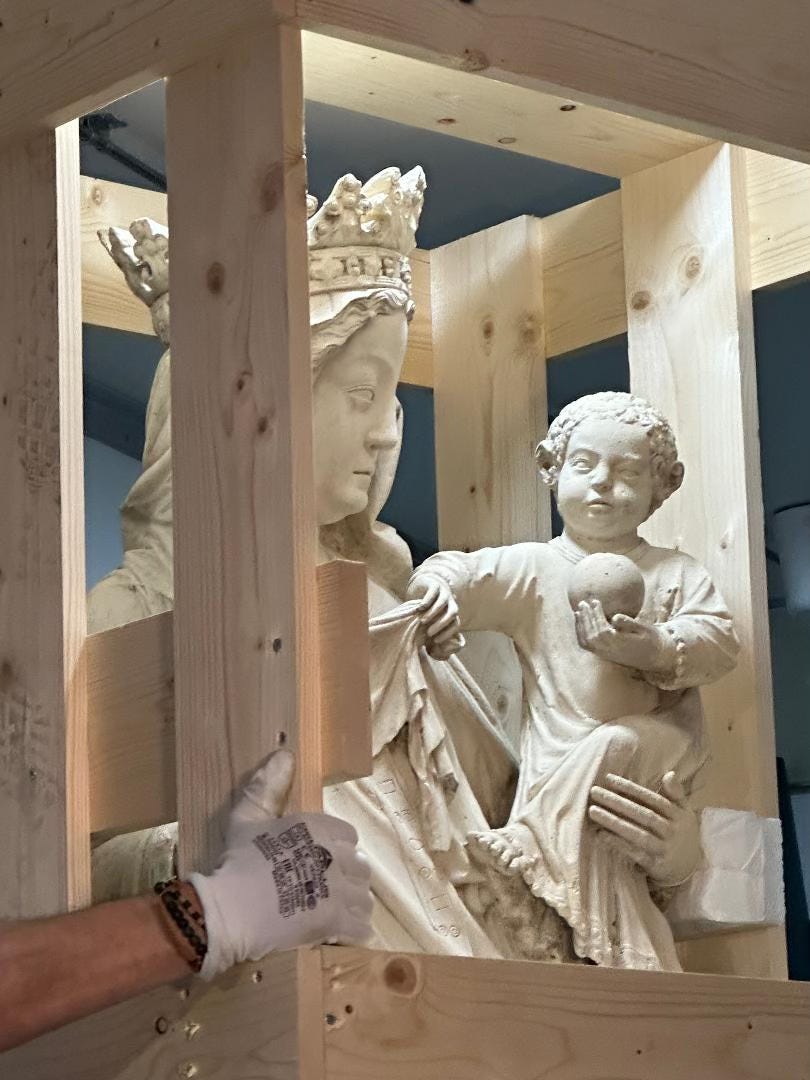
The beloved Mother and Child survived the rooftop collapse and was placed back in the sanctuary Nov. 15, 2024 Photo: Nancy Ing Duclos
“Check the Notre-Dame website for the registration link to reserve free seats for masses and private prayers as well as visits in the first week of the reopening (reservations should open around December 1, 2024). Or, look out for the new Notre-Dame mobile application to reserve dates and learn more. Five newly organized tours are available for visitors to fully appreciate and experience the full breadth of Notre Dame’s history, architecture, spirituality and restoration.”
“The Crown of Thorns will return to the cathedral’s treasury on December 13 in a grand ceremony. This religious relic, believed to be the woven crown worn by Christ on his way to crucifixion, was saved the night of the fire by those who risked their lives to enter the burning church.
On December 16, the cathedral returns to a normal schedule offering daily mass three times a day to the public.
Musical concerts with international artists are planned for the cathedral every Tuesday night for the following new year. Click here for the program and to reserve seats.”
So today, we in France give thanks that our beloved Cathedrale has survived and we will all get to visit the new and we are told even more beautiful inside in the near future.
Thanks for reading Out My Window! Subscribe for free to receive new posts and support my work.
“Donald Trump’s election for a second term will have consequences beyond the United States and in Europe in particular. The Republican has repeatedly tested the United States’ relationship with its historical allies and he notoriously promised to settle the war in Ukraine in “24 hours”.
But that doesn’t say what Trump will actually do once in office. What do the president-elect’s first declarations and appointments suggest? And will he deal with a united or divided Europe?”—Le Monde
This Q & A was held virtually. To read as the questions were addressed, start at the bottom of this Substack.
Thanks for reading Out My Window! This post is public so feel free to share it.
This is the end of our Q&A. Thank you very much for your great questions, looking forward to discussing Trump again with you on Le Monde in English!
Sylvie Kauffmann (Columnist)
4:47 PM (Paris)
Many Ukrainians I know seem happy about his reelection, hoping for change. Given he often oscilates between extremes, could we actually expect a positive change when it comes to US support for Ukraine?
Haris
Hi Haris,
This is a very good observation. Many Ukrainians, including in the leadership, have been frustrated over the past several months by the Biden administration’s hesitations, particularly by its refusal to grant permission to carry deep strikes within Russian territory using Western long-range missiles. I have even heard the nickname “Snake Sullivan” for Jake Sullivan, Biden’s National Security Advisor. They pointed out that Trump, during his first term, provided them with the first lethal equipment, the Javelin anti-tank missiles, that Obama had denied them. So those who were most critical of Biden hoped for a positive change if Trump was elected. Whether this positive change will actually happen is anybody’s guess. I think it will very much depend on President Putin’s attitude and also in part on China’s position, since it supports Russia in this war.
Sylvie Kauffmann (Columnist)
4:39 PM (Paris)
What will be the consequences of the political crisis in Germany for the union of Europe?
Clem
Hi Clem,
The first consequence of the political crisis in Germany is that it is missing in action at this crucial moment when Europeans should be getting together and showing a united front to the future Trump administration. The general election has been set for February 23, which means that Chancellor Scholz and his team will be busy campaigning when Trump is inaugurated and possibly when negotiations start over Ukraine. And it will probably take at least another month or two, or more, to build a governing coalition after the election.
This is the odd and unfortunate situation in Europe at the moment: its two biggest countries, Germany and France, which are supposed to provide the European “engine,” are weakened by domestic political and economic problems. This gives more space to a new player, Poland, to be more active: this is exactly what the Polish prime minister, Donald Tusk, has been doing since Trump’s victory, trying to coordinate a European common position to strengthen Ukraine in the event of a negotiation.
Published on November 7, 2024, at 4:06 pm (Paris) 2 min read
Sylvie Kauffmann (Columnist)
4:27 PM (Paris)
Does Trump care about Macron, one of the first leaders to have congratulated him on November 5?
Erika
Hi Erika,
You are right: Macron was actually the third European leader to congratulate Trump on November 6. The first one of course was Viktor Orban, who celebrated on X “the biggest comeback in American political history,” the second was the Austrian chancellor. Macron certainly hopes to resume the friendly relationship he had with Trump during their first term (Macron was elected president for the first time in 2017), even though he failed to convince him not to withdraw from the JCPOA (the Iranian nuclear deal) and from the Paris climate agreement. But they managed to have a working relationship, one that would be very helpful to have this time too.
But things are different today. The world is much more dangerous and unstable, a war is raging in the heart of Europe and the 47th president of the United States will most likely be more radical than the 45th. Also, Macron is weaker than during his own first term because of the political crisis at home and the fact that he no longer has a majority. So it remains to be seen who, with Trump, will speak for Europe. Orban will certainly have a close relationship with him but he can’t claim to speak for Europe.
Sylvie Kauffmann (Columnist)
4:10 PM (Paris)
Can Biden grant Ukraine membership to NATO invitation before the end of his term?
Ali
Hi Ali
Yes, theoretically, President Biden can state that he is in favor of extending an invitation to Ukraine to join NATO − something he has consistently been opposed to so far. This was part of the “victory plan” President Volodymyr Zelensky presented both to Biden and Trump in September. But this is not the most likely scenario.
Published on September 18, 2024, at 10:23 am (Paris) 4 min read
Sylvie Kauffmann (Columnist)
4:01 PM (Paris)
Are the Europeans hoping to obtain anything from the Biden administration in the next two months? Something that couldn’t be undone immediately by Trump
Liam
Hi Liam,
Yes indeed. This was the subject of the talks held yesterday in Brussels between Secretary of State Antony Blinken and NATO leaders and officials. The idea is to strengthen Ukraine’s armed forces and possibly provide them with more equipment in the short term so that Ukrainian leaders are in a stronger position when a negotiation with Russia eventually starts. But the Biden administration and Europeans must act very quickly, as the situation on the frontline is deteriorating.
Published on November 9, 2024, at 4:00 pm (Paris) 13 min read
Sylvie Kauffmann (Columnist)
3:58 PM (Paris) Further reading
The Republican president-elect has stepped up his threats to withdraw the US from NATO, to which it is the main contributor. Allies anticipate a symbolic withdrawal from the coordination of military aid to Ukraine.
Published on November 9, 2024, at 11:45 am (Paris) 6 min read
3:53 PM (Paris)
Are the Europeans involved in negotiations now with Russia to end the war or do they just want to continue to send aid to Ukraine hoping that the Russians capitulate? Trump says he is going to appoint a special negotiator.
Thomas Winterbottom
Hello Thomas,
Very good question! As far as we know, there are no negotiations going on at the moment. Most chances are that in Trump’s mind, any negotiation to end the war in Ukraine will be held between Russia and the United States – hopefully also with Ukraine involved. But he has never mentioned the possibility of inviting Europeans to sit at the table. This is a huge issue for them, particularly for France, because what is at stake in a possible settlement of the war in Ukraine is not only the future of Ukraine but also the whole security environment of Europe. President Emmanuel Macron said on Tuesday: “Let me be clear: nothing must be decided on Ukraine without the Ukrainians, nor on Europe without the Europeans”.
Sylvie Kauffmann (Columnist)
3:44 PM (Paris)
Do you foresee Trump following through with his threats of tariffs?
Ricardo Bruinton
Hi Ricardo,
Yes! I think this is one of the few things we can safely predict, unfortunately. The EU is better prepared this time, but it remains to be seen whether Europeans have really learnt “the art of the deal”.
Sylvie Kauffmann (Columnist)
3:44 PM (Paris)
How will Trump deal with NATO and America’s défense within Europe ?
Nigel
Hello Nigel,
We don’t yet know exactly how Trump will proceed. What we do know is how he behaved in his first term: he accused the Europeans of being free riders in NATO, of taking advantage of the United States and he demanded they spend more for their defense. The situation has improved on that issue: there are now 23 NATO members, out of 30, who have reached the minimum of 2% of their GDP in military spending. It would not be surprising that Trump now raises the threshold to 3%. Some Europeans fear that under a Trump presidency, the US might withdraw from NATO, but that seems highly unlikely, as NATO is also useful to the US. And if Europeans spend more for their defense, logically they will buy more American equipment, which is good for the American economy.
Sylvie Kauffmann (Columnist)
3:30 PM (Paris) Further reading
Hungarian Prime Minister Viktor Orban hosted a European Political Community summit in Budapest on November 7, followed by a European Council meeting.
Published on November 8, 2024, at 12:42 pm (Paris) 5 min read
2:50 PM (Paris) Further reading
The election of Donald Trump has plunged Ukraine into the unknown. The country is preparing for a ‘very delicate diplomacy’ when he takes office on January 20, 2025.
Published on November 13, 2024, at 4:15 pm (Paris) 3 min read
2:45 PM (Paris) Further reading
Speaking before members of the European Parliament, the European Union’s new high representative for foreign affairs put forward a slightly different vision from the one held by her predecessor, Josep Borrell.
Donald Trump’s re-election to a second term on November 6, and the success of the Republican Party, of which he has taken total control, represent a major turning point for the United States.
Published on November 6, 2024, at 11:15 am (Paris) 2 min read
2:32 PM (Paris) Further reading
Faced with the prospect of a settlement of the war in Ukraine from which they could be excluded, some European countries, such as Poland, are taking action, writes Sylvie Kauffmann in her latest column.
Four weeks ago, June 6-9, there was a parliamentary election in Europe, the tenth since the formation of the EU, the first since Brexit. The Far Right won the most delegates in France. Marine Le Pen and Jordan Bardella, her handpicked ersatz leader of RN (Rassemblement National), began to crow. Within one hour of getting the results, without any warning to his deputies or his “friends”, President Macron dissolved the standing Parliament and called for new elections. They would be held on Sundays: June 30 and July 7.
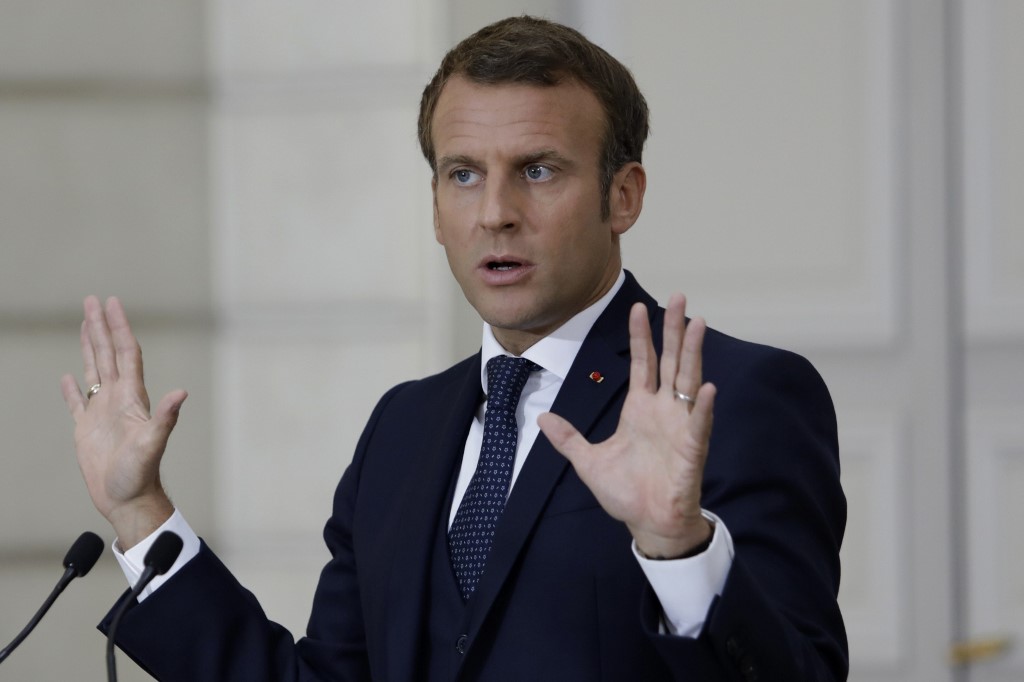
The country went into a tailspin. Journalists tried to guess why he did this. Most thought it was suicidal. In France, there are many parties from the Far Left to Center Left to Center Right to the Far Right. Macron first ran as Center neither left nor right but has turned out to be far more Right. He won his second election by a hair, many French voting against Marine Le Pen than voting for Macron. His newly formed party, Ensemble (Together) did not win a majority in the Parliament in 2022 so Macron has had difficulty passing many of his reforms. In many cases, the government has used the Article 49 of the French Constitution, paragraph 3 (Article 49.3) which allows the government (essentially Macron) to pass a law without a vote. Some journalists think that he knew he’d reach his limit of doing that. People were angry. He seemed to be favouring the wealthy. If he hadn’t dissolved the parliament, there could have been a call to pass a motion of No Confidence.
My friend, Fatiha, has been explaining to me what has happened day by day. The voters of France were galvinized. For many, the goal became ‘keep the Far Right from getting power.’ The same night as the dissolution, spurred on by François Ruffin, four parties on the left banded together and called themselves Nouveau Front Populaire. These parties do not agree on many things but they do agree that letting the Far Right get power would be disastrous for the country. They put aside any disagreements they had and campaigned as one party They agreed on a social program determining how much each piece of the program would cost. They worked on this for four days. They were the only party to think out and present a detailed plan. Fatiha and her friends were out on the street every day passing out flyers. They went door to door (mostly apartments, they would start at the top floor and work their way down) and talk to people. I asked Fatiha if people slammed doors on her. No, she told me. Some didn’t want to talk but many did. She would send me a photo of the campaigners at the end of the day all happy and exhausted.
Then came the first vote on Sunday, June 30. The outcome was 33% for the RN (Marine Le Pen), 28% for NFP (the Left), and 21% for Macron’s party. All the rest had under 12%. If a delegate received over 50% of the votes AND 25% of the constituency had voted, they were in. Marine Le Pen was in on the first vote. On July 7, all the delegates that had received over 12.5% would run against each other. This meant a triangle. There was real fear that votes would split between Ensemble and the Left giving the Far Right the majority. The left suggested and then followed through with the idea that if their delegate was in third place and RN had a chance of winning, they would drop out making it a two way run off. Macron’s party wasn’t so good. Many did drop out but many stayed. Historically, the Left has helped Macron against Le Pen probably giving him the presidency in both years 2017 and 2022. The favour has not been reciprocated or acknowledged according to Fatiha. I was now caught up in the breathtaking drama of this election. At the first election, 66.7% of France showed up to vote. “63% of French voters turned out to vote for the second round of the country’s snap parliamentary elections on Sunday, July 7, slightly less than for the first round (65%). It is the highest turnout since 1981. These figures confirm intense interest in the vote.” Le Monde
We all know the outcome. Nouveau Front Populaire won 182 seats. Macron’s Ensemble won 168 seats. Marine Le Pen’s Rassemblement National won 143 seats. A hung parliament. “A hung parliament with a large eurosceptic, anti-immigration contingent could weaken France’s international standing and threaten Western unity in the face of Russia’s invasion of Ukraine. European Union officials, already learning to deal with far-right parties in power in Italy and the Netherlands, are watching France closely. And in Rome, Pope Francis chose the day of the French vote to warn against “ideological temptations and populists”, adding: “Democracy is not in good health in the world today.” Le Monde—July 8.
The last time this kind of thing happened was in Mitterand’s Presidency. He honoured the French vote by choosing a prime minister from the party that got the most seats even though it wasn’t a majority. Fatiha has no faith that Macron will do the same. She is ready for anything sneaky, egotistical, and anti the French people. A majority of people now feel as she does. I asked her if she thought anything would happen before or during the Olympics. My common sense says it all should wait. The Olympics are fraught enough. No one knows. The French want a Parliament. Macron may try and stall. So far, he has not made an appearance on television. So far, he has not talked to the French people.
My sister wrote to me and wanted France to send NFP to the US to galvanise them. I wrote her back that there is a fatigue in the US. Much as I detest Marine Le Pen and her beliefs, she is not a criminal, she hasn’t stirred up the kind of violence that Trump has, she seems to keep her language in check. Americans seem inured to the most detestable way of speaking, they expect lies on a daily basis. We, in France, have watched stunned as all the news after the Biden-Trump debate has been about Biden and his age. Nothing about Trump’s criminal acts, his inflammatory speeches and actions, and he seems much more deficient in brain cells than Biden. WTF is going on? (Read my friend Pamela Drake’s Substack for an opinion:
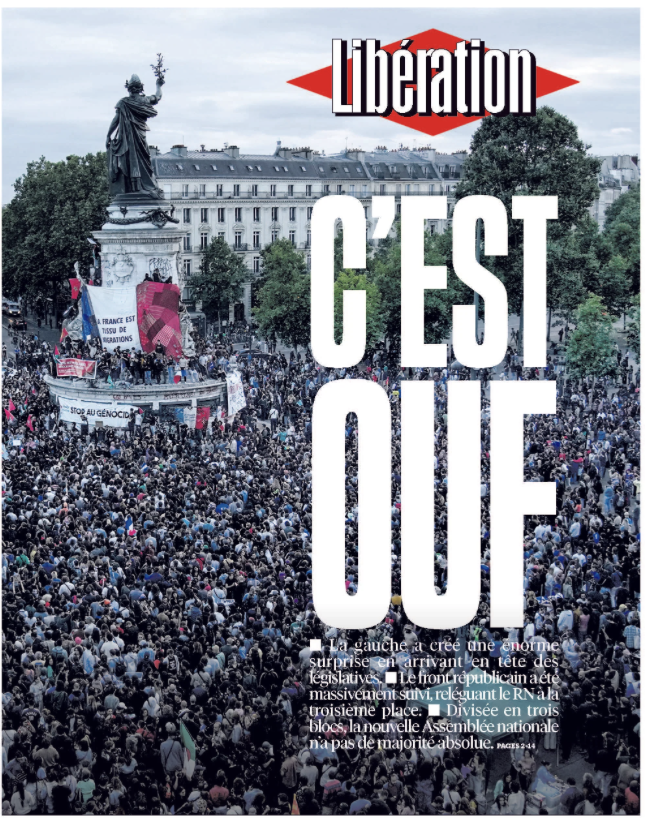
And what the heck does “C’est Ouf” mean? It’s a wonderful expression!
“C’est ouf – roughly pronounced say oof – is a colloquial French expression to express shock or surprise.
It is the rough equivalent of ‘it’s wild’ or ‘it’s crazy/mad’ in English or just ‘wow’. (From Fatiha: ‘ouf’ also means “What a relief!” This is what made the front cover of Liberation so brilliant)
C’est ouf can be either positive or negative, depending on the context.
The word ouf is the verlan, or backwards slang, of ‘fou’ which means crazy. While ouf is colloquial, you can still hear it used by people of different generations – not just young people.”—the local.fr
More excitement (and I’m afraid not the good kind) coming up.
Thanks for reading Out My Window! Subscribe for free to receive new posts and support my work.
The following is a reprint from an on-line journal that I subscribe to. All my friends in the US seem very confused by what is going on. I hope this helps.
“5-minute guide to the latest on France’s snap elections
written by Emma Pearson – emma.pearson@thelocal.com
Protesters gather to demonstrate against the far-right in Paris. Photo by Zakaria ABDELKAFI / AFP
From party alliances to shock announcements and the emerging key figures, here’s your essential roundup of all the latest from France’s snap parliamentary elections.
France will head back to the polls at the end of this month for snap parliamentary elections – called by Emmanuel Macron on Sunday in the wake of his party’s humiliating European election defeat at the hands of Marine Le Pen’s far-right Rassemblement National.
The president’s announcement caught everyone off guard – even key members of his own party – so three days later, political groups are scrambling to get ready and fight the very short election campaign.
The most widely-heard call in France over the last three days has been for a Front républicain.
The concept of a ‘republican front’ is not a new one, it essentially means that when necessary mainstream parties put aside their differences in order to combat the extremists in the far-right movement.
Most recently it’s been seen in the second round of the presidential elections of 2017 and 2022 – the final two candidates were far-right leader Marine Le Pen and Emmanuel Macron and in that context plenty of people who detest Macron and all that he stands for cast their vote for him because they considered that the alternative – a far-right president of France – was much worse.
In the context of these parliamentary elections, the Front Républicain is more to do with political parties and essentially involves parties making agreements not to run candidates against each other in certain constituencies, in avoid to avoid splitting the vote and allowing in the Rassemblement National candidate.
Talks on these potential agreements are mostly still ongoing but it would involve, for example, the four left-wing parties who made up the Nupes group agreeing to run a single Nupes candidate in each seat – rather than diving the leftist vote by fielding one candidate from the far-left La France Insoumise, one from the centre-left Parti Socialiste, one from the Green and one from the Communist party.
It’s early days, but most of these agreements are far from being done deals, despite pleas for unity.
Les Républicains is one of the two parties that dominated French politics in the post-war period – the party of presidents Jacques Chirac and Nicolas Sarkozy.
Badly weakened since 2017 and at risk of fading into irrelevance, the party has been steadily drifting to the right for several years, electing in 2022 the very right-wing Ciotti as party leader.
An alliance with Le Pen would not come as a surprise to anyone who had read his most recent manifestos and policies, but the thought of the political heirs of Charles de Gaulle getting into bed with the far-right has caused shockwaves in France and within the party itself.
Intended as a show of solidarity against the far-right, the protests are intended to echo 2002 when million of people took to the streets after Jean-Marie Le Pen progressed to the second round of the presidential election.
It’s not only opposition parties and the media who were taken by surprise by Macron’s election call, it also caught senior members of his own party off guard, with several saying privately (or less privately in the ear of friendly journalists) that they think Macron’s ‘grand pari‘ (big gamble) is a bad idea.
This number appears to include prime minister Gabriel Attal who was conspicuous by his absence for 48 hours after the announcement (even failing to post on his usually active Instagram account). However he’s now back and saying that he will do whatever it takes to “avoid the worst”.
Those of Macron’s ministers who are members of parliament – and in France it is not necessary to be an MP in order to be a minister – are also declaring their candidacy in these elections and so far there are no surprises . . .
Key dates
Candidates have until Friday to confirm that they are standing. The formal campaign period begins on Monday, which is when election posters will start to go up and TV debates will be organised.
Voting takes place in two rounds; Sunday, June 30th and Sunday, July 7th.”
Thanks for reading Out My Window! Subscribe for free to receive new posts and support my work.
Please leave comments below with thoughts and questions and I will do my best to answer as the elections move closer
It’s July 7, I have not yet heard from Stanford. I’m not holding my breath. I’m not anxious or letting the world pass by. In fact, the news of the world seems to be coming in fast and furious. Some bloggers I know are writing that their brains have gone on tilt-too much, too fast, too sad, too awful–and how hard it is to write at the moment. I absolutely concur. So I give you the things I’m focused on.
Today, Boris Johnson stepped down as Prime Minister. “It is clearly now the will of the parliamentary Conservative Party that there should be a new leader of that party and therefore, a new prime minister,” said Johnson. Ya think???? This morning I woke up to news that he was going to stick to it come hell or high water (my words). Four hours later, everyone who gets notifications on their phone got the same message as I did. CNN reported that Johnson is not planning to leave office immediately, however. “I’ve today appointed a Cabinet to serve, as I will, until a new leader is in place,” he said, in a televised speech outside 10 Downing Street. Hmmm. How much damage can he do between now and then?
British Prime Minister Boris Johnson walks at Downing Street in London, Britain July 6, 2022. REUTERS/Henry Nicholls
Everyone I know is getting Covid. Two friends came over, vaccinated and boostered, got Covid here (Europe) and I spent time on the phone with them helping them figure out what to do. Three friends were over here and tested positive after their return to the US. This virus will keep mutating and figure out how to get around all the vaccines. The great saving point is that it does make one sick but not so sick as to go into the hospital or die.
Covid Rears Its Ugly Head Again The seventh wave of new Covid cases in France is getting worse by the day, over 125k cases confirmed on July 1st, with the Ile-de-France (Paris) and Brittany leading the pack, and the Atlantic and Mediterranean coastal towns not far behind. The government recommends wearing masks, and encourages anyone over 60 or at high risk to get a fourth dose of the vaccine, but the government is too gridlocked to pass even the smallest of restrictions, so at the moment there’s no “risk” of the Pass Sanitaire or lockdowns making a comeback.
From ‘Secrets of Paris’ blog
In French Politics, Macron was forced to shuffle his cabinet around. “France has entered a new political era; or has reverted to an old one. Parliament is divided and therefore parliament rules. The President can no longer treat the National Assembly as his rubber-stamp or echo chamber. We have returned to the France of the 1950s or the 1930s, before Charles de Gaulle invented the supposedly all-powerful presidency (but left the ultimate power in parliament).”–John Litchfield in The Local. For more of his analysis, go to: https://www.thelocal.fr/20220706/opinion-france-begins-a-new-political-era-and-its-going-to-get-messy/?tpcc=newsletter_member
French Parliament
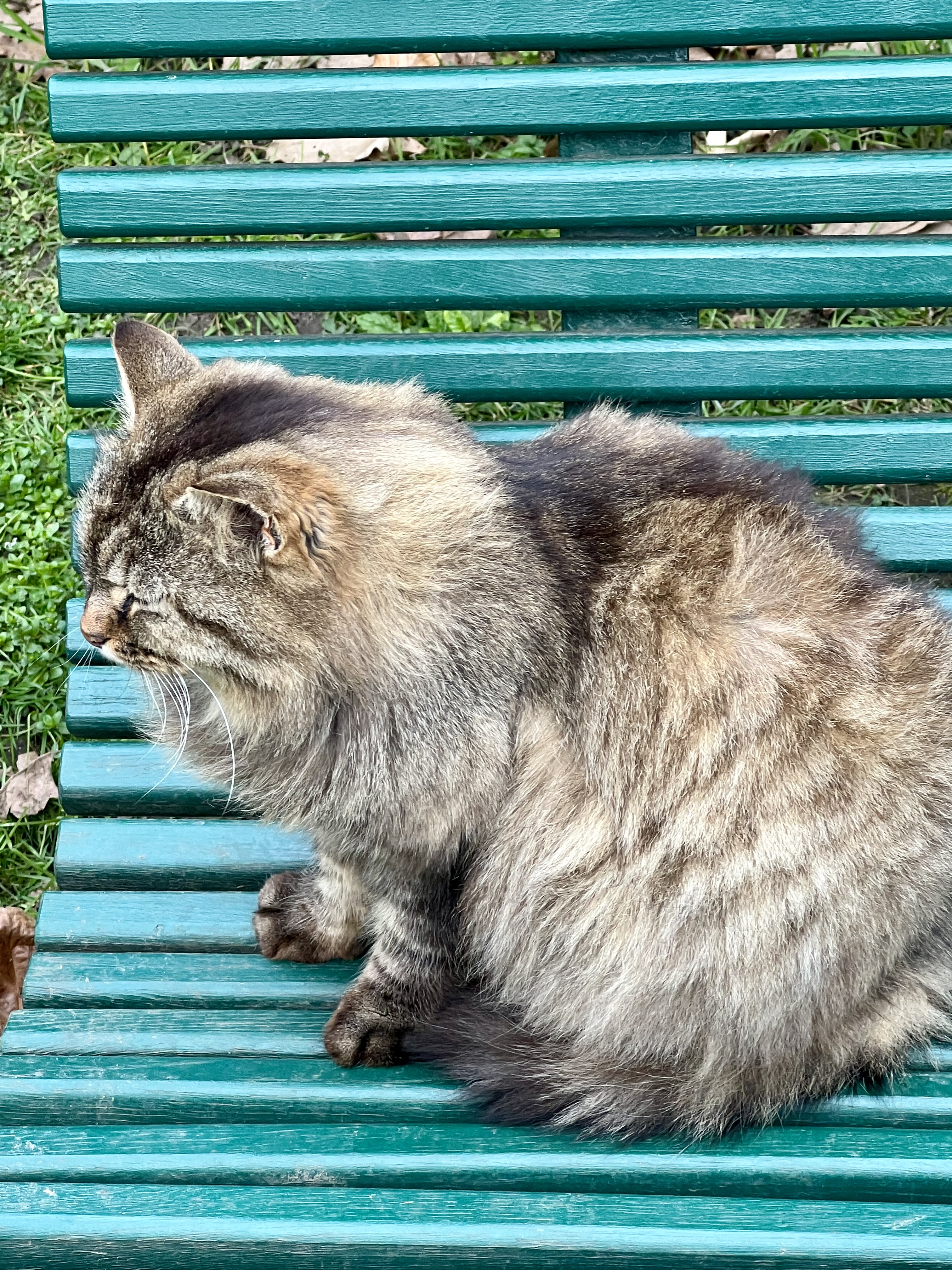
And on a sweet note, on a walk in the Parc de Bagatelle this past Sunday, I learned about two of the sweetest cats there. Their names are Zoe and Gaston. They come from a circus. Once the pandemic hit 28 months ago, the circus approached the non-profit that feeds and cares for the cats in Bagatelle and asked if Zoe and Gaston could stay there. The volunteer assured me that there was no abuse, nothing like that. The circus felt strongly they would be better cared for by the wonderful volunteers who come everyday to feed the cats. I went over and petted Zoe who rolled over on her back to get her belly rubbed. No wonder I see the two of them sitting on benches with people reading or just hanging out in the sun.
Zoe (or Gaston) waiting for company to sit on the bench with them
There is supposition that France is in for a long heatwave. Last summer, we had rain all summer and no canicules (heatwave). So far, we have had two that have been called a canicule and more is yet to come. Depending on where you are in France, it can be fine. In Paris, where the pollution is terrible, heatwaves are awful to bear. In the south of France where many people live in stone houses, one keeps the shutters closed, the lights off, and one stays inside cool as a cucumber until evening. As long as there is no humidity, these heatwaves cannot be compared to NYC or Philly in summer. However, if you have porcelain, British skin, it is hard to get through a french summer. I have dark olive skin inherited from my Russian grandparents and I love the heat of summer.
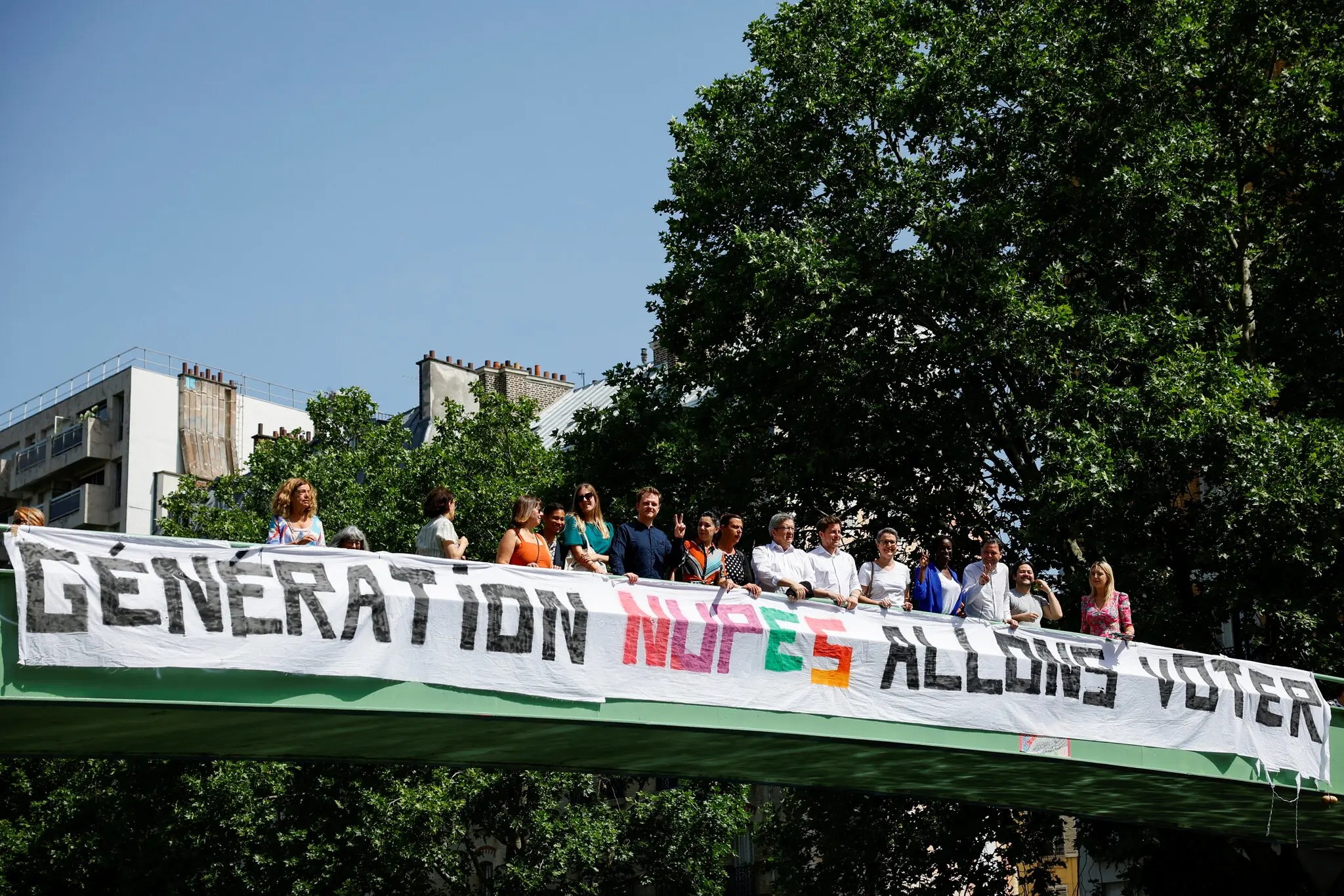
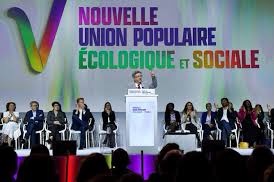
Two Sundays ago, June 12, the citizens of France voted in the first of two elections for seats in Parliament (Assemblée Nationale). For the past five years, President Macron has held a majority and been able to lead top down. Macron won his second election for President but is not enjoying the popularity he had in 2017. The parties on the left, who have a long history of fighting with each other, felt a resurgence of hope when Jean-Luc Mélenchon came in a very close third in the first Presidential elections. Now Jean-Luc Mélenchon’s party, LFI (La France Insoumise) has created along with three other leftist parties a new coalition known as the NUPES (Nouvelle Union Populaire Écologique et Sociale). On June 12th, the NUPES won a tenth of a percentage point more than Macron’s party, En Marche. Who are the NUPES why is this not good news for Macron?
Generation NUPES. Go Vote!!
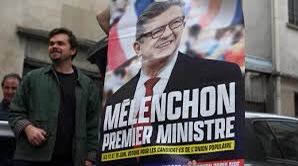
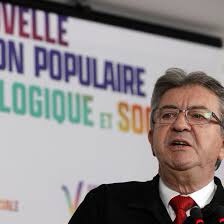
Mélenchon has not been a popular candidate (He also ran for President in 2017). They call him the Bernie Sanders of the French, but he doesn’t have Sanders’s personality. You mention his name and people used to say, “oh Mélenchon, he’s crazy’. But he is a leftist and with his high percentage of votes during the first round of Presidential elections, people on the left are looking to him for guidance to create obstacles for Macron. He has become the defacto leader of NUPES. As Macron has been leaning more and more right in an effort to appease conservatives, he has neglected what has been happening on the left. The four parties that have allied together to become a new left alliance are Mélenchon’s LFI, the Greens, the Communists, and the Socialists. The Nouvelle Union Populaire Ecologique et Sociale. NUPES (pronounced Newps or New Pays). If this alliance won a majority in the National Assembly on the 26th of June, Macron would be forced to reckon with this block and probably Mélenchon would become Prime Minister. The few times this has happened in the past, the president would deal with foreign policy and the Prime Minister with domestic. All 577 seats are up for grabs. Macron needs a majority, 289, to maintain the power he has enjoyed his first five years as President. En Marche, soon to be renamed Renaissance, could win 255 seats. NUPES is projected to win 150-190 seats. Marine Le Pen’s party could win as many as 40 up from 8 in 2017.
There is one other block of voters that made themselves known Sunday, the 12th. The no-shows or abstainers. According to the media, this is the largest no-show of voters – 52% — ever in France. It is made up mainly of young people who have stopped caring, who feel powerless to do anything about their circumstances. There is a chance that these people could be motivated to vote for NUPES. Followers of NUPES are out on the streets campaigning in every arrondissement of Paris urging these people to go to the polls on Sunday. Although the chance of NUPES gaining the majority of seats this Sunday is very low, this group of people if motivated to get to the polls, could make all the difference.
“Perhaps the most notable loser on Sunday was far-right pundit Eric Zemmour, who attracted vast media attention in the presidential race but has so far flopped as a candidate. Zemmour failed to advance to the second round on Sunday in his bid for a seat representing Saint Tropez. Nationally, his Reconquest party won just 4.24 percent of the vote, and did not send a single candidate to the run-offs.”—France24.
To keep leftist voters away from the polls or to convince them not to votes for NUPES, Macron and his buddies have reverted to some bizarre scare tactics. In a guest essay in the New York Times, Cole Stangler, (an American journalist based in France), wrote, “Amid tight polling and mounting anxiety, Mr. Macron and his allies have sought to tap into fears of this very scenario, reverting to red-baiting. The finance minister has likened Mr. Mélenchon to a “Gallic Chavez” who would “collectivize” the economy and bankrupt France, while a leading lawmaker from Mr. Macron’s party has warned of a “return to the Soviet era.” The chief of France’s top business lobby has said Mr. Mélenchon risks pushing the country “to the brink.”
In fact, the coalition’s actual platform is far from revolutionary. It’s inspired more by the golden days of European social democracy than by the Bolsheviks. The coalition’s two signature economic policy proposals — a hike in the minimum wage to 1,500 euros, or about $1,560, a month and a cap on the prices of essential goods — are modest measures at a time of rapidly rising inflation.
Plans to raise taxes on the superrich and boost investment in schools, hospitals and transport networks contrast with Mr. Macron’s embrace of the private sector, it’s true. Yet these are popular, standard-fare progressive policies in Europe. The alliance’s bold climate proposals — a five-year €200 billion, or nearly $209 billion, green investment plan driven by the principle of “ecological planning” — have led the ecology minister to accuse NUPES of “playing on young people’s fears.” But it’s hard to see the plans as anything other than an attempt to tackle the climate crisis head-on. The costs of inaction would be much greater, anyhow.” June 16, 2022
One thing is sure, since Macron will not gain a majority in Parliament, he has to stop governing top down. He and his ministers (some of whom may not even make it back to their seats in Parliament), will have to compromise with both the left and the right. The right is a solid unit that has actually spread from the southeast of France up North and northeast. The question will be – can those four entities on the left, the NUPES, who have vehemently disagreed with each other over the years stick together with an overall plan or will they fall in to in-fighting? I may be projecting my own fears of the US Democratic party which seems to shoot itself in the foot whenever possible.
Jean-Luc Mélenchon
My take on French politics has never been very clear. However I have found the rise of NUPES to be very interesting and I’ve caught the excitement that this alliance has incited. I hope I’ve been able to explain, albeit very simply, what is happening here in France and what the results on Sunday may look like.
Watch the voting news on Sunday, June 26, to see how all this plays out.
Janet writes a wonderful blog called Writing from the Heart. This blog spoke to me and for me. I wanted to share with you. The word ‘lassitude’ has now made it into my english vocabulary.
Reminders about “les gestes barrieres” in a train station
I had to look up the word “lassitude” this week. It is a word (in French) that is being spoken a lot recently. We have the same word in English, but it is one of those words we don’t use very often, so I had to look it up even in English. It means weariness.
Weariness is of course not quite the same thing as being tired. Being tired is something that can be cured by a nap, or perhaps a good night’s sleep. Weariness, on the other hand, suggests a fatigue born of an extended period of being tired of, or because of, something, something that wears down not only one’s level of energy, but also motivation, spirit, enthusiasm, and certainly joie de vivre.
And that is what we have here in France right now. Lassitude as we go into Year 2 of the Covid 19 pandemic.
There has been a lot of complaining this week, especially since, given concerning increases in the number of infections, especially in certain parts of France, and even more because, given frankly almost alarming reports of the increasing pressures on the hospitals in those regions, the government–some would sayfinally, others would say ridiculously–has imposed another set of restrictions.
This time only 16 departments of France (including Paris and the surrounding region, and also Lille, Nice, and their surrounding regions) are included. The theme of the lockdown this time is freiner sans fermer, which means “put the brakes on without closing down.” This has meant a rather complicated (and controversial) set of rules about what kinds of enterprises can stay open (bookstores, florists, hairdressers, bakeries OF COURSE) and which kind cannot (large-surface stores, museums, theaters, restaurants and cafes).
It’s been a terribly long time for some sectors of the economy, most notably restaurants and cafes, museums, theaters, and so on. It’s heartbreaking to hear restaurateurs in particular talk about their anxiety, about how they can possibly manage not to go out of business altogether, these people who in normal times provide all of us with such a wonderful service. (The word “restaurant” after all, comes from the French word restaurer (to restore). Think about that!) Managing a restaurant, it has always seemed to me, must be one of the hardest ways to make a living. How will they get through this?
The answers to these questions are not clear to me. In the beginning of the crisis, a year ago, one of the things that was most impressive and comforting to me about Macron’s address to the nation was the stress he placed on how the government intended to do everything it could to not only deal with the crise sanitaire (the health crisis) but also the economic consequences of having to shut so much of the economy down. Has this government kept those promises? I’m not too sure about that, but much of what I hear on French TV and radio suggests that whatever is being done is too little too late, or maybe in some cases not at all.
Some businesses have been spared the shutdown this time–bookshops, hairdressers, florists and of course bakeries and other food shops. The despised attestations that everyone was required to carry in the previous two lockdowns every time they left their homes is not required this time for people going out during the day and staying within the 10 kilometer limits of the restriction. And there is no time limit on how long you can be outside this time, for which everyone is grateful.
As I mentioned in my last post, I think it’s important for everyone to keep in mind for whom this year-long crisis is the most difficult, and calibrate our personal annoyance and lassitude with the situation accordingly. Of course everyone has had it with this crisis. (In French, the phrase is “on en a marre.”) But really, we do not all have an equal right to “having had it”: the health care workers who were being cheered in the streets as they made their weary way home after difficult days of saving lives a year ago are not being cheered anymore. Instead they are having to work just as hard (or harder) than they did a year ago with what must be an overwhelming sense of fatigue and pessimism about whether this extended trial will ever end. They are the ones who have the greatest right to being sick of it all. We have to just hope that they don’t throw in the towel, and be extremely grateful that most of them are not doing so. We need them!
I also would like to say something that I am pretty sure is going to be somewhat controversial, perhaps even downright unpopular. But I think it needs to be said. And that is that the amount of intense criticism that the government here in France is subject to is, I believe, somewhat unfair.
This is not to say that I do not agree with the thousands (millions?) of people who feel that the Macron government has bungled the managing of this crisis. What seemed to be a strong start in the beginning of the crisis is not as admirable by now, a year in. There are many reasons for this, some the fault of the government, and of Macron himself; but many of them are no one’s fault, really.
The problem is that this is so far, a very difficult crisis to manage. It may even be, to some extent, more or less impossible. One doesn’t have to look very far, all around in Europe in fact, to see that it is certainly not just Emmanuel Macron who is having a hard time figuring out what to do to keep his people safe, and prevent the economy from completely crashing.
This is a new disease, and new problems keep cropping up: shortages of the vaccines that almost miraculously have been able to be developed on such a short timeline; new variants of the disease cropping up all over the place in a most dismaying way. Europe is also struggling with trying to figure out how to function as a “union” rather than just a set of separate political entities that exist geographically adjacent to each other. It’s not easy (take a look at the United States to see how just how not-easy “forming a perfect union” can be, and how long it takes…)
So, while I do believe there’s been a lot of bungling in France since the fall. And while I personally believe that that is mainly because the government did not continue to listen to doctors as carefully as they should have, and did, in the beginning of the crisis. Where we are now was fairly predictable and probably could have been avoided by earlier, more aggressive governmental action. And by listening to the doctors, many of whom said “partial measures do not work.”
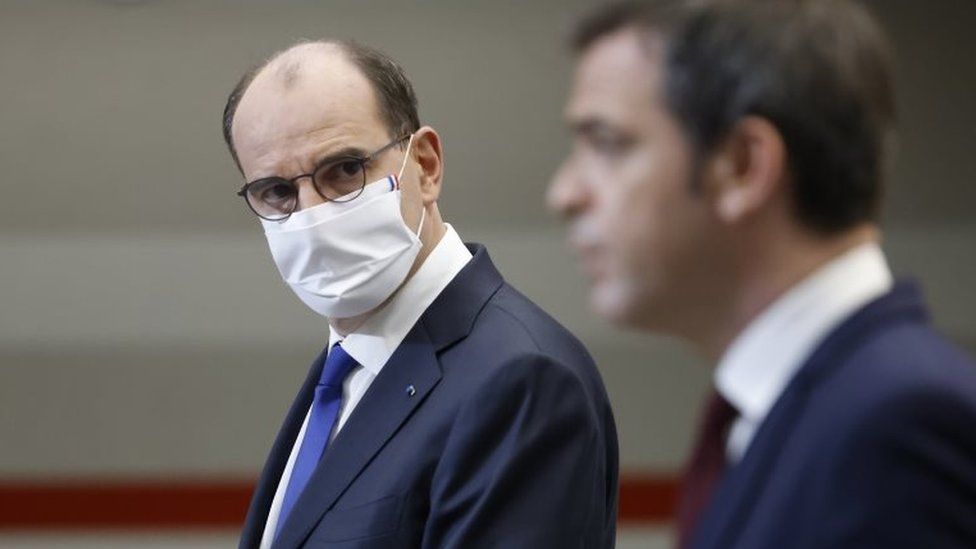
But I cannot help but think about what it must be like to be Emmanuel Macron, or Jean Castex, or Olivier Véran, the French minister of health, these days. I think we should all remember that these too are human beings, flawed like all human beings. They have probably made some big mistakes. But who among us would want to have the heavy burden of the responsibility that is on their shoulders? Who would want to have to keep guessing, or betting, or hoping rather than being able to plan in a way that was predictably fail-proof? Who would want to be any one of them trying to figure out what to do, trying to go to sleep at night, looking in the mirror and asking oneself if what they are doing is the right and best thing?
When I hear these people being criticized so strongly, I can’t help but think about their humanity, and how tired (and frightened) they must be as they struggle to keep up with this monstrous, protean virus.
The thing I think should be remembered is this: these are people who care and care deeply. We all saw the dreadful reality of a powerful leader of a nation who really did not care about the fact that hundreds of thousands of his citizens were dying, and who made things much worse, not better. (And his comment? “I take no responsibility,” and “It is what it is…”)
France is not in the hands of such people. I think they’re doing their best, or at least they’ve been trying to.
If we are going to blame anyone for this crisis, I suggest we look to the billionaires of the world, who apparently have been becoming even more obscenely wealthy, as the poorest of the poor bear the brunt of this crisis. It seems to me that the one thing that should be being done, and is not, is those very billionaires stepping up, and emptying their over-full pockets. Why couldn’t they do so? Why couldn’t they help the government by dumping some of their wealth in those places that need help the most? I don’t see any reason why they couldn’t.
Do you?
Janet Hulstrand is a writer, editor, writing coach, and teacher of writing and of literature who divides her time between the U.S. and France. She is the author of Demystifying the French: How to Love Them, and Make Them Love You, and is currently working on her next book, a literary memoir entitled “A Long Way from Iowa.”
Tuesday, I had an ophthalmologist appointment. A reader had written to ask me what the French thought of the insurrection in Washington D.C. last Wednesday. I thought I could answer that: that they were sad for us ex-Pats, couldn’t understand how we couldn’t see it coming, and that it was the nail in the coffin for America as the shining example of democracy. So I asked the good doctor. He laughed at me and said “Have you forgotten the Gilets Jaunes and all the destruction they did?” Actually, I had forgotten. Since the pandemic started last February, much of what happened before is gone from my mind. “The French love to dissent” he said.
“But they don’t use guns,” I told him.
“That’s true. But they did an awful lot of damage over the year of weekly protests. Remember the Champs Elysees?” I never saw it but I remember the photos of stores broken into, glass everywhere, looting, and fires in the street.
“And they weren’t goaded on by the President,” I added. He conceded that point. But he had also made his point. It is not unusual for the French to protest. They love to protest. When I was in university back in the late 60s, Paris was often shut down because of transportation strikes and postal strikes. Since I’ve lived here in Paris, there have been many transportation strikes. But the Gilets Jaunes was the longest protest I’ve seen. And who knows, if we hadn’t had a pandemic, they could still be protesting.
‘This is not America’: France’s Macron laments violence by pro-Trump supporters in US
President Macron is not a very popular president. But, in my opinion, he has done a good job of protecting us, as best he can, from the virus. The pandemic has taken all the focus away from how he was handling the Gilets Jaunes. However, getting the vaccine out to labs and given to people has proved very challenging for him and his administration. I’m not clear where the breakdown is but of all the EU countries, France seems to be the slowest. It’s even hard to get clear information even though someone from the Administration comes on TV to talk to us most Thursday nights. As of today, there is not another lockdown, but the curfew has been changed and extended. For all of France, the curfew is 6pm to 6am. If one has to go out, the ‘attestation’ is absolutely required.
French Prime Minister Jean Castex has announced a new evening curfew will begin nationally across France starting at 18:00 (17:00 GMT) on Saturday. The move is a tightening of a curfew already in place since December, which restricts movement from 20:00-06:00. BBC News
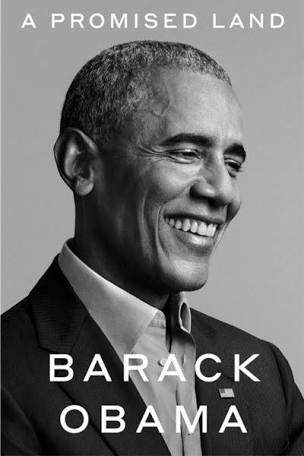
I have been reading Barak Obama’s The Promised Land. I don’t remember his other books but I am absolutely sure he is much improved as a writer. He is thoughtful, self-deprecating, and generous. Too generous. The book is long at almost 800 pages. He doesn’t repeat his earlier books. He skims over his growing up years, and then starts walking us through his many political decisions whether to run for office, their consequences, and how Michelle felt about each one. I couldn’t help but be awed. He clearly had written this book during most of the Trump presidency while Trump was publicly making it his mission to undo everything Obama. Yet, his elegant writing of his hopes and dreams, why he decided to run for President, and his basic humanity never miss a beat while, outside his study, the US was moving into crisis and the direction was clearly not what Obama has worked his whole life for. Visions of the insurrection kept coming to mind, as I was reading about the all the Hope put on Obama’s shoulders, the certainty on November 4, 2008 that finally things would change in the US. I thought once more of Van Jones’ question on CNN January 6, “Is this the death throes of something ugly in our country, desperate, about to go away and then the vision that Biden talked about is going to rise up or is this the birth pains of a worse disorder? Jones asked. “That’s where we are right now tonight. And I think the country has got to make a decision.” I thought of the Greek myths that I read in middle school. The hero has to deal with challenge after seemingly hopeless challenge as he gets closer to the prize. Is this violent outpouring of Trumpites one of the last challenges for American Democracy and the country can again move toward ‘equality for all’ or has the hero fallen and we will witness the sad flutterings of a dying dream?
And so, the world is holding its collective breath. Three and a half days until Biden’s Inauguration. The National Guard has been called out, streets are closed off in Washington. Already one person has been arrested using an unauthorised ID to get in past the “circle” of armed guards that is surrounding DC. He had a loaded Glock pistol and 500 rounds of ammunition in his car. People are being asked not to come to Washington. All 50 states have been warned that violence could erupt in their Capitols. I have canceled everything for late afternoon Wednesday so that I can watch Biden being sworn in. And, like most of my friends around the world, I’m praying for no violence. In the words of my old hippie self, “That may be a pipe-dream.”
Sonia Sotomayor
One historical note that hopefully will get air-time: Vice President-elect Kamala Harris, the first woman, the first Black and Asian, to be elected to such a high office, has asked Sonia Sotomayor, the first woman of color to be nominated to the Supreme Court, to swear her in on Wednesday. Ms Sotomayor has sworn in one other Vice President: Joe Biden in 2013!
A bientôt,
Sara
*apologies to William Butler Yeats
The Second Coming
Turning and turning in the widening gyre The falcon cannot hear the falconer; Things fall apart; the centre cannot hold; Mere anarchy is loosed upon the world, The blood-dimmed tide is loosed, and everywhere The ceremony of innocence is drowned; The best lack all conviction, while the worst Are full of passionate intensity.
Surely some revelation is at hand; Surely the Second Coming is at hand. The Second Coming! Hardly are those words out When a vast image out of Spiritus Mundi Troubles my sight: somewhere in sands of the desert A shape with lion body and the head of a man, A gaze blank and pitiless as the sun, Is moving its slow thighs, while all about it Reel shadows of the indignant desert birds. The darkness drops again; but now I know That twenty centuries of stony sleep Were vexed to nightmare by a rocking cradle, And what rough beast, its hour come round at last, Slouches towards Bethlehem to be born? —–William Butler Yeats
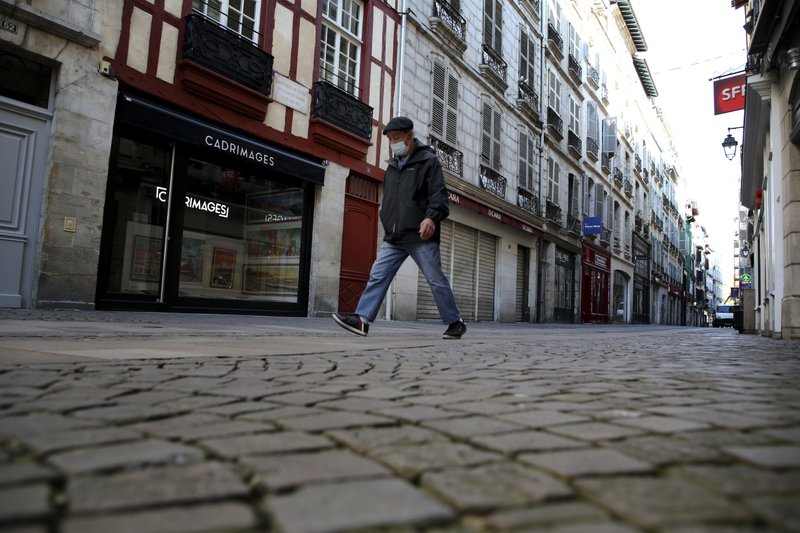
A friend back in Oakland, Ca wrote to me this morning asking me if I was ok. He included a photo from the Associated Press that was titled: “Parisians flee, sidewalks empty, as France enters lockdown.” The photo showed a solitary figure walking an empty street and everything was grey. My friend said “Frightening to see this–hope you’re holding out ok.”
Photo my friend sent. It turns out this street is in Bayonne not Paris.
It has been an adventure of sorts. Wednesday evening, 8pm CET, President Macron announced that France was going back into lockdown. Although he claims that it will be slightly different than the last time, I haven’t seen what the difference is. I was still in Normandie and knew I had to get home. The lockdown started at midnight on Friday. I was able to get a train reservation for Saturday morning and began a whirlwind, frenetic packing generated by my sense of urgency. But as each hour went by, the urgency subsided. I was told that the shelves were sparse and so I packed a full bag of my groceries that I hadn’t yet used. By the time I left on Saturday morning, I had my one fairly large suitcase, my cat inside her carrier which is soft and can be worn over the shoulder, my ‘market’ bag in which I carry things I might need during the day, the full bag of groceries and another bag that held all the overflow.
I turned my car in at the train station and loaded myself up with all my ‘stuff’. I got about five feet and I knew it was all too much and too heavy. I started to do something I hate in myself and hadn’t done in a long time. I sighed very, very loudly, tried to look as miserable and helpless as I felt, tilted to the left with the weight of the grocery bag, sighed a little louder, all in hopes that someone would come rushing to my rescue. I must have looked a bit lunatic if not homeless, and I’m sure anyone who passed me gave me a wide berth. I made very slow progress. I realized I would have to go up and over the bridge to get to the quai where the train to Paris was. I was close to tears. Someone did say there was an elevator but didn’t offer to help. I was halfway across the bridge still doing my Sarah Bernhardt act when an employee of SNCF asked where I was headed, grabbed two of my bags, and, asking which car I was in, deposited me in Voiture 5. The train left within 30 seconds of my being inside.
Of course, I pulled the same stunt walking to the taxi queue in Paris. This time, a young woman stopped and helped me. I was home in my apartment three hours after leaving my friends’ home in Normandie. Ultimately I was glad for all the groceries as I had no energy to shop for food on Saturday.
Sunday morning, Day 3 of Confinement Deux, I went for my usual morning walk at 10:30am. On my walk, I pass a parcours with exercise machines in the Jardin du Ranelagh. My habit is to stop for about fifteen minutes, and every other day work out my arms and, on alternate days, my legs. The parcours was packed with people. I’m not sure if the area would be considered a space for gathering but there were well over thirty people. Three-quarters were not wearing masks. I got on one machine, felt scared, got off and went on my way to finish my walk. This morning, it was the same thing on a much smaller level, probably twelve people total, all the men not wearing masks.
Current Covid-19 numbers in France, according to the Health Minister: 1 new positive every 2 seconds; 1 hospitalisation every 30 seconds; 1 death every 4 minutes
When I left Paris on October 14th, everyone was wearing a mask. Was this a rebellion? I noticed a number of people not wearing masks just walking or wearing the mask under their nose. Not only did my neighbourhood NOT look like the photo my friend sent, it seemed teeming with life. Av. Mozart, my shopping street, had more people than usual. Only stores that sold necessities were open so my little clothing store was closed but the florists were open. They were not open the first time around. I was able to purchase my weekly bunch of flowers and that made me happy.
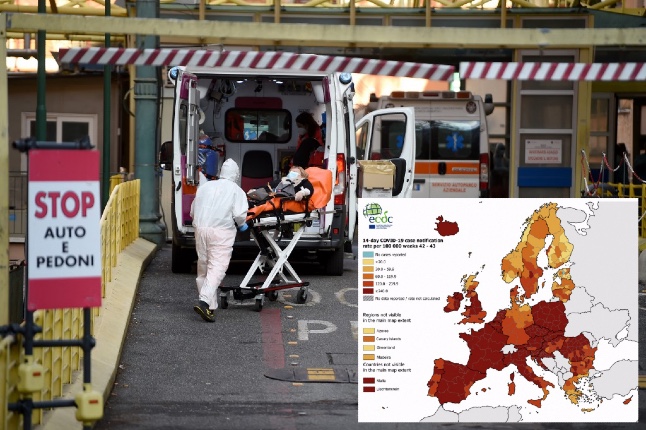
Around Europe, the numbers are devastating.
Macron said that the confinement would last one month but everything would be reviewed in fifteen days. If the cases of Covid-19 had stopped rising and looked to be diminishing, there was the possibility of some of the restrictions being relaxed. That is not likely to happen. Countries around France are following suit. The UK isn’t calling it a lockdown but much the same rules are in place. Germany is in lockdown. Spain and Italy had cities in lockdown for weeks already. Macron has said that this second wave is and will continue to be much more devastating.
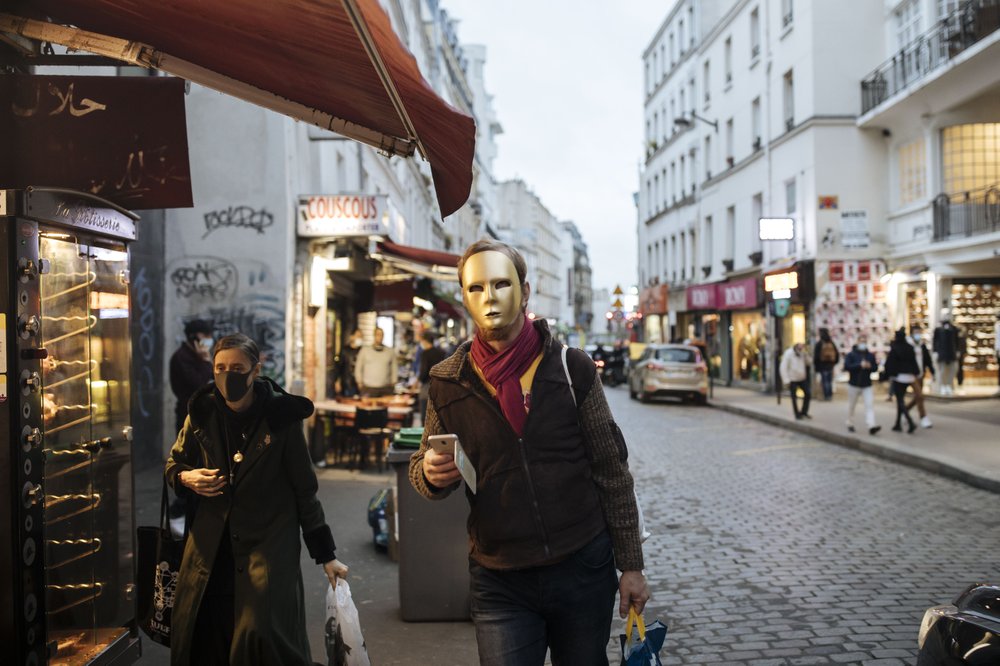
Wearing masks in Paris on Friday, October 30.
Last Spring, the days were getting longer. It was a novel experience and people all over the world went out on their balconies to sing and clap for the healthcare workers. Now the days are getting shorter, the wind howls at night and no one is celebrating anything. And, for US citizens, tomorrow is a day that almost everyone has been awaiting for four years, many of us have been working at getting out the vote, making sure everyone over here knows they must register anew every year, and that it is an honour to be able to vote. So Please Vote. Now we, and the rest of the world, are holding our collective breath both hoping and fearing the results.
So, to my friend in Oakland, I will respond, “Yes, I’m holding up. My Paris doesn’t look like that photo and I’m not sure if that is good or bad. Both politically and health wise, I think we are in for a long, cold winter. Je t’embrasse.”
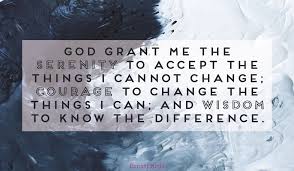
God grant me the serenity to accept the things I cannot change; courage to change the things I can; and wisdom to know the difference.
Another Sunday. The end of five weeks of confinement. For me–seven weeks, almost 1/6th of the year. The weeks fly by, there is a sameness about everything which, in many ways, is comforting. Yet, early March, when I first had my cold (definitely not the virus) seems like an eternity ago. President Macron came on national TV last Monday to tell us that the confinement would last through May 11. Then he outlined a plan that would start on May 12, assuming the curve had flattened and France’s deaths were declining. It would begin with primary school students going back to school, a few stores opening up and some services that had been shut down re-opening slowly. There was an implication that the eldest, the frailist and the most vulnerable would be asked to stay indoors. That was confirmed on Wednesday when the government’s chief scientific adviser, Jean-François Delfraissy, said that people over 65 years of age would stay confined the longest. On Friday, he reversed what he said and promised that all ages would have restricitons lifted at the same time.
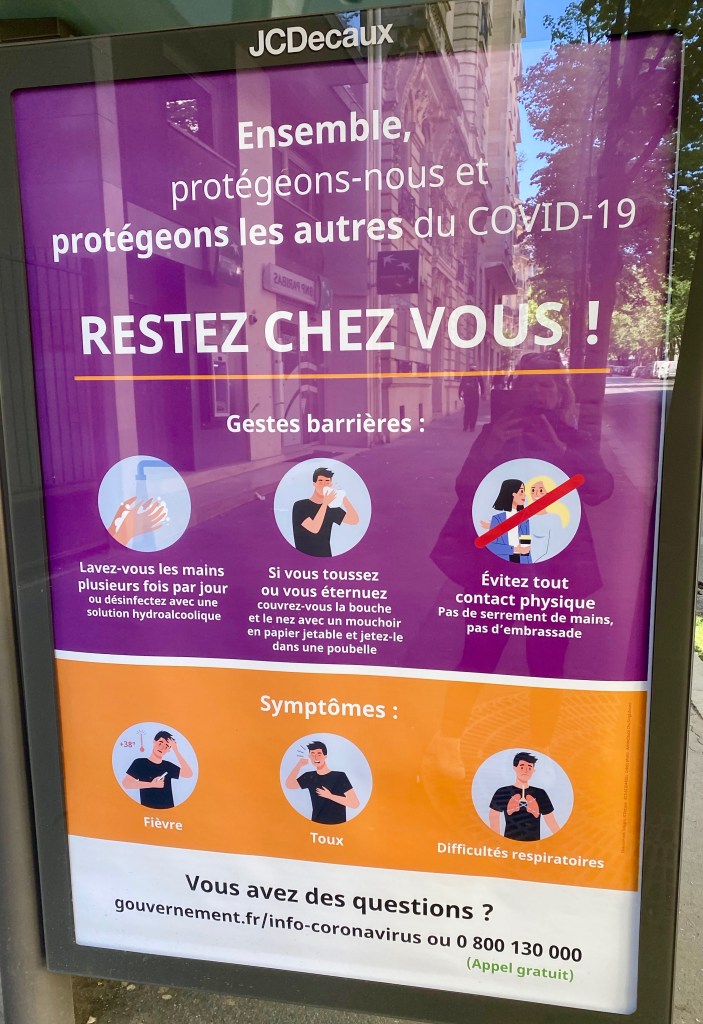
Sign on the street saying “Stay in your home”
It is one thing to be in lockdown and know that all my friends and neighbors were in the same boat as me. Friday morning, before the reversal, I thought of people going out and walking along the Seine, crossing the Pont Neuf and Pont Alexander III, going to the American Library, and I had to stay at home. Some friends said ‘it’s unconstitutional. They can’t age discriminate.’ I didn’t feel picked on at all. All along I have felt as safe as one can feel during a crisis like this. I have felt that France is looking after me. So if the wisdom said “You are over 65. We think it’s a good idea that you use extreme caution and stay inside,” ok, I would follow it. But I knew it would be harder. I would feel more alone, that I’m saying I’m vulnerable.
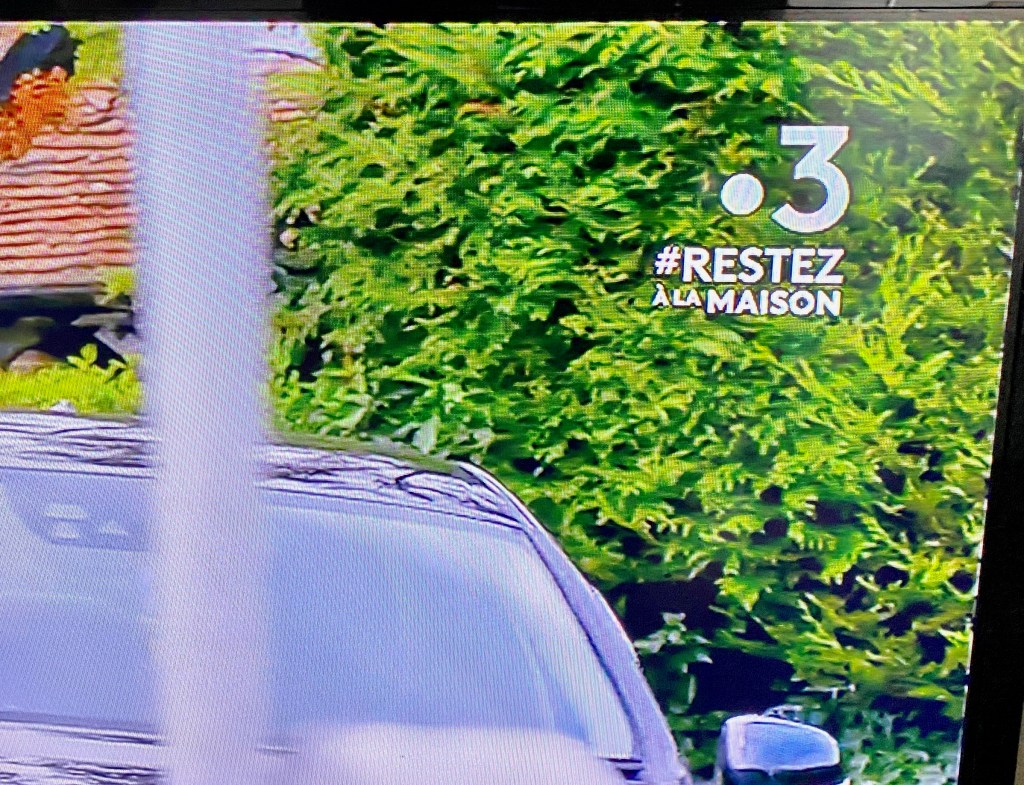
All the prime channels say the same thing in the corner: “Stay at home”
I thought of the Serenity Prayer which I say a lot. Sometimes I say it without really thinking about what it actually says. But Friday, I said it to myself many times as a way to pray for acceptance. What are the things I cannot change? This virus, how others respond to the restrictions, when it will all end if it does ever actually completely end, my age among other things.
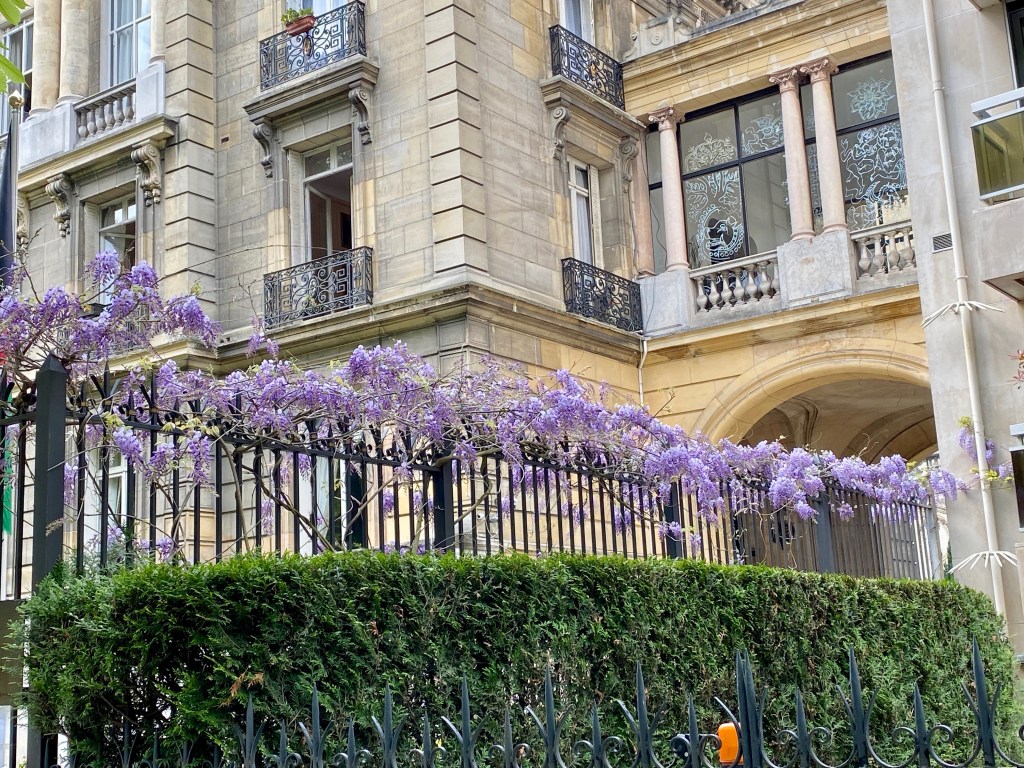
Wisteria-it never lasts long enough. A real sign of Spring.
What can I change? and do I have the courage to act on my own behalf? I can always change my attitude if I get lonely or too tired or grumpy, I can do as much exercise indoors and use my hour outside to walk – they say the stronger a person is the better they can fight off the virus, I can keep working and writing which feels very good – and when I feel good, I feel more positive and stronger, I can keep connected with as many people as I can so that the world feels very small right now. Stephen Colbert, in talking about the virus and the One World Concert that was held last night, showed us a T-shirt he was selling to raise money for healthcare workers and food for people who are going hungry. The front of the T-shirt said “United we stand, Divided. we fall” He was urging social distancing for as long as we can and how these things are actually bringing us together.
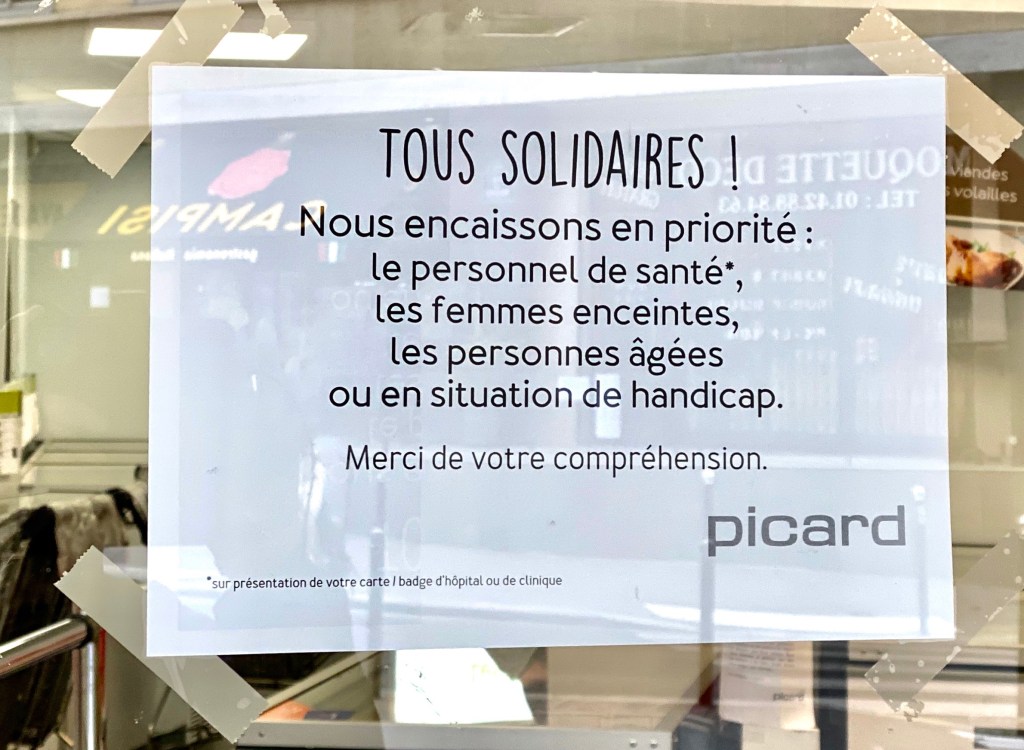
Sign on the door of Picard (one of my favorite stores): Everyone United–Check out priority-healthcare workers, pregnant women, older people and handicapped people. Thanks for your understanding.
Maybe… It seems there are two camps. There is the one camp that has turned some yucky lemons into wonderful lemonade–feeling closer to their friends and neighbors, not being self-destructive with food (Colbert said “order two of these T-shirts. One in the size you wear and one in the size you’ll be after we get out of lockdown and you’ve eaten everything available.”), allowing the slow-down of time to give birth to creativity, to meditate more, to rest more, to read more and learn more. Then there is the other camp. The ones who are scared and anxious, who listen to news that riles them up, makes them angry and provoked, who assume everyone is having as hard a time as they are, are basically miserable.
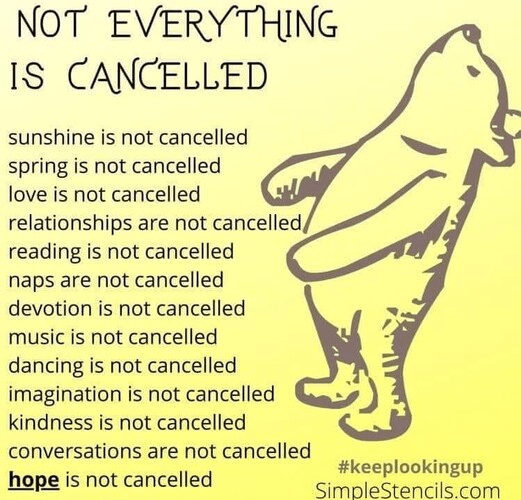
Sent to me by a friend in California.
The wisdom to know the difference. When I was a young woman, I kept repeating some stupid behaviors over and over again. I ran into brick walls, bloodied my nose then did it all over again. I had some older women friends and I would go crying to them each time I hurt myself. Finally one of them, in total frustration, said to me “Sara, has it ever occurred to you, when you are headed for that wall, to turn left?” Intellectually, I knew what she meant. I got the metaphor. But I didn’t have the wisdom, or self-knowledge to know when to turn. I guess wisdom comes from making mistakes, sometimes years of mistakes. This extraordinary time has allowed me to show myself the wisdom that I have picked up over six decades of life. I will say “Amazingly, I’m finding that lockdown isn’t difficult.” Perhaps it isn’t all that amazing. Perhaps it’s years of saying the Serenity Prayer and, to the very best of my ability, putting it into action. Meditators will call what they do “a practice”. They keep practicing every day. I tell people a lot younger than me who are trying to change some behaviors to “consider it a muscle you haven’t used in a long time or maybe ever. Strengthen that muscle a little at a time every day, keep practicing” Then comes a time in one’s lifetime when all the practice pays off. For my parents, it was the Depression and WWII. For us, it’s the Covid-19 virus of 2020. Extraordinary times brings out the best in many of us and the worst in many of us. Thanks to the Serenity Prayer and a lot of love, I’m being a person I quite like these days. So, I’m not wild about May 11 being the possible end of lockdown but it is what it is. I’m prepared.
May 12, also happens to be the launch date of my book Saving Sara A memoir of food addiction. I have a radio interview that day and will celebrate with as many people as I can.







 Covid Rears Its Ugly Head Again The seventh wave of new Covid cases in France is getting worse by the day, over 125k cases confirmed on July 1st, with the Ile-de-France (Paris) and Brittany leading the pack, and the Atlantic and Mediterranean coastal towns not far behind. The government recommends wearing masks, and encourages anyone over 60 or at high risk to get a fourth dose of the vaccine, but the government is too gridlocked to pass even the smallest of restrictions, so at the moment there’s no “risk” of the Pass Sanitaire or lockdowns making a comeback.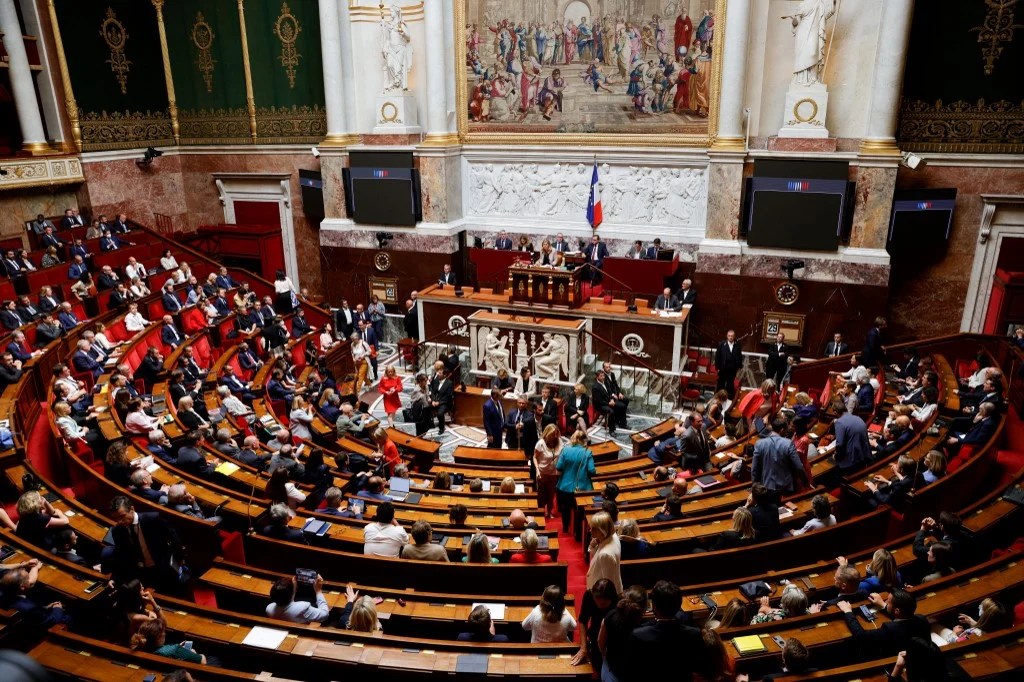




 Out My Window