A Touristic Pilgrimage to Notre Dame de Paris


There are a lot of substacks about Paris and France. Little Lights on Rosa Happiness Street is worth your investigation. Lorie is a great writer and journalist. 

Here is her post this week on Cathedrale de Notre Dame:

“You could spend a day, a year, even a lifetime exploring this hallowed place. You could also learn from my mistakes.

LORIE TEETER LICHTLEN

DEC 12, 2025


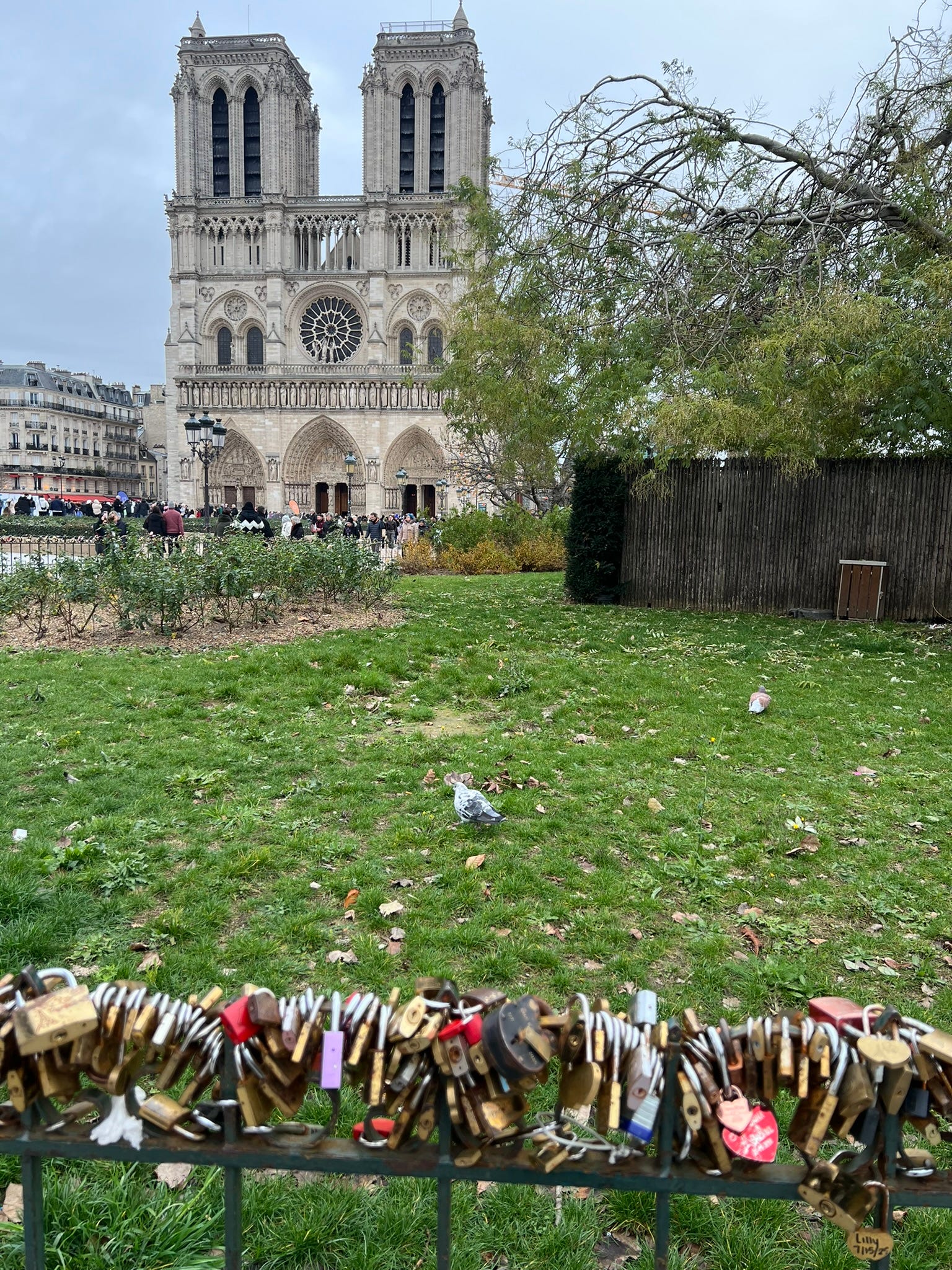
Notre Dame Cathedral on a blustery December day. Photo credit: Lorie Teeter Lichtlen

This week marks the first anniversary of the resurrection of Notre Dame Cathedral.

After the mass for heads of state, which was broadcast around the world, on December 8, 2024, the masses were allowed to visit. They flocked in numbers as monumental as the cathedral itself.

Over the past year, Notre Dame has hosted:

  • 11 million visitors – or more than 30,000 per day, every day, for a year
  • 1600 celebrations – for Lent, Easter, the death of Pope Francis, election of Pope Leo XIV, Advent, Christmas, etc.
  • more than 650 pilgrimages – of which one-third from outside of France
  • 600 official delegations, and
  • 44 groups of “vulnerable, isolated or disabled” people

Meanwhile, the renovations have continued apace. It’s now possible to climb to the towers, visit the crypt and admire the treasures in the sacristy. Thirty priests take turns staffing the two new confession chapels.

Much remains to be done. Designs for new stained-glass windows went on display in Paris this week; the windows themselves will be installed in Notre Dame in 2026. Other projects – notably involving the gargoyles and flying buttresses – will reportedly keep skilled artisans busy until 2030.

With all this exciting activity underway, why did it take me a year to finally visit the “new” Notre Dame?

Well, it took me that long to wait for the crowds to wane or, rather, to work up the courage to face them. I have walked by the cathedral many times over the past year and seen huge lines of people along the concrete forecourt. I have seen them drenched in the rainy spring and fall, and fried in the summer sun. I imagined them travelling from around the world for their dream vacation in Paris, only to find themselves in a very long line, kids whining, and cowering under the makeshift shelter of a scarf. The well-prepared will have brought umbrellas or bought plastic ponchos from the nearby shops.

Admission is free but advance reservations are recommended (there is direct access for the cathedral’s worship services). I tried for months to book and found few slots that would allow me to go in with family or friends, so finally decided to go alone. The evening of Sunday, November 30th, I booked a slot for one person the next afternoon.

Those who haven’t yet made the journey may benefit from my experience.

On this blustery December day, the lines were the shortest I had ever seen. My “reserved” line had about 20 people in it when I joined. After our QR code reservations were scanned, we were all allowed in at precisely 2:45pm. The “no-reservation” line was moving briskly, too.

We passed through the central doors under the 13th century Portal of the Last Judgment, hardly noticing its sculpted scenes of heaven and hell. Pristine statues of the 12 apostles watched quietly as we filed by.

Inside, as my eyes adjusted to the dimmer light, I was struck by the scent of wood smoke. Was it a remainder or a reminder of the tragic fire that nearly destroyed this hallowed place on April 15, 2019?

Many visitors did not heed the request to come without bulky backpacks. There are no lockers or coat check desks at Notre Dame. (No cafeterias or drinking-water fountains either.) Add in throngs in winter coats and it can get congested. At least no one seemed to be lugging luggage when I visited.

A year ago, some said the “new” Notre Dame seemed too new: too bright and shiny for its 860 years. Today’s lighting bathes the cathedral in a gentle golden glow. The result underscores the grandeur of the interior while allowing visitors to marvel at the artistry on display.

The visit is organized clockwise, starting with a welcome desk offering free headsets for guided tours via a mobile app and ending with a small gift shop area. Throughout the cathedral, votive candles can be purchased via credit card and vending machines offer commemorative medals. Proceeds from these and the shop help finance the restoration efforts.

Along the left (north) aisle, a series of chapels represent the stages in the history of Christian revelation, from Adam, Noah and Moses to Solomon and Elijah. Each has its own distinctive style, and each is more stunning or elaborate than the next. The chapels are adorned with precious paintings and frescoes, hand-woven tapestries, decorative tiles, and sculptures in wood, marble and other materials. Some are equipped with mini elevators to allow wheelchair access.
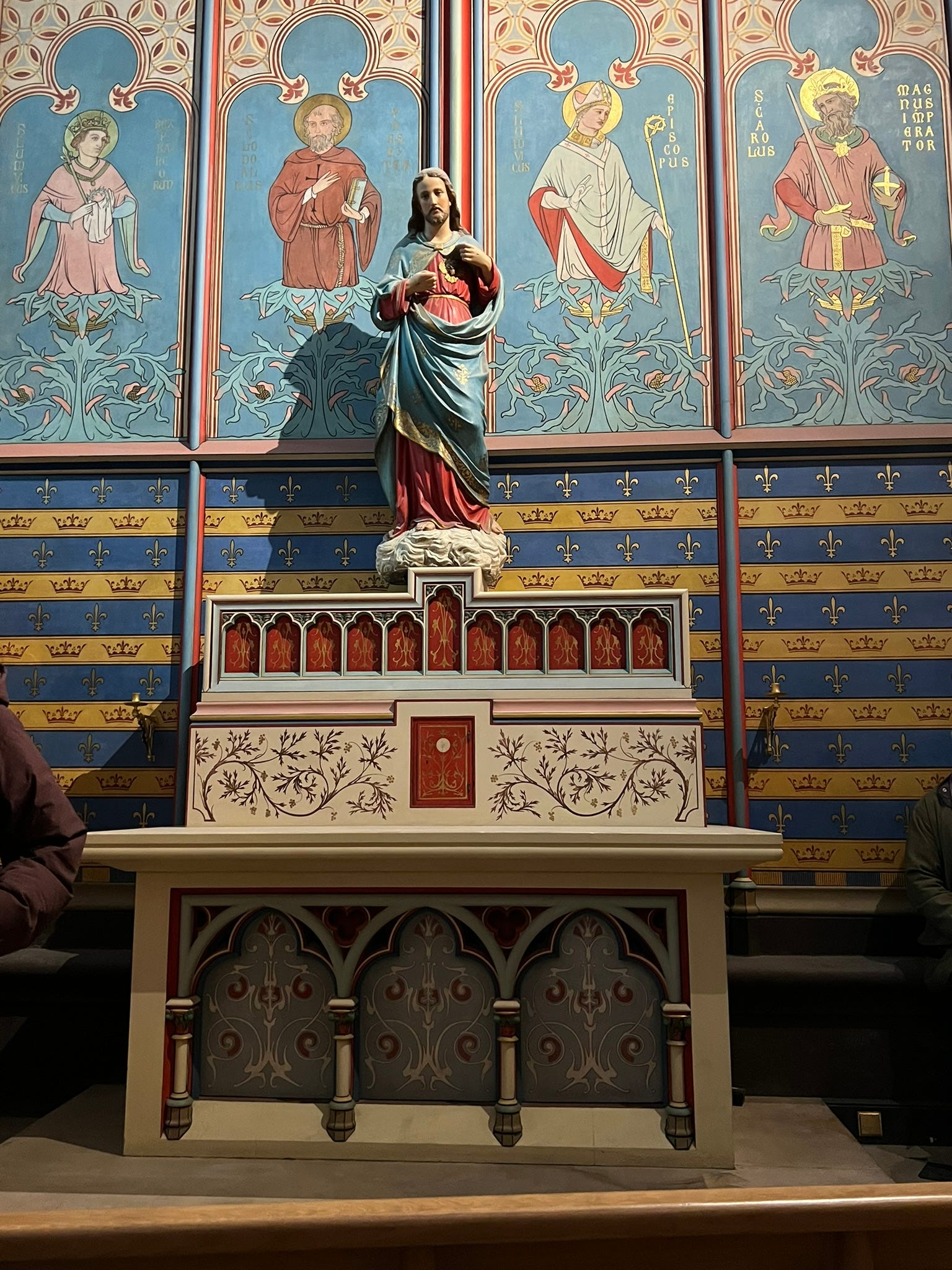
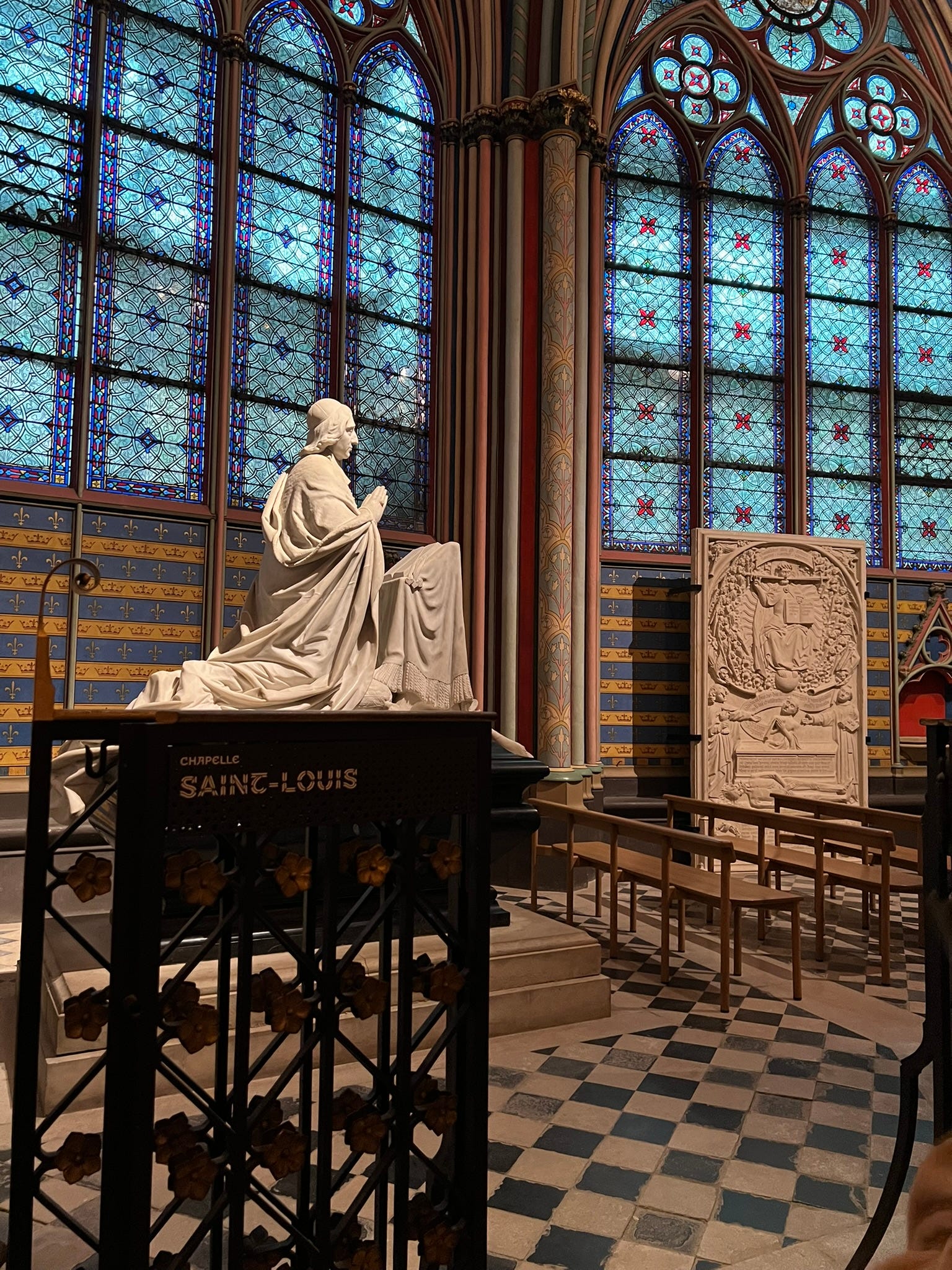
My favorite among the chapels is dedicated to Saint Louis: a beautifully simple space, twice the size of the others, with wooden benches that invite contemplation. Photo credits: Lorie Teeter Lichtlen

Across the aisle from the chapels, the north wall of the choir enclosure is lined with scenes from the life of Christ in polychrome stone. For this Christmas season (until February 2), this area also features a large “crèche” or nativity scene, with traditional Provençal figures and a terracotta village.
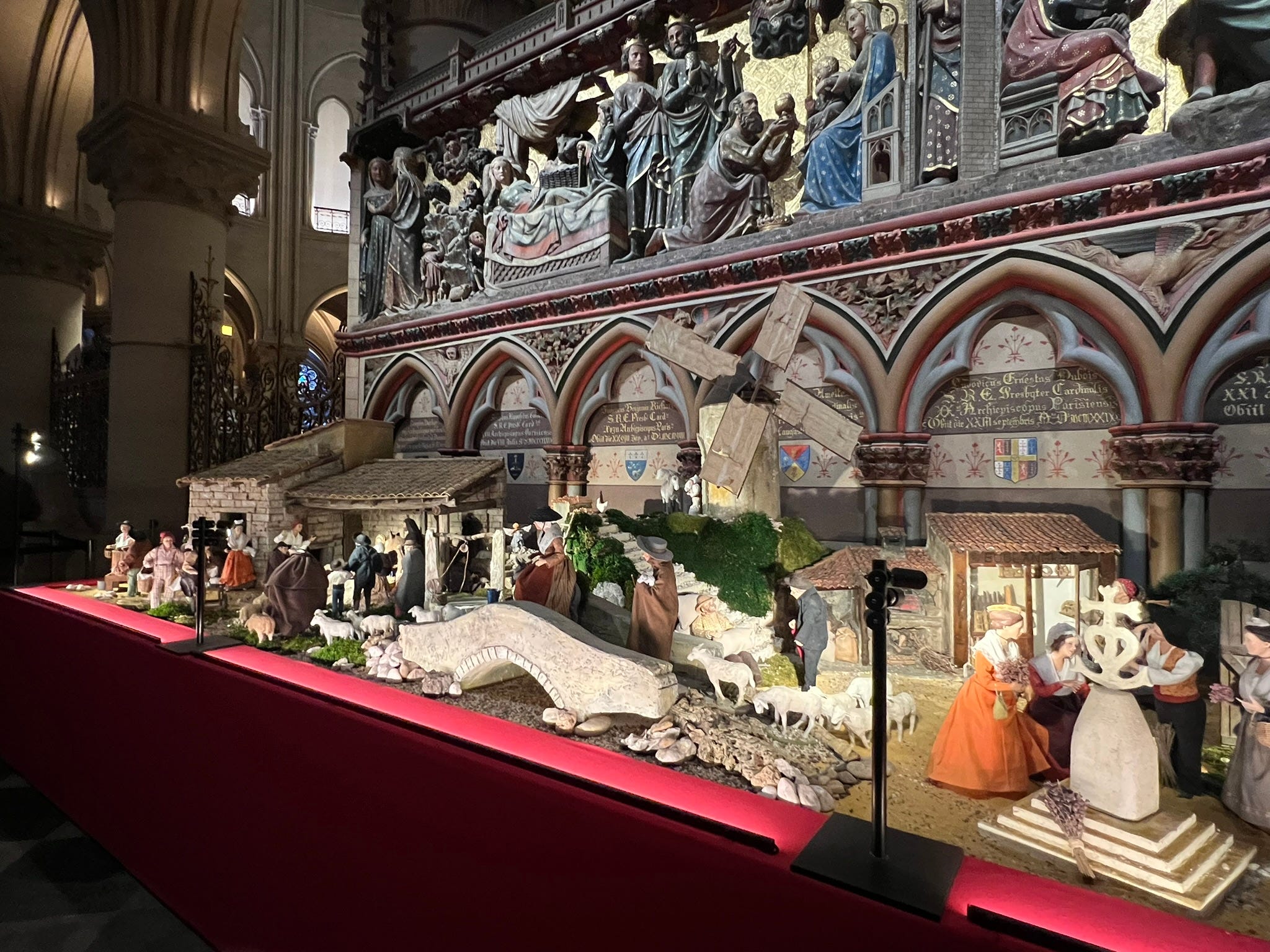
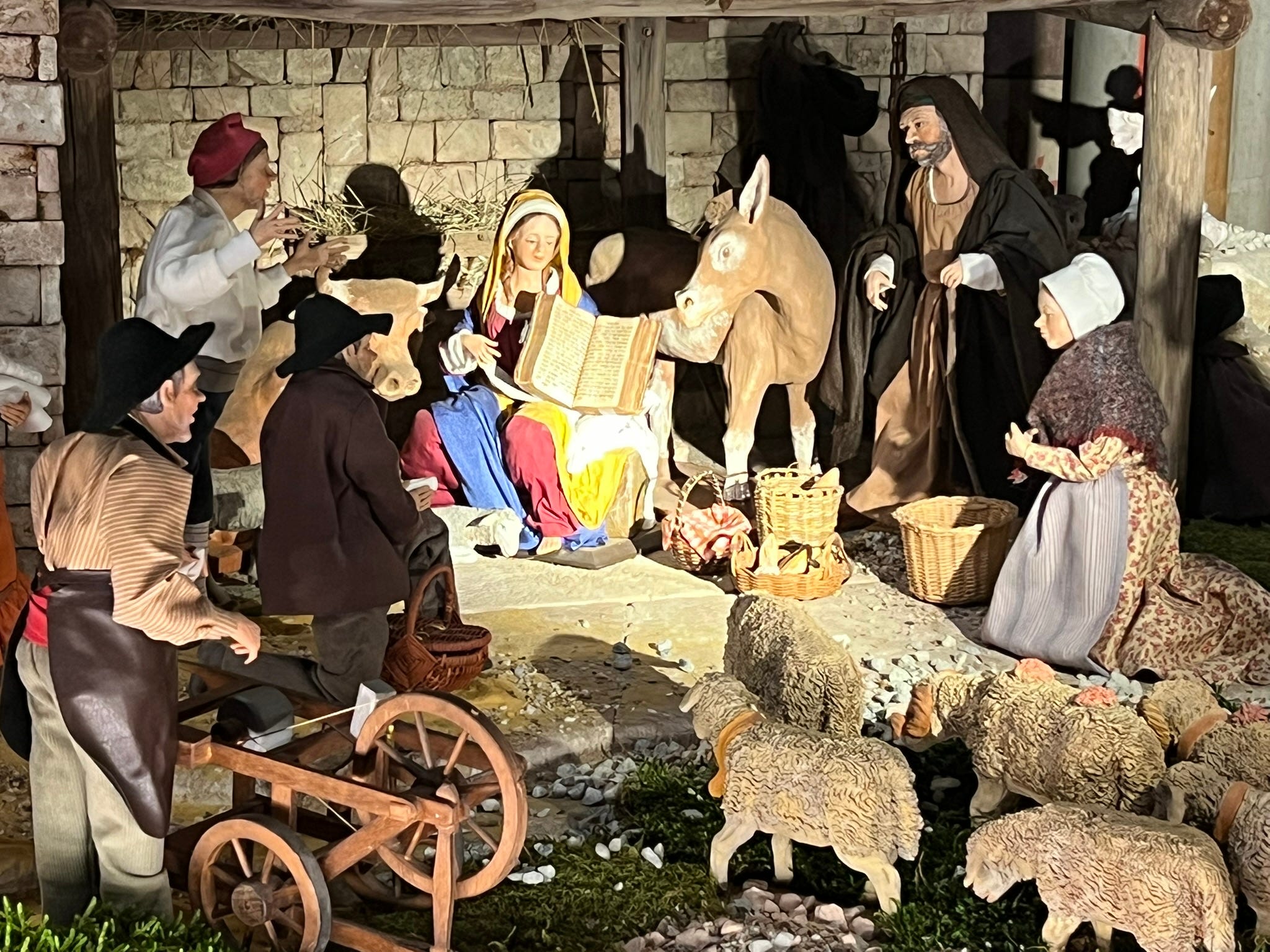
The north choir enclosure and Provençal “crèche” for Christmas. Photo credits: Lorie Teeter Lichtlen

Traffic jams formed near the north and south transepts – ie, the perpendicular arms that constitute the cathedral’s cruciform shape. Mobile phones aloft, hundreds of tourist pilgrims like me turned in circles, attempting to capture the reverential atmosphere distilled by the vaulted ceilings and famous rose windows.

Traffic jam at the north transept. Credit: Lorie Teeter Lichtlen

When the hum of collective admiration grew too loud, an ethereal “shhhhhhhhhhhhhhh … silence, please” floated from invisible speakers. This message played several times during my visit, once followed by an invitation to attend mass by heading to the reserved seating area. (Notre Dame celebrates three masses per day on weekdays and four on weekends.)

“The Cathedral of Notre-Dame de Paris is delighted to welcome you: pilgrims, believers or not, Christians, visitors from around the world, all men and women of goodwill!” – from the Notre Dame de Paris web site

I’m not Catholic but could have attended the mass. Instead, I continued to meander around the cathedral with the other tourists.

Another traffic jam soon formed, this time around the holy relics.

Who knew that Notre Dame houses what are believed to be relics from the Crucifixion of Jesus Christ? The Crown of Thorns, a Nail and a fragment of the Cross were purchased in 1238 by King Louis IX – later canonized as Saint Louis — from the Latin Emperor of Constantinople. Had I known, I might have been prepared to sit in thoughtful meditation before the holy crown in its crystal case within a large golden circle. Many others did so. Instead, I suddenly felt unworthy of occupying precious space there and just took pictures from a respectful distance.
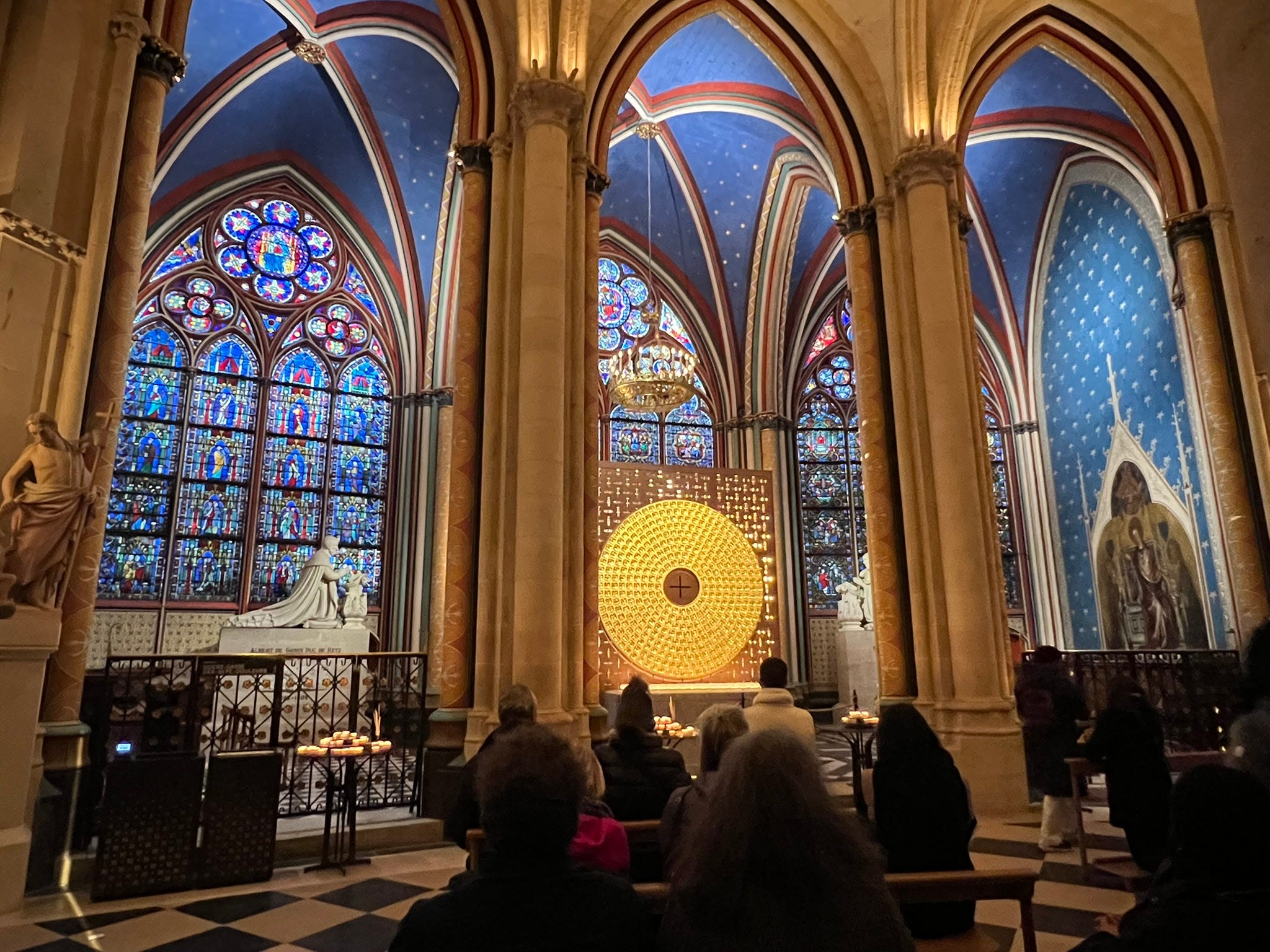
The Crown of Thorns in one of the holy relics housed at Notre Dame. It is displayed on Friday afternoons, in a crystal case within a golden circle. Photo credit: Lorie Teeter Lichtlen

My qualms turned out to be unfounded: the crown wasn’t on display the day of my visit. As I learned later, it was traditionally visible on the first Friday of each month; as of last week, it can be seen every Friday starting at 3:00pm.

Had I pored over the official Notre Dame web site and downloaded the mobile app, I would have been less clueless. As it was, I read every available description — and there are many!

The south aisle of the cathedral is lined with more chapels, including a new one devoted to Eastern Christians. The choir enclosure on this side offers another series of polychrome sculptures illustrating the apparitions of Christ. While the south enclosure is more recent than the north one, both were created by master sculptors in the 14thcentury.

By this time, I had been walking, studying and admiring the countless artistic and architectural masterpieces for over two hours. I wasn’t overwhelmed by all the beauty to the point of fainting, as the French author Stendahl was during a visit to Florence, Italy. I did need to sit down and process everything I was seeing and feeling, however.
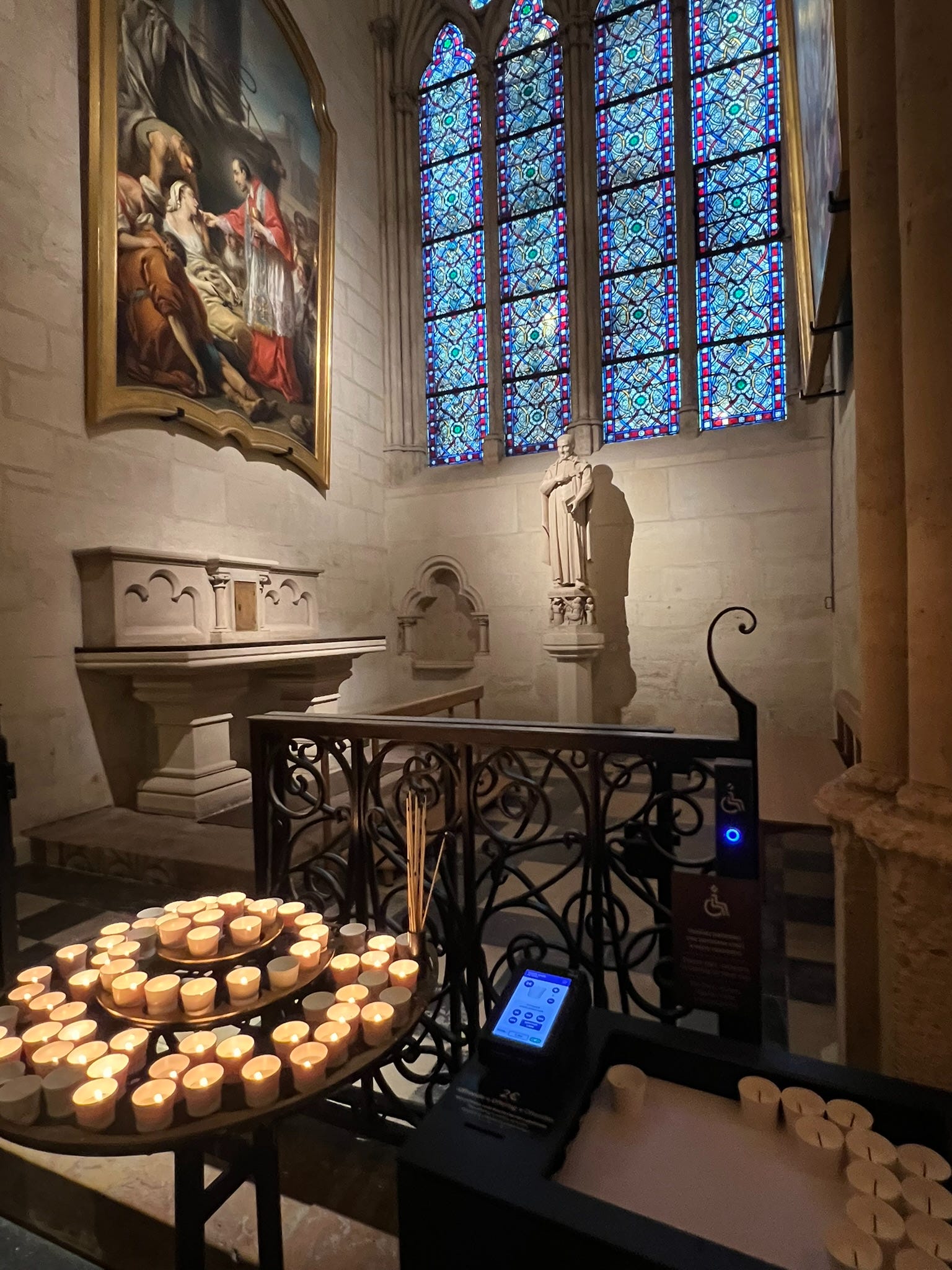
Mini lifts for wheelchair access and card payments for votive candles are among the enhancements at the “new” Notre Dame Cathedral. Photo credit: Lorie Teeter Lichtlen

I chose a seat in an empty section of the pews for the general public (as opposed to those reserved for worshippers) and started scribbling notes in my iPhone. Inspired by the atmosphere of Notre Dame, I was absorbed in poetic thoughts — until a group of tourists sat behind me and started happily chatting with each other.

I moved to another empty section but, within minutes, another chatty group arrived. I turned around a few times but, like the first group, they were oblivious to my frown. Should I have floated a “shhhh” of my own?

Instead, I saved the notes on my phone, put it in my pocket and went to the gift shops. The “shops” are actually four curved display cases forming a circle around the salesclerks; each case has its own cash register. Three of the counters sold similar items: a slim guide to the restoration works, notebooks, bookmarks, medals, necklaces, rosary beads, a Christmas music CD and decorations, etc. The fourth sold books, sculptures and more decorative items. I stood in line for two different cash registers to buy a few gifts. Had the line been shorter, I might have inspected that fourth counter’s wares. (Those items and many more are available at Notre Dame’s online boutique.)

I put on my coat and went outside, the fresh air feeling good after the crowds and hours indoors. The sun was low and the cathedral’s 21 bells were ringing. I love bells and it was great to hear them ringing, especially knowing they had been silenced for five years.

I was happy with my visit but wished I had focused less on getting through the front doors and more on studying all that the “new” cathedral has to offer. I’m determined to go back, once I have done my homework, to appreciate even more the miracle that is Notre Dame de Paris.

The bells of Notre Dame de Paris. Credit: Lorie Teeter Lichtlen

Those wishing to contribute to the continuing restoration of Notre Dame can find a way to do so at https://www.friendsofnotredamedeparis.org/

Thanks for reading Out My Window! Subscribe for free to receive new posts and support my work.

TIPS for getting the most out of your visit:

  • Read up on the history, art and architecture of Notre Dame before going!
  • Download the mobile app for tour guidance on-site in English, French and Spanish
  • Try to book your visit in advance through the official reservation site or attend a mass to avoid the long “no-reservation” lines
  • Check the practical information site for the opening hours, dress code, free guided tours, etc.
  • If you want to see the Crown of Thorns, aim to go on a Friday afternoon
  • Food and drink are not allowed on-site so have a bite before your visit
  • Bring a small umbrella for the wait in line, even on sunny days; small bottles of water are also a good idea
  • If you must bring a backpack, make it a small one; don’t bring bulky items
  • Ask for headphones at the welcome desk and use the app to better appreciate what you see
  • If you have to talk with others inside the cathedral, keep it short and whisper
  • The gift-shop counters offer a few items but can require standing in line multiple times; the official e-shop has a wider selection and you don’t have to carry heavy items or worry about breaking fragile ones. All proceeds go to the restoration effort.
  • Resist the temptation to head to the closest café or restaurant before or after your visit. A few blocks away in any direction, the fare and prices are less touristy. One exception: go for Berthillon ice cream on the Ile Saint Louis, behind Notre Dame. It’s a classic part of any visit to Paris!Let me know how it goes!
Little Lights on Rosa Happiness Street

A bientôt,

Sara

Joy and Serendipity

I am interrupting my six month WordPress sabbatical to write about 1-being back in heavenly Saint Jean de Luz and 2—an amazing experience (amazing to me) I had last Saturday.

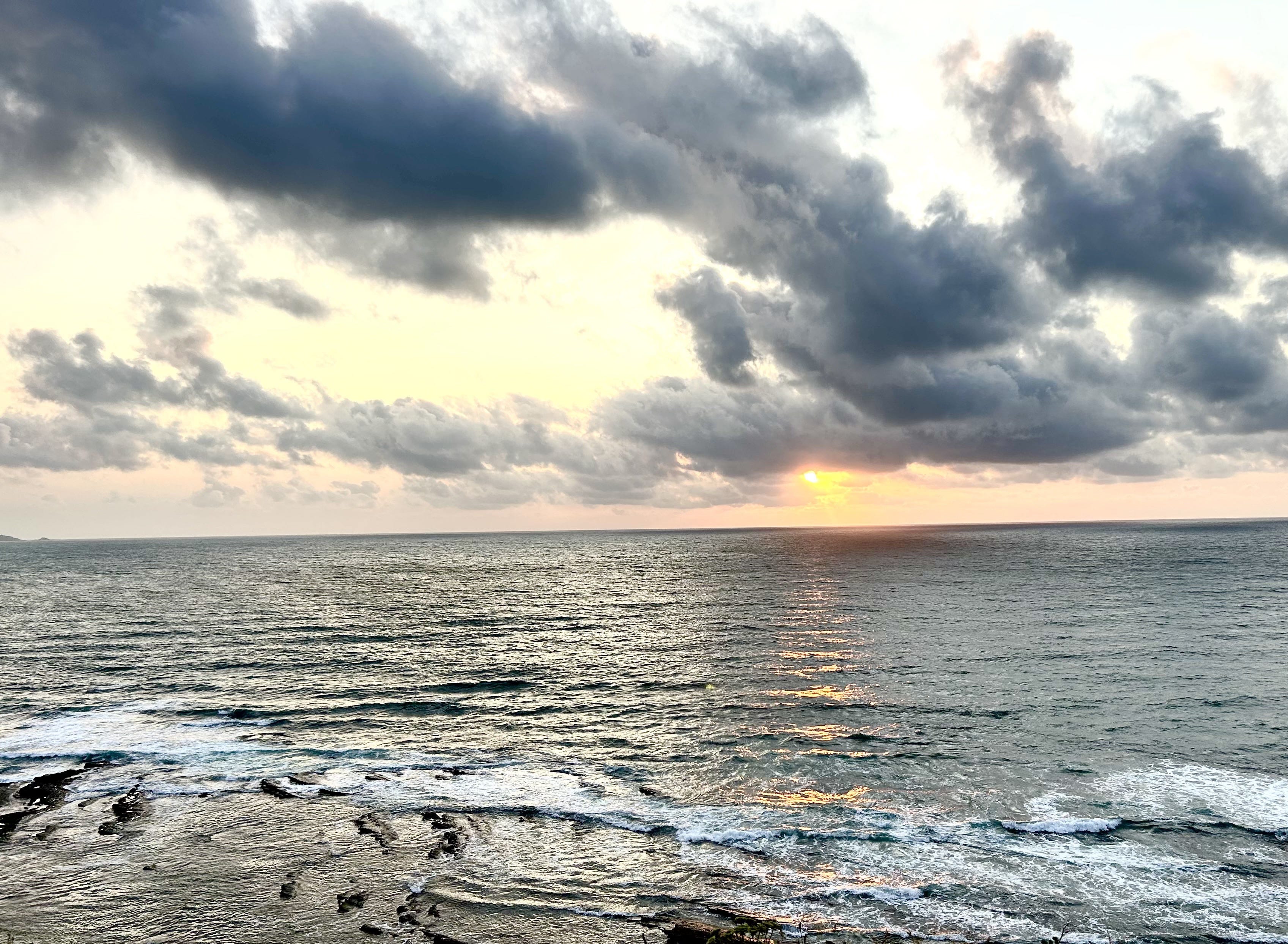
Sun setting over white caps after a very windy afternoon in Saint Jean de Luz

After being introduced to Saint Jean de Luz a number of summers ago, I have come down for two to four weeks each summer. This summer, I planned a self-imposed writing residency for myself to prepare submissions for a September writing retreat. Two or three months ago, my friend Jane from the Bay Area called to let me know she was hiking in the west of Ireland and would I like to meet up in Dublin at the end of her trip. Yes, I would love to but I had this trip to SJdeL planned, bought train tickets, paid for my rental. What did she think of coming to SJdeL? She had been here on my recommendation with her husband last summer and loved it. Needing a couple of days to figure it out, she made it happen. RyanAir from Dublin to Biarritz, taxi to SJdeL, stay 4 nights and then make the reverse trip in order to fly back to SFO. BUT….she needed to come on the 22nd and I had tickets for the 24th. I changed my train reservation and we have just spent four wonderful, heavenly days here in SJdeL. 

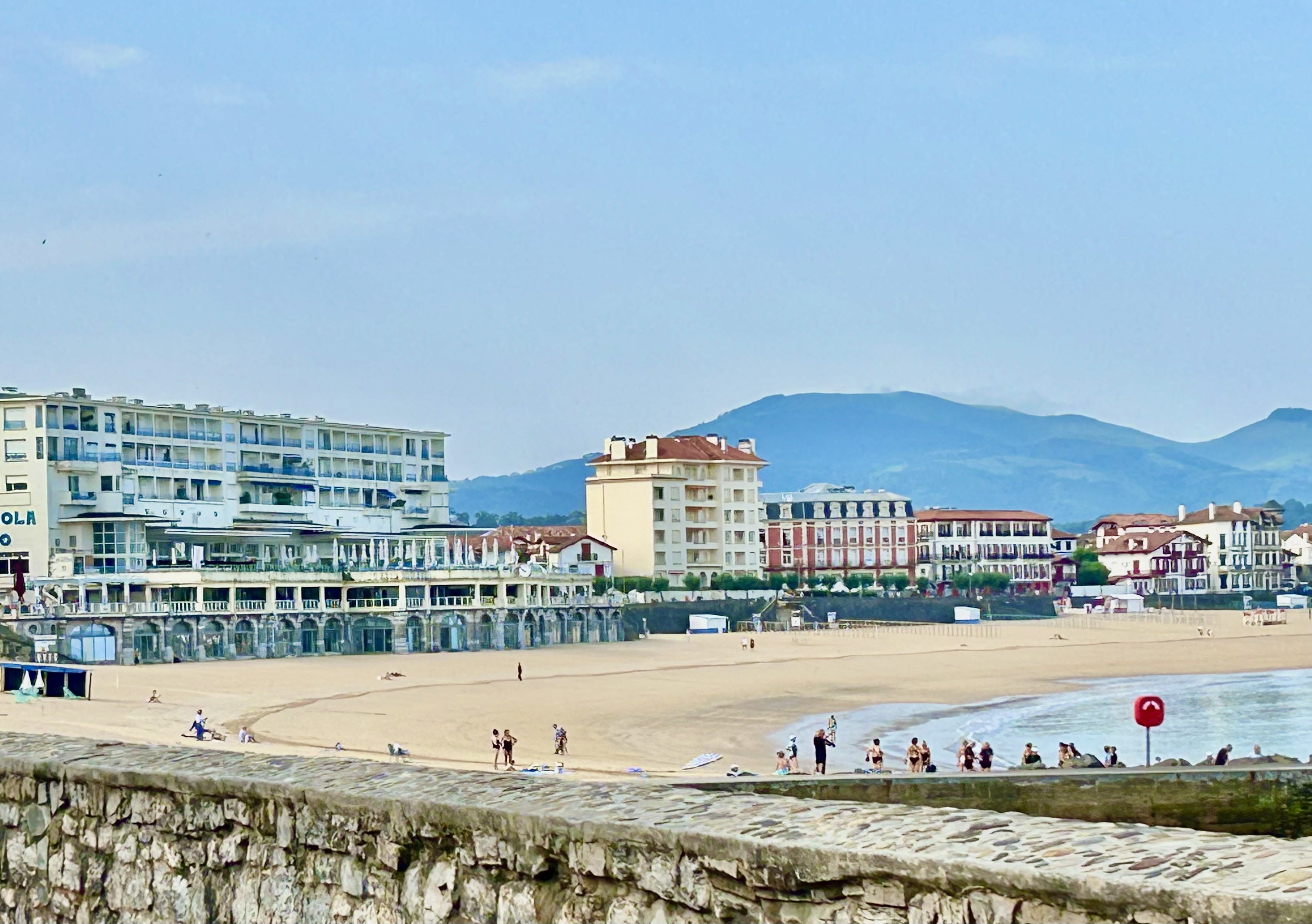
Looking at La Grande Plage from the Quai leading up to Saint Barbe

For me, it turned out to be a vacation before the writing started. I’ve been battling one thing after another health wise, none serious but all very annoying: vertigo, another carpal tunnel surgery that wanted to take its sweet time healing, etc. I slept in every morning, ate a leisurely breakfast, and then we walked the boardwalk to the marina, bought food at the marché, and shopped! I would leave Jane at the beach on our way back, and she swam while I came back to do I don’t know what. Jane stayed at a wonderful hotel at the top of the cliffs called La Réserve. A terrace extended off her bedroom and offered a view of the Atlantic Ocean that mesmerised. We’d make our dinner each evening and talk our way late into the night. Then walk to Saint Barbe and down the hill headed to my apartment. She’d leave me at the turn-off away from the beach. 

Sunset June 25, 2025

Jane and I have known each other for fifty years. We’ve gotten to be better friends as we’ve grown older and now, no matter the last time we were together, we fall into talking as if we’d been together a week ago. It’s very precious – the friendship with her and also with her husband. They have taught me a lot about thoughtfulness, open heartedness, curiosity about others just by living their lives, being examples of a life well lived.

Sharing SJdeL, one of my favorite places in the world, with Jane over these past four days has been so delightful—in the full sense of the word: full of delights. One evening as she walked back to La Réserve, she witnessed a lightning storm and took a video:

I had heard the thunder and went out on my little balcony to watch the sky explode with light. I don’t remember ever seeing such a sight. The next day after a lovely sunny morning, the wind picked up. Wind surfers gathered on the beach at the edge of the water raring to go. I was headed up to La Réserve and took this video of the sails flying by. If you turn the sound on, you can hear how loud the wind was roaring.

I’m now putting off feeling the sadness of her departure by writing about the last four days. 

*** ***

Last Saturday, my last day in Paris before leaving on this trip, I attended a poetry literature gathering. Our prof, Heather, had put together a number of poems for us to read and talk about. The first was Robert Frost The Road Less Traveled. Chatterbox that I am, I announced that Robert Frost had been the commencement speaker at my school, Baldwin School for Girls, when I was in 7th grade. The woman seated to my left, jumped and asked “What school did you say?” 

Baldwin School for Girls” I responded. 

“I graduated 1965,” she said. 

I told her that if I had stayed I also would have graduated 1965. “Did you know KV?” I asked. 

“Yes, she is a good friend of mine.”

By this time, it felt a bit Twilight Zone. In an apartment in the 15th arrondissement in Paris, France, what are the chances of sitting next to someone I probably knew but not well sixty-six years ago. When the salon had ended, we ran more names by each other. She knew them all. By the time I went to bed, that night, she had written emails to a number of them cc’ing me telling them what happened.

I had been writing a story that included skating in the afternoon when I attended Baldwin. I had been thinking of KV as she had looked then. A dreamy memory, more black and white than color. Monday morning, she wrote saying that she well remembered me. And my sister. And our thick hair—mine brunette, P’s red. 

There is something wonderful about accidents like these happening. I have unpleasant memories of being twelve, thirteen, and fourteen, actually most of my teens were not great. Here come witnesses to tell me if my memory is distorted or maybe just maybe, those times were not quite what I thought them to be. KV said she “always had fun when we got together.” I don’t think of myself as a fun person back then. It’s possible I still have some things to learn.

*** ***

My intention was to not write here until the end of the Writing Retreat in September. Time just didn’t allow for everything I wanted to do. Unless something jumps up and hits me in the face, I will stick to that resolution.

Thank you for reading and being there. Your support of my writing means the world to me.

Thanks for reading Out My Window! Subscribe for free to receive new posts and support my work.

A bientôt,

Sara

Today is Thanksgiving in the US but not in France.

The big news today in Paris is that the dates for the reoopening of Cathedrale de Notre Dame (which many of you will remember burned in a horrendous fire in 2019) have been set.

Notre-Dame de Paris Cathedral opens its doors on December 7-8, 2024 almost five years after a devastating fire. © Nancy Ing Duclos for INSPIRELLE

The magazine Inspirelle, https://inspirelle.com/notre-dame-reopening-how-to-celebrate-its-rise-from-the-ashes/ wrote today about Notre Dame and the day that we have all been waiting for. The re-Opening. The following are quotes taken from the article. I’ve put the address above if you would like to read the entire article.

Christians and non-Christians around the world watched in horror almost five years ago when flames engulfed the rooftop of the beloved 800-year-old Cathedral of Notre-Dame de Paris. When the spire toppled over in the early evening of April 15, 2019, crashing through the roof’s nave and sending billowing, ominous smoke into the Parisian skies, we all wondered if the cathedral would survive. Yet, here we are five years later, waiting with bated breath for Notre-Dame’s grand reopening and comeback. Rebuilt and restored. And word has it, the cathedral is more beautiful and transcendent than ever.”

Thanks for reading Out My Window! This post is public so feel free to share it.

“Our first look inside the restored Notre-Dame will be on November 29, 2024 when President Macron makes his seventh and last visit to the worksite inside the cathedral before it is officially handed back to the Paris Diocese in early December. The state was responsible for the full restoration of Notre-Dame after the fire, which it entrusted to the Notre-Dame Restoration Committee. Remember, the French President expressed his determination that the landmark would reopen its doors five years after it suffered serious damage to its structure.”

“December 7, 2024..(is the day). The President of the French Republic returns to Notre-Dame in the evening for the official reopening. On the square in the forefront, he will deliver a short, emotional speech before declaring the handover of the cathedral to the Archbishop of Paris. Monseigneur Laurent Ulrich will knock on the medieval doors of the cathedral three times with a crozier, his special staff. The cathedral, which had been silent, then “answers” ​​him by singing Psalm 121 three times – resounding again with the song of praise. On the third time, the doors open. The eight bells of Notre-Dame will also ring again, beckoning everyone to come in.

On this occasion, 100 world leaders, dignitaries, religious leaders and the faithful have been invited to the official ceremony that will be broadcast live by France Television and shared with international media. Inside, vestiges and prayers will be delivered.”

“The following day on December 8, Msgr Ulrich will oversee the inaugural mass at 10:30 a.m. Paris time. The rector, Msgr Olivier Ribadeau-Dumas, will be by his side. The religious procession will be filled with color and emotion. The liturgical vestments worn by the clergy have been designed by Jean-Charles de Castelbajac, a fixture on the French fashion scene. The capes recall medieval chivalric style with golden crosses surrounded by bursts of shards in primary colors, reflecting nobility and simplicity, modernity and joyful outreach. The President is expected to attend mass with over 1,200 guests representing various religious and charitable associations, workers, and donors who contributed to Notre-Dame’s restoration.

A second public mass is scheduled for the evening at 6 p.m. local time. France Television will cover the two masses live, and international media will be able to broadcast their images as well.”

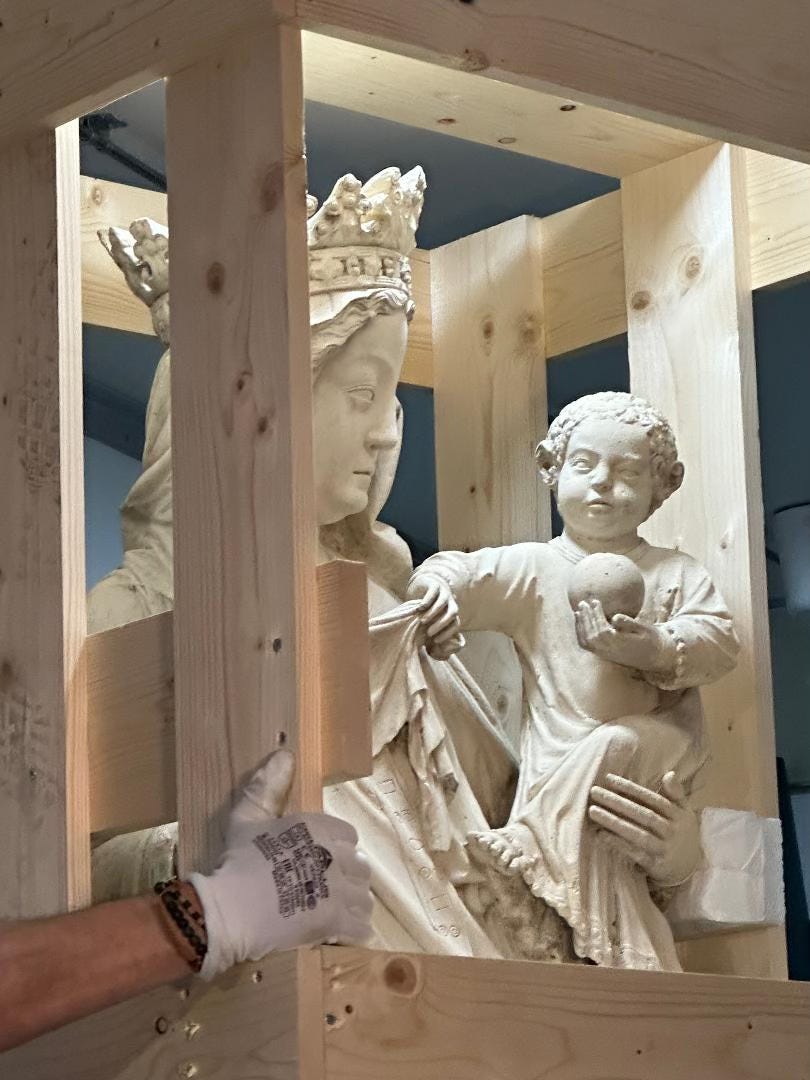
The beloved Mother and Child survived the rooftop collapse and was placed back in the sanctuary Nov. 15, 2024 Photo: Nancy Ing Duclos

“Check the Notre-Dame website for the registration link to reserve free seats for masses and private prayers as well as visits in the first week of the reopening (reservations should open around December 1, 2024). Or, look out for the new Notre-Dame mobile application to reserve dates and learn more. Five newly organized tours are available for visitors to fully appreciate and experience the full breadth of Notre Dame’s history, architecture, spirituality and restoration.”

“The Crown of Thorns will return to the cathedral’s treasury on December 13 in a grand ceremony. This religious relic, believed to be the woven crown worn by Christ on his way to crucifixion, was saved the night of the fire by those who risked their lives to enter the burning church.

On December 16, the cathedral returns to a normal schedule offering daily mass three times a day to the public.

Musical concerts with international artists are planned for the cathedral every Tuesday night for the following new year. Click here for the program and to reserve seats.”

So today, we in France give thanks that our beloved Cathedrale has survived and we will all get to visit the new and we are told even more beautiful inside in the near future.

Thanks for reading Out My Window! Subscribe for free to receive new posts and support my work.

Subscribed

A bientôt,

Sara

My favorite French photographer. The man who captured ‘vieux Paris’ captured my heart with his images

Those of you who have been reading me for awhile know that many of us who write about France are in a FranceStack that was organized by Judy MacMahon. This week I’d like to introduce you to Jenn Bragg and her recent post about her favorite photographer. Jenn writes For the Love of France.  You can find her substack by putting either her name or the name of the Substack in Search.

I hope you enjoy her post as much as I did.

“Something I have come to learn about France is that it puts a very high value on those who engage in literary or artistic endeavors. This is something I love about this country. And as many of us know, some of the best artists and creatives in history come from France.

love old photographs, especially of Paris, so this week I wanted to tell you about one of my absolute favorite French photographers – Eugène Atget.

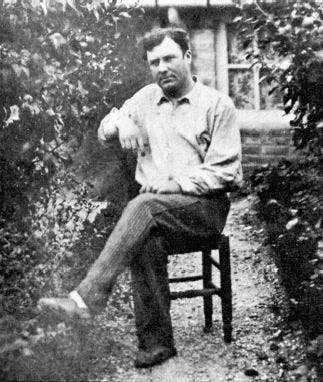
Eugène Atget, young and old. The photo on the right was taken by Berenice Abbott.

Atget always seemed destined for the arts.

Born in 1857, he was raised by his grandparents after being orphaned at the age of five. In his 20s, he worked as a cabin boy on passenger ships destined for South America. He returned to France and became an actor in the theater until he had problems with his vocal cords. Then he tried his hand (literally!) at painting. Not finding much success, he pursued photography.

Towards the end of the 19th century, Atget’s work mostly served as images on which artists could base their paintings.

But things started rapidly changing in Paris.

Industrialization began to change the city, which was being torn down and rebuilt by a man named Georges-Eugene Haussmann. Haussmann was tasked with cleaning up grimy old Paris. He did away with the narrow, rickety old streets and dilapidated buildings to create a more open, ‘breathable’ city.

Atget foresaw the disappearance of ‘vieux Paris’ (old Paris), so he decided to devote the next 30 years to documentary photography. Thank goodness, because without his work, we wouldn’t have much to go on.

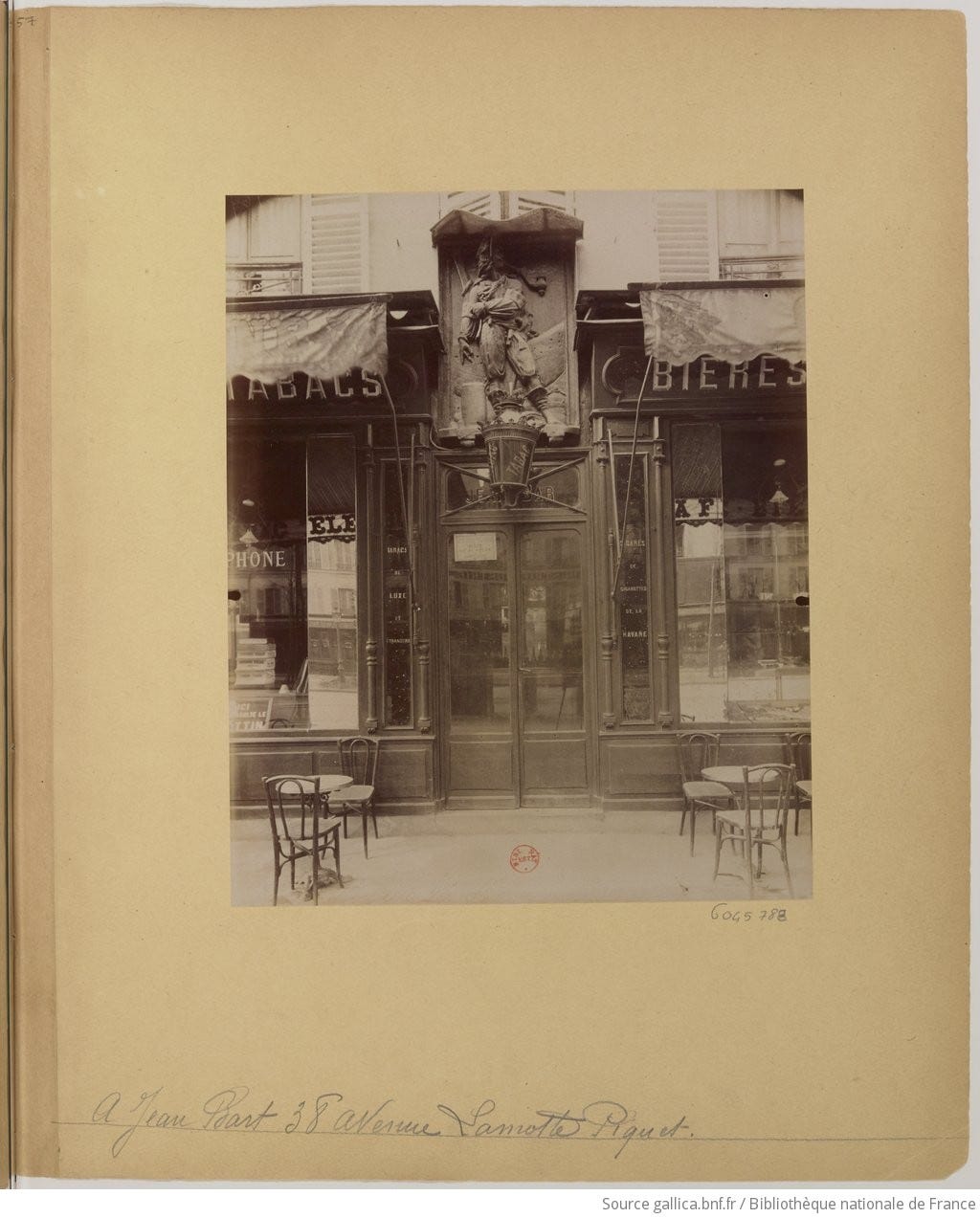
Photos of old Paris boutiques by Eugène Atget

Eugène Atget took photos of streets, storefronts, private hotels, and people. He traveled far and wide, from central Paris to the outskirts, which were entirely undeveloped.

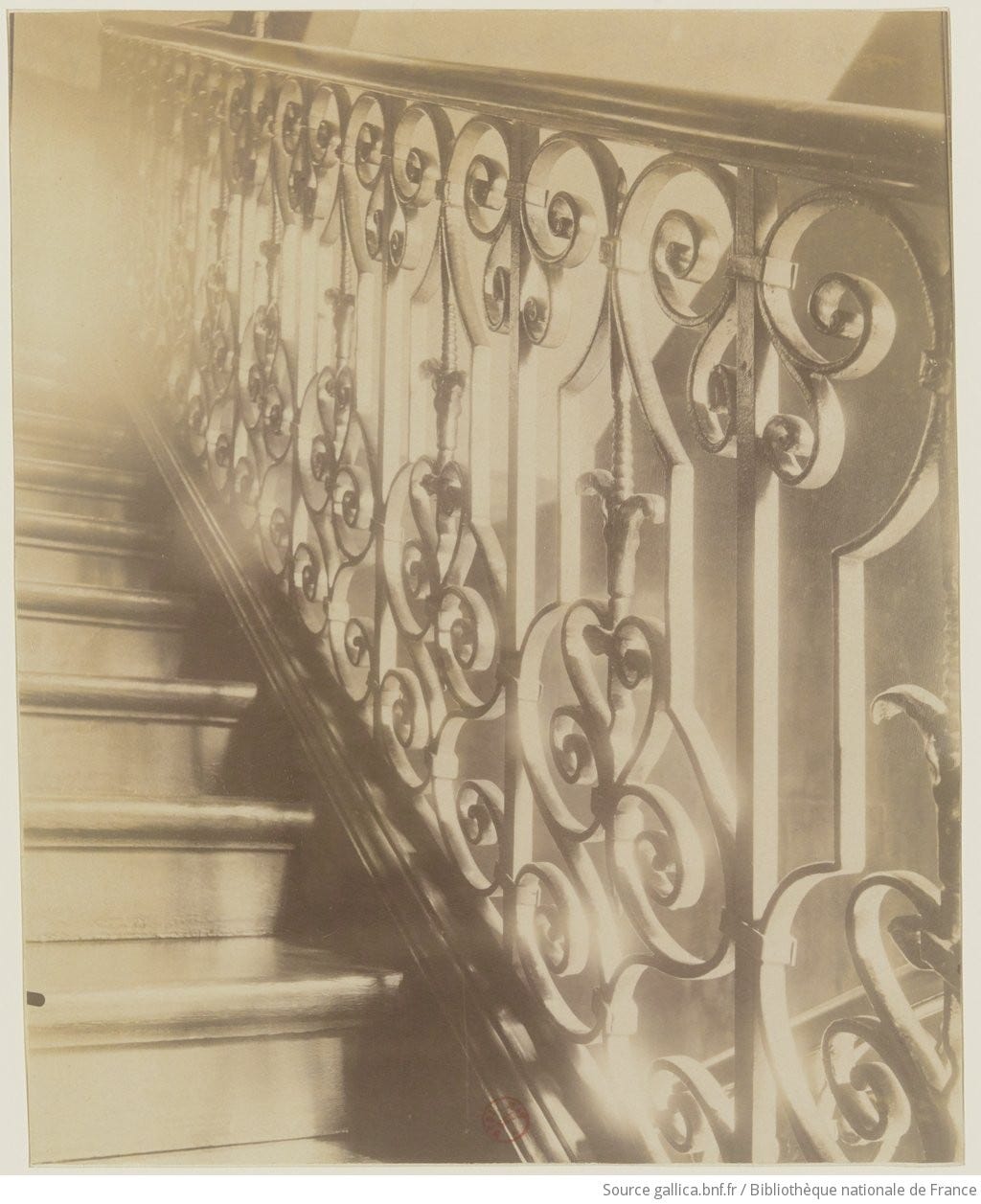
Photos capturing hotel design details. Source: BnF Gallica/Eugène Atget

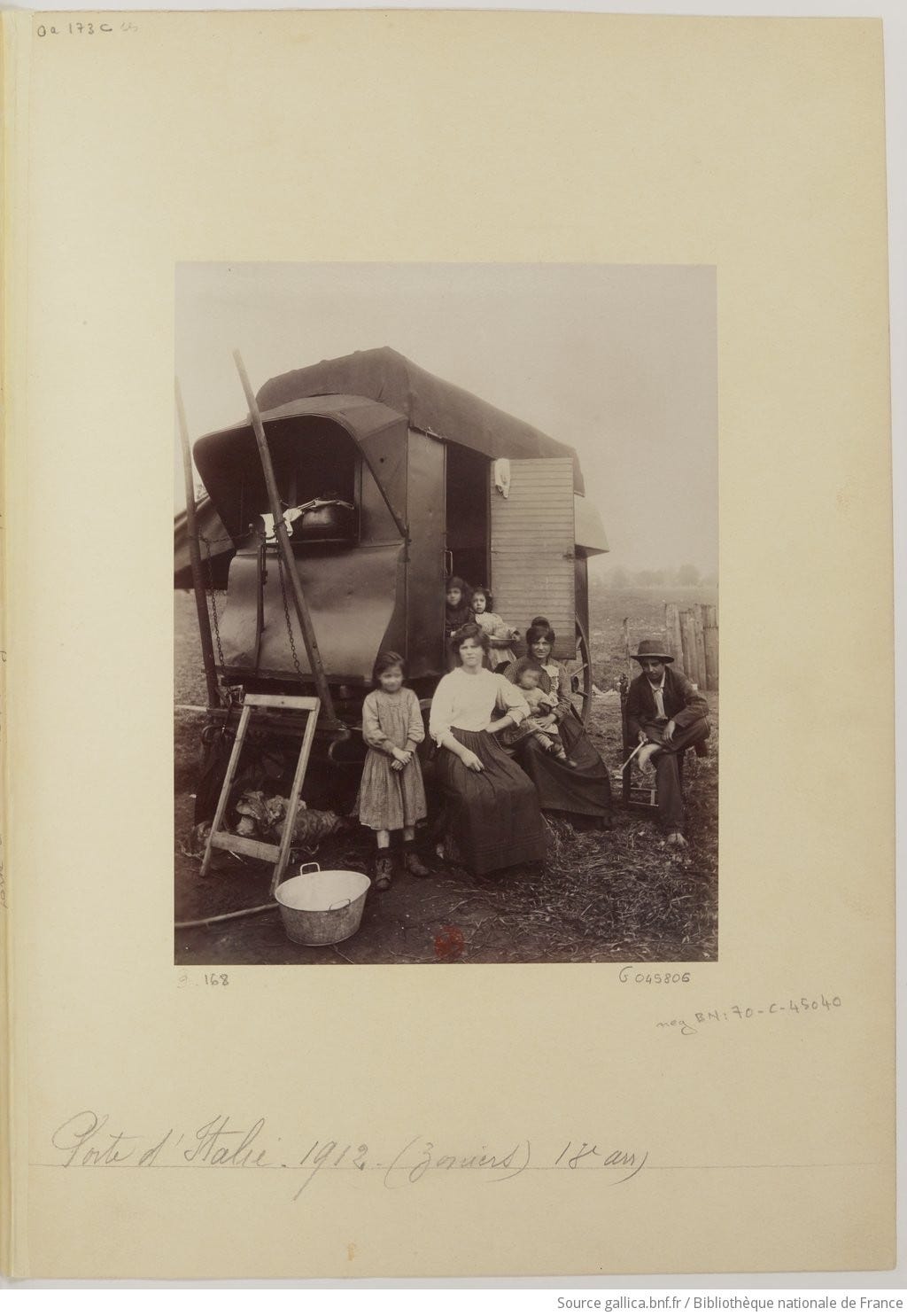
Those undeveloped areas were along the periphery of Paris, an area that was known as The Zone. (Today it’s known as ‘la péripherique’ and it’s fully developed and more affordable than central Paris.)

By the turn of the 20th century, the people living in la Zone were very poor, often in ramshackle, makeshift dwellings surrounded by trash. They were known as les zoniers. Their living conditions were unhygienic to say the least. It only got worse with Haussman’s project, which drove up real estate prices in Paris. (An entire article could be devoted to les zoniers, but I’ll leave that for another time.)

Atget did well to document the lives of les zoniers. When I see their images in his photos (below), they remind me of the scenes described in John Steinbeck’s ‘Grapes of Wrath’.

Except this was Paris, not the United States during the Dust Bowl.

Photos of people on the edges of Paris. Source: BnF Gallica/Eugène Atget

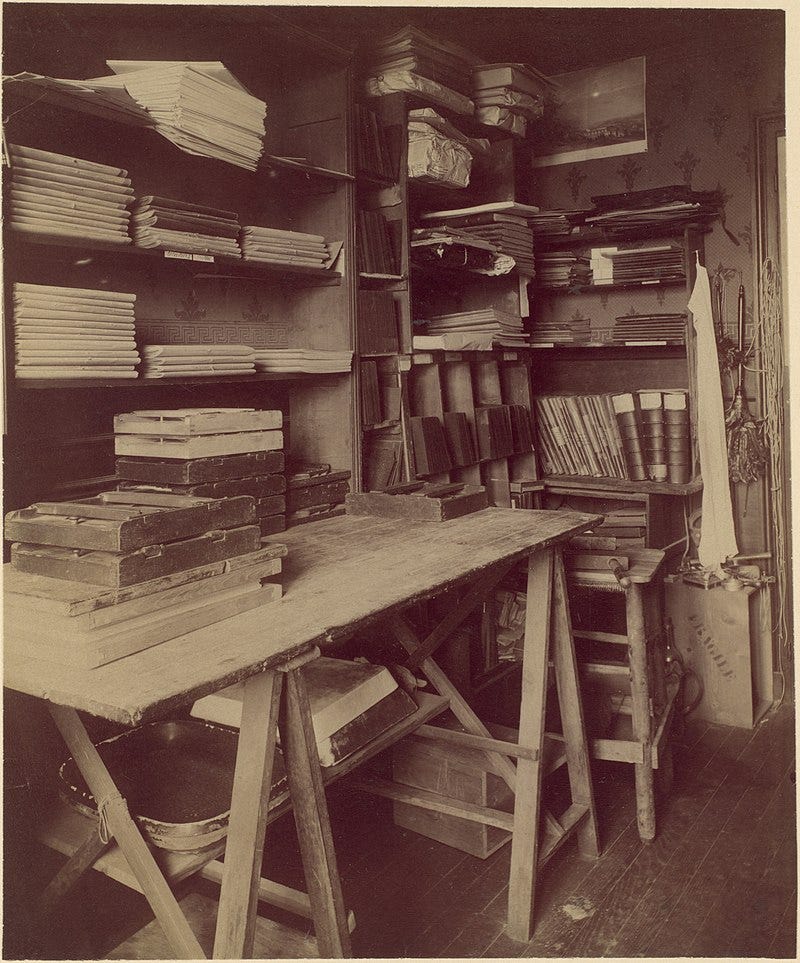
Over the years, Eugène Atget took more than 15,000 photographs, meticulously documenting exact locations and dates on his photos. He even captured his own studio (below), but identified it under a different name to create some distance between the artist and his subject.

Atget’s studio around 1910; photo: Metropolitan Museum of Art, New York

A few years before Eugène Atget died in 1927, he became acquainted with an American photographer named Berenice Abbott. At the time, Abbott was working for Man Ray in his Paris studio. (Man Ray and Atget lived on the same street in the Montparnasse neighborhood of Paris.)

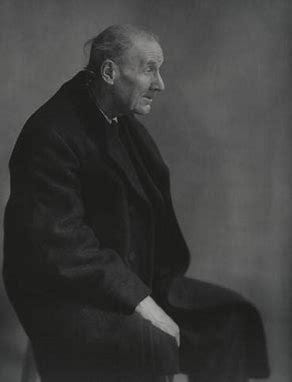
Atget and Abbot shared a love for documenting (and preserving) the magic of their modernizing cities – New York for her, Paris for him. Abbott took his portrait photos before he died. Sadly, she learned about his death when she returned to Paris to show them to him.

Eugène Atget by Berenice Abbott; photo of Berenice Abbott

Seizing the opportunity to tell the world about Atget’s work, Abbott spread the word among her New York circles. She also acquired thousands of his photographs, which gave to the Museum of Modern Art. (Separately, the National Library of France also has thousands of Atget’s photographs.)

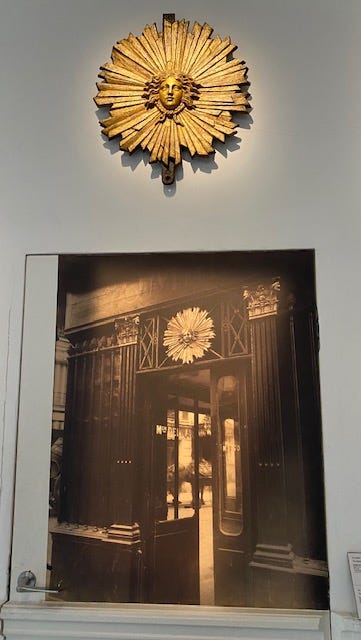
If you’re coming to Paris and have an interest in Atget’s work, you MUST visit the Musée Carnavelet, which is entirely devoted to Paris’ history. One of the best depictions of ‘vieux Paris’ is through Atget’s photography.

‘Au soleil d’or’ photo by Eugène Atget (1912) & the actual ‘golden sun’ sculpture above the door of Maison Delmas, displayed at the Musée Canavalet in Paris

Leave a comment

Sources:

Fondation Henri Cartier-Bresson: Eugene Atget

Museum of Modern Art: Eugene Atget

Bibliotheque Nationale de France

Chicago Tribune article about Atget and Abbott (from 1991)

Before you leave me, I would really appreciate if you would share my article, or my Substack, with anyone you think might be interested. I just know there is an audience out there for these ‘different’ kinds of stories from France! Thank you.”

Thanks for reading Out My Window! Subscribe for free to receive new posts and support my work.

A bientôt,

Sara

And on the 7th day….

I wanted to find a lighthearted title for this week’s Substack. For the last week, I worked eight, nine, ten hours a day unmaking a world that I had built up around myself in Oakland, California since the Oakland Firestorm of 1991. 

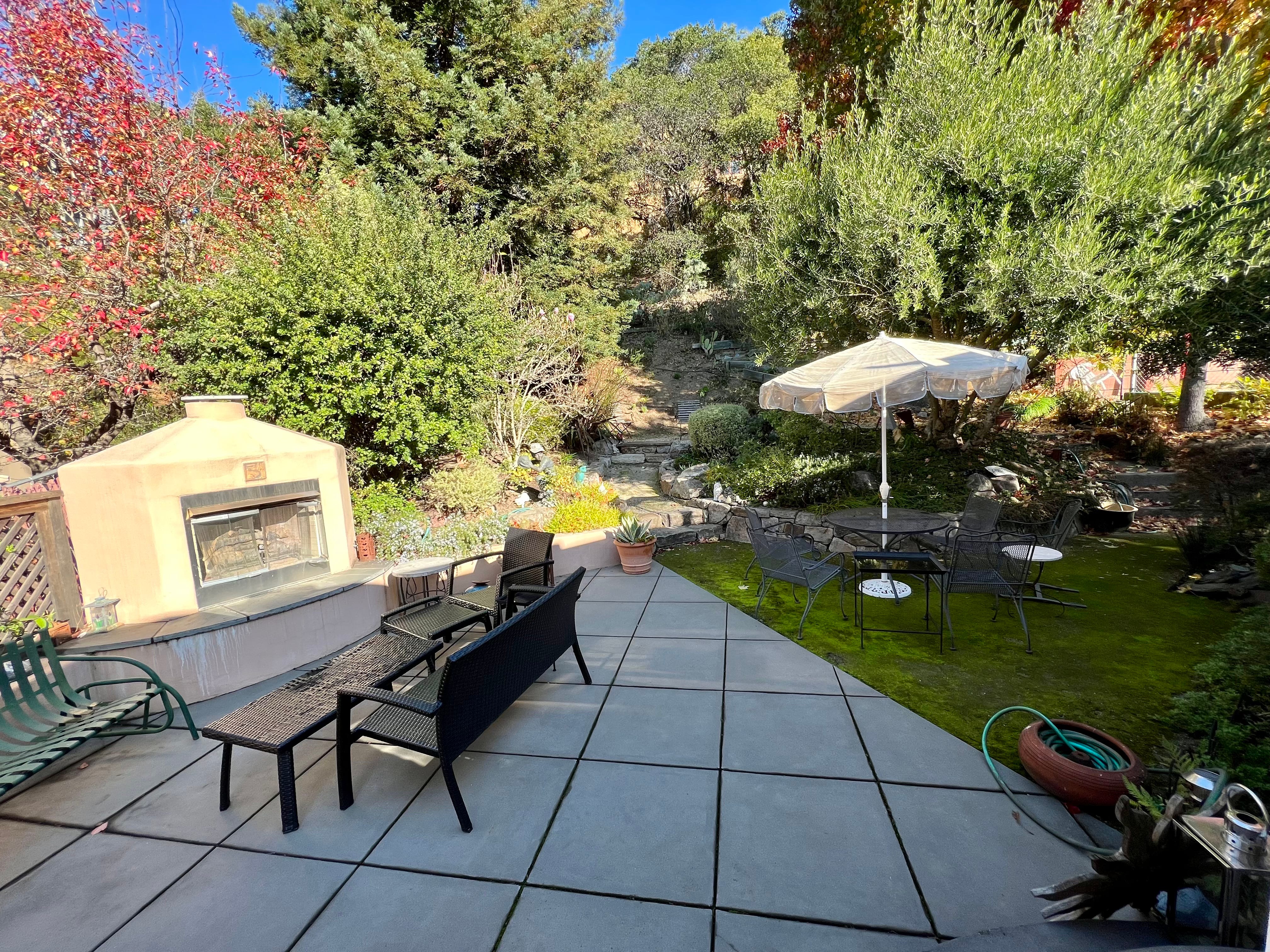
Backyard and terrace with gas fireplace off the bedroom

When my home burned down, I got the incredible opportunity (though I didn’t realise it at the time) to tell my architect exactly what I wanted in a house. I chose to simulate an adobe dwelling in Santa Fe. I was named after my great Aunt Sara who lived there most of her adult life and, romantic that I am, I thought this was a way of honouring her. I mixed the Adobe look with the Tuscan hills architecture around Florence where I spent one of the happiest times of my life. I chose doors from a company in Santa Fe, found mesquite wood at an antique store and asked the builders to plaster around it just as if it was adobe. I learned how to cut plastic garden pots in half, adhere them to the outside wall and stucco over them. Right side up, they became planters. Upside down they become covers for lights. The contractor let me design every nook and cranny (and there were many literal nooks and crannies where I could put all my treasures I’d collected in my travels) , and took my suggestions.

Most of it worked. Some of it didn’t. I closed in a deck and made it my bedroom and made my bedroom a sitting room. The entire top floor was a Master bedroom with french doors that opened onto a terrace with a gas fireplace, a table with six chairs, roses, coreanothus, a magnolia tree and a number of liquid amber. It was a sanctuary. As an old saying goes, I got out of that house exactly what I put into it: my heart and my soul. There were always animals running around as I volunteered at the Oakland Animal Shelter and couldn’t help myself.

In 2013, I had retired and decided to move to Paris for a year. As anyone knows who has been reading this blog since 2016, I fell in love with Paris. One year turned into two years. Two years turned into three. Eventually I was a resident in both countries and financially supporting two residences. As I grew older, I found it tiring to have so much responsibility. The idea that I had to make a decision about living in one place or the other developed long ago but was more a ping pong game in my head. I couldn’t land on a solution. I’d end up saying ‘if I could just beam my Oakland home over to Normandy, I’d be in heaven.’

Of course that was not going to happen. This winter, I made a decision before I realised I had. I decided to sell the sanctuary, leave California, and live permanently in Paris. My US presence would be in Ann Arbor, Michigan where my sister lives. I realised the decision was made at the end of a three month stay in Oakland. Immediately, I began to grieve and remember all the wonderful times in the house. I shut my feelings down temporarily and put the wheels in motion. I made reservations to return to Oakland on April 10th for one week. In that one week, I had to decide what I wanted to keep and would send to Ann Arbor; what I wanted to go to Paris — my hope is to find a larger apartment in Paris once the house sells; —and what to leave behind. I was referred to the most wonderful packer/mover, Amy McEachern, who showed me how to put blue stickies on anything going to Paris and yellow stickies on anything going to Michigan. She would come in with her crew after I left, and pack it all up and get it sent. Then another crew would enter the scene. They’d do an Estate Sale and liquidate what doesn’t sell. At that point, the house will just be a house. My sister has taken all the ceramic cats that lived in the back yard. Everything that possibly could be called a thing will be gone. Thirty years of what I loved, enjoyed waking up to in the morning, looked at when I climbed the stairs up to the bedroom will have traveled somewhere else. I got promises from everyone that that somewhere would not be a dump. The house would then be ready for staging. Staged by someone who doesn’t know the house, all her secrets and stories. I’m sure it will be beautiful but will it feel alive?

A week is not much time to make those kinds of decisions. I was afraid I would procrastinate. I didn’t think I would change my mind. I put out a Help call and friends came over to sit with me or make decisions with me. Either way, they provided energy so that I could get the work done and I got to spend time with them. By Monday, the 5th full day of work, I hit a wall, My exhaustion made me dizzy and I didn’t feel safe driving a car. I asked a friend if we could play Driving Ms Daisy. Amy called to ask if I needed a strong guy to come over and take things out of my attic so I could sort through it. I’d already seen what a mess it was up there. But I couldn’t remember any one thing that was there. I clearly hadn’t missed any of it in the past ten years. I thought about it for two minutes and then told her the truth. I couldn’t move my body, I couldn’t do any more work. I was going to leave it for the Estate and Liquidator people. The sixth day was spent with my realtor and going over everything to make sure the stickies had stayed stuck. And on the 7th day, I went to SFO and slept nine hours on the plane back to Paris. 

For the next three nights, I slept twelve hours a night. I’m sad. But here’s the thing. For one of the first times in my life, I made a decision to let go. I had a choice. I didn’t have to wait until my beautiful home collapsed in an earthquake or burned again in a Firestorm. The choice I made was to let go of something I love knowing that it meant lots of tears, grief, sadness, and memories. I wasn’t going to mistake the sorrow for thoughts that I’d made a mistake. Letting go is hard and I’d been trying to avoid that for years. Letting go also means that I get to move on. I moved to Paris ten years ago. It’s taken me ten years to get the message that it was time to move on. 

Or as a friend of mine says: “It is what it is and probably right on time.”

A bientôt,

Sara

Thanks for reading Out My Window! Subscribe for free to receive new posts and support my work.

Please Keep your Hands in my Food: Why this butter made people mad by Anna Muckerman

I have mentioned before that the indefatigable Judy MacMahon, who writes “le bulletin” substack has pulled as many of us that write about France or Paris together into FranceStack (click to see all the substacks).
She encourages us to repost each other’s writings 1—because they are often on different subjects and 2—to bring attention to other blogs and Substacks that might interest readers. I urge you to go visit Judy’s Substack ‘le bulletin.’ Unlike me, she consistently writes every week, does amazing research on fascinating subjects of French life, and is a wonderful, encouraging supporter of all of us that write here in France.

The following is an article from last week’s ‘le bulletin’ written for her magazine MyFrenchLife.org. She also has a book club that meets on Zoom about 4 times a year. Before the Zoom meeting, readers have a chance to discuss the book as they are reading it. Presently, the book club is reading The Postcard by Anne Berest.

beure - Butter
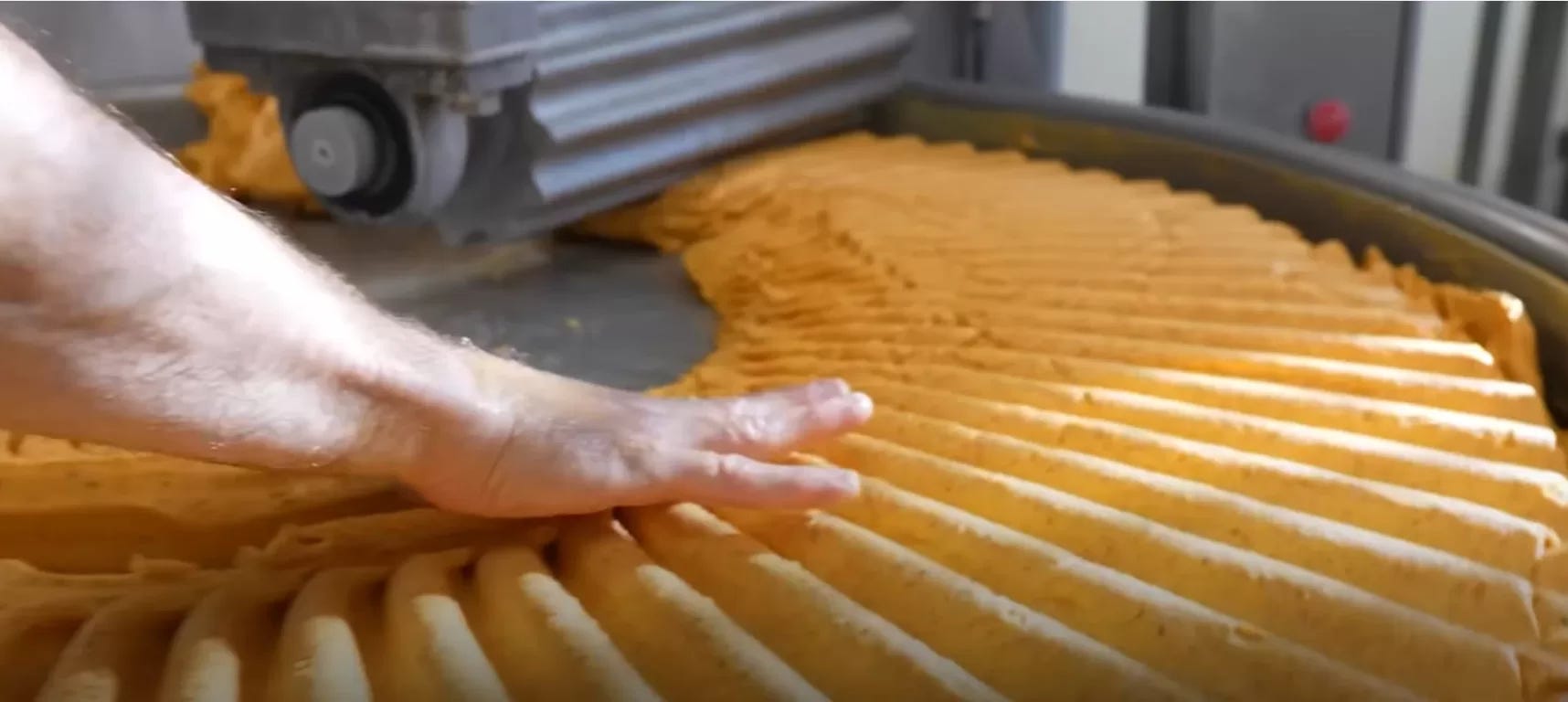
Kneading butter at the Beurre Bordier atelier in Brittany. Image from the Eater video found below

And now to the article by Anna Muckerman…….

Thanks for reading Out My Window! Subscribe for free to receive new posts and support my work

“In July 2022, I was filming a video about Dijon mustard in a village restaurant in Burgundy when the chef said to me,

You should really do a story about Beurre Bordier up in Saint-Malo. That’s what all the big French chefs use.”

Beurre Bordier

I had never heard of Beurre Bordier, but I soon discovered that it was almost like never having heard of Ben & Jerry’s — it was the butter, renowned both in France and worldwide, a gem, but hardly a hidden one.

Four months later, Eater sent me to Beurre Bordier’s atelier in Brittany to see the magic for myself. The company was founded by Jean-Yves Bordier, who in the 1980s revived the historical technique of remalaxage – or re-kneading – and developed a roster of flavored butter including the signature Brittany seaweed butter that the company is known for today.

La Maison Du Beurre
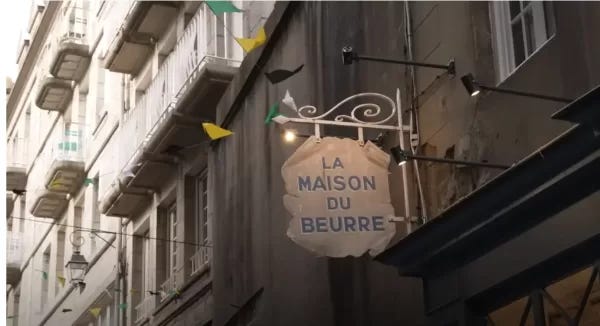
Bordier’s flagship store La Maison Du Beurre in Saint-Malo

Monsieur Bordier had recently retired, but the company’s oldest employee Vincent Philippe graciously walked us through the process. I learned that Beurre Bordier does not produce butter from cream. They buy high-quality, organic churned butter in giant blocks and rework it on a giant wooden kneading machine by adding salt and removing water until the flavors become more developed (read: delicious).

Then they add exciting flavors like wild garlic, Madagascan vanilla, buckwheat, or yuzu, to name a few, and form it into custom sizes and shapes for customers around the world.

A few months later, I spotted Beurre Bordier for sale in a swanky Bangkok shopping mall. I excitedly told the young woman behind the counter that I had just been to the place where the butter was made. Understandably, she pointed at the butter as if to say Cool story, and would you like to buy some?

You can see the whole process here:

Butter and YouTube

To date, 6.6 million people have watched this video, making it my most-viewed work (full disclosure: anything about butter performs well on YouTube). Nearly 2,000 people also took the time to leave a comment. Here is a selection of them:

 – “i really like the amount of hand hair that went to making of this butter”

– “love how they wear a Hairnet but his Hairy arms are wide open”

– “Love the taste of finger prints in slice of butter..!!” (This one really cracks me up: What do fingerprints taste like? Imagine slicing butter and finding one inside!)

– “While I’m sure this is quality butter I don’t want employees working gloveless with hairy ass arms kneading my butter.”

– “Hand sweat adds flavor.”

Now, if you’re going to work with YouTube in any capacity, you can’t get bent out of shape about the comments. In fact, it’s wise not to read them at all, except in specific cases like Eater videos because there are often a lot of lovely comments from people who have nice things to say.

However, these particular comments are emblematic of a wider societal problem: We can’t stand hands touching our food. I’ve noticed it in other places, too – like this Instagram Reel and this one where people are wearing gloves while cooking for no apparent reason.

Sure, some people may wear gloves to avoid the squishy texture of raw meat (although in the first video, he doesn’t even touch the ground beef!) but what purpose do gloves serve when slicing an onion or an avocado?

It seems that somewhere along the line, we got the idea that hands = contamination and that we should use gloves when preparing everything, as if the kitchen were a hospital. We forgot that cheese is made of mold and yogurt formed by bacteria. Food should be clean, but it was never sterile to begin with.

No longer a germaphobe

Ironically, I grew up quite the germaphobe. Even as a kid, I couldn’t stand to see people make food while wearing rings and so much as an eyelash hair on my plate would ruin my whole meal. Over time though, as I’ve traveled more and eaten in other people’s homes, I’ve come to realize that hands are precisely what elevates food from a simple means of sustenance to one of life’s greatest pleasures.

Food safety is important, but cleanliness should not mean avoiding human involvement.

In many places worldwide, food is now something that comes in a brightly colored package with lab-derived ingredients. Cheese is wrapped in plastic with a picture of an idealistic-looking farm that hardly resembles modern, industrial dairies. In the U.S., I recently saw flawless, elongated bell peppers, bagged and branded with a cutesy name as if they were produced in a candy factory instead of a field.

This isn’t a rant against mass-scale food production, which has allowed us to more efficiently feed ourselves, and refocus our energy on other areas. I’m simply pointing out that the more detached we become from what food is, the more we develop a warped view of how it should be produced. We’d rather a machine pop out perfectly uniform, brightly dyed pieces of cereal than eat butter molded with care by clean, washed hands.

At Beurre Bordier, Vincent explained that bare hands allow the workers to understand; if the butter has been mixed correctly, and if the temperature and consistency are right. In other words, whether it’s safe and delicious.

To be clear, not all cultures seem to suffer from the fear of hands touching food – some embrace it wholeheartedly. After all, isn’t this the way it’s been done since the literal beginning of mankind?

I, for one, would like to say:

please keep your hands in my food. “

As Vincent told me on the day I visited Beurre Bordier, clean hands are much preferable to dirty gloves.


What’s your view on cooking with your hands? Share in the comments below.


Further reading:
French Butter why is it so delicious?
Butter: Exploring the French Paradox

Thank you for reading Out My Window. This post is public so feel free to share it.

Thank you for being such an important part of my week. This blog wouldn’t exist without you: someone who wants to know more about this wonderful country.

A bientôt,

Sara

Coming to you from Paris in four short months: The Summer Olympics

If you ask a Parisian, any Parisian, French or exPat, if they are excited about the Olympics coming to Paris in late July, they will probably roll their eyes, get dark around the gills, and tell you they are leaving town—until the end of August. The newspapers say it will be a ghost town. With 10,000 tourists landing like locusts in every part of Paris, willing to pay up to 1000 euros a night for a place to stay, it will hardly be a ghost town. But likely a town of mostly tourists.

The problem for Parisians is that the majority of them cannot afford the prices of the events. We were led to believe that there would be special days where we would be privy to advance sales before they went public. Even then, the most reasonable ticket prices were gone, it was next to impossible to click through to purchasing a ticket, and it became so frustrating we gave up. I wanted the equestrian games which are to take place in Versailles, the tennis which is right around the corner from me at Roland Garros, gymnastics which I knew would be hard to get. Every time I went into the “special” site for residents, every single ticket was gone for all three events. In the end, I recently bought two tickets to a Rugby placement game the night before the Opening Ceremonies. I invited a friend who played Rugby for 20 years to join me. I have been wanting to learn the rules of Rugby so this in many ways would be perfect.

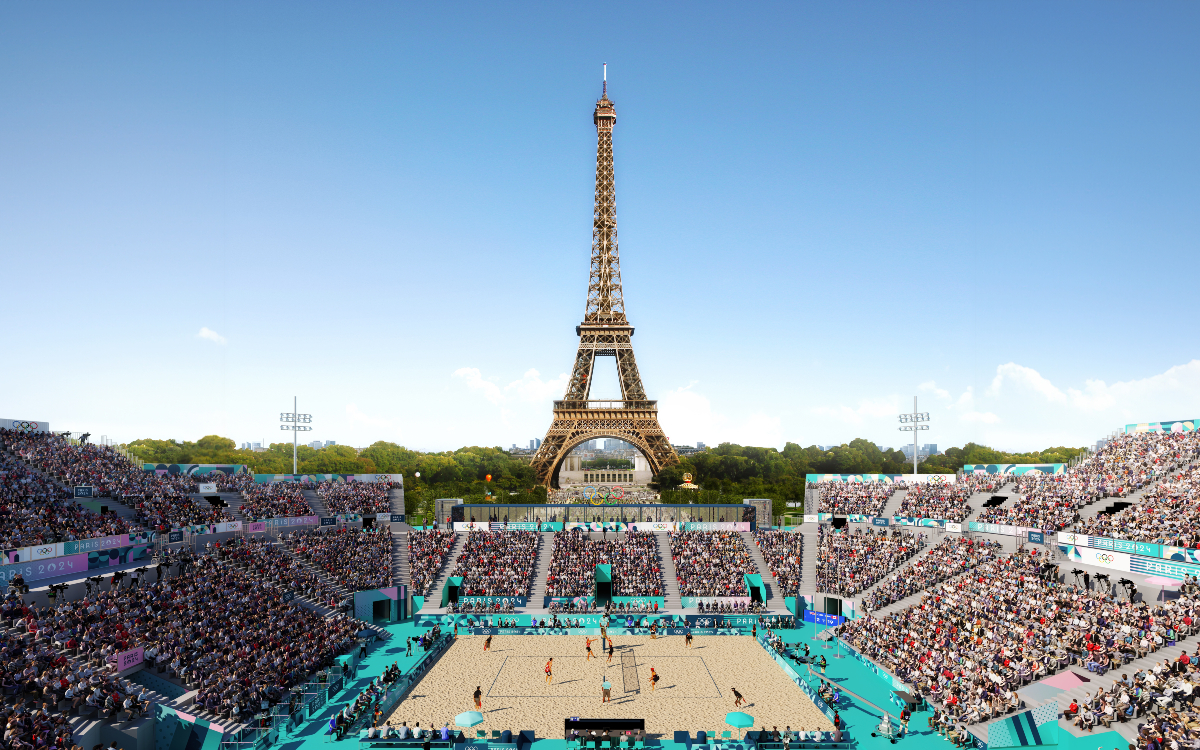
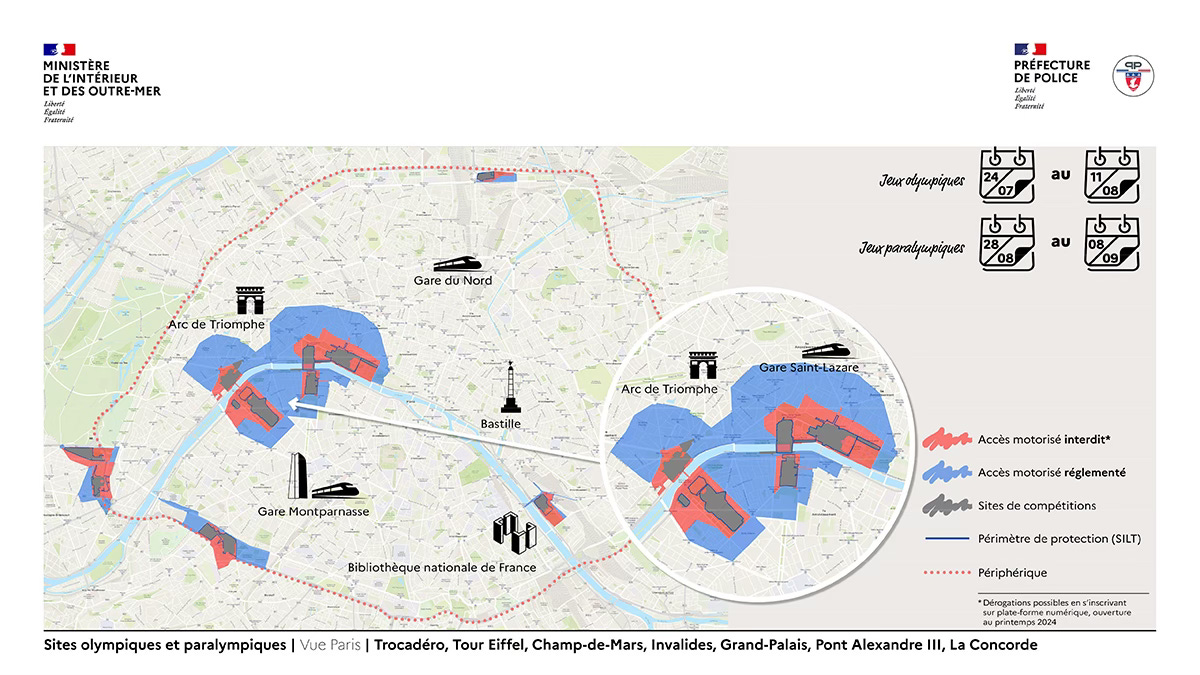
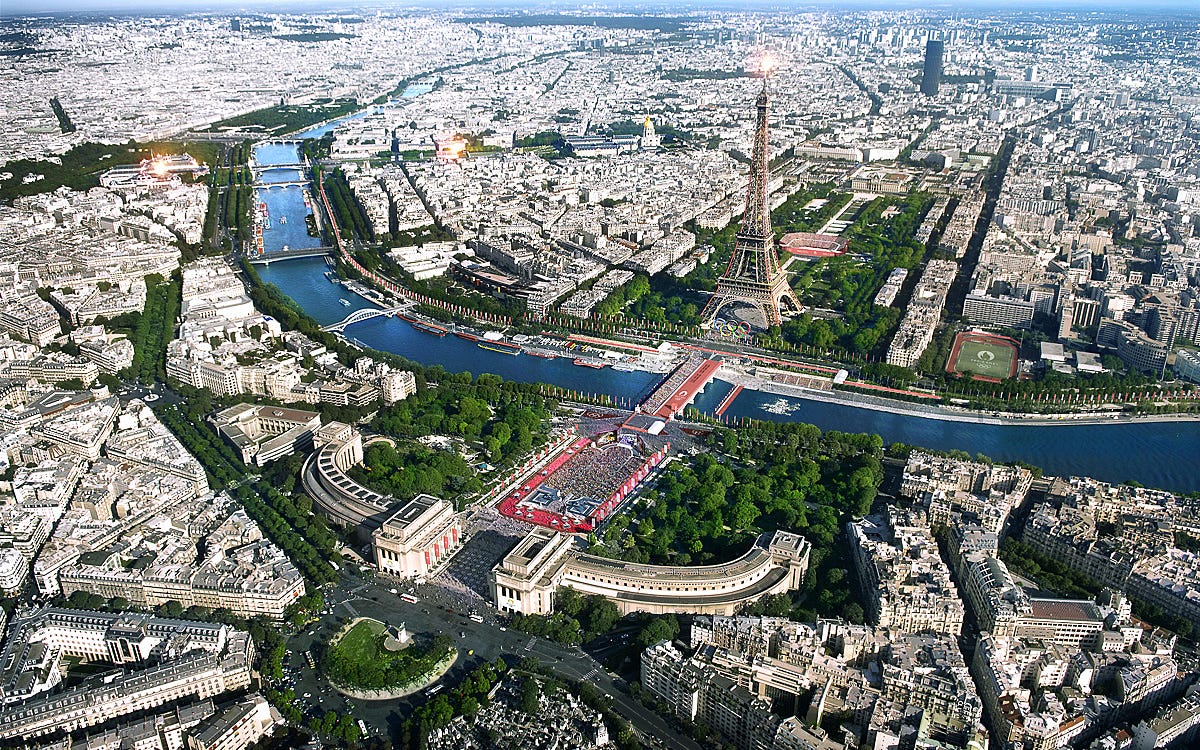
Then there is the roadworks, the renovations, the cleaning up of historic landmarks, putting in elevators and escalators in metro and RER stops. It has been inconvenient to say the least for at least 3 years, now it is getting unbearable. Places like Concorde will close to everything but metro traffic from now until the end of the summer. They are building a stadium at the foot of the Pont d’lena where the Trocadero gardens now are. Cars used to driving along the quai there will be diverted to…..I can’t even imagine where. Anywhere would be a nightmare of snarling traffic. The above map, taken from the French Government site, gives an idea of where construction is happening and who/what is not allowed there. 

There is no doubt that these renditions of the stadium with the Tour Eiffel looking over it are beautiful. For people living in other parts of the world, there is undoubtably a sigh of “how beautiful Paris manages to stay beautiful even for the Games.” The Games are for tourists. They will come maybe a couple of days before the Opening Ceremonies to get over jetlag and exclaim at the beauty, the wonder that is Paris with it’s light, it’s sky, and it’s history. They will not know and never know what Parisians had to put up with to get to the Opening Ceremonies. Which about sums up the Olympics for Parisians: all the inconvenience and the events are all unaffordable. ““We’ve been suffering since the Games were declared,” grumbles Nico, a law professor who lives across the street from the Louvre with his wife, Marianne, the owner of a P.R. firm. “Permanent road works, shit everywhere, and obviously the hassle during the Games themselves.”—Alexander Marshall in AirMail

“Today, as the clock ticks down to the opening ceremony on July 26, even as an 82 percent completion rate of building construction has been announced, mostly on schedule, and with a carbon footprint projected to be half that of the previous Games’ average, the city is far from having caught Olympic fever. Instead, it’s on the verge of a nervous breakdown.”—A. M. in AirMail

From the site Paris.fr:

Quel calendrier pour le montage et le démontage des sites ?

Zone Concorde

1er mars : Début de montage par l’est de la place

Extension progressive du chantier sur l’ensemble de la place de la Concorde du 1er mars au 1er juin

  • 1er avril : quart sud-ouest de la place
  • 26 avril : fermeture de la circulation : (piétons/vélos/véhicules) sur le Cours de la Reine entre l’avenue Winston-Churchill et l’avenue Franklin-D-Roosevelt
  • 17 mai : fermeture axe nord-sud à la circulation (piétons/vélos/véhicules)
  • 1er juin : fermeture de la circulation véhicule, piétonne et cycliste sur l’ensemble de la place de la Concorde
  • 1er juillet : fermeture à la circulation (véhicules) du Pont du Carrousel
  • 15 juillet : fermeture à la circulation (véhicules) du Pont Royal

Libération progressive du site à compter du 19 septembre :

  • 7 octobre : libération de la majorité du site, sauf autour de la place Jacques-Rueff
  • 4 novembre : libération totale du site

Zone Champ-de-Mars

4 mars : Début de montage par la place Jacques-Rueff et avenue Joseph-Boulard (fermeture aux véhicules et piétons)

Extension progressive du chantier sur l’ensemble des jardins du Champ-de-Mars du 4 mars au 1er juillet

  • 12 avril : fermeture de la place Gouraud et extension dans le jardin
  • 3 juin : fermeture quasi complète des jardins du Champ-de-Mars
  • 1er juillet : fermeture à la circulation (véhicules) du Pont d’Iéna
  • 24 juillet : fermeture à la circulation (véhicules en surface) du quai Jacques-Chirac

Libération progressive du site à compter du 19 septembre :

  • 7 octobre : libération de la majorité du site, sauf autour de la place Jacques-Rueff
  • 4 novembre : libération totale du site

And Finally:

Zone Trocadéro

20 mars : début du montage par la place de Varsovie et fermeture à la circulation de la partie nord de la place, mise à sens unique de l’avenue des Nations-Unies et fermeture aux piétons des abords de la fontaine

Fermeture progressive des jardins du Trocadéro du 20 mars au 1er juillet

  • 1er mai : Circulation réduite à une file dans chaque sens sur l’avenue du Président-Wilson et fermeture de la chaussée Sud de la place du Trocadéro
  • 10 juin : fermeture de l’avenue des Nations-Unies à la circulation (piétons compris)
  • 1er juillet : fermeture des jardins du Trocadéro et fermeture à la circulation (véhicules, piétons et vélos) de l’avenue Albert-de-Mun et du sud de l’avenue Wilson (entre Albert-de-Mun et place d’Iéna)
  • 16 juillet : fermeture de la place du Trocadéro et du pont d’Iéna (véhicules motorisés, piétons et vélos)
  • 21 juillet : fermeture aux voitures du quai Jacques-Chirac (entre les avenues Suffren et Bourdonnais), le souterrain reste ouvert à la circulation

Du 27 juillet au 8 octobre : libération progressive de l’emprise

  • 27 juillet : place du Trocadéro
  • 12 août : pont d’Iéna et quai Jacques-Chirac
  • 7 septembre : place de Varsovie et avenue des Nations-Unies
  • 15 septembre : avenue Wilson
  • 19 septembre : majorité des jardins du Trocadéro
  • 8 octobre : libération totale du site

Here is the schedule, in French, for the above sites. For a good translation app, use DeepL. It is the best of all available.

Pour voir les cartes en plus grand :  Click here to see bigger maps: both of sites and of the different events.

As is quite clear, and even those of you who don’t read French can probably suss out, that from the middle of March until the 4th of November, these sites will be a nightmare for those of us who live in Paris, have to work in Paris, have doctors’ appointmentts and other important appointments. People are being told to work from home. But perhaps their work won’t let them.

There are far too many questions floating around which only adds to the stress. It is impossible to get excited about the Olympics. This is the very first year that I haven’t been excited. I’m going to make an attempt, with friends, to try and see the Opening Ceremonies but I don’t have high hopes.

I plan to write more about the plans, growing furor, and possible excitement about the Parisian Summer Olympics—-which is followed immediately by ParaOlympics.

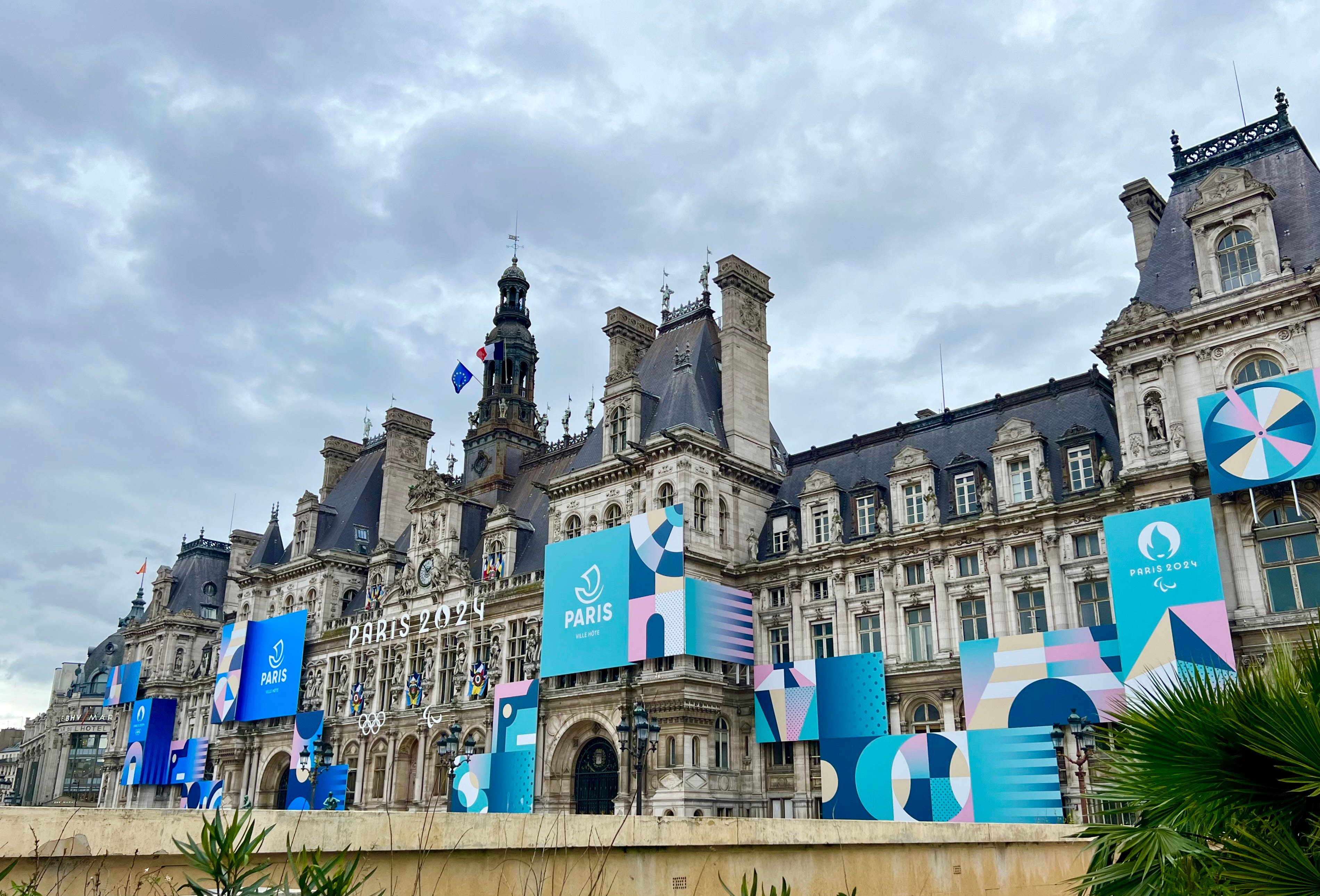
Hotel de Ville decked out in Olympic flags

A bientôt,

Sara

Thanks for reading Out My Window! Subscribe for free to receive new posts and support my work.

Back in Paris….

I flew back home last week, a smooth-as-ice plane ride with no hiccups, just nice people in the air. No flat tires, no holes blown out in the side of a plane. It was a United flight and United is getting bashed but this was a great flight. People smarter than I am say that it takes one day of jet lag for each time zone one crosses. I crossed nine and it took me about two weeks to feel solidly on French soil.

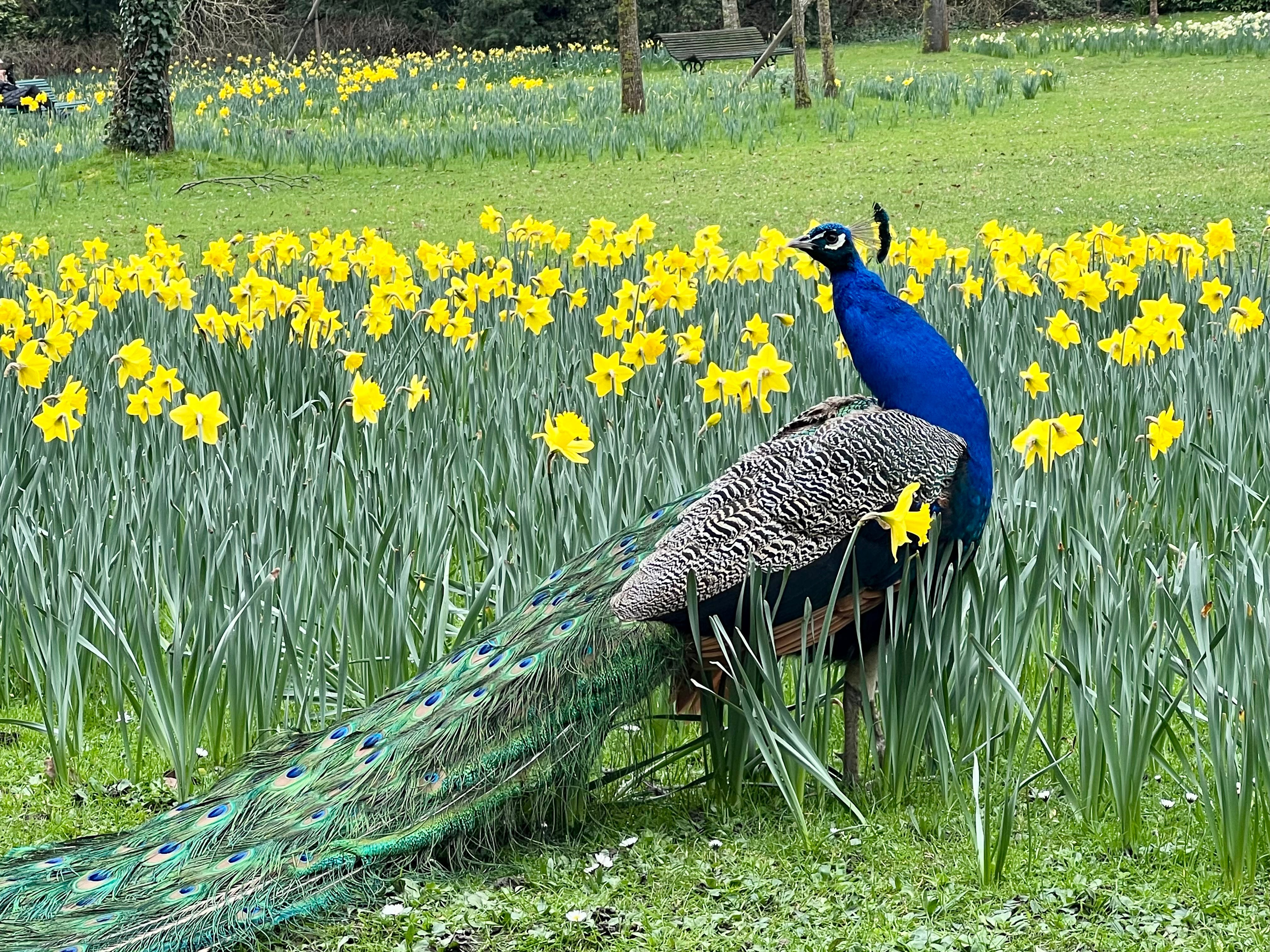
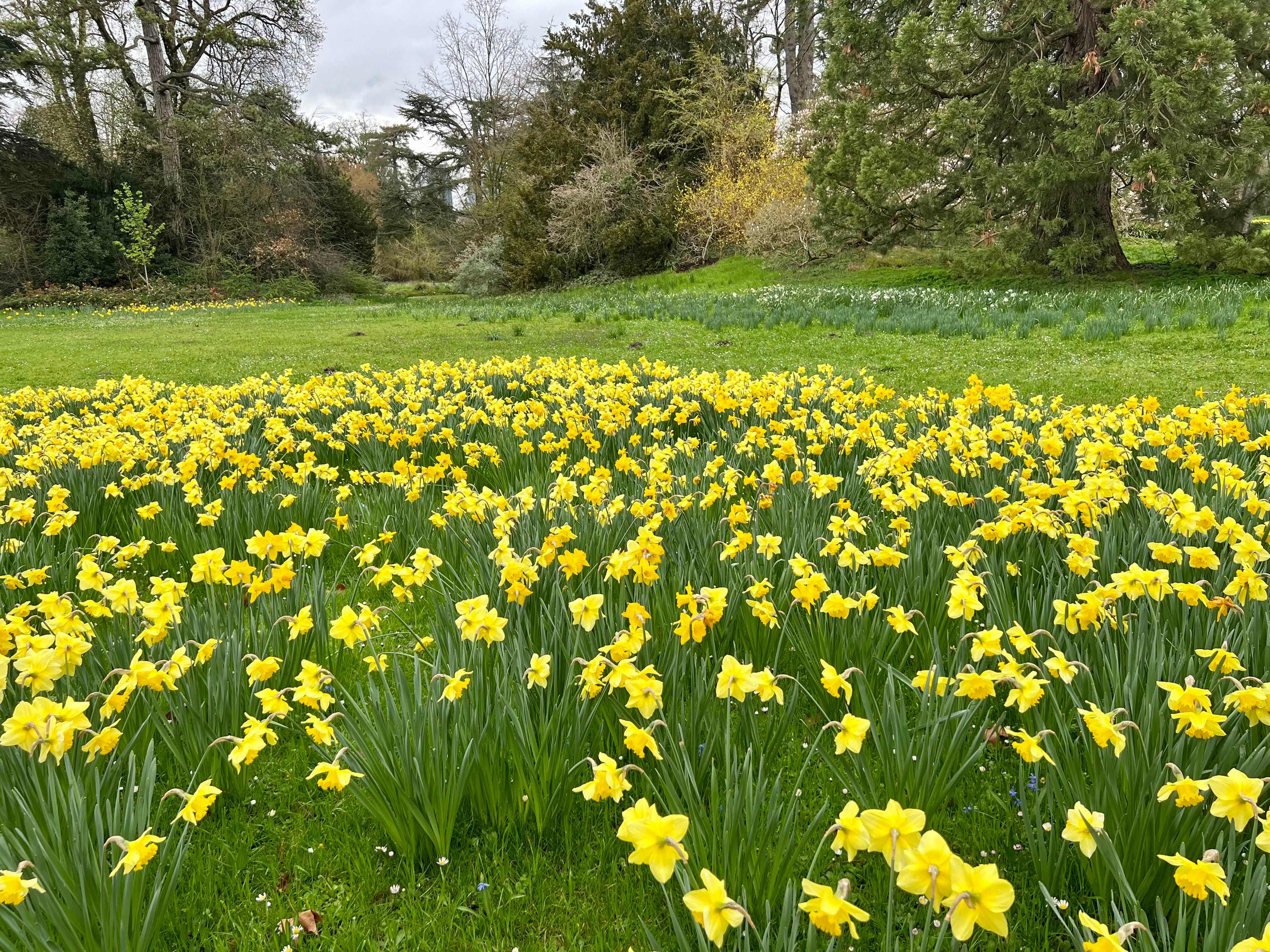
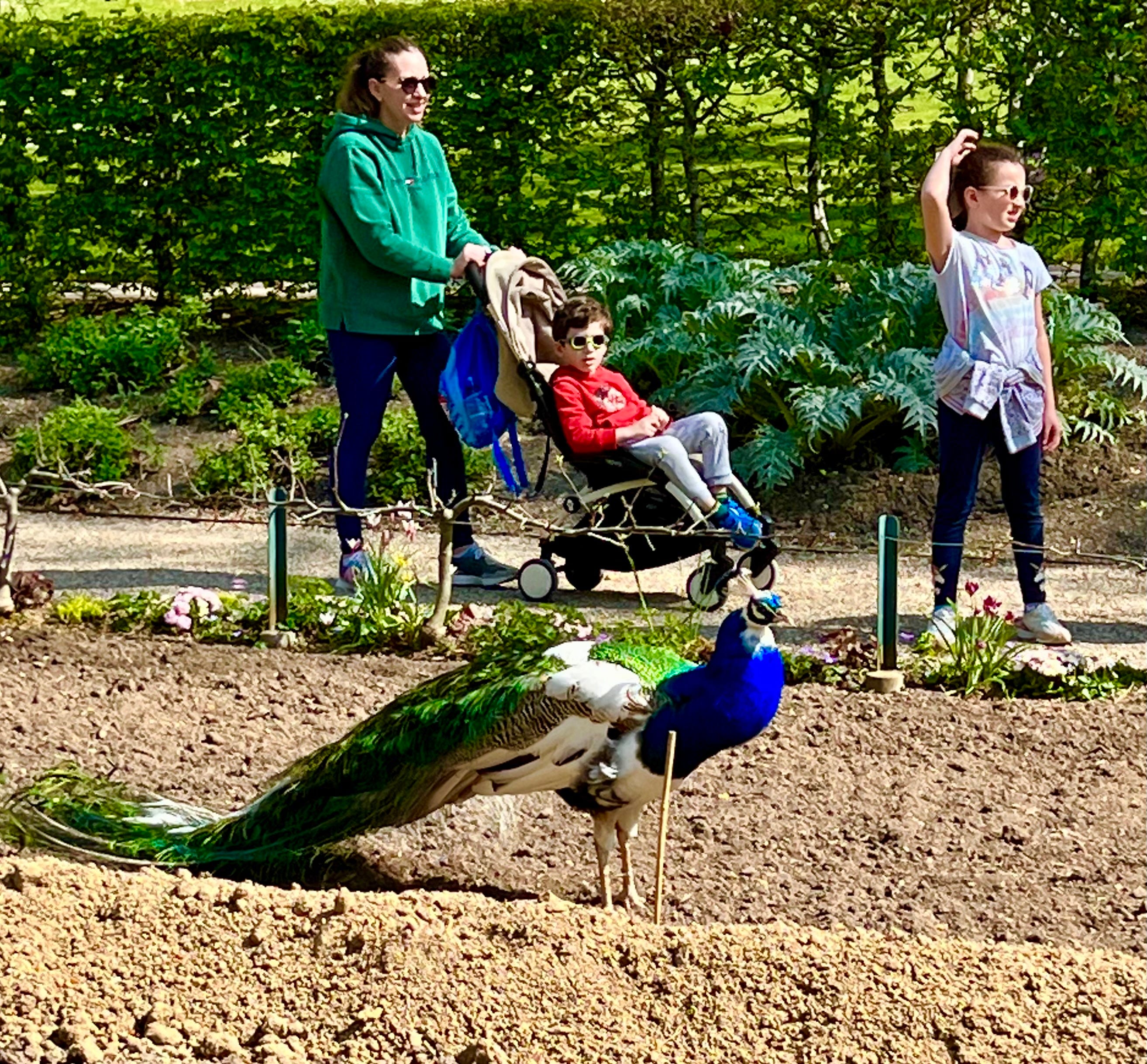
The day after I arrived, I walked to Parc de Bagatelle to check on my cats and peacocks. I was also crossing my fingers that I had not missed the daffodils which bloom in February and March. It is a sight to behold. Fields and fields of daffodils, yellow, white, cream, and even cream with yellow centers. Daffodils have long been one of my favorite flowers, and to see the Wordsworth poem laid out like a carpet in front of me is un émerveillement. I was not too late. I think that the entire month of March will be Daffodil Heaven!!

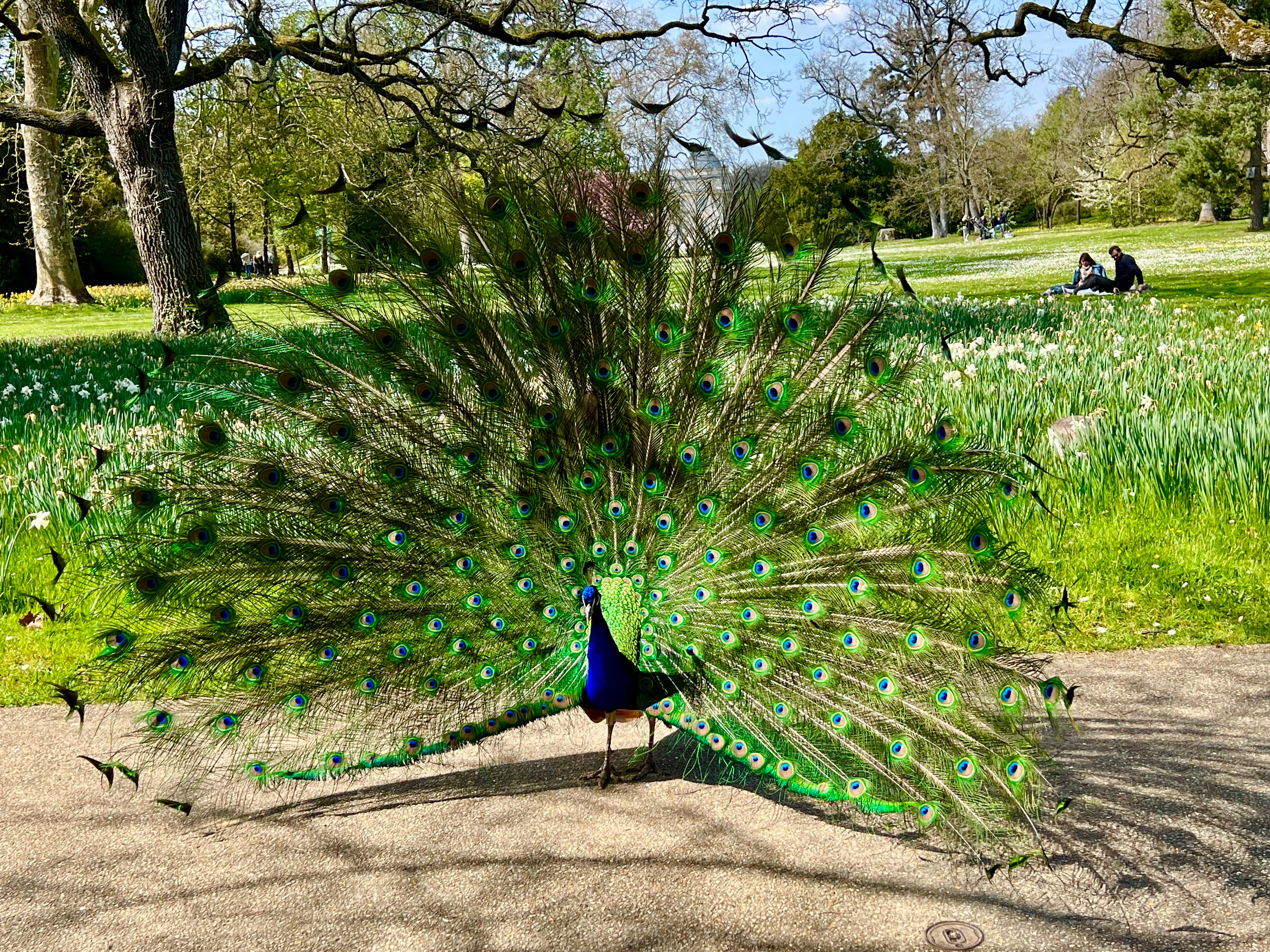
I also saw something else that in all my years of going to Bagatelle I’ve never seen. A male peacock courting a female peacock. Mating season starts now and goes through June or July. Female peacocks make themselves scarce while the males prance all over the parc. They are real show-offs. They will spread their beautiful tail feathers into a peacock fan if there are enough people to watch. They will walk right up to you, and, if you keep your hand open and flat, like one does with a horse, they will eat kibble out of your palm. What I saw was fascinating. A female was up on the stump of a tree cleaning herself and ignoring the male. The male had his fan unfolded. He would literally shake a tail feather and the entire fan would vibrate for about 30 seconds. If you watch the video, you can see him start the vibrations. The feathers shake like leaves blowing on a tree. It’s as if with the shaking of the tail feathers, he is winding up his motor for the fan vibration. He slowly takes little steps towards her. But before he gets close, she takes off.

Peacock courting
dance

Many European cities have Parks, Gardens, and Squares for the public and, probably Paris is not #1 but only because many European cities share the best public gardens with Paris. One cannot go walking for more than ten minutes without stumbling on a green space where Parisians are sitting on benches reading books, or eating a meal, or taking longs walks as is true with Bagatelle. Parc de Bagatelle is in the northeast corner of Bois de Boulogne. North, in the 17th arrondissement, is the beautiful Parc Monceau which combines the best of manicured gardens with wild grasses and trees, and the feel of walking in a forest. In the 20th is the Parc des Buttes-Chaumont. It is large but not on the scale of Boulogne or Vincennes, the two Bois that sandwich Paris between them. Buttes-Chaumont has many walking paths, a playground for children, marionettes, and food stands. East of the 20th arrondissement is Bois de Vincennes, slightly larger than Bois de Boulogne. There is a Chateau that is open to the public, two lakes, a tennis club, riding club and a sports arena. Among other things.

I have long theorised that the majority of Parisians have small apartments. With no front or back lawns to enjoy the sunshine, Parisians use the closest park as their outdoor home. The same is true for meeting for a coffee or a drink. Apartments for the most part are small and few of us have a kitchen table to hang out at with a friend. So we meet in cafés where no one will urge you to leave. As we exPats learn to do that, we join the wonderful sidewalk society that Paris is so famous for.

Avenue Mozart

I will end with one of my quibbles of living here and having a lot of communication with the US. The US changed their clocks and sprung forward on March 9/10. Europe and the UK do not change their clocks until Easter. Three weeks of having to remember that the time difference is one hour less than normal. I missed an important meeting last night, came an hour late to my writing class and my writing group. I usually am very good at remember this difference, and I’m blaming it all on still being sleepy from jet lag. I can’t get away with that much longer. So I wish those readers in the US: “Enjoy your late evenings” We will catch up with you!

A bientôt,

Sara
Thanks for reading Out My Window! Subscribe for free to receive new posts and support my work.

RACISM | POLICE BRUTALITY | WILL PROTESTS ACHIEVE THE DESIRED RESULTS

A post by Kit Desjacques

A number of you have written to make sure I was okay since there is so much rioting, violence, and arrests here in France. Yes, I am fine. Inconvenience is the biggest issue for people like me. Transportation stops at 9 pm in an effort to discourage the rioters from going places.

My friend, Kit Desjacques, has written a column for Medium. I would like to share it with it. Kit is in my Paris writing group and writes regularly for Medium so please check her out.

A Traffic Stop Ended in a Police Shooting That Provoked Violent Protests in France

The headline ‘tension between rioters and law enforcement’ doesn’t quite capture what’s going on

Kit Desjacques

Kit Desjacques

Photo of television coverage on Canal News France June 30, 2023 (Author’s photo)

At 12:15 am on Friday, we’re in bed but we can’t sleep.

“What’s that noise? Shh. Listen.”

It sounds like thunder, but there’s no storm. An explosion? A bomb? There’s a big sucking sound followed by a boom. Someone is shooting off giant commercial-grade fireworks, but there’s nothing visible in the sky.

The rockets are being launched at the police. On the ground.

Helicopters have been circling since nightfall. Despite the 9:00 pm curfew in Ile de France, the ring of suburbs that surround Paris, gangs of young French protesters are roaming the streets, launching rockets, and starting fires.

There’s a war going on, and it’s right next door.

It started on Tuesday with the shooting of a 17-year old boy from Nanterre, “Nahel M.” He and a couple of friends were stopped by police for driving in a bus lane. Witnesses say that the police got off their motorcycles and approached the car.

At that moment, Nahel hit the gas, apparently intending to escape.

An unidentified policeman fired his gun through the driver’s window hitting Nahel’s arm and chest. He died an hour later in a nearby hospital. The officer involved claimed Nahel was driving the car toward him.

An amateur video suggests otherwise.

It’s hard to maintain you were acting in self-defense if the other guy was fleeing. According to the lawyer for the officer who shot Nahel, his client was aiming for the driver’s legs but got bumped.

The lawyer said his (unidentified) client was “devastated” by Nahel’s death and didn’t mean to kill him.

Nahel’s mother disputes this version.

Appearing in TV interviews she was quoted as saying, “The policeman saw an Arab face, a little kid, and he wanted to take his life.” She asked residents of Nanterre to hold “a peaceful march” on Thursday afternoon.

By Thursday night, it had turned ugly.

Nahel was of Moroccan and Algerian descent. Protesters claim this is another case of police brutality and racial profiling. Are there policemen who are racist? Likely so.

Whether that was a factor, in this case, is unknown.

France prides itself on being colorblind, and the government goes to what seems (to my American perspective) extreme lengths to treat all citizens as “French,” prohibiting the collection of data on the racial or ethnic composition of its citizens.

The last time that kind of data was collected was when the Nazis occupied France.

It’s too early to know what happened. No one has any answers, but everyone has an opinion.

A number of public figures, including President Macron, have weighed in on the event. Macron was initially quoted as saying the shooting was “inexplicable and inexcusable,” but he later condemned the protests as “absolutely unjustifiable.”

He may be right on both counts.

French actor, Omar Sy, (star of the popular Lupin series), said, “May a justice system worthy of its name honor the memory of this child.” Popular Paris Saint-Germain soccer player Kylian Mbappe tweeted, “I am hurting for my France. An unacceptable situation.”

Meanwhile, we’re in our fourth day of violent protests—all over France.

Last night, 40,000 police, gendarmes, and the Anti-Gang Brigade were dispatched all over France to try and maintain order. Despite their efforts and the arrests of over 800 people, there was enough burning, looting, and destruction to leave everyone feeling skittish.

It feels like there is a civil war going on in France.

Earlier in the evening I had gone to a friend’s house with a few of her journalist friends for cold drinks and to admire her rooftop view of the Eiffel Tower. A journalist friend was on call to meet an incoming news team from London.

She had her phone nearby, awaiting developments. Everyone shared information—and misinformation—about the incident. The cop was a veteran who had served in Afghanistan, “not a hothead,” someone ventured.

“That’s true,” said another person. “There were no prior complaints about him. In fact, he got a couple of commendations as a policeman.”

We know that at age 17, Nahel M. didn’t have a driver’s license since the minimum age for one in France is 18. Further unconfirmed reports suggest that Nahel M. was known to police, but his record was clean.

Just then, my phone buzzed. It was my husband letting me know to come home early because public transportation was shutting down. It was only 7:30 pm, but we don’t live in central Paris.

We’re in a small suburban town that adjoins Nanterre, where the shooting occurred.

The Metro was still running, but all surface transportation was shutting down by 8:00 pm because of the curfew.

I was lucky to find a train that got me within walking distance of home.

We live in a white-bread bedroom community that was built as an affordable alternative to expensive Paris real estate when the car factories that previously occupied this bank of the river shut down.

It’s a slice of petite bourgeoisie that borders the working-class town of Nanterre.

Nanterre, a town of 100,000 people, is home to a large university and a sizeable immigrant population. It is where Nahel and his mother lived, and where the shooting took place.

My husband and I gave up trying to sleep and got up to watch the TV news.

The protesters have put up barricades and are shooting off fireworks from behind them. There are armored vehicles and troops in riot gear and fires everywhere.

The news resembles war footage with armed soldiers stepping over the burned skeletons of what used to be cars. There are buses on fire. A tram. A school. A community center. A bank.

Our neighborhood usually quiets down around midnight, but everyone is awake. Up and down the courtyard, building lights and TVs are on. People silently watch the war unfold on TV, less than three miles from our apartment.

The police officer has been charged with homicide intentional.

As the only lawyer at the party earlier, I was asked to translate the term for one of my reporter friends and the American network she works for.

“Voluntary manslaughter, I think.”

It was a guess. I know very little about American criminal law and even less about its French counterpart. I saw later that the New York Times called it “voluntary murder,” and wondered if I’d given her bum information.

Is there a such thing as involuntary murder? Sounds like an oxymoron.

Tension continues to build. There is a curfew again tonight. We canceled our weekend plans. Everyone is watching and waiting to see what will happen.

On the one hand, violent protests get important issues like racial profiling and police brutality on the table for people to discuss.

Will these discussions have the desired effect or will they just push more people into Marine Le Pen’s anti-immigrant camp in the next presidential election?

It remains to be seen.

Please consider Following me by clicking Follow above. You will be supporting my work and my weekly blogs will come right to your mailbox. Thank you.

A bientôt

Sara
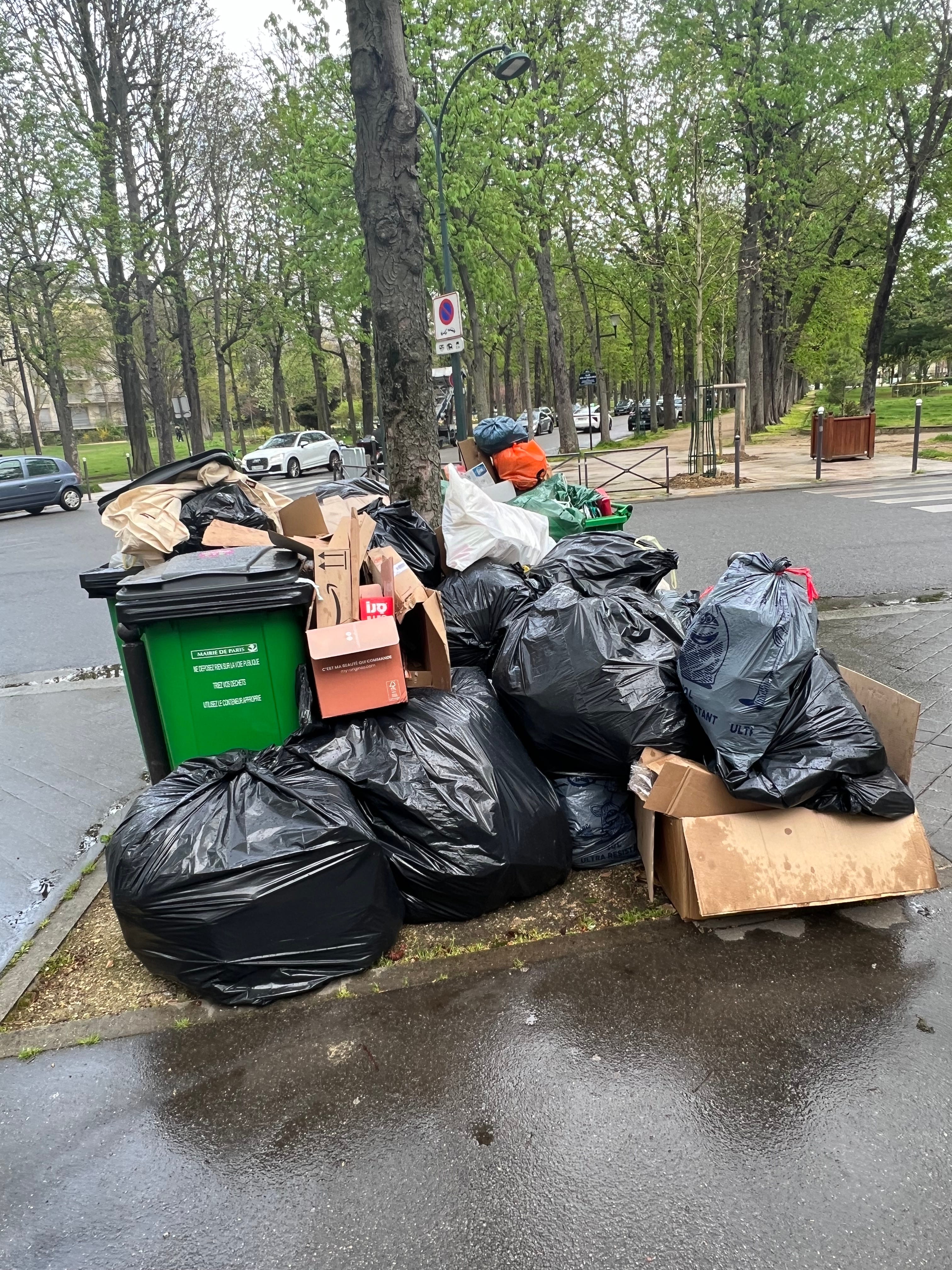
After three months in stormy, wet, miserable California, I am now back in Paris. Question marks hovered over my head for days wondering what would greet me. I read that the garbage strike was over but….how many days does it take to clean up ten days worth of a strike that left streets unpassable and people holding their noses? Many as it turns out. By the time I was taxing from CDG to my apartment, garbage bags were off the street but still in piles on sidewalks. The news says the outer arrondissements are taking longer to clean than the inner.

Garbage waiting to be picked up on April 1, in the 16ème near Parc du Ranelagh

I wondered about the airport itself. Everything I read said only Orly and Marseille airport workers were striking. In France, it is mandatory to tell the police ahead of time where, when, and who is striking. But I was raised in the US where surprise is part of the strike so I expect things to happen that aren’t known. The worst thing that happened, the day of my return, was that there was no place for the plane to taxi to. We waited thirty minutes on the plane in Frankfurt until the pilot was assured of a gate and then waited another ten minutes upon arrival in Paris for the gate to free up. After that, it was easy peasy. The unplanned wait allowed morning rush hour traffic to disappear and I was in my apartment less than two hours after we finally got to the gate.

I stepped into my apartment and it seemed as if I’d never been away. Time is something I don’t understand. I find it fascinating that some hours seem like days and some days pass by so fast, it feels like just a few breaths. Here I was, back in Paris, after what had felt like a decade of horrendous storms and now it all felt like a dream. It wasn’t raining and, though the sun wasn’t out, it was clear.

Parc du Ranelagh April 2, 2023

I suffer terrible jet lag and the common sense wisdom says jet lag is always worse going west to east. I had cut out three hours (or three days) by stopping in Michigan to visit my sister. I decided not to try and plan the jet lag or outsmart it or any of the other attempts at controlling what I can’t contol. I would sleep if I felt like sleeping and take everything else easy. So I made a few commitments and had to apologize for most of them when I was too tired to follow through. I did get outside and walk my neighborhood. The world was green, young green, shoots of baby plants green, that light green that says it can only be Spring. After a winter of so much rain (yes, I was grateful for California rain and that the Bay Area is no longer in drought conditions, but that didn’t make it fun), grey in the sky, grey on people’s faces, carrying an umbrella and warm clothes everywhere, I was experiencing a literal ‘light at the end of the tunnel.’ 

Rue de l’Assomption April 2, 2023

I managed to make it out to Parc de Bagatelle in my first days back. I knew I had missed the fields of golden daffodils that had taken my breath away last year. But Spring was here and I wanted to see the peacocks and the cats. I could hear the peacocks ‘crowing’ before I even entered the parc. Mating season was officially open. The first peacock I saw had his fan tail completely open and was doing a cat walk for a number of people with cameras and phones, and for two females who were playing hide and seek with him. It was a wonderful show. I kept wondering where all the feathers go when the tails start to molt. All the times I went to watch the progress of the new tail growth, I never saw a single feather.

Male peacock putting on a show for people and females alike. You can see one of the females vehind him at about 2 O’Clock.

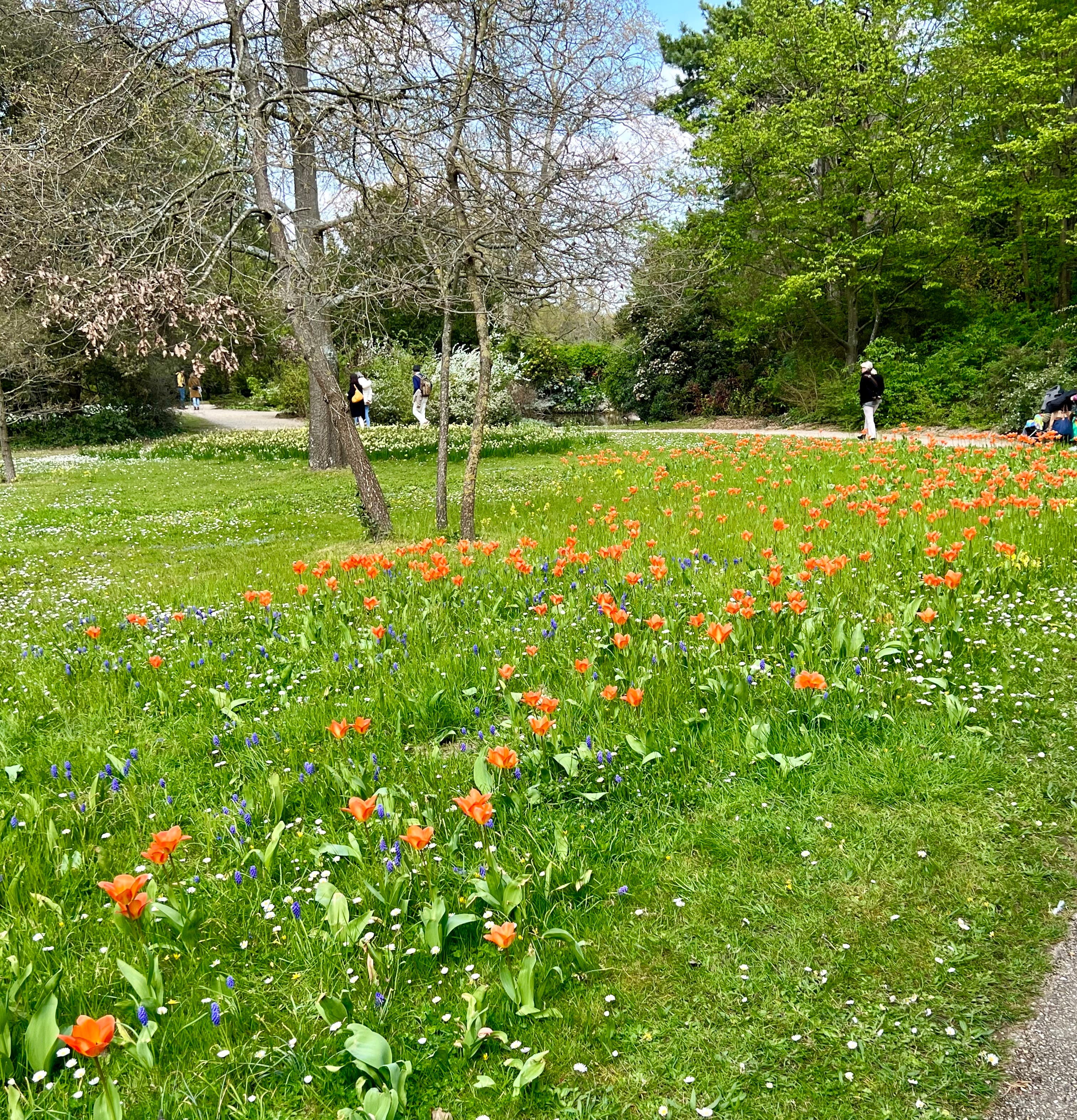
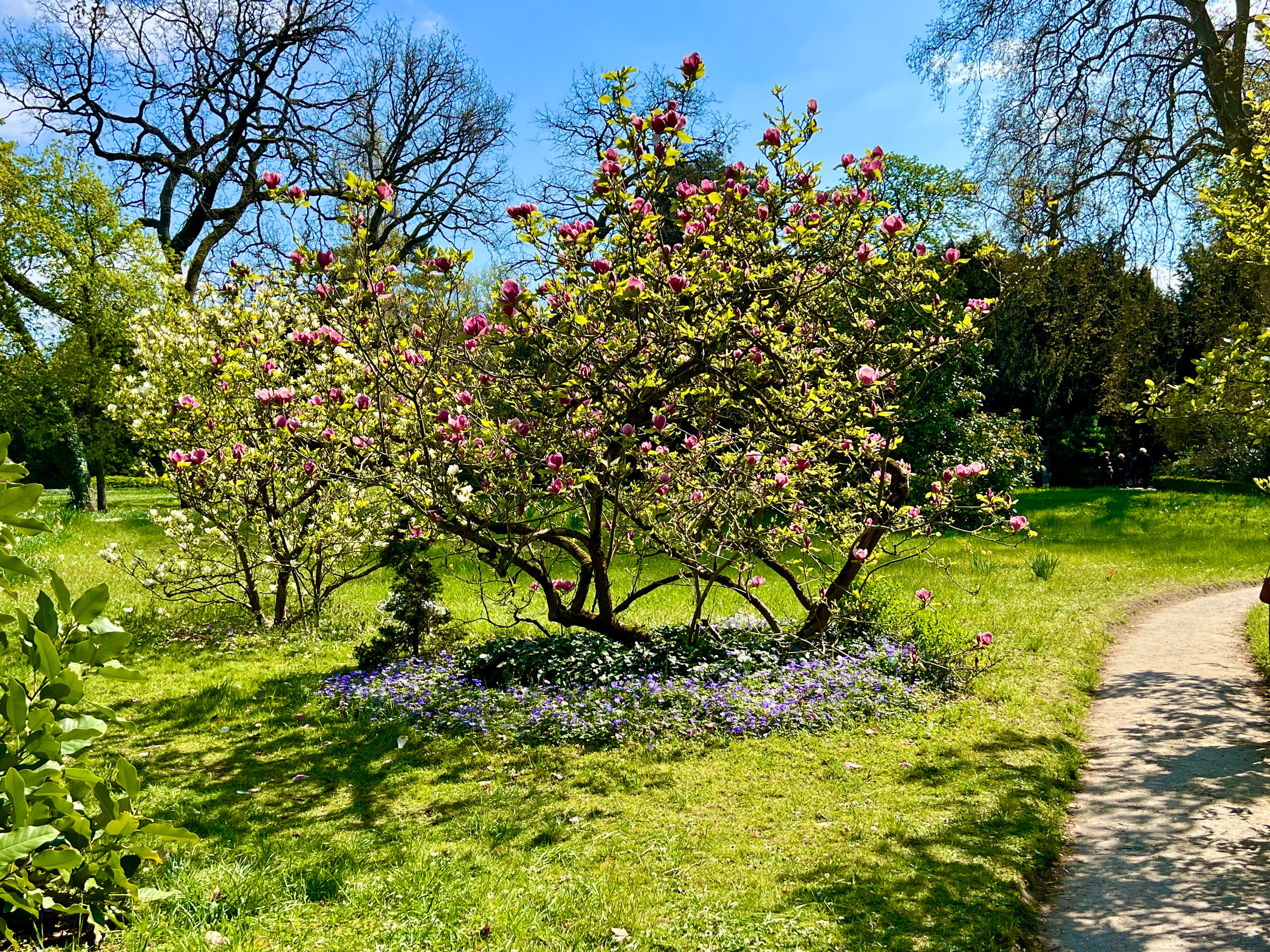
And though I missed the daffodils, the tulips were on display, tiny flowers of yellow and purple, red and orange, magnolia trees with purple flowers at its base, all sang of Spring. I was so happy to be back in Paris.

Fields of orange tulips replacing the plethera of daffodils
The albino peacock
One of two magnolias at Bagatelle

Thanks for reading Out My Window! Subscribe for free to receive new posts and support my work.

A bientôt,

Sara