We Were Eight Years in Power: An American Tragedy

Until five months ago, I had never heard of Ta-Nehisi Coates. I started seeing ads for his latest book We Were Eight Years in Power on my digital version of The New Yorker. Last week, I was sent an advance copy of the book to review (it hit bookstores on October 7th but I received an unedited version) and my world turned upside down.

This is not a scholarly review.  This is a review of a citizen of the United States living in Paris trying to understand how and why Trump happened.

33916061.jpg

The book consists of eight essays that Coates wrote for the Atlantic where he is now a Senior Editor. Each essay represents one year that Barak Obama was President. He prefaces each one with a present day writing telling us specifics of why he wrote what he wrote and how he sees the article now, 2017. He ends with an Epilogue about President Trump “our first white president”. The Guardian review calls him “the laureate of black lives”.

I am a seventy year old white woman living in Paris, France. I was raised in academia, my father taught at Princeton University. I say that I was released from behind Ivy League walls at eighteen years old a very naive young woman. I have always considered myself a liberal (my sister says that is a four letter word) and always voted Democrat. Never have I felt more naive and uneducated about the realities of the class system in the United States than reading Coate’s book.

Coates has a unique way of presenting his material in a New Yorker-type style while searing you with some very unpleasant truths. Truths that, the minute I read them, I knew were true though I’ve had my head in the sand for a long time. The Guardian says “Coates has the rare ability to express (it) in clear prose that combines historical scholarship with personal experience of being black in today’s America.” He calls all types of slavery, the Klu Klux Klan, White Supremacy ‘Domestic Terrorism’ which, of course, it is. Slavery was outlawed over 150 years ago, Blacks have the right to vote and the Civil Rights movement, of which I partook, was supposed to have ended all the inequality. Yet Blacks are consistently murdered and the murderers not indicted. Laws have been passed to stop Blacks from voting at the polls. Coates probably sited 100 instances of domestic terrorism. Some I knew about, many I did not. All done in the name of keeping the White class the superior class.

His eighth chapter was specifically about Obama. What made Obama unique and able to become President of the United States was the fact that he was raised by three white people who adored him and let him know how much he was loved. He was not educated to be suspicious of white people. He was not cautioned about going into certain neighborhoods that were too dangerous for black people. He was encouraged to learn and encouraged to strive for the best. Coates stated that 71% of Republicans still believe he is Muslim and many still believe he was not born in the United States. Trump began his political career by openly challenging Obama to produce his birth certificate. For years, he stated everywhere he could be heard his “Birther” beliefs. Obama was our first black president. However, if he was not born in the US, then he couldn’t be president and for the majority of people who are threatened by the idea of a black president, the string of white presidents remains unbroken.

I couldn’t put Coate’s book down. I learned that he was a fellow at the American Library in Paris where he wrote parts of his last book “Between the World and Me” I didn’t join the Library until after he had left France and want to turn back the clock. I feel cheated. I have watched his interviews on YouTube and his presentations at ALP. He seems a soft spoken man who is very funny and still a bit overwhelmed by his fame. He told Chris Jackson, his editor and publisher of One World books, that it felt like being hit by a Mack Truck. A Mack Truck with money but still a Mack Truck!

Coates is a man who has a lot to be angry about. But he has chosen to channel that energy into educating people like me about “Reality”. He is not surprised by a Trump presidency. I was. We Were Eight Years in Power felt like a fist to my gut. It hurt. I needed the painful punch. I didn’t choose what color my skin is anymore than Coates did. I have been fortunate. A whole class of my compatriots have not been.

If you are interested in reading The Guardian review:                                                                 https://www.theguardian.com/books/2017/oct/08/ta-nehisi-coates-our-story-is-a-tragedy-but-doesnt-depress-me-we-were-eight-years-in-power-interview

A bientôt,

Sara


The Scarred Woman

It’s about time for another book review of a favorite author.  So while I prepare my blog on my very first ‘Destination Wedding”, get out your reading glasses and prepare yourself with one of the earlier books while waiting for the release of the The Scarred Woman.

9836c994d9cfd310e9c2938e15181ac3-w204@1x.jpg

The Scarred Woman

by Jussi Adler-Olsen
Pub Date 19 Sep 2017

After I discovered and read, along with the rest of the world, the Dragon Tattoo Trilogy by Steig Larsson, I scarfed down every Scandinavian mystery/crime thriller I could find. I didn’t care if I’d never heard of the author, experience was teaching me that the books were sometimes good and often great. I don’t remember reading a poor one.

I was excited to discover two books by an author I’d not heard of, Jussi Adler-Olsen, a Dane, at a neighborhood book sale. They were both in practically perfect condition. Either the owner prior to me took extraordinarily good care of paperbacks or s/he was put off by the length of these mysteries. Her loss.

The two books I picked up happened to be the first two books in the series about Department Q. One certainly doesn’t have to read them in order–there are seven in all including The Scarred Woman–but I have loved being witness to the evolution of the main characters and Department Q itself. The first book details the beginning of Department Q, a demotion for Carl Morck who, although an excellent detective, is surly and on the outs with many of his colleagues. Department Q is created, in the bowels of the basement, for him to work on cold cases. He is given an assistant, Assad, a Muslim Dane, with a mysterious and dubious history. The two attempt to solve unsolvable cases.

As the series moves on, Carl and Assad get another member of the team, Rose. Rose is as off beat as the other two and the interactions between the three of them provide a levity much needed to balance the gruesome Nordic mystery and murders.

By the seventh book, years have passed, Carl and his team have become famous for solving hideous past crimes. They have saved each others’ lives and there is a strong if unspoken affection between all the team members that keeps the reader involved in these lengthy books. A fourth member has joined the team. Gordon has a serious crush on Rose and, as The Scarred Woman moves along, is traumatized by the fact that something is seriously emotionally wrong with Rose. The Chief of Police has retired and he, too, is falling apart after the death of his wife. However, a recent death looks to him like a murder as it is so similar to one seventeen years ago that he worked on. He is intrigued and asked Carl to look into it.

Meanwhile, another story of three beautiful but lazy, entitled girls, determined to marry rich men while living off their lies to their Social Worker, seems completely unrelated. Nothing happens without a reason and nothing happens quickly. For me, this is part of the charm of this series. We think along with Carl and Assad and sometimes the murderer. There are many many threads going at the same time much as life and the juggling of priorities and time are not unfamiliar to most of us. We are amused by the repartee between Carl and Assad especially and astounded by the many sides of Rose. The books are long, 500 to 600 or more pages but Adler-Olsen is such a good writer and so adapt at bringing the reader along far a wonderful ride that one feels we’re reading about distant friends. I never wanted any of the books to end.

I’ve always wondered how authors like Ruth Rendall, Adler-Olsen and a number of the Scandinavian writers come up with people and crimes that are pure evil. Some authors spend time making sure the reader understands that the murderer is a victim also, hostage to his or her past. I wouldn’t call Adler-Olsen’ books psychological thrillers as a number have now been labeled. He entertains us, he scares us and, often, he provides background to explain some of the horror but doesn’t dwell on it. As someone who worked in a psychological profession, I can say that he has definitely done his research. But then to create these masterful jigsaw puzzles from his research and extraordinary mind is true literary genius to me. One of the books says he is the No 1 bestselling author in Denmark. I didn’t know that as I’d never heard of him before this summer but I don’t doubt it.

If you are a true mystery/thriller fan and also like good writing, read this book and oh by the way, read the other five books also so that you became part of Department Q!.


B10GlZr+VYS._SY200_.jpgBiography

Carl Valdemar Jussi Henry Adler-Olsen (born August 2, 1950) is a Danish author, publisher, editor and entrepreneur. Jussi Adler-Olsen’s career is characterised by his great involvement in a wide range of media related activities. In 1984, he made his debut as a non-fiction writer. 1997 saw his debut as a fiction writer. His latest novel is The Boundless (Den Grænseløse) (2014) is the 6th volume in the Department Q series.
Bio from Wikipedia, the free encyclopedia. Photo by Lesekreis (Own work) [CC0], via Wikimedia Commons.
A bientôt,
Sara

La Grange

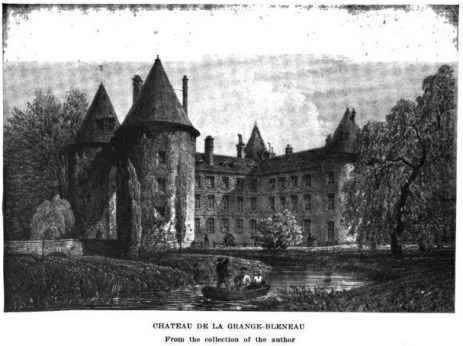
On Monday past, four members of my book club, The Mountainview Literary Circle, along with with four friends, went on a Field trip to La Grange in Rozay-en-Brie.  The Chateau at La Grange was the last home of Lafayette and his wife, Marie Adrienne Françoise de Noailles .  La Grange lies in the Provins region of France which is still part of Ile de France.  Lafayette lived there for 30 years after the peace of Amiens.  His wife, however, who had became very sick when she refused to leave him while he was imprisoned in Austria during the French Revolution and the Terror, lived there only eight years.

Chateau-de-la-grange.jpg

A year ago November, I attended the American Library Book Award ceremony held to give a monetary prize to the best book of 2015.  The subject matter has to be about France or French-American relations.   The winner in 2015 was a book by Laura Auricchio entitled Le Marquis: Lafayette Reconsidered.  It sounded so interesting that I recommended it to my book club.  At the end of the book, the author urged us all to visit La Grange explaining that it is probably the best museum of all things Lafayette as well as his wife, Madame Adrienne de Noailles La Fayette , a very interesting person in her own right.  So I made all the plans and got a date and then learned that the Chateau at La Grange is a private museum and one has to have special permission to visit.

800px-Marie_Adrienne_Francoise_de_Noailles,_French_School_18th_century_copy.jpg
Marie Adrienne de Noailles La Fayette

The Chateau today belongs to the Foundation Josée-and-Rene-de-Chambrun which is responsible for the management of  the inheritance and property of the family La Fayette. Interestingly enough the Chambrun family was instrumental in keeping the American Library open during WWII.   As a result of Mme Chambrun’s son’s marriage to the daughter of the Vichy prime minister, Pierre Laval, the library was ensured a friend in high places, and a near-exclusive right to keep its doors open and its collections largely uncensored throughout the war. A French diplomat later said the library had been to occupied Paris “an open window on the free world.”(Wikipedia)

800px-Marie_Joseph_Paul_Yves_Roch_Gilbert_du_Motier,_Marquis_de_Lafayette_from_NPG.jpg
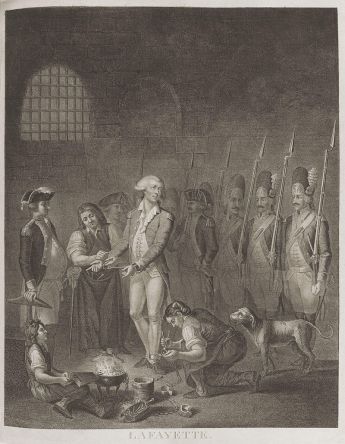
Lafayette in Prison during the French Revolution

One of our book club members is a “son of the American Revolution”  At a press meeting at the American Library, he met another SAR and together they requested permission for a visit.  It was very iffy until the last minute.  The Chateau will be closed for the next eighteen months while it undergoes renovation and it wasn’t clear if the renovation had actually started.  Three weeks ago, we were given the date of Monday, Dec. 12th for our visit.

Rozay-en-Brie is approximately 1 hour southeast of Paris.  Easy to get to.  We had lunch at one of those funky looking restos where you hold your breath hoping there is good food and leave thinking “imagine that, really good food in this place.We must be in France!”  We met our guide promptly at 2pm.  I was slightly handicapped as I was the only one who doesn’t speak fluent French.  Visually the place is an homage to La Fayette and the American Revolution. A copy of the Declaration of Independence hangs on the wall along with letters, gifts and reproductions of battles.

No one actually lives in the Chateau.  There was no heat.  I had a very definite feeling of what it would be like inhabiting one of these gorgeous old places before modern day comforts were invented.  We went from room to room enjoying the memorabilia.  There is a James Fenimore Cooper bedroom.  Cooper met General Lafayette when the latter visited the US in 1824, a reunion trip that took Lafayette to many states and many cities named after him.  Cooper later moved his family to Paris hoping for a better audience for his books and became good friends with Lafayette.

First_meeting_of_Washington_and_Lafayette,_Currier_and_Ives_1876.jpg

It’s easy to imagine Lafayette’s love affair with all things American as there was a long canoe like vessel in the barns next to the Chateau.  I wasn’t clear who had sent it to him but it looks very similar to the boat depicted in the painting of Washington crossing the Delaware.  While living at the Chateau in La Grange, Lafayette participated in politics but gradually grew very disillusioned.

On 20 May 1834, Lafayette died on 6 rue d’Anjou-Saint-Honoré in Paris (now 8 rue d’Anjou in the 8th arrondissement of Paris) at the age of 76. He was buried next to his wife at the Picpus Cemetery under soil from Bunker Hill, which his son Georges Washington sprinkled upon him.

220px-Sépulture_la_Fayette.jpg
Picpus Cimetière

To be able to visit this chateau was a treat and a privilege.  One most people won’t be able to have.  After we had visited all the rooms that were open, our guide invited us to tea.  She took us into a beautiful, oak-lined small dining room set out with a full English tea.  We were thanking her profusely and she said “no, it is I who should thank you.  It is a pleasure to show this place and these rooms to people who understand the context and the history”  Once again, I was reminded that our hero who had at least one city named after him in every state of the Union, who is synonymous with the American Revolution is not seen with the same eyes here in France.  He was an aristocrat at the time when aristocrats were suspect and the French were never quite sure what his motives for doing anything were.

http://www.balades-en-brie.com/brie/courpalay/chateau-de-la-grange-bleneau.html

A bientôt,

Sara


Le French Book

Once I no longer HAD to read good literature, I joined a Book Club so that at least once a month I could say I had read Literature.  But for pure reading pleasure, I started my life-long love affair with Mysteries and Thrillers.  Some would say that there are plenty of mysteries that are also well written literature.  I’m not a judge.  I know that I love to while away the day lying on the couch reading Lee Childs, Alexander McCall Smith, John Sanford, PD James, etc.  All written in English by American or British authors.

I don’t know when I discovered that the French write mysteries!  At my Alliance Française, they are filed under Policiers.  Anne Trager, editor and translator, says the French call them Polar — pronounced “pole-ARE”.  Whatever they are called, I love them.  And thanks to Ms. Trager, I get to read them in English.  I’m not exactly proud that my french isn’t good enough to read these books but I’m making progress.  In the meantime, there’s

static1.squarespace.jpg

Anne Trager founded Le French Book in 2011.  Her website says:   “The company’s founder—American translator and editor Anne Trager—loves France so much she has lived there for over a quarter of a century, and just can’t seem to leave. It’s not the baguettes that keep her there (she’s sans gluten), but a uniquely French mix of pleasure seeking and creativity. Well, that and the wine. After over a quarter of a century of experience in the translation business and nearly as much in publishing, she decided it was time for her to focus on the books she loves to read and bring them to a broader audience.”

static1.squarespace-1.jpg
Anne Trager, Editor and Translator

You can go to the website: https://www.lefrenchbook.com and discover all the books that she and her team have translated.  I want to tell you about one series in particular The Winemaker Detective Series by Jean-Pierre Alaux and Noël Balen.  I must have written Anne to thank her because I am now able to read advance copies of this series.  They aren’t quite The Cozies that some people steer clear of.  There is always a mystery and some are darker than others.  There is also plenty of wine as our hero ‘detective’, Benjamin, happens to be a renowned Wine Expert.  He and his assistant, Virgil, make the rounds of the vineyards of France, eating delicious meals, drinking fabulous wines and solving mysteries.  And, as with many series these days, one gets to know Benjamin’s family, Virgil’s love affairs and the state of wine production year after year.  The books are not lengthy so each one is an easy couple of afternoons reading.  Plus if you live in France as I do, it is so much fun to say “I’ve been there!”

WinemakerOmnibus1+copy.png

I wrote Anne last Spring and asked her if a TV series had ever been made of the books. Yes, she said, Blood of the Vine.  I subscribe to MhZ International Mysteries and found the series there.  I think I watched all four seasons in two weeks!  The series is loosely based on the books–once I got passed the fact that the shows were different, I fell in love with them also.

While writing this blog, I went on LeFrenchBook website and discovered that you can get 3 of the books free.  You just need to tell the team where to send them. Unless you only like violence that comes at you on every page, you will not be disappointed.

Webpage.gif

You can read an interview with the two authors from November 20, 2016:             https://www.lefrenchbook.com/le-french-book-blog/2016/11/20/revealed-the-winemaker-detective-and-winemaking

A bientôt,

Sara

The American Library in Paris

I had been living in Paris four months before I learned about the American Library here in Paris.  How it slipped through this book lover’s observation is a mystery.  I love libraries.  I love supporting libraries as well as not paying for my own books!

libraryimage.jpg

I had met an American couple while sitting in the immigration office waiting to get my physical that would allow my one year Visa to stay in France to start up.  The three of us were the only Americans in a room packed with people.  It was the first time I realized that I, in fact, was an immigrant.  We were shuttled from room to room just like I’m sure we do in the United States.  We had a long time to talk and get to know each other.  They invited me for tea about two weeks later and told me about ALP.

It is not free to go to ALP.  There is a membership fee.  For me, a single person, it cost 90 euros a year.  It may seem like a lot when one is used to free libraries in the States.  However, this library holds the largest collection of English language books in Europe.  I love mysteries and, so far, I haven’t been disappointed when I wanted to read a mystery that I had recently heard of.  The library also provides space and advertising for book groups.  So I signed up for the Mystery Book group! Of course!

The real treat that the ALP provides for the community is author, film and art events on Tuesday and Wednesday evenings.  Everyone comes to Paris.  Last month, I heard Jane Smiley talk about and read from her trilogy of the 20th Century.  Wednesday evening, just past, I saw the brand new documentary about Dr. Maya Angelou, And Still I Rise.  The reading room was overflowing with people wanting to learn more about her and many of us left with tears.

12924613_1713855828890063_3590623665477873647_n.jpg

Facebook has this post on it’s Maya Angelou Film Page:

“Today is Friday, October 14, 2016, the day that the award-winning #MayaAngelouFilm opens at select AMC Theatres across the country!! Here are the ticket and showtimes links that you’ve been waiting for. Take a friend with you to see this moving documentary. You will be inspired! #BringTissue

NEW YORK: http://bit.ly/mafnycmetro

LOS ANGELES: http://bit.ly/maflametro

SAN FRANCISCO: http://bit.ly/mafsf

Talks like these events would cost $100 or up in the Bay Area where I lived before Paris.  I consider 90 euros a bargain.

The library underwent a huge renovation and was closed from mid- May through the end of August.  It now has great security measures.  The city of Paris no longer allows a slot where one can drop books that are due.  We all got new library cards with electronic keys in them that open the doors into the library and also make taking out and returning books very easy.  Both for the reader and for the staff.

If you live in Paris, stop by the library.  Come to one of the evening events.  Look on line for more information:   americanlibraryinparis.org

If you are visiting, come to  10, rue du Général Camou 75007 Paris

See you at the library!

My Name is Lucy Barton

I wanted to read Elizabeth Strout’s latest book: My Name is Lucy Barton (Random House, New York, 2016) because I loved Olive Kittredge. I loved the book and I loved the HBO series. It was one of the first things I saw when I arrived in Paris.

I am a member of the amazing American Library in Paris which houses the largest collection of English language books on the continent. I put a Hold on Lucy Barton and then waited five months for my turn to come around.

When I picked it up, the back cover fell open to a photo of Ms. Strout. The photo is captivating. She is looking the reader right in the eye with a look of such kindness. She has a smile on her face that tells me she would be great company, someone to sit down with for a cup of tea and just talk about life. I can’t tell if her hair is blond or white or a combination of both. She has such an air of being young, approachable but full of depth – what I call experience. This photo contrasts so much with the glossy photos that often accompany action driven books. I was fairly sure just by looking at her that I would be reading a character driven novel.

My name is Lucy Barton is short, 191 pages. I read it in two sittings. Then I put the book down on the floor, sat on my couch and asked myself “how does she do that?” How does she write such simple sentences, such simple scenes and make them so full of all the pathos that makes up our lives” This book is for mothers, anyone who has a mother or has had a mother or has been a mother. This book is about relationships and marriage and children and doctors and first time loves. But it is all about Lucy Barton—how she reflects on her far past, her not so far past, her present and for a large part of the book, a hospital stay where she went for two days and stayed for nine weeks.

One morning, she woke up to find her mother sitting at the end of her bed. And this starts the story that almost every woman I know yearns for—some indication of her mother’s enduring love. Lucy calls her mother ‘mommy’. I’ve been embarrassed to say ‘mommy’ in either speech or writing since I was about fifteen years old. I had decided my mother wasn’t a mommy. If Lucy Barton’s mother was a mommy, mine was too. And just allowing the word back into my vocabulary, allows me to mourn her passing in a whole new way.

Lucy Barton was born dirt poor. She managed to leave home, go to college and live in NYC. She makes observations like: “It has been my experience throughout life that the people who have been given the most by our government—education, food, rent subsidies—are the ones who are most apt to find fault with the whole idea of government. I understand this in a way.”  And she does, it’s just an observation. One of hundreds that made me put the book in my lap for a few minutes and think.

Lucy Barton is a writer. Elizabeth Strout is an author. There are some wonderful insights into the life of an author. Are they autobiographical? I don’t know and don’t care. They speak for themselves. When Lucy attends a talk by an author she’d run into in a clothing store, some of the audience attacked her (the author) for reference to a past president. The moderator was fascinated and pushed the author, asking her how she responds “She said that she did not answer them….’It’s not my job to make readers know what’s a narrative voice and not the private view of the author,’ and that alone made me glad I had come (thought Lucy)” He pushed her some more .“He said, ‘What is your job as a writer of fiction?’ And she said that her job as a writer of fiction was to report on the human condition, to tell us who we are and what we think and what we do.”