It’s almost summer and in the US that means…..Baseball.

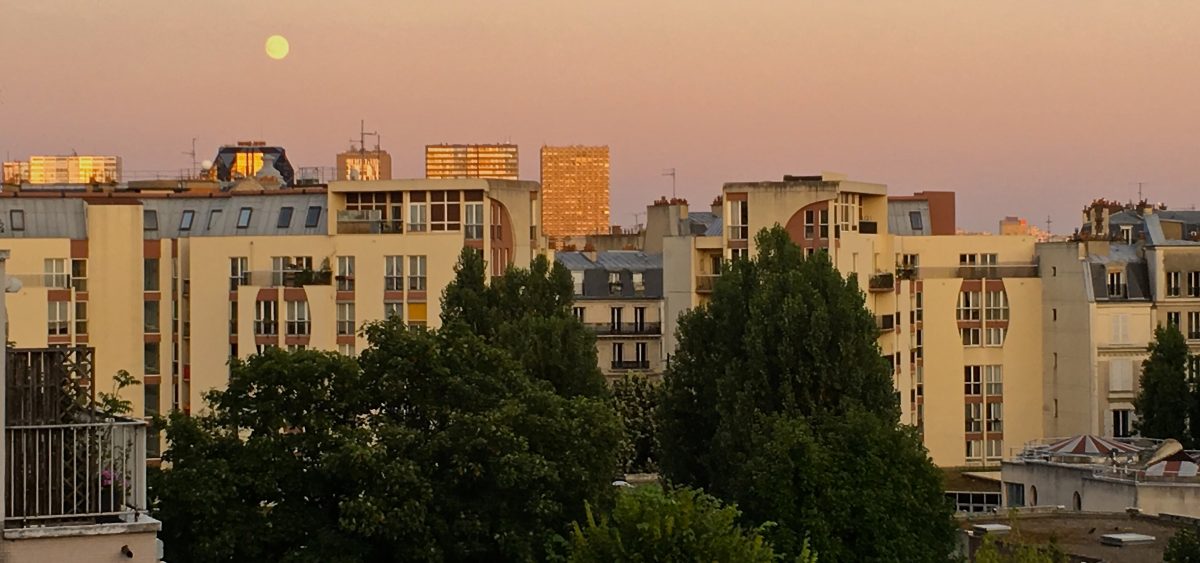
We are six days away from the start of summer. Here in Paris, the weather has been gorgeous. Radio Roland Garros kept saying over and over that the two weeks of near-perfect weather were heaven-sent. I have a large terrace with doors from both my bedroom and living room. From mid-May to the end of October (and sometimes longer) it’s like having a large extra room in the apartment. I have a dining table, a chaise longue for reading, and a planter garden full of hortensia (hydrangea) and geraniums. It’s very hard to be dissatisfied with life when the weather is like this. Wearing a linen sundress and sandals is a reason for huge smiles.
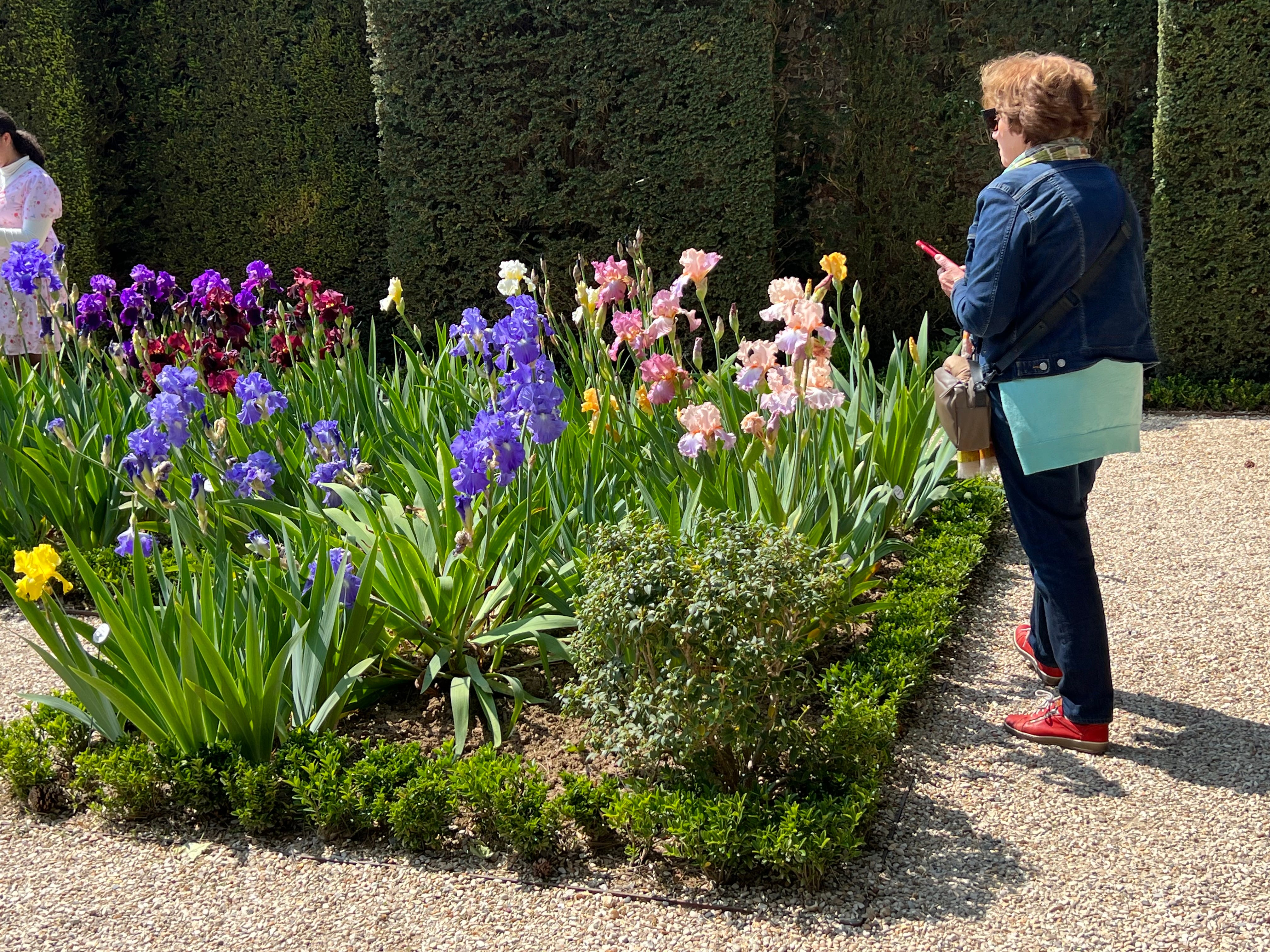
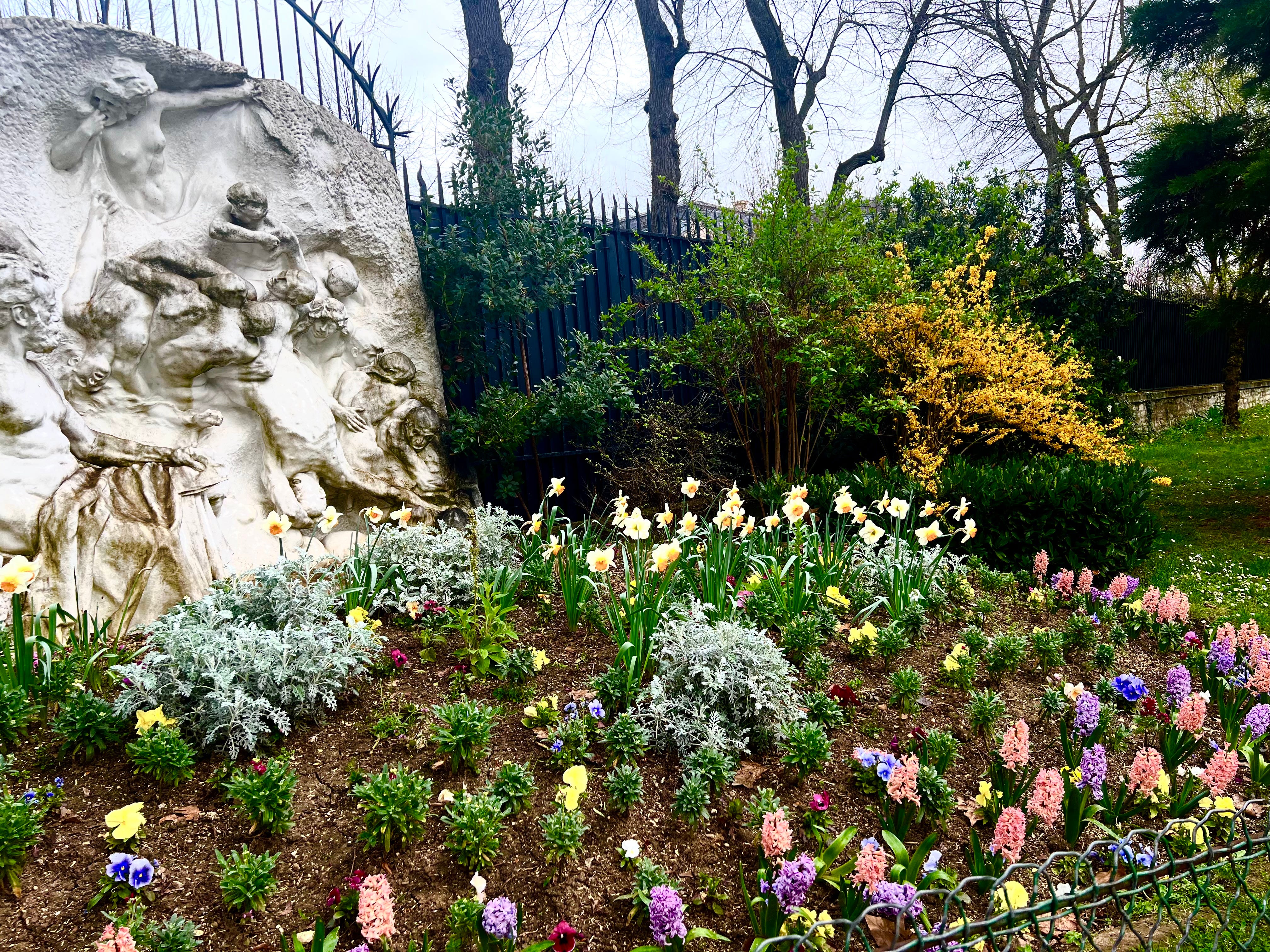
The iris in Parc de Bagatelle

I write this newsletter/blog 1—to keep my friends appraised of what I’m doing. 2—to let Americans into secret parts of Paris that most tourists don’t have time to discover, and 3—to reflect on the US from over here. Usually, that means politics. I guess what I want to talk about – baseball – is also politics.
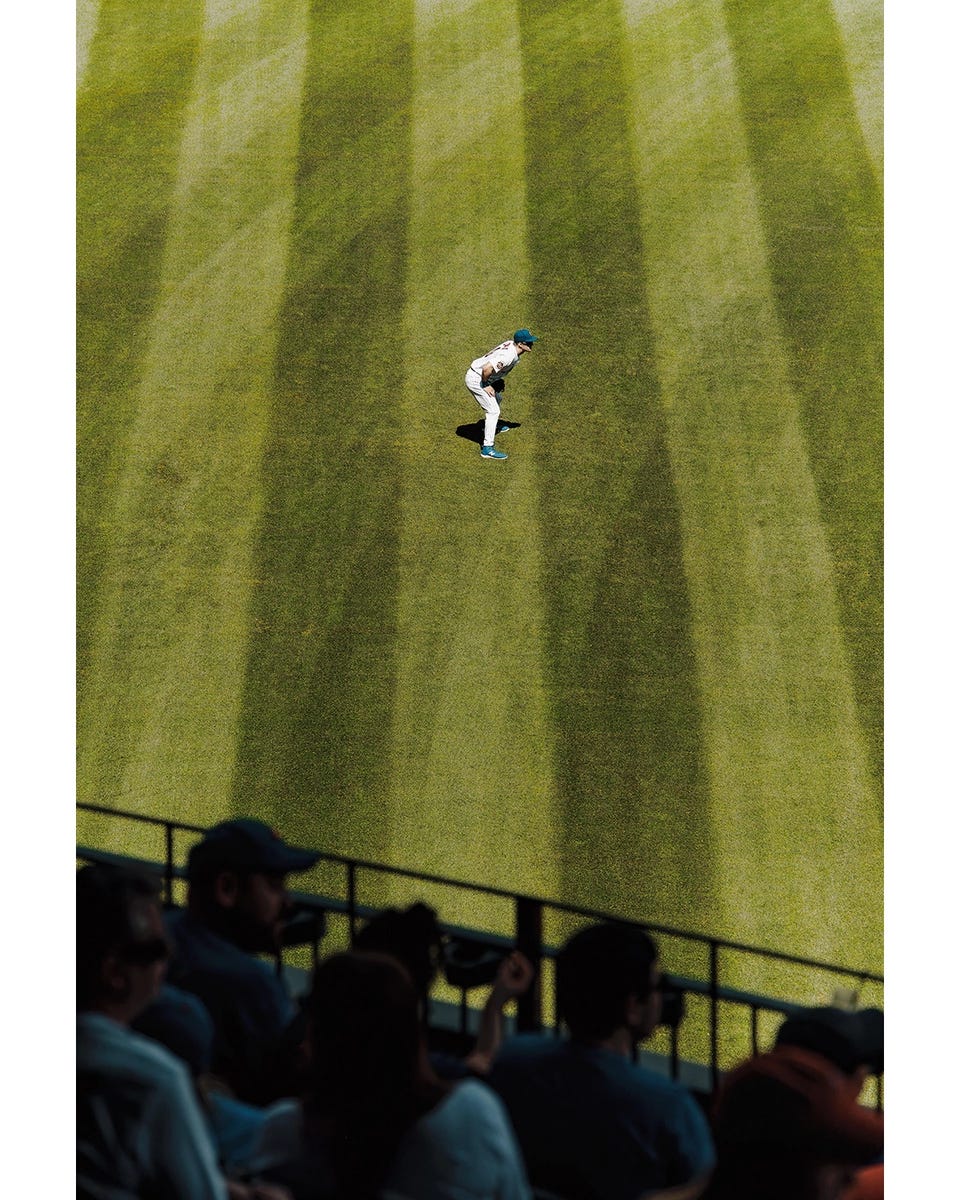
Photo by Tony Luong, The Atlantic

I am an Oakland Athletics (A’s) fan. Before I moved to Paris, I had season tickets on the lower level near home plate. If you go to enough games over a season and you know your baseball, you soon get to know your neighbors, and the section or a couple of sections become a baseball family. It’s a community. God knows we all need some type of community in our lives. My baseball family was extremely passionate about the Oakland A’s. Many had been fans and season ticket holders since the A’s moved from Kansas City in 1968. Many of us were like little kids wanting autographs, getting to know the players, and going to Spring Training for as long as work would allow.

In the 1980s, the A’s were owned by the Hass family (of Levi Strauss fame). They were golden years for the A’s. They got Manager Tony La Russa from the White Sox, Dennis Eckersley from the Cubs, and Dave Stewart from the Texas Rangers when he was almost out of options. All three got MVP of something while they were with the A’s. The team went to the World Series three times in as many years and won against the Giants in 1989 after the games were interrupted by the earthquake. The Haas family seemed to love the fans. They treated fans, players, front office with respect and with courtesy. Everyone had a good time.

When the Haas family sold the A’s, things started to go downhill. The owners held on to their money rather than investing in good players. They complained about the Coliseum but wanted the City of Oakland to do something about it. In 2003, Michael Lewis wrote his famous book Moneyball: The art of winning an unfair game. The book showed how Billy Beane, the general manager, used statistics to find and hire players with very little money (in the world of baseball, a little money would be a fortune to most of us.) A movie was made starring Brad Pitt. The movie centered around the 2002 season when the A’s won 20 games in a row breaking the American League record and tying the baseball record.

When I volunteered in the Mayor’s office of Jean Quan, I got to meet and talk to Lew Wolff, the managing owner of the A’s at the time. The silent partner was John Fisher. Everyone was miserable. The owners hated the coliseum and wanted a new stadium. Wolff was beyond frustrated with the city of Oakland. The fans hated ownership because everytime they had a good player, the owners traded him. It was a nasty time with a lot of nasty things said.

In 2016, Lew Wolff stepped down as a part-time owner. Dave Kaval took over as team President pushing Michael Crowley aside. ‘Kaval said the A’s are committed to staying in Oakland, per John Hickey of Bay Area News Group. Kaval said the team is looking at several potential sites but likes the idea of a “ballpark village” concept, according to Joe Stiglich of CSN Bay Area.”—Adam Wells, 2016

.

Smart A’s fans knew better than to believe that. They were cautiously hopeful as the City of Oakland began pushing for a spot near Jack London Square, Howard Terminal. Earlier this year, Kaval said he was going to sit down with the Mayor and work the Howard Terminal deal out. A week later, the A’s announced they were moving to Las Vegas. There was no intention to work with Oakland only empty words now known as False News. It is VERY clear that the only important thing to the ownership of John Fisher is money. He refused to give money for players, ticket prices doubled and attendance went way down. There are many who believe that was the point—show Major League Baseball that the fans won’t show up (and that had to be manipulated) and they would give their blessing to moving the A’s to Money Land following the Oakland Raiders.

Then came a one man group known as Rooted in Oakland. He tweeted that he thought A’s fans should form a reverse boycott: pick a day and all fans show up, show MLB and Fisher what the fan base looks like if you treated them well. More die-hard fans joined him, they raised $25,000 on Crowd Funding to make T-shirts that would say SELL on them. They picked a weekday night for the boycott. The game couldn’t be against one of the Big Four that have large fan bases everywhere: Yankees, Red Sox, Dodgers, Giants. They picked June 13, 2023. As the day drew closer, the A’s started winning. They no longer have the worse record in baseball history. I wish I could have been there. Over 27,000 fans came out. They stopped at various places in the parking lot and picked up their free Tshirts, put them on and entered the park. They roared for their team. I heard that, at one point, the catcher turned around and had a huge smile on his face. The A’s won 2-1 over the Tampa Bay Rays. The A’s have won seven games in a row.

“Mother and son Leslie and Justin Lopez walked together in their SELL T-shirts reflecting on how much the A’s have meant in their lives — 27-year-old Justin has been coming to games since he was 8 months old. He is devastated every year watching All-Stars depart to bigger markets in free agency or all the other stars get traded away.

“It’s been so sad to witness. We feel like the historically disenfranchised,” Justin Lopez said, embracing his mom.”—Janie McCauley, AP

When I volunteered in the Mayor’s Office and truly believed that my love of baseball could make a difference, could initiate some kind of change, and would help to keep the A’s in Oakland, someone much wiser than me said: “Sara, baseball is a business. They don’t care about the fans. It’s sad but it’s true. If you don’t remember that, you will have your heart broken over and over.” I heard him. It didn’t slow me down initially. When I decided to stay in Paris, people would ask me “What about your A’s?” Yeah, what about them? When you keep getting your heart broken, it’s a good idea to step out of the ring. Apple TV shows a daily baseball wrap-up over here in Paris. Today, I watched the highlights of Tuesday’s game. I saw the massive amount of kelly green T-shirts that said SELL. Fans were standing behind the batter’s box and every T-shirt said SELL. Not one word was said in explanation. Can you imagine if Trump went somewhere and not one word was said by the media. How MLB pulled off silencing everyone……., well I did say at the beginning of this blog that it’s all about politics.

A bientôt,

Sara

Thanks for reading Out My Window! Subscribe for free to receive new posts and support my work.
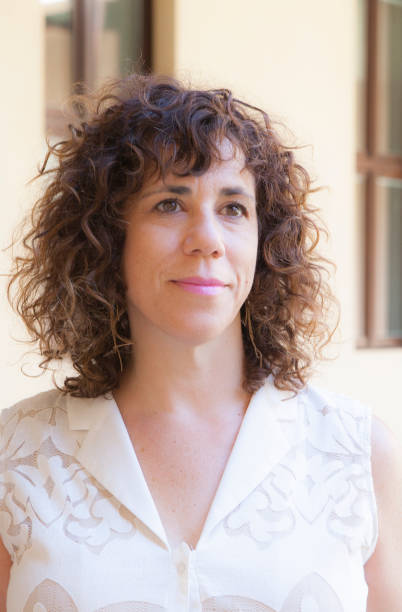
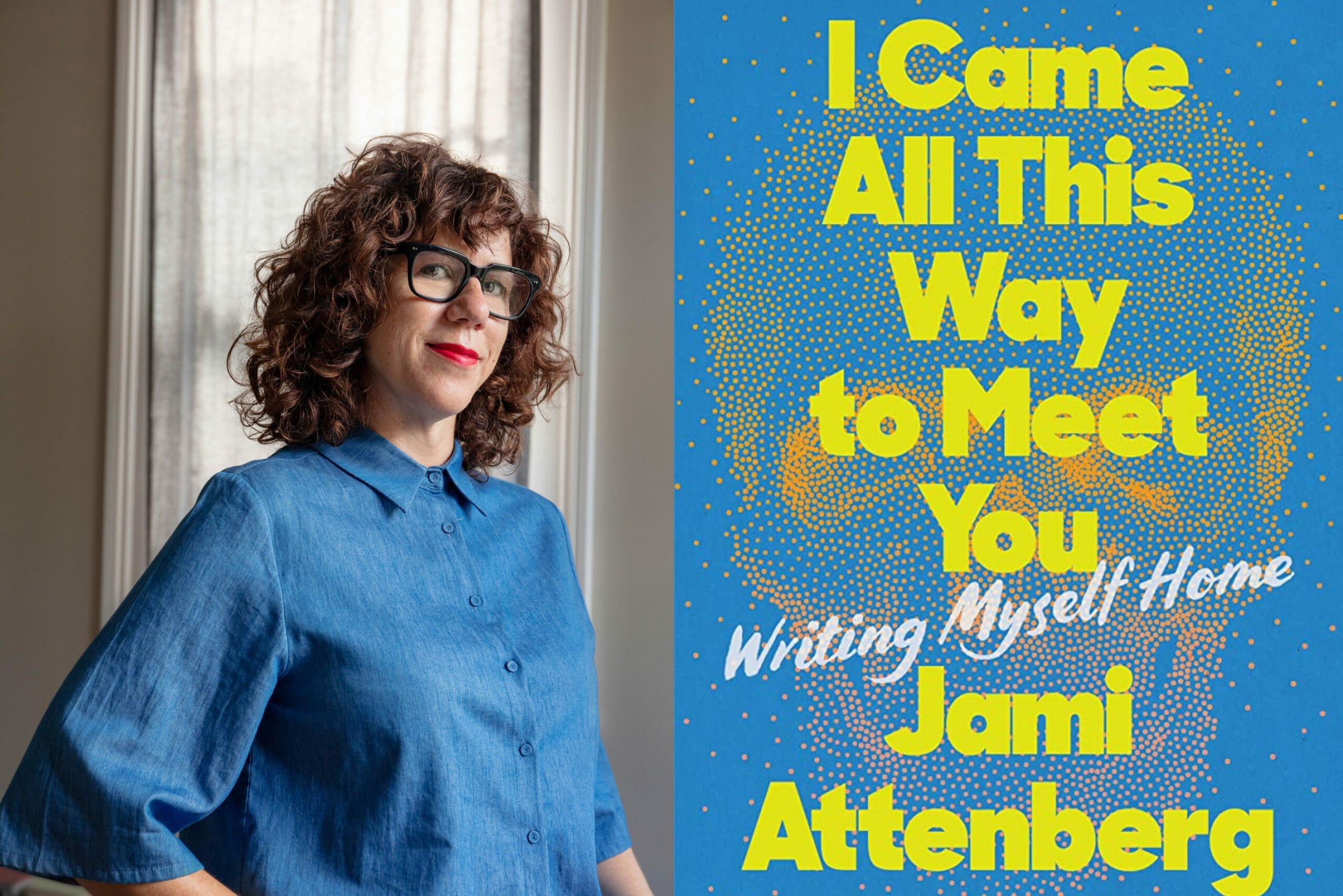
An Evening with Jami Attenberg

When I was in Oakland this winter, I had a computer crash. Not a real computer. The one in my brain that, on a daily basis works just fine, usually brings up the right things at the right time, shuts down to ‘sleep’ at night, wakes up at the appointed time ready to hit the day running. In January, it just burned to a crisp—nothing left to make it work. Sissssssssssssss! It’s called Burn Out. I don’t remember how I stumbled onto Jami Attenberg’s Substack newsletter. I had first discovered Substack when my sister wrote me about George Saunders’ Story Club with George Saunders. I immediately became a paying member. Comments were invited and I loved reading them. Wanting to know what that person read on Substack, I soon realized how many writers I respected had Substacks, and found ones that I didn’t know who wrote about the craft of writing. I found Jami and her #1000 Words of Summer Challenge.

https://www.pw.org/content/1000_words_of_summer_how_an_accountability_project_opened_up_my_writing_life

At the bottom of her Substack, she mentioned she’d written a memoir. I took the memoir, I Came all this way to meet you- Writing Myself Home, out of the library. First I read it. To say I loved it would be an understatement. I felt like she had me in mind when she wrote it. I, then, got the audio version and listened. Feeling exactly the same way as I had after the first reading, I bought the book and added All Grown Up (2017 First Mariner Books). What spoke to me? Jami writes in an intimate, conversationally (is that a word?) way that feels as if she is talking to ME. Writer to writer. She throws in comments about writing, about the craft of writing, about the love of writing, and how to grapple with certain problems, and many things that authors think about and only other writers and authors really relate to. This all while she is telling us about her life in often funny, self-deprecating ways. She is wise and knows herself well. She said eloquently what I felt but had not yet found words for. Writers, both ones she knows and ones she has yet to meet, are her friends. She roots for us. The memoir is one of those books that expands your world, makes you want to create because you can, and she is your cheerleader.

Jami Attenberg, American writer, Milano, Italy, 8th September 2016. (Photo by Leonardo Cendamo/Getty Images)

Recently, her weekly newsletter led off with dates that she would be reading or would be interviewed in various cities. There was the word PARIS. She was going to speak at the American Library. I immediately wrote her (you can do that on Substack. Write a comment). Jami responds to almost every comment. I told her I’d bring as many of my writer friends and book club friends as possible. She was up against some big competition. The American Library has had a pledge that would probably bring in quite a bit of money. For the first time, they can have two events on the same night. So, the next day, I learned that the second event was the San Francisco Theatre group, Word for Word, putting on George Saunders’ play HOME. This did not feel at all fair. I wanted to complain (I think I did). But the dates were set and I really really wanted to support Jami. So I put the play out of my mind.

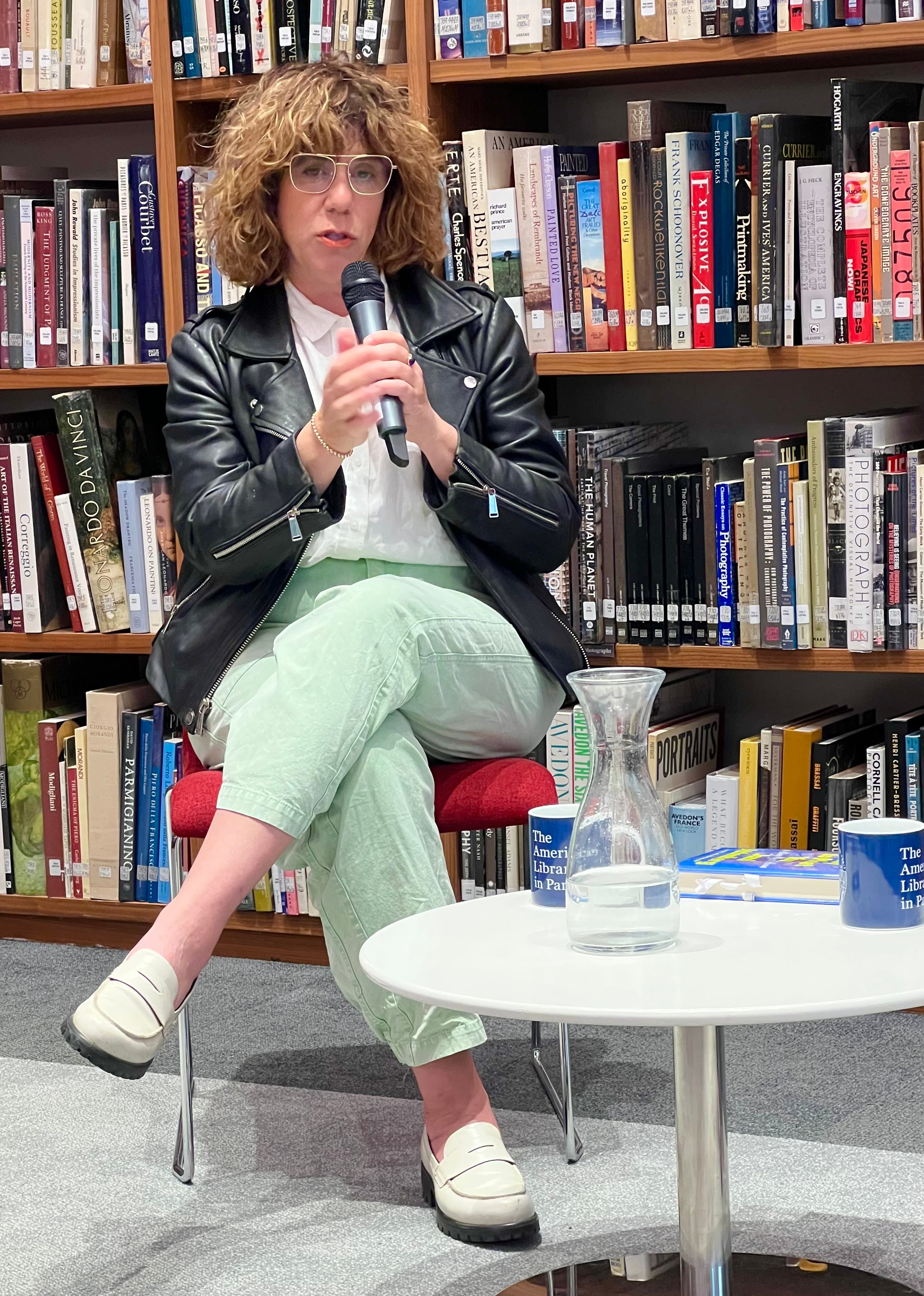
Tuesday evening, I went early to the Library to listen to Jami being interviewed by the wonderful Lauren Collins (staff writer, New Yorker). I brought both of her books hoping to get them autographed. The reading room in the library was packed and it was on Zoom. She told us that she was far enough away from the memoir – it was published January 2022 – that she could discuss it without too much emotion. She told us how she wrote and wrote until she knew what her focus was: being a writer. She explained how she structured the chapters in the book.

Jami and Lauren, reading room of the American Library in Paris

Structure is something that is often a stumbling block for me. It feels like the AP class in creative writing. Jami chose ten of the most important periods of her life for chapters. These events didn’t necessarily happen consecutively. So she didn’t write them that way. In my stories, I’m still learning the architecture of a really good story. What do you say when? When do you bring in backstory? What do you start with? And those last two sentences where in a short story, as my Stanford professor told us, they’d better be a knock-out punch.

I’m not the only one grateful to her and the way she writes, the way she tells us about her writing life. She manages to be be inclusive, her challenges are so often our challenges. Her #1000 Words of Summer, in its sixth year, has almost 30,000 subscribers. Most of these people she’ll never meet. Yet, she has had the experience of finding herself mentioned in the acknowledgments of a book as both the inspiration and the kick in the pants push the author needed to get going. I can just barely imagine what that must be like—a thought, an idea she has had and put into action, growing to such a degree that authors around the world express their gratitude in black and white on the acknowedgment page for getting them to the finish line.

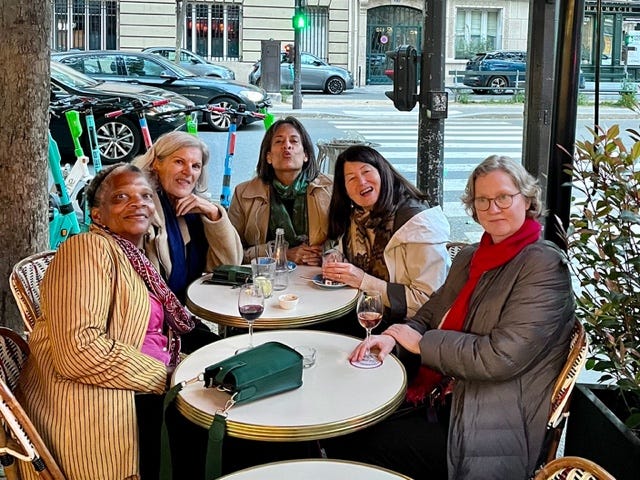
Part of my writing group: Gwen, Sara, Pamela, Kit, Lori, out for drinks after listening to Jami at the American Library

Thank you, Jami Attenberg. May you enjoy your Italian vacation!!

For more information on #1000 Words of Summer, go to Jami’s substack Craft Talk

A bientôt,

Sara

Thanks for reading Out My Window! Subscribe for free to receive new posts and support my work.
What’s going on in France?

As an exPat for the last nine and a half years, I encourage any of my readers and friends to chime in on this subject. It takes living in France a long time to understand the French.

One would have to be living in a bunker to not know what is going on in France. Transport strikes, garbage strikes, street protests, all in resistance to President Macron’s raising of the retirement age from 62 to 64 (at least that is the purported excuse though the french often don’t need much of an excuse to say they don’t like something).

Macron no longer has a majority in the Assemblée Nationale, so he enacted the new law by special powers under Article 49.3 of the constitution. Last Friday, the Constitutional Council met to decide whether he was correct to do so and had France’s best interests at heart. As the sun set Friday, word came out that it was constitutional and the committee agreed with Macron 100%. He signed it into law within twenty-four hours.

People protest with a poster referring to the visit of Britain’s King Charles III – cancelled due to unrest in France – in Nantes, western France. [Jeremias Gonzalez/AP Photo]

People took to the streets in more protests. Monday night, Macron gave a pre-recorded speech meant to calm down the masses and urge everyone to move on. John Litchfield, who writes Opinion for The Local, an English language newsletter, had this to say on Tuesday:

“Yes, the pension reform is painful. But it was necessary. It’s all over now. Dry those tears. End the tantrums.  We can move on to things you will enjoy.

Higher wages. Sharing of profits. Better schools. No queues in emergency wards.  Expulsion of failed asylum seekers. Something for the Left of you and something for the Right.

Will it work? Probably not. The nationwide fit of shrieking and toy-throwing, some sincere, some synthetic and hypocritical, will continue for quite a while.

It is unlikely that President Macron will have much to show his wailing child at the end of the 100-day recovery period, ending on July 14th, that he promised on Monday night.

Superficially, this is just French politics as usual. France demands “change”. It opposes all changes.

France complains that it is slipping down the global league table of prosperity, influence and functioning public services. It refuses to accept that it should work longer or tax itself less to compete with its rivals and neighbours.

Superficially, we have been here before. All presidents for the last three decades have faced strikes and street protests against modest social reforms.

Some were withdrawn. Others such at retirement at 62 instead of 60 are now the “acquis” (status quo) which the new generation of protesters defend.

Others, such as the simplification of hiring and firing and reduction in pay-roll taxes, help to explain why joblessness in France has plunged from 9 percent to 7 percent in the last six years. Those reforms, started by François Hollande and continued by Macron, were opposed at the time by strikes, marches and scattered violence.

Surprise, surprise, no-one mentions unemployment much anymore.   

But there has been something qualitatively different – almost existentially different – about the pensions reform protests of the last three months. The language is different. There is an edge of hysteria in the allegations that the modest move in the pension age from 62 to 64 is “brutal”, “unjust” and “autocratic”.

The government’s use of its special powers under Article 49.3 of the constitution to push through the reform was predictable and widely predicted. It has happened 100 times before in the last 65 years.

This time 49.3 was presented as “an assault on democracy , “a trampling of the will of the people”, an act of “violence which called for a violent response”.

Close to my village in Normandy someone has erected a cardboard sign with the scrawled message in felt-tip pen: “49.3 = 1789”.  Revolution is in the air again, in the Gilets Jaunes rural heartlands, not just among the self-pleased, black-clad, young bourgeois anti-capitalists who smash shop windows and burn cars in Rennes or Lyon or Paris.

Compare and contrast this hysteria (I believe that the word is justified) with the unemotional language of the Constitutional Council’s ruling last week. The nine “sages” declared that the pension reform was reasonable and constitutional – and so was the manner of its enactment.  

The Council said that the increase in the official retirement age to 64 by 2030  would “assure the financial balance of the (state pension system) and guarantee its survival in the light of the increase in life expectancy”. The government’s use of several special powers to hurry and then force a decision was “inhabitual” but not contrary to the Constitution.

Normally the pronouncements of The Sages are accepted without much comment. On this occasion, Jean-Luc Mélenchon, the leader of the radical Left, said that it was a “violent” decision which would encourage a violent response.

Macron’s decision to sign the pension reform within hours of the Council’s decision was presented, even by moderate union leaders, as a “denial of democracy” and an “autocratic” refusal to listen to the voice of the people.

All of this can be dismissed as the sour grapes of bad losers. Mélenchon, who has been stirring violence for weeks, has little right to talk of democracy.

But those who believe – like me – that the pension reform is modest and justified must also now accept that something is happening here which goes beyond the recent French cycle of reform and protest. It is something that also goes beyond rampant Macronphobia of many French people.

Solenn de Royer in a column in Le Monde said that this has become a revolt not just against pension reform, but against the technocratic, top-down, diluted democracy instituted by Charles de Gaulle 60 years ago. There is much truth in that.

Emmanuel Macron claimed in 2017 to be a suited revolutionary. He was an impatient young man with many good ideas but he was no revolutionary. He was – and he was seen by many to be – the epitome of the kind of technocrat who used to stand behind presidents. Now HE was the president.

The father-knows-best tone of his 15 minute address last night – “dry your tears; lets move on” – placed Macron firmly in the Fifth Republic tradition of paternalistic semi-democracy. In the age of social media and the collapse of old political allegiances, that no longer works very well.

The Gilets Jaunes movement of 2018-9 already revealed a formless hunger for a new, more direct kind of popular control of decision-making. It also exposed how dangerous that desire can be.

If the French people want to have more direct control of their lives, they also need to move on. They need to grow out of the child, or teenage-like, modes of thinking which the top-down Fifth Republic has encouraged.

“The state (like mummy and daddy) is all-responsible and usually wrong. The state should do more but we should pay less taxes.”

In sum, the crisis over pension reform is both absurd and profound. It is both Macron’s failure and France’s failure.

A drum-beat is already starting suggesting that Marine Le Pe and the Far Right will reap the benefits in 2027.  That is the subject for another column.

But I believe that, in four years’ time, the country may be  more likely to revert to the unthreatening immobilism of the Chirac years: someone who promises to “listen” and then delivers little.”—-The Local

A bientôt,

Sara

Thanks for reading Out My Window! Subscribe for free to receive new posts and support my work.

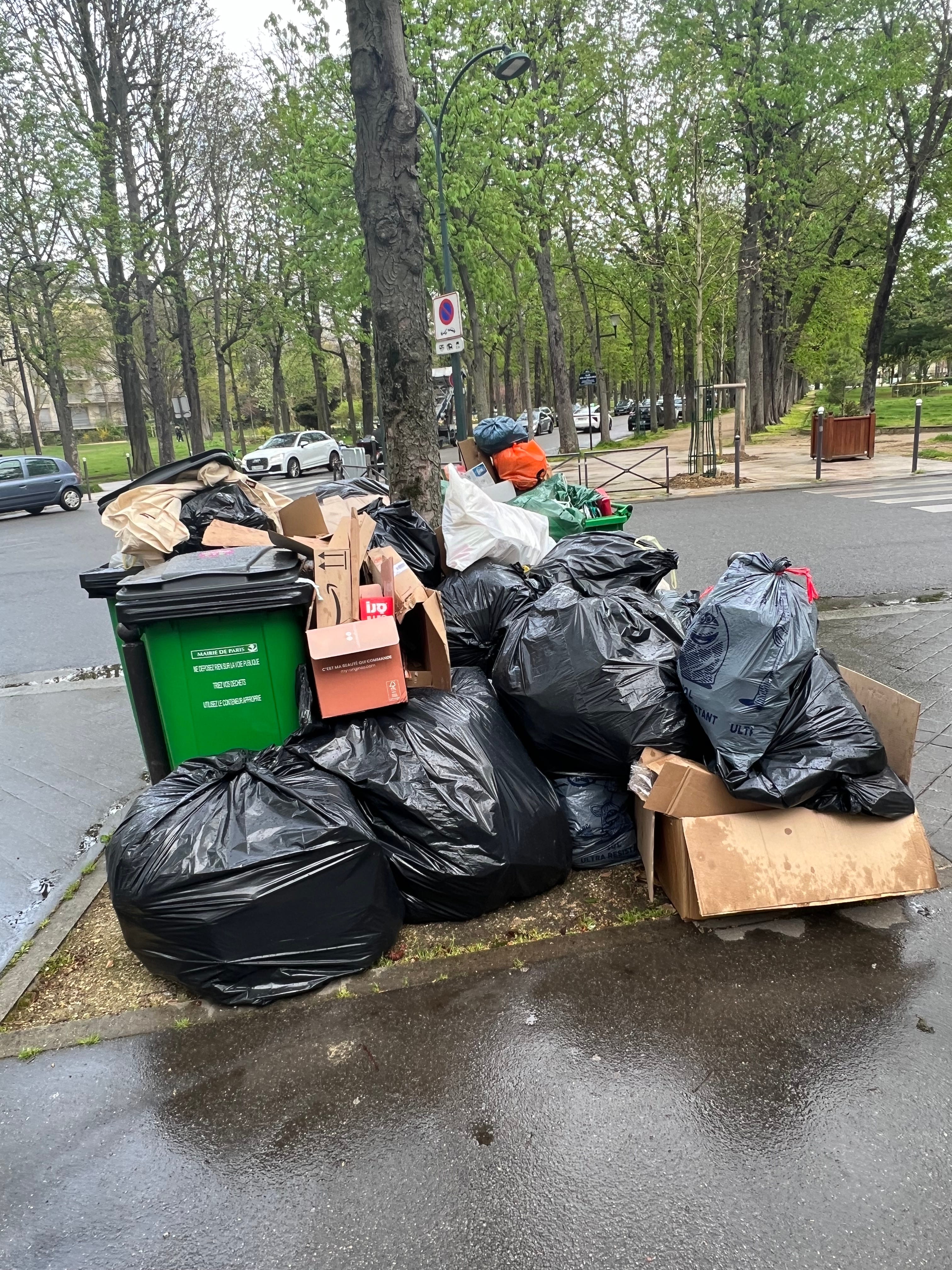
After three months in stormy, wet, miserable California, I am now back in Paris. Question marks hovered over my head for days wondering what would greet me. I read that the garbage strike was over but….how many days does it take to clean up ten days worth of a strike that left streets unpassable and people holding their noses? Many as it turns out. By the time I was taxing from CDG to my apartment, garbage bags were off the street but still in piles on sidewalks. The news says the outer arrondissements are taking longer to clean than the inner.

Garbage waiting to be picked up on April 1, in the 16ème near Parc du Ranelagh

I wondered about the airport itself. Everything I read said only Orly and Marseille airport workers were striking. In France, it is mandatory to tell the police ahead of time where, when, and who is striking. But I was raised in the US where surprise is part of the strike so I expect things to happen that aren’t known. The worst thing that happened, the day of my return, was that there was no place for the plane to taxi to. We waited thirty minutes on the plane in Frankfurt until the pilot was assured of a gate and then waited another ten minutes upon arrival in Paris for the gate to free up. After that, it was easy peasy. The unplanned wait allowed morning rush hour traffic to disappear and I was in my apartment less than two hours after we finally got to the gate.

I stepped into my apartment and it seemed as if I’d never been away. Time is something I don’t understand. I find it fascinating that some hours seem like days and some days pass by so fast, it feels like just a few breaths. Here I was, back in Paris, after what had felt like a decade of horrendous storms and now it all felt like a dream. It wasn’t raining and, though the sun wasn’t out, it was clear.

Parc du Ranelagh April 2, 2023

I suffer terrible jet lag and the common sense wisdom says jet lag is always worse going west to east. I had cut out three hours (or three days) by stopping in Michigan to visit my sister. I decided not to try and plan the jet lag or outsmart it or any of the other attempts at controlling what I can’t contol. I would sleep if I felt like sleeping and take everything else easy. So I made a few commitments and had to apologize for most of them when I was too tired to follow through. I did get outside and walk my neighborhood. The world was green, young green, shoots of baby plants green, that light green that says it can only be Spring. After a winter of so much rain (yes, I was grateful for California rain and that the Bay Area is no longer in drought conditions, but that didn’t make it fun), grey in the sky, grey on people’s faces, carrying an umbrella and warm clothes everywhere, I was experiencing a literal ‘light at the end of the tunnel.’ 

Rue de l’Assomption April 2, 2023

I managed to make it out to Parc de Bagatelle in my first days back. I knew I had missed the fields of golden daffodils that had taken my breath away last year. But Spring was here and I wanted to see the peacocks and the cats. I could hear the peacocks ‘crowing’ before I even entered the parc. Mating season was officially open. The first peacock I saw had his fan tail completely open and was doing a cat walk for a number of people with cameras and phones, and for two females who were playing hide and seek with him. It was a wonderful show. I kept wondering where all the feathers go when the tails start to molt. All the times I went to watch the progress of the new tail growth, I never saw a single feather.

Male peacock putting on a show for people and females alike. You can see one of the females vehind him at about 2 O’Clock.

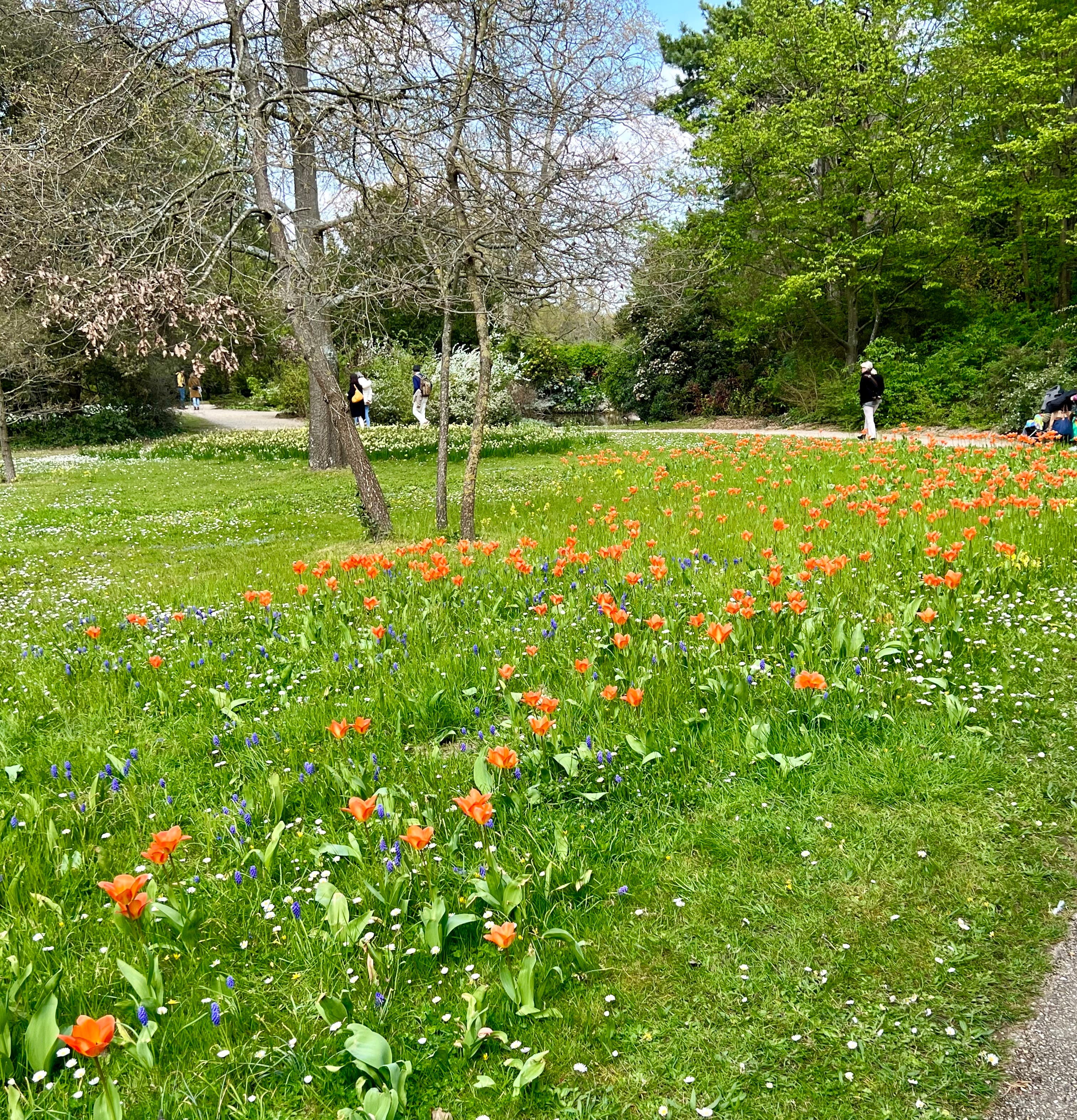
And though I missed the daffodils, the tulips were on display, tiny flowers of yellow and purple, red and orange, magnolia trees with purple flowers at its base, all sang of Spring. I was so happy to be back in Paris.

Fields of orange tulips replacing the plethera of daffodils
The albino peacock
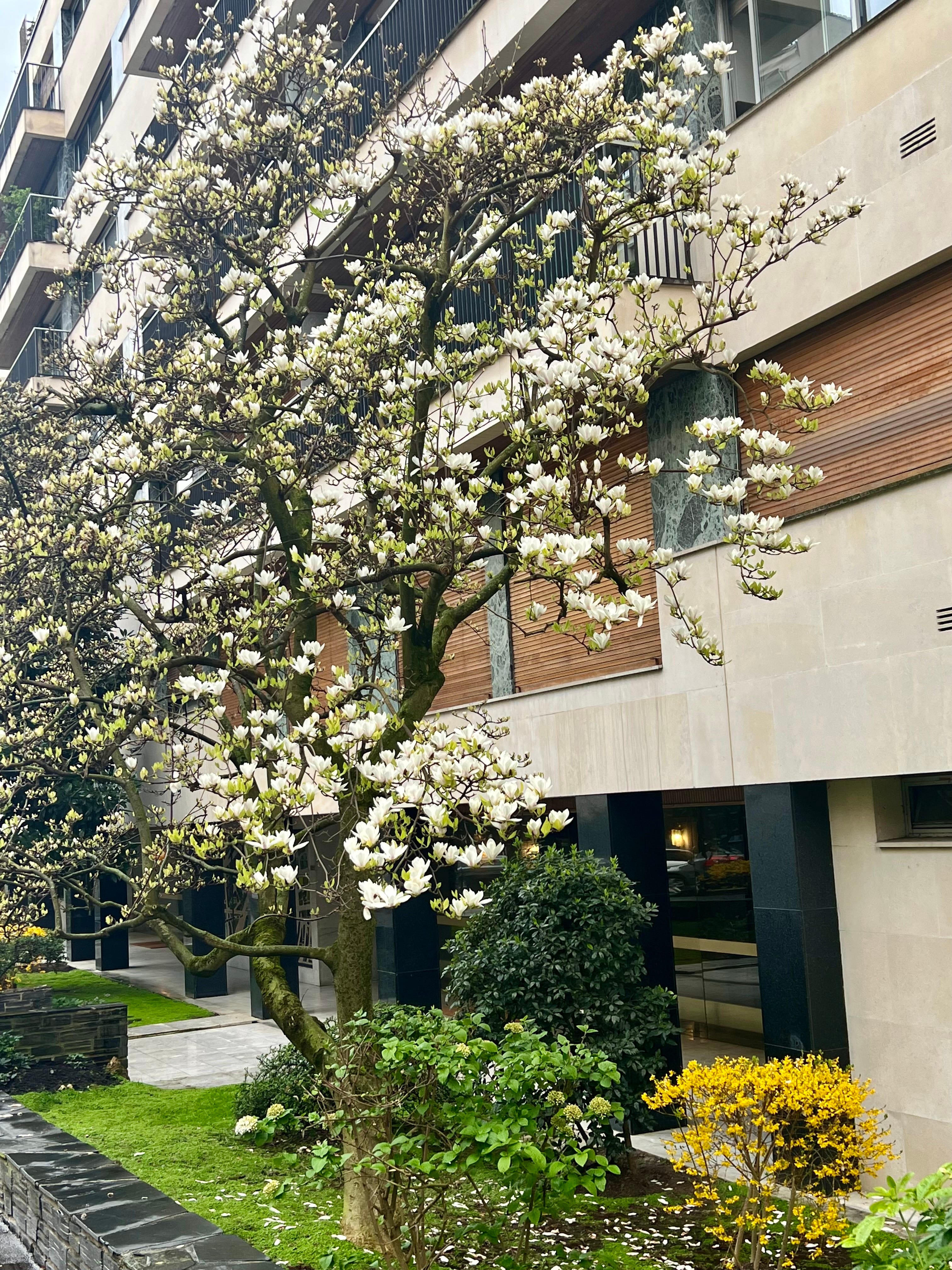
One of two magnolias at Bagatelle

Thanks for reading Out My Window! Subscribe for free to receive new posts and support my work.
A bientôt,

Sara

The Smells of Paris

I’m surprised to learn, after sniffing up a storm today, closing my eyes, and hoping the olfactory part of my mind would wander down some ancient pathways, that I have no real smell memory, not even one that reminds me of ‘home’.  I have three smells that take me back to earlier years. Someone taking the first puff on a cigarette.  There was nothing like that smell to me and it was non-reproducible. I can picture a friend (different friends throughout my smoking career) lighting up, taking a deep inhale, and blowing out the smoke.  All or much of it landing on my nose.   Today I try to move away from cigarettes.  Don’t really want the memory pull.

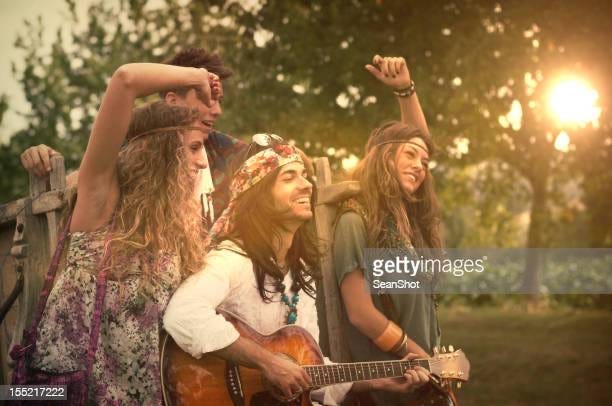
Then there is being outside on a walk and, suddenly out of nowhere, smelling marijuana.  Usually, I never see where it’s coming from. But the smell takes me back to the most romantic of my memories of my hippie years when everything was in front of me, and I had left all the bad, all the painful back at home. I easily picture in my mind, friends sitting around in a circle.  Sometimes we are talking.  Sometimes we are listening to music. But always, it was friendly, and it was an invitation for my brain to take a break from whatever the day had held.

And lastly, there is just-baked bread. Since weight has always been problematic, I don’t have great associations with that smell as delicious and heavenly as it is.  Since I’ve been in Paris and no longer worry about my weight (though I never eat bread), I’ve learned to just appreciate the smell, how aromatic it is. There is a boulangerie on the corner of my street and if I’m up and out early enough, I walk by and can inhale the staff of life while watching the cooks who have been up since 3:30 am take a break leaning up against the wall of the shop smoking cigarettes.

I must be an auditory memory person. I can hear the first three bars of “EaterPurple People ”, and I’m back in my youth, nine years old, lying in my twin bed with measles. A transistor radio propped on a chair in front of me where I first discovered Hy Lit on WIBG, Philadelphia.  

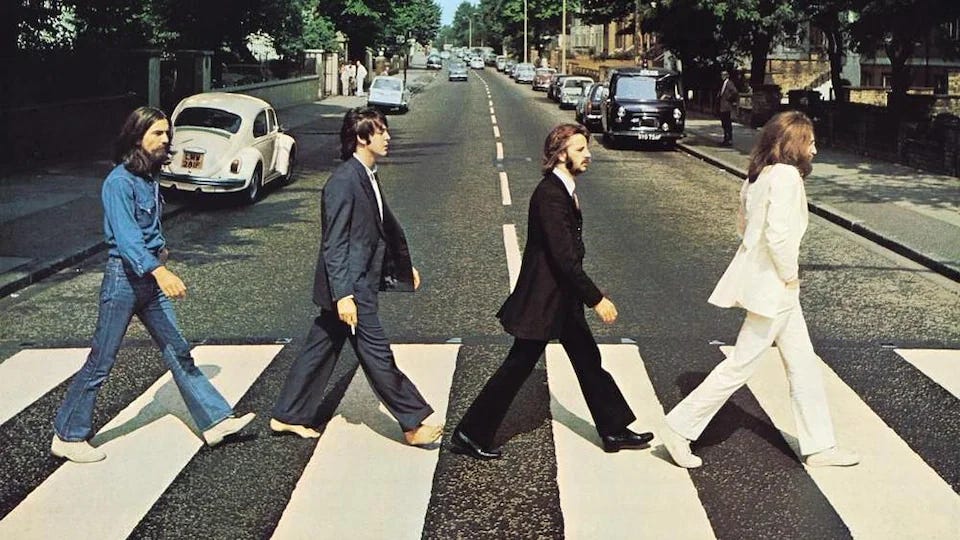
I can hear the first note of ‘Here Comes the Sun’ and I’m in a VW bus with four other people riding up the west coast of Italy singing at the top of my lungs.  I’m returning to Florence where I had spent my senior year abroad and I was buzzing with excitement. 

I can hear three strums of ‘Silver Dagger’ from Joan Baez’s first album and I’m sitting on the floor at Christmas, down in the rec room, my parents, uncle and aunt, and Peggy all sitting there.  I have a guitar and I’m playing a song I wrote. We’re at the far end of the room next to the doors that open up onto the backyard. I’m wearing my dark hair parted in the middle and trying to look as much like Joan Baez as I possibly can.

These are visceral feelings I have no control over. I recently listened to the Beatles on Spotify. Here Comes the Sun started the playlist. I was instantaneously overwhelmed with memories of being young, of being hopeful, of just wanting to have fun, and not worrying about money, family, or health. I had to sit down and take deep breaths and just let the feelings roll through me. It all feels so long ago—literally another time, a different person that was there.

Would I go back there? Not on your life? What hits me is always the best of those times.  Music was absolutely the best of the best. I lost myself in music.  I listened to rock ‘n roll around the clock.  I don’t know when it stopped but it stopped. And now it’s like sparkling sand that flows through my fingers.  I can’t hold onto the feelings, nor do I want to. But I do love that I have a magic key that takes me straight back and I get to relive a tiny part of the past.

Thanks for reading Out My Window! Subscribe for free to receive new posts and support my work.
A bientôt, 

Sara

Watching the Playoffs in Paris

If you mention baseball to a french person, they will either look at you incomprehensibly or roll their eyes. It’s not that they don’t know about the sport of baseball. It’s that they don’t understand such slow action and, therefore, the French do not do baseball. At the World Baseball Classic, an every four-year event that actually includes teams from all over the world, the Dutch have a baseball team, the Italians have a baseball team, but the French team is largely composed of Major League players who have some French in their ancestry.

Opening Nite in Houston-Game 1 (photo from CNN website as are all the rest of the photos).

So it is with great gratitude that I watch Apple TV+’s Weekly WrapUp every Saturday. In the US, it is shown on Friday nights, but as I live in a timezone that is six hours ahead of the East Coast, I get it on Saturdays. Now that the PlayOffs are in full swing, I get a daily report which I watch at noon. I can watch a nine-inning game in eight minutes. I’m so happy I get that. And for some people, eight minutes is just perfect. They get all the action and none of the stress of waiting, inning by inning, to learn who wins. For those of you who aren’t big baseball fans, the better team doesn’t always win. It’s part of baseball.

For Game 1 of the World Series, the Philadelphia Phillies were playing the Astros in Houston. I don’t know how fans in the US feel but, for me, the Astros have taken over from the Yankees as “the team we love to hate.” After the Astros won the World Series in 2017, it was discovered by Major League Baseball that the team was stealing signs. They did not lose their title. Fans were outraged. Maybe not Houston fans! Ok, then there is Dusty Baker who is now the manager of the Astros. He’s just about as nice a baseball person as you can find. It’s hard to imagine that he would be a party to sign stealing (any more than the rest of the teams). I know there are fans who are convinced that the Astros are still crooked.

Dusty Baker, manager of the Houston Astros

Back to Game 1 played last Friday. It went ten innings. For a fan like me, watching a nail-biter in eight minutes just doesn’t do it. As the lead went back and forth between the teams, I was just imagining what it would be like sitting in the stands, ecstatic when it is your team ahead and down in the dumps when the other team took the lead. In the end, in the tenth inning, the Phillies won. So a word about the Astros Opening Nite pitcher. I realize that for some of you this is way more information than you care to know. But it will help you understand why some people breathe baseball. And why as my friend, Darcy’s father used to say: “there are two seasons in the year. Winter and baseball season.” He was not wrong.

Justin Verlander, Opening nite pitcher for the Astros.

Justin Verlander was the Opening Nite pitcher for the Astros. He is and has been a great pitcher. He used to pitch for the Detroit Tigers. Back in the day when the Oakland A’s finished first in the American League West, somehow their first opponent in the playoffs was the Detroit Tigers two years in a row. And twice with the two teams tied 2-2 with one game to go to play the next tier of the playoffs, Justin Verlander would be on the mound for Game 5. It didn’t matter how tired he was, like Marly’s ghost, he loomed large over the A’s. And the A’s lost. Justin Verlander is moche ( french for ugly, total yuk) in the minds of A’s fans. And here he was, ten years later, Opening Nite pitcher for the team we love to hate. It may have only been an eight-minute game, but for this A’s fan, I jumped up and down when the stats said that Verlander was the losing pitcher!!!

I grew up for the first fourteen years of my life in the Philadelphia suburbs. Nothing about Philadephia says ‘home’ to me. My mother moved from Princeton, NJ to lower Bucks County in her late seventies. So it is easy for me to root for the Phillies. The last time the Phils won the World Series was in 2008, the year my mother died. The Oakland A’s started out in 1904 as the Philadelphia A’s. In 1954, they moved to Kansas City. After a short unsuccessful stint there, they moved to Oakland in 1967. I’ve always felt a kinship to the Philadelphia A’s and, at one point in my life, was given a lifetime membership to the Philadelphia Athletics Historical Museum. 

Jimmy Foxx of the Philadelphia Athletics

Four World Series games have been played. The teams are tied 2-2. Only the first two games were tight with the teams matching each other play for play. Last night, the Astros set a WS record: 4 pitchers pitched a No Hitter. Not one Phillies player got a hit. So what’s left is the best of three!

fans in Philadelphia waving their rally towels

If you’ve read this far, thank you. People ask how I could have ever moved to Paris when I love baseball so much. I really don’t have an answer to that question. I can tell you that it feels very nice to write about baseball. I am hoping to go to Spring Training in Arizona next March. So I’ll end with a shout out to all Phillies fans around the world. Go Phighting Phils!!!

Thanks for reading Out My Window! Subscribe for free to receive new posts and support my work.

A Bientôt,

Sara

Art in Paris: digital and natural

Monday, I was sitting on a platform in the back of an old foundry in Paris overlooking what is now known as Atelier des Lumières. The Atelier is the first digital art museum in Paris. I have gone five times since it opened its doors in April of 2018. All the shows are a combination of Art and Technology. Using 120 projectors, images are thrown up on walls and the floor. They are in constant motion and accompanied by music.

After watching a show of Cezanne, Kandinsky, and Van Gogh, I decided I wanted to know more about the origins of the Atelier des Lumières. As each of the shows ended and the credits were projected on the walls, eight cities (including Paris) now house these light shows: Bordeaux, Les Baux-de-Province, Amsterdam, New York, Dubai, Seoul, and Jeju. That is six more than the last time I was there during the summer of 2020. My sister had told me she had tickets to see the Van Gogh show in Detroit (for five times the price we pay here in Paris!). I had assumed it was the Paris show that was traveling but I’m not so sure. There is a permanent installation in New York.

The first of these art and technology shows, Carrières des Lumières, started in les Baux-de-Province. There the art is projected onto the walls of caves. It is part of a much larger organization called Cultural Spaces. Bruno Monnier, the president of Cultural Spaces, wanted to bring the idea to Paris. He found an unused foundry from the 19th century called Chemin-Vert located in the 11th arrondissement. It was created in 1835 to meet the needs of the Navy and railways for high-quality castings. It closed in 1929 due to the International crisis. Monnier has taken the space, left it intact, and cleaned it up while fitting it for all the projectors. It opened in 2018 with a show of Klimpt’s famous paintings. It is hard to describe the show if you haven’t seen one. My photos are static but the images are constantly moving like a giant slide show. Music is chosen specifically for certain periods in an artist’s life. The result is captivating. It’s not a stretch to call it a completely immersive experience. Children often run around chasing the images on the floor and become part of the fun of the show.

Kandinsky

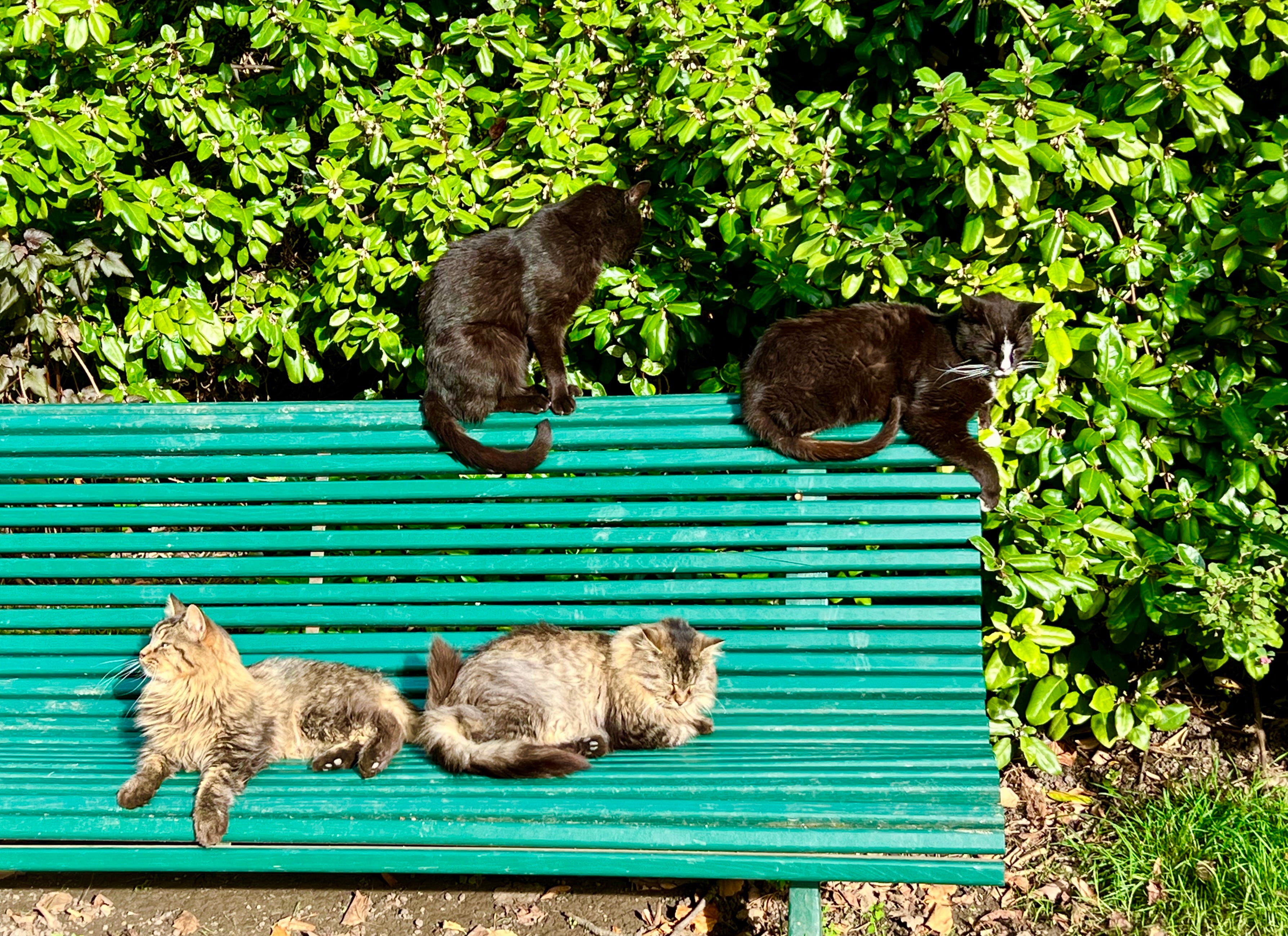
After writing the above, I walked to Parc de Bagatelle to check on the peacocks and the cats. I couldn’t go on Sunday. I saw how fast the peacock tails were growing in. I thought of sitting in the Atelier watching these famous artists’ depictions of nature dancing on the walls. And, of being in Bagatelle week after week, looking at the trees turn colors, the roses die away, a few defying nature and hanging on to their stems, the peacocks strutting around, their tails growing so fast it just might be a slide show. There is no sign of the females. There aren’t even that many people even though it was a lovely autumn day. The cats were all out enjoying the warmth of the sun.

Gaston and Zoe (the cats from the circus) are lying on the bench.

The regular volunteer was just finishing up feeding time for the cats. I asked him how long it took the peacock tails to complete the circle to full growth. He said April. They molt in August. Four months is the short time they are full and probably the equivalent of mating season.

Two months worth of growth, the eyes are now clearly visible

I asked him about kittens. He said most are born between September and December. We never see them because the mothers hide them in the thick bushes on the periphery of the park. I had visions of bushwacking my way through those bushes until I found a litter. Then I’d steal one and raise it—much to the chagrin of Bijou who is the true Lady and Mistress of my small apartment. A girl can dream.

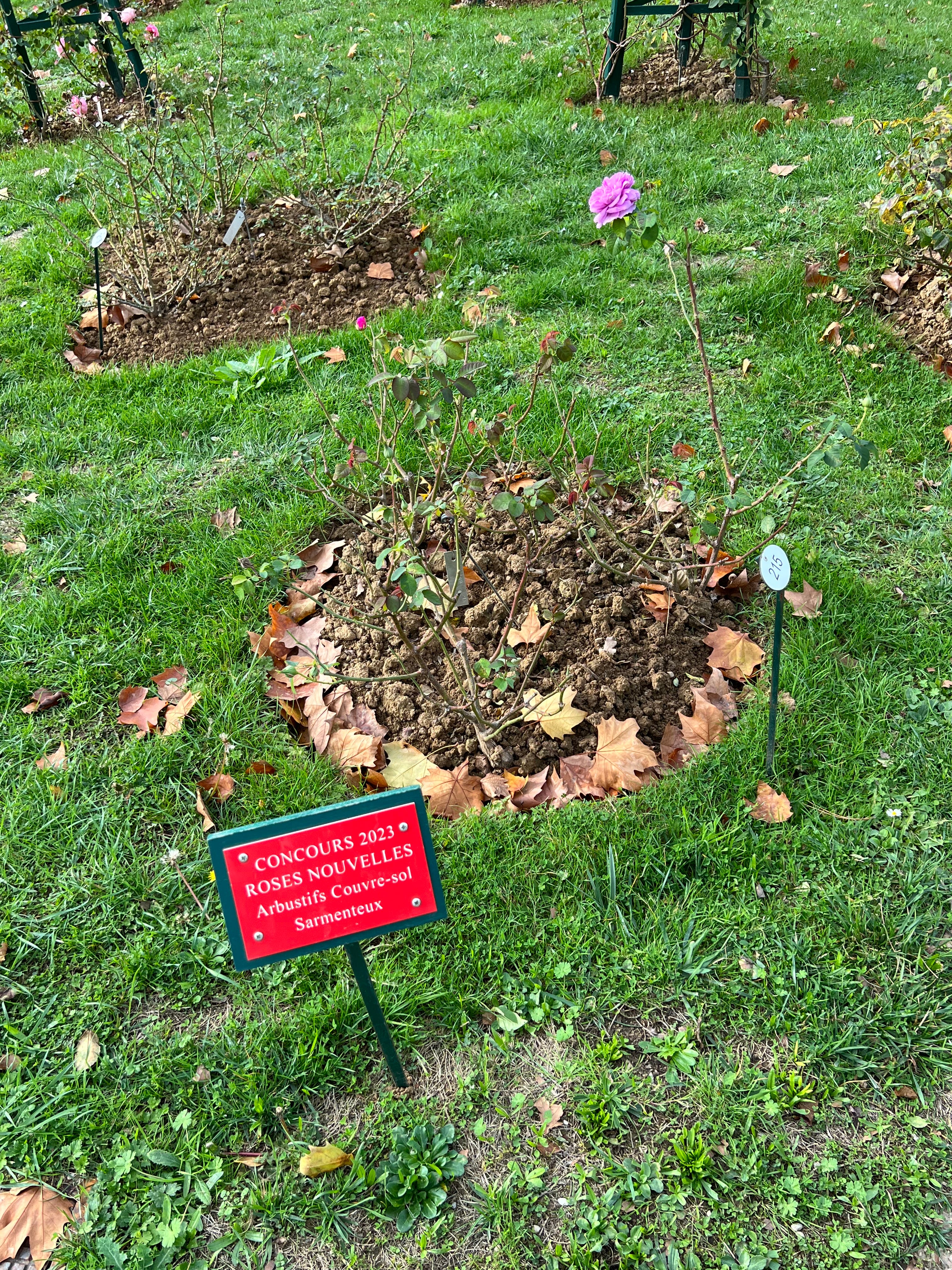
One rose, with a strong perfume, is hanging on. Because it is an entrant into the competition of 2023, it is not named.

Being at Bagatelle week after week is as immersive an experience as the digital art show at the Atelier. One shouldn’t compare apples and oranges but, if I were forced to choose…..

Van Gogh’s Starry Night

Thanks for reading Out My Window! Subscribe to receive new posts and support my work. This post is public so feel free to share it.

A bientôt,

Sara

There is a time for building, and a time for living and for generation-T.S. Eliot

I was sitting on my couch yesterday talking with a good friend who was visiting Paris from California. She asked me if it was smarter to rent something here or to buy. I said that it depends. Why was she asking? She said that the general atmosphere in the US has become unbearable for her and her husband because of politics. She had visited with another group of friends two days ago and that had been the focus of their conversation. Selling and moving to Paris (these were all people who love Paris). I was a bit stunned. She lives in California and I saw California as a refuge from all the insanity. I guess not. You can’t not know what’s going on all over the country if you own a computer or a TV or both. Maybe with the mid-terms coming up, the volume has risen so high that the desire to run away from it all must seem so attractive. 

I left in 2013. Before there was Trump (although we were going through the Tea Party mess). I wasn’t making myself crazy by trying to decide to leave my country because of principles. I left because I could. I had retired. I wanted to experience another culture, really experience it, and came to Paris for a year. That was one month short of nine years ago. I haven’t gone back. To be considering a permanent move without knowing anything about what the future holds seems very brave to me. 

That was the other thing we talked about. The future. We are both at the age where one has to be thinking “where do I want to get old?” “Where do I want to be old?” The US has wonderful Continuing Care Retirement Communities. France does not. France has a wonderful medical system. The US does not. If I can no longer live independently, if I have to depend on someone or someones, what country do I want to be in?

These are huge questions. Honestly, I try not to think about them very often though I should. Yet, it was a pleasure discussing it all with my friend yesterday. A pleasure because we are like-minded and putting it all out on the table. I recently put an offer on a house in Normandy. I had an inspection done by a wonderful Scotsman and I told him my age and asked if he could look at the house with that in mind. He was happy to. He told me the house wasn’t suitable for someone my age, meaning if I had to redo a room or a bathroom to make it more handicap accessible, it wasn’t possible in that house. I patted myself on the back for having the foresight to even think of that question much less ask it.

To me, thinking about leaving the country feels like a little death. It’s great to move if you are going towards something, have excitement about new things, having a chance to start over again somewhere else. But that isn’t what people are saying when they are talking about leaving. They say it with sadness, that it is so scary to live in the US right now. I don’t envy them. 

Meanwhile here in Paris….. I was down near Notre Dame last week. Before the fire in March of 2019, my favorite view of Notre Dame was looking at it from behind; the roof held up by flying buttresses. I’d stand about half a kilometer east on the left bank and take deep breaths looking at the extraordinary beauty of that cathedral against a blue sky. Now all you can see is scaffolding. And cranes. And more scaffolding. 

Two years ago, there was talk that Macron wanted the rebuilding finished by the 2024 Summer Olympics which are being held in Paris. No one believes that can happen. According to the Smithsonian website, the clean up was finished this past August and the rebuilding started in September. The government is still hoping to finish it in 2024 and has actually announced that it will be open to the public in the Spring of 2024. 

There was a contest, at one point, to design a new roof for the cathedral. There was even one with a swimming pool, I’m told. Now the new Notre Dame will look exactly like the old Notre Dame. Which makes me glad. “The French Senate rejected calls to replace the spire with a modern design, ultimately voting to restore it to its “last known visual state.” But France’s National Heritage and Architecture Commission did approve proposals to modernize Notre-Dame’s interior with new additions like contemporary artworks—a plan that some critics described as a “woke Disney revamp.” “A parallel initiative to invigorate Notre-Dame’s surroundings is also underway. Funded by Paris City Hall, the redesign includes planting more vegetation in the area and installing a cooling system, the New York Times’ Aurelien Breeden reported in June. Per the Times, Paris Mayor Anne Hidalgo said that Notre-Dame “had to be left in its beauty and have everything around it be a showcase for that beauty.”—smithsonianmag.com

This is what Notre Dame will look when finished.

And finally, I’ll end with a word about the peacocks in Parc de Bagatelle. I took my Sunday walk to the park four days ago. The first thing I do when I arrive is check up on the cats. If there is a volunteer there feeding them, I have a chat. That’s how I learn the stories about them. And now that I know that peacock tail feathers have a life cycle, I’m watching the male peacock carefully. I saw a peacock before a cat. He was looking in the opposite direction. It looked as if some pine needles had gotten caught under his back feathers. As I got closer, I realized what I thought were pine needles was the very beginnings of the new feathers.

Scattered on his back are what look like tufts of cotton. When the tail is completely grown out and he makes a fan to attract a female, it’s possible to see all the white fluff. This seemed unusual to me – to be able to see so much fluff even when both back wings were flat on his back. But I’m just learning and watching. I have no idea what the norm is.

It seems that today has been about cycles. The life cycle of the peacock tail of feathers, the cycle of a beautiful cathedral that has had parts destroyed by fires in the past, and the lifecycle of a political movement. With nature, it is truly a cycle. I lost my home in California to fire and built a lovely home from the ashes. With what’s happening in the US, one can only pray it cycles out and get into action to give it a big shove. That means Go Vote!

A bientôt,

Sara

“Reading is an act of resistance”

Last Friday, I had the pleasure of meeting Jennifer Egan, the Pulitzer Prize winning author of A Visit from the Goon Squad. She was in Paris to celebrate the launching of her latest book The Candy House in French, as well as participating in Festival America. I belong to a writing group through AAWE (Association of American Women in Europe). Through a unique partnership of AAWE, Editions Robert Laffont, and AAWE, Jennifer spoke at the beautiful American Center for Art and Culture in the 16ème. My writing group had the honor of being volunteers at the event on Friday.

Lorie Lichtlen, interviewer. Jennifer Egan, author, Margueritee Cappelle, translator

I’m embarrassed to admit that before this summer I had not read any of her books. When I learned she was making a special appearance at ACAC, I read three of her books backwards! First the Candy House (2022), then Manhattan Beach (2016), and finally A Visit from the Goon Squad (2011). My overall impression was that this was one brilliant woman who had an ultra creative mind and was also very complex. I wasn’t sure I understood The Candy House very well and resorted to reading reviews in the NYTimes and New Yorker. I was a bit afraid that I wouldn’t be able to follow her thinking.

Signing both French and English language books

I had absolutely nothing to be afraid of. Jennifer walked into the venue with a backpack slung over her shoulder, a simple black top, a short skirt, and knee high boots. She greeted everyone with a huge smile. The room filled up with a large Franco-American crowd of at least one hundred people. Answering questions posed by the interviewer, she gave generous, thoughtful answers and captured everyones’ hearts. When someone asked her “Do you think young people are still reading?” her response got a rocking spontaneous applause. “Reading is the only way that someone can step into someone else’s head. The world now is full of devices. My sons have told me that apps are built to be addictive, but looking at the phone keeps you on the outside. I say put your device in another room and read for pleasure. Nobody is selling you anything when you read a book. Reading is an act of resistance!”

When asked about her favorite books, she responded, House of Mirth by Edith Warton and The Invisible Man by Ralph Ellison. “To me, they describe America.” When she signed the book I bought, she was as generous with her dedication as she was with her responses. It was clear to me that Jennifer was having fun. She used that word multiple times in describing her writing, how she wrote, what inspired her, how her thought processes went.

Opening Night Ceremony of Festival America

I mentioned that she was here as a part of Festival America. FA was founded twenty years ago by a Frenchman who wanted to shine a light on American writers who were under-represented by the media. African American authors, indigenous authors, Asian-American authors. It has evolved into an every other year celebration of American authors. “An unparalleled event, the AMERICA festival (invites), every two years in Vincennes (Val-de-Marne, France), around 70 authors from North America (United States, Canada, Quebec, Mexico, Cuba, Haiti). Since 2002, it has set itself the goal of celebrating diversity on the other side of the Atlantic – a cultural mosaic that is Indian, Hispanic, African, Anglo-Saxon, French and Francophone – and giving the public the opportunity to better understand their cultural realities.”-actes-sud.fr

Leila Mottley

I had read recently that a nineteen year old young woman from Oakland, Leila Mottley, was long-listed for the Man Booker prize. Her book, Nightcrawling, has been applauded everywhere, translated into French, and won the Festival America prize at the end of the festival. I was so surprised to see her on the stage with the other authors. Afterwards, I saw her and told her that I was probably the only other person in the building from Oakland. She didn’t seem particularly impressed!

“A news item inspired Leila Mottley to write her novel, the first manuscript that she dared to intend for publication” writes Le Point, a french magazine, “In 2016, the media talked a lot about the rape of a young girl by the police and I was struck to see that we knew nothing about it. (Yet) they kept showing how the police lived the case. Women of color are particularly the target of violence because the law does not protect them in the same way. By imagining Kiara, I wanted to give the visibility she didn’t have at the time to this young black woman, to her world. And, to follow her into the night of prostitution, she had herself reread by a sex worker.”

I haven’t read the book yet but am so proud of her, a follow Oakland resident. A friend told me that the Bay Area Book Festival, in conjunction with the Oakland Museum, is planning an event for her in April, on the launch date of the paperback. Leila was asked to say something at the Opening Ceremony and she giggled like the teenager she is and spoke eloquently about what matters to her. She is something.

To finish this blog, I’m including a video of the Native Americans who performed a drumming concert for us.

A bientôt,

Sara

When Writers Come to Paris

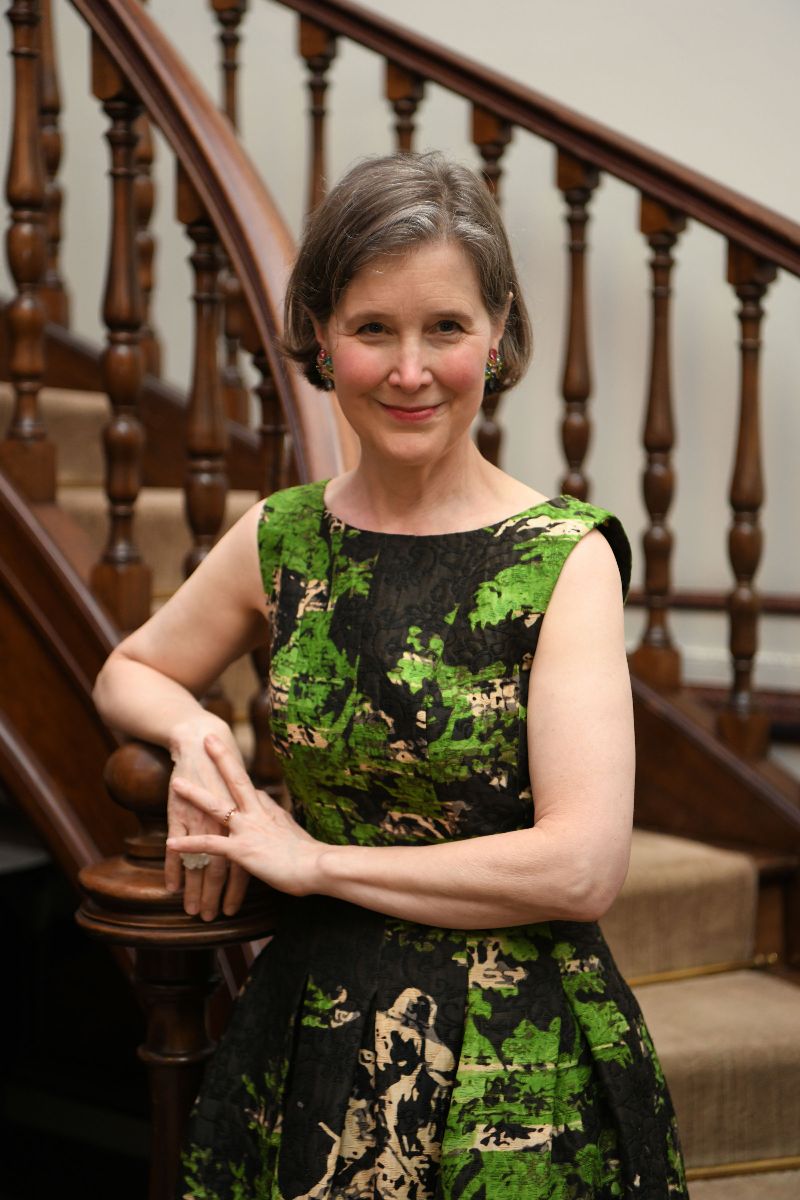
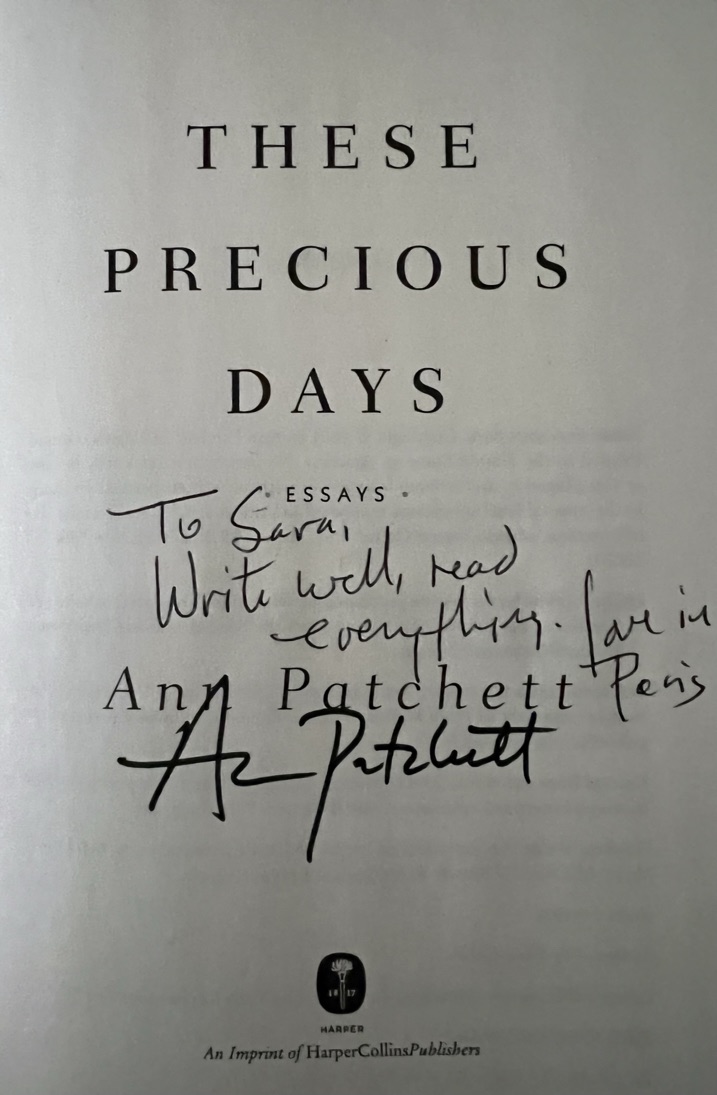
Because I live in Paris and because I love the American Library in Paris, I get to meet some great writers. I’m fairly sure this wouldn’t happen to me anywhere else. Paris is small for a world class city. Everyone comes to Paris. When Audrey Chapuis, Director of the American Library, introduced Ann Patchett at the Yearly ALP Gala last Thursday evening, she told us that Ann had sworn off traveling after the pandemic. Wasn’t going to do much anymore. But when offered the opportunity to speak at the largest fund raiser the Library has every year, she was easily persuaded. And I got to meet her. When I told her I was a budding author at 74 years old, she looked at me and said “Good for you!” Then she wrote ‘Write often, read everything, love in Paris’ on the title page of her latest book of essays These Precious Days.

Anne Patchett

Maybe it doesn’t mean much to the average person but it certainly does to me. I got to meet Ann Patchett! She wrote to me personally in my book. I’ve read the inscription every day. It makes me smile. Then comes the problem: when one’s favorite writers are people like Ann Patchett and George Saunders, it is hard not to compare my written words to their written words. They are great writers (in my humble opinion). Not only that, they are great speakers. It is not every author who is also someone who can captivate an audience. You can hear Ann’s talk on YouTube on the Library Channel. And if you haven’t already done so, listen to Saunders’ commencement speech on Kindness. https://www.youtube.com/watch?v=ruJWd_m-LgY

I’ve been writing creative non-fiction for over six years and a journal forever. I write this blog. I wrote a memoir of my eating disorder Saving Sara My Memoir of Food Addiction. I wrote another book with five women on the practicalities of abstaining from addictive binge foods. I’ve definitely honed my skills and learned the craft of writing non-fiction. Now I want to try my hand at fiction. I am a beginner. I love words. It shouldn’t be so hard to put a sentence together. Right? Wrong. With fiction, I first have to choose a Point of View (POV). In non-fiction, that’s a done deal, it’s my POV. Choosing the POV in novel writing is huge. Is it one of the main characters with all their baggage flavoring their thoughts? Is it a distant third person and the story is told from some unnamed observer?

I have an idea for a novel. I’ve had it for awhile now. It’s why I felt able to entertain the possibility of applying to the Stanford Writing Certificate program in novel writing. But to get into the program, as part of the application process, I have to submit 3000-6000 words of fiction. The application letter kindly says that it is ok to send in published work. They just want to know how the applicant writes. I not only don’t have published work, I don’t even have finished works. I have had to hire an editor to help me so that I don’t completely embarrass myself. She is the one who has stressed my need to pick a POV. I am a quick learner and I’m smart enough to know that if I were actually to write this novel, I need a structured environment with teaching and feedback to proceed. I just have to get in to the program.

Steven King started writing when he was nine years old. He started submitting his fiction to many different places when he was fourteen. Ann Patchett wrote as a teenager, published her first book when she was twenty-seven. George Saunders‘ story is more like mine. He wandered around doing many things in many different countries. I think he majored in a science in university. Since he started writing, he has won many awards including the Man Booker prize for his debut novel, Lincoln in the Bardo. And these are the people I find myself, hopelessly, comparing myself to. I told my editor. She said “That’s good. It means you will keep improving yourself.” I didn’t expect that.

A Class in a book for both writers and lovers of short stories.

So who else have I had the great good fortune to listen to while residing in Paris. Colsen Whitehead before he won the Pulitzer Prize; Richard Russo; Ta-Nehesi Coates was a visiting fellow and wrote most of his award winning book, Between the World and Me, down in a small cubicle reserved for Fellows; Lauren Collins, who writes for the New Yorker, married a frenchman and lives in Paris. She comes to the Library often to interview other writers. I subscribe to her newsletter and wonder if I ever could put together a sentence as she does.

Lauren Collins writes wonderful essays about France

Just a few days, I went to hear Colm Tóibín talk on James Joyce’s Ulysses. I’ve not yet been able to get through more than a few pages of Ulysses at a time. I went because it was Colm Tóibín. He wrote Brooklyn, made into a wonderful movie; The Magician about Thomas Mann another writer I tried to read but couldn’t get more than a few pages. (Colm told me to read Buddenbrooks. He said that was an easy book to read). Maybe it’s because he’s Irish! Mr. Tóibín makes anything sound fascinating. I loved The Magician and am now part way into The Master, his 2004 book on Henry James.

Colm Tóibín speaking at the American Library in Paris

I think you get the idea. I’m in Writing Mecca. If I can restrain the part of me that loves to say “You aren’t good enough,” I can listen and learn. I can say “Pay attention. Maybe one day you will be good enough.”

A bientôt,

Sara